
Liberty Hall,
Crawfordsville, Georgia,
28th October, 1878.
My Dear Sir:
Your letter was duly received. Two days afterwards the parcel came. * * *
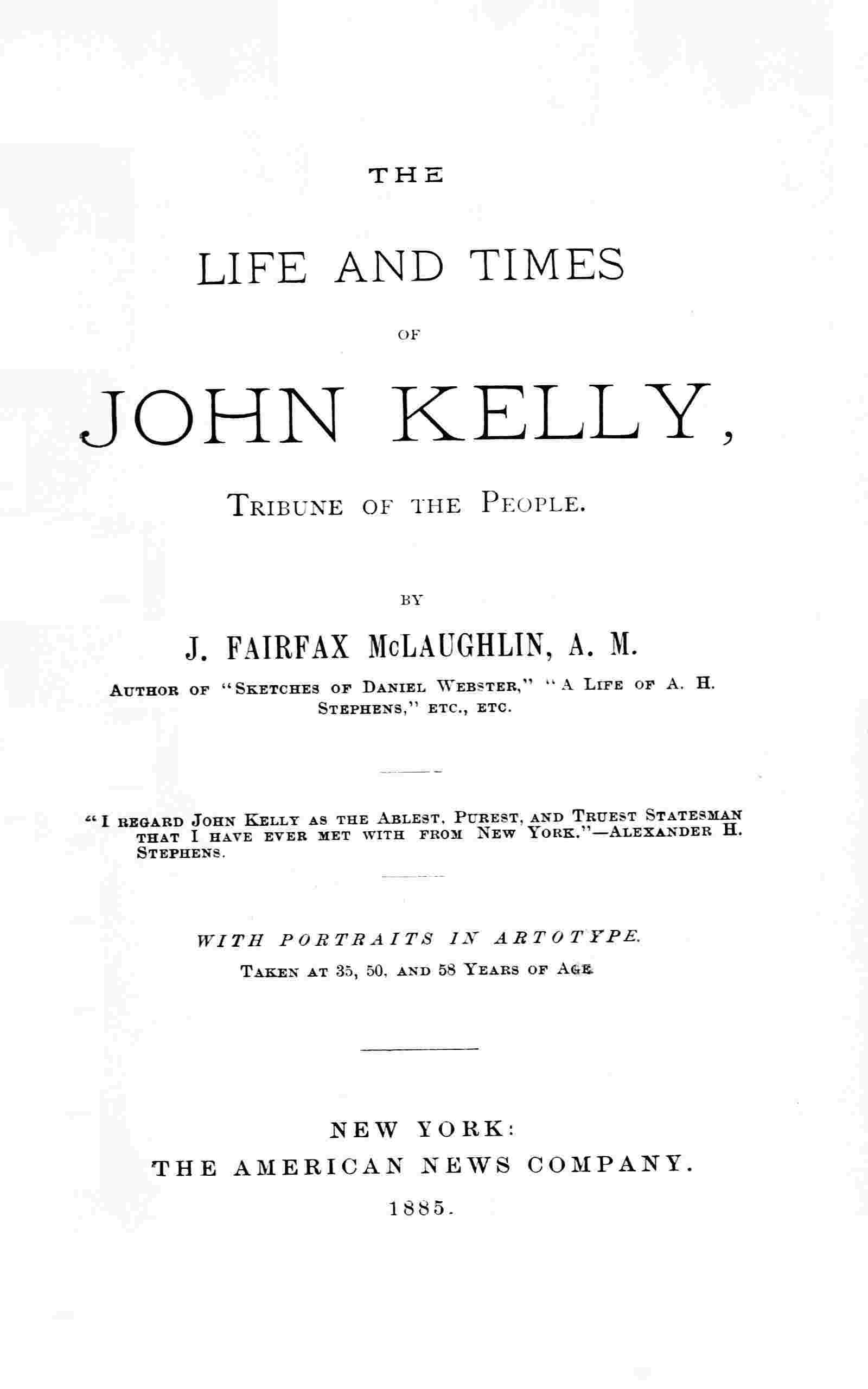
I am now just about leaving home for an absence of several days. I want you to read Johnston and Browne’s recent book. I have ordered several copies, but none has yet reached here, or I would send you one. Give John Kelly my kindest regards when you see him. I regard him as one of the ablest and truest men in this country. * * *
With best wishes to you and all yours, I remain,
Very truly,
Alexander H. Stephens.
Mr. Kelly’s esteem for Mr. Stephens while living, and his respect for the great Commoner’s memory when dead, are shown by the subjoined extract from an article which appeared in the New York Utica Observer, November 22, 1884:
“William M. Evarts, Republican, and John Kelly, Democrat, have each contributed fifty dollars to the Alexander H. Stephens Memorial Fund. John Kelly wrote as follows to the Committee: ‘I had the honor of sitting in Congress with this gentleman thirty years ago, and always entertained for him the highest regard. He was a noble example of a statesman; in fact, I never met a man who was so pure in his intentions in public life.’ Commenting upon this circumstance, the Atlanta Constitution says: ‘It is a good sign of the proper feeling between the South and North to see such men as W.M. Evarts and John Kelly joining in doing honor to the memory of the ex-Vice-President of the Confederacy.’”
FOOTNOTES:
[27] Life of A. H. Stephens. Johnston and Browne, p. 299.
[28] Twenty Years of Congress, vol. i, p. 122.
[29] Life of A. H. Stephens. Johnston and Browne, p. 306.
[30] Reminiscences of Daniel Webster, by Peter Harvey, p. 200.
[31] Garland’s Life of John Randolph, vol. II., p. 345.
[32] Memoirs of John Quincy Adams. X., 361.
[33] Life of A. H. Stephens. Johnston and Browne, p. 315.
[34] Ibid, p. 329.
[35] Ibid, p. 331.
[36] Ibid, p. 331.
[37] Ibid, p. 355.
[38] Jefferson’s Works, vol. ix., p. 508.
[39] Annals of Congress, 1798.
[40] Gobright’s Recollection of Men and Things at Washington, p. 164.
[41] Life of A. H. Stephens. Johnston & Browne, p. 330.
[42] Congressional Globe, part 3. 1st Session, 35th Congress, p. 2366.
[43] Thirty Years’ View, vol. I. p. 117.