
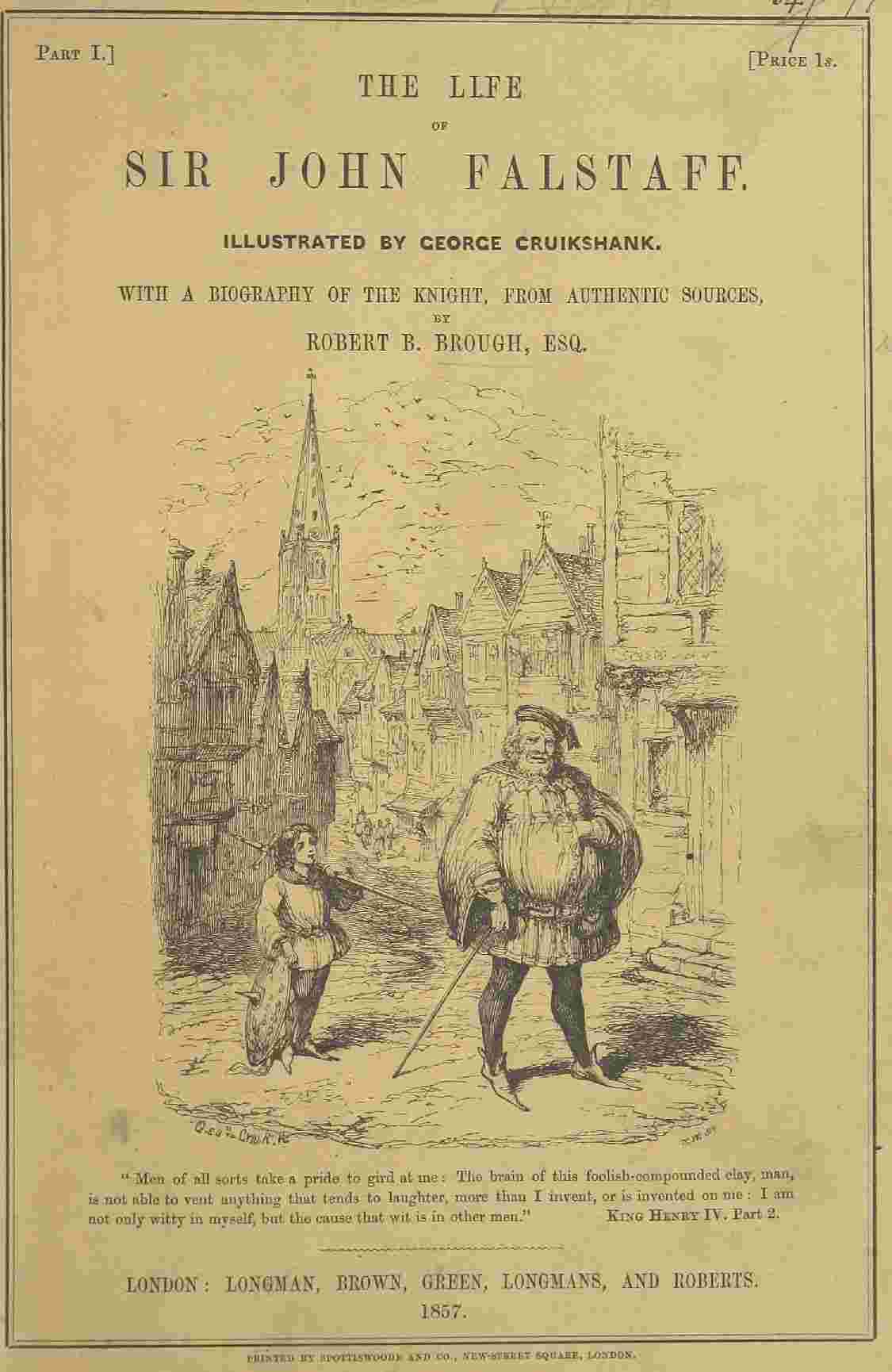
Original Size -- Medium-Size
I do not state that Mrs. Quickly was “set on” by Sir William Gascoigne. But I should very much like to know who else could possibly have been her instigator in the transaction? I do not suppose Mrs. Quickly would have known where to find Messrs. Fang and Snare—representatives of the Sheriff of London—without some legal advice on the subject. And allow me to ask, without prejudice, What was Sir William Gascoigne doing, hanging about the neighbourhood woth a strong posse of retainers at the moment of Sir John Falstaff’s attempted arrest, unless to promote, and exult in, the discomfiture of his victor of the preceding day? Perhaps the learned judge’s personal biographers can clear up this matter on honourable grounds. Nothing would give me greater satisfaction. But, till something of the kind be really done, the thing certainly wears an unfavourable aspect.
Leaving the motives of the case an open question, and wishing to give them the most charitable construction, I will confine myself to the facts. Sir John Falstaff, returning from the city, where he had been making purchases for the coming campaign, was waylaid by Messrs. Fang and Snare aforesaid, who attempted to arrest him at the suit of Quickly, that lady being present in person. The terror of Sir John’s name had been almost enough to keep the myrmidons of an oppressive law from entering upon their dangerous mission. That of the knight’s presence spread a panic amongst their craven forces. Sir John Falstaff was not alone. He was accompanied by the formidable Bardolph—more than a match for any bailiff, as countless well-contested actions had proved—and the less terrible personality of little Robin, the page, before whom Master Fang’s boy quailed abjectly. After a brief engagement, the troops of the Sheriff were routed. Victory, as usual, declared herself on the side of Sir John Falstaff—when, also as usual, invidious destiny interfered to deprive him of the fruits of conquest in the shape of the Lord Chief Justice, who suddenly made his appearance, “attended,” (observe the precaution) from round the corner—quite by accident, of course!
The Lord Chief Justice, after a brief show of wishing to keep the peace (I wonder if Lord Chief Justices then, any more than now, were in the habit of doing duty as common policemen, unless for some private purpose), enquired the grounds of dispute. He certainly said or did nothing to prove that lie had any previous knowledge of them; but he fell to abusing Sir John Falstaff, for being then detained in London instead of being on his way to York with his troops, with something like indelicate precipitancy—displaying a predisposition to quarrel unpleasantly suggestive to the modern reader of the fable of the wolf and the lamb.
It may have been a fault of the defective judicial science of the period, and no proof of personal bias, that Sir William conducted himself throughout the hearing of this case more as an advocate than as a judge. At any rate he sided with Mrs. Quickly from the outset, and “summed up” dead against Sir John Falstaff before he had heard a word of the evidence.
Mrs. Quickly stated her complaint in a rambling, disconnected speech, in which I do not say she was absolutely prompted by her learned friend (there is no offence in the designation; if Gascoigne were really what he pretended to be, to call him the friend of the poor, the widowed and the oppressed, is surely a compliment), but which—from the looseness of the speaker’s diction—was clearly a got-by-rote affair, and in no instance an expression of the heart’s feelings. The first count in the verbal indictment was a matter of money lent, and debt incurred for board and lodging. The second was one of breach of promise of marriage.
Falstaff appealed to the Justice, in words, the purport of which I have already quoted.
“My lord, this is a poor mad soul: and she says up and down the town that her eldest son is like you: she hath been in good case, and the truth is poverty hath distracted her.”
I have said that I decline giving an opinion as to the foundation of this report. I will only say, now, that the Lord Chief Justice had no better reply to make to it than a quibble. He did not contradict it. Moreover, he suddenly became civil to Sir John Falstaff, and recommended a friendly compromise. Curious, was it not?
Sir John Falstaff took Mrs. Quickly aside. The result of their tête-à-tête was an almost momentary reconciliation, proving the shallowness of the artificial soil on which the exotic plant of the hostess’s animosity had been forced by the subtle devices of her legal adviser, whoever that may have been. Scarcely fifty seconds had elapsed, and ere the same number of words could have passed between them, the following colloquial fragment was audible:—
Sin John Falstaff.—As I am a gentleman.
Mistress Helen Quickly.—Nay, you said so before—
Sir John Falstaff.—As I am a gentleman; come, no more words of it.
Mistress Helen Quickly.—By this heavenly ground I tread on, I must be fain to pawn both my plate and the tapestry of my dining chambers.
The Knight—-Glasses, glasses is the only drinking; and for thy walls,—a pretty slight drollery, or the story of the Prodigal, or the German hunting in water-work is worth a thousand of those bed-hangings and those fly-bitten tapestries. Let it be ten pound if thou canst. Come, an it were not fur thy humours, there is not a better wench in England. Go, wash thy face, and draw thy action. Come, thou must not be in this humour with me; dost not know me? Come, come, I know thou wast set on to this.
The Lady.—Pray thee, Sir John, let it be but twenty nobles; i’ faith I am loath to pawn my plate in good earnest, la!
The Brave.—Let it alone; I’ll make other shift; you’ll be a fool still.
The Fair.—Well, you shall have it, though I pawn my gown. I hope you’ll come to supper. You’ll pay me altogether?
The Invincible.—Will I live?
Original Size -- Medium-Size
And what was the upshot of this colloquy? Simply that Mrs. Quickly returned placidly to her home, under the friendly convoy of Bardolph and Robin, the former commissioned by his master to look well after the poor lady, and to see that no designing persons should a second time wean her from obeying the dictates of her better nature. It is worthy of remark that Mrs. Quickly did not say so much as “good morning” to the Lord Chief Justice. I suppose there was some motive for this, as for every other impulse of human action. For my part, I will maintain that course of dispassionate reserve I have so scrupulously adhered to throughout this trying inquiry, and offer no opinion whatever on the subject.
Mind, there is one thing I cannot, and will not, and do not intend to, allow anybody else to believe. I will not have it supposed, for a moment even, that Sir William Gascoigne could have been interested in the issue of this action on any grounds so contemptible as pecuniary commission in the event of recovery. Emphatically—No! If personal feeling had anything to do with his interference, it must have been a feeling far nobler than that of mere avarice—to wit, revenge! He had been baffled, discomfited, eclipsed by Falstaff, and he was human. That he may have wished to blight the prospects of Falstaff, is, alas! for our fallen nature, but too possible! But I cannot believe that he would even have accepted so much as a clerk’s fee from Mrs. Quickly,—in spite of the notorious corruptibility of judges in the Middle Ages, and the absence of any proof of such greatness of character in the subject of these remarks as should have placed him above the besetting weaknesses of his race and order.
And now I trust I have performed the difficult task I proposed to myself of doing the fullest justice to Sir William Gascoigne’s character. More; I flatter myself that when mere barren justice has failed to reestablish the memory of that great man in a sufficiently favourable light, I have at times even soared into chivalry. As his champion defender I have fearlessly grappled with all the accusations that could be brought against him in connection with this critical portion of his career. If I have failed in refuting them, the fault is mine.
It may be asked why I have taken all these pains in clearing up the character of a man who forms but a passing accessory to my main subject? In the first place, reader, let justice be done though the heavens fall. In the second place, if I had not satisfactorily proved—(for I have proved it, have I not?)—Sir William Gascoigne’s innocence of those charges, of which he might otherwise have been believed guilty, there are certain matters connected with the close of my hero’s public career which it would have been impossible for me to explain away, except on grounds which I will here say nothing about, and which I hope it will not be my painful duty to allude to on a future occasion.
III. SIR JOHN FALSTAFF AN AUTHOR.
FRAGMENTS OF HIS CORRESPONDENCE.—EPISODE OF THE FAIR DOROTHEA AND ANCIENT PISTOL.
LET us turn awhile from the sickening horrors of war, and the scarcely less revolting machinations of statecraft, faction, and personal rivalry, to contemplate Sir John Falstaff under the soothing influences of the arts and the affections.
With the valour and generalship of Hundwulf Falstaff, the necessities of Roger, the thirst of Hengist, the humour and, alas! the ill-luck of Uffa,—our hero inherited the literary tastes of his celebrated ancestor, Peter. A deficiency in that poet’s praiseworthy attribute of industry may have been one reason for his not having enriched the literature of his country by any legacy of first-class importance. Moreover, it must be borne in mind that the principle of encouraging authors to composition by adequate pecuniary rewards—defectively understood even in the present day—was, at that time, not even recognised; and the bare idea of aimless labour to a logical intellect like that of Sir John Falstaff would be naturally revolting.
Nevertheless, high rank may be claimed for Sir John as a British author—not so much from his actual achievements in the field of letters, as from the fact of his having been one of the earliest pioneers in the cause. Viewed by this light, he is entitled to classification in the same category with Chaucer, Lydgate, and others. He lacks the learning and polish of the first-mentioned writer, and is deficient in the patient observation of the second; while both surpass him in fecundity. On the other hand, he is vastly superior to the Monk of Bury in richness of imagination and daring boldness of invention; while the charges of gross plagiarism and corruption of the English language by the adoption of foreign idiom, from which the fondest partiality has been unable to clear the memory of the author of the Canterbury Pilgrimage, have never been brought against Sir John Falstaff, that I am aware of.
The Falstaff papers—such fragments of the author’s composition as have been saved from the wreck of ages (of which a perfect Spanish Armada has gone down, under the heavy fire of Rear-Admiral Time, since Sir John Falstaff trod the deck of earthly existence)—are not voluminous. Cause has been already shown to suppose that they could never, in any case, have attained to any considerable bulk. But on this head we have no accurate means of deciding. It has already been seen that Sir John Falstaff had powerful enemies. It would be to the interest of such people to destroy, or cause to be destroyed, any relics of our knight’s greatness that might lead to the perpetuation of his glories and their own infamy. But I am getting upon dangerous ground again.
The favourite form of composition adopted by Sir John Falstaff was the epistolary; and he may be confidently set forth as the first English writer who brought that delightful branch of literature to anything like perfection. I would not have it supposed that Sir John was a mere idle gossip, like Horace Walpole, Cowper, and such latter-day dilettanti. He was essentially a practical man—literature was with him a means, not an end. His pen to him was like his sword—a weapon only to be used upon pressing occasion; but which, once assumed, was seldom laid aside till it had done good service. When he wrote, it was with the view to remedy some glaring want of the age he lived in. Being essentially the man of his age, he always knew, from the unerring test of his own necessities, what the age wanted, and wrote for it accordingly. There were no journals or magazines in those days. When our knight felt that any crying hardship or calamity inflicted upon suffering humanity—typified in the personality of Sir John Falstaff—might be removed by the exercise of a little eloquence, persuasion, or even casuistry, he had no alternative but to address his arguments, prayers, or remonstrances, to private individuals. And trust me, Sir John Falstaff was not the man to write letters for nothing.
The earliest specimen of Sir John Falstaff’s correspondence extant (and of any such, I can fearlessly assert, there exists not one in a single antiquarian collection in Europe which the diligent researches of myself and emissaries have failed to discover) is a little schoolboy letter written in a villanous, sprawling attempt at the Gothic character, scarcely legible, owing to the ravages of time and the defective education of a lad of fourteen, at a period when English had barely begun to be a written language. How boys learnt to write at all under a caligraphic régime which made it almost as difficult to pen a syllable as to design a cathedral, is to me a marvel, only explained by the unwelcome theory that our ancestors were much cleverer and more persevering fellows than ourselves. However, that young Jack Falstaff, soon after he found himself put in the way of making his fortune, as a reward for stealing poor Sir Simon Ballard’s venison (mythical foreshadow of its owner’s doom, whom we have seen so cruelly hung and roasted!), was able to build up his groined “m’s,” “v’s,” and “n’s,” to erect the transepts on his “t’s,” and ornament the façades of his capitals generally, so as to leave them intelligible at this distance of centuries, is to me a proof that that good, kind, blue-eyed Lady Alice Falstaff,—of whom I regret to have so long lost sight,—was., amongst her other social recommendations, an excellent schoolmistress. For Jack’s sake, I am inclined to regret that he did not stop at home to finish his education. But in that case, what would have become of this instructive biography—not to mention one or two amusing works on the same subject by a previous writer encouragingly alluded to in these pages? Here is the letter—at least, such fragments of it as can be interpreted into modern English with any degree of certainty:—
“My good sweet mother, I am very well; London is a rare place, nothing but houses. I have seen King Edward, he is an old man, ill-favoured, and ever groaning. He laughs pleasant though, and tweaked me by the ear, giving me a gold florence, saying it was to keep me from hurting his deer. I live in a fine rare house, but there are finer houses-here, and Sir Thomas not near so fine as the princes are. You never told me there was a Queen. She is the same name as you, and very fair. The princes call her Mistress Perrers—why, I know not, except it be for sport. I saw the Princess of Wales that we call the fair maid of Kent. She is not so fair as the queen. She passed by the queen tossing her head quite disdainful. I asked why that was, and the queen said she had unruly sons who set their wives against her—whereat the king laughed, and the princes. The queen is not so old as you, and Prince John looks nearly as old as my good father. The queen is a merry lady, kissed me, and said I should be Mercury in her next pageant. She gave me a gold florence too, but my good father had it of me, Thursday last, saying,
* * * *
“Master Jehan says he will give me as many skins to write on as I will, so it be to write to you. Which he says good for me. He calls you that sweet, noble gentlewoman, my mother, and ever lifts his cap at your name. He makes sport for the princes with his sayings. I find no mirth in him, save his bad way of speaking English. He is sad enough with me. He lays his hand on my brow, looks at me, and sighs. I would fain please him, for, with all his tristeness, he is kind to me.” [Here three lines are carefully effaced; the words “saved” and “whipping” being alone decipherable.] “When I ply him with questions, he says ever, ‘write to my mother, boy, and love her.’ Why, see, now I do write, and ***** says he is struck by the falling sickness,—and truly he fell thrice up the pan tier’s stairs, coming to see me secretly, for Sir Thomas will not have him about the house * * * his chamber so sorry it would make you weep. The sanctuary is hard by the abbey. I found him much restored, and had got him canary with the gold florence I sent him—for medicine, he said; but other distressed gentlemen were drinking it with him that seemed not much in need of medicine. He is nigh ragged, and takes it to heart that I should go in brocaded satin. I pray you send me the six shillings—for I would not have Sir Thomas know of the torn doublet. he comes home Wednesday. The Prince of Wales is yet sick in Gascony. My good father would have me borrow him a suit of Sir Thomas’s—for one day—that he might visit a nobleman, owes him money, as he says. I was taking it from the house, no one seeing me but Master Jehan, who is ever prying. I was fain to tell him what I was carrying, and where. To see the rage he flew into, shedding tears, and chattering French, and yet not angry with me, for he said French for poor boy, poor child, many times. He bade me take the things back, and said he would go speak to my good father in sanctuary. I learn that he did so, and said bitter words to my good father—who hath not since named dress to me or bringing him aught of Sir Thomas’s. Master Jehan is going again into
Hainault, in Flanders, and in truth I grieve not much. **** My lady, Sir Thomas’s mother, gave me a shilling, saying I did well to defend our badge against the Ferrers’s—their’s is the ‘Six Horse-shoes,’—but this will not pay the doublet. I said not, I beat him for that he said my good father ran from Creçy; and taunted me with my uncle keeping the sign of the ‘Fleece,’ in Watling Street. I warrant you I shall hear no more of it. Master Pollen, the pantler, tells me it is true my father had the tablecloth cut cross-ways in front of him, in sign of disgrace to his knighthood, which is a sore shame to us. I would thou and he were friends, that I might not hear him say such bitter things of thee—which I know thou dost not merit. I pray thee forget not the six shillings (easterling). Master Pollen knows a skilful tailor, his brother, will repair it for that money, and Sir Thomas never know. I am bound to an archery play on the moor—whereat Prince John says there is none to match me. I would Wat Smith knew of this. I would fain see him and Hob, and you and Mistress Adlyn and Peter. I pray you send me the six shillings.
“Your loving dutiful Son,
“John Falstaff”
The above letter * is not dated; but was obviously written towards the autumn of 1365. From this date—to that of our hero’s ripest maturity—there is a deplorable gap in the Falstaff correspondence. Indeed, with the exception of the above specimen, the earliest relic or mention of any manuscript in Sir John’s handwriting may be traced to the conversation recorded in the first chapter of the present book.
depository of antiquarian lore (and the facilities afforded
by its enlightened owner for its inspection) the writer
cannot sufficiently express his obligations. He has much
pleasure in being the first to announce that it is the
intention of the fortunate possessor, Mr. Roderick Bolton,
F. S. A., of Kemys-Commander, Monmouthshire, to bequeath
this priceless collection to the British Museum at his
decease. Long may the melancholy event be delayed which
shall establish the nation in possession of so inestimable a
legacy!
Of the four letters entrusted by Falstaff to his page for delivery—the contents of two only can be known with any degree of certainty. The missing epistles are those addressed respectively to Prince John of Lancaster, and Ralph Nevil, Earl of Westmoreland—nominal leaders of the second Royalist expedition which Sir John Falstaff had pledged himself to conduct (it will be seen how the pledge was redeemed) against the northern rebels. The loss of these letters is scarcely to be regretted. Being written on the eve of the setting forth of the expedition, they were doubtless mere official despatches—containing reasons for the writer’s not having taken the field as early as he was expected to—or some other device in warlike stratagem, and therefore of no interest to any but the student of military science. The two remaining epistles—which have been fortunately handed down to us—are of far higher importance, as throwing light upon the author’s condition in mind, body, and finances, at this critical period of his career; when, as has been shown, he was about to raise his mailed heel, a second time, to crush the serpent of Rebellion—which reptile had most unaccountably managed to wriggle away from him alive on the field of Shrewsbury.
The first of these documents is a brief, playful note addressed to the Prince of Wales—on the return of that Royal Leader from the successful assertion of his claims to the Principality by the destruction of the bulk of its inhabitants. The manuscript has not been preserved; but the loss is immaterial. It existed as late as the time of Shakspeare, by whose care a verbatim copy of it has been transmitted to us. It is worded as follows:—
“Sir John Falstaff, Knight, to the son of the King nearest his father, greeting.
“I will imitate the honorable Romans in brevity. I commend me to thee; I commend thee, and I leave thee. Be not too familiar with Poins, for he misuses thy favours so much, that he swears thou art to marry his sister Nell. Repent at idle times as thou may’st, and so farewell!
“Thine by yea and no (which is as much as to say as thou noest him); Jack Falstaff with my familiars; John with my brothers and sisters; and SIR JOHN with all Europe.”
This epistle (meant as a mere reminder to the Prince, that his old companion is in London and anxious to see him) is conceived and written in a spirit of the purest pleasantry. This is evidenced in the mock stateliness of the exordium and signature, as well as in the allusion to imaginary brothers and sisters (Sir John, as the family annals and this history satisfactorily prove, being an only son). The caution against Poins is, of course, a joke; but, as will ever happen in the most playful badinage of a true satirist, founded on a subtle perception of the truth. It is more than probable that Mr. Poins—not having wit to perceive the drift of the Prince’s assumed easiness of disposition—may have contemplated the advancement of his family by some such device as the matrimonial device alluded to. At any rate, one thing is certain, Mr. Poins did not relish the joke.
However, this trifle serves to display Sir John Falstaff, on the eve of a vast military undertaking, light of heart and dauntless of spirit. The second letter is of a very different character and satisfactorily disproves the shortsighted, shallow theory, that our knight was incapable, on fitting occasions, of the loftiest sentiments as well as the most serious reflection. This letter exists in manuscript, carefully preserved in the collection to which I have so frequently expressed my obligations. I have been favoured with a photographic copy—which I hasten to transcribe with the idiomatic and orthographic modifications I have thought fit to observe in all such cases, for the greater ease of the general reader. Here and there a hiatus in the text occurs, due to the ravages of time. These I might easily have supplied from imagination; but have rigorously abstained from yielding to any such temptation: knowing well that the most imperfect ruin is more valuable to the antiquarian student than the most elaborate restoration.
TO DAME URSULA SWINSTEAD, AT THE TRENCHER, COOK’S HOUSE, BY THAMES STREET. *
houses by the River Thames, existed in flourishing vigour as
early as the reign of Henry the Second, and is
affectionately described by Fitzstephen. A good idea of the
barbarity of the times, and the utter ignorance of the first
principles of commercial reciprocity, may be gleaned from a
fact mentioned by that old writer, namely, that “the public
cooks sold no wine, while the taverners dressed no meat.”
This unnatural state of things existed for more than three
centuries, during which time it was impossible to obtain a
glass of ale with your ham sandwich, or a chop with your
pint of claret. It was not till the reign of Richard the
Second that a reform was effected. Then, the great discovery
was made, that it was possible to supply all the component
parts of a meal, solid as well as fluid, in one
establishment. In the simple words of Stowe, “since then the
cooks have sold wine, and the taverners dressed meat.”
Surely this triumph over the habits and prejudices of ages
must have originated in a master mind. Who so likely to feel
the evil, so powerful to remedy it, as Sir John Falstaff?
Assuming him to have been the Man of the Hour (that is, the
dinner hour), in addition to his other claims to
immortality, the hero of these pages must be ever revered as
the inventor of the noble Art and custom of Dining in the
City ‘.—Vide Fitzstephen and Stowe; Annals and Survey.
“Madam,—You doubtless never thought to hear of me again. Myself never thought to trouble you more with knowledge of my existence. I speak not of paltry money debts. You will do me the kindness (I may not say justice) to believe that I have not injured only to affront you.
“I am an old man, madam—fifty-three in birthdays, and I may not say how much in suffering and wickedness. Nay, I must put wickedness first. You, madam,—I am in no mood for flattery,—are not young. You were a widow with three prattling children—Robin, Davy, and Maudlin (they have ne’er a thought for old Uncle Jack now, I warrant me)—when I first knew you eighteen years ago. Would for your sake that time had never been! No matter! I would say you have approached that calm, sober lifetime—and there is so little left to love or sorrow for in me—that you may hear what I have to say without heartrending.
“I write, madam, to bid you a last farewell. I am for the wars, from which my chance to return alive is one to a thousand; and that one I will cast from me. You will think at my age,—having so well proved my courage,—I might be let to sleep on my laurels. They will not have it so. They will have courage like charity; wherefore a man, to keep his good name, shall not give his groat to one or two beggars and rest niggard ever after. He must be giving to his death. All’s one for that. Duty to honour and my sovereign apart, I must to the wars, having naught left to live for save the earning a soldier’s grave.
“I will speak the truth as a dying man speaks it, though it be to own himself villain. I have wronged you, but you know not how deeply. For eighteen years have I paid court to you—ever putting off our marriage upon some pretext, or earning your displeasure by some offence—but ever renewing the tie by fresh oaths and blandishments. All this time, madam, I was a married man. You knew it not—the world knew it not—but it was so. Blame me as you will, but pity me. As a headstrong youth, I contracted a foolish marriage with one who—well, she is no more; let her faults perish with her.
“This woman has made me what I am: she has been my blight and ruin. I concealed her, like an ugly wound, down on my father’s old estate; and like a wound in the flesh did she prey upon my heart and purse; for Lollard, witch, worse, as I knew her to be, was she not my wife? Happily, we had no children.
* * * *
“Can you wonder then that without hope or aim in life—without a being to love me in the world—debarred from forming domestic ties, that the very hopelessness of my state should make me regard you with your beauty (it is sore faded now; I flatter not, you see), your loving heart and your tranquil home, as the fallen spirits must regard paradise? What could I do but hover round the celestial gates? And yet bitterly have I striven to be more than myself—more than mortal man. And here, suspect me not of the vanity of hoping to exculpate myself in your eyes, if I tell you things that may make you set down some of my offences to a cause less gross than you have done. Many a time, even when I have felt raised and purified by your love, have I sought to degrade myself in your esteem: that you might cast me from your heart. It has been at such times I have brought my riotous comrades to your house—have affronted your sober guests—have robbed you of your savings, and shown myself to you a sot, a glutton, a swash-buckler, and a cheat. Had you known the pangs it caused me! Well, well! I have omitted duties enough in my life, to be allowed the solace of remembering this one performed at—oh! how great a cost!
* * * *
“This I must say, that when I first wooed you the woman was ailing, and I had hopes of her death. It has now come too late; for, even if I should escape the rebels’ swords, I cannot hope that you would forgive me so many years’ duplicity and frequent ill-treatment, which, after all, I have no right to believe you will set down to its real motives. Moreover, compared to me, you are still young. To my eyes, you would be ever fair; but that is nothing. You are wealthy, and what should I have to offer you but an old man’s love, backed only by a noble name and a soldier’s renown?
“Even were it a gift, I would ask it fearlessly for our old friendship’s sake. She must have a tomb becoming my rank, and I am penniless. A careless soldier, who is no courtier, cannot force kings to gratitude, or even to justice. The ring, I warn you, is of no great money value—as a jewel it would fetch little—let me say nothing. But to me it is priceless as an heirloom (you see it bears the letters of my ancestor, Keingelt Falstaff, with the hand grasping a staff), and should death fly me, as he will those who willingly pursue him, I would redeem it with—but this is idle. Only one thing could make me forego my resolution, which is a forgiveness I will not even ask for. I make but one stipulation; that if I fall (as I shall do) you will say you received the ring as a gift in token of our betrothal. The story of my secret marriage will be then publicly known, and it will be no shame for you to own that you once thought to be a poor knight’s lady.
“I have said enough. Farewell! That pardon which I do not beg for alive I know will be freely given after my death. I have but one merit to set against my faults—I love thee. It is said. Farewell!
“John Falstaff.”
“The boy may be trusted with the money, and will call for it any time in the morning not later than eleven of the o’clock, when we start westward.”
The story of Sir John’s unfortunate marriage, alluded to in the above, is too apocryphal to be entitled to a moment’s discussion. It may, indeed, be unhesitatingly set down as a pure fiction, invented from combined motives of policy and humanity—the former requiring no explanation; the latter originating in a good-natured desire that Mistress Ursula should at least have the comfort of believing that she had bestowed her heart’s affections and substantial friendship for a period of so many years upon a deserving object.
It is well known that Sir John Falstaff never married. “A soldier,” as the sage Bardolph once observed in answer to an inquiry upon this very subject, “is better accommodated than with a wife.” Sir John appears also to have considerately felt that a wife might be better accommodated than with a soldier; and though, doubtless, in his desire to please the fair sex, he frequently gave rise to dreams of happiness in numerous sensitive imaginations by ‘promising the honour of his matrimonial alliance, he was never so cruel as to dispel such visions by the harsh realities that must have ensued upon performance. There is no happiness like that of anticipation. Sir John delighted in making people happy—ladies especially—and the more at a time the better.
It would betray an ignorance of the times to suppose that our knight belonged to any of those chivalric orders who were bound to celibacy. Such institutions—as far as concerns England at any rate—had been long obsolete at his birth. Nevertheless, a lingering trace of their spirit may be found in the contemplation of Sir John Falstaff viewed as a man of gallantry. The knights of old, instead of seeking to advance themselves by matrimonial alliance or to sink their renown in the peaceful joys of domesticity, were accustomed to give vent to their superabundant affections in Platonic attachments. This would seem to have been the case with our hero; who, at the period of his history now under consideration, entertained a chaste regard for a gentlewoman of good family, named Mistress Dorothea Tearsheet, between whom and Sir John no engagement of any kind appears to have existed. I regret that this lady’s reputation should have been the subject of much calumny and misunderstanding, chiefly owing to some ribald expressions on the part of those ill-regulated young men, the Prince of Wales and his friend Poins. It is also brought forward in evidence against her, that she committed the impropriety of accepting an invitation to supper with Sir John, at the Old Boar’s Head, on the night of the day on which the letter just quoted was written, and then and there indulged in certain conduct and expressions by no means compatible with the bearing of a reproachless damsel. To these charges I can only answer: that, in the first place, it has been asserted * that Mistress Dorothea was connected with Sir John Falstaff by the ties of relationship—an assertion which has never been refuted except by a sneer from the Prince of Wales, of whose veracity we know sufficient by this time—and there could be surely nothing wrong in a lady partaking of a farewell repast with a respected kinsman about to depart on a perilous enterprise, and who must have been more than double her age. Besides, it must not be forgotten that any suspicion of impropriety on the occasion was more than guarded against by the matronly presence of Mrs. Quickly. With regard to the freedom of Mistress Tearsheet’s conduct and language, I need merely appeal to the manners of the age. The chaste Queen Elizabeth herself, more than two centuries later, is known to have taken part in the discussion of topics which would not be considered admissible within the circle of a modern drawing-room. That the lady was entitled to the highest respect is proved by the jealous care taken by Sir John Falstaff that she should be treated with ‘such by all comers, manifested in the fact, that when, on the night of the supper alluded to, Ancient Pistol, having entered the room in a state of intoxication, applied some injurious epithets to the lady, Sir John was so far roused from his habitual forbearance—and from the comfortable process of digestion—as to administer to the tipsy officer one of the soundest drubbings he ever received in the course of his well-pummelled existence. Which incident you may read in the Second Part of King Henry the Fourth, or view depicted in Mr. Cruikshank’s engraving.
Page.—None, my lord, but old Mistress Quickly and Mistress
Doll Tearsheet.
Prince Henry.—What pagan may that be?
Page.—A proper gentlewoman, sir, and a kinswoman of my
master’s. Henry IV. Part H. Act ii. Sc. 2.
Other specimens of the Falstaff correspondence will be introduced, and duly commented on, in chronological order.
Original Size -- Medium-Size
IV WARLIKE STRATEGY OF SIR JOHN FALSTAFF:
HOW THE KNIGHT ASSISTED THE YORKSHIRE REBELS AGAINST THE KING’S FORCES.—REAPPEARANCE OF MASTER ROBERT SHALLOW.
COMPARISONS have already been made between the hero of these pages and Julius Cæsar, Henry Percy, the great Earl of Warwick, the First Napoleon, and other heroes of ancient, mediæval, and modern history. The resemblance to all or any of them would be incomplete could we not prove that on some one occasion, at least, our hero suffered a sense of personal wrong or interest to withdraw him from a cause whereunto he had sworn allegiance, and induce him to throw the vast weight of his valour and influence into the opposite scale. This is as common and natural a proceeding with the rulers of kingdoms and armies, as it is with vulgar persons to withdraw their custom from a shop, when they have been offended or ill-served—in favour of another where they expect greater civility or better bargains. It is true that the lives of thousands, and the welfare of entire communities, may be sacrificed by such conduct on the part of great leaders. But these commodities, to such people, are merely what shillings and pence are to the retail purchasers—the base counters by which the value of their connection is to be estimated.
Sir John Falstaff, as I have shown, had been slighted by the King, outraged by the King’s Chief Justiciary, and trifled with by the King’s son, (I have not thought fit to call attention to His Highness’s last practical joke attempted on our hero, on the occasion of the supper alluded to at the close of the last chapter; in which, by consulting the chronicle, it will be seen the Prince came off no better than usual in such matches). And in the face of this treatment, it was expected that Sir John would, at a moment’s notice and without a word of apology, come forward with his original loyalty unshaken to annihilate the King’s enemies—now assembled in large numbers in Yorkshire under the leadership of the Earl of Northumberland, the Archbishop of York, and Thomas Mowbray, Earl of Nottingham and Lord Marshal of England—(son and successor to Sir John’s old lord and tutor—many years since exiled and cut to pieces by Saracen scimitars, in default of the privilege of having his ribs poked, his skull cleft, or his neck severed, comfortably, in his native land—the natural destiny and laudable ambition of every English nobleman of the period!) Briefly, Sir John resolved that he would do nothing of the kind.
It might be urged that Sir John—being in the main a good fellow, with a sense of justice lying somewhere or other at the bottom of his heart, and only a bit of a rogue upon expediency—in coming to such a resolution might have been actuated by other motives than such as we have suggested; that he might have thought the demands of the rebels were rather reasonable than otherwise (which they were), and that it might have gone against his conscience to aid and abet an intolerable crowned ruffian like Henry the Fourth, an assassin, an usurper, a kidnapper, a widow and orphan spoiler; and, to crown all, the man who enjoyed the distinguished honour of having introduced the practice of burning religious reformers (to which order he himself had once professed to belong) in this country—in his designs against better men and truer patriots than himself. To accept this theory would be a confession of weakness on Sir John Falstaff’s part, classing him among mere contemptible well-meaning persons—wholly destructive to those claims to the great souled or heroic CHARACTER which it has been my aim to establish for him from the very commencement of these pages. So I will follow the invariable custom of gentlemen of my calling, and adopt the view that best suits me.
It must not be supposed that Sir John FalstafF went, at once, over with all his forces to the enemy’s ranks. This would have been difficult, because, in the first place (which may forestal all further considerations), he had no forces. His general orders from head-quarters were that “he was to take up soldiers in the counties as he went.” Upon this Sir John built a most effective stratagem.
The reader who has not been lately at school (the remark will apply equally to the reader who has not yet gone there) is requested to cast his eye over a work, not so well-known in this country as it might be,—the map of England. Let him there study the relative positions of London and Yorkshire. If gifted with an intellect never so little logical, he will divine from his observations that the shortest way from the metropolis to the great northern county would not lie through Gloucestershire; and that the journey performed via that part of England would necessitate some considerable loss of time. Yorkshire being the centre of warlike operations, and the necessity for giving immediate battle to the rebels being imminent, it will be credited that reinforcements arriving via Gloucestershire would not be of material service to the Royalist cause—which, through having been relied on, their non-appearance, in time, might indeed be calculated to injure. Accordingly Sir John Falstaff, to whom a carte blanche of counties for his recruiting had been somewhat rashly given, decided that he would go round by Gloucestershire.
And Sir John did go round by Gloucestershire. That is certain. Also is it that he lost considerable time by so doing. This is proved by the fact that he did not come up with the King’s troops in Yorkshire till just at the close of the battle of Gualtree Forest (in which the rebels had been unaccountably routed without his assistance), and that in a “travel-tainted” condition. As we can only judge of men’s motives by their acts, we have a right to assume (as I have done) that Sir John Falstaff delayed his arrival purposely—to give advantage to the enemy, with whom he secretly sympathised—by withholding his terrible presence.
And yet there may have been another motive. Let us look at all possible sides of the question. Let us assume, for the sake of argument, that Sir John’s feelings towards the cause of Henry were not those of hostility but of mere indifference; and that he felt a not uncharacteristic preference for indulging in the gratification of his own pleasure and advantage, to swelling the victories of an ungrateful monarch. Let us suppose that he bent his northern course a little westward, for the purpose of touching at his favourite Coventry. Why his favourite Coventry? Because he once marched through that city with a disgraceful retinue? Reader, I am surprised at your ignorance. Do you not know that near to the city of Coventry stood the manor of Cheylesford, the private residence of Prince Hal, appertaining (Heaven knows why) to the Duchy of Cornwall, where the Prince and his comrades performed the wildest of their mad pranks; that it was “thither,” according to the chronicler Walsingham, “resorted all the young nobility as to a king’s court, while that of Henry the Fourth was deserted; that it was here the Prince and some of his comrades (of course, Falstaff among them) were laid by the heels by John Hornesby, the Mayor of Coventry, for raising a riot?” If you do not know all this, reader, let me tell you that I do; and it is of no consequence to you when I came by the information—whether years before I commenced this elaborate historical study, or only the day before yesterday.
Who then so likely to be a popular man in Coventry as Sir John Falstaff—the master, par excellence, of the Princely Revels? What town in the kingdom so likely to be endeared to Sir John’s affections as Coventry? Why, the knight’s repugnance to run the gauntlet of the gibes of his familiars, admirers, and butts, when at the head of his ragged regiment, is at once explained! What a joke for the pages and courtiers hanging about the inn-doors! What giggling from the tavern wenches! What grim chuckling and rubbing of hands from the long-account-keeping tradesmen! Above all, what triumph for the malignant soul of John Hornesby, Mayor of Coventry!
As I reflect on this view of the case, I find myself imperceptibly framing a new theory which tempts me to reject my former one. Yes, I have decided. I will assert an Englishman’s privilege of doing what he likes with his own, and throw it over altogether.
I am disposed, then, to maintain that, on this occasion, Sir John Falstaff entered Coventry more scantily, but more creditably attended than on the last; and took up his quarters at his favourite inn (the one where his bill was the shortest) with no intention of moving until the urgencies of war should absolutely compel him. Here he would be surrounded by old Cheylesford cronies, hangers-on to the palace—with their hangers-on and their hangers-on with the hangers-on of the latter—and so on dwindling into indefinite perspective. I can fancy Sir John, the true master of the situation—dispensing the last court scandal—retailing the last town jests—disposing of the rebellion, the King’s state of health, the Queen’s avarice and last rumoured act of sorcery, the Prince’s designs; in a word, laying down the law generally.
I can conceive him fighting the battle of Shrewsbury over again,—killing Percy by the cruellest of deaths, after the most protracted of sanguinary encounters,—and inflicting upon the absent Earl of Douglas what that gallant warrior, throughout his life, had never been accustomed to receive wounds aimed at him from behind his back. The rare honours Sir John found awaiting him on his return to London—the feasts prepared for him—and the precious gifts of gold, jewels, and costly raiment, showered upon him—all these would doubtless be displayed to the minds’ eyes of an admiring audience; their original value multiplied an hundredfold by the compound-interest afforded by the exhaustless bank of Sir John Falstaff’s golden imagination—in the mint attached to which establishment most of them had, indeed, been fabricated. Plow he would strike envy to the souls of exiles from the court—palace intendants, stewards, gentlemen-at-arms, and the like, sent to Coventry, and kept there, by duty or difficulties,—men stagnating for lack of news, and fain to follow the fashions “afar off like spies,”—how would he overwhelm them with glowing accounts of the last Venetian sleeve, the newest Saracenic hood, (for our Crusading fathers robbed the Paynims not merely of their heads but also of their turbans!) and the last Ferrarese device in armour—many costly specimens of which he would carelessly allude to as following him at leisure, with the bulk of his baggage, to be worn when the wars should be concluded—rough homespun, tough leather, and British iron being good enough for blood-stains and battle-smoke! How would he silence Detraction—wishing to know whereby Sir John Falstaff, after all his brilliant achievements, had escaped court preferment—by frowns and sighs, and mysterious innuendoes! Who knows but that the name of Queen Joanna of Brittany—a comely dame, scarce past her middle age, still capable of inspiring the tender passion—may have been covertly mentioned in connection with this delicate subject? Was not the king old, ailing, and jealous? Had not Duke Edward of York been already consigned, a hopeless captive, to the dungeons of Pevensey, for no greater offence than the inditing a not very brilliant copy of verses to her Breton and Britannic Majesty? Had not the bilious monarch, moreover, shown his mistrust of all persons favoured by his attractive (but supposed demon-leagued) consort—by the wholesale exile of “all French persons, Bretons, Lombards, Italians and Navarrese, whatsoever” * attached to the Queen’s establishment, with the exception of a cook, a few chambermaids, two knights, and their esquires (doubtless elderly and ill-favoured), and a strong body of Breton washerwomen? Is it improbable that the presence, about the court, of a personable and renowned warrior like Sir John Falstaff,—one who, even to the limits of maturity, retained so many of the graces of his youth,—should have been looked upon by the suspicious king as perilous to his conjugal felicity? At any rate, is it improbable that Sir John Falstaff should have thought so—or, whether he thought so or not, that he should have striven to impress his Coventry audience with a conviction that such was the case? Sir John may or may not have submitted such probabilities as these to the consideration of his hearers. Be this as it may, there is one topic he could not possibly, being situated as I have imagined him, have failed to enlarge upon. Depend upon it, the recent conduct of the Lord Chief Justice would be held up to such public scorn and indignation as to render that official’s next assize-visit to Warwickshire a somewhat perilous excursion!