
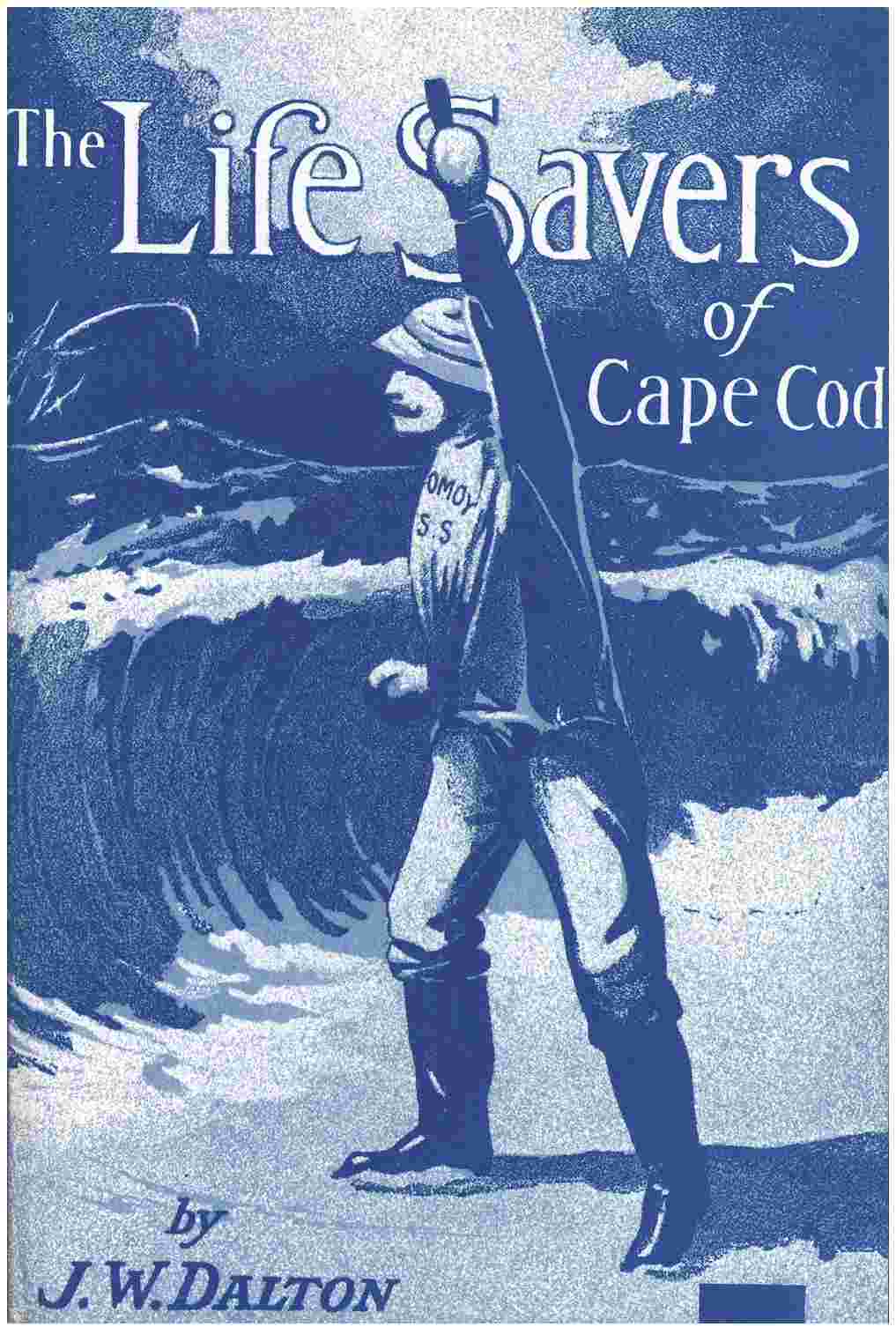
The Life Savers of Cape Cod.
Cape Cod’s life savers are known the world over for their intrepid, enduring bravery, gallant deeds, and the success in rescuing life that they have achieved in their hazardous duties along the most dangerous winter coast of the world.
Every night, along the shores of Cape Cod, from Wood End at Provincetown to Monomoy at Chatham, in moonlight, starlight, thick darkness, driving tempest, wind, rain, snow or hail, an endless line of life savers steadily march along the exposed beaches on the outlook for endangered vessels.
The life saver’s work is always arduous, often terrible. Quicksands, the blinding snow and cutting sand storms, the fearful blasts of winter gales, are more often than not to be encountered on their journeys; storm tides, flooding the beaches, drive them to the tops or back of the sand dunes, where they plod along their solitary patrol with great peril.
When a ship is in distress, whatever way the crew is rescued by the life savers, the task involves great hazard of their lives, hours of racking labor, protracted exposure to the roughest weather conditions, and a mental and bodily strain under the spur of exigency and the curb of discipline that exhaust even these hardy fearless coast guardians. In cases of boat service tremendous additional peril and hardships are added.
Death has often claimed the life saver at his work. Or as a result of his gallant, unselfish toil for the safety of others in the rigors of winter, one life saver after another is compelled to retire from the service on account of shattered health.
MAP OF CAPE COD, SHOWING LOCATION OF U. S. L. S. STATIONS.
Small circles show where principal wrecks have taken place within past fifty years.
Beyond their wages of sixty-five dollars per month the surfmen receive no allowances or emoluments of any kind except the quarters and fuel provided at the stations.
No person belonging to the service is allowed to hold an interest in or to be connected with any wrecking company, nor is he entitled to salvage upon any property he may save or assist to save. A surfman cannot be discharged from the service without good and sufficient reason. For well proven neglect of patrol duty or for disobedience or insubordination at a wreck the keeper may instantly discharge him; in all other cases special authority must be first obtained from the general superintendent.
The keeper lives at his station throughout the year, thus being on hand during the two summer months to summon the crew and volunteers in case of shipwreck or accident.
In “The Life Savers of Cape Cod” it has been the aim of the author to pen-picture some of the heroic deeds performed by these guardians of the “ocean graveyard,” as the shores of Cape Cod are known, the terrible hardships they are called upon to endure, and the peril they constantly face in the work of saving life and property, together with illustrations of the life-saving stations on Cape Cod, the boats, beach apparatus, breeches-buoy, etc., used in saving lives, photographs of the crews of the different stations, a historical sketch of the life-saving service, and stories of historic disasters, with biographies of the life savers of Cape Cod, their duties, manner of living, and their achievements.
Cape Cod extends directly out into the Atlantic, like a gigantic arm with clutched hand, bidding defiance to the mighty ocean, for a distance of forty miles. Shifting sand bars parallel its eastern shores, which are an unbroken line of sandy beaches from Monomoy Point at Chatham to Wood End at Provincetown, a distance of about fifty miles. Myriads of shoals lie along the coast, and unnumbered vessels have met their doom along its shores, which rightly bear the name “Ocean Graveyard.”
The shores of Cape Cod from Monomoy to Wood End are literally strewn with the bones of once staunch crafts, while unmarked graves in the burial-places in the villages along the coast mutely relate the sad tale of the sacrifice of human life.
Scenes of awful terror and heroic rescues have taken place at the time of shipwreck along these shifting sand bars, and here, too, the life savers have given up their lives in devotion to their duty.
HISTORIC WRECKS.
Thousands of lives have been lost in the wrecks that have taken place along the shores of Cape Cod since the Mayflower cast anchor in the harbor at Provincetown in 1620. There is no record of the disasters previous to the establishment of the United States Life-Saving Service in 1872, other than mention in town records and histories of the dates and circumstances of the most memorable, or those attended by great loss of life.
The first shipwreck on Cape Cod, of which there is any record, occurred in 1626, when the historic ship Sparrowhawk, Captain Johnson, from England, with colonists bound for Virginia, stranded on the shoals near Orleans, and became a total loss. The story of the wreck is told by Governor Bradford in his diary of the Plymouth Colony. The ship’s bones were discovered in a mud bank in 1863, the washing away of the shore line disclosing them to view.
Another historic wreck was that of the British frigate Somerset, which stranded on Peaked Hill Bars, Nov. 2 or 3, 1778. The Somerset was one of the fleet of British men-of-war, whose guns had stormed the heights of Bunker Hill, and terrorized the commerce of the colonies. She was at anchor in Boston Harbor the night that Paul Revere made his famous ride. When she met with disaster she was in pursuit of a fleet of French ships, which were reported to be in Boston Harbor. The Somerset had been at anchor in Provincetown harbor for some time, leaving there a few days before she was lost, to go in search of the French ships. She struck Peaked Hill Bars during a northeast gale, while trying to round the Cape, and enter the harbor at Provincetown. She had a complement of four hundred and eighty men, and is supposed to have carried sixty guns, thirty-two, twenty-four, and twelve pounders. She struck on the bars with terrific force, and instantly the seas began to pound her to pieces. She was finally thrown up on the beach by the tumultuous walls of water, and Captain Aurey and the few of the crew who had not perished reached the shore.
The residents of Provincetown viewed the wreck from High Pole Hill, and summoned Capt. Enoch Hallett, of Yarmouth, and Colonel Doane, of Wellfleet, who, with a detachment of militia, made Captain Aurey and the survivors prisoners.
Captain Hallett took charge of the prisoners, marching them up the Cape to Barnstable, and later to Boston, Colonel Doane being left to look after the wrecked craft. There was much jubilation on Cape Cod and in Boston over the disaster. The bones of the Somerset remained buried for a century, when the shifting sands exposed them to view. Relic hunters soon carried away nearly all of the wreckage that could be obtained, and the shifting sands have again entombed what remains of the famous old frigate.
Another historic wreck was that of the pirate ship Widdah, which was lost near the site of the Cahoon’s Hollow Life-Saving Station in 1718. The ship was commanded by Captain Bellamy, and carried twenty-three guns and a crew of one hundred and thirty men. Captain Bellamy had captured seven vessels off the shores of Cape Cod, and on one of them had placed seven of his crew. The captain of the captured ship ran his vessel close to the shore, and the seven pirates were taken prisoners. Later six of them were executed in Boston. The Widdah soon after was driven ashore during a gale, and all hands, save an Englishman and an Indian, were lost.
A scene of awful terror occurred when the Josephus, a British ship, was wrecked on Peaked Hill Bars in the year 1842. She had a cargo of iron rails. Her crew had been driven to the rigging as soon as the vessel struck, and one after another they were seen to fall into the raging sea. Those who had gathered on the shore could hear the despairing cries of the imperiled crew, but were powerless to aid them. At last two of the spectators, Daniel Cassidy and Jonathan Collins, procured a dory, and against the earnest pleadings of their friends, and in the almost certain assurance that they were going to their death, pushed off from the beach, saying as a last farewell, “We can’t stand this any longer; we are going to try and rescue those poor fellows if it cost us our lives.” Half-way out to the wreck the two heroes successfully battled with the sea, then a giant comber, catching their frail boat, carried it along and buried it under tons of tumbling water. The gallant men were seen to rise and struggle desperately to reach the overturned boat, but perished in the attempt. The men remaining in the rigging of the Josephus were soon after swept to death by the monstrous waves that tore the ship to pieces.
In 1848 the brig Cactus was lost on the bars along the back of the Cape.
Along the shore near the Cahoon’s Hollow Station the immigrant ship Franklin was deliberately run ashore in 1849, and many of her poor, helpless passengers perished in the disaster. This was one of the most appalling disasters that ever occurred on Cape Cod. Speedy retribution came to the officers of the ship for their terrible crime, the captain and nearly all the others losing their own lives in the wreck. The late Capt. Benjamin S. Rich, afterwards of the United States Life-Saving Service, was the first to discover the wreck, and also found a box containing some papers that subsequently proved that the disaster was intentional.
The year 1853 was a memorable one in the history of Cape Cod, there being twenty-three appalling disasters along its shore during that period. Among the vessels lost were many ships and brigs well known in shipping circles in Boston and on Cape Cod. The weather was bitter cold and violent storms swept the coast when most of the vessels were lost, so that nothing could be done to assist the imperiled crews, and those who did reach the shore perished from exposure on the desolate uplands and beaches.
In 1866 the White Squall, built for a blockade runner, while on her way home from China, struck on the bars along the back of the Cape and became a total loss.
The wreck of the Aurora is known to Cape Codders as the “Palm Oil Wreck.” The vessel was loaded with palm oil from the west coast of Africa. She struck on the bars off the back of the Cape, and was a total loss.
Another terrible disaster was the wreck of the schooner Clara Belle, coal laden, which stranded on the bars off High Head Station, on the night of March 6, 1872, at the height of a fearful blizzard. Captain Amesbury and crew of six men attempted to reach the shore in their boat. The craft had gone but a few yards when she was overturned, throwing the men into the sea. John Silva was the only member of the crew that reached the shore. He found himself alone on a frozen beach with the mercury below zero. He wandered about during the night trying to find some place of shelter, and was found the next morning by a farmer standing dazed, barefooted, and helpless in the highway three miles from the scene of the wreck. His feet and hands were frozen, and it was a long time before he recovered from the effects. The schooner was driven high and dry on the beach, and when boarded the next day a warm fire was found in the cabin. The haste of the crew to leave the vessel had cost them their lives.
The first fearful disaster after the life-saving service reorganization, took place on Peaked Hill Bars, March 4, 1875, when the Italian bark Giovanni became a total loss and her crew of fourteen perished. The bark stranded too far from the beach to be reached by the wreck ordnance used in those days, and the surf was pounding on the shore with such fury that a boat could not be launched, much less live, in the sea. No assistance could be rendered the poor sailors, and one by one they dropped into the sea and were lost.
The most appalling disaster in the history of the life-saving service on Cape Cod was the wreck of the iron ship Jason, on the bars at Pamet River, Dec. 5, 1893. Twenty-four lives were lost. The ship was bound from Calcutta, India, for Boston, with a cargo of jute. Captain McMillan, who was in charge of the ship, had a crew of twenty-four men, including an apprentice, Samuel J. Evans, of Raglan, England. Thick weather prevailed off the coast for several days preceding the disaster, and Captain McMillan, not being in possession of reliable information as to his position, obtained it from a New York pilot boat.
When about one hundred miles off the coast he unfortunately shaped his course to the westward for the purpose of raising some landmark. When the Jason approached the Cape, the wind was blowing a gale from the northeast, and the atmosphere was thick with rain, which soon turned to sleet and snow.
The life savers along the shore at Nauset first saw the Jason, and word that a ship was in dangerous proximity to the shore was sent along the Cape to all the stations. The Jason was last seen just before five o’clock by the day patrol of the Nauset Station. The life savers, knowing that she could hardly weather the Cape, kept a sharp lookout for her, and at all the stations the horses were hitched into the beach carts and every preparation made to go to the assistance of the ship without a moment’s delay. It was a fearful night along the shores of Cape Cod, the coast guardians having all they could do to go over their patrol. Nothing was seen or heard of the doomed ship up to seven o’clock in the evening, and the life savers hoped that she had managed to work offshore or around the Cape. At half-past seven, however, Surfman Honey, of the Pamet River Station, burst into the station, and shouted, “Hopkins (the north patrol) has just burned his signal.” A moment later Hopkins rushed into the station and reported that the Jason had struck on the bars about a half mile north of the station. Keeper Rich and his crew were ready for the emergency, and, with the beach cart, rushed to the scene. The shore was then piled with wreckage, and the slatting of the sails of the wrecked ship sounded above the roar and din of the storm. A careful lookout for the shipwrecked seafarers was kept by the life savers as they hurried to the scene, and Evans, the sole survivor of the disaster, was found clinging to a bale of jute. He was clad only in his underclothes, and was almost totally helpless.
The wrecked vessel was sighted through the storm and a shot promptly fired over the craft, but the crew had perished almost as soon as the ship struck, and the efforts of the life savers were of no avail. The ship (it was afterwards learned from young Evans) broke in two almost as soon as she struck, and the members of the crew perished shortly after. Evans told the author that as soon as the ship struck he put on a life-preserver and took to the rigging. The captain ordered the boats launched, but they were smashed as soon as they struck the water. While clinging to the rigging, considering what was best to do, Evans says that he must have been hit by a big wave or wall of water, as the next that he knew he was on the beach and the life savers were taking him to the station. The bodies of twenty of the crew were found and buried in the cemetery at Wellfleet. Evans soon recovered from the effects of the buffeting he received by the seas, and returned to his home in England. Part of the ship is now visible at low tide, and is an object of much interest to visitors to Cape Cod.
SAMUEL J. EVANS, SOLE SURVIVOR OF WRECKED SHIP JASON,
With life preserver which he wore when cast ashore.
The wreck of the ship Asia, in which twenty lives were lost, occurred on Nantucket shoals, near the Great Round Shoal Lightship in February, 1898. The ship was on her way from Manila for Boston, and was commanded by Captain Dakin. Besides the crew of twenty-three men Captain Dakin’s wife and little daughter were aboard.
The ship struck on the shoals during a furious northeast gale and snowstorm on Sunday afternoon, but did not begin to break up until the next day.
When the ship commenced to pound to pieces, the mate and the few members of the crew who had not been swept overboard did all in their power to assist Captain Dakin in shielding his wife and daughter from being swept away by the seas which were breaking over the craft. Before the ship broke up, the mate lashed the captain’s daughter and himself to a big piece of wreckage, hoping in that way to reach the shore. Captain Dakin and his wife were swept to death before they could fasten themselves to any of the wreckage. Of the whole number aboard the ill-fated craft but three were saved. These were sailors, who clung to a piece of the ship, and after drifting about in Vineyard Sound for several days, were picked up nearly dead and placed aboard one of the lightships. The bodies of the mate, with his arms locked about the captain’s daughter, and both securely lashed to a piece of wreckage, were picked up a few days later in Vineyard Sound. Both had been frozen to death. But few of the bodies of the other members of the crew were found. The ship became a total loss, and the following day there was not a vestige of her left to mark the spot where the tragedy took place.
The schooner Job H. Jackson was another terrible wreck that occurred on Peaked Hill Bars. The schooner struck on Jan. 5, 1895, during bitter cold weather, and the crew were driven into the rigging. A fearful sea was pounding on the shore, and it required the combined herculean efforts of the Peaked Hill Bars, Race Point, and High Head life-saving crews, with their life-boats, to rescue the imperiled seafarers, who were badly frost-bitten and helpless when taken from the wrecked vessel.
The schooner Daniel B. Fearing, which became a total loss on the bars off Cahoon’s Hollow Station, struck there during a fog on May 6, 1896. The life savers put off to the wreck in their surf-boat, and brought the crew ashore. A gale sprung up with great suddenness as the crew were leaving the doomed vessel, and as the last man jumped into the life-boat the masts of the big schooner fell with a crash, and the sea soon completed the work of total destruction.
On Sept. 14, 1896, the Italian bark Monte Tabor struck on Peaked Hill Bars during a furious northeast gale. The disaster was attended with the loss of five men, whose deaths were involved in circumstances of mysterious and almost romantic interest. Three were suicides, while the manner in which the other two perished could not be certainly explained. The bark hailed from Genoa, and carried a crew of twelve persons, including the officers and two boys. She had a cargo of salt from Trapani, Island of Sicily, for Boston. The craft had been struck by a hurricane on September 9, and when off Cape Cod on the night of the 13th, in endeavoring to make the harbor at Provincetown, she struck the dreaded Peaked Hill Bars. She was discovered by Patrolman Silvey, of the Peaked Hill Bars Station. The night was pitch dark, the surf extremely high, and the bark was soon pounded to pieces. As the life-saving crews could not locate the wreck, there was nothing to shoot at and nothing to pull to, even if a boat could have been launched. It is believed that the captain was so humiliated by the loss of his vessel, that he fell into a frenzy of despair, and resolved to take his own life, and it would appear that others of his crew followed his example of self-destruction.
Six of the crew managed to reach the shore on the top of the cabin, and were pulled out of the surf by the life savers. Another, a boy, said that he swam ashore. An investigation, conducted by the Italian counsel, disclosed that the captain committed suicide.
The first evidence that the steamer Portland had met with disaster during the memorable gale of November, 1898, was found by John Johnson, a surfman of the Race Point Station, who picked up a life-preserver from the ill-fated craft.
WRECKAGE WHICH CAME ASHORE AFTER THE STEAMER PORTLAND WAS LOST AND LIFE PRESERVER FROM THE ILL-FATED CRAFT.
Life preserver in right foreground.
Soon after Johnson found the life-preserver, wreckage from the steamer was seen in the surf along the shore, and within a short time the beach for miles was strewn with it. All the life savers suffered great hardship during that gale, which was the worst in the history of the life-saving service.
Twice since the establishment of the United States Life-Saving Service on Cape Cod, the life savers in the life-boats have met with disaster, and members of the crews perished in the catastrophe.
Keeper David H. Atkins and Surfman Frank Mayo and Elisha Taylor of the Peaked Hill Bars Station perished by their boat being wrecked during a second trip to the stone-loaded sloop, C. E. Trumbull, on the morning of Nov. 30, 1880, to take off two sailors who refused to go ashore the first time.
Surfman S. O. Fisher, now keeper of the Race Point Station, C. P. Kelley, now keeper at High Head Station, and Isaiah Young, who has not since seen a well day, lived to tell the story after a life or death struggle with icy seas and currents and being swept for miles along the shore before they crawled up on the beach.
But the Monomoy disaster of March 17, 1902 was the most appalling and attended with the greatest loss of life, twelve men, seven of them life savers, perishing.
The conduct of the Monomoy crew on this occasion affords a noteworthy example of unflinching fidelity to duty. By long experience they were fully aware of the perils that must be encountered in going to the wrecked vessels, but it was a summons which the brave and conscientious life savers could not disregard.
The story of this disaster is still fresh in the public mind.
THE ESTABLISHMENT OF THE LIFE-SAVING SERVICE ON CAPE COD.
The establishment of the United States Life-Saving Service on Cape Cod dates back but thirty years, which time also marks the reorganization, extension, and beginning of its efficiency in the United States. While as early as 1797 the town of Truro sold to the United States Government a tract of land upon which to erect the first lighthouse on Cape Cod,—Highland Light, so called,—it was not until half a century later that the government began to provide means for the relief of mariners wrecked upon its coasts, and seventy-five years afterwards that the first United States Life-Saving Station was erected on the shores of Cape Cod.
The Massachusetts Humane Society, originally formed in 1786, and incorporated for general purposes of benevolence a few years later, was the first to attempt organized relief for shipwrecked seafarers in the United States as well as upon Cape Cod.
The Society first began its work of rendering assistance to shipwrecked mariners by building huts on many of the desolate sections of the coast. These huts were for the shelter of shipwrecked persons who might reach the shore. The first building of this kind was erected on Lovell’s Island in Boston Harbor in 1807. Later, the Society established the first life-boat station at Cohasset, subsequently erecting others along the coast, and extending its good work to the shores of Cape Cod.
While the Society relied solely upon volunteer crews to man these life-boats in times of disaster, its efforts in saving life and property were of great value, and both the state and general government tendered it pecuniary aid at various times. When the government extended the life-saving service to Cape Cod, the Society was relieved of its burden of protecting that dangerous coast, thus enabling it to better provide for other sections of the coast of Massachusetts.
The Massachusetts Humane Society may be considered the parent of the United States Life-Saving Service. The Society is one of the oldest in the world. It originated its coast service more than thirty-six years before the English did, while the French service dates its birth much later.
In 1845, a few years before Congress took steps for providing means for rendering assistance to wrecked vessels along the coasts of the United States, the Society had eighteen stations on the Massachusetts coast, with boats and mortars for throwing life lines to stranded vessels, in addition to numerous huts of refuge.
With the exception of the Life-Saving Benevolent Association of New York, chartered by the Legislature of that State in 1849, no other successful organized efforts outside of those of the government were made up to this time to lessen the distress incident to shipwreck.
The first appropriation made by Congress for rendering assistance to the shipwrecked from shore was March 3, 1847. For nearly a half century prior to this time the efforts of the government for the protection of mariners upon the coasts of the United States were mainly in establishing the coast survey and extending the lighthouse system.
In 1848 the attention of Congress was called to the immediate needs of providing further means for rendering assistance to wrecked vessels along the Atlantic coast, and a second appropriation of $10,000 was made. The first appropriation of $5,000 remained in the treasury as an unexpended balance.
Later, this money was placed in the hands of the Collector of Customs at Boston for the benefit of the Massachusetts Humane Society, for use in the work of building and equipping new life stations along the Massachusetts coast.
The second appropriation of $10,000 was for expenditure upon the New Jersey coast. With this appropriation eight boat-houses were erected and supplied with appliances for saving life and property. This marks the beginning of the life-saving service of the United States.
In 1849 Congress appropriated $20,000 for life-saving purposes. With this sum eight life-saving stations were built on the Long Island coast and six additional stations erected on the shores of New Jersey. While these newly established life-saving stations were not manned by regular drilled crews of surfmen, as at present, they often proved of great value at times of disaster, and in 1850 Congress made another appropriation of $20,000 for life-saving purposes.
Of this sum half was expended in erecting additional stations along the shores of Long Island, and for a new station at Watch Hill, R. I.
The attention of Congress having been called to the needs of some means of rendering assistance to wrecked vessels along the coasts of North and South Carolina, Georgia, Florida, and Texas, the remaining $10,000 of this appropriation was expended in placing life-boats at the most exposed points on these coasts.
In 1853 and 1854 Congress made liberal appropriations for life-saving purposes, and fourteen new stations were built on the coast of New Jersey.
The service was at this time extended to the Great Lakes, twenty-three life-boats being stationed at different points on Lake Michigan, and several others on the other lake shores and on the Atlantic coast. In 1854 there were one hundred and thirty-seven life-boats stationed along the coasts of the United States. Of this number fifty-five were at stations on the New York and New Jersey coasts.
The absence of drilled and disciplined crews at these stations, however,—together with irresponsible custodians and the lack of proper equipments, the result of pillage or decay,—contributed to great loss of life and heartrending scenes of disaster along the Atlantic coast. The inefficiency of the life-saving service, as it then existed, was apparent to all. Public sentiment had now become excited, and Congress was appealed to for immediate relief from the existing conditions.
In 1853 a bill which provided for the increase and repair of the stations and the guardianship of the life-boats passed the Senate; but, unfortunately, failed to reach the House before adjournment. An appalling disaster, the wreck of the Powhatan, on the coast of New Jersey, in which three hundred lives were lost, caused the bill to be promptly and favorably acted upon at the next session of Congress. Under the provisions of this bill a superintendent at a salary of $1,500 per annum was appointed for the Atlantic and Lake coasts, keepers were placed in charge of the stations at a salary of $200, bonded custodians secured for the life-boats and other apparatus, and the stations and equipments speedily put in order.
The service was somewhat improved as a result of this, but there were still many defects in it, which were brought to light as disaster followed disaster along the seaboard. Up to this time the life-saving crews were not regularly employed.
A bill providing for the employment of regular crews of surfmen was presented to Congress in 1869. Strange though it may seem, in view of the terrible disasters and loss of life which had so recently taken place along the Atlantic coast, the bill suffered defeat. A substitute bill, however, which provided for the employment of crews of surfmen, though only at alternate stations, was passed. This marks the beginning of the employment of crews of surfmen at the United States life-saving stations, and was the first step in the direction of their employment at all stations for regular periods.
During the winter of 1870–71 a number of appalling, fatal disasters occurred along the Atlantic coast. These disasters not only revealed the fact that the coast was not properly guarded, but also that the service was inefficient and needed a more complete organization. In 1871 Congress again appropriated $200,000 and authorized the Secretary of the Treasury to employ crews of surfmen at such stations and for such periods as he might deem necessary.
Mr. Sumner I. Kimball, the present general superintendent of the United States Life-Saving Service, was at that time in charge of the Revenue Marine Service, and the life-saving stations being then under the charge of that bureau, he at once took steps to ascertain the conditions of the service.
An officer of the Revenue Marine Service was at once detailed to visit the life-saving stations and to make a report of their condition and requirements.
The report made by the officer was a startling revelation. Absolutely no discipline was found among the crews, no care had been taken of the apparatus, some of the stations were in ruins, others lacked such articles as powder, rockets, and shot lines, every portable article had been stolen from many stations, and the money that Congress had appropriated had been practically wasted.
From the report it was plainly evident that the reorganization of the service must be speedily brought about, and in accordance with an act of Congress in 1872, the organization of the present system of life-saving districts with superintendents took place.
The inefficient keepers were at once removed and the most skilled boatmen obtainable were placed in charge of the stations.
The stations were also manned by the most expert surfmen to be found along the coast, and the patrol of the coast at night and during thick weather by day was inaugurated. It was soon found that the life-saving stations, however, were too far apart for the crews to be of assistance to one another in the event of a wreck, and measures were adopted to place them within distances of from three to five miles of one another. To bring about this result, twelve new stations were built on the New Jersey coast, six on Long Island, while the location of some of the existing stations were changed.
The stations were plain houses forty-two feet long and eighteen wide, of two stories and four rooms. One room below was used by the crew as mess-room, the other room contained the boats and other apparatus used at wrecks. One of the upper rooms was used as a sleeping room for the crew, the other room was used as a storeroom.
As a result of the reorganization of the service, the record for the first season shows that not a life was lost in the disasters that occurred on either the Lake shores or the Atlantic coast.
Interest in the success of the life-saving service under the new system was now keyed up to a high pitch. Congress had authorized a new station for the coast of Rhode Island in 1871, and in June, 1872, one more was ordered for that coast, and nine for the coast of Cape Cod. These stations were built and manned in the winter of 1872. The nine that were erected on Cape Cod were located as follows: Race Point and Peaked Hill Bars, at Provincetown; Highlands, at North Truro; Pamet River, at Truro; Cahoon’s Hollow, at Wellfleet; Nauset, at North Eastham; Orleans, at Orleans; Chatham, at Chatham; and Monomoy, on Monomoy Island. Since that time four new stations have been established, the Wood End, High Head, Old Harbor, and Monomoy Point.
The life-saving stations on Cape Cod are situated among the sand hills common to the eastern shores of the Cape, at distances back from the high-water mark as to insure their safety. In most instances they are plain structures, designed to serve as a home for the crew and to afford storage for the boats and other apparatus. In most of the stations on Cape Cod the lower floor is divided into five rooms—a mess room, which also serves for a sitting room for the crew, a kitchen, a keeper’s room, a boat and beach apparatus room. Wide double-leafed doors with a sloping platform permit the quick and easy running out of the surf-boat and other apparatus from the station.
The second story contains two rooms: one the sleeping room for the crew; the other has spare cots for rescued persons, and is also used as a storeroom.
On every station there is a lookout or observatory, from which the life savers, during the day when the weather is fair, keep a careful watch of all shipping along the coast. In order that the life-saving stations may be distinguished from a long distance at sea, they are usually painted dark red, and as a further aid to shipping, they are marked by a flagstaff about sixty feet high erected close by them. This flagstaff is also used to signal passing vessels by the International code. These stations are manned from the 1st of August until June 1st following, the keeper remaining on duty throughout the year. The stations are generally furnished with two surf-boats (supplied with oars, life preservers, life-boat compass, drag, boat-hooks, hatchet, heaving line, knife, bucket, and other outfits), boat carriages, two sets of breeches-buoy apparatus (including guns and accessories), carts for the transportation of the apparatus, a life-car, cork-jackets (life preservers), Coston signals, signal rockets, signal flags of the International and General signal code, medicine chests with contents, patrol lanterns, barometer, thermometer, patrol clocks, the requisite furniture for housekeeping by the crew and for the succor of rescued persons, fuel, oil, tools for the repair of the boats and apparatus, and minor repairs to the buildings, and the necessary books and stationery.
With the International and General code of signals, shipping, when miles at sea, can, by this means, open communication with the stations, be reported, obtain latitude and longitude, or, if disabled, can thus send for assistance.
All the life-saving stations on Cape Cod are connected by telephone with lines running to central stations in Provincetown and Chatham. Close watch of the movements of all shipping is in this way easily maintained, and in time of disaster help is quickly summoned and obtained from one station to another.
In the life-saving service the week begins on Sunday night at midnight, and the days are each set apart for some particular kind of employment.
On Monday the members of the crew are employed putting the station in order. On Tuesday, weather permitting, the crew are drilled in launching and landing in the life-boat through the surf.
On Wednesday the men are drilled in the International and General code of signals.
Thursday, the crew drill with the beach apparatus and breeches-buoy.
Friday, the crew practice the resuscitation drill for restoring the apparently drowned.
Saturday is wash-day.
Sunday is devoted to religious practices.
SALARIES OF THE KEEPERS AND SURFMEN.
The keepers of the life-saving stations receive $900 per year for their services, and the surfmen $65 per month.
In the early history of the life-saving service the keepers received but $200 per year, later their salary was increased to $400, then to $700, and, finally, to the present figure.
The surfmen in the early days of the service received but $40 per month, later it was increased to $45, then to $60, and, finally, to the present sum.
At the opening of the “active season,” August 1 of each year, the men assemble at their respective stations and establish themselves for a residence of ten months, being allowed one day in seven to visit their homes between sunrise and sunset. They arrange for their housekeeping, usually forming a mess, each man taking turns by the week in cooking. The crew is organized by the keeper arranging and numbering them in their supposed order of merit, the most competent and trustworthy being designated as No. 1, the next No. 2, and so on. These numbers are changed by promotion as vacancies occur, or by such rearrangement from time to time as proficiency in drill and performance of duty may dictate. Whenever the keeper is absent, the No. 1 surfman assumes command and exercises the keeper’s functions. When the rank of the crew has been fixed, the keeper assigns to each his position and prepares station bills for the day watch, night patrol, boat and apparatus drill, care of the station, etc. Then all is ready for the active work and the watch of the sea and shore that never ceases, day or night, until the close of the active season ten months later.
The patrol of the beaches each night, and during thick weather by day, by which stranded vessels are promptly discovered and the rescue of the imperiled crews made the object of effort by the life saver, distinguishes the United States Life-Saving Service from all others in the world, and in a great measure accounts for its unparalleled triumphs in rescuing shipwrecked seafarers.
If the surfman sights a vessel in distress or running into danger during the night, he fires a brilliant red Coston signal which he always carries. This is a signal to the shipwrecked crew that they have been seen and assistance has been summoned, and to the crew of a vessel which is approaching the danger line along the coast that it is time to haul offshore.