
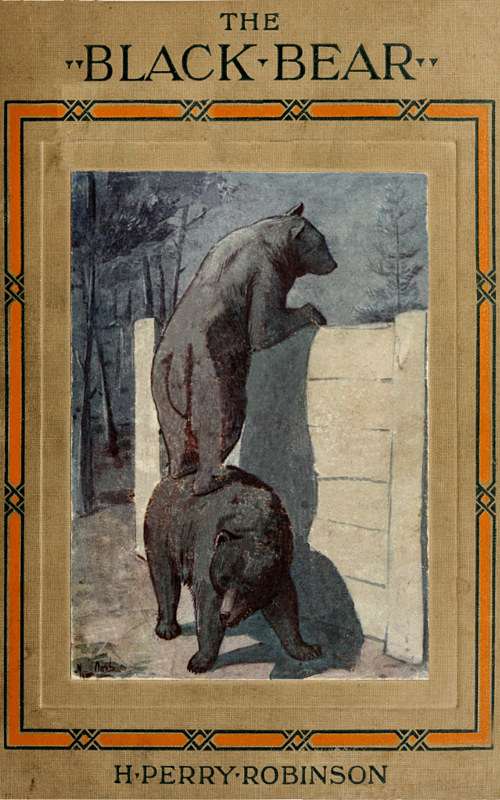
The Project Gutenberg eBook of The Life Story of a Black Bear
Title: The Life Story of a Black Bear
Author: Harry Perry Robinson
Release date: September 19, 2017 [eBook #55583]
Most recently updated: October 23, 2024
Language: English
Credits: Produced by Mhairi Hindle and the Online Distributed
Proofreading Team at http://www.pgdp.net (This file was
produced from images generously made available by The
Internet Archive)
Transcriber’s Note
Illustrations have been moved near to the text they illustrate and linked to the List of Illustrations. Chapters have been linked to the Table of Contents. Select “Enlarge” to access a larger version of the image.
All variant spellings and variant hyphenation have been preserved. However, punctuation has been corrected where necessary.
THE LIFE STORY OF
A BLACK BEAR
BY
H. PERRY ROBINSON
LONDON
ADAM·&·CHARLES·BLACK
1913
FOREWORD
There is always tragedy when man invades the solitudes of the earth, for his coming never fails to mean the destruction of the wild things. But, surely, nowhere can the pathos be greater than when, in the western part of North America, there is a discovery of new gold-diggings. Then from all points of the compass men come pouring into the mountains with axe and pick, gold-pan and rifle, breaking paths through the forest wildernesses, killing and driving before them the wild animals that have heretofore held the mountains for their own.
Here in these rocky, tree-clad fastnesses the bears have kinged it for centuries, ruling in right of descent for generation after generation, holding careless dominion over the coyote and the beaver, the wapiti, the white-tailed and the mule-eared deer. Except for the occasional rebellion of a mutinous lieutenant of a puma, there has been none to dispute their lordship from year to year and century to century. Each winter they have laid themselves down (or sat themselves up—for a bear does not lie down when hibernating) to sleep through the bitter months, in easy assurance that when they awoke they would find the sceptre still by their side.
But a spring comes when they issue from their winter lairs and new sounds are borne to them on the keen, resin-scented mountain air. The hills ring to the chopping of axes; and the voices of men—a new and terrible sound—reach their ears. The earth, soft with the melting snows, shows unaccustomed prints of heavy heels. The coyote and the deer and all the forest folk have gone; the beaver-dams are broken, and the builders vanished.
Dimly wondering at the strangeness of it all, the bears go forth, blundering and half awake, down the new-made pathways, not angry, but curious and perplexed, and by the trail-side they meet man—man with a rifle in his hand. And, still not angry, still only wondering and fearing nothing—for are they not lords of all the mountain-sides?—they die.
H. P. R.
First published September, 1905
Reissued Autumn, 1910; reprinted July, 1913