
WeRead Powered by ReaderPub
The literature of kissing cover

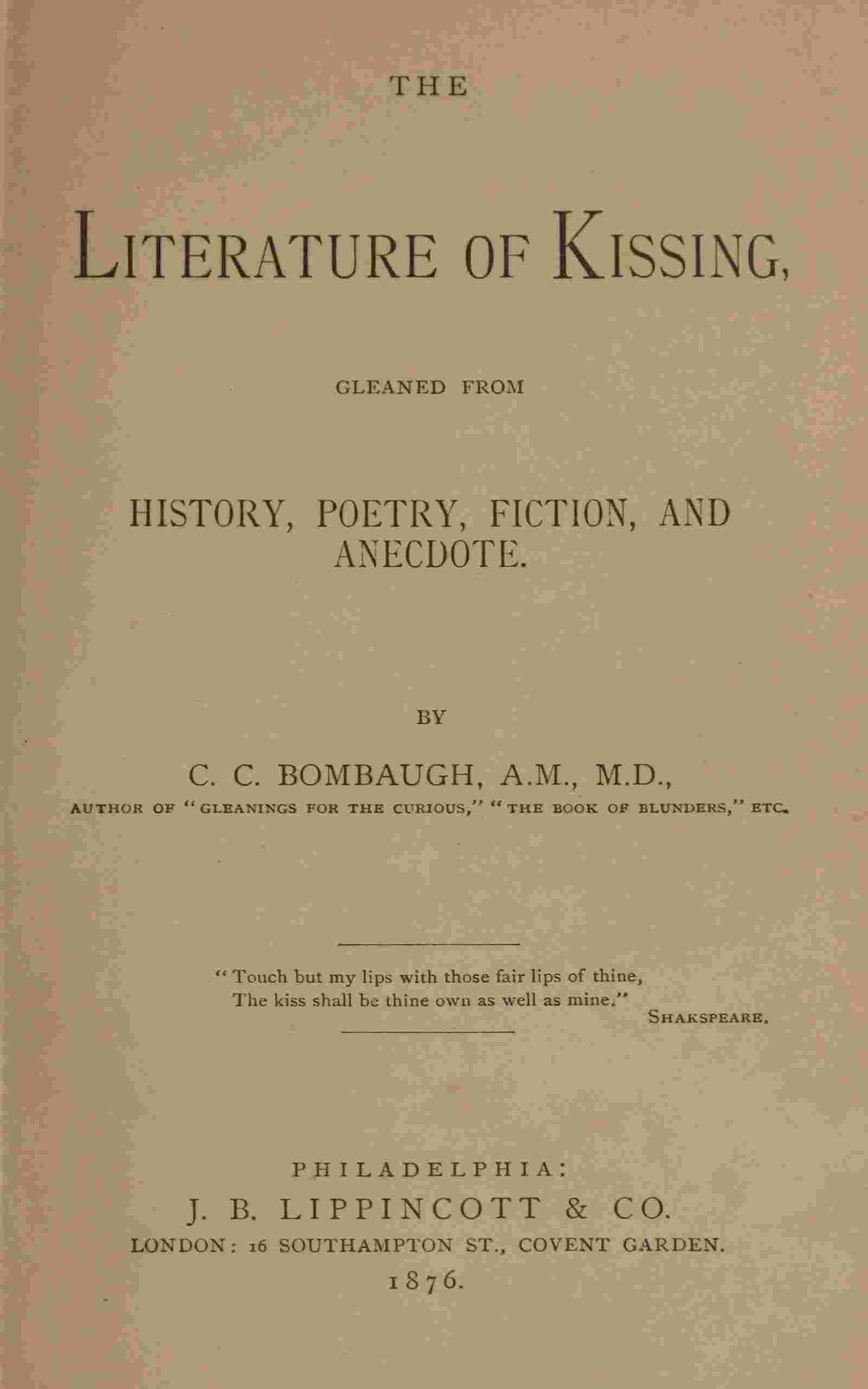
The literature of kissing

Chapter 267: NON-COMPUTATION.
Open in WeRead

Explore more books like this:

About This Book

This work explores the multifaceted nature of kissing throughout history, literature, and culture. It examines the significance of kisses as expressions of affection, joy, sorrow, and various social customs, tracing their roots from biblical references to modern practices. The text compiles anecdotes, poetry, and historical examples to illustrate the diverse meanings and contexts of kissing, from familial bonds to romantic encounters. It reflects on the emotional weight of kisses across different stages of life, highlighting their role in human connection and the rich tapestry of human experience surrounding this universal gesture.

MOUSTACHES.

Kate hates moustaches; so much hair
Makes every man look like a bear;
But Nellie, whom no thought could fetter,
Pouts out, “The more like bears the better,
Because” (her pretty shoulders shrugging)
“Bears are such glorious chaps for hugging.”

THE ANCIENT MAIDEN’S LAMENT.

I have a mouth for kisses,
No one to give or to take;
I have a heart in my bosom
Beating for nobody’s sake.

THE STAKES.

The following playful lines of Strode first appeared in a little volume entitled “New Court Songs and Poems,” printed in 1672, and were reproduced in Dryden’s “Miscellany,” 1716:

My love and I for kisses played:
She would hold stakes; I was content;
But when I won, she would be paid;
With that, I asked her what she meant.
“Nay, since I see,” quoth she, “your wrangling vain,
Take your own kisses; give me mine again.”[31]

DECLINING A KISS.

Said the master to Mary, a sweet-lipped lass,
As she stood in her place at the head of her class,
“You can decline ‘a kiss,’ no doubt?”
“I can,” she replied, with a blush and a pout,
And a glance to the master’s heart there shot,
“But, sir, if you please, I would rather not.”

EARLIEST RECOLLECTIONS.

I recollect a nurse called Ann,
Who carried me about the grass,
And one fine day a nice young man
Came up and kissed the pretty lass.
She did not make the least objection!
Thinks I, “Ah!
When I can talk, I’ll tell mamma”—
And that’s my earliest recollection.
Frederick Locker.

THE DISAPPOINTMENT.

Old Birch, who taught a village school,
Wedded a maid of homespun habit:
He was as stubborn as a mule,
And she was playful as a rabbit.
Poor Kate had scarce become a wife,
Before her husband sought to make her
The pink of country polished life,
And prim and formal as a Quaker.
One day the tutor went abroad,
And simple Katy sadly missed him:
When he returned, behind her lord
She slyly stole, and fondly kissed him.
The husband’s anger rose, and red
And white his face alternate grew.
“Less freedom, ma’am!”[32] Kate sighed, and said,
Oh, dear! I didn’t know ’twas you!

NON-COMPUTATION.

Old Jealousy would count our blisses;
Then give to me a thousand kisses,
Quick kissing me—quick kissing thee—
Oh, quick, oh, quick, the jade to trick!
O Ada, kiss so many kisses,
She, counting ever, ever misses.
Lessing.

BIANCA’S DREAM.

Meanwhile, remindful of the convent bars,
Bianca did not watch these signs in vain,
But turned to Julio at the dark eclipse,
With words like verbal kisses on her lips.
He took the hint full speedily, and, backed
By love, and night, and the occasion’s meetness,
Bestowed a something on her cheek that smacked
(Though quite in silence) of ambrosial sweetness,—
That made her think all other kisses lacked
Till then, but what she knew not, of completeness:
Being used but sisterly salutes to feel,
Insipid things—like sandwiches of veal.
Hood.

THE HONEY-MOON.

Oh, happy, happy, thrice happy state,
When such a bright planet governs the fate
Of a pair of united lovers!
’Tis theirs, in spite of the serpent’s hiss,
To enjoy the pure primeval kiss
With as much of the old original bliss
As mortality ever recovers.
Hood.

NO DOUBT OF IT.

She felt my lips’ impassioned touch,—
’Twas the first time I dared so much;
And yet she chid not,
But whispered o’er my burning brow,
“Oh! do you doubt I love you now?”
Sweet soul! I did not.

A REBUS.

“What is a rebus?” I asked of dear Mary,
As close by my side the dear maiden was seated:
I saw her eye droop and her countenance vary
As she said in reply, “’Tis a kiss, sir, repeated.”

THE DIFFERENCE.

My brother is shy,—I am not shy at all;
So, when there’s a mistletoe hung in our hall,
He manages always to miss all the kisses,
While I, on the contrary, kiss all the misses.

STOLEN KISSES.

Kiss her gently, but be sly;
Kiss her when there’s no one by;
Steal your kiss, for then ’tis meetest—
Stolen kisses are the sweetest.

THE REASON WHY.

An impertinent youth at Saratoga amused himself by exhibiting the following lines to some of the ladies at a hotel:

Men scorn to kiss among themselves,
And scarce would kiss a brother;
But women want to kiss so bad,
They kiss and kiss each other.

Whereupon a young lady pencilled this retort on the back of an envelope, and left it for the fool’s instruction:

Men do not kiss among themselves,
And it’s well that they refrain:
The bitter dose would vex them so,
They would never kiss again.
As sometimes on poor woman’s lip
Is applied this nauseous lotion,
We have to kiss among ourselves
As a counteracting potion.

THE INVENTOR OF KISSING.

When we dwell on the lips of the girl we adore,
What pleasure in Nature is missing?
May his soul be in heaven—he deserves it, I’m sure—
Who was first the inventor of kissing.
Master Adam, I verily think, was the man
Whose discovery can ne’er be surpast;
Then, since the sweet game with creation began,
To the end of the world may it last.
Wolcot.

FORGIVENESS.

Forgive thy foes; nor that alone;
Their evil deeds with good repay;
Fill those with joy who leave thee none,
And kiss the hand upraised to slay.
So does the fragrant sandal bow,
In meek forgiveness, to its doom,
And o’er the axe at every blow
Sheds in abundance rich perfume.

THE RIGHTS OF MEN.

While others, Delia, use their pen
To vindicate the rights of men,
Let us, more wise, to bliss attend:
Be ours the rights which they defend.
Those eyes that glow with love’s own fire,
And what they speak so well inspire;
That melting hand, that heaving breast,
That rises only to be prest;
That ivory neck, those lips of bliss
Which half invite the offered kiss;
These, these—and Love approves the plan—
I deem the dearest rights of man.

TO A PAINTED LADY IN THE OLDEN TIME.

Is’t for a grace, or is’t some dislike,
Where others give ye lippe you give the cheeke;
Some houlde it for a pride of your behaviour,
But I do rather count it as a favour.
Wherefore to shew my kindnesse and my love,
I leave both lippes and cheekes, and kisse your glove.
Now what’s the cause? To make you full acquainted,
Your glove’s perfumed, your lippes and cheekes bepainted.

THE SOURCE ALIKE OF LIFE AND DEATH.

Nature that gave the bee so feate a grace
To find honey of so wondrous fashion,
Hath taught the spyder out of the same place
To fetch poyson by strange alteration,
Though this be strange, it is a stranger case
With one kiss, by a secret operation,
Both these at once in those your lips to finde,
In change whereof I leave my heart behinde.
Sir Thomas Wyatt.

ON A LADY STUNG BY A BEE.

To heal the wound the bee had made
Upon my Delia’s face,
Its honey to the wound she laid,
And bid me kiss the place.
Pleased, I obeyed, and from the wound
Sucked both the sweet and smart:
The honey on my lips I found,
The sting went through my heart.

THE KISS IN METAPHOR.

MORNING SONG.

Speed, zephyr! kiss each opening flower,
Its fragrant spirit make thine own,
Then wing thy way to Rosa’s bower,’
Ere her light sleep is flown.
There, o’er her downy pillow fly,
Wake the sweet maid to life and day:
Breathe on her balmy lip a sigh,
And o’er her bosom play.
Mrs. Hemans.

SUNRISE ON THE HILLS.

I stood upon the hills, when heaven’s wide arch
Was glorious with the sun’s returning march,
And woods were brightened, and soft gales
Went forth to kiss the sun-clad vales.
Longfellow.

SPRING.

No icy fetters hold the stream;
The sun’s bright beam
Comes dancing o’er it to my feet;
The violets that skirt the bank
Bend down to thank
The laughing stream with kisses sweet.

SPRING FLOWERS

Spring has come with a smile of blessing,
Kissing the earth with her soft warm breath,
Till it blushes in flowers at her gentle caressing,
And wakes from the winter’s dream of death.

THE VIOLETS.

Close by the roots of moss-grown stumps,—
The sweetest and the first to blow,—
The blue-eyed violets, in clumps,
Kiss one another as they grow;
And, kissing one another, blend
Their dewy tears upon the earth,
And purest fragrance upward send,
Unconscious types of modest worth!

SPRING SONG.

When the soft winds blow,
And kiss away the snow,—
When the bluebirds sing,
For the dear warm spring,—
Then we’ll go a-Maying,
Through the meadows straying.
Rose Terry.

AUTUMN.

Morn on the mountain, like a summer bird,
Lifts up her purple wing, and in the vales
The gentle wind, a sweet and passionate wooer,
Kisses the blushing leaf, and stirs up life
Within the solemn woods of ash deep-crimsoned,
And silver beech, and maple yellow-leaved.
Longfellow.

THE EVENING WIND.

The faint old man shall lean his silver head
To feel thee; thou shalt kiss the child asleep,
And dry the moistened curls that overspread
His temples, while his breathing grows more deep.
Bryant.

THE CRIMSON SUNSET.

Fall on her, tell her dying glow,
How I am dreaming of her here,
And kiss for me her snowy brow;
Love, I am weak with hope and fear,
Thinking of thee.
Hone.

THE MOON-BEAM.

The silver light, so pale and faint,
Showed many a prophet, and many a saint,
Whose image on the glass was dyed;
Full in the midst, his cross of red
Triumphant Michael brandishèd,
And trampled the Apostate’s pride.
The moon-beam kissed the holy pane,
And threw on the pavement a bloody stain.
Scott.

THE LIGHT FROM THE TOMB.

No earthly flame blazed e’er so bright:
It shone like heaven’s own blessed light,
And, issuing from the tomb,
Showed the monk’s cowl, and visage pale,
Danced on the dark-browed warrior’s mail,
And kissed his waving plume.
Scott.

TIME AND TIDE.

The bridegroom sea
Is toying with the shore, his wedded bride,
And in the fulness of his marriage joy
He decorates her tawny brow with shells,
Retires a pace to see how fair she looks,
Then, proud, runs up to kiss her.

THE LIGHT-HOUSE.

It sees the ocean to its bosom clasp
The rocks and sea-sand with the kiss of peace;
It sees the wild winds lift it in their grasp,
And hold it up, and shake it like a fleece.
Longfellow.

THE GROWING CORN.

Then, like a column of Corinthian mould,
The stalk struts upward and the leaves unfold;
The bushy branches all the ridges fill,
Entwine their arms, and kiss from hill to hill.
Barlow.

FROM THE PSALMS OF DAVID.

Mercy and truth are met together; righteousness and peace have kissed each other.—lxxxv. 10.

PARAPHRASE.

In the book of Deuteronomy, ch. xxxiv. v. 5, occurs the sentence, “So Moses, the servant of the Lord, died there in the land of Moab, according to the word of the Lord.” The literal rendering of the last words is, “by the mouth of the Lord,” or, as the Hebrews express it, “with a kiss from the mouth of God.” It is thus paraphrased by an old English poet:

Softly his fainting head he lay
Upon his Maker’s breast;
His Maker kissed his soul away,
And laid his flesh to rest.

TO CELIA.

Drink to me only with thine eyes,
And I will pledge with mine;
Or leave a kiss but in the cup,
And I’ll not look for wine.
Ben Jonson.

FROM ANACREON.

The shadowy grove,
Where, in the tempting guise of love,
Reclining sleeps some witching maid,
Whose sunny charms, but half displayed,
Blush through the bower, that, closely twined,
Excludes the kisses of the wind.
Ode 59.

LOVE’S PHILOSOPHY.

The fountains mingle with the river,
And the rivers with the ocean,
The winds of heaven mix forever
With a sweet emotion;
Nothing in the world is single;
All things by a law divine
In one another’s being mingle—
Why not I with thine?
See the mountains kiss high heaven,
And the waves clasp one another;
No sister flower would be forgiven
If it disdained its brother:
And the sunlight clasps the earth,
And the moonbeams kiss the sea;
What are all these kissings worth,
If thou kiss not me?
Shelley.

FROM PLATO.

Kissing Helena, together
With my kiss, my soul beside it
Came to my lips, and there I kept it,—
For the poor thing had wandered thither,
To follow where the kiss should guide it;
Oh, cruel I, to intercept it!
Shelley.

FROM “THE LOVER’S CREED.”

I believe if I should die,
And you should kiss my eyelids when I lie
Cold, dead, and dumb to all the world contains,
The folded orbs would open at your breath,
And, from its exile in the Isles of Death,
Life would come gladly back along my veins.

NATURE’S MINISTRATIONS.

Nature’s voice
Bids thee hie fieldward and rejoice;
She calls thee from unhallowed mirth
To walk with beauty o’er the earth;
Proudly she calls thee forth, and now
Prints blandest kisses on thy brow;
On lip, on cheek, on bosom bare,
She pours the balmy morning air.
Motherwell.

“GENTLEST OF MY FRIENDS.”

The branches of the trees
Bend down thy touch to meet,
The clover-blossoms in the grass
Rise up to kiss thy feet.
Longfellow.

THE RELEASED CAPTIVE.

The hour which back to summer’s light
Calls the worn captive, with the gentle kiss
Of winds, and gush of waters, and the sight
Of the green earth.
Mrs. Hemans.

FROM “PHILASTER.”

Let me love lightning, let me be embraced
And kissed by scorpions, or adore the eyes
Of basilisks, rather than trust the tongues
Of hell-bred women.
Beaumont and Fletcher.

FROM “THE TRAITOR.”

Does not
That death’s head look most temptingly? the worms
Have kissed the lips off.
Shirley.

FROM “THE DYING SOLDIER.”

And here upon the battle ground,
Exhausted with the march and fight,
And sickened with the dreary sight
Of the red carnage all around,
I sigh to taste one cooling breath
Blown from the icy hills and sea;
Then welcome as a bride’s to me
Would be the gentle kiss of Death.

MARY IN HEAVEN.

Ayr, gurgling, kissed his pebbled shore
O’erhung with wild woods thickening green.
Burns.

QUEEN GUINEVERE.

A man had given all other bliss,
And all his worldly worth, for this,
To waste his whole heart on one kiss
Upon her perfect lips.
Tennyson.

THE PARTING.

The trance gave way
To those caresses, when a hundred times
In that last kiss, which never was the last,
Farewell, like endless welcome, lived and died.
Tennyson.

THE POET’S FOOD.

Nor seeks nor finds he mortal blisses,
But feeds on the aërial kisses
Of shapes that haunt Thought’s wildernesses.
Shelley.

SLEEP.

Sleep, the fresh dew of languid love, the rain
Whose drops quench kisses till they burn again.
Shelley.

THE KISS IN ENIGMA.

I am just two and two, I am warm, I am cold,
And the parent of numbers that cannot be told;
I am lawful, unlawful,—a duty, a fault;
I am often sold dear, good for nothing when bought;
An extraordinary boon, and a matter of course,
And yielded with pleasure—when taken by force.[33]
Cowper.