
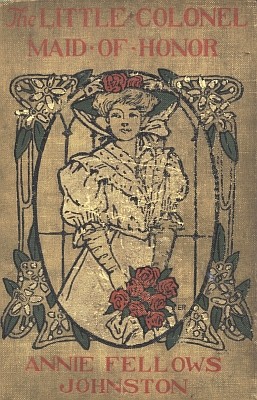
The Project Gutenberg eBook of The Little Colonel: Maid of Honor
Title: The Little Colonel: Maid of Honor
Author: Annie F. Johnston
Illustrator: Etheldred B. Barry
Release date: April 28, 2007 [eBook #21248]
Most recently updated: January 2, 2021
Language: English
Credits: Produced by Juliet Sutherland, Emmy and the Online
Distributed Proofreading Team at https://www.pgdp.net
"LLOYD . . . TOOK HER PLACE BESIDE THE HARP" (See page 68) |
Works of
ANNIE FELLOWS JOHNSTON
The Little Colonel Series
Each one vol., large 12mo, cloth, illustrated
| The Little Colonel Stories | $1.50 |
| (Containing in one volume the three stories, "The Little Colonel," "The Giant Scissors," and "Two Little Knights of Kentucky.") | |
| The Little Colonel's House Party | 1.50 |
| The Little Colonel's Holidays | 1.50 |
| The Little Colonel's Hero | 1.50 |
| The Little Colonel at Boarding-School | 1.50 |
| The Little Colonel in Arizona | 1.50 |
| The Little Colonel's Christmas Vacation | 1.50 |
| The Little Colonel: Maid of Honor | 1.50 |
| The Little Colonel's Knight Comes Riding | 1.50 |
| The above 9 vols., boxed | 13.50 |
| In Preparation—A New Little Colonel Book | 1.50 |
| The Little Colonel Good Times Book | 1.50 |
Illustrated Holiday Editions
| The Little Colonel | $1.25 |
| The Giant Scissors | 1.25 |
| Two Little Knights of Kentucky | 1.25 |
| Big Brother | 1.25 |
Cosy Corner Series
| The Little Colonel | $.50 |
| The Giant Scissors | .50 |
| Two Little Knights of Kentucky | .50 |
| Big Brother | .50 |
| Ole Mammy's Torment | .50 |
| The Story of Dago | .50 |
| Cicely | .50 |
| Aunt 'Liza's Hero | .50 |
| The Quilt that Jack Built | .50 |
| Flip's "Islands of Providence" | .50 |
| Mildred's Inheritance | .50 |
Other Books
| Joel: A Boy of Galilee | $1.50 |
| In the Desert of Waiting | .50 |
| The Three Weavers | .50 |
| Keeping Tryst | .50 |
| The Legend of the Bleeding Heart | .50 |
| Asa Holmes | 1.00 |
| Songs Ysame (Poems, with Albion Fellows Bacon) | 1.00 |
200 Summer Street Boston, Mass.
The Little Colonel:
| ||
By L. C. Page & Company
(INCORPORATED)
| First Impression, October, 1906 |
| Third Impression, August, 1907 |
| Fourth Impression, April, 1908 |
| Fifth Impression, March, 1909 |
| Sixth Impression, February, 1910 |
CONTENTS
| ||||||||||||||||||||||||||||||||||||||||||||||||||||
LIST OF ILLUSTRATIONS
| page | |
| "Lloyd ... took her place beside the harp" (See page 68) | Frontispiece |
| "It needed no second glance to tell him who she was" | 20 |
| "He was leaning forward in his chair, talking to joyce" | 66 |
| "A tall, athletic figure in outing flannels" | 84 |
| "A long-drawn 'o-o-oh' greeted the beautiful tableau" | 132 |
| "'All you girls standing with your hands stuck through the bars'" | 163 |
| "'They stepped in and rowed off down the shining waterway'" | 171 |
| "'One, two, three—THROW!'" | 253 |
THE LITTLE COLONEL,
MAID OF HONOR
CHAPTER I.
AT WARWICK HALL
It was mid-afternoon by the old sun-dial that marked the hours in Warwick Hall garden; a sunny afternoon in May. The usual busy routine of school work was going on inside the great Hall, but no whisper of it disturbed the quiet of the sleepy old garden. At intervals the faint clang of the call-bell, signalling a change of classes, floated through the open windows, but no buzz of recitations reached the hedge-hidden path where Betty Lewis sat writing.
The whole picturesque place seemed as still as the palace of the Sleeping Beauty. Even the peacocks on the terraced river-front stood motionless, their resplendent tails spread out in the sun; and although the air was filled with the odor of wild plum blossoms, the breeze that bore it through the arbor where Betty sat, absorbed in her work, was so gentle that it scarcely stirred the vines around her.
With her elbows resting on the rustic table in front of her, and one finger unconsciously twisting the lock of curly brown hair that strayed over her ear, she sat pushing her pencil rapidly across the pages of her note-book. At times she stopped to tap impatiently on the table, when the word she wanted failed to come. Then she would sit looking through half-closed eyes at the sun-dial, or let her dreamy gaze follow the lazy windings of the river, which, far below, took its slow way along between the willows.
As editor-in-chief of The Spinster, there was good reason why she should be excused from recitations now and then, to spend an afternoon in this retreat. This year's souvenir volume bade fair to be the brightest and most creditable one ever issued by the school. The English professor not only openly said so, but was plainly so proud of Betty's ability that the lower classes regarded her with awe, and adored her from a distance, as a real live genius.
Whether she was a genius or not, one thing is certain, she spent hours of patient, painstaking work to make her writing measure up to the standard she had set for it. It was work that she loved better than play, however, and to-day she sighed regretfully when the hunter's horn, blowing on the upper terrace, summoned the school to its outdoor sports.
Instantly, in answer to the winding call, the whole place began to awaken. There was a tread of many feet on the great staircase, the outer doors burst open, and a stream of rollicking girls poured out into the May sunshine.
Betty knew that in a few minutes the garden would be swarming with them as if a flock of chattering magpies had taken possession of it. With a preoccupied frown drawing her eyebrows together, she began gathering up her papers, preparatory to making her escape. She glanced down the long flight of marble steps leading to the river. There on the lowest terrace, a fringe of willow-trees trailed their sweeping branches in the water. Around the largest of these trees ran a circular bench. Seated on the far side of this, the huge trunk would shield her from view of the Hall, and she decided to go down there to finish.
It would never do to stop now, when the verses were spinning themselves out so easily. None of the girls, except her four most intimate friends, would dare think of following her down there, and if she could slip away from that audacious quartette, she would be safe for the rest of the afternoon.
Peering through a hole in the hedge, she stood waiting for them to pass. A section of the botany class came first, swinging their baskets, and bound for a wooded hillside where wild flowers grew in profusion. A group on their way to the golf links came next, then half a dozen tennis players, and the newly organized basket-ball team. A moment more, and the four she was waiting for tramped out abreast, arm in arm: Lloyd Sherman, Gay Melville, Allison and Kitty Walton. Gay carried a kodak, and, from the remarks which floated over the hedge, it was evident they were on their way to the orchard, to take a picture which would illustrate the nonsense rhyme Kitty was chanting at the top of her voice. They all repeated it after her in a singsong chorus, the four pairs of feet keeping time in a soldierly tread as they marched past the garden:
| "Diddledy diddledy dumpty! |
| Three old maids in a plum-tree! |
| Half a crown to get them down, |
| Diddledy diddledy dumpty!" |
Only in this instance Betty knew they were to be young maids instead of old ones, all in a row on the limb of a plum-tree in the orchard, their laughing faces thrust through the mass of snowy blossoms, as they waited to be photographed.
"Diddledy diddledy dumpty"—the ridiculous refrain grew fainter and died away as the girls passed on to the orchard, and Betty, smiling in sympathy with their high spirits, ran down the stately marble steps to the seat under the willow. It was so cool and shadowy down there that at first it was a temptation just to sit and listen to the lap of the water against the shore, but the very length of the shadows warned her that the afternoon was passing, and after a few moments she fell to work again with conscientious energy.
So deeply did she become absorbed in her task, she did not look up when some one came down the steps behind her. It was an adoring little freshman, who had caught the glimmer of her pink dress behind the tree. The special-delivery letter she carried was her excuse for following. She had been in a flutter of delight when Madame Chartley put it in her hand, asking her to find Elizabeth Lewis and give it to her. But now that she stood in the charmed presence, actually watching a poem in the process of construction, she paused, overwhelmed by the feeling that she was rushing in "where angels feared to tread."
Still, special-delivery letters are important things. Like time and tide they wait for no man. Somebody might be dead or dying. So summoning all her courage, she cleared her throat. Then she gave a bashful little cough. Betty looked up with an absent-minded stare. She had been so busy polishing a figure of speech to her satisfaction that she had forgotten where she was. For an instant the preoccupied little pucker between her eyebrows smote the timid freshman with dismay. She felt that she had gained her idol's everlasting displeasure by intruding at such a time. But the next instant Betty's face cleared, and the brown eyes smiled in the way that always made her friends wherever she went.
"What is it, Dora?" she asked, kindly. Dora, who could only stammer an embarrassed reply, held out the letter. Then she stood with toes turned in, and both hands fumbling nervously with her belt ribbon, while Betty broke the seal.
"I—I hope it isn't bad news," she managed to say at last. "I—I'd hate to bring you bad news."
Betty looked up with a smile which brought Dora's heart into her throat. "Thank you, dear," she answered, cordially. Then, as her eye travelled farther down the page, she gave a cry of pleasure.
"Oh, it is perfectly lovely news, Dora. It's the most beautiful surprise for Lloyd's birthday that ever was. She's not to know till to-morrow. It's too good a secret to keep to myself, so I'll share it with you in a minute if you'll swear not to tell till to-morrow."
Scarcely believing that she heard aright, Dora dropped down on the grass, regardless of the fact that her roommate and two other girls were waiting on the upper terrace for her to join them. They were going to Mammy Easter's cabin to have their fortunes told. Feeling that this was the best fortune that had befallen her since her arrival at Warwick Hall, and sure that Mammy Easter could foretell no greater honor than she was already enjoying, she signalled wildly for them to go on without her.
At first they did not understand her frantic gestures for them to go on, and stood beckoning, till she turned her back on them. Then they moved away reluctantly and in great disgust at her abandoning them. When a glance over her shoulder assured her that she was rid of them, she settled down with a blissful sigh. What greater honor could she have than to be chosen as the confidante of the most brilliant pupil ever enrolled at Warwick Hall? At least it was reported that that was the faculty's opinion of her. Dora's roommate, Cornie Dean, had chosen Lloyd Sherman as the shrine of her young affections, and it was from Cornie that Dora had learned the personal history of her literary idol. She knew that Lloyd Sherman's mother was Betty's godmother, and that the two girls lived together as sisters in a beautiful old home in Kentucky called "The Locusts." She had seen the photograph of the place hanging in Betty's room, and had heard scraps of information about the various house-parties that had frolicked under the hospitable rooftree of the fine old mansion. She knew that they had travelled abroad, and had had all sorts of delightful and unusual experiences. Now something else fine and unusual was about to happen, and Betty had offered to share a secret with her. A little shiver of pleasure passed over her at the thought. This was so delightfully intimate and confidential, almost like taking one of those "little journeys to the homes of famous people."
As Betty turned the page, Dora felt with another thrill that that was the hand which had written the poem on "Friendship," which all the girls had raved over. She herself knew it by heart, and she knew of at least six copies which, cut from the school magazine in which it had been published, were stuck in the frames of as many mirrors.
And that was the hand that had written the junior class song and the play that the juniors gave on Valentine night. If reports were true that was also the hand which would write the valedictory next year, and which was now secretly at work upon a book which would some day place its owner in the ranks with George Eliot and Thackeray.
While she still gazed in a sort of fascination at the daintily manicured pink-tipped fingers, Betty looked up with a radiant face. "Now I'll read it aloud," she said. "It will take several readings to make me realize that such a lovely time is actually in store for us. It's from godmother," she explained.
"Dear Elizabeth:—As I cannot be sure just when this will reach Warwick Hall, I am sending the enclosed letter to Lloyd in your care. A little package for her birthday has already gone on to her by express, but as this bit of news will give her more pleasure than any gift, I want her to receive it also on her birthday. I have just completed arrangements for a second house-party, a duplicate of the one she had six years ago, when she was eleven. I have bidden to it the same guests which came to the first one, you and Eugenia Forbes and Joyce Ware, but Eugenia will come as a bride this time. I have persuaded her to have her wedding here at Locust, among her only kindred, instead of in New York, where she and her father have no home ties. It will be a rose wedding, the last of June. The bridegroom's brother, Phil Tremont, is to be best man, and Lloyd maid of honor. Stuart's best friend, a young doctor from Boston, is to be one of the attendants, and Rob another. You and Joyce are to be bridesmaids, just as you would have been had the wedding been in New York.
"Eugenia writes that she bought the material in Paris for your gowns. I enclose a sample, pale pink chiffon. Like a rose-leaf, is it not? Dressed in this dainty color, you will certainly carry out my idea of a rose wedding. Now do not let the thoughts of all this gaiety interfere with your studies. That is all I can tell you now, but you may spend your spare time until school is out planning things to make this the happiest of house-parties, and we will try to carry out all the plans that are practicable. Your devoted godmother,
Betty spread the sample of chiffon out over her knee, and stroked it admiringly, before she slipped it back into the envelope with the letter. "The Princess is going to be so happy over this," she exclaimed. "I'm sure she'll enjoy this second house-party at seventeen a hundred times more than she did the first one at eleven, and yet nobody could have had more fun than we did at that time."
Dora's eager little face was eloquent with interest. Betty could not have chosen a more attentive listener, and, inspired by her flattering attention, she went on to recall some of the good times they had had at Locust, and in answer to Dora's timid questions explained why Lloyd was called The Little Colonel and the Princess Winsome and the Queen of Hearts and Hildegarde, and all the other titles her different friends had showered upon her.
"She must have been born with a gold spoon in her mouth, to be so lucky," sighed Dora, presently. "Life has been all roses for her, and no thorns whatever."
"No, indeed!" answered Betty, quickly. "She had a dreadful disappointment last year. She was taken sick during the Christmas vacation, and had to stay out of school all last term. It nearly broke her heart to drop behind her class, and she still grieves over it every day. The doctors forbade her taking extra work to catch up with it. Then so much is expected of an only child like her, who has had so many advantages, and it is no easy matter living up to all the expectations of a family like the old Colonel's."
Betty's back was turned to the terraces, but Dora, who faced them, happened to look up just then. "There she comes now," she cried in alarm. "Hide the letter! Quick, or she'll see you!"
Glancing over her shoulder, Betty saw, not only the four girls she had run away from, but four others, running down the terraces, taking the flight of marble steps two at a time. Gay's shoe-strings were tripping her at every leap, and Lloyd's hair had shaken down around her shoulders in a shining mass in the wild race from the orchard.
Lloyd reached the willow first. Dropping down on the bench, almost breathless, she began fanning herself with her hat.
"Oh!" she gasped. "Tell me quick, Betty! What is the mattah? Cornie Dean said a messenger boy had just come out to the Hall on a bicycle with a special-delivery lettah from home. I was so suah something awful had happened I could hardly run, it frightened me so."
"And we thought maybe something had happened at 'The Beeches,'" interrupted Allison, "and that mamma had written to you to break the news to us."
"Why, nothing at all is the matter," answered Betty, calmly, darting a quick look at Dora to see if her face was betraying anything. "It was just a little note from godmother. She wanted me to attend to something for her."
"But why should she send it by special delivery if it isn't impawtant?" asked Lloyd, in an aggrieved tone.
"It is important," laughed Betty. "Very."
"For goodness' sake, what is it, then?" demanded Lloyd. "Don't tease me by keeping me in suspense, Betty. You know that anything about mothah or The Locusts must concern me, too, and that I am just as much interested in the special lettah as you are. I should think it would be just as much my business as yoah's."
"This does concern you," admitted Betty, "and I'm dying to tell you, but godmother doesn't want you to know until to-morrow."
"To-morrow," echoed Lloyd, much puzzled. Then her face lighted up. "Oh, it's about my birthday present. Tell me what it is now, Betty," she wheedled. "I'd lots rathah know now than to wait. I could be enjoying the prospect of having whatevah it is all the rest of the day."
Betty clapped her hands over her mouth, and rocked back and forth on the bench, her eyes shining mischievously.
"Do go away," she begged. "Don't ask me! It's so lovely that I can hardly keep from telling you, and I'm afraid if you stay here I'll not have strength of character to resist."
"Tell us, Betty," suggested Kitty. "Lloyd will hide her ears while you confide in us."
"No, indeed!" laughed Betty. "The cat is half out of the bag when a secret is once shared, and I know you couldn't keep from telling Lloyd more than an hour or two."
Just then Lloyd, leaning forward, pounced upon something at Betty's feet. It was the sample of pink chiffon that had dropped from the envelope.
"Sherlock Holmes the second!" she cried. "I've discovahed the secret. It has something to do with Eugenia's rose wedding, and mothah is going to give me my bridesmaid's dress as a birthday present. Own up now, Betty. Isn't that it?"
Betty darted a startled look at Dora. "Well," she admitted, cautiously, "if it were a game of hunt the slipper, I'd say you were getting rather warm. That is not the present your mother mentioned, although it is a sample of the bridesmaids' dresses. Eugenia got the material in Paris for all of them. I'm at liberty to tell you that much."
"Is that the wedding where you are to be maid of honor, Princess?" asked Grace Campman, one of the girls who had been posing in the plum-tree, and who had followed her down to hear the news.
"Yes," answered Lloyd. "Is it any wondah that I'm neahly wild with curiosity?"
"Make her tell," urged an excited chorus. "Just half a day beforehand won't make any difference."
"Let's all begin and beg her," suggested Grace.
Lloyd, long used to gaining her own way with Betty by a system of affectionate coaxing hard to resist, turned impulsively to begin the siege to wrest the secret from her, but another reference to the maid of honor by Grace made her pause. Then she said suddenly, with the well-known princess-like lifting of the head that they all admired:
"No, don't tell me, Betty. A maid of honah should be too honahable to insist on finding out things that were not intended for her to know. I hadn't thought. If mothah took all the trouble of sending a special-delivery lettah to you to keep me from knowing till my birthday, I'm not going to pry around trying to find out."
"Well, if you aren't the queerest," began Grace. "One would think to hear you talk that 'maid of honor' was some great title to be lived up to like the 'Maid of Orleans,' and that only some high and mighty creature like Joan of Arc could do it. But it's nothing more than to go first in the wedding march, and hold the bride's bouquet. I shouldn't think you'd let a little thing like that stand in the way of your finding out what you're so crazy to know."
"Wouldn't you?" asked Lloyd, with a slight shrug, and in a tone which Dora described afterward to Cornie as simply withering.
| "'Well, that's the difference, as you see, |
| Betwixt my lord the king and me!'" |
To Grace's wonder, she dropped the sample of pink chiffon in Betty's lap, as if it had lost all interest for her, and stood up.
"Come on, girls," she exclaimed. "Let's take the rest of those pictuahs. There are two moah films left in the roll."
"I might as well go with you," said Betty, gathering up the loose leaves that had fallen from her note-book. "It's no use trying to write with my head so full of the grand secret. I couldn't possibly think of anything else."
Arm in arm with Allison, she sauntered up the steps behind the others to the old garden, which was the pride of every pupil in Warwick Hall. The hollyhocks from Ann Hathaway's cottage had not yet begun to flaunt their rosettes of color, but the rhododendrons from Killarney were in gorgeous bloom. As Lloyd focussed the camera in such a way as to make them a background for a picture of the sun-dial, Betty heard Kitty ask: "You'll let us know early in the morning what your present is, won't you, Princess?"
"Yes, I'll run into yoah room with it early in the mawning, just as soon as I lay eyes on it myself," promised Lloyd, solemnly.
"She can't!" whispered Betty to Allison, with a giggle. "In the first place, it's something that can't be carried, and in the second place it will take a month for her to see all of it herself."
Allison stopped short in the path, her face a picture of baffled curiosity. "Betty Lewis," she said, solemnly, "I could find it in my heart to choke you. Don't tempt me too far, or I'll do it with a good grace."
Betty laughed and pushed aside the vines at the entrance to the arbor. "Come in here," she said, in a low tone. "I've intended all along to tell you as soon as we got away from Grace Campman and those freshmen, for it concerns you and Kitty, too. You missed the first house-party we had at The Locusts, but you'll have a big share in the second one. For a June house-party with a wedding in it is the 'surprise' godmother has written about in Lloyd's birthday letter."
CHAPTER II.
AT WARE'S WIGWAM
In order that Lloyd's invitation to her own house-party might reach her on her birthday, it had not been mailed until several days after the others. So it happened that the same morning on which she slipped across the hall in her kimono, to share her first rapturous delight with Kitty, Joyce Ware's letter reached the end of its journey.
The postman on the first rural delivery route out of Phœnix jogged along in his cart toward Ware's Wigwam. He had left the highway and was following the wheel-tracks which led across the desert to Camelback Mountain. The horse dropped into a plodding walk as the wheels began pulling heavily through the sand, and the postman yawned. This stretch of road through the cactus and sage-brush was the worst part of his daily trip. He rarely passed anything more interesting than a jack-rabbit, but this morning he spied something ahead that aroused his curiosity.
At first it seemed only a flash of something pink beating the air; but, as he jogged nearer, he saw that the flash of pink was a short-skirted gingham dress. A high-peaked Mexican hat hid the face of the wearer, but it needed no second glance to tell him who she was. Every line of the sturdy little figure, from the uplifted arms brandishing a club to the dusty shoes planted widely apart to hold her balance, proclaimed that it was Mary Ware. As the blows fell with relentless energy, the postman chuckled.
"Must be killing a snake," he thought. "Whatever it is, it will be flatter than a pancake when she gets through with it."
Somehow he always felt like chuckling when he met Mary Ware. Whatever she happened to be doing was done with a zeal and a vim that made this fourteen-year-old girl a never-failing source of amusement to the easy-going postman. Now as he came within speaking distance, he saw a surrey drawn up to the side of the road, and recognized the horse as old Bogus from Lee's ranch.
A thin, tall woman, swathed in a blue veil, sat stiffly on the back seat, reaching forward to hold the reins in a grasp that showed both fear and unfamiliarity in the handling of horses. She was a new boarder at Lee's ranch. Evidently they had been out on some errand for Mrs. Lee, and were returning from one of the neighboring orange-groves, for the back of the surrey was filled with oranges and grapefruit.
The postman's glance turned from the surrey to the object in the road with an exclamation of surprise. One of the largest rattlesnakes he had ever seen lay stretched out there, and Mary, having dropped her club, was proceeding to drag it toward the surrey by a short lasso made of a piece of the hitching-rope. The postman stood up in his cart to look at it.
"Better be sure it's plumb dead before you give it a seat in your carriage," he advised.
Mary gave a glance of disgust toward the blue-veiled figure in the surrey.
"Oh, it's dead," she said, witheringly. "Mr. Craydock shot its head off to begin with, over at the orange-grove this morning, and I've killed it four different times on our way home. He gave it to me to take to Norman for his collection. But Miss Scudder is so scared of it that she makes me get out every half-mile to pound a few more inches off its neck. It was a perfect beauty when we started,—five feet long and twelve rattles. I'm so afraid I'll break off some of the rattles that I'll be mighty glad when I get it safely home."
"So will I!" ejaculated Miss Scudder, so fervently that the postman laughed as he drove on.
"Any mail for us?" Mary called after him.
"Only some papers and a letter for your sister," he answered over his shoulder.
"Now why didn't I ask him to take me and the snake on home in the cart with him?" exclaimed Mary, as she lifted the rattler into the surrey by means of the lasso, and took the reins from the new boarder's uneasy hands. "Even if you can't drive, Bogus could take you to the ranch all right by himself. Lots of times when Hazel Lee and I are out driving, we wrap the reins around the whipholder and let him pick his own way. Now I'll have to drag this snake all the way from the ranch to the Wigwam, and it will be a dreadful holdback when I'm in such a hurry to get there and see who Joyce's letter is from.
"You see," she continued, clucking cheerfully to Bogus, "the postman's mail-pouch is almost as interesting as a grab-bag, since my two brothers went away. Holland is in the navy," she added, proudly, "and my oldest brother, Jack, has a position in the mines up where mamma and Norman and I are going to spend the summer."
Three years in the desert had not made Mary Ware any the less talkative. At fourteen she was as much of a chatterbox as ever, but so diverting, with her fund of unexpected information and family history and her cheerful outlook on life, that Mrs. Lee often sent for her to amuse some invalid boarder, to the mutual pleasure of the small philosopher and her audience.
The experiment this morning had proved anything but a pleasure drive for either of them, however. Timid Miss Scudder, afraid of horses, afraid of the lonely desert, and with a deathly horror of snakes, gave a sigh of relief when they came in sight of the white tents clustered around the brown adobe ranch house on the edge of the irrigating canal. But with the end of her journey in sight, she relaxed her strained muscles and nerves somewhat, and listened with interest to what Mary was saying.
"This year has brought three of us our heart's desires, anyhow. Holland has been wild to get into the navy ever since he was big enough to know that there is one. Jack has been looking forward to this position in the mines ever since we came out West. It will be the making of him, everybody says. And Joyce's one dream in life has been to save enough money to go East to take lessons in designing. Her bees have done splendidly, but I don't believe she could have quite managed it if Eugenia Forbes hadn't invited her to be one of the bridesmaids at her wedding, and promised to send her a pass to New York."
She broke off abruptly as Bogus came to a stop in front of the tents, and, standing up, she proceeded to dangle the snake carefully over the wheel, till it was lowered in safety to the ground. Ordinarily she would have lingered at the ranch until the occupant of every tent had strolled out to admire her trophy, and afterward might have accepted Hazel Lee's invitation to stay to dinner. It was a common occurrence for them to spend their Saturdays together. But to-day not even the promise of strawberry shortcake and a ride home afterward, when it was cooler, could tempt her to stay.
The yellow road stretched hot and glaring across the treeless desert. The snake was too heavy to carry on a pole over her shoulder. She would have to drag it through the sun and sand if she went now. But her curiosity was too strong to allow her to wait. She must find out what was in that letter to Joyce. If it were from Jack, there would be something in it about their plans for the summer; maybe a kodak picture of the shack in the pine woods near the mines, where they were to board. If it were from Holland, there would be another interesting chapter of his experiences on board the training-ship.
Once as she trudged along the road, it occurred to her that the letter might be from her cousin Kate, the "witch with a wand," who had so often played fairy godmother to the family. She might be writing to say that she had sent another box. Straightway Mary's active imagination fell to picturing its contents so blissfully that she forgot the heat of the sun-baked road over which she was going. Her face was beaded with perspiration and her eyes squinted nearly shut under the broad brim of the Mexican sombrero, but, revelling in the picture her mind called up of cool white dresses and dainty thin-soled slippers, she walked faster and faster, oblivious to the heat and the glaring light. Her sunburned cheeks were flaming red when she finally reached the Wigwam, and the locks of hair straggling down her forehead hung in limp wet strings.
Lifting the snake carefully across the bridge which spanned the irrigating canal, she trailed it into the yard and toward the umbrella-tree which shaded the rustic front porch. Under this sheltering umbrella-tree, which spread its dense arch like a roof, sat Joyce and her mother. The heap of muslin goods piled up around them showed that they had spent a busy morning sewing. But they were idle now. One glance showed Mary that the letter, whosever it was, had brought unusual news. Joyce sat on the door-step with it in her lap and her hands clasped over her knees. Mrs. Ware, leaning back in her sewing-chair, was opening and shutting a pair of scissors in an absent-minded manner, as if her thoughts were a thousand miles away.
"Well, it's good news, anyway," was Mary's first thought, as she glanced at her sister's radiant face. "She wouldn't look so pretty if it wasn't. It's a pity she can't be hearing good news all the time. When her eyes shine like that, she's almost beautiful. Now me, all the good news in the world wouldn't make me look beautiful, freckled and fat and sunburned as I am, and my hair so fine and thin and straight—"
She paused in her musings to look up each sleeve for her handkerchief, and not finding it in either, caught up the hem of her short pink skirt to wipe her perspiring face.
"Oh, what did the postman bring?" she demanded, seating herself on the edge of the hammock swung under the umbrella-tree. "I've almost walked myself into a sunstroke, hurrying to get here and find out. Is it from Jack or Holland or Cousin Kate?"
"It is from The Locusts," answered Joyce, leaning forward to see what was tied to the other end of the rope which Mary still held. Seeing that it was only a snake, something which Mary and Holland were always dragging home, to add to their collection of skins and shells, she went on:
"The Little Colonel is to have a second house-party. The same girls that were at the first one are invited for the month of June, and Eugenia is to be married there instead of in New York. Think what a wedding it will be, in that beautiful old Southern home! A thousand times nicer than it would have been in New York."
She stopped to enjoy the effect her news had produced. Mary's face was glowing with unselfish pleasure in her sister's good fortune.
"And we're to wear pale pink chiffon dresses, just the color of wild roses. Eugenia got the material in Paris when she ordered her wedding-gown, and they're to be made in Louisville after we get there."
The light in Mary's face was deepening.
"And Phil Tremont is to be there the entire month of June. He is to be best man, you know, since Eugenia is to marry his brother."
"Oh, Joyce!" gasped Mary. "What a heavenly time you are going to have! Just The Locusts by itself would be good enough, but to be there at a house-party, and have Phil there and to see a wedding! I've always wanted to go to a wedding. I never saw one in my life."
"Tell her the rest, daughter," prompted Mrs. Ware, gently. "Don't keep her in the dark any longer."
"Well, then," said Joyce, smiling broadly. "Let me break it to you by degrees, so the shock won't give you apoplexy or heart-failure. The rest of it is, that you—Mary Ware, are invited also. You are invited to go with me to the house-party at The Locusts! And you'll see the wedding, for Mr. Sherman is going to send tickets for both of us, and mamma and I have made all the plans. Now that she is so well, she won't need either of us while she's up at the camp with Jack, and the money it would have taken to pay your board will buy the new clothes you need."
All the color faded out of the hot little face as Mary listened, growing pale with excitement.
"Oh, mamma, is it true?" she asked, imploringly. "I don't see how it can be. But Joyce wouldn't fool me about anything as big as this, would she?"
She asked the question in such a quiver of eagerness that the tears sprang to her eyes. Joyce had expected her to spin around on her toes and squeal one delighted little squeal after another, as she usually did when particularly happy. She did not know what to expect next, when all of a sudden Mary threw herself across her mother's lap and began to sob and laugh at the same time.
"Oh, mamma, the old Vicar was right. It's been awfully hard sometimes to k-keep inflexible. Sometimes I thought it would nearly k-kill me! But we did it! We did it! And now fortune has changed in our favor, and everything is all right!"
A rattle of wheels made her look up and hastily wipe the hem of her pink skirt across her face again. A wagon was stopping at the gate, and the man who was to stay in one of the tents and take care of the bees in their absence was getting out to discuss the details of the arrangement. Joyce tossed the letter into Mary's lap and rose to follow her mother out to the hives. There were several matters of business to arrange with him, and Mary knew it would be some time before they could resume the exciting conversation he had interrupted. She read the letter through, hardly believing the magnitude of her good fortune. But, as the truth of it began to dawn upon her, she felt that she could not possibly keep such news to herself another instant. It might be an hour before Joyce and her mother had finished discussing business with the man and Norman was away fishing somewhere up the canal.
So, settling her hat on her head, she started back over the hot road, so absorbed in the thought of all she had to tell Hazel that she was wholly unconscious of the fact that she was still holding tightly to the rope tied around the rattler's neck. Five feet of snake twitched along behind her as she started on a run toward the ranch.