
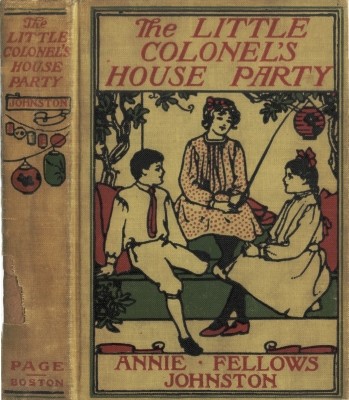
The Project Gutenberg eBook of The Little Colonel's House Party
Title: The Little Colonel's House Party
Author: Annie F. Johnston
Release date: May 2, 2005 [eBook #15741]
Most recently updated: December 14, 2020
Language: English
Credits: E-text prepared by Juliet Sutherland, Emmy, and the Project Gutenberg Online Distributed Proofreading Team
E-text prepared by Juliet Sutherland, Emmy,
and the Project Gutenberg Online Distributed Proofreading Team
(www.pgdp.net)
THE
LITTLE COLONEL'S™ HOUSE
PARTY
BY
ANNIE FELLOWS JOHNSTON
AUTHOR OF
THE LITTLE COLONEL, TWO LITTLE
KNIGHTS OF KENTUCKY,
THE STORY OF DAGO, ETC.
Illustrated by
LOUIS MEYNELL
BOSTON
L.C. PAGE AND COMPANY
PUBLISHERS
1907
Colonial Press
Electrotyped and Printed by C.H. Simonds & Co.
Boston. Mass., U.S.A.
Works of
Annie Fellows Johnston
The Little Colonel Series
(Trade Mark, Reg. U.S. Pat. Of.)
Each one vol., large 12mo, cloth, illustrated The Little Colonel Stories $1.50
(Containing in one volume the three stories, "The Little Colonel," "The Giant Scissors," and "Two Little Knights of Kentucky.")
| The Little Colonel's House Party | 1.50 |
| The Little Colonel's Holidays | 1.50 |
| The Little Colonel's Hero | 1.50 |
| The Little Colonel at Boarding-School | 1.50 |
| The Little Colonel in Arizona | 1.50 |
| The Little Colonel's Christmas Vacation | 1.50 |
| The Little Colonel: Maid of Honor | 1.50 |
| The above 8 vols.,boxed | 12.00 |
Illustrated Holiday Editions
Each one vol., small quarto, cloth, illustrated, and printed in color
| The Little Colonel | $1.25 |
| The Giant Scissors | 1.25 |
| Two Little Knights of Kentucky | 1.25 |
| The above 3 vols.,boxed | 3.75 |
Cosy Corner Series
Each one vol., thin 12mo, cloth, illustrated
| The Little Colonel | $.50 |
| The Giant Scissors | .50 |
| Two Little Knights of Kentucky | .50 |
| Big Brother | .50 |
| Ole Mammy's Torment | .50 |
| The Story of Dago | .50 |
| Cicely | .50 |
| Aunt 'Liza's Hero | .50 |
| The Quilt that Jack Built | .50 |
| Flip's "Islands of Providence" | .50 |
| Mildred's Inheritance | .50 |
Other Books
| Joel: A Boy of Galilee | $1.50 |
| In the Desert of Waiting | .50 |
| The Three Weavers | .50 |
| Keeping Tryst | .50 |
| Asa Holmes | 1.00 |
| Songs Ysame (Poems, with Albion Fellows Bacon) | 1.00 |
L.C. PAGE & COMPANY
200 Summer Street Boston, Mass.
"MALCOLM WENT ON CUTTING."
(See page 137.)
CONTENTS.
| CHAPTER | PAGE | |
| I. | The Invitations Are Sent | 11 |
| II. | "One Flew into the Cuckoo's Nest" | 25 |
| III. | "One Flew East" | 39 |
| IV. | "One Flew West" | 50 |
| V. | Betty Reaches the "House Beautiful" | 62 |
| VI. | The Enchanted Necklace | 81 |
| VII. | Bits from Betty's Diary | 96 |
| VIII. | The Gypsy Fortune-teller | 110 |
| IX. | Her Sacred Promise | 128 |
| X. | Found Out | 150 |
| XI. | Some Stories and a Poem | 171 |
| XII. | A Pillow-case Party | 189 |
| XIII. | More Measles | 205 |
| XIV. | A Long Night | 216 |
| XV. | "The Road of the Loving Heart" | 233 |
| XVI. | A Feast of Lanterns | 248 |
LIST OF ILLUSTRATIONS.
| PAGE | |
| "Malcolm went on cutting" | Frontispiece |
| "'Oh, run and get it, quick, Davy,' she cried" | 35 |
| "She sorted the ribbons and examined the gloves" | 59 |
| "Betty began the story" | 83 |
| "'I'm glad that I don't have to live in the country the year round!'" | 110 |
| "There was one wild scream after another" | 167 |
| "'But we caught the chickens and brought them back!'" | 228 |
| "'Let's all sit down on the steps'" | 255 |
THE LITTLE COLONEL'S™; HOUSE
PARTY.
CHAPTER I.
THE INVITATIONS ARE SENT.
Down the long avenue that led from the house to the great entrance gate came the Little Colonel on her pony. It was a sweet, white way that morning, filled with the breath of the locusts; white overhead where the giant trees locked branches to make an arch of bloom nearly a quarter of a mile in length, and white underneath where the fallen blossoms lay like scattered snowflakes along the path.
Everybody, in Lloydsboro Valley knew Locust. "It is one of the prettiest places in all Kentucky," they were fond of saying, and every visitor to the Valley was taken past the great entrance gate to admire the long rows of stately old trees, and the great stone house at the end, whose pillars gleamed white through the Virginia creeper that nearly covered it.
Everybody knew old Colonel Lloyd, too, the owner of the place. He also was often pointed out to the summer visitors. Some people called attention to him because he was an old Confederate soldier who had given his good right arm to the cause he loved, some because they thought he resembled Napoleon, and others because they had some amusing tale to tell of the eccentric things he had said or done.
Nearly every one who pointed out the imposing figure, which was clad always in white duck or linen in the summer, and wrapped in a picturesque military cape in winter, added the remark: "And he is the Little Colonel's grandfather." To be the grandfather of such an attractive little bunch of mischief as Lloyd Sherman was when she first came to the Valley was a distinction of which any man might well be proud, and Colonel Lloyd was proud of it. He was proud of the fact that she had inherited his lordly manner, his hot temper, and imperious ways. It pleased him that people had given her his title of Colonel on account of the resemblance to himself. She had outgrown it somewhat since she had first been nicknamed the Little Colonel. Then she was only a spoiled baby of five; but now his pride in her was even greater, since she had grown into a womanly little maid of eleven. He was proud of her delicate, flower-like beauty, of her dainty ways, and all her little schoolgirl accomplishments.
"She is like those who have gone before," he used to say to himself sometimes, pacing slowly back and forth under the locusts; and the bloom-tipped branches above would nod to each other as if they understood. "Yes-s, yes-s," they whispered in the soft lisping language of the leaves, "we know! She's like Amanthis,—sweet-souled and starry-eyed; we were here when you brought her home, a bride. She's like Amanthis! Like Amanthis!"
Under the blossoms rode the Little Colonel, all in white herself this May morning, except the little Napoleon hat of black velvet, set jauntily over her short light hair. Into the cockade she had stuck a spray of locust blossoms, and as she rode slowly along she fastened a bunch of them behind each ear of her pony, whose coat was as soft and black as the velvet of her hat. "Tarbaby" she called him, partly because he was so black, and partly because that was the name of her favourite Uncle Remus story.
"There!" she exclaimed, when the flowers were fastened to her satisfaction. "Yo' lookin' mighty fine this mawnin', Tarbaby! Maybe I'll take you visitin' aftah I've been to the post-office and mailed these lettahs. You didn't know that Judge Moore's place is open for the summah, did you, and that all the family came out yesta'day? Well, they did, and if Bobby Moore isn't ovah to my house by the time we get back home, we'll go ovah to Bobby's."
As she spoke, she passed through the gate at the end of the avenue and turned into the public road, a wide pike with a railroad track on one side of it and a bridle-path on the other. Two minutes' brisk canter brought her to another gate, one that had been closed all winter, and one that she was greatly interested in, because it led to Judge Moore's house. Judge Moore was Rob's grandfather, and she and Rob had played together every summer since she could remember.
The wide white gate was standing open now, and she drew rein, peering anxiously in. She hoped for the sight of a familiar freckled face or the sound of a welcoming whoop. But it was so still everywhere that all she saw was the squirrels playing hide and seek in the beech-grove around the house, and all she heard was the fearless cry, "Pewee! pewee!" of a little bird perched in a tree overarching the gate. It balanced itself on the limb, leaning over and cocking its bright bead-like eyes at her, as if admiring the sight.
What it saw was a slender girl of eleven, taller than most children of that age, and more graceful. There was a colour in her cheek like the delicate pink of a wild rose, and the big hazel eyes had a roguish twinkle in them, as they looked out fearlessly on the world from under the little Napoleon hat with its nodding cockade of locust blossoms.
"There's nobody in sight, Tarbaby," said the Little Colonel, "and there isn't time to go in befo' we've been to the post-office, so we might as well be travellin' on."
She was turning slowly away when down the pike behind her came the quick beat of a horse's hoofs and a shrill whistle. A twelve-year-old boy was riding toward her as fast as his big gray horse could carry him. He was riding bareback, straight and lithe as a young Indian, his cap pushed to the back of his head. He snatched it off with a flourish as he came within speaking distance of the Little Colonel, his freckled face all ashine with pleasure.
"Hello! Lloyd," he called, "I was just going to your house."
"And I was looking for you, Bobby," she answered, as informally as if it were only yesterday they had parted, instead of eight months before.
"Come and go down to the post-office with me. I must take these lettahs."
"All right," said Rob, wheeling the gray horse around beside the black pony, and smiling broadly as he looked down into the Little Colonel's welcoming eyes. "You don't know how good it feels to get back to the country again, Lloyd. I could hardly wait for school to close, when I'd think about the fish waiting for me out here in the creek, and the wild strawberries getting ripe, and the horses just spoiling to be exercised. It was more than I could stand. What have you been doing all winter?"
"Oh, the same old things: school and music lessons, and good times in the evenin' with mothah and papa Jack and grandfathah."
As they jogged along, side by side, the Little Colonel chatting gaily of all that had happened since their last meeting, Rob kept casting curious glances at her. "What have you been doing to yourself, Lloyd Sherman?" he demanded, finally. "You look so—so different!" There was such a puzzled expression in his sharp gray eyes that the Little Colonel laughed. Then her hand flew up to her head.
"Don't you see? I've had my hair cut. I had to beg and beg befo' mothah and papa Jack would let me have it done; but it was so long,—away below my waist,—and such a bothah. It had to be brushed and plaited a dozen times a day."
"I don't like it that way. It isn't a bit becoming," said Rob, with the frankness of old comradeship. "You look like a boy. Why, it is as short as mine."
"I don't care," answered Lloyd, her eyes flashing dangerously. "It's comfortable this way, and grandfathah likes it. He says he's got his Little Colonel back again now, and he sent to town for this Napoleon hat like the ones I used to weah when I was a little thing."
"When you were a little thing!" laughed Rob, teasingly. "What do you think you are now, missy? You're head and shoulders shorter than I am."
"I'm eleven yeahs old, anyway, I'd have you to undahstand, Bobby Moore," answered the Little Colonel, with such dignity that Rob wished he hadn't spoken. "I was eleven last week. That was one of my birthday presents, havin' my own way about cuttin' my hair, and anothah was the house pahty. Oh, you don't know anything about the house pahty I'm to have in June, do you!" she cried, every trace of displeasure vanishing at the thought. "Grandfathah and papa Jack are goin' away fo' a month to some mineral springs in Va'ginia, and I'm to have my house pahty in June to keep mothah and me from bein' lonesome. It will not be a very big one, only three girls to spend June with me, but mothah says we can have picnics every day if we want to, and invite all the boys and girls in the Valley, and we can have the house full from mawnin' till night. I'll invite you right now for every day that you want to come. We'll expect you at all the pahties and picnics and candy-pullin's that we have. I want you to help me give the girls a good time, Bobby."
Rob whirled his cap around his head with a "Whe-ew! Jolly for you!" before he answered more politely, "Thank you, Lloyd, you can count on me for my part. I'll be on hand every time you turn around, if you want me. Who all's coming?"
For answer Lloyd held up the three letters she was carrying, and let him see the first address, written in Mrs. Sherman's flowing hand.
| Miss Eugenia Forbes, |
| The Waldorf-Astoria, |
| New York City. |
"Well, who is she?" he asked, reading it aloud.
"Eugenia is a sort of cousin of mine," explained Lloyd. "At least her fathah and my fathah are related in some way. I used to know her when we lived in New York, but I haven't seen her since we left. I was five then and she was seven, so she must be neahly thirteen yeahs old now. When we played togethah she would scream and scream if I didn't give up to her in everything, and as I had a bad tempah, too, we were always fussin'. She was dreadfully spoiled. I'll nevah fo'get how my hand bled one day when she bit it, or how she clawed my face till it looked as if a tigah had scratched it."
"Then what did you do?" asked Rob, with a grin. He had experimented with Lloyd's temper himself in the past.
"I believe that that was the time I pounded her on the back with my little red chair," answered Lloyd, laughing at the recollection. "Or maybe it was the time I banged her ovah the head with a toy teakettle. I remembah I did both those bad things, and that we were always in trouble whenevah we were togethah. I didn't want mothah to invite her, but she said she felt that we ought to. Eugenia's mothah is dead. She died three yeahs ago, and since then she's been kept in a boa'din' school most of the time. When she's not away at school she stays in some big hotel with her fathah, eithah in New York or at some summah resort. He is always so busy there's no one to pay any attention to her but her maid. They are very wealthy, and Eugenia has had the best of everything so long that I'm afraid she'll find the Valley dreadfully poah and poky. I imagine she's stuck up, too. She used to be, and she's always had her own way about everything."
"Number one doesn't sound very inviting," said Rob, with a sour grimace. "Who is your number two?" Lloyd held out the second envelope.
| Miss Joyce Ware, |
| Plainsville, |
| Kansas. |
"I nevah saw her," said Lloyd, "but I feel as if we had always been old friends. Her mothah and mine used to go to school togethah heah in Lloydsboro Valley at the Girls' College, and they've written to each othah once a month for fifteen yeahs. Mrs. Ware is a widow now, and they have ha'd times, for they are poah, and she has foah children youngah than Joyce. But Joyce has had lots of things that neithah Eugenia nor I have had. Last yeah her cousin Kate took her abroad with her, and she studied French, and she had lots of beautiful times where they spent the wintah in France. Mrs. Ware sent some of the lettahs to mothah that Joyce wrote. One was about a Christmas tree that they gave to thirty little peasant children,—and so many queer things happened behind a gate that they called the 'Gate of the Giant Scissahs,' because there was a pair of enormous scissahs hanging ovah it, you know. Oh, it was just like a fairy tale, all the things that Joyce did when she was in Touraine."
"How old is she?" interrupted Rob.
"Just Eugenia's age, I believe, and she must be an interestin' sort of girl, for she draws beautifully. Mothah says that her sketches are fine, and that Joyce will be a real artist when she is grown."
"Number two is all right," said Rob, with an approving nod. "Next!" The Little Colonel held out the third envelope.
"One flew east and one flew west, so I s'pose this will fly into the cuckoo's nest," said Rob, as he read the address:
| Miss Elizabeth Lloyd Lewis, |
| Jaynes's Post-office, |
| Kentucky. |
"Why, that's just what mothah calls the place," cried the Little Colonel, "the cuckoo's nest! She says that the cuckoo is the most careless bird in the world about the way it builds its nest. They weave a few twigs and sticks togethah just in any kind of way, and nevah mind a bit if their poah little young ones fall out of the nest. They seem to think that any kind of home is good enough, and that is the kind of a home that Elizabeth Lewis has. She is a poah little orphan, and is livin' on a farm up Green Rivah. Mother is her godmothah. That's why she is named Elizabeth Lloyd. Mrs. Lewis was an old school friend of mothah's, too, and she wants Joyce and Elizabeth and me to be as deah friends as she and Emily Ware and Joyce Lewis were, she says. That's why she invited them."
"And you don't know anything about this one?" questioned Rob.
"Not a thing. I shouldn't be su'prised if she's mighty countrified, for the farm is several miles from a railroad, and the people she lives with don't think of anything but work, yeah in and yeah out."
They had reached the post-office by this time, and Rob held out his hand for the letters. "I'll put them in for you," he said. Then, dropping them into the box, one by one, he repeated the rhyme:
| "One flew east and one flew west. |
| And one flew into the cuckoo's nest." |
Lloyd added, quickly:
| "Eugenia, Joyce, or Elizabeth, |
| Which of the three shall we like best?" |
"Joyce," said Rob, promptly.
"I think so, too," agreed the Little Colonel, stooping to fasten the locust blossoms more securely behind the pony's ears.
"Well, the invitations are off now. Come on, Tarbaby, and see if you can't beat Bobby Moore's old gray hawse so bad it will be ashamed to evah race again."
With that the little black pony was off like an arrow toward Locust, with the big gray horse thundering hard at its heels.
The dust flew, dogs barked, and chickens ran squawking across the road out of the way. Heads were thrust out of the windows as the two vanished up the dusty pike, and an old graybeard loafing in front of the corner grocery gave an amused chuckle. "Beats all how them two do get over the ground," he said. "They ride like Tarn O'Shanter, and I'll bet a quarter there's nothing on earth that either of 'em are afraid of."
A little while later the three white envelopes were jogging sociably along, side by side in a mail-bag, on their way to Louisville. But their course did not lie together long. In the city post-office they were separated, and sent on their different ways, like three white carrier-pigeons, to bid the guests make ready for the Little Colonel's house party.
CHAPTER II.
"ONE FLEW INTO THE CUCKOO'S NEST."
The letter for Jaynes's Post-office reached the end of its journey first. It wasn't much of a post-office; only an old case of pigeon-holes set up in one corner of a cross-roads store. A man riding over from the nearest town twice a week brought the mail-bag on horseback. So few letters found their way into this, particular bag that Squire Jaynes, who kept the store and post-office, felt a personal interest in every envelope that passed through his hands.
"Miss Elizabeth Lloyd Lewis," he spelled aloud, examining the address through his square-bowed spectacles with a critical squint. "Now, who under the canopy might she be?"
There was no one in the store to answer the question but an overgrown boy who had stopped to get his father's weekly paper. He sat on the counter dangling his big bare feet against a nail-keg, and catching flies in his sunburned hands, while he waited for the mail to be opened.
The squire peered inquiringly at him over the square-bowed spectacles. "Jake," he asked, "ever hear tell of a Miss Elizabeth Lloyd Lewis up this way?"
"Wy, sure!" drawled the boy. "That's Betty. The Appletons' Betty. Don't you know? She's that little orphan they're a-bringin' up. I worked there a while this spring, a-plowin'."
"Hump!" grunted the squire, slipping the letter into the pigeon-hole marked "A." "If that's who it is, I know all about her. Precious little bringing up she'll get at the Appletons', I can tell you that. They keep her because they're her nearest of living kin, which isn't very near, after all; fourth or fifth cousins to her father, or something like that. Any-how, they're all she's got, and her father made some arrangement with them before he died. Left a little money to pay her board, they say, but I've heard she works just the same as if she was living on charity."
"That's the truth," said Jake; "she does. Talk about bringin' up. She doesn't get any of it. Mrs. Appleton has her hands so full of cookin' for farm hands and all, that she can't half tend to her own children, let alone anybody else's. It's Betty that 'pears to be bringin' up the little Appletons."
"I'm glad there's somebody takes enough interest in the child to write to her," continued the gossipy old squire, who often talked to himself when he could find no other audience. "I wonder who it is. Lloydsboro Valley it's postmarked. Wish she'd happen down here. I'd ask her who it's from."
Jake got up, dragged his bare feet across the floor, and leaned lazily on the counter as he reached for his paper.
"Little Betty will be mighty proud to get a real shore 'nuff letter all for herself. I never got one in my life. I'll take it up to her, squire, if you say so. I'm goin' by the Appletons' on my way home."
"Reckon you might as well," answered the old man, giving a final close scrutiny before handing it to the boy. "It might lie here all week in case none of them happened to come to the store, and it looks as if it might be important."
Jake slipped the letter into the band of his broad-brimmed straw hat and slouched lazily out of the store. An old blaze-faced sorrel horse whinnied as he stepped up to untie it. Jake mounted and rode off slowly, his bare feet dangling far below the stirrups. It was two miles to the Appleton farm, down a hot, dusty road, and he took his time in going. Well for little Betty that she did not know what wonderful surprise was on its way to her, or she would have been in a fever of impatience for the letter to arrive.
It had been a tiresome day for the child. Up before five, in her bare little room in the west gable, busy with morning chores until breakfast was ready, she had earned a rest long before the Little Colonel's day had begun. Afterward she had helped with the breakfast dishes and had taken her turn at the butter-making in the spring-house, thumping the heavy dasher up and down in the cedar churn until her arms ached. But it was cool and pleasant down in the spring-house with the water trickling out in a ceaseless drip-drip on the cold stones. She dabbled her fingers in the spring for a long time when the churning was done, wishing she had nothing to do but sit there and listen to the secrets it was trying to tell. Surely it must have learned a great many on its underground way among the roots of things, and all else that lies hidden in the earth.
But she could not loiter long. There was the dinner-table to set for the hungry farm-hands, and after the dinner was over more dishes to wash. Then there were some towels to iron. It was two o'clock before her work was all done, and she had time to go up to her little room in the west gable.
The sun poured in through the shutterless windows so fiercely that she did not stay long,—only long enough to put on a clean apron and brush her curly hair, as she stood in front of the little looking-glass. It was such a tiny mirror that she could see only a part of her face at a time. When her big brown eyes, wistful and questioning as a fawn's, were reflected in it, there was no room for the sensitive little mouth. Or if she stood on tiptoe so that she could see her plump round chin, dimpled cheeks, and white teeth, the eyes were left out, and she could see no more of her inquisitive little nose than lay below the big freckle in the middle of it.
Hastily tying back her curls with a bow of brown ribbon, she slipped on her apron, and ran down-stairs, buttoning it as she went. She was free now to do as she pleased until supper-time. Once out of the house, she walked slowly along through the shady orchard, swinging her sunbonnet by the strings. After the orchard came the long leafy lane, with its double rows of cherry-trees, and then the gate at the end, leading into the public highway.
As she slipped her hand around the post to unfasten the chain that held the gate, little bare feet came pattering behind her, and a shrill voice called: "Wait, Betty, wait a minute!" It was Davy Appleton. Betty's little lamb, they called him, and Betty's shadow, and Betty's sticking-plaster, because everywhere she went there was Davy just at her heels.
All the Appleton children were boys,—three younger and two older than Davy, whose last birthday cake should have had eight candles if there had been any celebration of the event. But there never had been a birthday cake with candles on it on the Appleton table. It would have been considered a foolish waste of time and money, and birthdays came and went sometimes, without the children knowing that they had passed.
Davy was a queer little fellow. He tagged along after Betty, switching at the grass with a whip he carried, never saying a word after that first eager call for her to wait. The two never tired of each other. He was content to follow and ask no questions, for he had learned long ago to look twice before he spoke once. As he caught up with her at the gate, he did not even ask where she was going, knowing that he would find out in due time if he only followed far enough.
He did not have to follow far to-day. Betty led the way across the road to a plain little wooden church, set back in a grove of cedar-trees. Behind the church was a graveyard, where they often strolled on summer afternoons, through the tangle of grass and weeds and myrtle vines, to read the names on the tombstones and smell the pinks and lilies that struggled up year after year above the neglected mounds. But that was not their errand to-day. A little red bookcase inside the church was the attraction. Betty had only lately discovered it, although it had stood for years on a back bench in a cobwebby corner.
It held all that was left of a scattered Sunday-school library, that had been in use two generations before. Queer little books they were, time-yellowed and musty smelling, but to story-loving little Betty, hungry for something new, they seemed a veritable gold-mine. She had found that no key barred her way into this little red treasure-house of a bookcase, and a board propped against the wall under the window outside gave her an easy entrance into the church. Here she came day after day, when her work was done, to pore over the musty old volumes of tales forgotten long ago.
In Betty's little room under the roof at home was a pile of handsomely bound books, lying on a chest beside her mother's Bible. They were twelve in all, and had come in several different Christmas boxes, and each one had Betty's name on the fly-leaf, with the date of the Christmas on which it happened to be sent. Underneath was always written: "From your loving godmother, Elizabeth Lloyd Sherman."
Excepting a few school-books and some out-of-date census reports, they were the only books in the Appleton house. Betty guarded them like a little dragon. They were the only things she owned that the children were not allowed to touch. Even Davy, when he was permitted to look at the wonderful pictures in her "Arabian Nights," or "Pilgrim's Progress," or "Mother Goose," had to sit with his hands behind his back while she carefully turned the leaves. Besides these three, there was "Alice in Wonderland," and "Æsop's Fables," there was "Robinson Crusoe," and "Little Women," and two volumes of fairy tales in green and gold with a gorgeous peacock on the cover. Eugene Field's poems had come in the last box, with Riley's "Songs of Childhood" and Kipling's jungle tales. Twelve beautiful books, all of Mrs. Sherman's giving, and they were like twelve great windows to Betty, opening into a new strange world, far away from the experiences of her every-day life.
She had read them over and over so many times that she always knew what was coming next, even before she turned the page; and she had read them to the other children so many times that they, too, knew them almost by heart.
The little dog-eared books in the meeting-house proved poor reading sometimes after such entertainment. So many of them were about unnaturally good children who never did wrong, and unnaturally bad children who never did right. At the end there was always the word MORAL, in big capital letters, as if the readers were supposed to be too blind to find it for themselves, and it had to be put directly across the path for them to stumble over.
Betty laughed at them sometimes, but she touched the little books with reverent fingers, when she remembered how old they were, and how long ago their first childish readers laid them aside. The hands that had held them first had years before grown tired and wrinkled and old, and had been lying for a generation under the myrtle and lilies of the churchyard outside.
Many an afternoon she had spent, perched in the high window, with her feet drawn up under her on the sill, reading aloud to Davy, who lay outside on the grass, staring up at the sky. Davy's short fat legs could not climb from the board to the window-sill, and since this little Mahomet could not come to the mountain, Betty had to carry the mountain to him.
The reading was slow work sometimes. Davy's mind, like his legs, could not climb as far as Betty's, and she usually had to stop at the bottom of every page to explain something. Often he fell asleep in the middle of the most interesting part, and then Betty read on to herself, with nothing to break the stillness around her but the buzzing of the wasps, as they darted angrily in and out of the open window above her head.
To-day Betty had read nearly an hour, and Davy's eyelids were beginning to flutter drowsily, when they heard the slow thud of a horse's hoofs in the thick dust of the road. Betty stopped reading to listen, and Davy sat up to look.
"It's Jake," he announced, recognising the boy who had helped his father with the ploughing.
"Hope he won't see us," said Betty, in a low tone, drawing in her head. "We are not hurting anything, but maybe some of the church people wouldn't like it, if they knew I climbed in at the window. They might think it wasn't respectful."
"He's looking this way," said Davy, who had stood up for a better view, but squatted down again at Betty's command.
It was too late. Jake had recognised Davy's shock of yellow hair, and called out, good-naturedly, "Hello, stickin'-plaster, where's Betty? Somewhere around here, I'll bet anything, or you wouldn't be here. I've got a letter for her."
"OH, RUN AND GET IT, QUICK, DAVY,' SHE CRIED."
At that, Betty leaned so far out of the window that she nearly lost her balance and toppled over. "Oh, run and get it, quick, Davy," she cried. The little bare feet twinkled through the grass to meet the old sorrel horse, and two brown hands were held up to receive the letter; but Jake preferred to deliver the important document himself.
"Here you are," he said, riding alongside the window and dropping the letter into her eager hands.
"Oh, thank you, Jake," she cried. "It makes me feel as if Christmas was coming. I never got a letter in my life except in my Christmas boxes. My godmother always writes to me then, and this must be from her, too. Yes, it is, I know her handwriting."
If Jake expected her to tear it open instantly and share the news with him before she had examined every inch of the big square envelope, he was disappointed. The old blaze-faced sorrel had carried him out of sight before she had finished cutting it open with a pin. Then she spread the letter out on her knees, drawing a long breath of pleasure as the faintest odour of violets floated up from the paper with its dainty monogram at the top.
Davy waited in silence, watching a flush spread over Betty's face as she read. Her breath came short and her heart beat fast.
"Oh, Davy," she exclaimed, in a low, wondering tone. "What do you think? It is an invitation to a house party at Locust; Lloyd Sherman's house party. Oh, it's like a lovely, lovely fairy tale with me for the princess. I've never travelled on the cars since I was old enough to remember it, and they've sent passes for me to go. I've never had any girls to play with in all my life, and now there will be two besides Lloyd; and, oh, Davy, best of all, I'll see my beautiful, beautiful godmother! I shall be there a whole month, and she knew my mamma and was her dearest friend. I haven't seen her since I was a baby, when she came to my christening, and of course I can't remember anything about that."
Davy listened to her raptures without saying anything for awhile. Then he set aside his usual custom and asked a question. "Why are you crying?" he demanded. "There's a tear running down the side of your nose."
"Is there?" asked Betty, brushing it away with the back of her hand. "I didn't know it. Maybe it's because I am so glad. It seems as if I was going back to my own family; to somebody who really belongs to you more than just fourth cousins, you know. A godmother must be the next best thing to a real mother, you see, Davy, because it's a mother that God gives you to take the place of your own, when she is gone. Oh, let's hurry home and tell Cousin Hetty."
Slipping from the window-sill to the floor, she carried the book she had been reading back to its corner in the little red bookcase, and shut it up with the musty volumes inside. Then she walked slowly down the narrow aisle of the little meeting-house, between its double rows of narrow straight-backed pews. As she reached the bench-like altar, extending in front of the pulpit, she slipped to her knees a moment. Her sunbonnet had fallen back from her tousled curls, and the late afternoon sun streamed across her shining little face.
"Thank you, God," came in a happy whisper from the depths of a glad little heart. "It's the nicest surprise you ever sent me, and I'm so much obliged."
Then Betty stood up and put on her sunbonnet. The next moment she had scrambled over the sill, pulled the window down after her, and walked down the slanting board to the ground. Catching Davy by the hand, and swinging it back and forth as they ran, she went skipping across the road regardless of the dust. Down the lane they went, between the rows of cherry-trees; across the orchard and up the path. Somehow the world had never before seemed half so beautiful to Betty as it did now. The May skies had never been quite so blue, or the afternoon sunshine so heavenly golden. She sang as she went, swinging Davy's warm little hand in hers. It was only one of Mother Goose's old melodies, but she sang it as a bird sings, for sheer gladness: