
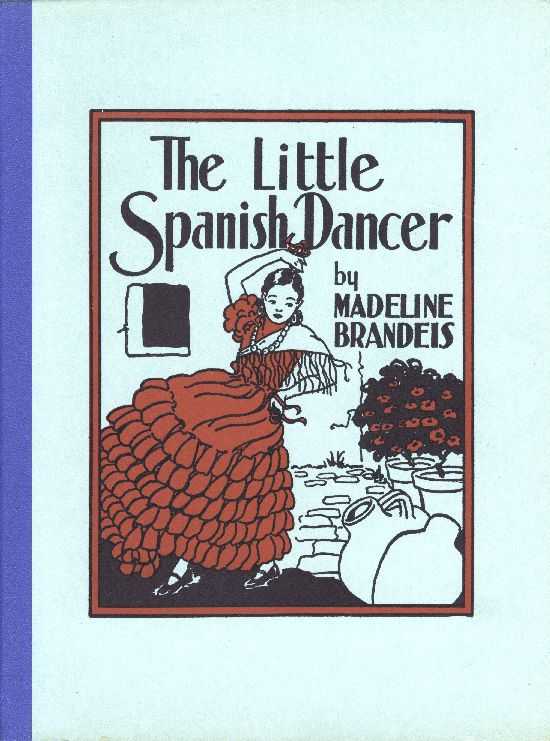
The Project Gutenberg eBook of The Little Spanish Dancer
Title: The Little Spanish Dancer
Author: Madeline Brandeis
Release date: August 28, 2012 [eBook #40592]
Most recently updated: October 23, 2024
Language: English
Credits: Produced by Juliet Sutherland, Matthias Grammel and the
Online Distributed Proofreading Team at http://www.pgdp.net
THE LITTLE
SPANISH DANCER
| A STREET IN SEVILLE |
The LITTLE SPANISH DANCER BY MADELINE BRANDEIS Photographic Illustrations GROSSET & DUNLAP PUBLISHERS NEW YORK by arrangement with the A. Flanagan Company |
|
COPYRIGHT, 1936, BY A. FLANAGAN COMPANY PRINTED IN THE UNITED STATES OF AMERICA |
| An International Dedication to AILEENY My "Parisian" Sister, Her "Rumanian" Husband, and the Memory of the "Russian" Ballet Dancing Which She Used To Do in "America" When She Was the Age of Little "Spanish" Pilar! NOTE The photographs in this book were taken in Spain by the author. The character of "The Little Spanish Dancer" is portrayed by Pilar Herrera, of Seville, a charming little girl, whom we wish to thank for helping to decorate this book. |
CONTENTS
| PAGE | |
| Chapter I | |
| The Magic Castanets | 9 |
| Chapter II | |
| An Old Red Cape | 20 |
| Chapter III | |
| In Old Cadiz (A Legend of the Castanets) | 32 |
| Chapter IV | |
| The Souvenirs Speak | 44 |
| Chapter V | |
| In Old Granada (A Legend of the Castanets) | 61 |
| Chapter VI | |
| Another Visit to Juan | 71 |
| Chapter VII | |
| Four Old Paintings | 77 |
| Chapter VIII | |
| Fiesta | 89 |
| Chapter IX | |
| The Mystery of the Young Prince | 100 |
| Chapter X | |
| A Stout Sweetheart | 115 |
| Chapter XI | |
| Dance of the Six (A Legend of the Castanets) | 123 |
| Chapter XII | |
| Pilar's Grandfather Remembers | 134 |
| Chapter XIII | |
| Bullfight in Madrid (A Legend of the Castanets) | 138 |
| Chapter XIV | |
| Where Is Pilar? | 156 |
| Chapter XV | |
| A Stranger Arrives | 163 |
| Pronouncing Vocabulary | 175 |
LIST OF ILLUSTRATIONS
| PAGE | |
| A STREET IN SEVILLE | 2 |
| THE LITTLE SPANISH DANCE | 8 |
| DANCING IN A PUBLIC SQUARE, SEVILLE | 11 |
| WHEN PILAR WAS LITTLE | 14 |
| PILAR KNELT DOWN BESIDE THE CHEST | 17 |
| GIRALDA TOWER, SEVILLE | 19 |
| STREET OF THE SERPENTS | 21 |
| ALCAZAR GARDENS, SEVILLE | 25 |
| JUAN, THE SHOPKEEPER | 27 |
| SEVILLE | 29 |
| CADIZ | 33 |
| STREET OF THE SERPENTS | 36 |
| ALCAZAR GARDENS, SEVILLE | 40 |
| SEVILLE | 43 |
| HOW COULD SHE GIVE THEM UP? | 46 |
| PUERTO DEL SOL, TOLEDO | 49 |
| BARCELONA | 51 |
| TOMB OF THE CHILDREN, EL ESCORIAL | 54 |
| PILAR LOOKED AT THE FAN | 56 |
| GYPSIES, GRANADA | 60 |
| GENERALIFE GARDENS, ALHAMBRA | 62 |
| BOABDIL SURRENDERING TO FERDINAND | 66 |
| GRANADA | 68 |
| POTTERY SHOP, TRIANA | 74 |
| COURT OF DOLLS, ALCAZAR | 76 |
| PILAR | 78 |
| SALAMANCA | 82 |
| ST. TERESA CONVENT, AVILA | 84 |
| PILAR IN HER COSTUME | 90 |
| THE MOSQUE, CORDOBA | 92 |
| ANDALUSIAN HAT | 93 |
| A FIELD NEAR CORDOBA | 95 |
| A DOUGHNUT STAND | 97 |
| AVILA | 103 |
| PARK IN MADRID, STATUE OF KING ALFONSO | 107 |
| BURGOS CATHEDRAL | 109 |
| MIRAFLORES MONASTERY, BURGOS | 112 |
| TOMBS OF FERDINAND AND ISABELLA, GRANADA CATHEDRAL | 114 |
| GIRL-DRAPED BALCONIES | 117 |
| GIBRALTAR | 120 |
| ALHAMBRA | 122 |
| DANCE OF THE SIX, SEVILLE CATHEDRAL | 125 |
| BOYS PLAYING BULLFIGHT | 136 |
| BULLFIGHT, MADRID | 137 |
| MADRID | 144 |
| DOÑA ISABEL CORBO DE PORCEL | 147 |
| BULLFIGHT, MADRID | 151 |
| THE PRADO, MADRID | 155 |
| TOLEDO | 159 |
| BULLFIGHT, TRIANA BRIDGE, SEVILLE | 162 |
| A NET MAKER, SEVILLE | 166 |
| TOLEDO | 169 |
| PILAR AND HER GRANDFATHER | 172 |
| THE LITTLE SPANISH DANCER |
The Little Spanish Dancer
THE MAGIC CASTANETS
Pilar was dancing in the Murillo (mū̍-rĭl´ō) Garden. It was a beautiful public garden named after the great Spanish painter, Murillo, who died in a house near by.
Pilar had been born ten years ago in this old city of Seville (sē̍-vĭl´). If you had asked Pilar, "Where is New York?" she would doubtless have laughed with her lovely dark eyes and inquired, "Is it in Seville?" Because, to Pilar, as to most of her friends, there was only one world, and that world was Seville.
Now a terrible thing was happening at Pilar's home this evening. But Pilar did not know it because she was dancing in the garden. Every night, after her grandfather went to bed, she ran off and danced with her friends to the music of a hurdy-gurdy.
But tonight, after Pilar had left, her grandfather had been taken very ill. The neighbors had sent for a doctor, who shook his head gravely over the poor old man.
Pilar knew nothing about this as she clicked her castanets and whirled about in the dance they call the Sevillana.
She was one of the best dancers in her group. And why not? Her mother had been a dancer; her grandmother, too, yes, and her great-grandmother and her great-great—oh, ever so many great-grandmothers! They had all been dancers.
Pilar's parents had died when she was a baby. She lived alone with her grandfather, and they struggled to keep the wolf named Hunger from their door. Her grandfather was a shoemaker, but he worked slowly these days because his hands were old.
| DANCING IN A PUBLIC SQUARE, SEVILLE |
Once when Pilar was very little, someone had asked her what pleasures she enjoyed most. She had answered, "The pleasures I enjoy most are—dancing!"
Now this could easily be the answer of every little girl in southern Spain. For while Italy sings, France designs, and Switzerland skates, Spain dances. Why, it is even possible that little girls in Seville would rather dance than go to moving picture shows!
Yet everyone in Seville does not feel that way, for the many open air theaters all over the city are crowded. And what the people seem to like best are the American comedies.
It was growing late, but Pilar seldom went to bed before midnight. She would have told you that evening was the time to live and to laugh and to dance. Then it was cool, while during the day the sun beat down cruelly and people slept for hours.
Through the narrow streets Pilar made her way home at last. She heard little snatches of song from the throats of strollers.
Everyone strolls in Seville; there is no hurry. Nearly everyone sings; there is no worry. Hurry and worry are as much out of place in this city as a woman's hat shop. For white flowers and black lace shawls take the place of hats in Seville.
Pilar hummed to herself as she walked along. Some day she would grow up to be a great dancer like her mother and—
What was that? A light in her house? She looked through the window and saw the doctor bending over her grandfather's bed.
Pilar caught her breath. Then she rushed indoors and ran straight to her grandfather's bedside. Sinking down on her knees, she burst into tears.
"Oh, Grandfather!" she cried. "You are ill! Dear Grandfather, what is the matter?"
The doctor smoothed her soft, black hair and raised her to her feet.
"There, now, my child," he said. "You must not cry. You will only make your grandfather worse. He will get well if you will do what I tell you."
"What—what is that, doctor?" Poor Pilar was trembling.
"You must buy and cook good, nourishing food for him," said the doctor. "And give him the medicines which I order."
Now Pilar's eyes were full of terror. "But, oh, doctor," she cried. "I cannot do that. We have no money."
"No money?" The doctor looked at her pityingly.
"We live by what Grandfather makes when he can work," said Pilar. "Now that he cannot work, there will be no money."
The doctor said, "Um-m" and stroked his beard. Then he asked, "Have you nothing which you might sell?"
"Only—" And Pilar gazed into her tiny cubbyhole of a room next door. "Only an old wooden chest filled with souvenirs, left to me by my mother." She added in a whisper, "I could not sell them!"
The doctor was silent for a moment. Then he said, "I am afraid you must sell them, Pilar, if you wish your grandfather to live."
When the doctor was gone, Pilar went into her room and looked at the precious wooden chest. In it were the souvenirs which her mother had collected throughout her interesting life as a dancer.
The doctor had given her grandfather medicine, and now he slept. But what would happen in the morning?
Pilar shuddered. She was only a little girl, and she was afraid. The doctor had said that her grandfather must have the best of everything, or maybe he would die.
A tear splashed down upon the old, carved chest. There was only one thing to do. Tomorrow she would go into town and sell one of her mother's souvenirs so that she might buy medicine and food.
She brushed away the tears and began to look through her treasures. There were a tall, graceful comb; a faded, but elegant fan; a richly decorated old bonnet; oh, such lovely things! How could she ever part with them?
She pulled out a pair of castanets (kăs´-tȧ-nĕts´). Now, in Spain, it seems that every baby is born with a pair of castanets in its hand. Of course, I only said, "It seems." Yet some of the tiniest tots are taught to click these wooden clappers to the rhythm of the traditional Spanish songs and dances.
Castanets are shaped very much like chestnuts. They say that this is why they are called castanuellos, which means "chestnuts" in Spanish.
| PILAR KNELT DOWN BESIDE THE CHEST |
But those which had belonged to Pilar's mother were no ordinary castanets. Indeed, they were said to possess some wonderful and dangerous power.
Mysterious legends had passed from mother to daughter down through Pilar's family. Each legend told of trouble caused by the loss of these castanets. For whenever they had been lost, given, stolen, or sold, misfortune had come to their owners.
A bit of verse, composed, no doubt, by the first ancestor who had used them, warned thus:
Never lose or give or sell;
If you do, then grief and strife
Will follow you through all your life."
But Pilar had never heard the old rime. Nor had her grandfather ever told her the strange legends. He did not want to frighten her. Besides, he realized that modern, educated people would have called such beliefs very foolish.
So Pilar did not know about the power of the magic castanets, and she fell asleep that night with these words going through her head: "Which souvenir shall I sell tomorrow? Which one shall it be?"
| GIRALDA TOWER, SEVILLE |
AN OLD RED CAPE
Morning came. Pilar attended her sick grandfather and made him comfortable in his bed. He did not speak to her. He seemed to want to doze all the time.
She went into her room and knelt down beside the wooden chest. She must go now and sell one of the treasures. Which one should it be?
She took out each in turn and looked at them. All were so precious—parts of her mother's life. Here was an old pair of castanets, scarred and battered, not so pretty as the beautiful comb, the handsome clock, the embroidered bonnet, or—
Perhaps she would sell those ugly castanets. And yet—just look at this old red cape! Like a bullfighter's cape, only small and faded and torn—surely the least interesting and attractive of her treasures. She took it into her grandfather's room.
| STREET OF THE SERPENTS |
"Grandfather," she said, "I am going to the shop of Juan (hwän) Sanchez, and I shall ask him to buy this old cape. With the money I shall buy food."
Her grandfather opened his dull eyes and looked first at the black-eyed, rosy little Pilar and then at the old red cape.
"It belonged, once long ago, to—Tony—" he began.
Then his voice trailed off. He closed his eyes and fell asleep again. He was very feeble.
Pilar kissed him gently and stole out of the house.
The narrow streets of Seville looked like thin Arabs with their arms pressed close to their white-robed sides. They were bright with sunlight. They were noisy with squawking motor horns, with chattering men and women.
Juan's shop was on the Street of the Serpents, a wriggling ribbon of a street with booths and shops and cafés—a street of ragged people, of staring people, of chanting, selling people. But no automobiles or wagons were allowed upon the Street of the Serpents.
Pilar met Juan Sanchez at the door of his tiny shop.
"Good morning, Señorita (sā´nyō-rē´-tä) Pilar," he smiled.
He was glad to see Pilar. Everyone in Spain is always glad to see children. This is a good thing, because Spain is overflowing with children.
"Good morning, Señor (sā-nyōr´) Juan," said the little girl. Then, timidly she held up the faded old cape. "Will you buy this from me?" she asked. "My grandfather is ill, and I must have money to pay for food and medicine."
Juan looked at the cape. He said nothing, but his mouth twitched as though it wanted to smile. He turned the cape inside out and stared at something he saw.
"The name 'Tony' is printed in ink on the inside of this cape," he said.
But Pilar was not interested. She only looked up at him and repeated earnestly, "Will you buy it, señor? Will you?"
Juan shook his head. "No, Pilar," he answered. "I cannot buy it because it is worth nothing to me."
Then as he saw the cloud cover her smile, he added, "But it may be worth a great deal to you if you will send it away!"
"If I will send it away, señor?" Pilar thought that the good Juan must be teasing her. "What do you mean?"
"I mean," he said, "that you must send it to America to the one whose name is written here."
He pointed to the name Tony. It meant nothing until Juan explained.
| ALCAZAR GARDENS, SEVILLE |
"Years ago," he said, "Tony was a little boy who played in the streets of Seville. He liked to play bullfight. This is the cape with which he angered the make-believe bull. I was that bull."
"You, Juan? You were the bull?" laughed Pilar.
"Yes, and a fierce one with great horns which I held proudly to my head," answered Juan. "But today," he went on, "today this Tony—ah, he is a very rich man. He has made many American dollars."
"But how did his cape come to be among my mother's souvenirs?" asked Pilar.
"When Tony went away to seek his fortune in America," said Juan, "he must have given it to your mother. They lived next door to each other when they were children. They were very good friends."
"But why should I send the cape to Tony in America?" asked Pilar.
"Because," answered Juan, "I am sure that he will remember your mother and help you in your trouble."
Pilar's eyes shone. "Oh, do you think so?" she cried.
| JUAN, THE SHOPKEEPER |
Juan nodded his head knowingly. "I shall send it for you, Pilar," he said. "And I shall write a letter, too, and tell Tony about your sick grandfather. Now take this money, child, and buy what you need."
He pressed some coins into Pilar's hand, but she shrank back.
"Oh, no, no!" she exclaimed. "I cannot take money from you, señor, when I have given you nothing for it!"
Juan laughed. "Very well, little proud one," he said. "You may bring me something else tomorrow."
Pilar thought of the old pair of castanets.
She asked Juan whether he would take them, and he replied, "Of course. It is not difficult to sell castanets in Seville."
So Pilar left the shop of Juan Sanchez, and her heart sang as she skipped along. She bought bread and fish and eggs and she took them home.
She cooked the fish and the eggs in oil, as Spanish people do. Then she poured some milk out of a pitcher and tried to make her grandfather eat and drink.
After that, she went into her tiny room and once again opened the wooden chest. This time she took out the magic castanets, whose mysterious history she did not know.
| SEVILLE |
But her grandfather knew all those terrible legends which had been handed down through the family. He was too intelligent really to believe them but when Pilar came into his room holding the clappers in her hand, his eyes suddenly filled with fear.
"What are you doing with the castanets, Pilly?" he asked in his weak voice.
"I am going to sell them to Juan Sanchez," answered Pilar, smoothing his pillow. "Then I shall buy a little chicken and cook it for your dinner."
"No, no!" The old man tried to sit up in bed. "Do not sell the cast—"
But Pilar interrupted him. "Please, Grandfather," she said. "You must not talk. You must rest while I am gone."
She made him lie down again and he sank back wearily, closing his eyes. He was too weak to say any more, but his lips began to move.
"Castanets, with—magic—spell—" he muttered to himself.
The words were muffled. Pilar could not understand them.
She patted his hand gently and said, "Go to sleep, dear Grandfather. Do not worry. Pilar will take good care of you."
Then she sang a little song which sounded like a Moorish chant. And perhaps it was, for Spain once was ruled by the Moors, who left much of their art and music behind them when they were driven out.
Pilar's soothing voice soon lulled her grandfather to sleep. And so it was that he did not finish the verse about the castanets.
It was a pity, too, as you will agree when you have heard the legend of the castanets in old Cadiz (kăd´ĭz).
IN OLD CADIZ
(A Legend of the Castanets)
Before the Moors came into Spain, Cadiz, or Gadir, as it was then called, had become famous for its dancers. Throughout the land they were known for their grace and beauty.
Now there lived at this time one who had grown too old to dance any more. So she wished to teach her little daughter the steps she had once loved so well.
But strangely enough, she was afraid to do this—afraid, because a savage race called the Visigoths (vĭz´ĭ gŏths) were sweeping through Spain and were trying to destroy the art of the people. They were overrunning the country, smashing great statues and burning fine books.
| CADIZ |
What would they do if they were to discover that women were secretly teaching their children to carry on the art of dancing?
Although she feared the Visigoths, this mother, who had once been a dancer, used to take her daughter to a cave far from the city. And here she would attempt to instruct the little girl.
But young Lira did not want to learn to dance. She was plump and lazy. She disliked to exercise, except with a knife and fork. For eating was the only thing she really enjoyed.
One day when the sun shone fiercely, Lira felt very sorry for herself. She was hot and twice as lazy as usual—which, I assure you, was dreadfully lazy!
She decided that she would not take her dancing lesson. Yet how was she to escape it? Soon her mother would be leading her off to the cave and making her work.
Lira bit into a large loaf of bread and thought furiously. Why, of course! She would hide her mother's castanets and then say that she had lost them. This was a splendid idea.
So running off ahead of her mother, she made her way to the secret cave. Below her lay the city of Cadiz. It was so white that it made one think of chalk on snow. But to hungry little Lira, it looked like whipped cream!
Cadiz points her long, white finger out into the azure blue bay. She has a gleaming golden eye, which is the dome of her cathedral.
When Lira's mother arrived at the cave, Lira ran up to her and exclaimed, "Oh, Mother, I have lost the castanets! And now there will be no lesson today."
She then sat down and continued to chew contentedly upon her enormous loaf of bread. But her mother's face turned white.
| STREET OF THE SERPENTS |
"What are you saying, child?" she cried. "Do you tell me you have lost the castanets?"
Lira nodded and took an unusually large bite out of the loaf. Her mother stood over her, her face a mask of fear.
"Lira," she gasped, "do you know what you have done? If, indeed, you have lost the castanets, then truly you have brought misfortune upon your whole family."
Whereupon, her mother recited this verse: