
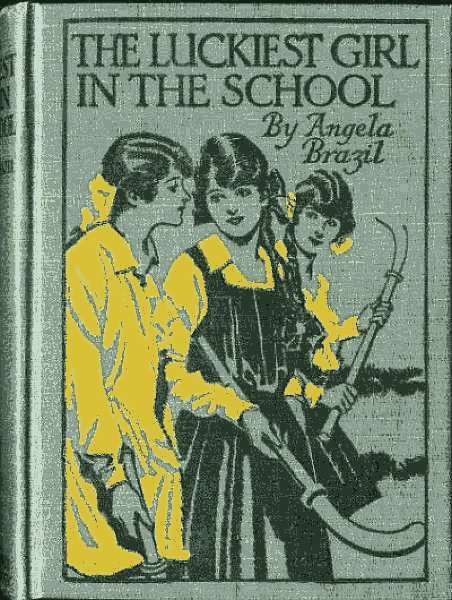
The Project Gutenberg eBook of The Luckiest Girl in the School
Title: The Luckiest Girl in the School
Author: Angela Brazil
Release date: March 19, 2006 [eBook #18019]
Language: English
Credits: E-text prepared by Paul Ereaut, Suzanne Shell, and the Project Gutenberg Online Distributed Proofreading Team
E-text prepared by Paul Ereaut, Suzanne Shell,
and the Project Gutenberg Online Distributed Proofreading Team
(http://www.pgdp.net/)
CONTENTS
| CHAPTER | PAGE | |
| I. | A Great Change | 1 |
| II. | An Entrance Examination | 15 |
| III. | Seaton High School | 30 |
| IV. | The Symposium | 42 |
| V. | Aunt Harriet | 58 |
| VI. | A Crisis | 73 |
| VII. | An Autumn Foray | 87 |
| VIII. | Concerns a Camera | 102 |
| IX. | The School Service Badge | 116 |
| X. | A Scare | 130 |
| XI. | The Open-air Camp | 143 |
| XII. | Captain Winona | 158 |
| XIII. | The Hostel | 167 |
| XIV. | The Hockey Season | 181 |
| XV. | Winona turns Chauffeur | 193 |
| XVI. | The Athletic Display | 209 |
| XVII. | Back to the Land | 222 |
| XVIII. | A Friend in Need | 236 |
| XIX. | The Swimming Contest | 251 |
| XX. | The Red Cross Hospital | 265 |
| XXI. | The End of the Term | 278 |
THE LUCKIEST GIRL IN THE SCHOOL
CHAPTER I
A Great Change
"There's no doubt about it, we really must economize somehow!" sighed Mrs. Woodward helplessly, with her housekeeping book in one hand, and her bank pass-book in the other, and an array of bills spread out on the table in front of her. "Children, do you hear what I say? The war will make a great difference to our income, and we can't—simply can't—go on living in exactly the old way. The sooner we all realize it the better. I wish I knew where to begin."
"Might knock off going to church, and save the money we give in collections!" suggested Percy flippantly. "It must tot up to quite a decent sum in the course of a year, not to mention pew rent!"
His mother cast a reproachful glance at him.
"Now, Percy, do be serious for once! You and Winona are quite old enough to understand business matters. I must discuss them with somebody. As I said before, we shall really have to economize somehow, and the question is where to begin."
"I saw some hints in a magazine the other day," volunteered Winona, hunting among a pile of papers, and fishing up a copy of The Housewife's Journal. "Here you are! There's a whole article on War Economies. It says you can halve your expenses if you only try. It gives ten different recipes. Number One, Dispense with Servants. Oh, goody! I don't know how the house would get along without Maggie and Mary! Isn't that rather stiff?"
"It's impossible to be thought of for a moment! I should never dream of dismissing maids who have lived with me for years. I've read that article, and it may be practicable for other people, but certainly not for us. Oh, dear! Some of my friends recommend me to remove to the town, and others say 'Stay where you are, and keep poultry!'"
"We can't leave Highfield! We were all born here!" objected Winona decisively.
"And we tried keeping hens some time ago," said Percy. "They laid on an average three-quarters of an egg a year each, as far as I remember."
"I'm afraid we didn't know how to manage them," replied Mrs. Woodward fretfully. "Percy, leave those papers alone! I didn't tell you to turn them over. You're mixing them all up, tiresome boy! Don't touch them again! It's no use trying to discuss business with you children! I shall write and consult Aunt Harriet. Go away, both of you, now! I want to have a quiet half-hour."
Aunt Harriet stood to the Woodward family somewhat in the light of a Delphic oracle. To apply to her was always the very last resource. Matters must have reached a crisis, Winona thought, if they were obliged to appeal to Aunt Harriet's judgment. She followed Percy into the garden with a sober look on her face.
"You don't think mother would really leave Highfield?" she asked her brother anxiously.
"Bunkum!" replied that light-hearted youth. "We always have more or less of a fuss when my school bills come in. It'll soon fizzle out again! Don't you fret yourself. Things will jog on as they always have jogged on. There'll be nothing done, you'll see. Come on and bowl for me, that's a chubby one!"
"But this time mother really seemed to be in earnest," said Winona meditatively, as she helped to put up the stumps.
Mrs. Woodward had been left a widow three years before this story opens. She was a fair, fragile little woman, still pretty, and pathetically helpless. She had been accustomed to lean upon her husband, and now, for lack of firmer support, she leaned upon Winona. Winona was young to act as prop, and though it flattered her sense of importance, it had put a row of wrinkles on her girlish forehead. At fifteen she seemed much older than Percy at sixteen. No one ever dreamt of taking Percy seriously; he was one of those jolly, easy-going, happy-go-lucky, unreliable people who saunter through life with no other aim than to amuse themselves at all costs. To depend upon him was like trusting to a boat without a bottom. Though nominally the eldest, he had little more sense of responsibility than Ernie, the youngest. It was Winona who shouldered the family burdens.
The Woodwards had always lived at Highfield, and in their opinion it was the most desirable residence in the whole of Rytonshire. The house was old enough to be picturesque, but modern enough for comfort. Its quaint gables, mullioned windows and Cromwellian porch were the joy of photographers, while the old-fashioned hall, when the big log fire was lighted, would be hard to beat for coziness. The schoolroom, on the ground floor, had a separate side entrance on to the lawn, leading through a small ante-room where boots and coats and cricket bats and tennis rackets could be kept; the drawing-room had a luxurious ingle nook with cushioned seats, and all the bedrooms but two had a southern aspect. As for the big rambling garden, it was full of delightful old-world flowers that came up year after year: daffodils and violets and snow-flakes, and clumps of pinks, and orange lilies and Canterbury bells, and tall Michaelmas daisies, and ribbon grass and royal Osmunda fern, the sort of flowers that people used to pick in days gone by, put a paper frill round, and call a nosegay or a posy. There was a lawn for tennis and cricket, a pond planted with irises and bulrushes, and a wild corner where crocuses and coltsfoot and golden aconite came up as they liked in the spring time.
Winona loved this garden with somewhat the same attachment that a French peasant bears for the soil upon which he has been reared. She rejoiced in every yard of it. To go away and resign it to others would be tragedy unspeakable. The fear that Aunt Harriet might recommend the family to leave Highfield was sufficient to darken her horizon indefinitely. That her mother had written to consult the oracle she was well aware, for she had been sent to post the letter. She had an instinctive apprehension that the answer would prove a turning-point in her career.
For a day or two everything went on as usual. Mrs. Woodward did not again allude to her difficulties, Percy had conveniently forgotten them, and the younger children were not aware of their existence. Winona lived with a black spot dancing before her mental eyes. It was continually rising up and blotting out the sunshine. On the fourth morning appeared a letter addressed in an old-fashioned slanting handwriting, and bearing the Seaton post mark. Mrs. Woodward read it in silence, and left her toast unfinished. Aunt Harriet's communications generally upset her for the day.
"Come here, Winona," she said agitatedly, after breakfast. "Oh, dear, I wish I knew what to do! It's so very unexpected, but of course it would be a splendid thing for you. If only I could consult somebody! I suppose girls nowadays will have to learn to support themselves, and the war will alter everything, but I'd always meant you to stop at home and look after the little ones for me, and it's very—"
"What does Aunt Harriet say, mother?" interrupted Winona, with a catch in her throat.
"She says a great deal, and I dare say she's right. Oh, this terrible war! Things were so different when I was a girl! You might as well read the letter for yourself, as it concerns you. I always think she's hard on Percy, poor lad! I was afraid the children were too noisy the last time she was here, but they wouldn't keep quiet. I'm sure I try to do my best all round, and you know, Winona, how I said Aunt Harriet—"
But Winona was already devouring the letter.
"10 Abbey Close,
"Seaton,
"August 26th.
"My Dear Florita,—You are quite right to consult me in your difficulties, and are welcome to any advice which I am able to offer you. I am sorry to hear of your financial embarrassments, but I am not surprised. The present increase in the cost of living, and extra taxation, will make retrenchments necessary to everybody. In the circumstances I should not advise you to leave Highfield. ("Oh, thank goodness!" ejaculated Winona.) The expense of a removal would probably cancel what you would otherwise save. Neither should I recommend you to take Percy from Longworth College and send him daily to be coached by your parish curate. From my knowledge of his character I consider the discipline of a public school to be indispensable if he is to grow into worthy manhood, and sooner than allow the wholesome restraint of his house master to be removed at this critical portion of his life, I will myself defray half the cost of his maintenance for the next two years.
"Now as regards Winona. I believe she has ability, and it is high time to begin to think seriously what you mean to do with her. In the future women will have to depend upon themselves, and I consider that all girls should be trained to gain their own living. The foundation of every career is a good education—without this it is impossible to build at all, and Winona certainly cannot obtain it if she remains at home. The new High School at Seaton is offering two open Scholarships to girls resident in the County, the examination for which is on September 8th. I propose that Winona enters for this examination, and that if she should be a successful candidate, she should come to live with me during the period of her attendance at the High School. The education is the best possible, there is a prospect of a University Scholarship to be competed for, and every help and encouragement is given to the girls in their choice of a career. With Winona off your hands, I should suggest that you should engage a competent nursery governess to teach the younger children the elements of order and discipline. I would gladly pay her salary on the understanding that I should myself select her.
"Trusting that these proposals may be of some service, and hoping to hear a better account of your health,
"I remain,
"Your affectionate Aunt
"and Godmother,
"Harriet Beach."
Winona laid down the letter with an agitated gasp. The proposition almost took her breath away.
"What an idea!" she exclaimed indignantly. "Mother, of course you won't even dream of it for an instant! I'd hate to go and live with Aunt Harriet. It's not to be thought of!"
"Well, I don't know, Winona!" wavered Mrs. Woodward. "We must look at it from all sides, and perhaps Aunt Harriet's right, and it really would be for the best. Miss Harmon's a poor teacher, and I'm sure your music, at any rate, is not a credit to her. You played that last piece shockingly out of time. You know you said yourself that you were getting beyond Miss Harmon!"
Whatever impeachments Winona may have brought against her teacher, she was certainly not prepared to admit them now. She rejected the project of the Seaton High School with the utmost energy and determination, bringing into the fray all that force of character which her mother lacked. Poor Mrs. Woodward vacillated feebly—she was generally swayed by whoever was nearest at the moment—and I verily believe Winona's arguments would have prevailed, and the whole scheme would have been abandoned, had not Mr. Joynson opportunely happened to turn up.
Mr. Joynson was a solicitor, and the trustee of Mrs. Woodward's property. He managed most of her business affairs, and some of her private ones as well. She had confidence in his judgment, and she at once thankfully submitted the question of Winona's future to his decision.
"The very thing for her!" he declared. "Do her a world of good to go to a proper school. She's frittering her time away here. Send her to Seaton by all means. What are you to do without her? Nonsense! Nobody's indispensable—especially a girl of fifteen! Pack her off as soon as you can. Doesn't want to go? Oh, she'll sing a different song when once she gets there, you'll see!"
Thus supported by masculine authority, Mrs. Woodward settled the question in the affirmative, and replied to her aunt by return of post.
Naturally such a stupendous event as the exodus of Winona made a sensation in the household.
"Well, of all the rum shows!" exclaimed Percy. "You and Aunt Harriet in double harness! It beats me altogether!"
"It's atrocious!" groaned Winona. "I'm a victim sacrificed for the good of the family. Oh! why couldn't mother have thought of some other way of economizing? I don't want to win scholarships and go in for a career!"
"Buck up! Perhaps you won't win! There'll be others in for the exam., you bet! You'll probably fail, and come whining home like a whipped puppy with its tail between its legs!"
"Indeed I shan't!" flared Winona indignantly. "I've a little more spirit than that, thank you! And why should you imagine I'm going to fail? I suppose I've as much brains as most people!"
"That's right! Upset the pepper-pot! I was only trying to comfort you!" teased Percy. "In my opinion you'll be returned like a bad halfpenny, or one of those articles 'of no use to anybody except the owner.' Aunt Harriet will be cheated of her prey after all!"
"If Win goes away, I shall be the eldest daughter at home," said Letty airily, shaking out her short skirts. "I'll sit at the end of the table, and pour out tea if mother has a headache, and unlock the apple room, and use the best inkpot if I like, and have first innings at the piano."
"You forget about the nursery governess," retorted Winona. "If I go, she comes, and you'll find you've exchanged King Log for King Stork. Oh, very well, just wait and see! It won't be as idyllic as you imagine. I shall be saved the trouble of looking after you, at any rate."
"What I'm trying to ascertain, madam," said Percy blandly, "is whether your ladyship wishes to take up your residence in Seaton or not. With the usual perversity of your sex you pursue a pig policy. When I venture to picture you seated at the board of your venerable aunt, you protest you are a sacrifice; when, on the other hand, I suggest your return to the bosom of your family, you revile me equally."
"You're the most unsympathetic beast I've ever met!" declared Winona aggrievedly.
When she analyzed her feelings, however, she was obliged to allow that they were mixed. Though the prospect of settling down at Seaton filled her with dismay, Percy's gibe at her probable failure touched her pride. Winona had always been counted as the clever member of the family. It would be too ignominious to be sent home labeled unfit. She set her teeth and clenched her fists at the bare notion.
"I'll show them all what I can do if I take a thing up!" she resolved.
In the meantime Mrs. Woodward was immersed in the subject of clothing. Every post brought her boxes of patterns, amongst which she hesitated, lost in choice.
"If I knew whether you're really going to stay at Seaton or not, it would make all the difference, Winona," she fluttered. "It's no use buying you these new things if you're only to wear them at home, but I'd make an effort to send you nice to Aunt Harriet's. I know she'll criticize everything you have on. Dear me, I think I'd better risk it! It would be such a nuisance to have to write for the patterns all over again, and how could I get your dresses fitted when you weren't here to be tried on? Miss Jones is at liberty now, and can come for a week's sewing, but she'll probably be busy if I want her later. Now tell me, which do you really think is the prettier of these two shades? I like the fawn, but I believe the material will spot. What have you done with the lace collar Aunt Harriet gave you last Christmas? She's sure to ask about it if you don't wear it!"
Having decided that on the whole she intended to win a scholarship, Winona bluffed off the matter of her departure.
"I've changed my mind, that's all," she announced to her home circle. "It will be a great comfort to me not to hear Mamie scraping away at her violin in the evenings, or Letty strumming at scales. Think what a relief not to be obliged to rout up Dorrie and Godfrey, and haul them off to school every day! I'm tired of setting an example. You needn't snigger!"
The family grinned appreciatively. They understood Winona.
"Don't you worry! I'll set the example when you're gone," Letty assured her. "I'll be as improving as a copy-book. I wish I'd your chance; I'd stand Aunt Harriet for the sake of going to a big High School. Younger sisters never have any luck! Eldests just sweep the board. I don't know where we come in!"
"Don't you fret, young 'un, you'll score later on!" cooed an indulgent voice from the sofa, where Percy sprawled with a book and a bag of walnuts. "Remember that when you're still in all the bliss and sparkle of your teens, Winona'll be a mature and passée person of twenty-two. 'That eldest Miss Woodward's getting on, you know!' people will say, and somebody'll reply: 'Yes, poor thing!'"
"They won't when I've got a career," retorted Winona, pelting Percy with his own walnut-shells.
"You assured us the other day that you despised such vanities."
"Well, it depends. Perhaps I'll be a lady tram conductor, and punch tickets, or a post-woman, or drive a Government van!"
"If those are careers for girls, bag me for a steeple jack," chirped Dorrie.
It was perhaps a good thing for Winona that such a short interval elapsed between the acceptance of Aunt Harriet's proposal and the date of the scholarship examination. The ten days were very busy ones, for there seemed much to be done in the way of preparation. Miss Jones, the dressmaker, was installed in the nursery with the sewing-machine, and demanded frequent tryings-on, a process Winona hated.
"I shall buy all my clothes ready made when I'm grown up!" she declared.
"They very seldom fit, and have to be altered," returned her mother. "Do stand still, Winona! And I hope you're learning up a few dates and facts for this examination. You ought to be studying every morning. If only Miss Harmon were home, I'd have asked her to coach you. I'm afraid she'll be disappointed at your leaving, but of course she can't expect to keep you for ever. I heard a rumor that she means to give up her school altogether, and go and live with her uncle. I hope it's true, and then I can take the little ones away with an easy conscience. I don't want to treat her badly, poor thing, but I'm sure teaching's not her vocation."
Winona really made a heroic effort to prepare herself for the coming ordeal. She retired to a secluded part of the garden and read over her latest school books. The process landed her in the depths of despondency.
"I'll never remember anything—never!" she mourned to her family. "To try and get all this into my head at once is like bolting a week's meals at a single go! I know a date here and there, and I've a hazy notion of French and Latin verbs, and a general impression of other subjects, but if they ask me for anything definite, such as the battles of the Wars of the Roses, or a list of the products of India, I'm done for!"
"Go in for Post-Impressionism, then," suggested Percy. "Write from a romantic standpoint, and don't condescend to mere facts. Stick in a quotation or two, and a drawing if possible, and make your paper sound eloquent and dramatic and poetical, and all the rest of it. They'll mark you low for accuracy, but put you on ten per cent. for style, you bet! I know a chap who tries it on at the Coll., and it always pays."
"It's worth thinking about, certainly," said Winona, shutting her books with a weary yawn.
CHAPTER II
An Entrance Examination
The Seaton High School was a large, handsome brick building exactly opposite the public park. It had only been erected two years ago, so everything about it was absolutely new and up-to-date. It supplied a great need in the rapidly growing city, and indeed offered the best and most go-ahead education to be obtained in the district.
It was the aim of the school to fit girls for various professions and careers; there was a classical and a modern side, a department for domestic economy, and a commercial class for instruction in business details. Art, music, and nature study were well catered for, and manual training was not forgotten. As the school was intended to become in time a center for the county, the Governors had offered two open free scholarships to be competed for by girls resident in other parts of Rytonshire, hoping by this means to attract pupils from the country places round about.
On the morning of September 8th, precisely at 8.35, Winona presented herself at the school for the scholarship examination. There were twenty other candidates awaiting the ordeal, in various stages of nervousness or sangfroid. Some looked dejected, some confident, and others hid their feelings under a mask of stolidity. Winona joined them shyly. They were all unknown to one another, and so far nobody had plucked up courage to venture a remark. It is horribly depressing to sit on a form staring at twenty taciturn strangers. Winona bore for awhile with the stony silence, then—rather frightened at the sound of her own voice—she announced:
"I suppose we're all going in for this same exam.!" It was a trite commonplace, but it broke the ice. Everybody looked relieved. The atmosphere seemed to clear.
"Yes, we're all going in—that's right enough," replied a ruddy-haired girl in spectacles, "but there are only two scholarships, so nineteen of us are bound to fail—that's logic and mathematics and all the rest of it."
"Whew! A nice cheering prospect. Wish they'd put us out of our misery at once!" groaned a stout girl with a long fair pigtail.
"I'm all upset!" shivered another.
"It's like a game of musical chairs," suggested a fourth. "We're all scrambling for the same thing, and some are bound to be out of it."
The ruddy-haired girl laughed nervously.
"Suppose we've got to take our sporting luck!" she murmured.
"If nineteen are sure to lose, two are sure to win at any rate," said Winona. "That's logic and mathematics and all the rest of it, too!"
"Right you are! That's a more cheering creed! It doesn't do to cry 'Miserere me' too soon!" chirped a jolly-looking dark-eyed girl with a red hair-ribbon. "'Never say die till you're dead,' is my motto!"
"I'm wearing a swastika for a mascot," said a short, pale girl, exhibiting her charm, which hung from a chain round her neck. "I never am lucky, so I thought I'd try what this would do for me for once. I know English history beautifully down to the end of Queen Anne, and no further, and if they set any questions on the Georges I'll be stumped."
"I've learnt Africa, but Asia would floor me!" observed another, looking up from a geography book, in which she was making a last desperate clutch at likely items of knowledge. "I never can remember which side of India Madras is on; I get it hopelessly mixed with Bombay."
"I wish to goodness they'd go ahead and begin," mourned the owner of the red hair-ribbon. "It's this waiting that knocks the spirit out of me. Patience isn't my pet virtue. I call it cruelty to animals to leave us on tenter-hooks."
Almost as if in answer to her pathetic appeal the door opened, and a teacher appeared. In a brisk, business-like manner she marshaled the candidates into line, and conducted them to the door of the head-mistress' study, where one by one they were admitted for a brief private interview. Winona's turn came about the middle of the row.
"Pass in: as quickly as you can, please!" commanded the teacher, motioning her onward.
As Winona entered, she gave one hasty comprehensive glance round the room, taking in a general impression of books, busts and pictures, then focussed her attention on the figure that sat at the desk. It was only at a later date that she grasped any details of Miss Bishop's personality; at that first meeting she realized nothing but the pair of compelling blue eyes that drew her forward like a magnet.
"Your name?"
"Winona Woodward."
"Age?"
"Fifteen."
"Residence?"
"Highfield, Ashbourne, near Great Marston."
"How long have you lived in the county of Rytonshire?"
"Ever since I was born."
Miss Bishop hastily ticked off these replies on a page of her ledger, and handed Winona a card.
"This will admit you to the examination room. Remember that instead of putting your name at the head of your papers, you are to write the number given you on your card. Any candidate writing her own name will be disqualified. Next girl!"
It was all over in two minutes. Winona seemed hardly to have entered the room before she was out again.
"Move on, please!" said the teacher, marshaling the little crowd round the door. "Will those who have seen Miss Bishop kindly go along the corridor."
Several girls who had been standing in a knot made a sudden bolt, and pushed their fellows forward. Somebody jogged Winona's elbow. Her card slid from her grasp and fell on to the ground. As she bent in the crush to pick it up, the ruddy-haired girl stooped on a like errand.
"Dropped mine too! Clumsy, isn't it?" she laughed. "Hope we've got our own! What was your number?"
"I hadn't time to look."
"Well, I'm sure mine was eleven, so that's all right. I wish you luck! Won't we just be glad when it's over, rather!"
At the further end of the corridor was a door with a notice pinned on to it. "Examination for County Scholarships." A mistress stood there, and scrutinized each girl's card as she entered, directing her to a seat in the room marked with the corresponding number. Winona walked rather solemnly to the desk labeled 10. The great ordeal was at last about to begin. She wondered what would be the end of it. Little thrills of nervousness seemed running down her back like drops from a shower-bath. Her hands were trembling. With a great effort she pulled herself together.
"It's no use funking!" she thought. "I'll make as good a shot as I can at things, and if I fail—well, I shall have plenty of companions in misfortune, at any rate!"
A pile of foolscap paper with red-ruled margins, a clean sheet of white blotting paper, and a penholder with a new nib lay ready. Each of the other twenty victims was surveying a supply of similar material. On the blackboard was chalked the word "Silence."
In a dead hush the candidates sat and waited. Exactly on the stroke of nine Miss Bishop entered and handed a sheaf of printed questions to the teacher in charge, who distributed them round the room. The subject for the first hour was arithmetic. Winona read over her paper slowly. She felt capable of managing it, all except the last two problem sums, which were outside her experience. She knew it would mainly be a question of accuracy.
"I'll work them each twice if I've only time," she thought, starting at number one.
An hour is after all only made up of sixty minutes, and these seemed to fly with incredible rapidity. The teacher on the platform had sternly reproved a girl guilty of counting aloud in an agitated whisper, threatening instant expulsion for a repetition of such an offense, but with this solitary exception nobody transgressed the rules. All sat quietly absorbed in their work, and an occasional rustle of paper or scratch of a pen were the only sounds audible. At precisely five minutes to ten the deity on the platform sounded a bell, and ordered papers to be put together. She collected them, handed them to another mistress, then without any break proceeded to deal out the questions for the next hour's examination. This was in geography, and here Winona was not on such sure ground. Granted that you are acquainted with certain rules in arithmetic, it is always possible to work out problems, but it needed more knowledge than she possessed to write answers to the riddles that confronted her. She had never heard of "The Iron Gates," could not place Alcona and Altona, was hazy as to the whereabouts of the Mourne Mountains, and utterly unable to draw an accurate map of the Balkan States. She scored a little on Canada, for she had learnt North America last term at Miss Harmon's, but with Australia and New Zealand she was imperfectly acquainted. She wrote away, getting hotter and hotter as she realized her deficiencies, winding up five minutes before the time allotted, in a flushed and decidedly inky condition.
At eleven a short interval was allowed, and the candidates thankfully adjourned. Outside in the corridor they compared notes.
"Well, of all detestable papers this geography one is the limit!" declared an aggrieved voice.
It was the girl who had said that she always mixed Madras and Bombay, and who had studied her text-book up to the last available moment. Apparently her eleventh hour industry had not sufficed to tide her over her difficulties.
"It was catchy in parts," agreed the owner of the swastika, "but I liked one or two questions. I just happened to know them, so I bowled ahead. That's what comes of wearing a mascot!"
"Don't crow too soon!" laughed the girl with the fair pigtail. "Remember, there are four other exams. to follow. Your luck may leave you at any moment."
"Don't mention more exams.! I feel inclined to turn tail and run home!" declared another.
"There's the bell! Don't give us much time, do they? Now for the torture chamber again! Brace your nerves!"
"I wonder if most of them have done better or worse than I have!" thought Winona, as she took her seat once more at No. 10 desk. "A good many were grumbling, but that sandy-haired girl in the spectacles said nothing. No more did the one with the red hair-ribbon. Of course they might be feeling too agonized for words, but on the other hand they might be secretly congratulating themselves."
It was not the moment, however, for speculation as to her neighbors' progress. The next set of questions was being distributed, and she took up her copy eagerly. Her heart fell as she read it over. Her knowledge of English history was not very accurate, and the facts demanded were for the most part exactly those which she could not remember. The dread of failure loomed up large. She could only attempt about half of the questions, and even in these she was not ready with dates. Then suddenly Percy's advice flashed into her mind. "Write from a romantic standpoint, and make your paper sound poetical." It seemed rather a forlorn hope, and she feared it would scarcely satisfy her examiners, but in such a desperate situation anything was worth trying. Winona possessed a certain facility in essay writing. Prose composition had been her favorite lesson at Miss Harmon's. She collected her wits now, and did the very utmost of which she was capable in the matter of style. Choosing question No. 4, "Write a life of Lady Jane Grey," she proceeded to treat the subject in as post-impressionist a manner as possible. The pathetic tragedy of the young Queen had always appealed to her imagination, and she could have had no more congenial a theme upon which to write, if she had been given free choice of all the characters in the history book.
"'Whom the gods love die young,'" she began, and paused. It seemed an excellent opening, if she could only continue in the same strain, but what ought to come next? Her thoughts flew to a painting of Lady Jane Grey, which she had once seen at a loan collection of Tudor portraits. Why should she not describe it? Her pen flew rapidly as she wrote a word-picture of the sweet, pale face, so round and childish in spite of its earnest expression; the smooth yellow hair, the gray eyes bent demurely over the book. Her heroine seemed beginning to live. Now for her surroundings. A year ago Winona had paid a visit to Hampton Court, and her remembrance of its associations was still keen and vivid. She described its old-world garden by the side of the Thames, where the little King Edward VI. must often have roamed with his pretty cousin Jane: the two wonderful ill-starred children, playing for a brief hour in happy unconsciousness of the fate that faced them. What did they talk about, she asked, as they stood on the paved terrace and watched the river hurrying by? Plato, perchance, and his philosophy, or the marvelous geography-book with woodcuts of foreign beasts that had been specially printed for the young king's use. Did they compare notes about their tutors? Jane would certainly hold a brief for her much-loved Mr. Elmer, who, in sharp contrast to her parents' severity, taught her so gently and patiently that she grudged the time which was not spent in his presence. Edward might bemoan the ill-luck of his whipping-boy, who had to bear the floggings which Court etiquette denied to the royal shoulders, and perhaps would declare that when he was grown up, and could make the laws himself, no children should be beaten for badly said lessons, and Jane would agree with him, and then they would pick the red damask roses that Cardinal Wolsey had planted, and walk back under the shadow of the clipped yew hedge to eat cherries and junket in the room that looked out towards the sunset.
Winona had warmed to her work. Her imagination, always her strongest faculty, completely carried her away. She pictured her heroine's life, not from the outside, as historians would chronicle it, a mere string of events and dates, but from the inner view of a girl's standpoint. Did Jane wish to leave her Plato for the bustle of a Court? Did she care for the gay young husband forced upon her by her ambitious parents? Surely for her gentle nature a crown held few allurements. The clouds were gathering thick and fast, and burst in a waterspout of utter ruin. Jane's courage was calm and hopeful as that of Socrates in the dialogues she had loved.
The good stars met in your horoscope,
Made you of spirit, fire and dew."
quoted Winona enthusiastically. Browning always stirred her blood, and threw her into poetical channels. She cast about in her mind for any other appropriate verses.
Let the bell toll—a saintly soul floats on the Stygian river.
Come, let the burial rite be read—the funeral song be sung,
An anthem for the queenliest dead that ever died so young,
A dirge for her, the doubly dead, in that she died so young."
"So they finished their foul deed, and laid her to rest," wrote Winona, "the earthly part, that is, which perishes, for the true part of her they could not touch. Farewell, sweet innocent soul, of whom the world was not worthy. To you surely may apply Andre de Chénier's tender lines: