
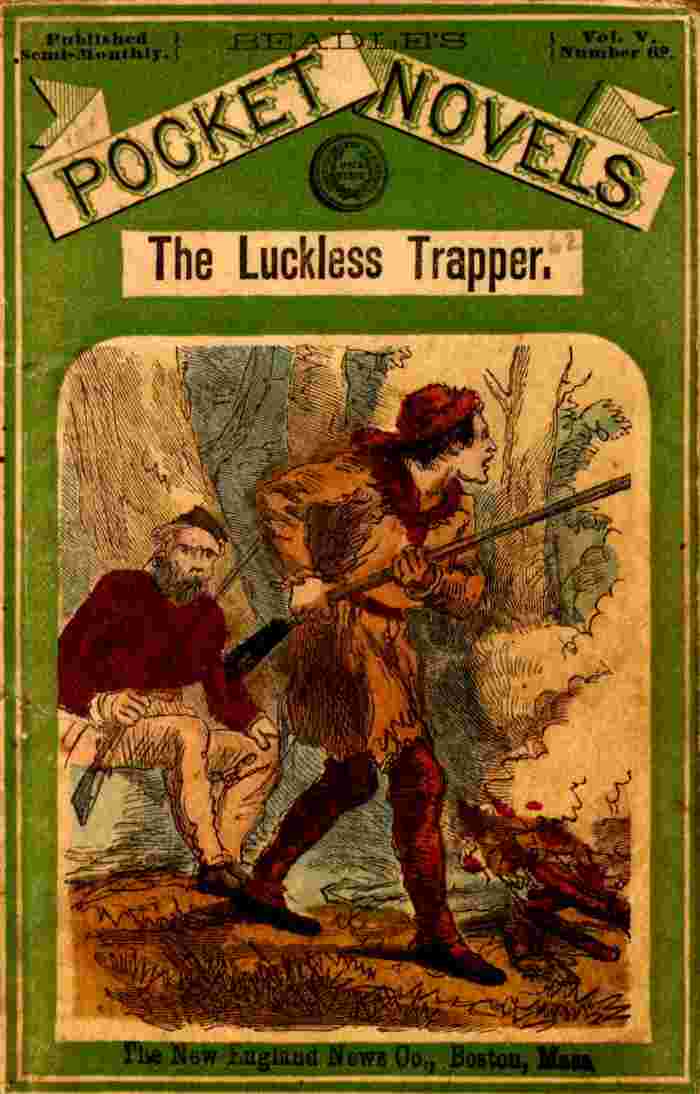
The Project Gutenberg eBook of The luckless trapper; or, The haunted hunter
Title: The luckless trapper; or, The haunted hunter
Author: William R. Eyster
Release date: June 21, 2022 [eBook #68371]
Most recently updated: October 18, 2024
Language: English
Original publication: United States: Beadle and Adams, 1872
Credits: David Edwards, Mary Meehan and the Online Distributed Proofreading Team at https://www.pgdp.net (Northern Illinois University Digital Library)
THE LUCKLESS TRAPPER;
OR,
THE HAUNTED HUNTER
BY WILLIAM R. EYSTER,
Author of "Wild Nat" (Pocket Novel 21.)
Vol. V.
NOVEMBER 11, 1876.
No. 62.
NEW YORK:
BEADLE AND ADAMS, PUBLISHERS,
98 WILLIAM STREET.
Entered according to Act of Congress, in the year 1871, by
FRANK STARR & CO.,
In the office of the Librarian of Congress, at Washington.
THE HAUNTED HUNTER;
OR,
BILL BLAZE, THE LUCKLESS TRAPPER
CHAPTER I.
A CORPSE IN THE STREAM.
There is a peculiar hiss when a rifle-ball passes in close proximity to one's head, a sound that no doubt chords with some musical note, yet upon most ears the noise is apt to fall rather unpleasantly. So the trapper, though thoroughly seasoned to danger and the thousand chances and mischances of the bush and plain, dodged his head suddenly, with a movement more energetic than graceful, at the same time uttering, though not above a whisper, an ejaculation of surprise and discontent. In the midst of his reconnoitering it seemed to him that he had been reconnoitered, and that to some purpose. There was danger in the atmosphere.
Carefully he peered around him. He caught no sight of the hand that had fired the shot; he could see nothing and could hear nothing that gave sign of hostile intentions. Through the bushes that were spread before him like a curtain he anxiously gazed, with one hand pushing them aside.
"Where the dickins c'u'd that 'a' come from," he muttered. "Some one hez hed a line shot on this hyer old hoss an' cum mighty nigh a-sendin' him under. Ef I could only git a site at the varmint ther'd be a case o' suddint death, sure—ah!"
The soliloquy ceased, for on the small level spot on the opposite side of the stream, standing out bold and full in the clear moonlight, there appeared two men. The distance was not great, their actions evinced no knowledge that any other human being was near them, and as they broke into conversation every word they spoke was wafted distinctly to the ears of the listener who lay concealed in the close hanging bushes.
One of these two men was tall and shapely in build. His form gave token of strength and activity, while the moonbeams that fell upon his face lit up a countenance that was more than ordinarily handsome. One hand rested upon the muzzle-end of a heavy rifle, the other was extended in a shunning gesture, the palm outward as if waving back the man who faced him.
The other was, if any thing, shorter in stature, but made up for any lack of hight in breadth of build. His shoulders were almost Herculean in shape, his hands were large, his neck thick and powerful—altogether his appearance promised strength rather than activity. His face could scarcely be distinguished, but even in the shadow one could fancifully map out a countenance indicative of boldness and resolution.
Thus the two stood in the moonlight, scarcely three yards apart and facing each other.
"You're quick on the trigger," said the short man; "and if it had been daylight I might have gone under. I'm not one to bear malice, though it's a rough old joke to be shot at. If I was some men you'd not be standing now."
"I know it. Yet daylight or dark, if I had not discovered my mistake in time, I should have been standing and you down. As I pulled the trigger I raised the barrel for I saw it was the wrong man. The right one is near me somewhere though, and had you been he, the scores would have all been wiped out by this time."
"I thought so. I kinder saw you hitch up your iron, so I knew you had made a mistake when you threw the tube to your shoulder. It was sudden though—and not the first time a white man has drawn sights on me. I've been watching you since you came around here; I've been waiting for you to show your hand, and I want to know to-night what your game is. If you are on the square, with no infernal curious kinks in yer nature, well an' good. But if ye want to know more than ye see, if ye must take a hand in what don't concern you nor your'n, then take a fool's advice—an' move on."
"See here, Martin, if that's your name, don't borrow trouble about me. You're not my man. I don't want to know more than one thing, and that is, where my man is. Then I don't want to do more than one thing. I want to lay sights on him. After that it's a matter between him and Killemquick, and the chances in Killemquick's favor."
"That's all right; but s'posin' 'your man' is one of my men—I want to know something about that; fur down here along Back Load Trail there's a few on us as hang together mighty close. Ef you get them double-sights pulled on some as I knows on, mebbe there'll be the like on you with a quicker finger on the trigger."
"Very well, old man, you know all I can tell you. My name is Winkle, and I'm laying out for my man. I've heard of Back Load Trail and I've heard of Dick Martin that rules it. I'm an honest man and a square man, and I tell you there will be some fancy shooting done along here before long. If it's to be war between you and me let us know it now and I'll play my hand careful. Remember, I'm not going to interfere with you except as I have to; but if so be that there's danger in the air for one of your friends, more's the pity."
"Yer mighty indefinite, stranger. Ef you've ever heard of Back Load Trail, as ye say ye have, ye must know that outsiders that sometimes try to ring in here, occasionally git the'r last sickness. We run things down here to suit ourselves purty much, an' ef you've got a grudge ag'in' any one it's all right, so he's an outsider, too. But, ef it's ag'in' one of us Free Trappers, the bullet is already run that puts yer light out. I don't know of any strangers on this trail but yerself an' one more, an' he only come down from the mountains last night. Ef it's him, all right. Ef it ain't—look sharp. Ef it's me, but ye say it ain't, I'm here now!"
The voice of Dick Martin rolled out round and full as he uttered the words, "I'm here now"; there was even something heroic in his tone, just as there was a world of bitter warning in the first part of his address. But he seemed to make little impression on his vis-a-vis, who looked at him steadily, and answered him coolly:
"I neither know nor care if the man I'm seeking is a Free Trapper, or whether he just came down from the mountains. I know I'm a dead shot and I know I'll shoot him dead. When you find a corpse lying on the broad of its back with its left eye shot out you may calculate that my mission is accomplished and that I'm done with this region. As for any threats you make, I care nothing for them, I fear for nothing, nothing can harm me. I am above all chances, for I am a minister of Fate, and until Fate has been served, the lead is not run nor the steel forged that can harm me."
"By heavens! yer either a gritty man or yer crazy. Ther's not many men stood up lately and talked that way to my face. I like pluck and I like grit, so I'm goin' to hold on a leetle longer till I see yer game. It's not often I take a likin', but I half like you. I come down here to where you were camped intendin' to do some plain talkin', but I've altered my mind a leetle on it. Turn in, stranger, Dick Martin bids ye good-night."
Something in Martin's voice gave evidence to the other of the sincerity of his words. Though, on their very faces, as much as from their conversation, you could plainly see their wide dissimilarity, yet Winkle's voice lost something of its hard, steely ring as he responded:
"Good-night then. We understand each other pretty fairly. Watch my hand and you may see what I play. I don't think it's against your game, but if it is I say nothing against your doing your best. Each man for himself and—"
Whatever else the taller man was about to say was suddenly interrupted by a wild cry proceeding from the opposite side of the stream, a cry that startled both men. Martin dropped at full length upon the ground, while Winkle brought his rifle to a ready and gazed in the direction from whence came the sound.
The bushes which lined the bank seemed to be violently agitated, there was a noise as of two men engaged in a fierce and well-contested struggle. This lasted but for a few seconds, then a dark body shot out into the moonlight and fell into the water with a sullen splash.
Both men cast curious glances at the spot where the body had disappeared. Great waves circled out and out, but there was no further struggling, and for a time no sign of what was the object that had fallen into the stream. But at length, as the two spectators looked curiously at each other, there rose into the clear moonshine, that lay broad and silvery upon the surface of the water, the face of a dead man; while from his breast, as a center, there irradiated a crimson fluid that dyed the water with its stain.
Henry Winkle took a few steps forward and gazed anxiously at the body that was slowly drifting down with the current. Apparently he was satisfied, for he turned around with what might have been taken for a sigh of relief. But when his eye explored the little plateau it rested not on any living thing—Dick Martin had quietly glided away.
CHAPTER II.
AN APPARITION.
Although there was nothing in the sudden disappearance of Martin that could particularly alarm Winkle, impressed as he really was with the present good faith of the man with whom he had lately been conversing, still from some cause or other he felt by no means at his ease. Who might be upon the other side of the stream yet remained a mystery, and until that was solved he could not follow the advice lately tendered him and "turn in." He gave a quick glance up and down the stream, a sharp look at the bushes that lined the other shore, and then, with a quick, noiseless step, turned into the woods from which but a few moments before he had emerged.
It was his purpose to move up the stream for some little distance, and then, crossing over, beat carefully down the bank, keeping a look-out for traces of the parties whom he had no doubt had been engaged in a deadly struggle at the time the cry had interrupted his conversation.
All about him was silent, and he met with no haps or mishaps for the time. As he came down the bank, however, his eyes wandered in every direction, every clump was carefully examined, and his progress was necessarily slow. At first nothing rewarded his search; but at length something caught his practiced eye and by even the uncertain light he could plainly discover a trail, leading in the direction in which he was proceeding. Immediately he halted for its examination. Almost a glance showed him that it was a careless and unconcealed one, and that it was made by a white man. A moment more and Winkle decided within himself that it was made by the man whom Martin stated had just come down from the mountains. It led on down the stream, and the explorer followed cautiously upon it, not forgetting to look from time to time at either side, in search of further information. When he arrived opposite to the spot where he and the Free Trapper had held their late conversation, the track suddenly turned at right angles and it seemed to him as though the man who made it had from this spot acted with more caution. And as he cast his eyes to one side he saw the marks left by the footsteps of a distinct party.
His movements were governed by the utmost caution, but he went rapidly and noiselessly to the spot. The footprints that he there found appeared to give him more trouble than the former ones, for it was some time before his mind was fully settled; then he looked up with the one word, "Indian," on his lips. He noticed that from their direction both trails led into the bushes in such a manner as to cross, or at least meet each other at about the spot from which the body had been projected into the stream—and accordingly he noiselessly followed the second trail, with every sense and nerve on the alert to catch the first signal telling of the proximity of any living beings. It was not long before he found the trail most suddenly ended, for he came to a spot where the ground had been beaten and the branches and shrubs most evidently disarranged by a short but desperate contest. It was too dark for him to see if there were any traces of blood, but he had no doubt in his mind but that they were there. Carefully pushing aside the boughs, he saw that he was immediately on the bank, and in a position not only to see clearly the spot where he and Martin had met, but near enough to hear every word of what was then and there said. This much he noted, then turned aside to seek for further traces of the probable survivor.
He was not there; and, it was some time before Winkle, practiced as he was in woodcraft, could discover any sign to indicate in which way the victor had left. Evidently the man had dropped his carelessness and was now as cautious in concealing his trail—and he evinced no mean skill in his efforts—as he was before thoughtless or careless about the matter. At length, in the dim and hazy light, the search was rewarded, and Winkle was enabled to tell in which way the man had departed.
Following a trail that is made carefully and with the intent of leaving no trace, is at best but slow business. At night it is infinitely worse. More than once in a dozen rods Winkle paused and scanned the ground narrowly. At length he came to a halt, completely puzzled—no mark of bruised grass, imprinted earth or broken twig was to be seen. A few moments' hesitation and he decided to adopt the plan best adapted to such a case. Going back to the last spot it was discernible, he took a careful survey of the surrounding ground, and then turning to the right he began circling, with a diameter of some rods. Even this method at first seemed fruitless, but at length, as the perimeter of the circle almost touched the bank of the stream, he found a faint trace that sufficed to set him again on the trail. The man had evidently gone down-stream for several yards, and then, turning to the left, either taken to the water to conceal his track or else crossed over to the opposite side. Which had he done? Without hesitation Winkle pushed ahead, and on gaining the opposite bank discovered the trail, this time leading up the stream.
This was a discovery indeed, and, while feeling some little uneasiness, he felt more determined than ever to follow the trail and gain a sight of this mysterious stranger.
Under the shadow of the trees the traces grew more indistinct and were once more lost; but allowing himself to be led by instinct, he hurried on, with his rifle ready to swing to his shoulder at a moment's warning. A noise fell upon his ears and he halted. At some distance, and in the direction of down-stream, he heard horse's hoofs rapidly approaching, the animal, however, being evidently under the control of a rider.
This appeared to put a new aspect on matters, for, although it might be Martin, or a friend, the chances also were that it might be an enemy. Rapidly thrusting his hand in his bosom, Winkle drew therefrom a whistle, and placed it to his lips. A moment more and a sound peculiarly shrill and trilling arose on the air. Then the man bent forward in expectancy. Right ahead, at the distance of a dozen yards, sounded the neigh of a horse, followed by the noise of a plunge, and something that resembled the sudden fall of a heavy body. Then bursting through the underbrush in answer to the call came a noble white steed, that approached his master at a gallop and placed itself alongside of him. From the direction in which the animal had come might have been heard other sounds, but Winkle's whole attention was now given to the approaching rider. He stood with one hand outstretched, and resting on the neck of his horse, his eyes riveted on the open sward which, between the trees among which he stood, glittered and shone clear.
Behind him there was an exclamation, the sound of a struggle and the voice of some one:
"Dar now, dis chile has yer, suah! T'ink yer steal dat hoss, did yer?"
But at the same time a horse and rider flashed into the anxious sight of Winkle.
And that rider was a woman!
For just a moment were they visible, but that moment seemed sufficient to produce a terrible effect on the gazer. He threw up his hand and uttered a sharp, unearthly cry; his eyes eagerly followed the slight and graceful form that so easily swung in the saddle; bent forward he caught the last glimpse of her as her riding-dress fluttered away again and was lost in the enfolding branches.
Then followed the sound of another horseman. Again a steed and rider glided across his plane of vision like a shadow on a curtain or a moving figure in some pantomime. For a moment only it appeared in view, and then disappeared in the same direction as did the woman.
Emotion was fairly overmastering Winkle. He shook like an aspen, his hands seemed to have lost their power; but hardly had the second figure disappeared when his rifle had found its way to his shoulder. But if he desired to use it with deadly effect, it was too late. Again stillness, and moonlight, and the nodding trees alone lay before him, while the retreating footsteps waxed fainter and fainter in the distance.
Mechanically he turned and pursued his way; he heard nothing, saw nothing—not even the dumb brute by his side, which faithfully paced along with a step corresponding in slowness with that of its master.
At length a huge rock or mass of rocks lay in his path. Moving a little to one side he soon skirted them, and as he did so, a light, as from a suddenly-stirred fire, flamed up before him, illuminating the side of the bowlder and a small circle in front of it.
Into this circle of light Winkle staggered, and with his rifle convulsively clutched at a ready, stood gazing with a half-dazed look into the fire.
CHAPTER III.
DOUBLY WARNED.
It was no particular feeling of fear that caused Martin to move away in so quiet a manner, while the struggle was going on upon the opposite side of the stream. But, as Winkle was to him a stranger, and there might be some need of investigation, he thought it best that whatever might be done, should be done by his own unaided exertions. Moving cautiously, keeping himself well under shade and waiting patiently, he saw the man, with whom he had been so lately conversing, look around with a gaze of half wonder at finding himself alone, and then set forward upon an exploring tour. Not long afterward, at a point some distance down the stream, a man crossed; and, entering the woods, after a moment's hesitation, struck off in the direction in which Martin knew Winkle had camped, or intended to camp for the night. After a little, hard upon the trail came Winkle, himself. He would doubtless have followed on for the purpose of seeing the meeting between these two persons—if meet they should—when he was startled by the sudden appearance of the two riders. He, too, in a manner almost involuntary, threw his rifle to his shoulder and, in fact, had the pursuer fairly covered; but, instead of drawing the trigger, he lowered the weapon, listened a moment, and then, utterly disregarding the motions of the two men upon which he had been, but lately, so intent, followed silently on in the direction in which the woman and the pursuing man had disappeared.
A walk of a few minutes and the aspect of surrounding things somewhat changed—sufficiently at least to give token that some man or men had made a permanent settlement near by. The sound of galloping horses had ceased; as he advanced, he thought he heard voices engaged in conversation.
Nor was he mistaken. At some little distance from the edge of the wood stood a cabin. In front of this the parties had halted. The man was still mounted, but the woman stood by the threshold of the cabin, facing her late pursuer, a steely look of defiance upon her countenance.
The man was speaking when Martin came within hearing distance, and his words fell upon the night-air coldly and distinctly.
"Listen, Edith," he said. "You know me so well, that I need not tell you that sooner or later I will be heard. I have not come all these miles to have you put me off with a hand-wave, and a 'begone.' We are, both of us, older than when we last met and care little for listeners; but must I say now what I have to say, or will you accord me a more fitting time and place?"
"As between us, there never can be either a fitting time or place for communication. All connection, all intercourse between us has ceased, and forever. I would refuse to willingly hear you, if you came as a messenger announcing my eternal salvation, and nothing that you can say or do shall cause me to alter my determination. If you would be safe, leave me. I am willing to forgive the past, even if I can not forget it, and I would not see you harmed; therefore I warn you away from these grounds. I caution you to return from whence you came, if you dare. And if you dare not, then seek some other place. Away, begone! for something tells me there is danger in the atmosphere for you here."
"Edith, again, I say, listen. I would speak somewhat of the past; but more of the future. Through me you have suffered, I admit, but through me I would have you return again—return to joy and life and youth and love. I have much that I would tell you. I have sought you long and faithfully; for three long years I have followed constantly in your footsteps, but you have as constantly eluded me. Now I find you here and I must speak."
"Yes, you have followed in my footsteps for three years, and for four, and for five. Through you I have suffered; but never, never through you did I or shall I sin. You over-shadowed, you darkened my young life, made for me existence wretched, pursued me with a thousand unmanly and mean arts, sought by foul means that which, I can tell you now, you might then have gained by fair, sought to coerce when you might have persuaded, actually hunted me down; and now you have sought me out in this last retreat. Charles Endicott, I tell you beware. I will not listen to you; I will not hear you; if you pursue I will fly; if you speak, I will hold my hands to my ears; with me you can do nothing. But I see trouble for you beyond, trouble black and deadly. Be advised before it is too late. I am no prophetess or soothsayer, but I tell you, sure as fate, if you linger here, you linger to meet your own death. Go your way then; I am dead to the world; I am dead to you; why should you waste time on a fruitless task?"
"I know you, Edith, and I know your resolution; but, for all that, I will not go. I am ready to meet death when it comes, for I am one of those that believe the lot of man is foreordered, and no whining or flinching can avail aught; but rest assured I shall not die without a struggle. If you refer to the men of doubtful stamp who are supposed to haunt this region, all I can say is, I am ready for them; though I count on no danger in that direction. I have heard of their doings, and I have heard, too, the name of one who is supposed to exercise a control over their movements. Martin and I were once friends, and I do not think I count in vain, when I reckon on his support in all needed cases. Let this fruitless talk come to an end, and let me, if you will not appoint a more favorable time, come to that of which I would speak."
The man called Charles Endicott grew more in earnest. With a rapidity and ease almost miraculous, he threw himself from his horse. So quick was he, and so graceful, that before the woman fairly knew it, he was standing near and facing her. She shrunk back somewhat, then raised her hand with a proud gesture.
"No nearer, sir, no nearer! Think not I am unprotected because you see me alone."
Endicott stood for a moment gazing silently into the eyes that met his, fair and full, glowing and sparkling under the moonlight. There was no quailing in them; no unsettledness of purpose; they did not fall. He sought to read her soul through them; and all he could see was unflinching resolution. Poor encouragement to proceed was that steady stare; a chill crept along his spine, a shiver went through his brain as he gazed into that face, handsome as a dream, but thin and colorless as chalk. Her eyes dilated; her form, lithe and slender, straightened; the proud gesture grew one of menace, and again her lips opened:
"Yes, sir, I am no unprotected female now. I hold your life in my hands in a dozen ways. Times have altered, sir. We stand on a new stage with new spectators and a new cast of parts. A man more or less, is of but little importance; your corpse, found with face turned upward and dead-set eyes staring ghastly, would create little excitement among the few who might learn of it. Perhaps they might bury it; maybe they would leave that duty to the wolves. Who knows?"
Endicott's face darkened, for the tone of the woman's voice had a disdainful ring that cut into his pride like the needle points of a tattooer. There was sharp pain and an ugly picture left behind. He tried to smile at her earnestness, but it was a very dismal smile, and his courage dropped away down toward zero. Not that he feared death—he only found that he feared the woman!
"Death's-heads and thigh-bones! Run out the black flag if you choose, yet there will many a day pass before I walk the plank. I see no vision of sudden death, feel no premonition of approaching dissolution. Say your say, for you are honest at heart, and when I have listened to you, you will listen to me, I know. And for my corpse—I entreat you to give it a Christian burial, should it be found with a ball in the base of my skull or an underhanded knife-thrust in the small of my back. Danger of that kind though, is I trust far off."
"Laugh if you will at my warning; yet, as you stand there in the full moonlight, you make a fair target; and on my honor you stand this minute covered by more than one weapon of death. You doubt me? Well, I see a rifle-barrel aimed at your head by the hand of a man who never yet missed his mark. I see it gleaming, and a wave of my hand brings the leaden messenger. So go your way; if you remain here five minutes longer, so help me Heaven, I will see you shot down with as little mercy as I would a prowling coyote."
How or exactly where she disappeared, Endicott scarcely knew. A mist appeared to sweep across his eyes, and when the mist rolled away she was gone. He stared a moment blankly before him, with the words of her warning ringing in his ears, and a doubt as to what to do in his heart.
"'Shot as a prowling coyote!' Faith, she is in one of her tragic moods to-night, and I verily believe she would do as she says. She may speak truly too about some one lying in wait; this is a queer region here, and if all accounts be true, a bullet from behind a bush would be no unprecedented thing. I will find my way back to camp as best I can. But how came she here?"
While muttering these things to himself he remounted his horse, turned its head in the direction from which he had come and slowly and thoughtfully began to retrace his steps.
Charles Endicott was a young man. He was well built, strong limbed, easy in his motions, with a clear, strong voice. His brown hair, long and well kept, was pushed back from a square forehead; his gray eyes looked out keenly from under long eyelashes; his nose was shapely, mouth not ungainly, his beard and mustache full and silken. He settled firmly in his saddle as though he belonged there, and his horse bore him as though knowing its master. The manner of his hand upon the bridle-rein seemed to tell that, though his thoughts might be elsewhere, still there was will left behind—will and a soul prepared for any emergency. A face seen by moonlight, it is said, is a heart unmasked. It may not be so in all cases; but it was in this. There was a heart then unmasked, a heart untrammeled by the fetters of conscience or the gyves of moral law. The man was a plotter, the man was a schemer. Perhaps his plots and schemes might come in contravention with right? Then right must of needs go to the wall, for the measure of expediency was the measure of equity with Endicott.
As he passed from the clear space into the wood the animal he bestrode gave a start, which, while it caused no particular emotion in the heart of the rider, was still sufficient to make him look warily around. He thought he saw a gleaming and a glancing some little distance off; he imagined he could hear the tread of some one approaching. He was right in his thought, and in his imagination. The gleaming and glancing were the moonbeams shivering off of the long rifle, and the noise of footsteps announced the approach of Dick Martin.
Endicott at first sight of the man had thrown his hand warily in search of a weapon. But, almost instantly recognizing the man, he suffered it to drop by his side, and, reining in his horse, awaited the issue of the interview which he foresaw was about to ensue.
When Martin was within a few feet he paused, and the two gave a look at each other as though they would read the man confronting to the very soul.
It was Endicott who first broke the silence. He urged his steed onward a few paces, bent down in his saddle and extended his hand, at the same time exclaiming:
"Then it is you, Martin. I had half-suspected as much when I first caught sight of you, and it gave me a shock. We meet as friends, I hope?"
Martin remained standing unmoved, and as though he did not see the proffered hand, and answered, in a cool, careless tone:
"Yes, Endicott, it is I—no more, and no less. I know you've got nerves that are tolerably steady, so I won't show any wonder at your taking this meeting so coolly; but it's kind of unexpected. You've drifted a long way out of your latitude to be floating along Back Load Trail. What's wrong in the East? Are the fools all dead, are the geese not worth the plucking, have the sheep come short in the wool crop, that you come here? Or are you in the stream that sets to the gold-diggings?"
"Bah, don't talk to me about the fools, geese and sheep that I've left behind me! Tell me how it is here. You and I used to understand each other pretty well, ay, and each other's secrets; so, come now; what's the best news in this heaven-forsaken region. Dick Martin doesn't locate here for nothing."
"No, he ain't located here for nothing; you're right. That something happens to be necessity. My luck in my little speculations ran out first, and I had to leave. As to what I'm doing here—that's not to be talked about. Maybe prospecting for gold; maybe Injun trading; maybe putting daylight through stray travelers and vamoosing with their traps; maybe any or all of these things—but not likely. I ain't here for nothing. That's all I can say."
"Martin, we have done business together many a time; we were allies, if not friends, and I want to know how the case stands now. I don't want to pry and peer into your private affairs. Maybe I'd be bringing something to the light that wouldn't stand it so well; but, I've heard somewhat of you as I came in this direction. Of course I didn't know it was you I heard the talk about, and of course there is a chance of what I heard being either true or false, with a little extra weight on the truth. You remember how we separated, and I don't think you have any thing to complain of, or any charges of ill faith on my part to bring against me. Now, the question I want to ask is: Can we rely on each other as we could of old? A plain yes or no will make the best answer to the question."
"Well, Endicott, I haven't heard of you particularly, either good or bad, though I had an intimation that you were in the neighborhood. It makes no difference what reports have gone trailing toward the East, and I don't claim to know them; they're bad enough, no doubt. You ask me a question, and if you must have an answer, why all I can say, is: In some things, yes, in other things, no! Will that suit you, or shall I go ahead and explain?"
"What do you mean by yes?"
"I mean that, in the first place, I would rely on you just as much as I ever did, and not a particle more. In the second, whatever you get my word to, that you can depend on my carrying through; but if you think to find me ready to promise to any and every mad scheme, you are very much mistaken."
"Any thing that is honest, eh?"
A grim smile flitted over Martin's face at the mention of the word honest. It was gone in a moment though, and he proceeded:
"Yes, any thing that's honest. Now what is it that you have to propose? I don't suppose you would have made so much of an introductory if you had not had something behind it."
"You are partly right. My motto is business first and pleasure afterward, else I would have had a thousand things to say with regard to our mutual lives in the past few years. Yet I hardly know what I would say. I did not seek you; yet, since I have met you, I want to know if I can count upon your assistance in a little matter which, springing up suddenly, has found me unprepared to meet it."
"Then you didn't hunt up Back Load Trail for any special reason?"
"No, indeed! It is just my lucky chance. The party I am with are camped half a mile over yonder. I left them for no very definable reason, and thereby met with an adventure that may have a great influence on my actions, perhaps on my whole future life. When we camped over there by the side of the stream, I thought it was but for the night, now I may linger in this neighborhood for a day or so. The question is, if I need a friend will you stand behind me?"
"What's this adventure, and how do you want me to stand behind you? If what I think is true, you may have more need of it than you think for."
"Well, Martin, I scarce know in what manner I would have you aid me; perhaps after all only by a neutrality. As to the adventure—I met with a woman."
There seemed to be nothing either astonishing or disconcerting in this revelation. After waiting in unbroken silence for any remarks that Martin might feel inclined to make, Endicott proceeded:
"It was rather strange for a man to ride out of camp with no aim or object and to stumble upon a woman; stranger, too, when that woman chanced to be one whom you had known long before, and for whom you had been long searching and in vain. I do not know what may come of it; but I know what I want to. How is it? There is no one of our little party that I care to trust—if I need assistance within the next twenty-four hours will you give it, and where can I find you?"
Martin looked up slowly and deliberately.
"It seems to me you're putting things on their old basis, what one of us plans the other is to help carry through."
"Why not? Neither you nor I have grown what the world calls better since then, and of course the understanding would be now as it always was—nothing for nothing, all for whatever pays."
"No, I don't suppose we have grown much better; but there may have been a few changes. As to the woman you speak of, here is all I have to say. If you have any plans and can carry them out openly and above board, no force, no underhanded means, no fraud, I'll not lay a straw in your way; maybe I can help you."
"If not?"
"This. Just you attempt the slightest bit of compulsion, or the first grain of trickery—try any thing that's not honest, make a move toward abduction, or take a step toward foul play, and I'll lay you dead in your tracks."
"What do you mean?"
"I mean what I say. I give you fair leave and fair warning, too. I don't intend to interfere in any thing she wishes to do, but I mean she shall not do what she doesn't want to do."
"Do you mean to say that you will exert any control over her actions?"
"Yes, just so far as to let her have her own will. She's one of the few persons that I have cared for, and when time stops and the sea gives up its dead, you may, perhaps, see me go back on my dead sister's daughter."
CHAPTER IV.
BILL BLAZE, THE "SNOLLIGOSTER."
At the very edge of the camp-fire lay two men, mutually clutching each other, although hostile operations seemed, for the nonce, to have been suspended. So near to the fire were they that one of them, without relaxing his hold, had been able to give a log thereon a rousing kick which had caused the light to flare up, thus enabling him to obtain a fair view of the other. As Harry Winkle staggered into the circle of light the two men loosened their grips, and with deliberation rose to their feet, one of them returning to its sheath a knife, the other dropping to the ground a hatchet.
"A'mitey Moses, but yer kim neah gittin' a crack across yer skull. What yer want to steal dat hoss fur—eh?"
"Pompey, there war a nigger nigh onto goin' under about two minnits ago, an' so yer had better not be axing fool's questions. How d'yer s'pose I knowed whose hoss that war? The durned red niggers cleaned me out, root an' branch, 'bout a week ago, an' cum clost to rizin' my ha'r. I've bin trampin' on the back trace, an' when I cum acrost a animile handy I wouldn't 'a' bin Bill Blaze ef I hadn't gone fur him—'special arter what I met to-night. What yer doin' here? Last time I see'd yer yer war on the Big Red with Cap. Le Compte."
"Hi! You t'ink so! Somebody mite 'a' bin hurt ef I hadn't'a' knowed it was you when you talk; but dunno 'bout it's bein' dis chile. I's not bin with dem Hudson Bay fellers sence dat winter when you got so bad bit up wid dat grizzly. I's on my own hook now, an' takin' care o' Mass'r Winkle. An' bress my soul, dar he am now!"
The speaker, who was an African of the unmitigated breed, caught sight of Winkle standing upon the opposite side of the fire.
"Mass'r, dis yere am Mister Bill Blaze. I knows 'um well, an' he's a fust-rate feller, ef he war a-goin' fur yer hoss. Nussed him up when he war tore all into leetle bits."
Winkle appeared to be somewhat recalled to life by this address of his sable attendant; and turning, looked the man thus recommended full in the face.
Blaze, once introduced, did not stand upon ceremony; but advanced across the intervening space, extending his hand as he walked.
"Yes siree, I'm that identikle individool, Bill Blaze, jist frum the mountings! I kin trap more beaver, eat more buffler, steal more hoss-flesh an' raise more top-knots than any man frum here to the Columby River. I'm a blarsted bulldorg an' a high-heeled snolligoster. I kin lick my weight in b'ar's meat, an' my name's Bill Blaze. Waugh!"
"I've heard that name before," said Winkle, taking the offered hand, "and you're welcome. I'm a little abroad just now, and don't feel like my own self—for I've seen a ghost."
"Thunder! You look kinder skeery; but ghosts ain't nothin'. I've seen more ghosts than any man a-trampin'. Had 'em for pards onc't. Fact. Three on 'em an' myself camped in a shanty down on Black-horn Lick fur nigh onto a month. There war a woman with her throat cut, an' a half-breed with his brains stove in, an' his skulp a-danglin' ahind, an' a black b'ar with his back bruk. The way they tore around that 'ere shanty war nasty. Why, down thar on that thar Lick, ghosts war as plenty as ha'rs in yer head. An' yell? The catamounts got so 'shamed of their own mule music they packed their trapsacks an' got. Yer couldn't find a painter nigher ner fifty mile. No, stranger; don't talk to Bill Blaze about ghosts, fur he's bin thar!"
Winkle appeared to be little moved by this address. His face still bore marks of evident perturbation, and there was an absence of mind depicted in his manner and actions that seemed to strike Blaze as rather unwarranted. To some remark made he answered rather shortly; but he accepted of the hospitalities offered him, so far at least as to seat himself by the fire, and, in default of other entertainment, entertained himself by the sound of his own voice.
"No, ghosts don't bother this hyar hoss. Nor red-skins nor grizzlies neither. I kin trap more beaver, kill more b'ar, shoot straighter, run quicker, jump further, lie faster, stampede more animiles, an' carry more pelts than any bloody bulldorg ever invented. But, I'm the man without luck. I've wrastled with the old boy fur thirty years; he's got an under holt on me; but, I'm dead game, I am! Luck or no luck, I'll hang like seventeen pair o' tongs and a last inch gamecock. Waugh!"
The negro listened to these announcements, if Winkle did not. He was accustomed to this style of thing and had heard Blaze before.
"Mass'r Blaze, 'pears to me de bad luck ain't so mitey bad; I's t'inkin it's toder way cl'ar. Any odder man 'ud bin gone under—dun gone suah—ef he'd had de half what you's had to go tru. You's allers a-sayin' you's nary luck, an' allers a-gittin inter de w'ustest kind o' skrimdigers—an' still you am heah. What's de trouble now?"
"Wal, Pomp, I allow it's no luck as pulls me through, but just pure grit and muskle in this huyer hoss. I war camped out in a bully old spot last week; meat plenty, beaver to be had for the taken of 'em, and every thing going along on a string. Didn't think thar was Injin within twenty mile, an', blast me, ef they didn't cum down an' clear us out quicker than the jerk of a dead deer's tail. Bob Short an' I war thar together, you see, an' Bob struck all right, but they got my old sorrel mare, an' all our provender, an' I just cum down from them are mountings after a chase o' four days, poorer ner Job's turkey, an' nothen left me but Slicer an' this huyer old shootin'-iron. An' this huyer very blessed night, as I were movin' along promisc'us, thar war a rifle-ball went sizz a-past my head-piece, ad' I squatted an' see'd two men a talkin', an' found that thar bit o' lead warn't meant fur me an' while I war a-listenin', sock cum somethin' right acrost me, an' hove a yell wuss ner forty catamounts fitin' in a small box. I know'd it war a copper-belly an' clinched. We hed it, pull an' hug a bit, an' then I got Slicer out. That thar red-skin won't cum a-pryin' an' a-peerin' down along Back Load Trace soon ag'in. Nary; not much; waugh!"
The story of the trapper began to interest Winkle; he thought less and less of the ghost; he descended from the clouds and listened with earnestness to what the man was saying. He thought of the corpse that Martin and he had seen drifting down the stream, and believed that the Indian would not come prying and peering in that neighborhood soon again. Perhaps, too, this man might be of service to him? At any rate it would do no harm to meet him cordially.
"Then you are the man who had the tussle over there with an Indian? I heard the yell, saw him shoot into the stream, and went across to see what it was about. I was following your trail, when I came across a sight, or rather a sight came across me, that unhinged my nerves. But, how came the difficulty with the Indian? What was he doing there? Is there danger from others that should be specially guarded against?"
"Yes, siree, I'm the man! The diffikilty perobably arove from his not keepin' both eyes peeled. He was so bent on hearin' that he couldn't take time to see, an' tumbled onto a hornet's nest. He clinched right in then by instink, an' as it war die dorg er eat the hatchet, I hed to let it inte him, though I'd as ruther not. What he was a-doin' I dunno. Injin deviltry are various. Thar oughtn't to be a red-skin within fifty miles o' huyer. Thar may be a couple more on 'em or thar mayn't. What they'd be arter I can't say. Martin ought to know'd ef thar war any, an' I guess he's got his men out by this time a-lookin'."
"It will be best then to keep a bright look-out?"
"'Twouldn't be onsensible. Leastwise, though I don't think thar's much danger, it won't hurt to keep one eye open, for I've found it don't altogether gee right to be too confiding in this section with anybody—white er red. I'd advise it. I'd advise it, partickler, arter the talk I heard between you an' Martin. You see, I hain't any doubt but what yer a good man an' a game man; but, supposin' he was to tell it to some o' his cronies around here, an' one on 'em should be the man yer after—I wouldn't put it a-past 'em to slip in here an' slide a few inch o' steel in somewhar nigh yer jug'lar."
Winkle meditated some little time before he responded; then his words dropped out slowly and distinctly.
"I am safe from any thing in that shape. It is no mere bravado on my part when I say so, but a belief so settled that it must be true. I bear a charmed life while that one other man lives. I have passed through all straits during the past three years, and from desperate encounters have come forth unharmed; from beds of deadly sickness have come up sound and well. I have changed in that time wonderfully, and the change was not for naught. I do most firmly believe that destiny has something in store for me; till to-night I thought I knew what it was. Now I am uncertain; but that it is something more than a stab in the back or a chance shot in the melée of a night attack I have no doubt."
"That's all right. I only give my 'pinion on the matter, seein' as may be I've tramped around here ruther more nor you hev. Jest keep yer weather eye open—you an' Pomp here is all I mean. And ef any thing should turn up while I'm in shooting distance, yer kin kalkerlate that Bill Blaze'll give yer a hint on it."
"Well, well," responded Winkle, "I am not likely to have much dealings with any one hereabouts; but I begin to think my intentions have deceived me. I have been lingering in this neighborhood for several days; but I will do so no longer. To-morrow I will move on westward—and perhaps, if you have nothing better, you could find it to your interest to go along."
"That's my identikle name—Moovin'-west Blaze. But I'm steerin' in toward the settlements to see if thar's anybody sich a blarsted fool as to trust me fur an outfit. The season's jist commencing, an' ef I hev any thing like nateral luck I kin pay 'em back when I cum in ag'in and hev a few pelts in my sack."
"I can arrange that matter, I think," responded Winkle. "I have an extra horse, and, in fact, nearly every thing you need. I was going on to the trapping-grounds. Suppose you remain with me a couple days, and if nothing turns up I will leave this region. If I should, however, accomplish any of my aims, you shall have what you need anyhow."
"Durn my Trojan! I'm your man. I kin put in a week here, easy. Hev yer seen Martin's head-quarters yit? If yer hevn't yer ought to call in on him."
"No; I didn't know that I was so near to it. I have been near here for some days—within ten or twelve miles perhaps—but I only came into camp here to-night."
"Yer must go in then. Some on en 'em nosed ye out long ago, an' if yer don't they may come playin' tricks on yer without sayin' any thing to Dick. Maybe ye kin git some hints of what yer arter down thar."
"You are right. It may be as well to look a little in that direction. I've hardly been systematic in my plan of procedure. That comes, though, of trusting to chance and drifting in the direction Fate seems to call me. And, by the way, are there any females with the party?"
"Wal, to-morrer morning early will be time enuff to talk it over. I'm goin' to turn in now and git a snooze. I've had a blarsted long tramp to-day, and them legs o' mine ain't exackly a steam injine—though," by way of a saving clause, and to prevent the idea of any derogatory admission, "I'm a bloody, blarsted bull-dog and a high-heeled snolligoster on wheels."
To make arrangements for the night occupied but a short time; and soon, wrapped in a blanket of Winkle's, Blaze was wooing