
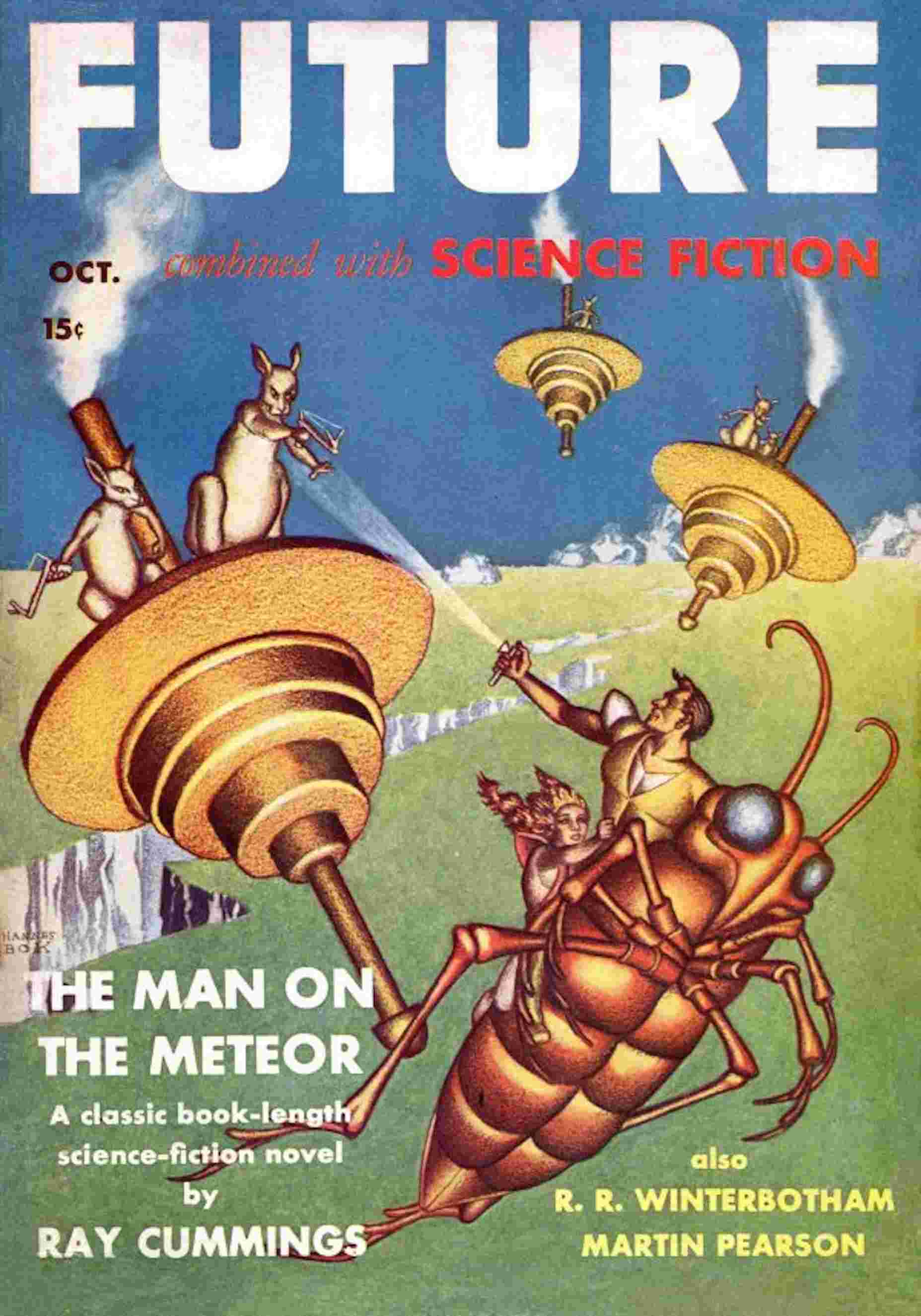
The Project Gutenberg eBook of The man on the meteor
Title: The man on the meteor
Author: Ray Cummings
Illustrator: Hannes Bok
Release date: February 9, 2024 [eBook #72914]
Language: English
Original publication: New York, NY: Columbia Publications Inc, 1941
Credits: Alex White, Greg Weeks & the online Distributed Proofreaders Canada team at https://www.pgdpcanada.net (This file was produced from images generously made available by Internet Archive.)
THE MAN ON THE METEOR
By
RAY CUMMINGS
(Author of “Tarrano, the Conqueror”, “The Exile of Time”, etc.)
Illustration by Hannes Bok.
First published Science and Invention, in 9 parts, 1924.
[Transcriber's Note: This ebook transcribed from
Future Combined with Science Fiction, October 1941.
Extensive research did not uncover any evidence that
the U.S. copyright on this publication was renewed.]
Alone on this strange little world in the orbit of Saturn, the man who knew himself as Nemo, and the golden haired girl who called herself Nona, lived the lives of simple primitives. But weird was this planetoid where rocks burned and the water was fit to breathe, yet no less fantastic than the meteor itself was the bizarre Marinoid people who dwelt deep in its waters! A tale to remember.
CHAPTER I
I do not know where I was born. I am ignorant of the country—I do not even know on which world it was.
I shall tell you my history exactly as I remember it.
The first recollection that I have was when I was a young man at the full height of my physical strength. Let us say, I was twenty, with dark hair and eyes, a slender body, but muscular and powerful. The day I have in mind is clear to my memory now—but everything that happened to me before it is a blank. I found myself lying on the ground. It was dark and there was a sky full of stars and strange flashing lights.
I sat up, stiff and sore, and bruised all over. I was encased in some sort of a rubber suit, with a pack on my back; my head was enclosed in a helmet of transparent, rigid material.
I felt as though I were smothering; and I tore off the helmet and flung it from me. I drank in a deep breath of the night air. It was pure and sweet, but heady. It made my senses reel like some potent wine.
I say that I sat up. That is not strictly true. I pushed my elbow against the ground, and my whole body went into the air. I floated back to a sitting posture. I was light as a feather!
The night was calm without a breath of air stirring—— Lucky for me for I would have blown away had there been any wind! I sat there puzzling over my very existence. I knew nothing, not even my own name. I have since named myself Nemo.
This place where I found myself that starry night showed a barren landscape with only a few queerly-shaped, stunted trees. The horizon was very close to me—almost at hand, in fact—for the ground was curved with an enormous convexity.
It was, indeed, as though I were clinging to the top of a ball, whirling through Space. The stars were swinging across the sky with visible movement.
I had been conscious no more than a minute when a moon swung into view. Then another. And then, without warning, a million tiny worlds flashing silver with reflected sunlight, burst up from below the horizon and swarmed the heavens. Behind them I saw a tremendous, glowing silver sphere, with dark bands upon it—a sphere so large that as it rose it almost filled the sky.
I was on a tiny meteor—one of the myriad that swarm in circular orbits about the planet Saturn and form its rings.
Saturn, in position outward from the Sun, is the sixth major planet of the Solar System. Its mean distance from the Sun is 887,098,000 miles. It is a globe almost as large as Jupiter—74,163 miles in diameter, to be exact. It has, however, a trifle less than half Jupiter’s density and only one-ninth the density of the Earth.
With Saturn’s rings you are perhaps familiar in a general way. They are concentric, and encircle the planet like a flat hat-brim—a brim more than 37,000 miles broad. These rings are composed of billions upon billions of tiny meteors revolving about Saturn all in almost the same plane and each maintaining its separate orbit—each a tiny satellite, each glowing silver from its reflected sunlight.
And it was upon one of these tiny meteors that I found myself. Do not imagine that I knew all these facts at the moment. Far from it. I had no knowledge of any kind. My body was developed to manhood but I was ignorant of everything with only instinct and a dawning reason to guide me.
I had tossed away my transparent helmet. It left my hand and went through the air like a stone from a catapult. The last I saw of it it was sailing out over a line of trees. My brain was still confused but I knew that my body was over-warm. I took off the rubber garment and pack, finding myself in a white knitted affair like a bathing suit—sleeveless shirt and trunks.
I stood up unsteadily, and found that I had just enough weight to maintain my footing. My head was reeling, I suppose, largely because of the quality of the air.
Air, you say! Air on a meteor like that! Do you call yourself an astronomer? If so, you show your ignorance by such questioning. Air, or at least something that served my purposes of breathing, was there and that I am here alive to tell it must be your proof.
I could see perhaps a quarter of a mile. The land curved away, dropping down in every direction so that the sky at the horizon showed seemingly below the level of my feet. I was visibly on the top of the world.
Overhead those billions of tiny worlds were swarming. Sometimes fragments of star-dust would enter my atmosphere—flaming red shooting stars, burning themselves out in an instant. And behind everything hung that gigantic silver ball that was Saturn.
The whole firmament was swinging sidewise. In a few moments half of Saturn was below my horizon. The Sun rose behind me—a smaller Sun than appears to you here on Earth, but still the same yellow-red color.
It was daylight, with the Sun mounting toward the zenith so quickly in less than an hour it would be there, and my day would be half over.
I saw myself now to be standing on a slight rise of black, sandy ground. There were metallic rocks lying about, a low, scanty vegetation in patches on the ground—vegetation of a bluish color; and flimsy, stunted trees. These had broad, angular blue-white trunks with spreading tops ten feet up, and foliage that was bluish-white. Behind me was a jagged, metallic peak perhaps a hundred feet in height.
There was no water in sight, no sign of life of any kind. Quite suddenly I discovered that I was both hungry and thirsty.
What was I to do? This world was so small I could have started walking in any direction and come back to my starting point in a very short time. Walking! It was impossible to walk! I weighed almost nothing. I stood teetering on tip-toe, straining every muscle to maintain my balance, feeling like a balloon poised ready to sail away.
I took a step forward. Under the impulse of my gentle leg-thrust, my body rose into the air in a broad arc. I suppose I went up a hundred feet, sailing forward toward the line of trees at the horizon. I lost my balance; my arms and legs were flying. I floated gently down and landed on my face near the base of a tree!
You smile! I assure you it was not humorous to me. I stood up again, trembling with surprise and alarm. A new vista of land beyond the former horizon had opened. I saw other little jagged peaks a few hundred feet away and behind them, over that dizzying curve downward of the world, was the azure of cloudless Space.
I was frightened, and now I know it was with good reason. Had I leaped recklessly into the air I might have left my tiny world entirely—escaped from its slight gravitation sufficiently to become its satellite, or perhaps even completely to depart its vicinity and become a satellite of Saturn!
This tiny world upon which I found myself was inhospitable to the extreme; and yet if I had been conscious of the choice, I would not have wanted to abandon it for empty Space. Out there, worse than suffering hunger and thirst, I would not be able to breathe.
Whatever my life before this day may have been, walking evidently was part of it. I know that because my instinct was to walk. I decided to weigh myself down with rocks and thus be able to maintain a footing. Futile conception! I seized a huge rock of black metallic quartz in each hand—only to find that the rocks themselves were mere feathers in my grasp! Angered, I flung them into the air. They sailed away, out over the horizon. Undoubtedly they left my world never to return.
The Sun was now past the zenith. It was mid-afternoon. Shortly it would be night again.
I was clinging to the tree-trunk for support, when quite near me I saw what seemed to be the mouth of a cave. I was staring at it when a figure appeared from below. I did not move, and this thing evidently did not see me.
It was a girl, fashioned in human form like myself. She stood there cloaked in the long waving masses of her hair. I must have made some slight sound for after a moment she looked my way. I caught a glimpse of a beautiful oval face framed in the golden tresses, lips full and red, eyes blue, wide now with fear.
Without warning, she left the ground. She went swiftly past me, lying in the air gracefully on one side, her arms moving rhythmically. She was swimming in the air with all the grace and skill of a mermaid!
I stood spellbound. In a moment she had passed over the curve of the world and disappeared.
CHAPTER II
Can I say that the sight of this girl inspired in me any emotion stronger than my passions of hunger and thirst? Not so. I was in the full bloom of my manhood, yet the sight of this beautiful woman thrilled me because now I knew instinctively I might find food and water.
I scrambled forward, holding myself to the ground with difficulty, and entered the mouth of her cave like some marauding animal seeking the sustenance I craved.
The cave-mouth gave into a tunnel leading at an angle downward. The walls were smooth. I forced myself down, half sliding, half gently falling. For an instant the thought came to me that I would encounter other living creatures—things to keep me from the food and drink I wanted. Had I met them—humans or beasts—I know I should have fought desperately.
It was dark in the tunnel; but soon I saw that the rocks were glowing with a phosphorescence. This grew brighter as I advanced.
I went down perhaps two hundred feet; then the tunnel opened. I was in a subterranean chamber of indeterminate size, possibly five hundred feet square, with a black rocky ceiling some fifty feet above me. The whole place was dimly lighted by the red-silver glow which came from the rocks. The air was denser, with a pungent, aromatic odor. It seemed to strengthen me and clear my head.
The sides of the cave were rough and broken with overhanging rocks like shelves. Here and there were other small tunnel-mouths. Most important of all, a small subterranean stream crossed the cave, opening up into a little lagoon near the center. It was a thin-looking, milk-white fluid. I flung myself down to it with a splash.
It tasted, not like milk, but like pure, cold water, though very thin and light. I drank my fill. The joy of it!
There was a pile of blue fabric—woven grass—on the bank beside the stream. The girl’s couch, it proved to be. The robes were very soft, gossamer in weight. I started to dry myself upon one of them. But the water—I shall call it that—evaporated like alcohol, and I was dry in a moment.
There was food here. A patch of black soil had queer, fungus-like growths in it. I had no doubt it was the girl’s food. There were the remains of a fire, though I did not know what it was at the time. On a stone was some of the fungus which had been cooked. Of this I ate.
Upon the couch I lay at ease. The blue robes lay around me like swan’s down. My slight weight made me seem floating in them. It was my first conscious moment of physical peace.
With hunger and thirst appeased my thoughts turned to the girl. She was not only the first woman, but, to my memory, the first living thing I had ever seen. Where was she now? Could I capture her?
Across the cave I saw something move. The mouth of a passageway was there beyond the stream; and in the dim glow of light I could make out the girl standing there. She was watching me as I lay in possession of her couch.
I held myself motionless. After a moment she began coming forward, timidly, yet curiously to inspect me. She stopped at the edge of the stream no more than fifty feet away. Her hair fell in waves to her knees. She stood hesitating, frightened, yet drawn by a power greater than her fear. I could see the muscles of her limbs tensed for instant flight.
I had intended to leap suddenly across the stream but a strange shyness came over me. Instead, I called to her. Words? I had no spoken language. I called some syllable. It startled her; but she answered—a soft little call of shy friendliness.
I wanted her to come to my side of the stream, but she would not. I beckoned to her; but she moved backward on fairy-like tip-toed steps. It angered me. I waved my arm vehemently and tried to climb to my feet, struggling with the airy, half-floating robes of the couch.
The girl took flight. Her arms struck out, and like a swimmer mounting through water she floated up to the ceiling, landing upon a ledge of rock. Through a tangle of her hair her face peered down at me. And though her eyes were frightened, there seemed an impish, mocking expression to her tremulous smile.
Shyness dropped from me. She would obey me; I would make her. I kicked myself into the air and swam as I had seen her swim. But it was not as easy as it looked. I turned over in the air, losing my balance in spite of myself.
I reached the ledge, striking my shoulder violently upon it as I landed in a heap. But she was not there. Across the cave, down by the couch she stood poised on tip-toe, looking at me. And this time her red mouth and dancing eyes were openly mocking.
For half an hour I pursued her about the cave; but she eluded me as easily as though she had been a butterfly and I one of your Earth-children in eager chase. She could have escaped from the cave, but she had no fear of me now. At last, bruised and exhausted by my futile efforts, I sank upon her couch; and again she stood nearby, regarding me.
I was angry and sulky. I pretended to disregard her. At last, utterly worn out, I fell asleep.
CHAPTER III
When I awoke, the girl was sitting beside me. Her soft fingers had been stroking my hair; it was their touch which awakened me. As I moved and opened my eyes, she instantly withdrew beyond my reach.
I was hungry and when I motioned to her and indicated the food, she seemed to understand. I sat quite still, and within a few minutes she was deftly preparing a meal. But I was aware that she watched me narrowly and seldom came within my reach.
The fire she produced by rubbing two stones together. It seemed to ignite the stones, with a tiny flickering flame like the burning of sulphur. She had gathered a pile of dried vegetation from the surface above the cave; and when that was blazing she added rocks that glowed like coal. The fire interested me tremendously. It alarmed me; but only at first, for I saw that the girl had no fear of it.
I need not go into details. Her manner was proud when presently she indicated the hot food ready to eat and she watched me expectantly while I tasted it. I smiled my approval and beckoned her to take some of it with me. At which she curled up on the robe beside me, eating the food I pushed toward her.
We were friends. Like myself, she had no spoken language. But when we tried to talk it came fast. I indicated myself and told her I was Nemo. The word seemed to spring readily to my mind; I have no doubt it was some part of my earlier life. She had no name. I called her Nona. It seemed to please her. She repeated it after me half a dozen times, and clapped her hands delightedly.
A little later we went up to the surface of our tiny world. It chanced to be daylight; and Nona taught me how to swim through the air, how to handle myself against this lack of gravity.
The art came to me quickly. I was soon able to swim about with swift, powerful strokes. My stronger muscles gave me an advantage over her. I could swim more quickly; but I could never attain her deftness, her agility. She would swoop about, dive head downward in a graceful arc, right herself and land on tip-toe.
We circled our little globe, swimming at an altitude of a hundred feet, and following the Sun; and within half an hour were back at our starting point. Everywhere I saw the same bleak landscape. It was night when we returned, for we had overtaken the Sun and passed it. But in a few moments daylight came again.
Then Nona showed me how to jump. With arms folded, she leaped vertically into the air. Straight up her body shot, her hair brushed flat against her by the downward rush of wind. She held herself upright by throwing out a hand occasionally. Like an arrow she mounted; until standing on the ground I could see her only as a tiny dark speck against the blue of the sky.
She came swimming down a few moments later, her hair waving like a cloak behind her, spun gold with the sunlight on it. She was laughing and flushed from the exertion.
Then at arm’s length with fingers clasped, we leaped upward together. The tiny world dropped away. Looking down, it showed itself as a ball. I could see far around it.
We seemed to mount endlessly. The air grew so rare I gasped for breath. My head was roaring. I was cold. Below, I could see the spherical meteor turning under us. We were in Space, no longer a part of our world. And we had almost reached the limit of its atmosphere.
Nona’s fingers clutched mine tightly. Suddenly she twisted me downward and dropped me. A strong side wind had sprung up. We swam down against it, fighting our way until we at last were back to the meteor’s surface.
I was tired, for through my clumsiness I had used far more energy than Nona; but I would not let her see it. I saw her look upon the muscles of my arms and shoulders, and her admiration pleased me. I stretched my arms for her, showed her the muscles of my legs; and looked about for some way of displaying my prowess. There were many boulders around that could be loosened. One by one I flung them into the air, sent them into Space never to return.
Nona watched me with awe, encouraging me with little syllables of pleasure as I selected larger and larger rocks. Some I dug up and tore loose, until at last I ripped off the top and side of a hill. It was a mountain of rock. I staggered like Atlas, with it over my head, and then launched it into the air. It rose a short distance, and fell back to form another hill.
Nona gazed at me with new respect and with a look in her eyes that made my heart pound. I was casting about for some larger burden, but she drew me away.
I was pleased. A sense of my own power filled me. I was master here on this world of mine. I could have taken it apart bit by bit and tossed it into Space. I could tear down mountains, build others in their stead.
“With my slight weight, I could lift huge masses of stone.”
Facts and figures? I am in a position now to give them to you. My meteor had a diameter of five miles, a circumference of some fifteen. Its density relative to Earth was .67. Its surface gravity—again relative to your Earth—was .00039, placing Earth as 1.00. My weight at the surface of my meteor—neglecting other factors which I shall name in a moment—was slightly over one ounce.
Without undue exertion I could leap upward nearly ten thousand feet—that is to say, almost two miles. And the mountain of rock I tossed into the air on your Earth would have weighed some 320,000 pounds!
I have said that the boulders I tossed upward left the surface of the meteor never to return. At an initial velocity of 13 feet a second, all objects became satellites of the meteor, revolving about it comparatively close to the surface in perfect circles. The velocity of escape was but 18½ feet a second, i. e., that velocity which would cause an object to pass into outer Space, moving onward until it found some larger body to encircle.
I give these figures without corrections for atmosphere, axial rotation of the meteor, or the attraction of other bodies. Theoretically they are accurate, though in practice they were altered somewhat. During our brief days we weighed more than I have stated; while at night, less. Indeed, had we essayed a jump into the air at night, we should doubtless have been unable to struggle our way back.
How can that be, you ask? Our proximity to Saturn! Around this great planet we were revolving at a distance of no more than thirty-five thousand miles. Saturn’s surface gravity is a trifle greater than that of your earth—1.07 to be exact. Saturn’s density is only one-ninth that of the Earth; but the difference is made up because of its tremendous size. Saturn’s gravity—to us on the meteor—was an appreciable pull, even though diminished by the distance between us, and further offset by the meteor’s rapid rotation.
Thus, you see, when Saturn was below us—in daytime—its gravity was added to ours. But at night, when it was in the sky above, it was subtracted.
These conditions applied to the days I am describing. Our meteor was then between Saturn and the Sun. Later in our year, when we had passed around Saturn, the Sun was blotted out. There was then no daylight—merely alternate periods of a sky filled with Saturn’s silver disk and the azure, star-filled outer Space.
I have not mentioned the time of our meteor’s axial rotation. It was, as you on Earth measure time, 2 hours, 58 minutes. A complete day and night in less than three hours!
When I had finished showing Nona my strength, it was night again. And such a night! Saturn no more than thirty-five thousand miles away! The darkened bands were plainly visible. When fully overhead, the circular limb of the planet came down in all directions almost to our horizon. The silver light from it was dazzling. And everywhere in the sky, meteors like ourselves were whirling past—silver in Space, flaming red when fragments of them struck our atmosphere.
Occasionally a meteorite would strike our surface, but we had no fear of them. For an hour perhaps, we stood together, silent, gazing with awe at these mysteries of the sky. Until at last Nona gently drew me back to her cave.
CHAPTER IV
Within the cave the air seemed warmer than before, perhaps because I was flushed and tired from my exertion. The radiant light from the rocks was soft. Here all was quiet and peace.
At once I threw myself upon Nona’s couch, stretching my limbs, head pillowed upon my crooked arm. For a time, as before she stood regarding me. There was in her gaze now no fear, but a curious softness. I sensed it. With sudden thought she smiled, and swam across the cave. She got a stone, hollowed out like a cup. She filled it at the stream and offered it to me. I drank gratefully.
Again I was conscious of hunger. The fungus-like food was unsatisfying. I made Nona understand, and she seemed distressed. I could see she wanted to feed me but had no other food.
Finally she motioned me to lie quiet. I watched her as she stretched herself prone on the ground near me. Her head was raised; she was looking keenly, carefully about the cave. Then she began swimming, slowly, stealthily, no more than a foot or two above the cave floor, circling about, up along the walls, back overhead following the line of the ceiling.
Once, when she was hovering over by the side wall, I saw her grow suddenly alert. I followed her steady gaze; and on a rock fifty feet from her I made out the outlines of something lying motionless. It looked like a lizard some three feet long, with white eyes standing out from its forehead. It was because of the eyes that I first saw it.
Nona was in midair. Then, like a wasp she darted at that thing on the rock.
The lizard—I shall call it that—saw her coming. It leaped, and sailed across the cave. I saw it that it had webbed membranes connecting its six outstretched legs.
Nona turned in the air after it, her slim body as sinuous as her waving hair itself. She was faster than the lizard, but again, on the opposite side of the cave, it eluded her.
Back and forth across the cave they went. Often the reptile would dash for one of the passageways but Nona with her greater intelligence, always anticipated it and was there to bar its way.
The lizard seemed jointed all over, and it could turn in the air with extraordinary swiftness. But not so swift as Nona. Once the reptile whirled back and forth on a sustained flight. Nona followed its every twist and turn as one bird follows another.
At last she had it in her arms, in midair at the center of the cave. Calling to me in triumph, she struggled with it, fighting her way down to the ground.
I started toward her, but her voice and gesture waved me away. The lizard was screaming—a shrill, hideous scream. But she had its back bent across her knee. Its spine broke with a crack. It lay still.
By one foreleg she held its quivering body up to me; she was laughing with happiness as she sought my applause.
We ate the meat of its tail and legs; and satiated, I lay somnolent on the robes and watched Nona moving about the cave. She extinguished the fire, and at last approached me timidly. I did not notice her. My eyes were half closed. I was vaguely planning my own hunting for food—wondering if there would be other reptiles larger, for me to capture.
A twitch at the coverings on which I was lying aroused me. Nona was pulling a robe out from under me for herself. I pushed it toward her.
I did not move. It was very soundless in the cave with only the murmuring of the stream. Nona curled up on her robe near me. Thus we lay silent; but I felt her shy gaze always upon me and suddenly I came back to complete wakefulness.
We stared wordlessly at each other until her gaze timidly dropped. With heart racing, I moved myself slowly toward her. I was afraid to frighten her; but she moved, not away, but to me. Abruptly my arms were around her.
Thus I found my habitable world and my mate—beyond which the legitimate needs of man do not go.
The days that followed were happy ones for us both. We lived in our cave and seldom left it. The securing of food, preparing it, eating it, and sleeping until we were hungry again—this was our life.
Animals, yet both of us with the latent intelligence of civilized human beings! Our spoken language came very fast. We seemed to be pent up with words, which once spoken were remembered almost without conscious effort. So it is with your Earth-children who are the despair of their parents because sometimes they do not talk until they are almost two years old. They have it stored up—and when they do give voice, their fluency is amazing.
Our language? I cannot tell you what it was; I do not know. It seemed almost as though we were inventing it as we went along.
Nona, in her spiritual and mental existence, was the counterpart of myself. Who she was, where she had come from—those questions she could not answer. Her mental life had started on the meteor with herself almost a matured woman. One’s mental life, you will realize, is dependent exclusively upon memory. And Nona’s memory previous to the time of our meeting was short and dim. Perhaps human memory only exists with spoken language—or social intercourse of a similar kind. I do not know. Even your hermit speaks, or has spoken to his fellow man.
Time passed. How much time I cannot say. A month—five months perhaps. Time is as inconstant as the wind itself, as you would very soon perceive were you to live in semi-darkness, eating when you could get the food, sleeping when you were tired—and with no mechanical timepiece or its equivalent to measure arbitrarily your passing existence.
The securing of a steady and varied supply of food gave us trouble. The day came when we could not capture a lizard. The fungus-like stuff Nona was growing I had begun heartily to dislike. I had searched every corner of the cave and its passageways for a lizard and had come back unsuccessful.
Nona had started a fire and was sitting beside it drying her hair. Water was evaporating from her shoulders; she had been in the stream. A few molluscs, or something of the kind, lay at her feet.
“See!” she cried triumphantly. “They are to eat. My man Nemo can get them—they are in the water.”
I broke them open and ate one. It was good. I kissed her approvingly and her arms clung about my neck. Nona always was happiest in my approbation; she seemed to think of nothing save how to win it.
When her caresses were passed, I stood up.
“How do I get them?” I demanded. “Nona must show me once—then I will get very many of them for us to eat.”
Nona led me to the stream and we waded into it waist-deep. I had bathed here, but I had never been further along. Nona had, however. She led me forward to where the water went under a low archway of our cave and thence into the bowels of the meteor.
The river-bed under my feet began sloping downward. The water deepened around me—to my chest, shoulders, almost to my neck. I was terrified. I pulled back from Nona’s hand which was drawing me along. Her hair was floating out like golden seaweed around us. The milk-white water was under her uptilted chin.
Her eyes smiled at me tenderly. “No,” she said. “My man Nemo never can he be afraid.”
Afraid! I could not let her see that. I grunted scornfully, and we went forward.
The water rose to my own chin. We were well underground now—the ceiling of this subterranean passageway was hardly a foot above my head. In front of me I could see where the ceiling touched the water.
Suddenly I remembered Nona. One of her hands still held mine—the other was braced against a projection of the side wall to hold us against the gentle current that pressed us forward. The water now almost reached the top of her head. I could see her face beneath the surface. Her mouth was opened round and wide; a stream of air bubbles came gurgling up from it. Her chest was expanding and contracting rhythmically and swiftly, seemingly with great effort, like a man panting after an exhausting run. She was breathing the water!
CHAPTER V
I stared at Nona silently. The air bubbles from her mouth grew less, until soon there were almost none of them. The tidal air in her lungs had been forced out; water had taken its place. Through her opened mouth she was drawing in the water and expelling it—rapid respirations taxing the intercostal muscles almost to their limit.
Nona smiled up at me through the water, which in spite of its milk-white color, was curiously limpid and transparent. I felt the tug of her hand; I stepped forward, and in the deepening water my face went under.
Whatever may have been my previous existence, an experience such as this quite evidently was no part of it. My instinct was to hold my breath. I did so until I could no longer. I struggled against Nona’s hand and tried to get my head above the surface. But she held me; and my fear of having her know me to be afraid was greater than my fear of the water.
At last I let out my pent-up breath. It gurgled from my mouth in bubbles. Then, in a gulp of desperation, I inhaled. The water choked me. I tried to cough; but could not—or at least the cough became my exhalation.
My ears were roaring as though the torrents of your Niagara were rushing past them. My head and chest seemed bursting—icy-cold at first, then burning with fire.
My eyes were open. I was standing beside Nona and she was looking up at me. Through the half-light of the water I could see her almost as plainly as through air. She smiled encouragingly at me, and I tried to smile back.
I was drawing the water in and out swiftly now, with my mouth held extended like an expiring fish. It was a tremendous effort, this respiration. The muscles of my chest and diaphragm were tired in a moment. A weight in my chest seemed smothering my heart; I seemed on fire inside—a million inflamed little lung passages rebelling at this unaccustomed medium.
Spots were dancing before my eyes. I was losing consciousness through lack of oxygen. The poisoned venous blood was dulling my brain.
Then I began to feel better. I was respiring now almost as swiftly as Nona, and with far less effort than I had used at first.
You are skeptical? Because you cannot breathe your Earth-water, you assume that I could not breathe this water on my meteor. What quaint logic that is! Yet I find all you Earth-people think on similar lines. It is your inadequate mentality, I suppose, so I must hasten to enlighten you.
There are two fundamental objects of respiration. First: the introduction into the system of oxygen by which the products resulting from the disintegration of the muscular, nervous and other tissues of the body may be converted into compounds easily eliminated. Secondly: the direct removal of the most noxious and therefore most important of these waste products—carbonic acid gas.
In man, as you know him on Earth, this is accomplished by the lungs. The venous blood, charged with its carbonic acid and its waste products, needing a renewal of oxygen and a removal of the carbonic acid, is pumped by the heart through the lungs. These by their construction present an immense amount of internal surface covered by a vascular network, through which the blood flows in innumerable minute streamlets.
In respiration, the inhaled air is separated from the blood only by an extraordinarily thin membrane—less than 1/20,000 of an inch in thickness. Through this membrane the blood absorbs oxygen from the air, giving in return to the air its noxious carbonic acid gas.
Such is the basic process in you Earth-men. In the case, let us say, of your Earth-fishes breathing your water, there is little fundamental difference. The blood in their gills is brought practically into contact with a steadily moving stream of water. But fishes do not get their oxygen from the water in some mysterious fashion. Did you think they did? They get the oxygen, not from water, but from air—the air that is held in solution in the water.
But for two things, you on Earth could breathe your water. First, your lung passages are too minute to receive a substance so heavy, so unvolatile, let me say, as is the water of Earth. Secondly, there is not proportionally enough air in your water.
Both these conditions were different on my meteor.
This water on my meteor was very different from water as you know it. I have already said it was light and thin. To be exact, I estimate that on your Earth it would have a specific gravity of no more than .18, placing your water at 1.00.
In your sea-water a normally fleshy man will float with a small margin to spare. This water on my meteor was not saline; but more than that, Nona and I stood submerged in it with hardly any perceptible feeling of buoyancy.
Let me make my point still clearer. The low specific gravity of this water compared to yours was principally caused by the large amount of air it held in solution. It was, in a word, highly aerified to an extent proportionally eleven times more than is your average water on Earth. For this reason, my lungs needed but one-eleventh the amount of it from which to secure the necessary oxygen.
On Earth, your normal respiration varies widely; sixteen to twenty times per minute for a healthy adult at rest might be taken as a fair average. I was breathing this water at approximately eighty respirations per minute.
I do not know how long I stood there under the surface with Nona before I attained semblance of normality. But gradually the burning in my chest and the smothering of my heart subsided. My brain cleared.
I looked about me curiously. The water was clear and transparent to a remarkable degree. There seemed inherent light diffused through it, like a phosphorescence.
We had taken several steps forward and were well below the surface now. Underneath my feet was a sandy soil. To the right and left were rocky walls—the sides of the submerged tunnel. And ahead lay open water, dim in the distance, with the narrow sandy floor sloping downward like a path down a hillside.
Everything was slightly blurred in outline. Nona’s hair floated out and above her. The freedom of movement we had had in the air above was gone. We were hampered in moving by the friction of the water.
But it was nothing like the friction of walking in your water. Indeed, it was far more like your Earthly existence on land.
I am very specific in detailing these sensations. You will see why in a moment; you will see that this experience was the means of saving both our lives—Nona’s and mine—and projecting us into a new era of my existence.
For after the very next time of sleep, the catastrophe to our tiny world overtook us.
CHAPTER VI
We found our molluscs and struggled back up the sloping path to shallow water. On the bank I lay and coughed, gasping and struggling to remove the residual water from my lungs and replace it with air. The transition back was far worse than entering the water. Nona, who quite evidently had done it several times before, recovered more quickly than I. As I lay panting and choking upon our couch, she made up a fire. The two stones which she rubbed together ignited in a moment—a slow, sulphurous-looking flame with a little smoke which the slight current of air through the cave carried away. Then, when the first stones were burning, she added other stones which glowed like coal.
We ate our meal, and I lay again upon our couch with Nona sitting beside me.
I was awakened by a sense of burning and smothering. I sat up, coughed, and twitched at Nona’s hair to arouse her.
The cave was full of smoke. Beside me was what seemed a pit of fire. The heat from it was intolerable. I flung Nona into the air and followed her myself with a leap.
Across the cave we stood trembling with fright, regarding the red monster of fire that had eaten for itself an open pit in the cave-floor.
Nona had forgotten to extinguish the fire of our evening meal. These rocks were inflammable. The fire had eaten its way downward, as a fire on your Earth would eat downward into a bed of coal, spreading out beneath the ground.
Nona and I did not reason it out that way at the time. All we knew was that the red fire-monster had broken loose, and we were afraid of it. Blue and red tongues of flame licked up from the mouth of its lair; its hot, poisonous breath was stifling us even across the cave.
I was inactive only for a moment. Bidding Nona keep away, I tried to throw dirt into the little crater-mouth.
But the dirt had no effect. I might have extinguished it with water you say? True, I might, though I think now that the volatile, highly aerated water would have been of little avail.
I did not try the water. I did not know that water and fire were traditional enemies. Nor did Nona. How were we to know that, unless we had chanced to discover it for ourselves, which we had not.
Nona screamed at me and I gave up my futile efforts. The air in the cave was almost suffocating; and with the instinct that comes to any trapped animal underground, we scrambled up the passageway to the surface of the meteor.
It was night, with silver Saturn filling the overhead sky. Trembling, we stood and watched the cave-mouth from which a visible line of smoke was now issuing. Our home was down there; the fire-monster had it—and we could not go down and take it from him.
We never went back to the cave. The meteor’s swift days and nights passed in rapid succession; and during several of them we stood helplessly watching.
Presently the fire came to the surface. I realize now that it was eating its way downward as well as upward until the entire vicinity of the cave was glowing with molten, burning rocks.
The ground all around the cave-mouth soon fell inward. A seething crater was exposed where the cave had been—a bottomless pit of lurid, licking flames with black smoke rolling up from it, and the hissing of steam below.
We took instant flight, swimming through the air over our tiny world, until, on its opposite hemisphere we found sanctuary.
There was no evidence of the fire here. We were pleased. We would find another cave, another river, and build our home anew.
We were both famished. I caught a lizard and we ate it—uncooked, for we were both afraid to unleash again the monster that had all but overcome us.
Then we slept; and again, when two of the meteor’s brief days and nights were passed, and Saturn was sinking below the horizon to give place to dawning sunlight, we searched for a new cave.
No cave was to be found. But there was water. A river several hundred yards wide bubbled up from the ground and flowed in a broad shallow stream toward the horizon. We followed it to a tiny line of hills. Into a hole in a cliff-face it plunged downward with an impetuous current.
Here we decided to build our home. There were blue rushes along the river bank. Nona gathered them; she would dry them, plait them into robes for our couch.
Once I flew back to the fire. I could not get very close to it, for the air choked me. The fire seemed to be burning itself out. It was dull, with flickering puffs of flame in the midst of a thick pall of smoke which hung motionless in the still air.
I returned to Nona.
“The fire-monster is dying,” I said. “But it has eaten our cave.”
I know now what was happening. The fire was being smothered for lack of fresh air to sustain its combustion. Had there been any wind I do not doubt but that the entire surface of the meteor would have been consumed.
An almost equally great danger threatened us, however—and presently we were made aware of it. The smothering, smouldering fire gave off steadily a tremendous volume of unconsumed gases. Even without any wind they diffused themselves throughout the meteor’s atmosphere, it was so small a world, with so thin a blanket of air about it—an infinitesimal fraction of the air that envelopes your Earth. Rapidly it became polluted with poisonous gases from the half-smothered fire—polluted throughout its entire extent.
For a day we were uneasy. Then we grew frightened. There was little evidence of smoke—only a blue haze. But the air seemed to choke us. It was the poisonous breath of the fire-monster come to make us sick.
We tried to go somewhere to escape it. But we were on the opposite side of the world from it already, and no matter which direction we took, inevitably we approached it.
Except upward. We tried higher altitudes. The air was purer up there, but also it was thinner, and we could not live in it for any length of time. Nor could we sustain ourselves aloft indefinitely—to say nothing of sleeping and eating.
Once in desperation we tried swimming off the meteor into Space. But the lack of any breathable air at all soon brought us struggling downward.
That night there was a gentle wind. The breath of the fire-monster swept up over the horizon and came upon us with a deadly blast. We woke up, choking. It was daylight, with a small red-yellow sun dim and blurred by the poisonous haze that enveloped us.
Nona was crying. But suddenly I laughed, triumphantly, for I realized now that the fire-monster could not harm us.
We were lying at the river bank. I seized Nona in my arms and flung her headlong downward into the water. And I plunged in after her. The water here was deep—thirty feet perhaps, as you on Earth would measure it. With arms flying, we sank like stones to the river bottom.