
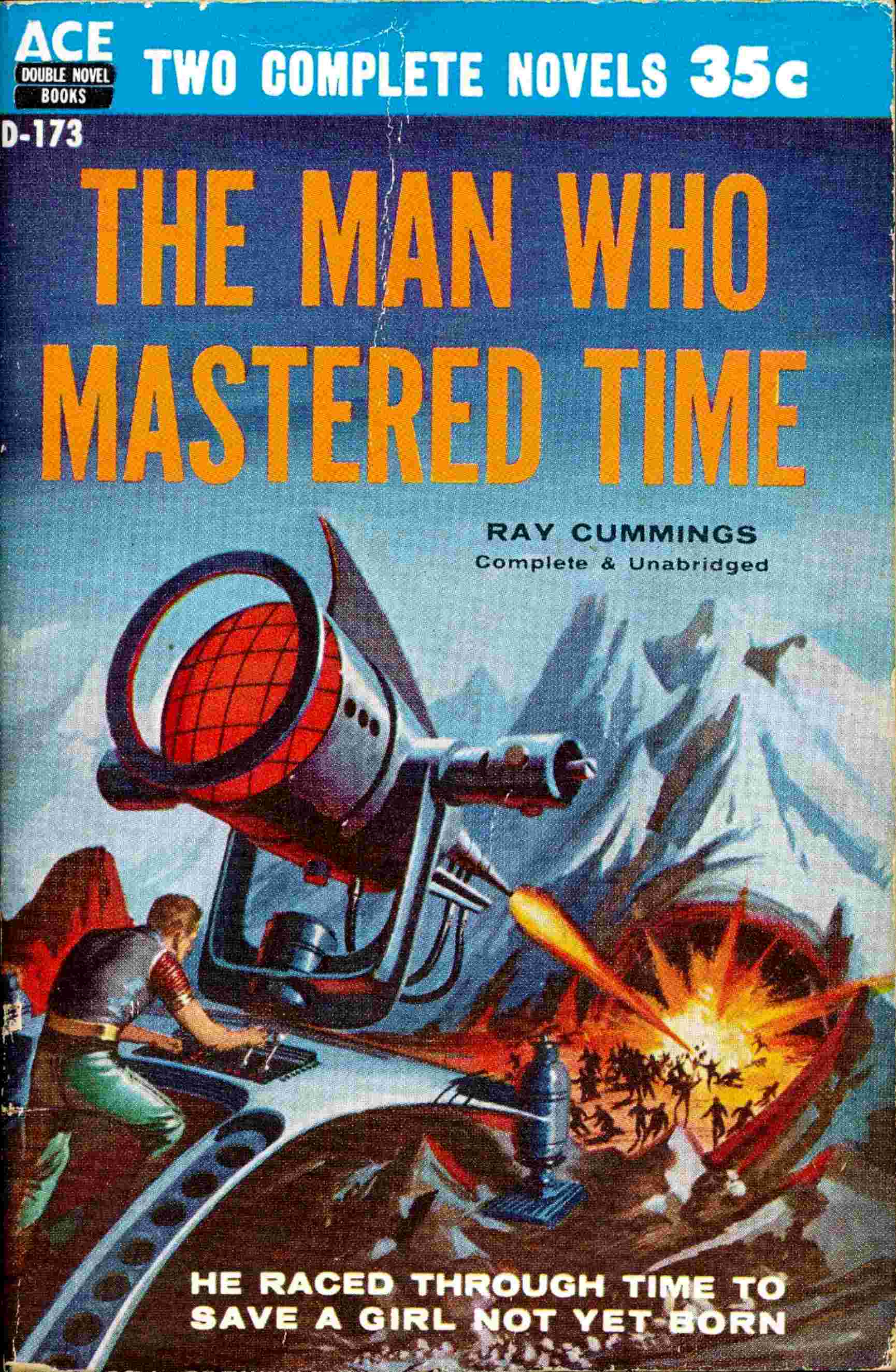
The Project Gutenberg eBook of The man who mastered time
Title: The man who mastered time
Author: Ray Cummings
Illustrator: Ed Valigursky
Release date: July 14, 2025 [eBook #76503]
Language: English
Original publication: New York, NY: Ace Books, 1929
Credits: Greg Weeks, Paul Ereaut, Mary Meehan & the Online Distributed Proofreading Canada Team at http://www.pgdpcanada.net
THE MAN WHO MASTERED TIME
RAY CUMMINGS
ACE BOOKS
A Division of A. A. Wyn, Inc.
23 West 47th Street, New York 36, N. Y.
THE MAN WHO MASTERED TIME
Copyright, 1929, by Ray Cummings
An Ace Book, by arrangement with the author.
To Gabrielle
Who has given me affectionate
assistance for a long, long time.
Printed in U. S. A.
CHAPTER ONE
"Time," said George, "why I can give you a definition of time. It's what keeps everything from happening at once."
A ripple of laughter went about the little group of men.
"Quite so," agreed the Chemist. "And, gentlemen, that's not nearly so funny as it sounds. As a matter of fact, it is really not a bad scientific definition. Time and space are all that separate one event from another. Everything happens somewhere at sometime."
"You intimated you had something vitally important to tell us," the Big Business Man suggested. "Something, Rogers, that would amaze us. Some project you were about to undertake—"
Rogers raised his hand. "In a moment, gentlemen. I want to prepare you first—to some extent, at least. That's why I have led you into this discussion. I want you to realize that your preconceived ideas of time are wrong, inadequate. You must think along entirely different lines, in terms of, I shall say, the new science."
"I will," agreed George, "only tell me how."
"You said that time, space, and matter are not separate, distinct entities, but are blended together," the Doctor declared. "Just what do you mean?"
Rogers gazed earnestly about the room. "This, my friends. Those are the three factors which make up our universe as we know it. I said they were blended. I mean that the actual reality underlying all the manifestations we experience is not temporal or spatial or material, but a blend of all three. It is we who, in our minds, have split up the original unity into three such supposedly different things as time, space and matter."
"Take space and time," said the Big Business Man. "Those two seem wholly different to me. I shouldn't think they had the slightest connection."
"But they have. Between the three planes of space—length, breadth and thickness—and time, there is no essential distinction. We think of them differently; we instinctively feel differently about them. But science is not concerned with our feelings—and science recognizes today that time is a property of space, just as are length, breadth and thickness."
"That's easy to say," growled the Banker. "Any one can make statements that can't be proven."
"It has been proven," Rogers declared quietly. "The mathematical language of science would bore you. Let me give you a popular illustration—an illustration, by the way, that I saw in print long before Einstein's theory was made public. For instance, think about this: A house has length, breadth and thickness. The house is matter, and it has three dimensions of space. But what else has it?"
A blank silence followed his sudden question.
"Hasn't it duration, gentlemen? Could a house have any real existence if it did not exist for any time at all?"
"Well," said George, "I guess that's something to think about."
Rogers went on calmly: "You must admit, my friends, that the existence of matter depends on time equally as on space. They are, as I said, blended together. A house must have length, breadth, thickness and duration, or it cannot exist. Matter, in other words, persists in time and space. Let me give you another illustration of this blending. How would you define motion?"
Again there was a dubious silence.
"Motion," said George suddenly, "why, that's when something—something material changes place." He was blushing at his own temerity, and he sat back in his leather chair, smoking furiously.
"Quite so," smiled Rogers. "That, gentlemen, is about the way we all conceive motion. Something material, a railroad train, for instance, changes its position in space." He regarded the men before him, and this time there was a touch of triumph in his manner. "But, my friends, that's where our line of reasoning is inadequate. Time is involved equally with space. The train was there then; it is here now. That involves time."
"In other words—" the Doctor began.
"In other words, motion is the simultaneous change of the position of matter in time and space. You see how impossible it is to speak of one factor without involving the others? That is the mental attitude into which I'm trying to get you. I want you to think of time exactly as you think of length, breadth and thickness—as one of the properties of space. Isn't that clear?"
The Big Business Man answered him. "I think so. I can understand now what you mean by a blending of—"
"Oh, his words are clear enough," the Banker interjected testily. "But what's the argument about? He started in by saying—"
George sat up suddenly. "Mr. Rogers, you said we were to come here for something vitally important to you. Something about time and space. You said—"
Rogers interrupted him. "I did indeed. I asked you all to come here to the club tonight because you are my friends. Mine and Loto's. And the affair concerns him more directly than it does me."
He glanced across the room. "Come, Loto. You're the one to tell them."
The Chemist's son, a young man of twenty, rose reluctantly from his obscure seat in a corner of the room. He was tall, and slight of build, with thick, wavy chestnut hair and blue eyes; his delicate features were offset by a square firmness of chin. He came forward slowly, flushing as the eyes of the men were turned on him; a poetic-looking boy, with only the firm line of his lips and the set of his jaw to mark him for a man.
"My son, gentlemen," Rogers added. "You all know Loto."
"We do," said George enthusiastically. He vacated his own chair, shoving it forward, and selected another, more retired position for himself.
Loto settled himself in the chair and then hesitated, as though in doubt how to begin. He was still flushing, and yet his manner was thoroughly poised. His forehead was wrinkled in thought.
"Father and I were experimenting," he began abruptly, "about two years ago. We were interested in electrons. We were experimenting with the fluorescence in a Crookes tube—breaking down the atoms into electrons. Then we followed the experiments of Lenard and Roentgen. We darkened the tube and prepared a chemical screen, which grew luminous."
Loto turned to Rogers: "They don't want to hear all this. These technicalities—"
Rogers smiled. "We hit upon it quite by accident—an accident that we have never been able to duplicate. We had, that evening, an adaptation of the familiar Crookes tube. I do not know the exact conditions we secured; we had no idea we were on the threshold of any discovery and we kept no record of what we did. Nor am I sure just how I prepared the screen—what proportions of the chemicals I used—"
"You're worse than Loto," the Banker growled. "If you'll just tell us what—"
"I will," agreed Rogers good-naturedly. "We were working one night in my laboratory on Forty-third Street—only a few hundred yards from the Scientific Club here. The room was dark, and we had set up a small chemical screen. It grew luminous as the electrons from the tube struck it, but the glowing was not what we had expected—not what we had observed before. The difference is unexplainable to you, but we both noticed it. And then Loto noticed something else, something in the darkness behind the screen."
Loto was sitting upright on the edge of his chair; his eyes were snapping with eagerness as he interrupted his father.
"I'll tell them because it was I who saw it first. Behind the screen, the darkness of the room itself was growing luminous with a glowing radiance that seemed to spread out into rays that were not parallel, but divergent. It looked almost as though the screen were a searchlight sending a spreading beam out behind it.
"Father saw it almost as soon as I did. It was a very curious light; it did not illuminate the room about us. Then we suddenly discovered that it went through the walls of the laboratory. We were looking into a space that seemed to be opening up for miles ahead of us. The walls of the room, the house itself, the city around us, were all blotted out. We were looking into an empty distance."
"Empty?" echoed George tensely. "Didn't you see anything?"
"Not at first." Loto had relaxed; his earnest gaze passed from one to the other of the intent faces of the men. "We were only conscious of empty distance. It was not darkness nor was it light. It was more a dim phosphorescence. We had forgotten the Crookes tube, the screen, everything but that glowing, empty scene before us.
"After a moment, or it may have been much longer, the scene seemed to brighten. It turned to gleaming silver, and then we saw that we were looking out over a snow-covered waste. Miles of it. Snow reaching back to the horizon, and dull gray sky overhead. The ground seemed about sixty feet below us, and we were poised in the air above it."
Loto paused a moment, and Rogers added, "You understand, gentlemen, that my laboratory is not on the ground floor of the building, but somewhat above the level of that part of the city."
"But—" began the Big Business Man.
"Let him go on," growled the Banker. "Go on, boy. Didn't you see anything but snow?"
"No, not at once. It was all bleak and desolate. But it kept on brightening, losing its silvery, glowing look until at last we could see it was daylight. It was apparently late afternoon—or perhaps early morning. The sun wasn't showing—it must have been behind a cloud.
"We sat staring down at this cold, snowy landscape, and then, almost from below us, something moving came into view. It had passed under us—under the laboratory—and was traveling on away from us."
"What was it?" the Banker demanded.
"Well, it seemed to be a huge sled, with fur covered figures on it, and pulled by an animal almost as large as a horse. But it wasn't a horse—it was a dog."
Loto paused, but no one else spoke. After a moment he resumed:
"The sled slackened and stopped about a quarter of a mile north of the laboratory—up toward where Central Park is now. And then we saw that there was a building there, a large, oval-shaped structure. It may have been built of snow, or ice—or perhaps some whitish stone. There seemed to be an enclosed space behind it. The whole thing blended into the landscape so that we had overlooked it before.
"The sled stopped. We could see the figures climbing down from it. Then there was sudden darkness. The scene went black. We were sitting facing the side wall of the laboratory."
"A wire in our apparatus had burned out," Rogers explained. "And that night I was taken sick. It developed into pneumonia and I was laid up for weeks. Loto was left alone to follow up our discovery."
"Just a minute," the Banker interjected. "Do I understand you to imply that you actually saw all this? It was not a vision, or an electrical picture of some sort that you were reproducing?"
"No, they mean it was an actual scene," the Big Business Man put in. "They were seeing New York City at some other time. Isn't that so?"
Rogers nodded. "Exactly. And while I was sick, Loto went ahead and—"
"Was it the past?" the Doctor interposed. "Were you looking back into the past?"
"We were looking across countless centuries into the future," said Loto.
"The future!"
"Yes," declared Rogers. "Must you always think of the future as a wonderful civilization of marvelous inventions, mammoth buildings and airplanes like ocean steamships? All that lies ahead of us, no doubt. A hundred years—two hundred—a thousand—will bring all that. But further on? What about then, gentlemen? Ten thousand years from now? Or fifty thousand? Do you anticipate that civilization will always climb steadily upward? You are wrong. There must be a peak, and then a down grade—the decadence of mankind."
"Please, let me go on," Loto said eagerly. "I need not tell you all now exactly how we knew we were looking into the future, and not the past. We, ourselves, did not know it that first evening. But later, when I studied the scene more closely, I could tell easily."
"How?" the Banker demanded.
"By the details I saw. The type of building. That animal that looked like a dog. The sun—I'll tell you about that in a moment. An artificial light in the house—I saw it once or twice when it was night there. And the girl. Her manner of dress—"
"There was a girl?" said George quickly. "A girl! Tell us about her, Loto. Was she pretty? Was she—"
"Go on, boy," growled the Banker. "Tell it from where you left off."
"Yes, she was very pretty," said Loto gravely. "She—" He stopped suddenly, his gaze drifting off into distance.
"Oh boy!" breathed George, but at the Banker's glare he sat back, abashed.
Loto went on after a moment: "I won't go into details now. While my father was sick, I was able to examine the scene many times. I even think I—well, I sat watching it most of the time for a week at least.
"The house had a sort of stable—or a kennel, if you want to call it that—behind it. And there was an open space, like a garden, with a wall around it. There was a little tree in the garden; a tree all covered with snow. But after a few days the sun came out and melted the snow on the tree branches.
"The girl was a captive. I guess they were bringing her in on that sled the night we first saw them. There was another woman about the place, and an old man. And a younger man—the one who was holding the girl a prisoner."
"You said the house looked about a quarter of a mile away," the Banker declared. "How could you see all these details?"
"I had a small telescope, sir."
"The scene actually was there," Rogers put in. "Loto used a telescope quite as he would have used one through the window to see Central Park. Go on, Loto."
"The girl..." George prompted.
"She was a small girl. Very slender—about sixteen, I guess. She had long, golden hair, but it was red when she stood outside with the sun on it. That's because the sun was red; an enormous glowing red ball, like the end of a cigar. It tinged the snow with blood, but there didn't seem to be much heat from it.
"Sometimes I could see the girl through the doorway. There was a door, but it was transparent—glass, perhaps—and the house was lighted inside. She would sit on a low seat, with her hair in sort of braids down over her shoulders. Once she played on some little stringed instrument. And sang. I could see her so plainly it seemed curious not to hear her voice.
"They appeared to treat her kindly, even though she was a captive. But once the man came in and tried to kiss her. She fended him off. Then he went out and got on his sled and drove away. He was gone several hours.
"The girl cried that night. She cried for a long time. Once she ran outside, but one of those huge dogs came leaping out of the other building and drove her back. The dog's baying must have aroused the place. The old man and the woman appeared, and they locked the girl up in some other room. I never saw her again.
"A week or two went by and father was better. But the next time I went to the laboratory, the apparatus wouldn't work. Perhaps the chemicals on the screen were worn out—We're not really sure. But we've never been able since to make a screen that would do more than glow. We've never had another that would affect the time-space behind it."
"You mean," said the Big Business Man softly, "that after those brief glimpses into the future, it is closed again to you?"
Rogers spoke. "Tell them the rest, Loto."
The younger man was hesitant. "Perhaps you gentlemen wouldn't understand. We have seen nothing more, but I couldn't forget that girl."
"I understand," George murmured. But Loto went on unheeding:
"It wasn't the scientific part of our discovery that impressed me most. We kept that secret because we had no proof of what we had done, and we couldn't seem to get any. It was the girl that bothered me. That girl—a captive—facing some danger.... You gentlemen will say she isn't living, that she won't be alive for thousands of years yet. But I say your conception of it is wrong."
Loto's voice had gained sudden power. He seemed abruptly years older—forceful, commanding.
"You say that girl will be living in the future. I say she is living in the future. She is living just as you and I are living—right here in this exact space that we call New York—within a few hundred yards of this room. She is separated from us, not by space, but only by time.
"You, gentlemen, perhaps cannot conceive of crossing that time. But if it were a mile of space, or a thousand miles, you could imagine crossing it very easily. Yet we know that time is a property of space; not one iota different from length, breadth and thickness except that we think of it differently."
Loto's flashing eyes held his little audience. "Gentlemen, suppose you—with your human intelligence—were trees, rooted to one spot here in America. And suppose that the accustomed order of things was that Asia would come slowly and steadily toward you and pass before you. That is what time does for us. Do you suppose, under those circumstances, that you could readily conceive of going across space and reaching Asia? Think about that, gentlemen! It's easy for us to imagine moving through space, because we've always done it. But a tree with your intelligence would not feel that way about it. The tree would say: 'Asia will be here.' And if you said: 'That's true. But Asia exists just the same in a different part of space from you. If you go there, you will not have to wait for it to come to you,' the tree—even if it had your present intelligence in every other way—wouldn't understand that. Simply because the tree had always conceived space as we are accustomed to conceiving time. That conception of ours does not fit the real facts, for—except for the way space and time affect us personally—there is actually no distinction to be made between them. That is no original theory of mine; it is modern scientific thought—mathematically proven and accepted ever since Albert Einstein first made his theory public."
A silence followed Loto's outburst. Rogers broke it:
"We would like to have you gentlemen meet us here two weeks from tonight. We are not quite ready yet. Will you do that?"
Every one in the room signified assent.
"But what for?" George asked earnestly. "Of course we will, but has Loto discovered anything? Has he—"
Loto interrupted him. "I have been working and experimenting for two years." He had fallen back to his quiet manner. "Father has helped me, of course. And given me money—more than he could afford."
He smiled at Rogers, who returned it with a gaze of affection.
"In two weeks I will be completely ready. Don't you think so, father?"
"Yes," said Rogers, and a sudden cloud of anxiety crossed his face. He was a scientist, but he was a father as well, and even his scientific enthusiasm could not allay the fear for his son that was in his heart.
"Yes," he repeated. "I think you will be quite ready, Loto."
"Ready for what?" growled the Banker. He was mopping his forehead with a huge white handkerchief.
Loto's glance swept across all the men in the room. "I have found a way to cross time, just as you are able to cross space. And two weeks from tonight, gentlemen, with, your assistance, I propose to start forward through the centuries that lie ahead of us. I'm going to find that girl—if I can—and release her—help her out of whatever danger, whatever trouble she is in!"
CHAPTER TWO
"Honor to Loto," cried the Big Business Man. "The youngest and greatest scientist of all time!"
"There's a double meaning in that," laughed the Doctor, amid the applause. "The greatest scientist of time! He is, indeed."
It was outwardly a gay little gathering, having dinner in a small private room of the Scientific Club. But underneath the laughter there was a note of tenseness, and two of the people—a man and a woman—laughed infrequently with gayety that was forced.
The man was Rogers; the woman, Lylda, his wife, mother of Loto. She was the only woman in the room. At first glance she would have seemed no more than thirty-five, though in reality she was several years older—a small, slender figure in a simple black evening dress that covered her shoulders, but left her throat bare. Her beauty was of a curious type; her face was oval, her features delicately molded and of pronounced Grecian cast. Yet there seemed about her, also, an indefinable touch of the Orient; her eyes, perhaps, which were slate gray, large and very slightly upturned at the corners. Her complexion was fair; her hair thick, wavy and coal-black.
That she was a woman of intellect, culture and refinement was obvious. There was about her, too, a look of gentle sweetness, the air of a woman who could be nothing less than charming. Her eyes, as she met those of her men friends around her, were direct and honest. But when she regarded Loto this evening, a yearning melancholy sprang into them, with a mistiness as though the tears were restrained only by an effort.
The laughter about the table died out. A waiter was removing the last of the dishes; the men were lighting their cigars.
"Well," said the Banker, breaking the silence, "now let us hear it. If everyone is as curious as I am—"
"More," put in George. "I'm more curious."
"You're right," agreed Rogers. "We must get on."
"First," the Big Business Man interrupted, "I want to know more about that screen behind which you saw that other time world of the future."
"I know very little myself," Rogers answered. "So little that Loto and I could never duplicate it. But the theory is understandable. The space where Central Park now is has a certain time factor allied to its other properties. The light, the rays, from that screen, whatever may have been their character, altered the time factor of that space.
"As Loto told you, the modern conception of the reality of things is that the future exists—but with a different time dimension. We have a familiar axiom, 'No two masses of matter can occupy the same space at the same time.' That is just another way of saying it. To reason logically from that, an infinite number of masses of matter can, and do, occupy the same space at different times."
"I'd rather hear about this new experiment," the Banker said. "You made the statement—"
"So would I," agreed George. "That girl—"
"You shall," said Rogers. His grave, troubled glance went to his wife's face, but she smiled at him bravely. "You shall have all the facts as briefly as I can give them to you.
"Loto became obsessed—I can hardly call it anything less—with the idea that he could alter the time factor of human consciousness. In theory it was perfectly possible—I had to admit that. And so I let him go ahead. He has worked feverishly, with an energy I feared would injure his health, for nearly two years. But, gentlemen, this is all that counts: he has succeeded. I'm sure of that; we have already made a test. The apparatus is ready upstairs now, and—"
"Let Loto tell it," grumbled the Banker. "Go on, boy, can't you tell us how you did it?"
"Yes, sir. I can in principle." Loto hesitated, then added with a mixture of sarcasm and deference: "I can explain it to you in a general way, but the details are very technical."
He paused until the waiter had left the room; then he began speaking slowly, evidently choosing his words with the utmost care.
"Matter, as we know it now, has four dimensions; the three so-called planes of space, and one of time. But what is matter? The new science tells us it is molecules, composed of atoms. And atoms? An atom is a ring of electrons, which are particles of negative, disembodied electricity, revolving at enormously high speeds around a central nucleus. Am I clear?"
Loto's gaze rested on the Banker, who nodded somewhat dubiously.
"Then," Loto went on, "we have resolved all matter to one common entity, that central nucleus of positive electricity which is sometimes called the proton. All this is now generally known and accepted. But of what substance, what character, is the proton? For years now, the theory has been fairly accepted that the proton is merely a vortex, or whirlpool. And the electron is conceived to be something very similar. Do you grasp the significance of that? It robs matter of what I, personally, always instinctively feel is its chief characteristic—substance. We delve into matter, resolving its complexities to find one basic substance, and we find not substance but a whirlpool—electrical, doubtless—in space!"
"That makes you rather gasp!" the Big Business Man exclaimed, gazing about the table.
"It is quite correct," affirmed Rogers. "It transforms our conception of substance to motion. Of what? Motion of something intangible—the ether, let us say. Or space itself."
"I can't seem to get a mental grip on it," the Big Business Man declared. "You—"
"Think of it this way," Rogers went on earnestly. "Motion can easily change our impression of solidity. This is not an analogous case, perhaps, but it will give you something to think about. Water is normally a fluid. You can pass your hand through a stream of water from a garden hose. But set that water in more rapid motion, and what physical impression do you get? At Fully, Switzerland, water for a turbine emerges from a nozzle at a speed of four hundred miles per hour. What would happen if you tried to pass your hand through that? I have seen a jet no more than three inches in diameter of such rapidly moving water, and you cannot cut through it with the blow of a crowbar! There you have a physical substance—an impression of solidity—derived from motion."
"But what has all this to do with time?" the Banker objected, after a moment of silence.
"Everything," said Loto quickly. "Since we are changing the time-dimension of matter, without altering its space-dimensions, you must have some conception of what matter really is. When once you realize the real intangibility of even our own bodies, or this house we are in, you will be able to understand us better."
The Banker relaxed. "Go on, boy. Let's hear it."
"Yes, sir. Changing the time-dimension of substance amounts merely to a change in the rate and character of the motion that constitutes the electrical vortex we call a proton."
Loto looked at Rogers somewhat helplessly, with a faintly quizzical smile twitching at his lips.
"I seem to be talking very ponderously tonight, father. I wonder if it wouldn't be easier for us to show them the apparatus?"
Rogers rose from his chair. "By all means. Gentlemen, Loto has completed his apparatus on the roof of the club. You may have noticed for the past month that one end is boarded up, and has a canvas roof over it. That is where Loto has been working. Will you come up with us?"
The building that houses the New York Scientific Club is a full block in depth and twenty stories high. Its flat roof is surrounded by a parapet of stone. One end of the roof is a garden, with pergolas, trellised vines, and beds of flowers with white gravel walks between. At the other end, on this particular evening, a twenty-foot, rough board wall enclosed a space about a hundred feet square, with a canvas roof above it.
The night was calm and moonless, with a purple sky brilliantly studded with stars. At this height the hum of the great city was stilled. Near by, many buildings towered still higher, but for the most part the roofs lay below, with their chimneys and pot-bellied water tanks set upon spindly legs like huge, grotesque bugs on guard. A block away the roof garden of a great hotel blazed with red and green lights. Spots of light crawled through the streets below, with black blobs that were pedestrians scurrying between them. Occasionally the drone of a plane overhead broke the stillness.
Rogers led the way across the roof top, and unlocked a tiny door that led into the temporary board enclosure. Lylda and Loto entered last, the woman clinging to her son's hand. The turn of a switch flooded the place with light.
At first glance one would have said it was a modern passenger airplane that was standing there under the canvas—a huge, glistening dragonfly of aluminum color with a long, narrow cabin below.
"There," said Rogers, "is the product of Loto's work. What you see from here is merely an adaptation of the Frazia plane—and the Frazia company built it for us. The apparatus flies as any other Frazia plane does; it has the same motors, the same equipment. Its other mechanism—by which the time-dimension, the basic electrical nature of the whole apparatus, and everything or everybody within its cabin can be changed at will—that mechanism Loto constructed and installed himself."
"There you go again," growled the Banker. "Let Loto tell it, won't you?"
Rogers bridled a little. "I'll tell you this, Donald. That is the apparatus in which Loto is going to cross time into the future. At least you can understand that—if you keep your mind on it."
There was a general laugh at the Banker's expense. But Lylda did not laugh. She was leaning against a wooden post, clinging to her son's hand, and staring at that sleek, shining thing with wide, terrified eyes.
"Come, Loto," said Rogers. "They want you to show it to them."
The young man disengaged himself from his mother and went forward. In a moment the men were scattered about, examining the plane.
"You may not understand the Frazia model," Loto was saying. "It was only put on the market recently. It's slightly larger than the average of the older types—more stable in the air, but no faster. The 'copter-type, variable-pitch propellers are powered by a Frazier atomic motor."
The Banker called to them. He was standing on a box, looking into one of the cabin windows. "You've got different rooms in here."
"Yes, sir," said Loto. "I've divided it into three small compartments according to my own needs."
"Can we get inside?"
"I think perhaps it would be better not to," said Rogers, coming forward. "At least, not tonight. Loto wants to get started. There is—"
"You plan to operate this tonight?" the Doctor asked.
"Yes," answered Loto. "I am going forward in time, to—"
"To find that girl," George finished eagerly. "To rescue her. Don't you remember he saw her in that—"
"Be quiet, boy," the Banker commanded. "Loto, what is this other mechanism your father mentioned?"
"It is not particularly complicated," the young man answered readily. "In general principle, that is. The Frazia mechanism causes the machine to travel through space—to change its space-factors at the will of the operator. That's clear, isn't it?"
"Of course it is," said the Banker impatiently.
"It's clear because you've always been able to travel through space yourself," interjected the Big Business Man. "Don't be so self-satisfied, Donald. If you'd been rooted to one spot all your life—like a tree—you wouldn't have a chance on earth of understanding an airplane."
"That's exactly what I mean," said Loto quickly. "My other mechanism changes the time-factor of the entire apparatus. I can explain it best this way: Every particle of matter in that machine—as well as my own body—is electrical in its basic nature. My mechanism circulates a current through every particle of that matter. Not an electrical current, but something closely allied to it. The nature of this I do not yet know. But it causes the inherent vibratory movements of the protons of matter to change their character. The matter changes its state. It acquires a different time-factor, in other words."
"Is this change instantaneous?" the Doctor asked.
"No, sir. It is progressive. To reach the time-factor of tomorrow night, take the first few minutes of time as it seems to us to pass. The time-factor of next week would be reached during the succeeding two or three minutes."
"In other words, it picks up speed," said the Big Business Man.
"Yes. How long the acceleration will last I do not know. I have a series of dials for registering the time-movement. By altering the strength, the intensity of the current, I can vary the speed, or check it entirely."
"But why have this apparatus in the form of an airplane?" asked the Banker. "You're going through time, not space."
Rogers answered: "In a hundred years from now this building will not be here. If we were to stop his time-movement at that point, he would drop twenty stories through space to the ground."
"Why, of course!" exclaimed the Big Business Man. "But in the air..."
"Exactly," said Loto. "I shall not start the propellers until later; until I am launched into future time, and need them."
Rogers looked at his watch. "Have you much to do before you start, Loto?"
"No, sir—nothing. I have food and water, clothing, and everything else I need. I filled our list very carefully, and checked over everything this afternoon. I could have started then; I've left nothing to do tonight."
"Then you might as well get away at once. You'll remember everything I've told you, Loto? You'll come back here, as quickly as possible? Here to this rooftop?"
The strain of anxiety under which Rogers was subconsciously laboring came out suddenly in his voice. "You'll be careful, lad?"
"Yes, sir, of course. I—well, I might as well say good-by now, Father."
They shook hands silently, and Rogers abruptly turned away.
Loto shook hands with the others.
The Banker had withdrawn to the farthest corner of the enclosure, where he stood regarding the airplane fearfully. Loto walked over to him.
"Good-by, boy." The Banker's voice was gruff and a trifle unsteady. "Take it easy. Don't be a reckless fool just because you're young."
"I'll be all right, sir." Silently they shook hands.
Loto met his mother a few paces away. He stood head and shoulders above her, and her arms went around him hungrily as he bent down to kiss her.
"You'll come back to me, little son?" she whispered. "You'll come back safely?"
"Yes, Mother. Of course."
He met her eyes, with the terror lurking in their gray depths.
"Don't look like that, mamita. I'll be all right."
Rogers was calling to them. Loto disengaged himself gently.
"Good-by, mamita. I'll be back tomorrow or the next day. Don't worry—it's nothing."
The last preparations took no more than a moment or two. Loto climbed to the cabin and disappeared within it.
"Be sure and take off the canvas roof later tonight," he called down to them. "And leave it off so I can get back."
"Yes," said Rogers, "we will. And one of us, at least, will be here watching all the time you're away. Good-by, Loto."
"Good-by, Father." The cabin door closed upon him.
At a distance of twenty feet the men stood in a solemn group, watching.
"What will it look like going?" George whispered.
But no one answered him.
Presently a low hum became audible. It grew in intensity, until it sounded like the droning of a thousand winged insects. The airplane rocked gently on its foundation. It was straining, trembling in every fiber.
A moment passed. Then the plane began to glow, seemingly phosphorescent even in the light of the electric bulbs on the scaffolding beside it. Another moment. There was a fleeting impression that the thing was growing translucent—transparent—vapory. For one brief instant the vision and sound of it persisted—then it was gone!
The men stood facing a silent, empty space, where a few loose boards were lying, with a discarded hammer, a saw, and a keg of nails.
They had forgotten the woman. In an opposite corner of the enclosure Lylda was seated alone, crying softly and miserably to herself.
George sat alone on a little bench in the roof garden of the Scientific Club. On the ground beside him, stretched on a broad leather cushion, Rogers lay asleep. It was well after midnight. There was hardly a breath of air stirring, and only a few fleecy clouds to hide the stars. In the east, a flattened moon was rising.
George sat with his chin cupped in his hands, staring out over the lights and the roofs of the city. The growing moonlight gleamed on his soft white shirt and white flannel trousers.
Rogers stirred and sat up. "Are you awake, George?"
"Go on to sleep. I'm good for nearly all night."
But Rogers rose, stretching. "What time is it?"
"Quarter of two. Go on to sleep, I tell you."
"I've had enough." The older man sat down on the bench and lighted a cigar. "You'd better take a turn, George. You'll wear yourself out."
"I can't. I'm too excited. How long has he been gone now?"
Rogers calculated. "About twenty-eight hours."
"Do you think he'll get back tonight?"
"I don't know. Perhaps."
"I wonder what he's doing right now," George persisted after a silence.
Rogers did not answer.
"You don't think anything could have happened to him, do you?"
"I hope he brings that girl back with him," George said after another silence. "I certainly would like to meet her."
Rogers plucked a flower from the trellis beside them, breaking it in his fingers idly. "He may get back tonight. It was our idea that—"
He stopped abruptly, and simultaneously George gripped him by the arm. They both saw it; a little blob of radiance in the air just beyond the flower trellis; a shining spot small as a puff of tobacco smoke gleaming silvery in the moonlight.
George murmured tensely, "Over there...something."
A transparent radiance. But in a moment it was congealing, turning into a glistening, solid shape. The faint hum of it sounded as it hung in mid-air by the trellis.
"Not the plane," George murmured. "Then what is it?"
The humming ceased. They could see the little object clearly now; a metal cube, each of its faces some twenty inches in diameter. It hung for another moment, then dropped with a little thump to the rooftop.
Both the men were on their feet. Rogers said, "A message from him. An emergency..." He picked up the cube.
George stared wonderingly. "You know about this?"
"We arranged it—only for an emergency. If he could not come, or felt it unwise, he was to send this. We did not want to worry anyone—particularly his mother—so we didn't mention this possibility."
In a downstairs club room, the men and Lylda were gathered, all of them gazing mute and solemn as Rogers opened the cube. Much of its interior was filled with the intricate time-mechanisms. To one side a sheaf of manuscript pages was crowded, closely written with Loto's script.
"His message," George murmured. "I do hope he found the girl, and that they're all right."
"I'll read it to you." Rogers' fingers were trembling as he drew out the pages. He lighted a cigarette, steadied himself. "The first thing he says—he's all right—"
"Of course he's all right," the Banker growled. "That boy is resourceful."
"He wants us to know that he's safe and well. It says...."
CHAPTER THREE
First I want you all to know, I'm quite safe and well. Mamita dear, please try not to worry about me. Remember, Father we anticipated I might decide it best to send you a message. I do hope I have calculated the space-and time-factors correctly, and that I've set the mechanisms of the cube so that it will come back to you within a day or two after my departure. I'm assuming that is so.
You will understand, of course, that as I have lived time, it has been far longer than that. Much has happened to me, and I want to tell you now what I can of it.
You recall that night when I left you—to me now it seems so long ago. I remember your solemn faces as I closed the door of the cabin after me. I was in the forward one of the three compartments—you saw it when you inspected the plane the night I started.
In this compartment are the controls for the Frazia motors and the flying controls. The controls of my own mechanism are there also. These are simple; merely a switch to regulate the proton current, as Father and I call it, and a series of small dials for recording the time-change. These dials are geared, with one for days, another for days in multiples of ten, one for years, and others for years in multiples of tens, hundreds, and thousands.
I took my seat behind the Frazia controls. I was not going to use them at once, because there was no immediate need to raise the plane into the air. But I wanted to be seated; I could not tell what the shock of starting might be. The dials and switch were on the wall at my right. I moved the lever of the switch over to the first intensity. There was a low hum. The floor seemed to rock under me. The humming increased; it roared in my ears. Everything was vibrating with an infinitely tiny, trembling quiver that penetrated into my body, into my bones, even coursed through my blood.
They were swift sensations, I suppose, lasting no more than a few seconds. I felt, as near as I can explain it, as though some force that holds my own body together, cell by cell, were being tampered with; as if, had the struggle continued, I might be shattered into a myriad of tiny fragments, like a puff of exploded powder.
The humming grew still louder, and I remember trying to stand up. A wild impulse to throw back the switch and stop the thing came to me, but I resisted it. Then I was conscious of a sensation of falling headlong; a dizzy, sickening reeling of the senses, rather than the body.
I lost consciousness—for only a moment or two, I think. I was sitting in my seat, uninjured. The humming was still in my ears, insistent. But it was not so loud as I had thought, and after a time I forgot it almost entirely.
My first impression now was that everything about me was glowing, radiating a phosphorescent light. I looked down at my knees; my clothes were glowing. I could no longer distinguish color; my hands and my shoes were the same—all that same glowing phosphorescence. It gave a sense of unreality to everything. And then I saw that everything was unreal; nothing had any substance. I could distinguish the side of the cabin through my hand, and beyond the cabin wall I could see the solidity of the board enclosure where the plane was resting. It was as though my body and the cabin interior were shimmering ghosts. But when I gripped my knee with my hand, I felt solid enough.
I have given you details of my sensations as I remember them now, but I do not suppose that more than a minute or two had elapsed since I had first pulled the switch. I glanced at the dial recording the passage of days but there was no movement.
I stood up, conscious of a nausea and a strong feeling of light-headedness. I peered through one of the side windows. Outside, everything looked at first glance as though I had not yet started. The walls of the enclosure were clear, solid and as distinct as before. Then I saw George staring directly at me, and I could tell by the expression of his face that he was looking, not at the plane, but at an empty space where the plane had been.
It was all as real outside as though I had been part of it myself—until I saw the others move across the enclosure. They were walking extremely fast and their gestures were rapid; two or three times more rapid than normal.
For what seemed like five or ten minutes I stood there watching you all. It was like a moving picture being run too fast—and being constantly accelerated. I saw you roll back the canvas roof, and then you went scurrying out through the door—the last of you so fast that the figure blurred in my sight.
I was left alone. For a while I sat there, a little dazed. There is a small clock on the side wall of the cabin. It might have been completely radium-painted, by the look of it at that moment, but even though it glowed as intangible as a ghost, I could make out the hands. I was sure they would be traveling through space at their accustomed speed and thus give me the time of the world I had left. I had started at about ten minutes of ten; the clock now showed about five minutes after ten. I had been gone fifteen minutes. Above the enclosure, to the east, I saw the moon. It was about an hour up, I judged. And that gave me a basis to compute my starting acceleration. The moon an hour up would have made your time ten minutes of two—four hours after I started. I had passed through those first four hours in fifteen minutes!
This was with my control at the weakest intensity of the current. There are twenty subdivisions of power. I pushed the handle around from one to the other of them quickly, pausing only an instant on each, and stopping at the tenth. There was no change of sensation, except that the humming seemed to grow, not louder exactly, but more powerful—more penetrating. The interior of the cabin and my own body lost visible density in appearance. You had switched off the electric lights outside, but in the moonlight I could still see the board walls, not only through the windows, but through the metallic sides of the cabin.
I was tingling all over, but the sensation, now that I was used to it, was pleasant rather than the reverse; a feeling of lightness, buoyancy and strength.
With the power increased tenfold, the acceleration of time-movement was enormous. The movement of the rising moon became visible; the heavens were turning over, the stars progressing from point to point with ever increasing speed.
About ten minutes after ten by the clock, the moon was near the zenith, and the sun rose an instant later. I was conscious of a flash of twilight, and the sun's disk shot up from the horizon. The world was plunged into daylight.
From my position inside the enclosure I could see nothing outside but the sky and one or two of the tallest buildings near at hand. There was no visible movement of anything but the sun. You can understand that, of course. Had any of you come into the enclosure, or had an airplane passed overhead, I would not have seen either one. The movement would have been too rapid for my vision.
In perhaps a minute or two the sun was directly overhead, and in another fraction of a minute it had set. Darkness was upon me. Then the moon rose again and flashed across the heavens. Clouds formed and disappeared so quickly I could hardly see them.
I glanced at the dial recording days. Its hand was moving. One day had passed, and the hand was traveling toward the next.
For ten minutes or so I sat there, while day succeeded night and night came again, only to be followed almost instantly by the day light. Soon I could distinguish only thin streaks of light as the sun and moon crossed above me—streaks that came closer together, merged into one, and separated again as the month passed. And then the days became so brief that they blurred with the nights. A grayness settled upon everything; the mingled twilight of light and darkness.
The hand of the day dial was sweeping around swiftly. I looked at the dial beside it, which recorded days in multiples of ten. Its pointer was also moving. Forty odd days were recorded and the movement was accelerating every instant.
I thought then I had better leave the rooftop. I started the Frazia 'copters, and rose about a thousand feet. Then I slowed them down until a balance with gravity was maintained, and I hung stationary. You may be surprised that the flying mechanism was effective while I was sweeping so swiftly through time. If our atmosphere did not persist in time, the propellers would have exerted no pressure against it. But the air does persist, and so does gravity.
There was apparently no wind. The transient winds and storms of a few hours were all blended. The result, however, must have been a slight influence to the north, for I found myself drifting very slowly in that direction. After a few moments my time-velocity had so increased that even that drift was averaged. I hung motionless.
From this height—a thousand feet above the southern boundary of Central Park—the scene below me was a strange one. At first glance, I might have been hanging in a balloon on a dull, soundless day very heavily overcast. Except that the sky, instead of showing dark clouds, was a queer, luminous gray blur that distinguished nothing.
The city below me lay clear cut but absolutely shadowless, which gave it a very extraordinary look of flatness—a vista of buildings painted upon a huge, concave canvas. Colors were distinguishable, but they were abnormally grayish and drab. Vague, unreal pencil points of light dotted the scene—electric lights that were on every night in the same spots, and off in the daytime—the blended effect of which was visible. There was no sound. Nor was there motion. It looked like a dead, empty city. The streets seemed deserted, with not even a blur to mark those millions of transitory movements of humans and vehicles that I knew were taking place.
I had been conscious of a brief period of chill, and for a moment or two the scene had assumed a whiter aspect, especially in the park. I conceived this as a blending of several heavy, lingering snowfalls of the winter.
The lowest dial, marking days, now showed only a blur as its pointer swept around. And the year-dial pointer was visibly moving. I had passed one year and was well into the second. The clock showed ten thirty. I had been gone forty minutes!
I said there was no visible movement in the scene beneath me. That was so, at first, but I soon began to see plenty of movement. The white look had come and gone again—far briefer this time—when my attention was caught by a building on Broadway, along in the Fifties somewhere. It was a broad but low building, no more than eight or ten stories high; the lowest in its immediate vicinity. It seemed now to be melting before my eyes! That is the only way I can describe it—melting. Parts of it were vanishing! It was dismembering, as though piece by piece it was being taken apart and carried away. Which, of course, is exactly what was happening.
Can you form a mental picture of that? I hope so, for it was characteristic of all the movement that now began to assume visibility throughout the silent city. This building that melted—I come back to that word because it seems the only one suitable—was gone in a moment or two. Try to conceive that I did not see actual movement—not the physical movement we are accustomed to. They were tearing down that building—doubtless over a period of weeks. But I could not see any specific thing being done, any part of the building come off and move away. All such details were too rapid—far too rapid. What I saw, rather, was the effect of movement; a change of aspect, not the movement itself. The building progressively looked smaller, until at last it was not there.
Then another building began rising in its place. It grew steadily. It was as if I were blinking, and between each blink, with an unseen movement, it had leaped upward another story. It seemed a skeleton at first, and then it was clothed. I watched it, ignoring others further away, until it stood complete—a full block in depth and thirty or forty stories high.
I began to realize now the tremendous acceleration of time velocity I was undergoing. The year-dial pointer very soon had moved to ten years; the pointer of the century-dial was stirring. Again I glanced at the clock. It was after eleven; I had been gone about an hour and a quarter.
There was nothing that I had to do, and I moved about the cabin, looking out of each of the windows in turn. The city was rising; not one building, but hundreds. As my time velocity increased, I could no longer see them come and go individually. They were there—and then they were were gone, and others always larger and higher were in their stead.
So I say the city was rising, coming up to meet me as I hung a thousand feet or more above it. Already one gigantic edifice to the south seemed to rear its spire far above me. The edges of the island stayed low, a fringe of the new and old mingled; but down the backbone, roughly following Broadway, great piles of steel and masonry were coming up.
To the southeast I could make out the bridges over the river. There were others now, extraordinarily broad and high, dwarfing the older ones that stood neglected beside them.
It was a period of tremendous activity. And suddenly I discovered that the southern half of Central Park was obliterated. I had drifted a little further north and was over it. A building was rising, coming up toward me so swiftly that its outlines were blurred and shadowy. I was gazing down through the window in the floor of the cabin, and caught a vague impression of a network of gigantic steel girders almost underneath the machine.
I was too low. I ascended perhaps another thousand feet. When I was again hanging stationary, I found beneath me a tremendous terraced building—a pyramid with its apex sliced off. To the north and south it connected with others of its kind; giant structures generally of pyramid shape, with streets running along their steplike terraces. Innumerable bridges connected these mammoth buildings, so that north and south, and for a few blocks east and west of the center, there were continuous aerial streets, in some places as many as ten or fifteen, one above the other.
I turned to the window facing the north. There was now nothing but buildings as far as my line of vision extended; buildings like a ridge down the center, shading off to the lower areas of the east and west. There were trees and parks in spots on the top, but the original ground was covered.
Some of the upper street levels—those alternate sections of terraces and bridges over courtyards whose ground was merely the rooftops of lower edifices—were laid with gleaming rails. And rearing itself above everything, a skeleton structure of monorails stretched north and south—eight or ten single rails paralleled at widths of some fifty feet, which I realized must be carrying some system of aerial railroad.
This towering pile was indeed the backbone of the city, extending roughly north and south like a mountain range that forms the backbone of a continent. The lower areas adjacent—five hundred feet above the ground, perhaps—were for the most part buildings with broad, flat roofs.
In New Jersey, on Long Island, and north of Manhattan as far as I could see, lesser cities had appeared, with occasional giants among buildings that were lower. The whole was now welded into one, for the rivers on each side of me were spanned by a bridge at almost every street; a network of bridges under which the water flowed almost unnoticed.
My time-velocity was still accelerating. I saw now, increasingly, many things about the city that were shadowy—structures that were erected and stood no more than twenty or thirty years, perhaps, which to my vision now was only a moment. I became aware, not only below me, but even above me, of occasional vague aerial structures; skeletons that reared themselves up a few thousand feet and dissipated into nothing before I could form a conception of their real nature.
There was, indeed, everywhere this shadowy aspect as to detail. Changes were taking place; things were being done even the effect of which was too fleeting for my vision to grasp.
I was constantly losing more details, but in general the growth of the city was outward and upward. Presently there came a pause, as though the city were resting. Occasional areas were blurred by their changing form; across the river in Jersey a tremendous tower was rising into the sky far above me. But as a whole the scene had quieted. My brain was confused by what I had tried to observe and comprehend. I found myself hungry and a little faint. I dropped into my seat.
The dials beside me caught my attention. The century-dial pointer had passed eighteen. Eighteen hundred years, and approaching two thousand even as I sat staring at it. The clock marked one forty. I had been gone almost four hours. I said the city was resting. That is true. The growth of two thousand years had carried it to splendors of mechanical perfection that I could only guess at. But now it seemed to have reached its height; the summit of human achievement had been attained.
I waited and watched through another period. There were changes, but they were minor. I suppose all the buildings and various structures decayed and were replenished. I do not know. The changes were too fleeting for me to see, and the general form remained the same.
I was at what seemed the pinnacle of civilization, where mankind was resting and enjoying the results of its labors. Decadence was bound to come, as truly as death followed birth.
The clock now recorded two fifty. I had been gone five hours. The century-dial was beyond thirty-seven hundred years. Two thousand years of growth upward from our own time-world, and only two thousand more of resting on the summit before the inevitable decline began. He who stands still, goes backward. And so it is with mankind as a whole. This triumphant city went down almost as quickly at it had come up. And through the windows of that cabin I watched it—neglected a little at first, then more and more as its softened masters, with nature turned against them, became unable to cope with it, until at last it broke up and sank back into ruin, decay and desolation.