
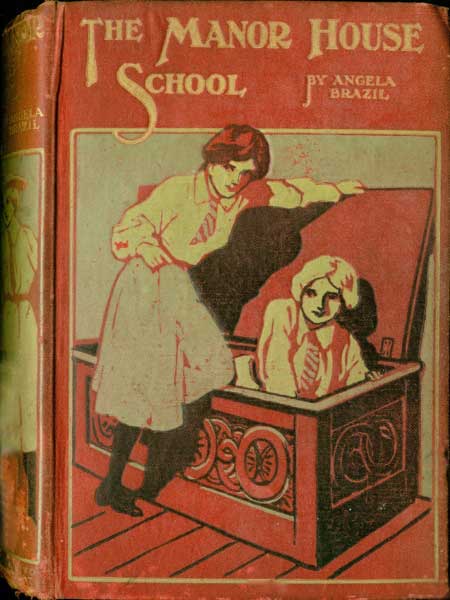
The Project Gutenberg eBook of The Manor House School
Title: The Manor House School
Author: Angela Brazil
Illustrator: Arthur A. Dixon
Release date: May 26, 2009 [eBook #28974]
Most recently updated: January 5, 2021
Language: English
Credits: Produced by Suzanne Shell and the Online Distributed
Proofreading Team at https://www.pgdp.net
The Manor House School
BY
ANGELA BRAZIL
Author of "The Nicest Girl in the School" "The Third Class at Miss Kaye's" "The Fortunes of Philippa" &c.
ILLUSTRATED BY A. A. DIXON
BLACKIE AND SON LIMITED LONDON GLASGOW AND BOMBAY
Contents
| Chap. | Page | |
| I. | Nora's News | 9 |
| II. | An Interesting Stranger | 22 |
| III. | A Strong Suspicion | 36 |
| IV. | Haversleigh | 50 |
| V. | An Unexpected Development | 67 |
| VI. | Monica | 80 |
| VII. | Lindsay's Luck | 94 |
| VIII. | Pendle Tor | 111 |
| IX. | The Plot Thickens | 127 |
| X. | Under the Hawthorn Tree | 143 |
| XI. | Sir Mervyn's Tower | 161 |
| XII. | An Enigma | 178 |
| XIII. | Lindsay Makes a Resolve | 189 |
| XIV. | The Lantern Room | 202 |
| XV. | Hide-and-Seek | 215 |
| XVI. | A Surprise | 229 |
| XVII. | Good-bye to the Manor | 243 |
Illustrations
| Page | |
| Glorious News! | Frontispiece 239 |
| "She opened the door cautiously" | 35 |
| "I know what Monica was going to say" | 93 |
| An Unfortunate Accident | 139 |
| The Secret Door | 202 |
CHAPTER I
Nora's News
It was the first week of the summer term at Winterburn Lodge. Afternoon preparation was over, and most of the girls had left the classroom for a chat and a stroll round the playground until the tea-bell should ring. From the tennis court came the sounds of the soft thud of balls and a few excited voices recording the score; while through the open windows of the house floated the strains of three pianos, on which three separate pieces were being practised in three different keys, the mingled result forming a particularly inharmonious jangle.
On a bench in the corner by the swing two yellow heads and a brown one might be seen bent in close proximity over a rather dilapidated atlas. Their respective owners were apparently making a half-hearted endeavour to hunt out a list of towns upon the map of England, and were amusing themselves between whiles with the pleasant, though somewhat unprofitable pastime of grumbling.
"I hate geography!" declared Lindsay Hepburn. "If we could be taken a picnic to each of the places, there'd be some sense in it; but to have to reel off a string of tiresome names that don't mean anything at all to you—I call it stupid!"
"It's such a fearfully long lesson, too!" agreed Cicely Chalmers dolefully. "Miss Frazer might have set us a shorter one for the first! It's really too bad of her to make us begin with two pages and a half in a new book! I'm sure I shall never get it into my head, if I try till midnight."
"I wonder why things always seem so much harder to learn when one's just come back after the holidays?" propounded Marjorie Butler with a melancholy yawn.
"I don't know. I suppose because it all feels so horrid. It's perfectly dreadful to think what a huge time it is until we can go home again."
"Thirteen whole weeks! And every one of them will be exactly the same: lessons with Miss Frazer or Mademoiselle, an hour's practising, a walk in the park or along the Surrey Road, and a game of tennis when you can manage to get hold of the court. There's never anything different, unless Miss Russell takes us to a museum or a concert, and that doesn't happen often, worse luck!"
Lindsay's picture of the forthcoming term certainly did not seem a remarkably enlivening one, and the other two groaned at the prospect.
"I wish one wasn't obliged to go to a boarding school," said Cicely in an injured tone.
"Girls! Girls!" cried a fourth voice, breaking abruptly into the conversation, "I've been hunting for you everywhere. I thought you were in the house or the gymnasium. Oh! I've such a piece of news to tell you!"
"What's the matter, Nora?" enquired Marjorie, for the newcomer was out of breath, and looked as excited as if it were breaking-up day.
"Come here and sit between us," added Lindsay, pushing the others farther along the seat to make room.
"Is it anything really nice?" asked Cicely.
"It depends on what you call 'nice'. I'll give you each six guesses, and even then I don't believe one of you'll be right."
"Miss Frazer doesn't mean to take geography to-morrow?"
"Absolutely wrong, though I wish she wouldn't."
"Somebody has broken another window with a tennis ball?"
"Don't be silly! It's much more interesting than that."
"Miss Russell's going to give us a holiday?"
"You're getting warm! Try again."
"Oh, we can't!"
"We give it up!"
"Do you remember that just before Easter a gentleman came with Dr. Redford, and they both went over the school, peeping and poking about in such a mysterious manner?"
"Yes, we wondered what they were doing."
"Well, it turns out that he's a sanitary inspector, and he's sent a report to Miss Russell to say that the drains are wrong, and must be taken up immediately."
"Is that your grand news?"
"No, it's only the first part of it. Let me finish, and then you'll see. Dr. Redford says the drains can't possibly be touched while we're all in the house, and yet they must be opened at once. Can't you guess now?"
"Miss Russell never means to send us home when we've only just come back?" gasped Lindsay hopefully.
"No, not that, though it's nearly as jolly. She's taken a beautiful old manor house in the country, and it's to be our school for the whole of the summer term. We're to go there in a body—girls, and teachers, and servants, and everyone."
If Nora had hoped to astonish her companions she had certainly succeeded. They were wild with curiosity, and fired off questions all three together.
"Where is it?"
"When are we going?"
"One at a time, please," said Nora, enjoying her importance. "I met Mildred Roper in the hall just now. Miss Russell has been explaining it to the monitresses, and said they might tell us as soon as they liked. It's a lovely Elizabethan house, at a place called Haversleigh, a long way from here. We're to start next Tuesday."
Such a tremendous event as the removal of the school from town to country was without precedent in the annals of Winterburn Lodge.
"It's almost too good to be true," cried Cicely rapturously.
"It will be like the last day and setting off for the seaside both together," declared Lindsay, waltzing round the seat in the exuberance of her spirits.
"Not quite, because we shall have lessons when we get there," corrected Nora.
"Well, at any rate it'll be ever so much nicer than being in London."
"Hurrah for the old Manor!" shouted Marjorie Butler, clapping her hands.
Miss Russell had indeed been much alarmed by the sanitary inspector's report. She was determined to make the change without delay, and hurried on the preparation as speedily as possible.
Boxes were brought down from the attic, and teachers and monitresses were kept busy superintending the packing of clothes, linen, schoolbooks, and numberless other articles. For the few days that remained work was relaxed, the headmistress's chief anxiety seeming to be the health of the girls, and her one object to take them away before any sign of illness should break out amongst them.
"Miss Russell looked so worried when I told her my head ached," said Nora Proctor. "She asked every one of us afterwards if we had sore throats."
"I was silly enough to say I thought mine felt a little scrapy," said Lindsay ruefully. "I soon wished I hadn't, because she gave me a horribly nasty disinfectant lozenge, and told me to suck it slowly until I'd finished it. Ugh! I can taste it yet!"
"I'm absolutely sick of the smell of carbolic. There's a jar full in every room," said Cicely.
"Never mind! You'll only have to endure it for one day more. We're actually off to-morrow."
Those in authority might certainly be excused if they looked worried, for it was no light task to accomplish so much in such a short space of time. By Tuesday morning, however, the final arrangements were completed; the rows of boxes were locked, strapped, and piled on railway carts; while the girls, an excited, chattering crew, were ready and waiting for the omnibuses which were to take them to the station.
"Good-bye to poor old Winterburn Lodge!" said Cicely, giving a last peep into the familiar classroom. "We shan't see these maps and desks again until next September."
"I wonder how many things will have happened before we come back here?" said Lindsay thoughtfully.
It was a long journey into Somerset, but Miss Russell had engaged saloon carriages, and taken large baskets of lunch; so, in the opinion of her thirty pupils at least, the expedition felt like a picnic.
"How I wish we could go every year, or that Miss Russell would remove into the country altogether," said Beryl Austen, who had secured a corner seat, and was in raptures over the view.
"Then it wouldn't be town, and we shouldn't be able to have visiting masters," said Mildred Roper, one of the monitresses.
"Who wants them? I'm sure I should be only too delighted never to see any of them again!"
Mildred smiled.
"I suppose, after all, we're sent to school to learn something," she remarked dryly. "I'm afraid you'll find Miss Frazer will give you plenty of work to make up for the loss of Herr Hoffmann and Monsieur Guizet."
"I don't care a scrap, so long as there's fun when lessons are over. We're going to have a glorious time, and I mean to thoroughly enjoy myself."
Beryl only expressed the sentiments of the rest of the girls, most of whom regarded the coming term in the light of a holiday. As the train steamed through green meadows and woods just breaking into leaf, it indeed seemed as if London and professors had been effectually left behind, and their spirits rose higher with every mile.
By afternoon they were all impatience to arrive. For fully an hour before they reached their destination they kept enquiring whether they must get out at the next station, and were sure that each ancient house visible from the carriage windows could not fail to be the Manor.
"Here we are at last!" announced Miss Russell, when, after many false alarms, the welcome word "Haversleigh" made its appearance in plain letters, and a porter's voice was heard pronouncing something which bore a faint resemblance to the name. "Steady, girls! Steady! Remember each is to take her own bag, and file out in proper order. Nobody is to move until I say 'March!'"
Miss Russell first held a review on the platform, to make sure that none of her pupils or their belongings had gone astray.
"I am quite relieved we have all arrived safely," she said. "I think we may congratulate ourselves that not even an umbrella is missing. It is only half a mile from here to the house, quite an easy walk, so we will start at once, and leave our luggage to follow."
In a few minutes more they had passed the ticket collector, and found themselves on the leafy high road. It seemed as different from London as a fairy tale from a Latin grammar. There had been a slight shower of rain, which had brought out the scent of growing grass and budding leaves; the ground was white with the fallen blossom of blackthorn hedges; and a thrush, seated on the summit of an apple tree, was pouring forth a volume of song that sounded almost like a welcome to the country.
With so many new sights to gaze at, it was difficult to walk primly two and two, and the line proved a straggling one, in spite of Miss Frazer's efforts in the rear. At a pair of great iron gates Miss Russell stopped and turned to her girls.
"This is our first glimpse of the Manor," she said, with a touch of pride in her voice. "I want you to take a good look at your new school."
It was nicer even than they had expected—a glorious old place, built partly in Tudor fashion of grey stone, and partly of black and white timbers. There were latticed windows, and a porch ornamented with stone balls, and curious twisted chimneys, and picturesque gables at odd angles.
"It's like a house out of one of Sir Walter Scott's novels," said Marjorie Butler.
"It looks as if one might have all kinds of adventures there," added Lindsay Hepburn gleefully.
The inside proved just as satisfactory as the outside. It was delightful to sit down to tea in a great dining-hall, with a carved roof, and walls hung with spears, shields, and stags' antlers.
"I feel we oughtn't to be drinking tea," said Cicely Chalmers. "I'm sure they didn't have it in Queen Elizabeth's times. It was tankards of ale or mead in those days."
"Don't finish your cup, then, if you wish to imagine yourself entirely in the past," said Mildred Roper. "I'm afraid you'll have to leave the marmalade too. That's quite a modern invention, and so are the Bath buns."
"Don't be horrid!" said Cicely. "It really is an old-fashioned place. Lindsay and I have got the quaintest panelled bedroom you could possibly imagine. There's a great four-post bed, with yellow brocaded curtains; it's big enough to hold six, instead of only two."
"And there's a lovely library, and a picture gallery, and ever so many queer rooms and long passages upstairs," put in Nora Proctor. "I got quite lost, and couldn't find my way down at first."
"So did I," said Beryl Austen. "I tried to explore a little, but it looked so dim and dark I didn't dare to go alone, so I turned back. I thought I might meet a Cavalier or a Roundhead on the landing!"
Beryl was not the only one to whom their new quarters seemed rather weird and strange on this first evening of their arrival. After being accustomed to electric light and modern bedrooms, it was a great change to walk upstairs with candles to antique chambers that might have belonged to the Middle Ages.
"Don't be silly, girls!" exclaimed Miss Russell indignantly, as they scurried past the suits of armour in the picture gallery. "I shall not allow any absurd nonsense of this kind. You have no more to be afraid of here than you had at Winterburn Lodge. I will take you over the house to-morrow and show you everything, and when you study the real history of the place you won't want to concern yourselves with silly superstitions."
Though the old Manor might look ghostly by night, it wore a bright and cheerful aspect in the sunshine of next morning, and not even the most ardent of Cockneys would have wished herself back among streets and squares. It certainly seemed more interesting to learn lessons sitting on tall-backed oak chairs at a carved table, than at desks in an ordinary schoolroom, furnished with maps and blackboard. The teachers enjoyed it as much as the girls, and everybody had a delightfully romantic feeling of being transferred to the reign of Queen Elizabeth.
"We oughtn't to have science, or physiology, or anything up-to-date here," said Cicely, as, in company with the rest of the third form, she took possession of the panelled parlour that was to be their temporary classroom.
"No, indeed," said Lindsay. "Girls in those days didn't have half our work."
"You forget Lady Jane Grey," said Miss Frazer. "In the matter of knowledge she would easily have put you to shame. If you want her sixteenth-century studies you will have to begin Greek as well as Latin, French, Italian, and some Hebrew and Arabic!"
"Oh, dear!" exclaimed Lindsay, aghast at such a list of accomplishments. "I'd rather stick to our own century."
"I thought ladies did nothing but go hunting and hawking then," said Marjorie Butler. "Did they all know Greek and Latin?"
"Probably not, but they could make preserves, and perfumes, and other secrets of the still-room; and they embroidered the most beautiful tapestries, if we are to judge from the specimens in the big drawing-room. Young people were very severely brought up. They might never sit without permission in the presence of their parents or teachers, and they were beaten for the slightest offences. Don't you remember that even poor Lady Jane Grey was punished with 'nips, bobs, and pinches'; and little Edward VI had his whipping-boy, to receive the blows which it was not considered seemly to bestow upon his own princely person!"
"Had the other boy to be whipped for what the king had done? How horribly unfair!" said Beryl Austen.
"Yes, their ideas of justice were rather different from ours. They would have thought present-day children absolutely spoilt. The girls who perhaps may have done lessons in this room three hundred years ago would not learn them so easily and pleasantly as you are going to do this morning. Fetch the geology books, Beryl. We must go on with modern work, in spite of our ancient surroundings."
CHAPTER II
An Interesting Stranger
Among all Miss Russell's thirty pupils you could not have found two stancher friends than Lindsay Hepburn and Cicely Chalmers, both of whom were members of the third, or lowest, class.
Lindsay was a short, plump, fair, jolly-looking girl of twelve, with a very energetic disposition; apt, according to Miss Frazer, to be inconveniently lively and irrepressible in school, but a general favourite in the playground.
Cicely, six months younger, was much more quiet and steady on the surface, though her twinkling brown eyes belied her demurer manners, and proclaimed her ready for anything in the shape of fun. She admired Lindsay immensely, and copied her absolutely, being generally ready to follow her through thick and thin, whatever scrapes might be the consequence.
The pair shared a bedroom, and were so inseparable that Cicely was often called Lindsay's shadow. That was an injustice, however; she had a character of her own, though she might choose to merge it in her friend's stronger personality. It is with these two, and their strange experiences at the Manor, that my tale is chiefly concerned, for if it had not been for Lindsay's enquiring mind, backed by Cicely's persistent efforts, there might have been no story to tell.
This is how it all began.
On the second morning after their instalment at Haversleigh the whole school was assembled ready for a history class in the big dining-hall. Miss Russell, for a wonder, was late, and when she entered at last she brought with her a new pupil. The stranger was about sixteen, a pretty, graceful girl, with hazel eyes, long chestnut hair, and a rather distinguished air. She was given a seat in the first form, and replied to the few questions asked her in a quiet voice; then, at the close of the lecture, she took her books and went away alone, without waiting to join in the next lesson.
Naturally her sudden appearance and departure excited much curiosity. The moment work was over, Lindsay and Cicely seized upon Kathleen Crawford, who was rather a friend of theirs among the monitresses.
"Who's the new girl?" they asked. "We hadn't heard anybody was coming."
"She's only a day pupil for a few classes," answered Kathleen. "Her name's Monica Courtenay. She lives here, but of course not just now."
"What do you mean?" enquired Cicely.
"Why, surely you knew Miss Russell has taken the Manor for the summer from Mrs. Courtenay?"
"I never thought about whom it belonged to," confessed Lindsay.
"Well, at any rate, Mrs. Courtenay and Monica are staying in rooms in the village while their house is let, and Monica is to come three times a week for French and history."
"So this is really her home?"
"Yes, and I heard someone say it is all her own. She's an only child, and her father is dead."
"It must seem funny for her to see a whole school here!"
"I expect it does. I shouldn't like it if the place were mine."
"Is she nice?"
"How can I tell? I saw no more of her than you did yourselves."
Everybody was greatly interested in the newcomer, and ready, at the end of a week's acquaintance, to decide heartily in her favour. Monica was rather dignified and reserved in her manners, and evidently not much accustomed to mix with companions of her own age; but when her shyness began to wear off she proved most attractive.
"She's not at all conceited, although she's mistress of the Manor," said Lindsay.
"No, I can't say she gives herself airs in the least," agreed Cicely.
"I think she behaves beautifully," said Mildred Roper. "She never so much as hints that it's her own house, or tries to take the lead, as some girls would certainly have done. She doesn't go anywhere without leave, nor even stop to play tennis unless she's asked. I heard her apologizing to Miss Russell yesterday for giving an order to the gardener. Mademoiselle says she is 'bien elevée' and 'très gentille', and that's a great compliment, for she doesn't admire English girls as a rule."
"No one could help liking Monica," said Kathleen Crawford. "She's charming. I call her one of the nicest girls I've ever met. And she's had such hard luck! I've just been hearing all about her from Irene Spencer."
"How does Irene know?" asked Lindsay.
"She stays sometimes with an uncle who is vicar of the next parish, and her cousins are friends of Monica's. It's a most extraordinary story—it might have come out of a book."
"Oh, do tell us!" said the others eagerly.
Kathleen's tale was in scraps, and missed out several points of which she was not aware at the time, so it will be better to set it down here as the girls learnt it more fully afterwards, for it was of great importance, and formed the basis of much that was to follow.
The Courtenays, it appeared, were a very ancient family, and had inherited the Manor from an ancestor who had fought bravely on the Yorkist side in the days of the Wars of the Roses. In the present generation there was no male heir, and Monica was the last of her race.
Until a few years ago the old house had been in the possession of her great-uncle, Sir Giles Courtenay, a most eccentric man, so odd and peculiar, indeed, that many people had considered him to be out of his mind. He was reputed to be extremely wealthy, yet lived in a miserly fashion, entertaining no visitors, and never spending a penny which it was possible for him to save. He never married, but passed his days as a recluse, shut up among the books in his library, seeing only a few old servants whose services he had retained. Sometimes in the early morning he would wander about the woods and fields in the neighbourhood, seeking for wild flowers, but on such occasions he seemed much annoyed if spoken to, and evidently preferred to take his rambles unnoticed.
At his death he left everything to his great-niece, Monica.
"Both the Manor", so ran the will, "and all that it may contain, especially commending to her the volumes in my library, and advising her to pursue the study of botany, which has ever been a solace and a distraction to me amidst the various ills and disappointments of life."
At first it was supposed that Monica must be a great heiress, but when Sir Giles's legacy came to be investigated nothing could be found beyond the ordinary furniture in the house and a few pounds in the local bank. No one knew anything about his affairs, and neither papers nor documents were forthcoming to give the slightest indication as to what had become of the fortune he was known to have inherited.
Not only was all trace of the money lost, but the valuable silver plate and jewellery that had been handed down from generation to generation of the Courtenays were also missing, and there was no clue to their whereabouts. It was generally believed that Sir Giles must have concealed the whole of his wealth somewhere in the old house, but, though a minute search had been made from cellar to garret, the hiding-place had not yet come to light.
Instead, therefore, of owning a fortune, Monica had received nothing but the Manor, in itself a very barren heritage. She and her mother had taken up their residence there, but they possessed only a small income, quite insufficient to maintain the former traditions of the family. It was on this account that they had been glad to let the house to Miss Russell for the summer, and to retire themselves into quiet lodgings close by.
"Hasn't Monica ever tried to hunt for the treasure?" asked Lindsay, when Kathleen had finished her narrative.
"Oh, yes—often! I believe she has gone systematically through each room, but it's so well hidden that it seems quite impossible to find it."
"Yet it must be there!"
"No doubt. It may never turn up, though, until the place is pulled down. The whole thing is a complete mystery, and so far nobody has been able to solve it."
"Have you asked Monica where she has looked?"
"Certainly not. Irene says she's very sensitive about it, and can't bear to hear it spoken of. Naturally it must have been a most terrible disappointment. I don't wonder she avoids the subject. Please be careful never to mention it to her, or you'll offend her dreadfully, and I shall be sorry I told you."
"I'm sure both Lindsay and Cicely would have too nice feeling to question Monica on such a personal matter," said Mildred Roper.
"Of course we shan't say anything—we wouldn't for worlds," promised the two younger girls.
That Monica should be the heroine of so romantic a story made her doubly interesting in the eyes of Lindsay and Cicely. They were much impressed by Kathleen's account, and retired to the privacy of the summer-house to talk it over together.
"It must be dreadful to be so poor when you know you ought to be so rich!" said Lindsay.
"And so tantalizing, when perhaps the fortune is actually in the house," said Cicely.
"I could never be happy for thinking about it."
"No more could I."
"Look here! Why shouldn't you and I set to work? So long as this treasure is hidden away somewhere, I suppose it's possible to find it."
"Oh, don't I wish we could!" cried Cicely, her eyes round at the idea.
"Well, I can't see why we shouldn't have as good a chance as anybody else. I expect it's chiefly a matter of careful hunting."
"How splendid it would be if Monica really turned out an heiress after all!"
"Glorious! It's worth trying for. Those panelled walls might be full of hiding-places. We don't know what we may discover when once we begin."
"We shan't have to let Miss Frazer catch us looking about."
"Rather not! Nobody must know what we intend to do."
"Not even Marjorie Butler?" pleaded Cicely.
"No," said Lindsay firmly. "Marjorie couldn't help whispering it to Nora, and then it would be all over the school. The big girls would make dreadful fun of us, I'm sure. They'd call us 'The Gold Seekers', or some other stupid name, simply for the sake of teasing. Besides, if it were talked about among the rest, it would be sure to get to Monica's ears, and we particularly don't want that."
"No, she mustn't hear a word of it."
"Very well, then, we had better keep it to ourselves. Will you promise faithfully that it shall be a dead secret just between you and me?"
"Absolutely dead!" agreed Cicely.
The two girls were determined to institute a thorough search for the lost legacy, but they foresaw many difficulties in the way. In the first place, it was hard even to make a start without letting anybody suspect what they were doing. Although the term at the Manor seemed like a holiday, it was nevertheless school: there was a certain amount of supervision by the mistresses, and there were rules and regulations to be obeyed, the same as at Winterburn Lodge. The girls were not allowed to wander about alone exactly when and where they wished, and even during recreation time they were expected to play games in the garden.
One of the greatest hindrances to their plan was Mrs. Wilson, an elderly servant who had been left in charge by Mrs. Courtenay, and who seemed to consider herself responsible for her mistress's property. She evidently much resented the presence of thirty schoolgirls in the Manor, and kept a keen eye upon them to see that they did no damage. She was continually watching to satisfy herself that they were not scratching the furniture, nor spilling candle-grease upon the stairs; and was loud in her complaints to Miss Russell over the most absurd trifles.
If she had had sufficient authority, I believe she would have limited the girls entirely to their bedrooms and schoolrooms, but as that was impossible, she did her best to frighten them away from the rest of the house by being as disagreeable as she could. As a natural consequence they detested her. They nicknamed her "The Griffin", and took a naughty pleasure in defying her as far as they dared.
"She's as sour as a green gooseberry!" grumbled Effie Hargreaves. "If we only take a stroll along the portrait gallery, she thinks we're going to knock down the armour, or poke our fingers through the pictures."
"Yes, she seems to imagine we can't look at a thing without breaking it. It's perfectly ridiculous!" declared Beryl Austen.
"She's an absolute nuisance. It's a pity she was left behind," said Nora Proctor; and that was the general verdict in the old housekeeper's disfavour.
With such a dragon continually on the alert, it was almost impossible for Lindsay and Cicely to find the slightest opportunity of beginning their treasure hunt, and they were reduced to very low spirits on the subject. One half-holiday afternoon, however, Lindsay reported that Mrs. Wilson, dressed in black bonnet and mantle, had been seen to leave the back door and walk away in the direction of the village.
"Now is our chance!" she assured Cicely. "Miss Russell is lying down in her bedroom with a bad headache, Miss Frazer is playing tennis, and Mademoiselle is sitting reading in the arbour. Everyone else is in the garden, and if we run indoors at once nobody will notice, and we shall have the place practically to ourselves."
Could anything have been more fortunate? They lost no time in hurrying into the Manor, feeling almost as desperate conspirators as Guy Fawkes and his confederates; and commenced immediately to make a careful tour of investigation. They stole round the hall, the dining-room, and the library, scrutinizing every nook and corner, tapping the panels to hear if they sounded hollow, and peeping up the old wide chimneys, but all with no success.
"I'm afraid we shan't find anything down here," said Lindsay at last. "I expect people made hiding-places where they wouldn't be so easy to get at. Let us go and explore the attics. We've never been up there yet."
They reached the top storey without encountering even a servant. Somehow it felt a little eerie to hear nothing but the echo of their own footsteps, and to find themselves quite alone in such an out-of-the-way part of the house. The Manor was very large, and nearly the whole of the left wing was unoccupied. They passed door after door, all leading to more and more empty rooms, till Lindsay began to grow almost dismayed at the bigness of their undertaking.
"I didn't know the place was so huge!" she sighed. "I'm afraid one might spend years looking round and examining it thoroughly. I don't wonder Monica lost heart. There isn't the faintest clue to go upon, either, to give one a hint where to hunt."
"Hadn't we better be turning back?"
Cicely was growing rather tired of the fruitless attempt.
"In a minute. Let us go to the end of this landing."
The passage in itself was like the others, but it differed in one particular, for it terminated in a narrow, winding staircase. This looked tempting—just the sort of thing, in fact, that they felt ought to lead to somewhere interesting and important.
"It's like the way to the turret chamber where Sir Walter was imprisoned, in Tales of the Middle Ages," said Lindsay.
"Or where Katherine was dragged when Sir Gilbert found she had overheard the secret plot," said Cicely.
They scrambled almost on hands and knees up sixteen steep steps. At the top was a small landing, and exactly facing them, up three steps more, stood a closed door. The girls paused for a moment to consider what to do next.
"Listen!" said Cicely suddenly. "I thought I heard a queer noise."
There certainly was a most extraordinary sound issuing from the room opposite. It resembled somebody groaning, or giving long-drawn, sighing breaths. It went on for a few moments and then stopped, then commenced louder than before, and finally died away altogether.
"What is it?" whispered Cicely, rather nervously.
"I don't know, but I'm going to look and see."
"Oh! Dare you? I hope it's nothing that will bounce out!"