
The Project Gutenberg eBook of The Manufacture of Chocolate and other Cacao Preparations
Title: The Manufacture of Chocolate and other Cacao Preparations
Author: Paul Zipperer
Editor: Herm. Schaeffer
Release date: September 19, 2017 [eBook #55584]
Most recently updated: October 23, 2024
Language: English
Credits: Produced by Chris Curnow, Les Galloway and the Online
Distributed Proofreading Team at http://www.pgdp.net (This
file was produced from images generously made available
by The Internet Archive)
The Cacao Tree—Theobroma Cacao, Linné.
Zipperer, Manufacture of Chocolate etc. 3rd edition.
Verlag M. Krayn, Berlin W. 10.
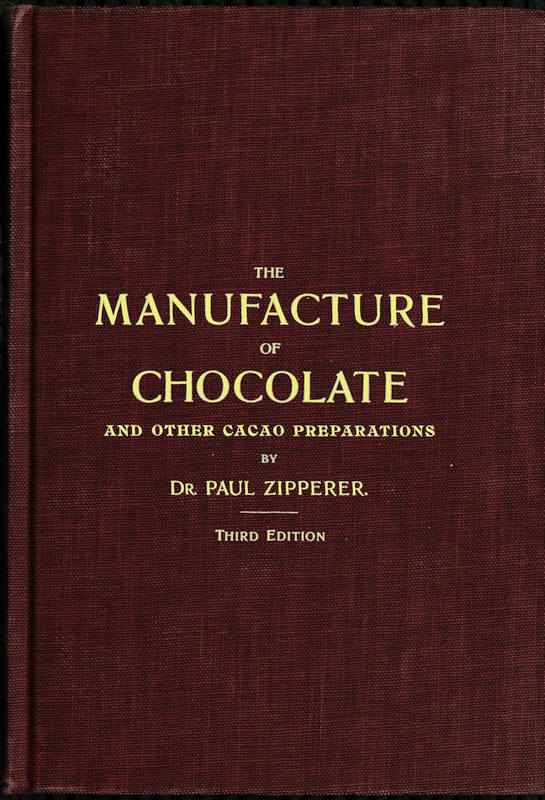
THE
MANUFACTURE
OF
CHOCOLATE
AND OTHER CACAO PREPARATIONS
BY
Dr. PAUL ZIPPERER.
Third Edition
REARRANGED, THOROUGHLY REVISED, AND LARGELY REWRITTEN.
EDITOR
DR. PHIL. HERM. SCHAEFFER
FOOD CHEMIST AND MANAGING DIRECTOR.
WITH 132 ILLUSTRATIONS, 21 TABLES AND 3 PLATES.
| BERLIN W. | ||
| VERLAG VON M. KRAYN. | ||
| LONDON | NEW YORK | |
| E. & F. N. SPON Ltd. | 1915 | SPON & CHAMBERLAIN |
| PUBLISHERS | PUBLISHERS | |
| 57 HAYMARKET. | 123-125 LIBERTY STREET. | |
ALL RIGHTS RESERVED.
Rosenthal & Co., Berlin NW.21, Alt-Moabit 105
Preface to the third edition of “The Manufacture of Chocolate” by Dr. Zipperer.
It is now a decade since the appearance of the last edition, and owing to continual delays in the compiling of the present volume, the book has been out of print for several years. These delays ensued because the editor wished to take into account the most recent determinations and decrees of the guilds and various legislative factors connected with the industry; but he was at length forced to the conclusion that notwithstanding the excellent organisation and lofty standing of the branch under consideration, it was useless to wait for anything final and absolute in such a field. Suggestions of possible improvements and indications of blemishes are therefore earnestly invited, in order that they may be duly allowed for in the event of a new edition.—The plan followed by Zipperer has been adopted in the main; a tribute due to its previous success. Yet on the other hand, the arrangement of the book has undergone some alteration, and is, at least in the editor’s opinion, a perceptible improvement.—All scientific, industrial and technical progress has been treated as fully as possible, the economic part in particular having been diligently recast.
It would, of course, have been impossible for the editor to write all these chapters without external aid, his knowledge of the respective branches being by no means exhaustive enough. He may therefore be allowed to express here his obligation and thanks to all his fellow-workers; and in particular, to the Association of German Chocolate Manufacturers, Dresden; its managing director, Herr Greiert; the director of the Cocoa Purchase Co., Hamburg, Herr Rittscher, who contributed the whole of the chapter headed; Commercial Varieties of Cacao Beans; further to Prof. Dr. Härtel, Chief Inspector of the Royal Research Institute, Leipsic; Dr. R. Böhme, Managing Director of Messrs. Stollwerck Bros. Chemical Laboratory, Cologne; and to Superintendent Engineer Schneider, of the firm J. M. Lehman, Dresden, among many others. Mention must also be made of the manufacturers who so kindly placed material at the editor’s disposal. Let us hope that the work will meet with a success corresponding to the pains taken by the editor and publishers, and prove a really serviceable Handbook to the Chocolate Industry.
Dr. Schaeffer.
Extracts from the prefaces to the first and second editions.
The object of this work is to furnish a source of information and advice for those who are interested in the branch of industry to which it relates.
The author of this treatise has therefore endeavoured not only to describe the manufacturing processes; but he has also devoted special attention to the raw materials employed, and endeavoured to make them generally familiar by reference to the literature on the subject, as well as by providing a precise account of the chemical constituents of these substances and discussing the consequently necessary procedure to be observed in the course of manufacture. The art of chocolate making is no longer what it was a few decades ago; it has for the most part passed from small operators into the hands of large manufacturers. A short historical resumé will serve as a sketch of this development and a cursory description of some forms of apparatus which have now merely historical interest will serve to show how improvement in the industry has been effected.
Chocolate is a favourite and most important article of food, and in that sense it is subject to legal regulations for which allowances must be made, as well as for the most suitable analytical methods by means of which a manufacturer can ascertain the presence of unlawful mixtures in competing products, so that knowing the regulations in force, he may avoid any infringement of the same.
Within the ten years that have elapsed since the first edition of this work appeared, the manufacture of chocolate has undergone considerable expansion. Not only has the modus operandi been simplified and improved by the introduction of a number of new mechanical appliances, but the technique of the subject has been so extended, both from chemical and mechanical points of view, as partly to furnish a new standard in estimating and determining cacao constituents and preparations. The author has endeavoured to take due account of all these advances, and made a point of collecting the material scattered through the various professional journals, sifting or supplementing where necessary, in order that all engaged in the industry, the manufacturer as well as the food analyst and the engineer, may be in a position to derive a vivid impression of existing conditions in the chocolate manufacture, from the present volume.
In consideration of the importance which several branches of the industry have recently acquired, such as the preparation of cocoa powder, soluble cocoa, cacao butter, pralinés and chocolate creams, space has been given to descriptions of the respective details. On the other hand no attempt has been made to introduce calculations as to the cost of manufacture, since statements to that effect would possibly be rather detrimental than otherwise.
Costs of production as regards cacao preparations is subject to great variation, according to the scale on which they are carried out, so that estimates made on the basis of large operations might eventually lead to the conclusion that a small factory might be profitable, and with no better result than that of creating undue competition in prices and occasioning eventual failure. Moreover, the fluctuations in the market price of cacao and sugar are so frequent, and there is such possibility of new sources of expense, that calculations can only apply to the time when they are made; they soon become out of date, and then afford no trustworthy indication of probable profit and loss.
The section treating of legislative regulations relating to the trade in cacao preparations has undergone complete revision to adapt it to existing conditions.
To render the book more useful, an appendix has been added in which the production and composition of a few cacao preparations are treated of, providing valuable data for reference.
Dr. Paul Zipperer.
CONTENTS
| First Part: The Cacao Tree | Page | |||
| A. Tree and Beans | 1 | |||
| a) | Description of the Cacao Tree and its Fruit | 1 | ||
| b) | Geographical Distribution and History of the Cacao Tree | 4 | ||
| c) | Cultivation of the Cacao Tree; Diseases and Parasites | 7 | ||
| d) | Gathering and Fermentation | 9 | ||
| e) | Description of the Beans | 12 | ||
| f) | The Commercial Sorts of the Cacao Bean | 16 | ||
| 1. | American Cacao Varieties | 19 | ||
| 2. | African Cacao Varieties | 28 | ||
| 3. | Asiatic Cacao Sorts | 32 | ||
| 4. | Australian Cacao Sorts | 33 | ||
| g) | The Trade in Cacao and the Consumption of Cacao Products; Statistics | 33 | ||
| B. Chemical Constitution of the Bean | 43 | |||
| a) | The Cacao Bean Proper | 43 | ||
| 1. | Water or Moisture | 49 | ||
| 2. | Fat | 49 | ||
| 3. | Cacao red or Pigment | 59 | ||
| 4. | Theobromine | 62 | ||
| 5. | Albumin | 67 | ||
| 6. | Starch | 70 | ||
| 7. | Cellulose or crude fibre | 72 | ||
| 8. | Sugar and plant acids | 73 | ||
| 9. | The mineral or ash constituents | 73 | ||
| b) | The Cacao Shells | 76 | ||
| Second Part: The Manufacture of Cacao Preparations | ||||
| A. Manufacture of Chocolate | 85 | |||
| I. | The Preparation of the Cacao Beans | 87 | ||
| 1. | Storing, cleansing and sorting | 87 | ||
| 2. | Roasting the Beans | 89 | ||
| 3. | Crushing, hulling and cleansing | 100 | ||
| 4. | Mixing different kinds | 108 | ||
| II. | Production of the Cacao Mass and Mixing with Sugar | 109 | ||
| 5. | Fine grinding and trituration | 109 | ||
| 6. | Mixture with sugar and spices | 117 | ||
| 7. | Treatment of the Mixture | 119 | ||
| a) | Trituration | 119 | ||
| b) | Levigation | 123 | ||
| c) | Proportions for mixing cacao mass, sugar and spices | 136 | ||
| III. | Further Treatment of the Raw Chocolate | 138 | ||
| 8. | Manufacture of “Chocolats Fondants” | 138 | ||
| 9. | Heating Chambers and Closets | 141 | ||
| 10. | Removal of Air and Division | 143 | ||
| IV. | Moulding of the Chocolate | 149 | ||
| 11. | Transference to the Moulds | 149 | ||
| 12. | The Shaking Table | 156 | ||
| 13. | Cooling the Chocolate | 162 | ||
| a) | Cooling in Chambers. | |||
| b) | Cooling in Closets. | |||
| V. | Special Preparations | 176 | ||
| a) | Chocolate Lozenges and Pastilles | 176 | ||
| b) | “Pralinés” or coated goods | 182 | ||
| B. The Manufacture of Cocoa Powder and “Soluble” Cocoa | 195 | |||
| a) | The various methods of disintegrating or opening up the tissues of cacao | 195 | ||
| b) | Methods of disintegration | 197 | ||
| 1. | Preliminary Treatment of the Beans | 197 | ||
| 2. | Expression of the Fat | 199 | ||
| 3. | Pulverising and Sifting the defatted Cacao | 209 | ||
| c) | Disintegration after Roasting | 216 | ||
| 1. | Disintegration prior to Pressing | 217 | ||
| 2. | Disintegration after Pressing | 224 | ||
| 3. | Opinions to these methods | 225 | ||
| C. Packing and Storing of the Finished Cacao Preparations | 228 | |||
| a) | General hints | 228 | ||
| b) | Suitable storage | 228 | ||
| c) | Machines for packing en masse | 229 | ||
| Third Part: Ingredients used in the Manufacture of Chocolate | ||||
| A. Legal enactments. Condemned ingredients | 230 | |||
| B. Ingredients allowed | 231 | |||
| I. | Sweet Stuffs | 231 | ||
| a) | Sugar | 231 | ||
| b) | Saccharin and other sweetening agents | 234 | ||
| II. | Kinds of Starch, Flour | 236 | ||
| 1. | Potato starch or flour | 236 | ||
| 2. | Wheat starch | 236 | ||
| 3. | Dextrin | 237 | ||
| 4. | Rice starch | 237 | ||
| 5. | Arrowroot | 237 | ||
| 6. | Chestnut meal | 238 | ||
| 7. | Bean meal | 238 | ||
| 8. | Salep | 238 | ||
| III. | Spices | 238 | ||
| a) | General Introduction | 238 | ||
| b) | Vanilla | 241 | ||
| c) | Vanillin | 243 | ||
| d) | Cinnamon | 246 | ||
| e) | Cloves | 247 | ||
| f) | Nutmeg and Mace | 247 | ||
| g) | Cardamoms | 248 | ||
| IV. | Other Ingredients | 248 | ||
| a) | Ether oils | 248 | ||
| b) | Peru balsam and Gum benzoin | 249 | ||
| V. | Colouring Materials | 250 | ||
| Fourth Part: Examination and Analysis of Cacao Preparations | ||||
| A. Chemical and microscopial examination of cacao and cacao preparations | 253 | |||
| a) | Testing | 253 | ||
| b) | Chemical analyses | 254 | ||
| 1. | Estimation of moisture | 254 | ||
| 2. | Estimation of ash | 255 | ||
| 3. | Estimation of silicic acid in the ash | 256 | ||
| 4. | Estimation of alkalis remaining in cocoa powders | 256 | ||
| 5. | Determination of the fatty contents | 258 | ||
| 6. | Determination of Theobromine and Caffeine | 263 | ||
| 7. | Determination of Starch | 264 | ||
| 8. | Determination of crude Fibre | 266 | ||
| 9. | Determination of Cacao husk | 267 | ||
| 10. | Determination of Sugar | 269 | ||
| 11. | Determination of Albuminates | 271 | ||
| 12. | Investigation of Milk and Cream Chocolate | 272 | ||
| c) | Microscopical-botanical investigation | 275 | ||
| B. Definitions of Cacao Preparations | 279 | |||
| a) | Regulations of the Association of German Chocolate Manufacturers relating to the Trade in Cacao Preparations | 279 | ||
| b) | Final Wording of the Principles of the Free Union of German Food Chemists for the estimation of the Value of Cacao Preparations | 282 | ||
| c) | Vienna Regulations | 284 | ||
| d) | International Definitions | 285 | ||
| C. Adulteration of Cacao Wares and their Recognition | 288 | |||
| a) | Introductory | 288 | ||
| b) | The Principles | 288 | ||
| c) | Laws and Enactments as to Trade in Cacao Preparations | 291 | ||
| 1. | Belgium | 291 | ||
| 2. | Roumania | 293 | ||
| 3. | Switzerland | 294 | ||
| 4. | Austria | 298 | ||
| 5. | Germany | 301 | ||
| Fifth Part: Appendix | ||||
| A. Installation of a Chocolate and Cacao Powder Factory (with 2 plates) | 304 | |||
| 1. | Chocolate Factory (Table I) | 305 | ||
| 2. | Cacao Powder Factory (Table II) | 306 | ||
| 3. | Appendix containing an account of the methods of preparation and the composition of some Commercial dietetic and other cacao preparations | 306 | ||
| INDEX | ||||
| A. Index to literature | 319 | |||
| B. Tables | 320 | |||
| C. Figures | 321 | |||
| D. Authors | 323 | |||
| E. Alphabetical index to contents | 326 | |||