
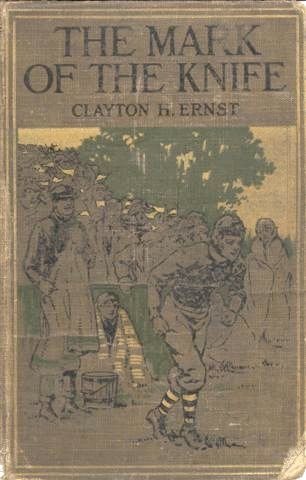
At the beginning of the final quarter Coach Murray sent in Teeny-bits to take the place of White.
When Ridgley finally did get its chance the time was slipping swiftly away, and hope was glimmering but faintly in the home stands. There was to be one more sensation, however. The ball was Ridgley's on its own twenty-five-yard line. Durant carried it forward ten yards, then Tom Curwood plunged through for five more. Then Dean called on Teeny-bits.
"Twenty-seven, sixteen, eleven," he called out, and the ball came back swiftly into his hands. Teeny-bits took it from Dean on the run and began to circle the right end of the line; a gap opened for an instant; he was through it like a rabbit diving through a hedge and with a thrill dashed on. He did not mean to stop until the last whitewashed line was behind him.
In front, the Wilton quarter-back was crouching tensely to intercept him. Teeny-bits shifted direction to pass him, but the quarter-back was not only wily, but swift; he was after Teeny-bits like a cat and began to force him to run diagonally across the field. Two Wilton players converged on Teeny-bits from the other side and one of them made a desperate tackle. Teeny-bits used his straight arm to ward off the attack and succeeded in slipping from the tackler's clutches, but the fraction of a second that he lost opened an opportunity to the Wilton quarter-back. Teeny-bits felt himself tackled heavily; he fell against the player who had first tackled him and to his utter dismay felt the ball knocked from his grasp and saw it go bounding over the ground. He lay sprawling, so tangled with the Wilton players that for the moment he could not rise. With horrified gaze he saw the leather oval roll free and he felt the overwhelming shame of one who has failed to be equal to the demands of a crisis. But his feeling of self-condemnation immediately gave way to an entirely different emotion, for a swiftly moving pair of legs incased in the Ridgley red and white came within the range of his vision. He glanced up and saw that it was Neil Durant. Two Wilton players were after the ball also, but the Ridgley captain was before them; he scooped it up and ran swiftly down the field. While the stands roared in a frenzy of delight, Neil crossed the goal line and circled round till he placed the ball squarely behind the posts. Tom Curwood kicked the goal, and two minutes later the game ended with the ball in mid-field and the score 13-13.
"I'm glad you dropped that ball," said Durant, joining Teeny-bits as the substitute half-back was walking off the field; "it came just right to bounce up into my hands."
"It was lucky," admitted the candidate, "but I was mighty ashamed of myself."
"Well, it was a hard tackle," said Durant. "I don't blame you for dropping the ball."
Teeny-bits was about to make a reply when he saw coming toward them a white-haired man who walked with a limp. "There's Dad," he said, "I didn't know he was coming to the game."
Old Daniel Holbrook approached them with a beaming face. "Well, well, son!" he exclaimed, "I thought maybe you'd play, so I came to see the game."
Teeny-bits introduced Durant and tried to smother a feeling of embarrassment, the source of which he would not have cared to probe.
"Your ma, Teeny-bits, wants you should come down for Sunday dinner to-morrow," said the station master, "and she's particular for you to bring a friend. I've killed two young roosters and ma's fixin' 'em up with the kind of stuffin' you like. Now if this friend of yours here would like to come down with you I'll drive up and get both of you in the morning after church. He looks as if he'd have a good appetite."
Teeny-bits expected to hear Neil Durant express courteous regret; he did not for a moment think that the son of Major-General Durant and the most popular member of Ridgley School would be interested in visiting the humble Holbrook home. He was even a little ashamed that Dad Holbrook had extended the invitation with so much genial assurance.
"I'll be mighty glad to come—if Teeny-bits wants me to," said Durant, and Teeny-bits looked at him with such a queer expression of surprise and pleasure that Neil added: "You didn't expect me to refuse an invitation like that, did you?"
At the steps of the locker building Durant left them, and Teeny-bits remained outside for a few minutes to talk to the station master. Then he said good-by and went inside to take his shower.
He found his team-mates discussing the game in detail and bestowing praise on Neil Durant.
"Well, cap'n, old scout," Ned Stillson was saying, as Teeny-bits came clamping in, "you sure were Johnny-on-the-spot."
Though there was nothing in the words to signify actual criticism of any one, Teeny-bits felt that the real meaning behind them was that when some one else had failed, Durant had saved the day. That some one else was himself, and, though the members of the team treated him as cordially as ever, he had the unpleasant feeling that they looked upon him now as one who had failed in a crisis, and he had to admit to himself that their opinion—if they held it—was justly founded. He went back to his room and for half an hour before supper sat by his window, thinking deeply. The conclusion to which he came was this: if he ever got another chance to run with the ball for Ridgley he would squeeze that leather oval so hard that the thing would be in danger of bursting. He resolved to make no apologies to Coach Murray, but to show by future deeds that he could be trusted. When he went over to Lincoln Hall for dinner he found the fellows at his table apparently unchanged in their attitude toward him. They seemed to have forgotten that he had covered himself with no glory.
While the soup was being disposed of some one who came in late brought a bit of news that spread from table to table as if by magic. It seemed to fly from one end of the room to the other and instantly it became the topic of excited conversation. Everywhere it went it created looks of dismay on the faces of the Ridgleyites, for there was a portentous quality in it that boded bitter things for "the best school in the world."
While Ridgley had been striving mightily to hold its own against Wilton and had found its opponent so redoubtable that the tie score seemed to be fully as much as it deserved—and perhaps a little more—Jefferson, the big rival of Ridgley from time immemorial, had been winning the laurels. Jefferson had trampled mercilessly upon Goodrich Academy and with seeming ease had scored touchdown after touchdown. The final score was 34-0 and herein lay the menace for Ridgley: only a week before, Goodrich had defeated Wilton 7-0. If Goodrich were better than Wilton and Wilton were as good as Ridgley, what chance did Ridgley stand against Jefferson, which had apparently toyed with the Goodrich eleven and scored at will? It was a problem that would seem to be answered correctly only by three dismal words: None at all! A buzz of talk filled the dining hall and every one knew that Ridgley was face to face with a forlorn hope.
"Well, we'll have to fight," said Mr. Stevens, who sat at the head of Teeny-bits' table, "and fight hard—it will never do to get discouraged."
But discouragement is subtle; there was good need of something to instill spirit into the Ridgley team, for in the days that followed, rumors like the fables of old began to reach the school on the hill. It was said that tacklers found it almost impossible to stop Norris, the Jefferson full-back. Half a dozen colleges were begging him to bestow honors upon them by making them his Alma Mater. He could run a hundred yards in ten and one fifth seconds and he weighed one hundred and seventy pounds stripped. In the Goodrich game time and again he had made ten yards with two or more of the Goodrich players clinging to him as unavailingly as Lilliputians clinging to a giant. No less fearsome tales were told of Whipple, the Jefferson punter, and of Phillips and Burton, the two ends.
The punter could send a wickedly twisting spiral sixty yards, and the ends had an uncanny way of catching forward passes. Through the newspapers, through word of mouth and by letters the news arrived,—and it became increasingly disconcerting. Unless Ridgley wished to be disgraced before the eyes of the world something must be done—and done soon—to bolster up the team.
CHAPTER IV
TWO VISITS AND A THEFT
True to his word, old Daniel Holbrook drove his sorrel horse up to the school at noon on Sunday and brought Neil Durant and Teeny-bits down to the little white house that had been his home for thirty years. "Ma" Holbrook was a motherly person, plump, gray-haired and smiling.
"I do hope you two are good and hungry," she said, after Teeny-bits had introduced Neil. "We'll sit right down and keep sittin' till we're full."
It came over Teeny-bits suddenly as he sat down at the oval table and faced the familiar array of thick china, glassware and inexpensive cutlery what a different life he had been leading for the past few weeks, and he glanced at Neil to see what effect this homely air of simplicity would have on the son of a major-general. But the football captain showed by neither word nor sign that he noticed anything crude or unfamiliar. Dad Holbrook whetted the carving knife briskly on a steel sharpener and stood up to attack the two roosters. He heaped a bounteous supply of white and dark meat and "stuffing" on each plate and passed it to "Ma", who put on brown corn fritters and sweet potatoes baked with sirup.
"I never saw anything look so good in my life," said Neil, and a moment later he added: "Or taste so good, either."
Ma Holbrook beamed with pleasure, and said to herself that Teeny-bits' friend was "real nice." Teeny-bits himself ate with relish and enjoyment, and at the sight of Neil's contented manner of attacking the food lost most of his feeling of uneasiness.
"Land of Goshen!" Ma suddenly exclaimed, "I forgot to bring on the conserve!" And getting up hurriedly from the table she stepped quickly out into the pantry. From that little room presently came the sound of a creaking chair, and Teeny-bits knew that Ma was standing on the seat to reach one of those richly laden jars that adorned the upper shelves, row on row. There was the scrape of a spoon against glass and then Ma Holbrook appeared in the door, bearing a dish full of a golden substance that Teeny-bits recognized as her famous preserved watermelon. No one had ever failed to become the slave of his appetite when confronted by this masterpiece of Ma's handiwork, and Neil Durant, after putting one mouthful to his lips, looked at Teeny-bits with such a blissful expression that Teeny-bits felt all constraint and uneasiness slip suddenly away.
"You can't beat it anywhere in this world," he said with a smile.
It was an unpretentious sort of pleasure that Teeny-bits and his friend shared that Sunday afternoon. When the meal was over they walked lazily through the village to look at some of the old buildings that were standing in Revolutionary days and then they came lazily back and Dad Holbrook harnessed the sorrel horse and drove them up to Ridgley. Neil Durant spoke sincerely when he said:
"I don't know when I've had such a good Sunday, and as for the dinner—I could talk a week about it."
While Teeny-bits and the football captain were spending the afternoon in Hamilton, two of their schoolmates, Campbell and Bassett, were using their time, as it seemed to them, to no little advantage. Campbell had telephoned to his mother and had persuaded her to send the family automobile—a heavy, seven-passenger machine—to the school for him.
The chauffeur brought it to a stop in front of Gannett Hall at twelve o'clock and Campbell had the satisfaction of ordering the driver to take the rear seat and, with Bassett at his side, of piloting the big car out of the campus. He went by the most roundabout way and cut the corners of the gravel drives at a pace that was intended to make the Ridgleyites who were lounging in the dormitory windows sit up and take notice. After a spin out through Greensboro they arrived at the Campbell place in time for dinner and Bassett had an opportunity to see the "got-rich-quick" pictures and to eat from plates that were lavishly decorated in the best style of the shops that cater to the tastes of those persons whose family crest is the dollar sign. Bassett thought it was "grand and gorgeous" and he made a mental note of several things that he intended to have duplicated in his own home at the next available opportunity.
Campbell, Senior, was away on a business trip, but Mrs. Campbell succeeded in making the dinner sufficiently impressive. She was a large woman with a heavy, double chin and a high, somewhat whining voice which she kept in constant use. Obviously she was much attached to Tracey, and Bassett could see with half a glance that her son could, by using his talents, persuade her to do almost anything for him.
"I suppose you two are great friends," she said to Bassett. "Every one likes Tracey."
"Oh, yes, we go around together a lot," said the Whirlwind with his most winning smile.
"And are you as athletic as Tracey is?" asked Mrs. Campbell.
"Well, you see, I've got flat feet," said Bassett in a tone that implied that if he were not so afflicted he would be captain of all the major sports in the school.
"You're on the first team now, I suppose, Tracey," said Mrs. Campbell.
"No," said Tracey, "they're still making me play with the scrub."
"Why?" demanded his mother, raising her shrill voice. "You told me two weeks ago that the coach was going to promote you. What happened, will you tell me?"
"They're not giving Tracey a fair show, Mrs. Campbell," declared Bassett. "The coach has a few favorites and he can't see anything that any one else does."
Mrs. Campbell let her fork fall into her plate with a clatter. "I'm going to see Doctor Wells about it!" she declared. "Such a condition is perfectly shameful! Why, it's—it's——"
"Now, mother, don't do anything like that," warned Tracey. "You'd only spoil what chances I've got."
"Well, if they can't treat you fairly, I'd rather have you leave the school. Your father will have something to say about this when he comes home. I don't doubt that he'll go right up there and make them stand around a bit."
"By the time he gets home I'll be on the team," said Tracey.
In the afternoon Campbell and his satellite rode out into the country without the chauffeur and Tracey took occasion to race any automobile that would accept an obvious challenge. It was his particular delight to drive alongside a car of one of the cheaper makes and to pretend that he was doing his utmost to pass and in that way to lure the small-car owner into competition. Sometimes he succeeded and after he had made his victim believe that the big car was about to be vanquished he would step hard on the accelerator and leave the scene of competition in a cloud of dust. On such occasions Bassett felt called upon to turn and thumb his nose at the crestfallen driver.
At dusk the pair came back to Greensboro for refreshment and Campbell declared that he would take Bassett to a "regular place."
Greensboro was a bustling town in which there were department stores, theaters and restaurants. The stores and theaters were closed, but the restaurants were open, though Sunday business was dull. Campbell drove the big car down a side street and stopped in front of a building that was decorated with an Oriental sign announcing to the world that this was the Eating Palace of Chuan Kai. "Here's where I feed you the dinner I owe you," he said.
Tracey seemed to be well known to the Oriental managers of the restaurant. Chuan Kai himself, a yellow Chinaman in American clothes, greeted him in with a smile that showed his tusks; he directed the two to a table set in a little booth that was decorated with panels showing dragons and temples. Here Tracey and Bassett lolled back at ease, ate chow mein and chop suey with mushrooms, drank tea from small cups without handles and smoked till the air of the little booth was blue.
Chuan Kai stole softly in and out and occasionally glanced with satisfaction at the two students. They were spending money freely and the wily old Oriental knew that young Campbell would drop a fat tip into his yellow palm when it so pleased him to leave the restaurant. Silently the Chinese waiters in their slippers and loose trousers slipped in and out of the mysterious regions where the strange food was prepared. Tracey, displaying nonchalance for Bassett's benefit, declared that old Chuan Kai kept "a dozen Chinks on the job", and that they all slept in rooms directly above the restaurant. The persons who sat at the inlaid tables and leaned heavily on their elbows as they scanned the much-fingered menus were a nondescript lot—some the riff-raff of the town who found it cheaper to eat at Kai's than to eat elsewhere, others, more respectable in appearance, who doubtless had been drawn to the place by curiosity.
"Do you really want to give him a good jolt?" said Bassett to Campbell.
"I told you I did."
"Then why not try my plan? I know it will work."
Bassett leaned forward and talked in low tones as if fearing to be overheard, but there was no danger of that, for the other persons in the restaurant were too much interested in their own affairs to eavesdrop on two young fellows chatting in a booth.
At eight o'clock Campbell and Bassett sauntered out and Chuan Kai received his fat tip. The big car rolled out to the "mansion" on the hillock and, when the chauffeur had been found, sped to Ridgley School. Five minutes before nine it discharged its burden at the doors of Gannett Hall.
During the week that followed there was a frenzy of football talk in every Ridgley dormitory. At chapel on Tuesday morning Doctor Wells granted Neil Durant's request to speak to the school. The football captain mounted the platform a little nervously, but he made a straightforward speech in which he appealed for more candidates for the scrub. "There are a good many likely-looking fellows in this school who have never tried for the football team," he said. "It's late in the season, but there's a chance for them now on the scrub and, if they show any real ability, an opportunity with the team. We've got to do our best to beat Jefferson this year and we can't afford to overlook good material even now, so if you want to show your school spirit come down to the field this afternoon."
The result of the speech and of numerous personal appeals was that a dozen new players appeared with the scrub that afternoon; they were not a remarkable addition in respect to quality, however, and after a couple of days of looking them over Coach Murray remarked to Neil Durant that he was afraid that none of them would "set the world on fire."
Those were days of feverish activity on the football field; the coach drove the members of the first team for all they were worth and when he thought they were in danger of being overworked from too much scrimmaging he called them together in the locker building and gave them blackboard talks. In the middle of the week he advanced Tracey Campbell and Fred Harper to the first squad; he then began to test some new and intricate formations.
Among the candidates who had responded to Neil Durant's appeal had been Snubby Turner. Snubby succeeded Fred Harper as quarter-back of the scrub and felt an immense elation which he intimated to Teeny-bits one afternoon on the way back to the campus.
"Keep it up, Snubby," said Teeny-bits. "You're putting life into the scrub."
"If I'll come up to your room to-night, will you give me a few pointers about running with the ball?" asked Snubby as the two approached the Gannett Hall steps.
"Come up right after supper and we'll talk for half an hour; then I'll have to study," said Teeny-bits.
Snubby Turner came—but not to talk about football. He closed the door softly behind him and looked at his friend with such a strange expression on his freckled face that Teeny-bits said:
"What in the name of mud is the matter, Snubby?"
"Do you suppose there's any one in this school mean enough to steal?" asked Turner. "When I went down to football practice to-day I left my gold watch and a purse with twelve dollars in it in the top drawer of my chiffonier. They're both gone!"
"Are you sure?" asked Teeny-bits.
"Yes, I am," declared Snubby. "Absolutely sure."
CHAPTER V
TEENY-BITS' CHANCE
Snubby Turner was not the only member of Ridgley School who lost property during the days that preceded the game with Jefferson. His gold watch and the twelve dollars that had mysteriously disappeared from his chiffonier were the first to vanish, but they were quickly followed by other bits of jewelry and money—not only from the Ridgleyites in Gannett Hall but also from those in other dormitories.
Ned Stillson, over in Ames Hall, lost six dollars and a small gold-handled penknife that a maiden aunt had given him; Fred Harper reported the disappearance of a silver trophy of which he was inordinately proud,—a graceful little model of a sailing boat which he and his brother had won during a season of boat racing with their twenty-footer. The actual value of the trophy, aside from its sentimental value, was said to be thirty-six dollars.
In the case of Harper's loss there was an additional interest because of the fact that Fred nearly succeeded—unwittingly—in discovering the identity of the thief. His room was on the first floor of Gannett Hall, and he remembered that on the Wednesday night when the theft occurred he had left the window wide open at the time he went over to Lincoln Hall for supper. He had gone from the table early and on arriving at the dormitory had immediately entered his room. As he opened the door he saw a dark form outlined in the window and it occurred to him that perhaps one of his schoolmates was attempting to play a practical joke upon him.
"What's the idea?" he had said. "Why don't you come in the front door like a human being?"
He had expected an answer in harmony with his question, but to his surprise the person in the window had immediately scrambled out, jumped down five feet to the ground and had lost no time in running out of sight around the corner of the building. Fred Harper had peered out of the window, still thinking that he had been the victim of a prank, and had not noticed the loss of his silver sailing trophy until he had turned on the electric lights and had seen that the place where it stood on the mantelpiece was vacant. He had then dashed out of the dormitory in the hope of intercepting the fugitive as he crossed the campus, but no one was in sight except his schoolmates returning from Lincoln Hall. To these he reported his loss, and a dozen of the Ridgleyites made a hurried search of the campus; they investigated all the shaded corners and unlighted doorways but found nothing that in any way offered a clew to the identity of the mysterious thief.
Within a week a dozen other thefts had been reported, and no little talk went the rounds of the school. Poor Jerry, the grizzled old-timer, who for years had been general helper to Slocum, the head janitor, was an object of suspicion in the eyes of some of the newcomers at Ridgley. There was no doubt about it, Jerry did have a most fearsome cast of features. Mr. Stevens, the English master, once remarked that he looked like an "amiable murderer." It was an apt description. Jerry had an expansive smile, but it was bestowed only upon those Ridgleyites—masters and pupils—who, for some subtle reason, loomed high in his esteem. All others he glowered upon with an expression ferocious and uncompromising. It was said that Doctor Wells was head of the school six months before he gained the reward of the smile that Jerry bestowed on the elect. But Jerry's heart was in the right place, and the older members of Ridgley School laughed to scorn the suggestion that he had any connection with the thefts.
"I'd as soon suspect my own father as Jerry!" said Snubby Turner, "but that gives me an idea."
What the idea was he revealed to no one except Jerry himself. For some reason Jerry had taken a great liking to the genial Snubby, and when he received a call from that young man down in his basement room, his seamed features took on an expression that might have caused Mr. Stevens to add the adjectives happy and harmless to the "amiable murderer."
"I have an idea, Jerry," said Snubby. "You know some one's been getting away with a lot of valuable truck from the fellows' rooms. It would be an awfully clever stunt to catch him. Why don't you snoop around and find out who it is?"
"There's ijeers and ijeers," said Jerry. "I got my ijeers too. I ain't got no need to snoop around. I got eyes an' ears as are uncommon good, even though I been usin' the same ones for nigh on to seventy year. I got my own ijeers as to who's sneak-thieving this school and bime-by somebody's goin' to get ketched."
"What are your ideas?" asked Snubby. "Do you know who's doing it?"
But old Jerry had no further enlightenment for his friend, even when Snubby pressed him further. "I got eyes an' ears," said the old man, "an' I got my ijeers too."
Doctor Wells referred to the mystery indirectly one morning at chapel. "How foolish it is for any of us to believe that we can commit a wrong and escape the penalty merely because no one sees us," he said. "Every evil deed leaves its heaviest mark not on the victim of it but on the misguided person who performs it. Once in a while something happens at our school that proves anew that old, old truth."
There was absolute silence in the hall; every one knew to what the head was referring.
But other incidents of more stirring nature were under way at Ridgley School. As the impending struggle for football honors with Jefferson drew nearer, each day seemed to be more strongly charged with suspense and excitement until the very air that wafted itself among the maples and elms, which were now dropping their red and yellow leaves on the campus, seemed electric with possibilities both glorious and disastrous.
Since the game with Wilton, Teeny-bits had practiced regularly with the first squad and more than once had demonstrated that his ability to run with the ball was above the average. White, whose place he had taken in the Wilton game, recovered from his slightly sprained ankle, however, and resumed his old position as left half-back. Teeny-bits continued to be a substitute.
Tracey Campbell, who likewise had been promoted to the first team, seemed to have regained the attention of Coach Murray. On the Saturday that followed the tie game with Wilton, Ridgley journeyed to Springfield to play Prescott Academy. Ridgley won the game by the score of 17 to 0, but more than once had to fight to keep the light but active Prescott team from scoring. Both Teeny-bits and Campbell played through the whole fourth quarter and, to an impartial observer, might have seemed to display a nearly equal ability. Five minutes before the end of the game, however, Teeny-bits brought the spectators to their feet by catching a punt and dodging through half the Prescott team for a gain of fifty-five yards before the home quarter-back forced him over the side line. The spectacular thing about the run was that Teeny-bits somehow wriggled and squirmed out of the grasp of four Prescott players who successively had at least a fair opportunity to tackle him. The play did not result in a touchdown, for Prescott recovered the ball on an attempted forward pass and the game soon came to an end.
Coach Murray seemed to be pretty well satisfied with the playing of the Ridgley team. "What I liked best," he said on the way back, "was that you played an intelligent game—you took advantage of your opportunities—but let me add in a hurry that you will have to play better and harder football than you've played yet when you meet Jefferson."
On the same Saturday, Jefferson performed in a manner that brought no encouragement to Ridgley. With Norris, the mighty full-back, leading the team, Jefferson had "snowed under and buried", as one newspaper put it, the lighter Dale School eleven, which previously had won some little attention by its development of the open game, especially forward passing. Against Jefferson, Dale seemed helpless. She was stopped before she could get started; her players kept possession of the ball only for brief moments, and as soon as it came again into the hands of the bigger team another procession toward a touchdown started. The final score was 69-0, nine touchdowns and three drop kicks.
Of the nine touchdowns, Norris had made six, which was said to establish a record for school games in the state. Three goals were missed.
At Ridgley the name of Norris became a thing of dread; the leader of the Jefferson team had assumed the proportions of a Goliath.
"I'll bet Neil Durant can stop him," Fred Harper loyally declared to a group on the steps of Gannett Hall. But there was no great assurance in his voice and the answer that came back revealed the doubt that was in every one's mind.
"He can if any one can."
Teeny-bits was walking up from the locker building with Neil Durant after practice when the captain surprised him by saying:
"I used to know Norris; we used to go to a day school in Washington together."
"You did!" exclaimed Teeny-bits. "What was he like?"
"It was four or five years ago and we were young kids, but I remember that Norris was gritty as the dickens; he used to play quarter-back then; of course he's developed a lot since those days."
Somehow that little incident seemed to change Teeny-bits' state of mind toward Norris; he had been unconsciously thinking of him as scarcely a human being, rather as a super-athlete who was virtually invincible. He began to develop a great desire to play against him, and then suddenly something happened that seemed to make what had been a remote possibility almost a certainty.
Ten days before the big game, during a scrimmage in front of the scrub's goal line, White's weak ankle gave way sharply beneath him with the result that the bone was cracked and White was out of the game for the season. It was a heavy blow to the team; White had never been a spectacular player, but by hard work he had earned the reputation of being the "Old Reliable" of the team. Neil Durant and Ned Stillson were better at running with the ball and played perhaps more brilliantly, but White was steady and sure. His team-mates called him "a bear at secondary defense." He had an uncanny way of guessing where a play was coming through, and he made it his duty to plant himself in front of it,—and to stop it. If he had had more of leadership in his personality, he might have made as good a captain as Neil Durant made.
Coach Murray and Neil helped him off the field, plainly showing their disappointment and sympathy.
"Two of you fellows help White over to the locker building and 'phone for Doctor Peters to come down with his car," said the coach, addressing a group of substitutes at the side lines.
Teeny-bits jumped forward, but the coach said:
"Let some one else do that, Teeny-bits. I want you out on the field."
Teeny-bits walked back to the scrimmage line with the captain and the coach. A moment ago he had been a substitute; now suddenly he had become a regular. The other members of the team had a word of encouragement for him, but it was impossible for them to hide completely their belief that a disaster had come upon the eleven. Teeny-bits was a good substitute, they all acknowledged, but as a regular against such a team as Jefferson, well, he was too light in spite of his quickness and grit.
After a quarter of an hour of practice, Coach Murray sent Teeny-bits back to the side lines and called Tracey Campbell out. A few minutes later he recalled Teeny-bits and put the team through a long signal drill in which the new plays that he had been developing were practiced again and again. Those two maneuvers on the part of the coach indicated plainly enough that he had chosen Teeny-bits as regular left half-back in the place of White and that he had selected Tracey Campbell as first substitute.
At the end of practice Mr. Murray asked Neil and Teeny-bits to stay on the field for a few minutes.
"Three or four weeks ago, Teeny-bits," said the coach, "I looked upon you as an interesting possibility for the team next year. Now you've landed on the eleven, and I'm sure you can make good. You're quick and you've got a good eye for plays, but I want you to make up your mind that you are going to show us something that you never thought you had in you. I have an idea for a surprise play that I'm going to build around you. It may prove to be pretty important in the game with Jefferson. I want you to work on change of pace and shifting direction. Neil has both better than you have, and we'll depend on him and Ned to carry the ball a good part of the time; then if we can trust you to do the rest, things will look hopeful as far as our offense goes."
For half an hour Neil went through a practice with Teeny-bits that was intended to give the new member of the team greater flexibility as a runner with the ball.
"You see," said Coach Murray, "it's like this: if a fellow runs straight ahead with the ball he makes a clear target for the tackler—in other words he's an 'easy mark.' But if he's shifty and is able to fool the enemy by putting on a little extra steam at just the right moment or by slowing down in such a way that the tackler doesn't know what to expect, he has a tremendous advantage.
"Now suppose, for example, that the opposing end comes in swiftly toward you when you have started for all you're worth around his territory. If you have something in reserve which you can turn on just at the instant he's reaching for you and if you rely furthermore on a good straight arm to take care of him when he gets too close, the chances are that you'll go through to open ground. When I was in college I remember two fellows who came out for the team. One was the 'varsity sprinter and could cover a hundred yards in ten flat. The other was a fellow of about the same build who didn't have as much speed—I think the best he could do in the century dash was eleven or eleven and a half—yet that first man failed to make the team and the other fellow, who would have been left far behind in a sprint, was a regular on the eleven for three years and could always be relied upon to do his share in carrying the ball. He had a way of running straight at a tackler and then shifting direction in such a manner that you couldn't seem to bring him down. And then, of course, he was clever in using the straight arm and he always ran with high knee-action. When you tackled him it felt just as if you were tackling a man with a dozen legs, all of which were going up and down like the piston rod on a steam engine.
"Now you get down there in the middle of the field, Teeny-bits, and try to pass Neil and me. See what you can do to keep us guessing and when you use your straight arm remember to throw your hips; don't stand up stiff like a wooden Indian target."
Teeny-bits followed directions and again and again came down upon the coach and the captain, remembering their instructions to shift, to use his straight arm, to dodge, to change his pace and to exercise every stratagem that differentiates the skilful back-field runner from the novice. He felt that he was learning real football and took each bit of advice that was offered with an intense concentration.
"I wish you could have seen some movie pictures of one of the college games that I saw last year," said Coach Murray. "It showed better than any talk could show just what I mean by change of pace. The back that made the greatest gains of any man on the field had an uncanny way of eluding tacklers. The films showed how he did it. Again and again he slowed down just before the opposing tackle reached him—when they were running the film slowly it looked almost as if he stopped—and then, when the tackler leaped forward to bring him down, that shifty runner would slip around like a fox leaping away from a dog, and on he would go, leaving the tackler sprawling on the ground. Now try it again!"
Teeny-bits put his whole soul into this practice and at the end of the half-hour felt that he was making real headway.
"You're getting it great," said Neil Durant, as they walked back to the campus together. "The coach is wonderful on helping a fellow; and you can always be sure that what he says is exactly right. When he was in college he made the All-American team two years in succession."
The game at the end of the week—the next to the last of the season—was played in the midst of a steady drizzle on a muddy field. Dale School, which had fallen such an easy victim to Jefferson, visited Ridgley and went home defeated, 21-7. Coach Murray instructed the quarter-back to use only straight plays—to reveal none of the strategy that he had been drilling into the team during the past few weeks. Ridgley made three touchdowns in the first two quarters, one each by Neil Durant, Ned Stillson and Teeny-bits. At the beginning of the third quarter Mr. Murray sent in one substitute after another until finally big Tom Curwood and Teeny-bits were the only regulars left. Tracey Campbell then took Teeny-bits' place.
With an entire team of substitutes on the field Ridgley was at first able to hold her own against Dale, but presently the visiting team seemed to see its opportunity and by persistent rushing crossed the Ridgley goal line. Had it not been for the strong playing of Tracey Campbell, the Dale team might have scored at least another goal; Campbell was the main strength of the substitutes and again and again stopped the rushes of the Dale regulars. There was no question about Campbell's right to the place of first substitute back.
After the game, Coach Murray announced the probable line-up of the team for the Jefferson contest. There were no surprises. Neil Durant, Ned Stillson and Teeny-bits were to play in the back-field with Dean, the regular quarter-back.
That week-end Tracey Campbell went home to the "mansion" on the hillock. After the game with Dale he approached Neil Durant and invited the captain to be his guest. He did not say that he was acting under orders from his father. The elder Campbell was ambitious for his son to be prominent, as befitted the scion of a man who had made a million. He had written a letter to Tracey that week in which he had devoted two pages to advice in the matter of "getting ahead." One of his bits of instruction ran as follows:
"There's one lesson you've got to learn right now—the lesson of politics. Every big man knows how to use his friends to help him along. Don't let the other fellow beat you out by getting the inside course. Get the jump on him. Now this football business is just like any other business—you've got to use friends. I want you to ask that Durant fellow home over the week-end. He must have influence with the coach. Bring some others too, if you want to."
Campbell put his invitation as casually as he could. "The old man wants me to bring some one home with me this week-end," he said. "Don't you want to come? Thought we could go to a show in Greensboro and to-morrow we'll tour around in the car."
Durant looked at Campbell keenly, but he showed neither surprise nor indifference. "It's mighty good of you to ask me," said the captain, "but I can't make it; I've got to study to-night, and to-morrow I think I'd better stay at the school. Much obliged, though!"
"Sorry. Some other time will be just as good."
Campbell spoke in an off-hand manner, but his words did not express the thoughts in his mind.
It was the faithful Bassett who finally went home with Campbell and accompanied him to the theater in Greensboro. At dinner Bassett put in a few words of praise for Tracey and phrased them in such a way that without telling any actual falsehoods he gave the impression that the game with Dale had been an important one and that Tracey had been chiefly responsible for saving Ridgley from defeat.
Tracey took the compliments gracefully and even denied that he had done quite as much as Bassett asserted.
"You mustn't be too modest, Tracey," declared Mrs. Campbell in her shrill voice. "Take the credit that's due you. I suppose this means you've won the letter that you talk so much about."
"You know about as much football as a porcupine, Ma!" exclaimed Tracey. "A fellow has to play in the Jefferson game to get his R."
"Well I'm glad you've proved that you've got the goods," declared Campbell, senior. "If you do as well in the big game I might be favorable toward giving you that racy runabout you've been nagging me to buy you."
CHAPTER VI
DISCOVERIES
That third week in November at Ridgley School was like the home stretch in a mile race. The finish was in sight and the victory could be lost or won by what was about to take place. The Ridgley team was trailing—every one admitted that—but by a magnificent burst of speed it might yet come abreast of its rival—and might even snatch the victory. Nothing is impossible; we can do it if we have the spirit: that was the word on every one's lips—spirit not alone in the team but in the heart of every son of Ridgley,—such a spirit through the whole school that those eleven fellows in whom rested the entire hope of several hundred should go on the field with the conviction that however well the Jefferson team played, the Ridgley team would play better.
There were mass meetings at which Coach Murray and Neil Durant and prominent members of the team spoke. All of them made the point that victory depended on the spirit of the whole school as well as on the team. At the meeting on Monday night in Lincoln Hall after Neil Durant had spoken, some one in the crowd yelled, "We want Teeny-bits," and the cry was instantly taken up by others until in the space of a few seconds the whole hall was resounding to the concerted clamor for the smallest and the newest member of the eleven.
There was some little delay, for Teeny-bits, surprised and dismayed, had settled himself lower in his seat, hoping thereby to escape detection until a demand had started for some other member of the team. But the Ridgleyites who were sitting beside him yelled, "Here he is!" and Neil Durant, perceiving him at last, leaped down from the platform and laid hold on him with vigorous hands. In a second or two Teeny-bits was standing up there facing the school with such a shout of greeting ringing in his ears that his head swam a little. There was no room for the slightest doubt that the sons of Ridgley liked this quiet, unassuming, new member of the school and that they admired his manner of saying little but doing much. The school would have excused Teeny-bits if he had stammered a bit and sat down to cover his embarrassment, but there was no need for excuses of any sort. Teeny-bits suddenly found that he had something to say and he said it in a manner that brought the already enthusiastic crowd to its feet.
"I want to tell you," he said, "that I'm glad Jefferson has such a good team; every one says it's the best their school has ever produced. That's something worthy to strive for—to beat their best ever—and I know that every member of our team has his mind and heart and soul made up to meet Jefferson more than halfway and to fight so hard for Ridgley that when the game is over there'll be shouting and bonfires on our hill."
That was all Teeny-bits said but he spoke with a manner that almost brought tears to the eyes of those loyal sons of Ridgley whose faces were turned up toward him where he stood in the bright lights of the platform. A hoarse shout of confidence and satisfaction shook the hall.
Instead of jumping down and returning to his seat, Teeny-bits left the platform by the back way and hurried out of the building by the rear door. He wanted to be alone just then. The November night air was cool on his flushed face and he strode swiftly toward his room, thinking of all the things that had happened to him in the few short weeks since he had come to Ridgley and of all the friends he had made. Never had he seen the campus so deserted; every one was at the mass meeting, it seemed. There were lights only in the entries of the dormitories. He took a short cut across the tennis courts and approached Gannett Hall from the rear.
When the grayish-white bulk of the building was only twenty-five yards away, Teeny-bits heard a sudden sound that caused him to gaze upward. What he saw instantly dispelled from his mind the pleasant thoughts in which he had been absorbed. A window in the third story was open; stretching downward from it was one of the fire-escape ropes with which each room was equipped. Some one was letting himself downward by sitting in the patent sling and allowing the rope to slide slowly through his hands. Teeny-bits stepped behind one of the beech trees that grew close to the building. While he watched, the person on the rope came down even with the second story. There he paused, resting his feet on the ledge of a window. In a moment he had raised the sash and had climbed inside.
Teeny-bits remained behind the tree, peering upward and wondering if he had hit upon the solution of the mystery of the petty thefts. Inside the room on the second floor a dim light shone for a moment and then went out; the thief was using a flashlamp. Teeny-bits' first thought was to notify some one in authority, but he quickly made up his mind that he would do better to observe developments and to stay on watch until the thief should come out.
Close to the wall of the building grew some shrubs which seemed to offer a better vantage point from which to watch. Teeny-bits stepped quickly among them and crouched down so that, as seen from above, the dark shadow of his body would seem to be part of the shrubbery. Looking upward he could see any object on the side of the building outlined clearly against the starlit sky. Two or three minutes after he reached this new place of concealment a foot was thrust out of the second story window above him; some one climbed out and after closing the window began to clamber swiftly upward, using his hands on the rope and his feet against the wall.
Teeny-bits at once recognized the person who was performing this suspicious-appearing bit of acrobatics but he was astounded by his discovery. The person who was fast making his way upward, who even now had reached the third story and was climbing into the open window, was none other than Snubby Turner, the genial and innocent-appearing quarter-back of the scrub team. In the first place it was almost unbelievable that Snubby with his tremendous interest in the approaching football game should be absent from the mass meeting; in the second place it seemed even more incredible to Teeny-bits that this friend of his should be guilty of stealing the property of his schoolmates.
The newcomer at Ridgley remained standing in the bushes as if frozen to the spot. He was revolving in his mind many things: Snubby's seemingly frank and happy manner, the fact that it was he who had first reported a loss, his interest in the subsequent thefts. It seemed impossible; and yet here was indisputable evidence that Snubby had chosen a moment when the dormitory was deserted to break into one of the rooms.
Whose room was it, anyway? Teeny-bits, still looking upward, suddenly realized that the room into which Snubby had broken was Tracey Campbell's; confusing thoughts were still sweeping through his mind when he became aware that some one who was stepping swiftly along the walk that passed close behind the hall was almost upon him. Teeny-bits never knew just why he followed the sudden impulse that came over him. His first thought was that he did not want any one to see him standing there in the shrubbery apparently without reason; he started to crouch, but his quick movement caught the eye of the person who was passing. The footfalls came to a sudden pause, and a voice, which Teeny-bits recognized as that of Mr. Stevens, the English master, called out:
"Who's that?"
With a sinking sensation in the pit of his stomach, Teeny-bits stepped out of the bushes and said:
"It's Findley Holbrook—" and then, as if for good measure, he added his nickname—"Teeny-bits."
"What's up?" asked Mr. Stevens.
The question was put pleasantly, but Teeny-bits knew that behind it there must be wonder and suspicion—yes, surely suspicion—for it was not an ordinary circumstance to find a member of the school concealing himself close to the rear windows of one of the dormitories when all the rest of the school was absent at a mass meeting. For the life of him Teeny-bits could think of nothing to say—he had made up his mind instantly not to tell what he had seen—and there did not seem to be anything else left. For seconds that seemed like hours he did not answer Mr. Stevens' question and then he managed to get a few words across his benumbed lips.
"It's nothing," he said. "I just—I'm—I was coming back from the mass meeting."
Mr. Stevens looked at him keenly and laid a hand on his shoulder. "What's the matter, Teeny-bits?" he asked, and the newcomer at Ridgley knew from the very fact that the master addressed him by his nickname that he expected a straightforward answer.
Teeny-bits looked at Mr. Stevens in dumb misery and said nothing.
"Can I help you?" asked Mr. Stevens.
"No," said Teeny-bits. "Thanks, but I'm just going up to my room; that's all."
They walked round to the front of the hall together; Mr. Stevens said nothing more, and Teeny-bits ran up to his room and sat down to think. A few minutes before the impending struggle with Jefferson had filled his mind so completely that there seemed to be room for nothing else; now suddenly this other thing had come upon him and in an instant had engulfed his mind. Circumstances had involved him in a situation from which he would have given a year of his life to escape. He suddenly realized that he valued his good name above everything else.
Doctor Wells had been away from Ridgley over the week-end, to make an address in Philadelphia. He came back to the school Monday afternoon and did not get an opportunity to attend to his mail until evening. One letter that came to him contained a brief but surprising message. He read it once and then again, and forgot the rest of his mail. He got up from his desk chair and walking over to the window looked out into the night. Voices came to him faintly,—the eager, confident, carefree voices of youth. He knew that the boys were returning from the mass meeting. He turned away from the window, drew down the shade and read again the brief message.
It never took Doctor Wells long to make a decision; the course of action he determined on now he quickly put into execution. He reached for the telephone and in a moment was talking with Mr. Stevens, whose room was situated in Gannett Hall.
"Mr. Stevens," he said, "I want you to go up to Holbrook's room and ask him to come over here immediately. I'd like to have you stay with him until he starts."
Teeny-bits was not greatly surprised when Mr. Stevens came into his room a quarter of an hour after he had said good night to him. When any one was in trouble Mr. Stevens had a way of dropping round to see how he could help. Teeny-bits was surprised, however, when the English master delivered Doctor Wells' message. The first thought that came into his mind was that Mr. Stevens had reported what he had seen and that Doctor Wells was calling him to his office to request an explanation. Mr. Stevens may have read his thought for he looked at Teeny-bits rather searchingly and said:
"I don't know why Doctor Wells wants to see you; I haven't talked with him since he returned except to answer the request that has just been made. If you need me in any way, let me know."
That was the second time the English master had offered himself.
"I guess there isn't anything you can do," said Teeny-bits as he picked up his hat and started out of the room. "I'll run over to the office and see what Doctor Wells wants."
Teeny-bits' heart was pounding a little as he mounted the granite steps of "The White House", as every one called Doctor Wells' home. It was always an impressive thing to make a call on Doctor Wells—and one calculated to make the blood run a little faster, whatever the errand. There was something about this summons, moreover, that gave it an unusual quality, and to Teeny-bits, who had passed through two experiences that evening, it seemed to be a climax that held for him vague and perhaps unpleasant possibilities. He rang the bell and was ushered immediately into Doctor Wells' study where the soft lamplight, the paintings on the walls and the garnet-colored rugs, which harmonized with the mahogany furniture, gave an atmosphere of dignity and refinement. One always carried himself with a certain feeling of awe—at least every member of the school did—in Doctor Wells' office. But there was no unpleasant formality in Doctor Wells' manner. He shook hands with Teeny-bits cordially, asked him to sit down and came to the point immediately.
"I received a letter in the mail to-day which has something to do with you, Holbrook. I thought you'd better see it immediately. It isn't a pleasant subject and I want you to tell me frankly what you know about it."
He handed over a sheet of paper on which were three or four lines of typewritten words. They were simple enough in their meaning, but Teeny-bits had to read them twice before he completely grasped their import. There were two sentences: