
IN a short time Mrs. Brave began to feel better, and, by the time the ambulance returned, was able to stir about.
“Let us have a look at this broken leg,” said Doctor Quickenquack, examining Mr. Brave. “Ahem! I think, Miss Bossem, after all, we would better use—
First-Aid Treatment for Broken Leg
(See Reference List)
Place pillows under the leg to make it more comfortable, but do not move the patient before the doctor comes, unless absolutely necessary. If necessary to move, place a board or an umbrella, one on each side of the leg, and tie in place, (or tie both legs together if it seems advisable) using bands of muslin, handkerchiefs, or[A]triangular bandages.
“After we have Mr. Brave in the hospital, we’ll put that leg in the right kind of splints and bandages,” remarked the doctor, as he and the driver and orderly placed him on the stretcher. “You’ll be running a race like a boy in a few weeks,” he continued encouragingly as he seated himself beside the patient in the ambulance, and the nurse helped Mrs. Brave to a place.
“Like a tortoise, I’m thinking,” said Mr. Brave, trying to joke above the pain, for oh, how his broken leg did ache.
Clang! clang! clang—clang! sounded the ambulance gong, and in less than a few minutes they were at the Dolls’ Hospital.
The next, morning little Ibee came into his father’s room, where his mother was sitting beside the bed with her scalded arm nicely dressed and bandaged.
“I’m going to be a doctor,” he announced proudly, after bidding his parents good-morning. “This is a dandy place! There aren’t any private rooms for Soami or me, so we’re each in a ward, and there’s a fellow in the men’s ward all done up in bandages. I just wish you could see him! I got Doctor Quickenquack to tell me what kinds they all were and I can’t remember all of them, but I know he said something about triangular and spiral and figure-of-eight bandages. My, that fellow looks fine! He has a broken arm and a broken leg and a dislocated shoulder and a fractured jaw, and his bandages are swell! He did the whole thing by sliding off his barn roof last Sunday when he was putting shingles on it. He says it’s a judgment—whatever that is.”
“Well, for pity’s sake,” exclaimed his mother, “Ibee, how you talk! Do take a breath!”
“Hello, everybody!” said little Soami, running in. “How’s father? Shesa’s fine, Miss Helpem told me. No bones broken except one finger. Shesa’s asleep now, and her finger’s bandaged beautifully!”
“Father’s just about as well as can be expected, dear,” answered their father. “And very thankful none of us are hurt worse.”
“I don’t know,” said Ibee, shaking his head. “Even though my arm aches so, I’d have liked to have had something worth while; for instance, a compound fracture of the thigh. Father’s was only a simple fracture. In a compound fracture the broken bone often comes through the skin, I heard the head nurse say to one of the assistants.”
“Well, sir,” said his father, “if you had this, you’d find it was enough!”
“Why, what’s the matter with the boy? Is he crazy?” exclaimed his mother. “As though we hadn’t all had trouble enough!”
“I don’t think he’s crazy,” said Soami. “There’s a girl in our ward who has a broken nose, and it looks too interesting for anything to see the nurse dress it! I want to be a nurse when I grow up! Just think how many people one can help! Why, if it hadn’t been for the nurses, perhaps we might—nearly all be dead!”
“Indeed we might,” agreed their mother. “I don’t know whether you’ll be a doctor, Ibee, or whether Soami will be a nurse, but I do know that I’m going to ask Miss Bossem if a class cannot be formed in our neighborhood in which we can all learn how to render first-aid to the injured.”
“Good for you, Mother,” said Shesa, coming in at that moment, and kissing her father. “I’ve just been talking with Miss Helpem, and she has explained how to join the Preparedness Movement, so that if we should have war right in our own land, or serious accidents, we could help care for the wounded or injured.”
“That brings my dear Ima to mind. Oh, I do hope we’ll get a letter to-day,” said her mother.
“Here’s a postcard just received for Master Ibee Brave,” said a nurse, coming along with the mail.
“From Ima!” said Ibee. “It’s from New York,” looking at the postmark.
“Read it out loud!” cried his mother. “Let us all hear how the dear boy is.”
Ibee read:
New York never looked better to us than as we left for the front—but who wouldn’t be brave for the sake of the red, white and blue? Will write mother a long letter as soon as time permits.
As ever,
Ima Brave.
“Now, isn’t that brave?” exclaimed his mother. “He’s as brave as Teddy Roosevelt!”
“It’s wonderful to belong to such a brave family,” said Miss Helpem, who came in just then to renew the dressing on Mr. Brave’s head.
FOOTNOTE:
[A] Triangular bandages are described in Chapter XIII.
CHAPTER V
The Real Cross Nurses
“COME,” she added, “this excitement will never do for Mr. Brave. Everybody leave the room, and everybody go to bed and take a nap.”
“I don’t want to,” began Ibee. “I want—” but at that moment, Miss Bossem, who was passing, came into the room.
“Why, what does this mean?” she asked crisply, gazing around. “How does it happen, Miss Helpem, that all these people are in the invalid’s room? Everyone who comes in must have permission.”
“Well, I am surprised!” exclaimed Mrs. Brave. “As though I’d have to ask permission!”
“Well,” replied Miss Bossem, in a very decided manner, “everybody who stays in this hospital must obey the rules. Miss Helpem, will you kindly see that the children are put to bed, and I will take Mrs. Brave to her room.”
“I’m no child,” began Mrs. Brave, “I’m an older woman than you, and I’ve had——”
“Do you intend to risk your husband’s life any further?” asked Miss Bossem, lifting her eyebrows and speaking in a low, icy tone.
“Poor wife—” began Mr. Brave.
“See!” said Miss Bossem. “He’s already too excited to rest tonight without some medicine.”
“Oh, dear,” whispered Mrs. Brave, “I’m so sorry!” Then aloud: “Miss Nurse, I’m real tired. I think I need a nap. Good-bye, dear, I’m going to my room—you take a nap, too.”
“Well,” said Miss Bossem to Miss Helpem, “I did succeed in making Mrs. Brave see how dangerous it was to excite the patient, but my, I don’t like to be so cross!”
“I just had to be firm with the children, too,” replied the assistant nurse. “But Shesa’s a dear, and has extraordinary good sense. She is going to form a class in Red Cross first-aid work.”
“Yes, and we’ll give the instructions,” said Miss Bossem; “that is, if you are willing.”
“Of course,” answered Miss Helpem, “but what I meant to tell you is that Miss Shesa is going to form a class for children.”
“What a lovely idea!” exclaimed Miss Bossem, passing on into the clinic.
“Doctor, I’m getting quite tired of being here,” complained little Ibee to Doctor Surecure, when he met him in the corridor one day about three weeks later. “Of course it’s dandy to see so many banged-up people, but I’m nearly well. My arm aches only on rainy days, and I can wiggle my fingers fine.”
“Good,” smiled the doctor. “I’m thinking myself that we’ll be parting with some of the Brave family soon. Your mother and sisters are to leave us Saturday.”
“Can’t I go, too, Doctor? Can’t I?” begged the little boy.
“Why, that’s a pretty way to talk,” replied the doctor. “Don’t you like us?”
“Oh, sure,” said Ibee, “but the fellows miss me a lot, you know.”
“Why, what will your poor father do without any of you?” teased Doctor Quickenquack, who happened to be passing.
“Oh, I’ll come see him every day,” said Ibee. “He’ll love to hear all about home. Can’t I go?”
“We’ll think it over,” said Doctor Quickenquack.
“And if we do decide to let you go,” added Doctor Surecure, “you must promise not to try to take off your bandage.”
“Oh, I promise,” said Ibee. “Doctor Quickenquack said that if I let my arm be in it long enough, I’d be able to play baseball again: and besides, I want to show it to the fellows.”
“But you’ll not pitch ball for some time to come, young man,” laughed the doctor.
So Mrs. Brave and the children were soon in their own home, leaving poor Mr. Brave in the hospital. By the time Mr. Brave was able to return, walking with a crutch, they had formed three first-aid classes. Mrs. Brave’s was for grown-up ladies, and of this Shesa was a member. Shesa herself, with Soami and Ibee’s help, had formed two others; one for Boy Scouts, and one for Camp Fire Girls.
CHAPTER VI
Lessons in First Aid
“MISS HELPEM,” said the head nurse to her assistant, “how would it be for you to take charge of Miss Brave’s children’s classes, with her help, of course? If you think well of that arrangement, I will take the adult class, and leave the children’s instructions to you.”
“Nothing could please me better, Miss Bossem,” answered Mary Frances (I mean, Miss Helpem). “I dearly love dolls—oh, I meant to say, children.”
Miss Bossem laughed. “Perhaps you’ll grow up some day,” she teased.
“How would you like to assist me with the children’s lessons?”
Miss Helpem was talking with Shesa Brave.
“Oh, do you really think I would be able to do that?” asked Shesa, delighted.
“Yes,” answered the nurse, “Miss Bossem and I feel quite certain you can be a great help in showing the boys and girls what you learn in the women’s class.”
“I never felt so proud in my life!” declared the young girl, hugging her first-aid kit close in her arms.
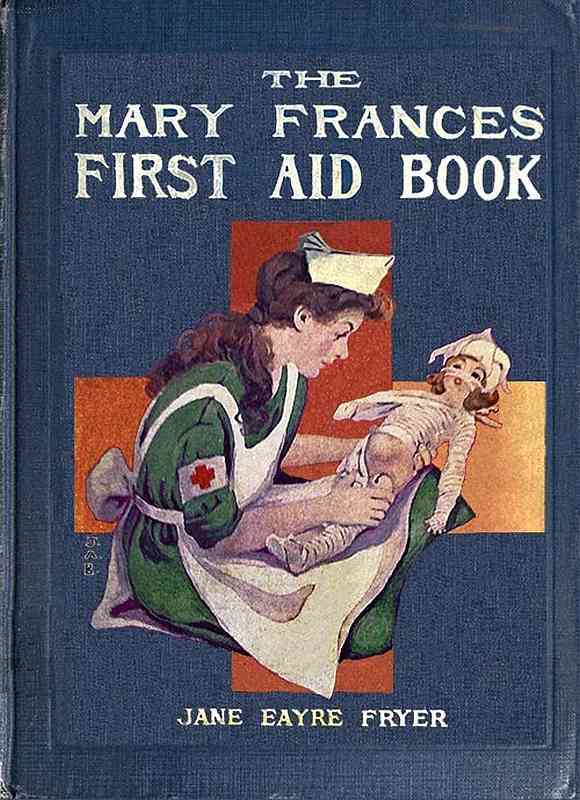
So it came about that when Mary Frances’ dolls gathered together for their lessons, it was Mary Frances herself dressed in the spotless white uniform, with the red cross on the arm and cap, of the American Red Cross Society, who gave their—
First Lesson in First Aid to the Injured
“Good morning, children,” she began. “We will imagine all kinds of troubles and accidents this morning, and we will not be a bit gloomy over them, for our thoughts will all be on how we can help the sick and hurt people.”
“Please, Miss Helpem, can’t I be the soldier?” begged Ibee Brave.
“And can’t I pretend to drive the field ambulance?” asked little Jack.
“And can’t I be run over?” asked another boy.
“Mercy, children,” exclaimed the nurse, “please wait for an explanation—and in the next lesson, I’ll assign you all something to do. Now, ready with your note-books and pencils to take down the list of articles needed for the medicine closet. You will learn what they are to be used for later. Keep the list and show it to your parents when you get home. Now write as I dictate:
Medicine Closet
In every home there should be a certain closet or shelf high above little children’s reach, where the medicines and articles needed in emergencies are kept. Among these should be found, plainly labeled, the following:[B]
- 1. Tincture of Iodine.
- 2. Aromatic Spirit of Ammonia.
- 3. Boric Acid Powder.
- 4. Stearate of Zinc.
- 5. Pure Alcohol.
- 6. Lime Water.
- 7. Carron Oil.
- 8. Epsom Salt.
- 9. Soda Mint and Pepsin Tablets.
- 10. Baking Soda.
- 11. Household Ammonia.
- 12. Adhesive (Zinc Oxide) Plaster.
- 13. Tube Vaseline.
- 14. Capsicum Vaseline.
- 15. Peroxide of Hydrogen.
- 16. Castor Oil.
- 17. Witch Hazel.
- 18. Essence of Ginger.
- 19. Syrup of Ipecac.
- 20. Spirit of Camphor.
- 21. Sweet Spirit of Nitre.
- 22. Boric Acid Ointment.
- 23. Powdered Alum.
- 24. Borax.
- 25. Spiced Syrup of Rhubarb.
- 26. Picric Acid Gauze.
- 27. Aromatic Smelling Salts.
- 28. Oil of Cloves.
- 29. Normal Salt Solution.
- 30. Powdered Mustard.
- 31. Essence of Peppermint.
- 32. Tincture of Arnica.
- 33. Oil of Turpentine.
- 34. Aseptic Absorbent Cotton.
- 35. Sterile Gauze.
- 36. Triangular Bandages.
- 37. Roller Bandages.
- 38. Rubber Ear Syringe.
- 39. Fountain Syringe.
- 40. Measuring Glass.
- 41. Eye Dropper.
- 42. Hot Water Bottle.
The children wrote very quietly and listened attentively to what Miss Helpem told them about being prepared for Ordinary Household Accidents, such as cuts, burns, scalds, bruises, stings, etc.
“Children,” beamed Miss Helpem as they finished writing the list, “I never dreamed you could be so interested. Why, not one of you has been inattentive! Now, as a reward, I shall show you how—
To Make a Sanitary Drinking Cup from Any Piece of Clean Paper
FOOTNOTE:
[B] The full list of remedies, with explanatory notes, is given in the Ready Reference List at the end of this book.
CHAPTER VII
Safety First
“WE girls get our second lesson before you boys do!” declared little Soami to her brother Ibee at the lunch table the next day.
“I bet you don’t have as much fun as we do!” answered Ibee.
“What is the next lesson about?” asked their father.
“It’s about Safety First,” replied Ibee. “I know that.”
“Yes,” agreed Soami, “but,” glancing at the clock, “I’ll be late to class if I don’t hurry. Mother, will you excuse me?”
Her mother nodded and smiled, and Soami left hastily.
“Well, girls,” began Miss Helpem, “to-day we have a more serious time, for we’re going to learn, in Lesson II, What to Do in Case of Slight Cuts and Pin Pricks; Slight Burns and Scalds; Frost Bites.
“Now, as you know, almost every accident could be avoided if we thought ahead far enough; if we did not let the knife or needle slip; if we did not allow little children to carry scalding hot water or lighted lamps, or to play with matches; if we looked up and down the street before crossing. Yes, almost all accidents are avoidable if we think far enough ahead—if we think ‘Safety First.’”
Miss Helpem paused.
“All ordinary everyday accidents,” she went on, “if treated rightly, will give but slight trouble; but if not treated rightly may bring much suffering to the victim, and even cause ‘blood poisoning’ and death.
“So you see how necessary it is to understand ‘What to Do.’
“Now, these serious dangers do not come from the slight accidents themselves, but because of uncleanliness.”
Again the assistant nurse paused, and she could not help smiling at the look of astonishment on the faces of her girl dolls.
“It is true, girls,” she continued; “cleanliness is the rarest thing in the world, and I will tell you why: because everywhere about us, in the dust, in the air, on our clothing, on our hands, in standing water, on the floor, on the ground—everywhere, even though we cannot see them, are
Germs
These little living particles are too small to be seen without a microscope, but they cause more disease and deaths than any of the big animals you are afraid of—like lions or bears or tigers. They make great deep sores out of little cuts, and prevent wounds from healing. So you can readily understand how necessary it is to keep all materials which touch broken skin perfectly clean, and they cannot be clean if touched by the hands. Neither is any material clean which has come in contact with dust.
Understanding this, your aim will be to keep germs out of any wound. If you do not have a first-aid outfit, you should have on hand a small package of sterile gauze.[C] Sterile means perfectly free from germs. Any cloth which has been washed and ironed is quite safe, however, if it has not been used. You see, heat kills germs. Use next to the wound the surface which has been folded inside.
Do not think that every germ does evil, for some germs are good—just as some people are bad and some are good. Indeed, we depend for some kinds of food upon the action of certain good germs. Among such foods are cheese and vinegar.
The disease germs which we dread most in cases of wounds are the germs of blood-poisoning and lockjaw (or tetanus). They are everywhere about us, in standing water, air, dust. They cannot do a bit of harm to the outside of the body, if the skin is unbroken—no more than a fly can do to the armor of some old knight. But if they can enter where the skin is broken, they begin to do all kinds of harm, which sometimes results in months of suffering from “infected” wounds, and sometimes finally causes the patient to lose a leg or an arm—or perhaps to die.
“We have spent a great deal of time on the subject of germs, children,” continued Miss Helpem, “because unless you really understand how necessary cleanliness is, you may not be particular to have clean materials.”
“And clean hands,” suggested Soami.
“Yes,” smiled the nurse, “Soami has noticed the nurses at the hospital washing their hands for five minutes in order to have them truly clean before attending to a dressing on a patient.”
The little girl looked around proudly upon the class.
“Can’t we begin the first-aid games now?” asked one of the group.
“Not yet,” the nurse shook her head. “Wait, please, until you have learned what to do for—
Slight Cuts and Pin Pricks
The bleeding from a slight cut is never very severe and will generally stop of itself in a short time. It is best to let a slight cut bleed a little, as the bleeding carries away the germs which may have been on the edge of the knife or whatever caused the wound.
Treatment:
Touch slight cute with tincture of iodine;[D] or with alcohol; or vinegar and water, half and half; or salt and water, a half teaspoonful of salt to a cup of water.
Wrap with clean gauze.
In cases of severe hemorrhage (bleeding) send immediately for a doctor. Stop bleeding by using pressure above or below wound, or by bandaging a gauze compress on the wound.
Never give whiskey or alcohol in any form. It makes hemorrhages worse. See Reference List.
Burns and Scalds
(See Reference List)
Apply carron oil. See List of Medicines.
If carron oil is not at hand, use any dressing[E] to cover surface to keep out the air—as lard, butter, olive oil—or sprinkle with baking soda, or cover with white of egg, or with a paste made of starch or flour and water. Also spread on compress[E] some of the same remedy that has been applied to the burn. Hold compress in place with a loose bandage.
Solution of bicarbonate of soda (baking soda) made by dissolving as much soda as possible in hot water (about one teaspoonful to a cup) is particularly relieving to scalds. Dip cloths into this and apply to the burned surface. Never remove skin from blisters. If blisters are large, see the doctor.
How to Put Out Flames
Caution.—If your clothing catches fire, do not run! Roll (in a rug, if possible) on the floor or ground!
In putting out fire on another person’s clothing, use rugs or blankets. In throwing a rug on another person, be careful not to allow your own clothing to catch fire. Let the sufferer lie down and roll. Stand in back of the rug, and throw from the head downward.
If in a burning building, creep to the door on hands and knees to avoid the smoke.
To Avoid Accidents from Fire
1. Children should not make bonfires without the aid of older persons.
2. Matches should be kept out of reach of small children.
3. Children should be taught to be careful of open fireplaces.
4. Children should be taught to roll if their clothing catches fire. This would save scores of lives in a year.
Safety First. Look ahead! See the danger before the accident!
Frost Bites
When nose, ears, hands or feet are exposed to intense cold they often become frost-bitten, turning purple at first. If frozen thoroughly, they turn waxy white; then no pain is felt, because the nerves are frozen.
Treatment:
1. Keep patient in cold room.
2. Do not warm frozen parts quickly. Instead, rub with snow or bathe with ice water until a tingling pain is felt; then stop.
If frozen parts are warmed too quickly, “gangrene” may result, or perhaps the sudden heat may cause—
Chilblains
Chilblains are the result of too rapid warming of cold parts, generally feet or fingers. Sometimes for years after being frost-bitten, exposure to severe cold will produce itching and burning, and perhaps swelling and ulcers.
Treatment:
Rub with turpentine or alcohol. The rubbing in itself is excellent. See doctor.
FOOTNOTES:
[C] Sterile gauze is cheesecloth which has been so treated that it is free of germs and is very absorbent. It is sold at all drug stores. It should be kept closely wrapped, and the surface should never be touched with the hands before it is placed on a wound.
If you do not have sterile gauze, keep old linen or cotton cloth (which has been well washed and ironed) in glass jars, which have been boiled and dried in the air without wiping.
[D] Soldiers on active service carry iodine to be applied to wounds immediately, if possible—to kill germs. Iodine is a poison if swallowed, so be careful not to leave it within the reach of small children.
[E] Important Note.—Dressings are everything applied to a wounded or sore surface. A compress is the dressing which is placed directly upon the wound. It is usually made of clean new gauze. A bandage is the dressing which holds the compress (or other dressings) in place.
Compresses are used to—
- 1. Hold medication in place.
- 2. Protect sore place.
- 3. Stop bleeding.
CHAPTER VIII
Practice Games
“THAT is all the lecture part of to-day’s lesson,” smiled Miss Helpem. “Now, for the practice.”
She made a gesture toward Shesa Brave, who came forward, and together they lifted before the class the tiny medicine cabinet which Mary Frances’ Aunt Maria had given her for her Dolls’ Hospital.
“Let me see,” said Miss Helpem. “Yes, we have everything here, I believe. Girls, you may all come look.”
The dolls—I mean, girls—gathered around the little glass closet and compared the labeled bottles and packages with the list given them in the previous lesson.
They were delighted with the beautiful cleanliness of the closet—its bright glass door and white shelves and shining enamel frame.
“Now,” continued Miss Helpem, “please divide into groups of two. That will make five groups. We will play that one girl in each group is the mother, and the other her child. The child has cut her hand while slicing bread. Mothers, what will you do? What will be your first-aid treatment?”
Mary Frances—I mean, Miss Helpem—was delighted with the girls’ answers and with the way in which they sought out the iodine bottle, and wrapped the supposed injury with narrow gauze.
“In the next practice game, the ‘child’ acts as mother and ‘mother’ as ‘child,’” said the assistant nurse. “This time the ‘child’s’ clothing has caught fire from a spark which snapped out of the fireplace.”
The girls laughed.
The nurse smiled. “Girls,” she said, “these games may make you feel like laughing, but please keep in mind how serious the real accident would be, and try to learn what to do. You will be so much better able to live useful lives.”
You see, Mary Frances didn’t quite remember that they were only dolls. Even so, they have served a very useful purpose if they only teach the readers of this book some of their lessons.
“Ready, now, for practice,” said the nurse. “Girl No. 2 of each group is to act as a little daughter whose frock has caught fire.”
The girls remembered not to run, and “pretended” to smother out the flames.
“That was so well done,” said Miss Helpem, “that no one was severely burned, so we’ll merely have to treat for slight burns.”
The “mother” girl from each group went to Shesa Brave for carron oil, which she applied on gauze compresses to imaginary hurt fingers.
Then they reversed parts again, and played the “child” had frosted her fingers. The “mother” girls rubbed the fingers with imaginary snow, gradually restoring the circulation of the blood in the “frozen” parts.
Throughout all their fun the girls acted in a serious, purposeful manner.
“I’m not so certain that boys would ‘play in earnest,’” said Miss Helpem to Shesa.
“I think they would,” replied the young girl. “I’m certain Ibee is just as interested as Soami,” which pleased the assistant nurse more than I can tell you.
CHAPTER IX
The Hikers
THE assistant nurse had very little time for the next lesson in the boys’ class, so she gave them only notes in the morning, promising the practice games at four o’clock in the afternoon. After telling them of this plan, she began the lesson.
“Probably you boys have never thought of the fact that the little pipes and larger tubes which carry the blood may be broken under the skin,” Miss Helpem said. “When the blood gathers in dark purplish spots underneath the unbroken skin, you have what is called a bruise or contusion.
Bruises (Contusions)
(See Reference List)
“Black and blue” spots which result from bleeding under the skin are caused by falls or blows, or pinching (as in door or window).
Treatment:
Apply cold water or ice wrapped in a cloth, or an ice bag, or bathe with half water and half alcohol, or witch hazel, or arnica.
If an arm or finger, hold up over the head.
If severe, after the pain and swelling have lessened, use hot applications, wringing cloths out of hot water, changing them as they cool, or use a hot-water bag.
For “black eye,” bathe with ice-cold water, or use cloths wrung out of water as hot as can be borne.
Massage gently for discoloration.
Note.—Never open a blood blister—apply hot water.
Sprains
(See Reference List)
should be treated as soon as possible by a physician, but while waiting for the doctor, use cold water applications. If cold water does not relieve the pain in an hour’s time, try hot water.
Do not attempt to use the sprained joint.
Stings and Bites of Insects
(See Reference List)
For stings of bees and bites of spiders, apply any of the following list:
- Mud.
- Slice of onion.
- Household ammonia.
- Paste made of bicarbonate of soda (baking soda).
- Spirit of camphor.
Miss Helpem paused. “While we are thinking about insects,” she said, “I wish to speak of—
The Filthy Flies
If you could look at the bottom of a fly’s foot under the microscope, you would see thousands of the most disgusting germs, particularly of the dreaded typhoid fever.
Please remember that it is far more important to prevent disease than to cure—so do all that you can to keep flies out of the house, out of food, off the baby’s bottle and body. Just looking at this picture shows you a little of what must go into baby’s mouth after the fly has stolen a bit of baby’s breakfast. How many of you promise to do everything you can to reduce the number of flies in this beautiful country of ours—by destroying them and by removing their breeding places, which are in manure piles?”
Every boy’s hand shot up.
“Thank you,” smiled the assistant nurse. “I can see that the boys of this class are to be real soldiers of health for this entire community.”
“Please, Miss Helpem,” said Ibee Brave, “there are two more animals I would like to learn something about. One is the mosquito, and the other is fleas.”
The boys laughed.
“Not animals, Ibee; insects,” corrected Miss Helpem. “We will not have time to speak at length of the mosquito, for that would make a whole lesson in itself, but I do want to say that mosquitoes are the cause of some of our worst diseases, for they carry disease germs from one person’s blood into another’s. To destroy them, kerosene oil should be sprayed or sprinkled or poured on the surface of any stagnant water; for mosquito babies (wigglers) live in stagnant (standing) water. Please remember this: one old tin tomato can half full of water will be an ample amount to supply a whole neighborhood with young mosquitoes in a short time, so overturn any old tins you see, just to help in a good cause.”
“Now, Ibee,” she continued, after a slight pause, “I will tell you
How to Rid a House of Fleas
Dust naphtha flakes[F] all over the floors. Leave twenty-four hours, if possible, then sweep up and sprinkle the sweepings with kerosene to destroy the eggs before throwing away.
“I say, fellows,” sang out Ibee Brave, after the class was dismissed, “let’s go on a hike like any good scouts. Gee, I wish I were twelve years old, so I could be a boy scout!”
“We treat you just as if you were one. Let’s go over to the river bank,” suggested their patrol leader. At the signal, off they started over the hills of the sand-pile of Mary Frances’ playroom, coming at length to Painted River and Looking Glass Lake, on which floated the toy ducks and swans which Mary Frances’ little friend Eleanor had given her for a Christmas present.
When they re-assembled at four o’clock, the assistant nurse was surprised at their appearance, for several swollen faces were plastered in blotches of mud.
“We don’t need any practice games,” commented one of the boys.
“We have had real practical practice,” explained their leader.
“I should judge you had,” said Miss Helpem, looking over the group. “Do tell me what happened.”
“When we left here, we started on a hike to the river,” went on the leader, “and after we had rested a little while, we began a game of baseball. Tom Holden was catcher, and somehow when he leaned over to fasten his shoe, bang! the ball went into his eye—an accident, of course.”