
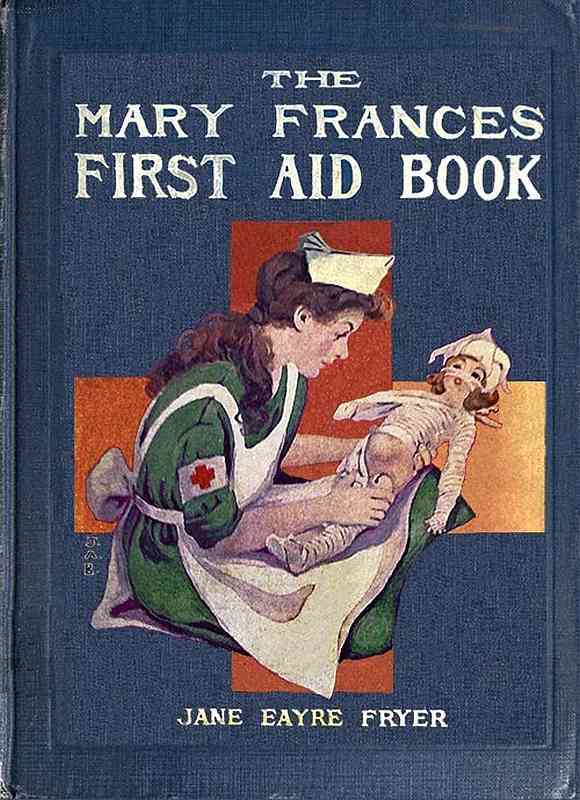
The Project Gutenberg eBook of The Mary Frances first aid book
Title: The Mary Frances first aid book
with ready reference list of ordinary accidents and illnesses, and approved home remedies
Author: Jane Eayre Fryer
Illustrator: Jane Allen Boyer
Release date: February 21, 2017 [eBook #54216]
Language: English
Credits: E-text prepared by Emmy, MWS, and the Online Distributed Proofreading Team (http://www.pgdp.net) from page images generously made available by Internet Archive (https://archive.org)
E-text prepared by Emmy, MWS,
and the Online Distributed Proofreading Team
(http://www.pgdp.net)
from page images generously made available by
Internet Archive
(https://archive.org)
| Note: | Images of the original pages are available through Internet Archive. See https://archive.org/details/maryfrancesfirst00fryeiala |
Transcriber’s Note: Please be advised that this First Aid book is very old and its advice and practices should not be taken as the best, safest, modern choices.
THE MARY FRANCES FIRST AID BOOK
MARY FRANCES
FIRST AID BOOK
Mary Frances Puts Her First Aid Knowledge into Practice
FIRST AID BOOK
WITH READY REFERENCE LIST OF ORDINARY
ACCIDENTS AND ILLNESSES, AND APPROVED
HOME REMEDIES
By
Member American Red Cross Society,
Member New Jersey Women’s Division National
Preparedness Association,
Author of “The Mary Frances Story-Instruction Books.”
ILLUSTRATIONS BY
JANE ALLEN BOYER
PREPAREDNESS
This book is for every boy and girl who hopes to render first-aid to the sick or injured—in time of peace—in time of war—at all times in the service of
OUR COUNTRY
PREFACE
This book is more than a story to inspire children with a desire to relieve suffering; it is a simplified and handy reference book, telling what to do in cases of accident or illness. In no sense is it intended to take the place of the physician. The first principle of first-aid cannot too often be repeated—when in doubt, send for the doctor.
Especial thanks are due to E. A. Y. Schellenger, M.D., member Surgical Staff, Cooper Hospital, Camden, N. J., for his great assistance in verifying and revising the medical and first-aid instructions given herein; and to Constance Cooper Crichton, Instructor of First Aid Classes, New Jersey Women’s Division National Preparedness, whose helpful criticism and suggestions have been invaluable.
Merchantville, N. J.
CONTENTS
| CHAPTER | PAGE | |
| I. | Off to Mexico | 17 |
| II. | The Speeders’ Accident | 21 |
| III. | First Aid to the Injured | 26 |
| IV. | At the Dolls’ Hospital | 30 |
| V. | The Real Cross Nurses | 35 |
| VI. | Lessons in First Aid | 39 |
| VII. | Safety First | 43 |
| VIII. | Practice Games | 50 |
| IX. | The Hikers | 53 |
| X. | On Looking Glass Lake | 60 |
| XI. | Two Boys are Late | 67 |
| XII. | Plans | 73 |
| XIII. | A Sane Fourth of July | 81 |
| XIV. | Shesa, a Red Cross Nurse | 88 |
| XV. | A Telegram from Mexico | 94 |
| XVI. | Private Brave’s Adventures | 97 |
| XVII. | The Mad Dog | 102 |
| XVIII. | The Poisoned Baby | 105 |
| XIX. | Hurrah for Our Hero | 108 |
| APPENDIX | ||
A Ready Reference List of Ordinary Accidents and Illnesses, with Approved Home Remedies |
115 | |
INSTRUCTIONS
What to Do until the Doctor Comes, in Ordinary Household Emergencies (See Ready Reference List)
| PAGE | |
| Biliousness | 117 |
| Bites of Animals | 117 |
| Bites of Insects | 117 |
| “Black Eye” | 117 |
| Bleeding of Gums | 117 |
| Blood Blisters | 118 |
| Broken Bones or Fractures | 118 |
| Bruises or Contusions | 118 |
| Burns and Scalds | 119 |
| Car Sickness | 120 |
| Chilblains | 120 |
| Chills | 120 |
| Choking | 120 |
| Coal Gas, Suffocation from | 120 |
| Colds | 120 |
| Colic | 121 |
| Convulsions of Children | 122 |
| Corns | 122 |
| Croup | 122 |
| Cuts (Slight) | 122 |
| Diarrhea | 123 |
| Earache | 123 |
| Fainting | 123 |
| Fever Blisters (Cold Sores) | 124 |
| Fire, to Avoid Accidents from | 48 |
| Fits | 124 |
| Foreign Body in Ear | 124 |
| Foreign Body in Eye | 125 |
| Frost Bites | 125 |
| Gum Boils (“Canker Spots”) | 125 |
| Heat Exhaustion | 125 |
| Hemorrhage (Severe Bleeding) | 125 |
| Hiccough | 127 |
| Hives | 127 |
| Indigestion | 127 |
| Itching | 127 |
| Lice in Hair (Pediculosis) | 127 |
| Nails (Ingrowing) | 127 |
| Nausea (Sick Stomach) | 128 |
| Nosebleed | 128 |
| Perspiration | 128 |
| Poison Ivy Rash | 128 |
| Poisoning—Treatments and Antidotes | 128 |
| Powder Wounds | 130 |
| Prickly Heat | 130 |
| Ptomaine Poisoning | 130 |
| Sea-Sickness | 130 |
| Shock | 131 |
| Sore Throat | 131 |
| Splinters | 131 |
| Sprain | 131 |
| Stiff Neck | 131 |
| Stings | 132 |
| Strain of Muscles | 132 |
| Sunburn | 132 |
| Sunstroke | 132 |
| Toothache | 132 |
| Warts | 133 |
| Wounds | 133 |
| Plasters, Poultices and Stupes | 134 |
| How to Rid a House of Fleas | 56 |
| How to Use First Aid Bandages | 82, 83, 84, 98, 99 |
| How to Make a Drinking Cup | 42 |
| List of Remedies for the Home Medicine Closet | 136 |
CHAPTER I
Off to Mexico
THE Head Nurse, Miss Bossem, rushed out of the Dolls’ Hospital toward the children. “You’re late, Miss Helpem,” she called to Mary Frances. “Go right on duty rolling bandages for the soldiers who start for Mexico to-day. The troop-train leaves at two-thirty. Hurry, now, or you won’t get them to the station on time.”
Then, turning to Billy, “Get the ambulance ready immediately,” she commanded, and Billy disappeared into the garage.
You see, Mary Frances finished the course in First Aid Nursing with the Red Cross Preparedness Class just before her birthday. Being very proud of her newly acquired knowledge, she wanted to show Billy how much she had learned.
When Billy promised her any favor she could think of as a birthday present, Mary Frances joyfully asked him to spend a whole day at the Dolls’ Hospital in the playroom, pretending they were little kiddies again—that she was Miss Helpem, the assistant nurse, and that Billy was the ambulance driver. To keep his promise, Billy consented.
Just as they stepped into the playroom door, they seemed to grow smaller and smaller, until they were no bigger than the dolls themselves.
Now, go on with the story and see what happened.
Promptly at two-fifteen, Miss Helpem arrived at the station with an ambulance full of bandages, and just in time to see the Brave family bidding good-bye to Private Ima Brave. All the family were there, even Michael, the big bulldog. Private Brave was among the last of the soldiers to board the little train.
“You’ll write from New York, dear,” begged his mother, kissing him for the twentieth time, and slipping a little American Red Cross first-aid outfit in his hand. “Always carry this with you, and remember how your mother loves you.”
“And you’ll send me picture postcards from everywhere, won’t you?” begged little Ibee Brave, standing on tip-toe to get a better view of his tall, straight brother.
“There’s a speck of dust on your uniform,” fussed Soami, his little sister, as she brushed him with her handkerchief.
Private Brave smiled. “We’re not on dress parade, little sister,” he said. “It’s good that khaki doesn’t show the dust, for it’s a dusty country we’re going to.”
“‘It’s a long, long way to Mexico, it’s a long way to go,’” began little Ibee; but at that moment the engine whistled, and his father clasped Private Brave’s hand.
“I am proud of my son,” was all he said.
“And I, of my brother,” Shesa, his big sister, added, with tears in her eyes.
One more whistle, and the little train started down the playroom railroad track.
“We’ll bring the limousine nearer the station,” said Mr. Brave, taking Mrs. Brave’s arm and walking away.
“Father and Mother don’t want anyone to talk with them just now,” said Shesa.
“I don’t see why. Gee, I wish I was big enough to go,” said little Ibee, as he watched the train until the last car turned a curve in the track.
“You’d make a fine soldier, wouldn’t you,” laughed Soami, “when you’re afraid to go upstairs in the dark.”
“Only sometimes,” answered Ibee; “only when the wind blows hard and when it’s not moonlight—and then, not often.”
“Why, Soami, Ibee is real brave,” said Shesa. “Don’t you remember how you were afraid to go down cellar to get some jam last night and Ibee would have gone, if father hadn’t made you go?”
“Yes, and father stood on the landing the whole time you were gone, too, Miss,” declared Ibee triumphantly.
“Yes, that’s so,” acknowledged Soami. “I guess Ibee would make a good soldier—especially a drummer boy. My! he can drum bravely! Did you hear him yesterday, Shesa?”
“Indeed I did,” laughed the sister.
“Yes,” continued Soami, mischievously, “don’t you remember the verses about—
“Come, children,” said their father, driving up, “here’s the car. Hop in.”
CHAPTER II
The Speeders’ Accident
THE shrill sound of a policeman’s whistle cut the air three times, but the dollsmobile sped on faster than ever.
“I couldn’t catch them at all, at all,” reported the little thin sub-officer, McStoppem, at headquarters.
“Bring my motorcycle, McStoppem,” ordered Chief Arrestem.
“All right, sir,” nodded Officer McStoppem, bringing out the wonderful little toy. “If you take the cross-cut road toward Sandpile Village, you’ll catch them. The number is—here it is, I wrote it down—1492. You can easily remember it—the year Columbus made ‘preparedness’ necessary.”
“Cut out your chatter, McStoppem, and follow me in a hurry,” directed the chief, as he kicked the pedal of the motorcycle to start the engine. “Hand me the paper,” and, snatching it, was off.
“The chief’ll get ’em O.K.,” muttered Officer McStoppem to himself, as he watched the long line of dust and smoke in the wake of the little motorcycle.
Just as Chief Arrestem came into the cross-roads leading to Sandpile Village, the runaway automobile flew past.
“By Jiminy, I don’t wonder McStoppem couldn’t catch them,” he said under his breath, as he put on still more speed. “That man’s lost control of his car, and unless I’m mistaken there’ll be an accident when he comes to that dangerous turn in the road where that big rocking chair stands.”
Meanwhile everybody in the dollsmobile was trying not to be frightened.
“Can’t you slow down a little, Father?” asked Mrs. Brave.
“The brakes won’t hold,” panted Mr. Brave, forcing both brakes on with all his might. “This is dreadful!”
“Gee whiz!” exclaimed little Ibee, looking out the rear window. “Here comes the motor police. He’ll arrest us for speeding.”
“Oh, mercy, we’re coming to Rocking Hill road,” gasped Shesa. “Father, do turn off the power!”
But Shesa spoke too late, and kerr-smash! kerr-bang! kerr-plunk! went the dollsmobile right into the rockers of the rocking chair, turning “turtle” twice, and breaking the beautiful glass windows to pieces. Out of the broken radiator the boiling hot water poured over poor Mrs. Brave’s arm where she lay just as she was thrown.
“Oh, the engine’s on fire!” shrieked little Soami, “and I’m burning to death!”
“Father, Father,” called little Ibee, “come get me out! I’m fast under the car! Come get me out, please! Oh, I’ll be burned to death! Father, oh, my arm hurts! Oh, I can’t move my arm!”
The mother managed to get up when she heard the children call.
“Where’s your father? Oh, where is he?” she cried, and going to the other side of the car, she saw poor Mr. Brave lying amidst a heap of broken glass and wheels and gears. From his head ran a little stream of blood.
“Oh, he’s dead!” she sobbed, but just then he gave a little groan. “Oh, my dear husband,” she exclaimed, “tell me you’re not dead! Tell me you’re not dead!” she begged, unmindful of her own arm.
“I’m dead, Mother,” groaned little Soami. “I just know I’m dead with pain.”
“Well, I’m not!” said little Ibee, “and even though my arm hurts so, I’m going to try to go for help if I can get out from under this car.”
“My, that’s so!” exclaimed the mother. “I myself forgot to be brave. I’ll go for help.”
But just as she spoke, up came Chief Arrestem.
“I saw it all, madam,” he said, “and I stopped to telephone to the hospital for the ambulance.”
“Oh, don’t ’rest us, please,” begged little Ibee. “Please, Mr. Officer, don’t arrest us. We weren’t speeding. Father couldn’t make the brakes hold!”
“Don’t you worry, little chap,” replied Chief Arrestem. “I won’t arrest any of you. Here comes Officer McStoppem on his motorcycle, just as I told him to, and in a minute we’ll have you all out from under.”
“Never mind about me,” said Ibee. “Please get poor Soami out. She’s dead, I think.”
“Quick, McStoppem,” called the chief, “help throw sand on this car to put out the fire!”
It took about ten seconds for the two officers to put the fire out, and even before that, they heard the honk! honk! of the ambulance.
“Here comes the ambulance!” cried Chief Arrestem. “Now, with the driver’s help, we’ll soon be able to lift this car.”
CHAPTER III
First Aid to the Injured
“NOW, all at once,” directed Chief Arrestem. “One, two, three!” and the two officers and the two ambulance men lifted the dollsmobile high up over to the other side of the road.
“Well, friends,” said Officer Arrestem, “if there’s nothing more we can do, we’ll return to our duty.”
“Nothing more, thank you,” the head nurse answered.
The driver had quickly smothered the flames of little Soami’s frock by using the automobile robes.
“Oh, my goodness!” shrieked Mrs. Brave, “where’s Shesa? I wonder where my dear daughter is! Where is she? Where can she be?” she kept on asking, crying hysterically.
“Hush! quiet yourself!” commanded the assistant nurse, who came in the ambulance. “We found your daughter a few moments ago where she was thrown. She had fainted, but she is all right now.”
“Oh, sit her up; don’t let her lie there!” exclaimed the mother.
“Indeed, you must keep quiet,” said the nurse, “or we cannot do anything for anybody. It is better for her to lie down than to sit up.”
“I’d keep quiet if I knew what to do! Every woman and man, too, ought to know.”
“Yes,” replied the nurse, “every person ought to know something about first aid to the injured.” She and the other nurse were busily directing the orderly and driver of the ambulance in every movement, giving them explicit directions.
They attended the most dangerously injured first, stopping the bleeding (hemorrhage) of Mr. Brave’s head and bandaging a dressing in place. They applied soothing carron oil to the burns on little Soami’s arms and legs.
They bandaged temporary splints to little Ibee’s broken arm, and, since Mrs. Brave’s scalds were not serious, they attended her last.
Under Mr. Brave’s broken leg they placed pillows to make him more comfortable.
“If I’d only remembered to turn off the power this never would have happened,” he muttered. “How foolish of me!”
“There would never be any accidents to speak of,” said the assistant nurse, soothingly, “if everybody did everything right, you know.”
“If everybody just kept his head cool,” said Mr. Brave, as he tried to move his position, but fell back with a groan.
“Give him a half-teaspoon of aromatic spirit of ammonia, Miss Helpem,” said Miss Bossem, who was engaged in spreading the stretcher.
“Now, everyone ready to lift this patient,” she directed, as she and the driver and orderly knelt on one knee beside Shesa, and Miss Helpem took her position on the opposite side of the stretcher. As the three lifted Shesa, Miss Helpem carefully held the stretcher in place, and afterward helped carry the patient to the ambulance. Next they carried the two children, using a stretcher for little Ibee, and making a two-handed seat for Soami. (A “sedan chair,” you know—the kind you play with at school.)
“I’m sorry neither doctor could leave the operating room to come, Miss Helpem,” remarked Miss Bossem, to her assistant, who was Mary Frances, you remember. “If you will wait here with these two patients,” (they were Mrs. and Mr. Brave) “I will return with either Doctor Surecure or Doctor Quickenquack.”
“Oh, why can’t you take my dear husband along?” begged Mrs. Brave. “He’s awfully hurt! awfully!”
“Please explain to her, Miss Helpem,” said Miss Bossem, getting into the ambulance, “that it is far better to wait for the doctor to attend a broken leg than to attempt to place it in splints—unless it is absolutely necessary to move the patient.”
Miss Helpem turned to Mrs. Brave, who was by this time quite exhausted, and after explaining the situation, treated her, as she had all the others, for—
Shock
Cause:
A severe injury, or even the sight of one, will often cause intense nervousness, which is very weakening. This is especially true if the patient is suffering from severe bleeding. Check the bleeding before treating for shock.
Shock differs from fainting. The patient’s face becomes pale and the skin cold, the pupils of the eyes large.
What to do:
1. Send for the doctor.
2. Place patient on back with head low to allow plenty of blood to enter head.
3. Give hot water or hot coffee, or one-half teaspoonful aromatic spirit of ammonia in a quarter of a tumbler of water.
4. Hold smelling salts to the nose.
5. Do not excite by trying to remove clothing unless absolutely necessary, but keep patient warm by use of hot-water bottles and blankets, etc.
6. Cover patient. Rub limbs toward body.
7. Do not give whiskey or any other form of alcohol, if any other stimulant can be found—and never whiskey in case of hemorrhage (severe bleeding).