
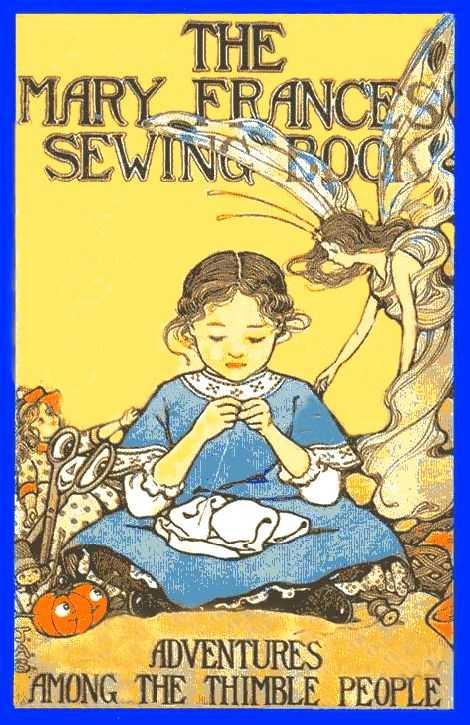
MARY FRANCES stopped on the stairs to listen.
“Surely,” she thought, “Sewing Bird is talking with some one. I wonder if it’s one of the Thimble People. Oh, I do hope so!” and, as she tripped into the sewing-room, she asked,
that
I heard?”
“Oh, Sewing Bird, what’s that I heard as I came up the stair? It really doesn’t matter much—for Grandma wouldn’t care.”
sang Sewing Bird.
“Oh,” laughed Mary Frances. “Caught myself making a rhyme;—but I don’t want to become a little birdie, even though they are so dear,—besides, I don’t have wings.”
“No,” said Sewing Bird. “I don’t suppose you do want to be a birdie—for many reasons;—but the most important must be that little birds do not have hands!”
are so
wonderful!”
“Hands are so wonderful!” said Mary Frances, “they can do so many things. They are pincers, hammers, wedges, and yet they can do the most dainty, delicate work.”
“Yes,” said Sewing Bird, “they come in handy!”
“Oh, ho, hee-hee!” laughed Mary Frances.
“Chirp, chirp!” twittered Dick Canary.
asked Sewing Bird. “But now to learn
1. Count six holes down and four from right hand end. Put needle in from under side: pull through.
2. Count one hole to the left. Find the hole above it. Point needle downward through the upper hole—bring it up to right side through the under hole.
3. Finish row and fasten thread on wrong side, by running thread through the last few stitches.
1. Count one hole from top of canvas and two in from end.
2. Commence as for Overhanding.
3. Bring needle out two holes to the left of first stitch.
4. Fasten as in Overhanding.
Overcasting stitch is used to finish raw edges of material to keep from fraying.
“The next stitch is the first stitch your grandmother learned to make,” said Sewing Bird. “Her little fingers got so tired and sore trying to make tiny little bits of stitches on muslin, that you may be glad you are to learn on canvas.”
1. Six rows from top—four over to left. Needle up from
wrong side: pull through.2. On row of holes below, one hole to left, point needle down,
bring it up in first row of holes, two holes to the left of first stitch.3. Hood canvas over the first finger. Finish row.
4. Fasten as in Overcasting.
“Is that all there is to hemming?” asked Mary
Frances happily.
“No, little Miss, that is just a ‘first beginning,’
as my grandmother used to say. Some day I hope
you will make hemming stitches so small that they
will scarcely show—on a dolly’s apron.”
“Oh, how perfectly lovely!” cried Mary Frances.
“I can scarcely wait! Will it be long?”
“That all depends, my little friend—”
“Upon me,” said Mary Frances. “I’ll work very
in-dus-tri-ous-ly, dear little teacher.”
that little birds do not have hands