
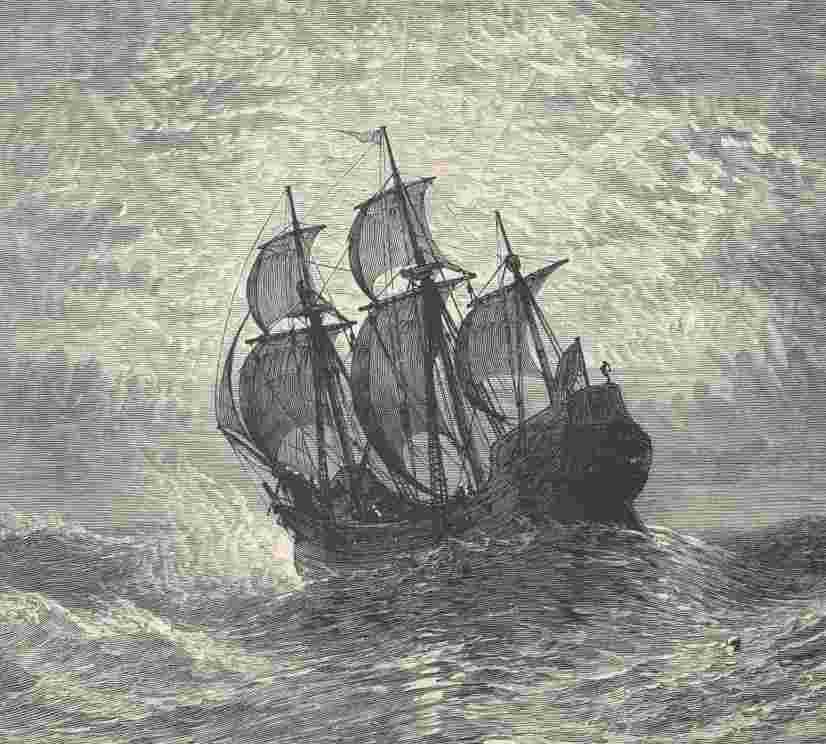
Pilgrim Fathers, p. 341. John Brown, in his Pilgrim Fathers of New
England, p. 198, says: “She [the SPEEDWELL] was to remain with the
colony for a year.” Evidently a mistake, arising from the length of
time for which her crew were shipped. The pinnace herself was
intended, as we have seen, for the permanent use of they colonists,
and was to remain indefinitely.]
that the crew of the SPEEDWELL “were hired for a year,” and we know,
in a general way, that most of them went with her to London when she
abandoned the voyage. This there is ample evidence Coppin did not do,
going as he did to New England as “second mate” or “pilott” of the
MAY-FLOWER, which there is no reason to doubt he was when she left London.
Neither is there anywhere any suggestion that there was at Southampton any
change in the second mate of the larger ship, as there must have been to
make good the suggestion of Dr. Dexter.
Where the SPEEDWELL lay while being “refitted” has not been ascertained, though presumably at Delfshaven, whence she sailed, though possibly at one of the neighboring larger ports, where her new masts and cordage could be “set up” to best advantage.
We know that Reynolds—“pilott” and “Master” went from London to superintend the “making-ready” for sea. Nothing is known, however, of his antecedents, and nothing of his history after he left the service of the Pilgrims in disgrace, except that he appears to have come again to New England some years later, in command of a vessel, in the service of the reckless adventurer Weston (a traitor to the Pilgrims), through whom, it is probable, he was originally selected for their service in Holland. Bradford and others entitled to judge have given their opinions of this cowardly scoundrel (Reynolds) in unmistakable terms.
What other officers and crew the pinnace had does not appear, and we know nothing certainly of them, except the time for which they shipped; that some of them were fellow-conspirators with the Master (self-confessed), in the “strategem” to compel the SPEEDWELL’S abandonment of the voyage; and that a few were transferred to the MAYFLOWER. From the fact that the sailors Trevore and Ely returned from New Plymouth on the FORTUNE in 1621, “their time having expired,” as Bradford notes, it may be fairly assumed that they were originally of the SPEEDWELL’S crew.
That the fears of the SPEEDWELL’S men had been worked upon, and their cooperation thus secured by the artful Reynolds, is clearly indicated by the statement of Bradford: “For they apprehended that the greater ship being of force and in which most of the provisions were stored, she would retain enough for herself, whatever became of them or the passengers, and indeed such speeches had been cast out by some of them.”
Of the list of passengers who embarked at Delfshaven, July 22, 1620, “bound for Southampton on the English coast, and thence for the northern parts of Virginia,” we fortunately have a pretty accurate knowledge. All of the Leyden congregation who were to emigrate, with the exception of Robert Cushman and family, and (probably) John Carver, were doubtless passengers upon the SPEEDWELL from Delfshaven to Southampton, though the presence of Elder Brewster has been questioned. The evidence that he was there is well-nigh as conclusive as that Robert Cushman sailed on the MAY-FLOWER from London, and that Carver, who had been for some months in England,—chiefly at Southampton, making preparations for the voyage, was there to meet the ships on their arrival. It is possible, of course, that Cushman’s wife and son came on the SPEEDWELL from Delfshaven; but is not probable. Among the passengers, however, were some who, like Thomas Blossom and his son, William Ring, and others, abandoned the voyage to America at Plymouth, and returned in the pinnace to London and thence went back to Holland. Deducting from the passenger list of the MAYFLOWER those known to have been of the English contingent, with Robert Cushman and family, and John Carver, we have a very close approximate to the SPEEDWELL’S company on her “departure from Delfshaven.” It has not been found possible to determine with absolute certainty the correct relation of a few persons. They may have been of the Leyden contingent and so have come with their brethren on the SPEEDWELL, or they may have been of the English colonists, and first embarked either at London or at Southampton, or even at Plymouth,—though none are supposed to have joined the emigrants there or at Dartmouth.
The list of those embarking at Delfshaven on the SPEEDWELL, and so of the participants in that historic event,—a list now published for the first time, so far as known,—is undoubtedly accurate, within the limitations stated, as follows, being for convenience’ sake arranged by families:
embracing:—
Mrs. Katherine Carver,
John Howland (perhaps kinsman of Carver), “servant” or “employee,”
Desire Minter, or Minther (probably companion of Mrs. Carver,
perhaps kinswoman),
Roger Wilder, “servant,”
“Mrs. Carver’s maid” (whose name has never transpired).
Mrs. Dorothy (May) Bradford.
Mrs. Elizabeth (Barker) Winslow,
George Soule a “servant” (or employee),
Elias Story, “servant.”
Mrs. Mary Brewster,
Love Brewster, a son,
Wrestling Brewster, a son.
Mrs. Mary (Morris) Allerton,
Bartholomew Allerton, a son,
Remember Allerton, a daughter,
Mary Allerton, a daughter,
John Hooke, “servant-boy.”
William Butten, “servant"-assistant.
Mrs. Rose Standish.
Mrs. Susanna (Fuller) White,
Resolved White, a son,
William Holbeck, “servant,”
Edward Thompson, “servant.”
——- Blossom, a son.
Mrs. Ann Tilley.
Mrs. Bridget (Van der Velde?) Tilley (2d wife),
Elizabeth Tilley, a daughter of Mr. Tilley by a former wife(?)
John Crackstone (Jr.), a son.
John Cooke, a son.
—— Turner, a son,
—— Turner, a son.
Joseph Rogers, a son.
Mrs. —— Tinker,
—— Tinker, a son.
Mrs. —— Fuller,
Samuel Fuller, a son.
Mrs. Alice Rigdale.
Mrs. —— Eaton,
Samuel Eaton, an infant son.
over in charge of Howland, who was probably a kinsman, both he and
Deacon Carver coming from Essex in England,—as they could hardly
have been in England with Carver during the time of his exacting
work of preparation. He, it is quite certain, was not a passenger
on the Speedwell, for Pastor Robinson would hardly have sent him
such a letter as that received by him at Southampton, previously
mentioned (Bradford’s “Historie,” Deane’s ed. p. 63), if he had been
with him at Delfshaven at the “departure,” a few days before. Nor
if he had handed it to him at Delfshaven, would he have told him in
it, “I have written a large letter to the whole company.”
“servant,” and a man of standing and influence from the outset.
That he was in Leyden and hence a SPEEDWELL passenger appears
altogether probable, but is not absolutely certain.
the “Troth Book” (or “marriage-in-tention” records) for 1616, at the
Stadtbuis of Leyden, shows, was probably wife or widow of one
William Minther—evidently of Pastor Robinson’s congregation—when
she appeared on May 13 as a “voucher” for Elizabeth Claes, who then
pledged herself to Heraut Wilson, a pump-maker, John Carver being
one of Wilson’s “vouchers.” In 1618 Sarah Minther (then recorded as
the widow of William) reappeared, to plight her troth to Roger
Simons, brick-maker, from Amsterdam. These two records and the
rarity of the name warrant an inference that Desire Minter (or
Minther) was the daughter of William and Sarah (Willet) Minter (or
Minther), of Robinson’s flock; that her father had died prior to
1618 (perhaps before 1616); that the Carvers were near friends,
perhaps kinsfolk; that her father being dead, her mother, a poor
widow (there were clearly no rich ones in the Leyden congregation),
placed this daughter with the Carvers, and, marrying herself, and
removing to Amsterdam the year before the exodus, was glad to leave
her daughter in so good a home and such hands as Deacon and Mistress
Carver’s. The record shows that the father and mother of Mrs. Sarah
Minther, Thomas and Alice Willet, the probable grandparents of
Desire Minter, appear as “vouchers” for their daughter at her Leyden
betrothal. Of them we know nothing further, but it is a reasonable
conjecture that they may have returned to England after the
remarriage of their daughter and her removal to Amsterdam, and the
removal of the Carvers and their granddaughter to America, and that
it was to them that Desire went, when, as Bradford records, “she
returned to her friends in England, and proved not very well and
died there.”
naturally strong that she came from; Leyden with her mistress. Her
early marriage and; death are duly recorded.
and accompanied the family from thence. Bradford calls him “his
[Carver’s] man Roger,” as if an old, familiar household servant,
which (as Wilder died soon after the arrival at Plymouth) Bradford
would not have been as likely to do—writing in 1650, thirty years
after—if he had been only a short-time English addition to Carver’s
household, known to Bradford only during the voyage. The fact that
he speaks of him as a “man” also indicates something as to his age,
and renders it certain that he was not an “indentured” lad. It is
fair to presume he was a passenger on the SPEEDWELL to Southampton.
(It is probable that Carver’s “servant-boy,” William Latham, and
Jasper More, his “bound-boy,” were obtained in England, as more
fully appears.)
SPEEDWELL, as shown by his own recorded account of the embarkation.
(Bradford’s “Historie,” etc.)
(“Hypocrisie Unmasked,” pp. 10-13, etc.) makes it certain that
himself and family were SPEEDWELL passengers.
“steward,” it is not certain was with Winslow in Holland, though it
is probable.
though not surely so. Both servants might possibly have been
procured from London or at Southampton, but probably sailed from
Delfshaven with Winslow in the SPEEDWELL.
passengers on the SPEEDWELL, beyond reasonable doubt. He was, in
fact, the ranking man of the Leyden brethren till they reached
Southampton and the respective ships’ “governors” were chosen. The
Church to that point was dominant. (The Elder’s two “bound-boys,”
being from London, do not appear as SPEEDWELL passengers.) There is,
on careful study, no warrant to be found for the remarkable
statements of Goodwin (“Pilgrim Republic,” p. 33), that, during the
hunt for Brewster in Holland in 1619, by the emissaries of James I.
of England (in the endeavor to apprehend and punish him for printing
and publishing certain religious works alleged to be seditious),
“William Brewster was in London . . . and there he remained until
the sailing of the MAYFLOWER, which he helped to fit out;” and that
during that time “he visited Scrooby.” That he had no hand whatever
in fitting out the MAYFLOWER is certain, and the Scrooby statement
equally lacks foundation. Professor Arber, who is certainly a
better authority upon the “hidden press” of the Separatists in
Holland, and the official correspondence relating to its proprietors
and their movements, says (“The Story of the Pilgrim Fathers,”
p.196): “The Ruling Elder of the Pilgrim Church was, for more than a
year before he left Delfshaven on the SPEEDWELL, on the 22 July-
1 August, 1620, a hunted man.” Again (p. 334), he says: “Here let
us consider the excellent management and strategy of this Exodus.
If the Pilgrims had gone to London to embark for America, many, if
not most of them, would have been put in prison [and this is the
opinion of a British historian, knowing the temper of those times,
especially William Brewster.] So only those embarked in London
against whom the Bishops could take no action.” We can understand,
in light, why Carver—a more objectionable person than Cushman to
the prelates, because of his office in the Separatist Church—was
chiefly employed out of their sight, at Southampton, etc., while the
diplomatic and urbane Cushman did effective work at London, under
the Bishops’ eyes. It is not improbable that the personal
friendship of Sir Robert Naunton (Principal Secretary of State to
King James) for Sir Edward Sandys and the Leyden brethren (though
officially seemingly active under his masters’ orders in pushing Sir
Dudley Carleton, the English ambassador at the Hague, to an
unrelenting search for Brewster) may have been of material aid to
the Pilgrims in gaining their departure unmolested. The only basis
known for the positive expression of Goodwin resides in the
suggestions of several letters’ of Sir Dudley Carleton to Sir Robert
Naunton, during the quest for Brewster; the later seeming clearly to
nullify the earlier.
Under date of July 22, 1619, Carleton says: “One William Brewster,
a Brownist, who has been for some years an inhabitant and printer at
Leyden, but is now within these three weeks removed from thence and
gone back to dwell in London,” etc.
On August 16, 1619 (N.S.), he writes: “I am told William Brewster is
come again for Leyden,” but on the 30th adds: “I have made good
enquiry after William Brewster and am well assured he is not
returned thither, neither is it likely he will; having removed from
thence both his family and goods,” etc.
On September 7, 1619 (N.S.), he writes: “Touching Brewster, I am now
informed that he is on this side the seas [not in London, as before
alleged]; and that he was seen yesterday, at Leyden, but, as yet, is
not there settled,” etc.
On September 13, 1619 (N.S.), he says: “I have used all diligence to
enquire after Brewster; and find he keeps most at Amsterdam; but
being ‘incerti laris’, he is not yet to be lighted upon. I
understand he prepares to settle himself at a village called
Leerdorp, not far from Leyden, thinking there to be able to print
prohibited books without discovery, but I shall lay wait for him,
both there and in other places, so as I doubt but either he must
leave this country; or I shall, sooner or later, find him out.”
On September 20, 1619 (N.S.), he says: “I have at length found out
Brewster at Leyden,” etc. It was a mistake, and Brewster’s partner
(Thomas Brewer), one of the Merchant Adventurers, was arrested
instead.
On September 28, 1619 (N.S.), he states, writing from Amsterdam:
“If he lurk here for fear of apprehension, it will be hard to find
him,” etc.
As late as February 8, 1619/20, there was still a desire and hope
for his arrest, but by June the matter had become to the King—and
all others—something of an old story. While, as appears by a
letter of Robert Cushman, written in London, in May, 1619, Brewster
was then undoubtedly there, one cannot agree, in the light of the
official correspondence just quoted, with the conclusion of Dr.
Alexander Young (“Chronicles of the Pilgrim Fathers,” vol. i.
p. 462), that “it is probable he [Brewster] did not return to
Leyden, but kept close till the MAYFLOWER sailed.”
Everything indicates that he was at Leyden long after this; that he
did not again return to London, as supposed; and that he was in
hiding with his family (after their escape from the pursuit at
Leyden), somewhere among friends in the Low Countries. Although by
July, 1620, the King had, as usual, considerably “cooled off,” we
may be sure that with full knowledge of the harsh treatment meted
out to his partner (Brewer) when caught, though unusually mild (by
agreement with the authorities of the University and Province of
Holland), Brewster did not deliberately put himself “under the
lion’s paw” at London, or take any chances of arrest there, even in
disguise. Dr. Griffis has lent his assent (“The Pilgrims in their
Homes,” p, 167), though probably without careful analysis of all the
facts, to the untenable opinion expressed by Goodwin, that Brewster
was “hiding in England” when the SPEEDWELL sailed from Delfshaven.
There can be no doubt that, with his ever ready welcome of sound
amendment, he will, on examination, revise his opinion, as would the
clear-sighted Goodwin, if living and cognizant of the facts as
marshalled against his evident error. As the leader and guide of
the outgoing part of the Leyden church we may, with good warrant,
believe—as all would wish—that Elder Brewster was the chief figure
the departing Pilgrims gathered on the SPEEDWELL deck, as she took
her departure from Delfshaven.
sons and a daughter, were of the Leyden company and passengers in
the SPEEDWELL. We know he was active there as a leader, and was
undoubtedly one of those who bought the SPEEDWELL. He was one of
the signers of the joint-letter from Leyden, to Carver and Cushman,
May 31 (O.S.) 1620.
Southampton, but it is hardly probable, as Allerton was a man of
means, consulted his comfort, and would have hardly started so large
a family on such a journey without a servant.
connected by blood and marriage with many of the leading families of
Robinson’s congregation. He was active in the preparations for the
voyage the first signer of the joint-letter of May 31, and doubtless
one of the negotiators for the SPEEDWELL. His wife and child were
left behind, to follow later as they did.
probability, a student-“servant” of Doctor Fuller at Leyden, and
doubtless embarked with him at Delfshaven. Bradford calls him
(writing of his death) “Wm. Butten, a youth, servant to Samuel
Fuller.” Captain Myles Standish and his wife Rose, we know from
Bradford, were with the Pilgrims in Leyden and doubtless shipped
with them. Arber calls him (“The Story of the Pilgrim Fathers,”
p. 378) a “chief of the Pilgrim Fathers” in the sense of a father
and leader in their Israel; but there is no warrant for this
assumption, though he became their “sword-hand” in the New World.
By some writers, though apparently with insufficient warrant,
Standish has been declared a Roman Catholic. It does not appear
that he was ever a communicant of the Pilgrim Church. His family,
moreover, was not of the Roman Catholic faith, and all his conduct
in the colony is inconsistent with the idea that he was of that
belief. Master William White, his wife and son, were of the Leyden
congregation, both husband and wife being among its principal
people, and nearly related to several of the Pilgrim band. The
marriage of Mr. and Mrs. White is duly recorded in Leyden. William
Holbeck and Edward Thompson, Master White’s two servants, he
probably took with him from Leyden, as his was a family of means and
position, though they might possibly have been procured at
Southampton. They were apparently passengers in the SPEEDWELL.
Deacon Thomas Blossom and his son were well known as of Pastor
Robinson’s flock at Leyden. They returned, moreover, to Holland
from Plymouth, England (where they gave up the voyage), via London.
The father went to New Plymouth ten years later, the son dying
before that time. (See Blossom’s letter to Governor Bradford.
Bradford’s Letter Book, “Plymouth Church Records,” i. 42.) In his
letter dated at Leyden, December 15, 1625, he says: “God hath taken
away my son that was with me in the ship MAYFLOWER when I went back
again.”
known to have been of the Leyden company. (Bradford’s “Historie,”
p. 83.) It is doubtful if their “cousins,” Henry Sampson and
Humility Cooper, were of Leyden. They apparently were English
kinsfolk, taken to New England with the Tilleys, very likely joined
them at Southampton and hence were not of the SPEEDWELL’S
passengers. Humility Cooper returned to England after the death of
Tilley and his wife. That Mrs. Tilley’s “given name” was Ann is not
positively established, but rests on Bradford’s evidence.
Edward, and is known to have been—as also his wife—of the Leyden
church (Bradford, Deane’s ed. p. 83.) His second wife Bridget Van
der Velde, was evidently of Holland blood, and their marriage is
recorded in Leyden. Elizabeth Tilley was clearly a daughter by an
earlier wife. He is said by Goodwin (“Pilgrim Republic,” p. 32) to
have been a “silk worker” Leyden, but earlier authority for this
occupation is not found.
remained there, and came later to America.
in England, who escaped with them to Holland, in 1608. He and his
son perhaps embarked at Delfshaven, leaving his wife and three other
children to follow later. (See Robinson’s letter to Governor
Bradford, “Mass. Hist. Coll.,” vol. iii. p. 45, also Appendix for
account of Cooke’s marriage.)
survivor of the MAY-FLOWER, but Richard More proves to have survived
him. He was a prominent man in the colony, like his father, and the
founder of Dartmouth (Mass.).
as he was undoubtedly the messenger sent to London with the letter
(of May 31) of the leaders to Carver and Cushman, arriving there
June 10, 1620. They were beyond doubt of the SPEEDWELL’S list.
member of the Leyden body. His marriage is recorded there, and he
left his family in the care of his pastor and friends, to follow him
later. He died early.
(according to Bradford) some of his family there—as did Cooke and
Priest—to follow later. It has been suggested that Rogers might
have been of the Essex (England) lineage, but no evidence of this
appears. The Rogers family of Essex were distinctively Puritans,
both in England and in the Massachusetts colony.
married there, in 1613, to his second wife. He was perhaps of the
English Amsterdam family of Separatists, of that name. As the only
blacksmith of the colonists, his early death was a great loss.
Williams known to have been of Leyden congregation. Hon. H. C.
Murphy and Arber include him—apparently through oversight alone
—in the list of those of Leyden who did not go, unless there were
two of the name, one of whom remained in Holland.
Leyden company, or to have embarked at Delfshaven, but their
constant association in close relation with others who were and who
so embarked warrants the inference that they were of the SPEEDWELL’S
passengers. It is, however, remotely possible, that they were of
the English contingent.
on the SPEEDWELL. He is reputed to have been a brother of Dr.
Fuller, and is occasionally so claimed by early writers, but by what
warrant is not clear.
association with the Leyden emigrants but there is a possibility
that they were of the English party. Probability assigns them to
the SPEEDWELL, and they are needed to make her accredited number.
said to have been a carpenter there (Goodwin, “Pilgrim Republic,” p.
32), and was married there, as the record attests.
established authority for this except tradition, and he might
possibly have been of the English emigrants, though probably a
SPEEDWELL passenger; he is needed to make good her putative number.
speaks of him, in his Dartmouth letter to Edward Southworth (of
August 17), in terms of intimacy, though this, while suggestive, of
course proves nothing, and he gave up the voyage and returned from
Plymouth to London with Cushman. He was certainly from Leyden.
Margeson, and Richard Britteridge. They have always been
traditionally classed with the Leyden colonists, yet some of them
were possibly among the English emigrants. They are all needed,
however, to make up the number usually assigned to Leyden, as are
all the above “doubtfuls,” which is of itself somewhat confirmatory
of the substantial correctness of the list.
shallopp” of the colonists, in New England waters. He was probably
hired in Holland and was almost certainly of the SPEEDWELL.
man, reputed [reckoned] one of the company, but was to go back
(being a seaman) and so making no account of the voyages for the
help of others behind” [probably at Leyden]. It is probable that he
was hired in Holland, and came to Southampton on the SPEEDWELL.
Both English and Alderton seem to have stood on a different footing
from Trevore and Ely, the other two seamen in the employ of the
colonists.
year in the countrie,” but whether or not as part of the SPEEDWELL’S
Crew (who, he tells us, were all hired for a year) does not appear.
As the Master (Reynolds) and others of her crew undoubtedly returned
to London in her from Plymouth, and her voyage was cancelled, the
presumption is that Trevore and Ely were either hired anew or—more
probably—retained under their former agreement, to proceed by the
MAY-FLOWER to America, apparently (practically) as passengers.
Whether of the consort’s crew or not, there can be little doubt that
he left Delfshaven on the SPEEDWELL.
a year in the countrie,” appears to have been drafted, like Trevore,
from the SPEEDWELL before she returned to London, having, no doubt,
made passage from Holland in her. Both Trevore and Ely survived
“the general sickness” at New Plimoth, and at the expiration of the
time for which they were employed returned on the FORTUNE to England
Of course the initial embarkation, on Friday, July 21/31 1620, was at Leyden, doubtless upon the Dutch canal-boats which undoubtedly brought them from a point closely adjacent to Pastor Robinson’s house in the Klock-Steeg (Bell, Belfry, Alley), in the garden of which were the houses of many, to Delfshaven.
Rev. John Brown, D.D., says: “The barges needed for the journey were most likely moored near the Nuns’ Bridge which spans the Rapenburg immediately opposite the Klok-Steeg, where Robinsons house was. This, being their usual meeting-place, would naturally be the place of rendezvous on the morning of departure. From thence it was but a stone’s throw to the boats, and quickly after starting they would enter the Vliet, as the section of the canal between Leyden and Delft is named, and which for a little distance runs within the city bounds, its quays forming the streets. In those days the point where the canal leaves the city was guarded by a water-gate, which has long since been removed, as have also the town walls, the only remaining portions of which are the Morsch-gate and the Zylgate. So, gliding along the quiet waters of the Vliet, past the Water-gate, and looking up at the frowning turrets of the Cow-gate, ‘they left that goodly and pleasant city which had been their resting-place near twelve years.’ . . . Nine miles from Leyden a branch canal connects the Vliet with the Hague, and immediately beyond their junction a sharp turn is made to the left, as the canal passes beneath the Hoom-bridge; from this point, for the remaining five miles, the high road from the Hague to Delft, lined with noble trees, runs side by side with the canal. In our time the canal-boats make a circuit of the town to the right, but in those days the traffic went by canal through the heart of the city . . . . Passing out of the gates of Delft and leaving the town behind, they had still a good ten miles of canal journey before them ere they reached their vessel and came to the final parting, for, as Mr. Van Pelt has clearly shown, it is a mistake to confound Delft with Delfshaven, as the point of embarkation in the SPEEDWELL. Below Delft the canal, which from Leyden thither is the Vliet, then becomes the Schie, and at the village of Overschie the travellers entered the Delfshaven Canal, which between perfectly straight dykes flows at a considerable height above the surrounding pastures. Then finally passing through one set of sluice gates after another, the Pilgrims were lifted from the canal into a broad receptacle for vessels, then into the outer haven, and so to the side of the SPEEDWELL as she lay at the quay awaiting their arrival.”
Dr. Holmes has prettily pictured the “Departure” in his “Robinson of Leyden,” even if not altogether correctly, geographically.
With tears of love and partings fond,
They floated down the creeping Maas,
Along the isle of Ysselmond.
“They passed the frowning towers of Briel,
The ‘Hook of Holland’s’ shelf of sand,
And grated soon with lifting keel
The sullen shores of Fatherland.
“No home for these! too well they knew
The mitred king behind the throne;
The sails were set, the pennons flew,
And westward ho! for worlds unknown.”
Winslow informs us that they of the Leyden congregation who volunteered for the American enterprise were rather the smaller fraction of the whole body, though he adds, as noted “that the difference was not great.” A careful analysis of the approximate list of the Leyden colonists, —including, of course, Carver, and Cushman and his family,—whose total number seems to have been seventy-two, indicates that of this number, forty-two, or considerably more than half (the rest being children, seamen, or servants), were probably members of the Leyden church. Of these, thirty, probably, were males and twelve females. The exact proportion this number bore to the numerical strength of Robinson’s church at that time cannot be determined, because while something less than half as we know, gave their votes for the American undertaking, it cannot be known whether or not the women of church had a vote in the matter. Presumably they did not, the primitive church gave good heed to the words of Paul (i Corinthians xiv. 34), “Let your women keep silence in the churches.” Neither can it be known—if they had a voice—whether the wives and daughters of some of the embarking Pilgrims, who did not go themselves at this time, voted with their husbands and fathers for the removal. The total number, seventy-two, coincides very nearly with the estimate made by Goodwin, who says: “Only eighty or ninety could go in this party from Leyden,” and again: “Not more than eighty of the MAY-FLOWER company were from Leyden. Allowing for [i.e. leaving out] the younger children and servants, it is evident that not half the company can have been from Robinson’s congregation.” As the total number of passengers on the MAYFLOWER was one hundred and two when she took her final departure from England, it is clear that Goodwin’s estimate is substantially correct, and that the number representing the Leyden church as given above, viz., forty-two, is very close to the fact.
“When they came to the place” [Delfshaven], says Bradford, “they found the ship and all things ready; and such of their friends as could not come with them [from Leyden] followed after them; and sundry also came from Amsterdam (about fifty miles) to see them shipped, and to take their leave of them.”
Saturday, July 22/Aug. 1, 1620, the Pilgrim company took their farewells, and Winslow records: “We only going aboard, the ship lying to the key [quay] and ready to sail; the wind being fair, we gave them [their friends] a volley of small shot [musketry] and three pieces of ordnance and so lifting up our hands to each other and our hearts for each other to the Lord our God, we departed.”
Goodwin says of the parting: “The hull was wrapped in smoke, through which was seen at the stern the white flag of England doubly bisected by the great red cross of St. George, a token that the emigrants had at last resumed their dearly-loved nationality. Far above them at the main was seen the Union Jack of new device.”
And so after more than eleven years of banishment for conscience’ sake from their native shores, this little band of English exiles, as true to their mother-land—despite persecutions—as to their God, raised the flag of England, above their own little vessel, and under its folds set sail to plant themselves for a larger life in a New World.
And thus opens the “Log” of the SPEEDWELL, and the “Westward-Ho” of the Pilgrim Fathers.
THE SPEEDWELL’S LOG
On the German Ocean. Wind fair. General
course D.W., toward Southampton. sails
set, running free.
Fair. Wind moderate. Dover Straits
English Channel. In sight Dover Cliffs.
Hugging English shore. Enters Southampton
Water.
Came to anchor in Port of Southampton near
ship MAYFLOWER of Yarmouth, from London (to
which this pinnace is consort), off the
north of the West Quay.’
At anchor in port of Southampton.
Lying at anchor at Southampton.
Lying at Southampton. MAY-FLOWER ready for
sea, but pinnace leaking and requires
re-trimming.
Lying at Southampton.
Ditto.
Ditto.
Ditto. Pinnace leaking. Re-trimmed again.
Ditto. Receiving passengers, etc. Some of
principal Leyden men assigned to SPEEDWELL.
Southampton. Making ready to leave.