
“1 Iron Pot.
1 Great Copper Kettle.
1 Small Kettle.
1 Lesser Kettle.
1 Large Frying pan.
1 Brass Mortar.
1 Spit.
1 Gridiron.
2 Skillets.
Platters, dishes, and spoons of wood.
A pair of Bellows.
A Skoope, etc.”
Among the implements of husbandry, etc., and mechanics’ tools we find evidence of hoes, spades, shovels, scythes, “sikles,” mattocks, bill-hooks, garden-rakes, hay-forks (“pitch-forks”), besides seed-grain and garden seeds. Axes, saws, hammers, “adzs,” augers, chisels, gouges, squares, hatchets, an “iron jack-scrue,” “holdfasts” (vises), blacksmiths’ tools, coopers’ tools, iron and steel in bar, anvils, chains, etc., “staples and locks,” rope, lime (for mortar), nails, etc., are also known to have been in the ship. Francis Eaton, the carpenter, seems to have had a very respectable “kit,” and Fletcher, the smith, was evidently fairly “outfitted.”
The implements of husbandry were of the lighter (?) sort; no ploughs, harrows, carts, harness, stone-drags, or other farming tools requiring the strength of beasts for their use, were included. In nothing could they have experienced so sharp a contrast as in the absence of horses, cattle, and sheep in their husbandry, and especially of milch kine. Bradford and Window both mention hoes, spades, mattocks, and sickles, while shovels, scythes, bill-hooks (brush-scythes, the terrible weapons of the English peasantry in their great “Mon mouth” and earlier uprisings), pitchforks, etc., find very early mention in inventories and colonial records. Josselyn, in his “Two Voyages to New England,” gives, in 1628, the following very pertinent list of “Tools for a Family of six persons, and so after this rate for more,—intending for New England.” This may be taken as fairly approximating the possessions of the average MAY-FLOWER planter, though probably somewhat exceeding individual supplies. Eight years of the Pilgrims’ experience had taught those who came after them very much that was of service.
6 Chisels.
5 Narrow Howes [hoes].
3 Gimblets.
5 Felling Axes.
2 hatchets.
2 steel hand saws.
2 frones (?) to cleave pail! (Probably knives for cleaving pail stock.)
2 hand saws.
2 hand-bills.
1 whip saw, set and files with box.
Nails of all sorts.
2 Pick-axes.
A file and rest.
3 Locks and 3 paire fetters.
2 Hammers.
2 Currie Combs.
3 Shovels.
Brands for beasts.
2 Spades.
A hand vice.
2 Augers.
A pitchfork, etc.
2 Broad Axes.
Unhappily we know little from contemporaneous authority as to what grain and other seeds the Pilgrims brought with them for planting. We may be sure, however, that rye, barley, oats, wheat, pease, and beans were the bulkiest of this part of their freight, though Bradford mentions the planting of “garden seeds” their first spring.
While we know from the earliest Pilgrim chronicles that their mechanics’ implements embraced axes, saws, hammers, “adzs,” augers, hatchets, an “iron jack-scrue,” “staples and locks,” etc., we know there must have been many other tools not mentioned by them, brought over with the settlers. The “great iron-scrue,” as Bradford calls it in his original MS., played, as all know, a most important part on the voyage, in forcing the “cracked and bowed” deck-beam of the ship into place. Governor Bradford tells us that “it was brought on board by one of the Leyden passengers,” and one may hazard the guess that it was by either Moses Fletcher, the smith, or Francis Eaton, the “carpenter.” “Staples” and “locks” found their place and mention, as well as the “chains,” “manacles,” and “leg-irons” named in the list of accoutrements for offence or defence, when it became necessary to chain up the Indian spy of the Neponsets (as narrated by Winslow in his “Good Newes from New England”) and other evil-doers. The planters seem to have made stiff “mortar,” which premises the use of lime and indicates a supply.
Among the fishing and fowling implements of the MAY FLOWER colonists are recorded, nets, “seynes,” twine, fish hooks, muskets (for large game), “fowling pieces,” powder, “goose-shot,” “hail-shot,” etc.
Such early mention is found of the nets, “seynes,” etc., of their fishing equipment, as to leave no room for doubt that store of them was brought in the ship. They seem to have been unfortunate in the size of their fish-hooks, which are spoken of as “too large” even for cod. They must, as Goodwin remarks, “have been very large.” Window also says, “We wanted fit and strong seines and other netting.”
They seem to have relied upon their muskets to some extent for wild fowl (as witness Winslow’s long and successful shot at a duck, on his visit to Massasoit), as they undoubtedly did for deer, etc. They were apparently fairly well supplied with them, of either the “matchlock” or “snaphance” (flintlock) pattern, though the planters complained to the Merchant Adventurers (in their letter of August 3, from Southampton), that they were “wanting many muskets,” etc. That they had some “fowling-pieces” is shown by the fact that young Billington seems (according to Bradford) to have “shot one off in his father’s cabin” aboard ship in Cape Cod harbor, and there are several other coeval mentions of them.
The arms and accoutrements (besides ordnance) of the MAY-FLOWER Pilgrims, known on the authority of Bradford and Winslow to have been brought by them, included muskets (“matchlocks”), “snaphances” (flintlocks), armor (“corslets,” “cuirasses,” “helmets,” “bandoliers,” etc.), swords, “curtlaxes” (cutlasses), “daggers,” powder, “mould-shot,” “match” (slow-match for guns), “flints,” belts, “knapsacks,” “drum,” “trumpet,” “manacles,” “leg-irons,” etc., etc. “Pistols” (brass) appear in early inventories, but their absence in the early hand-to-hand encounter at Wessagussett indicates that none were then available, or that they were not trusted. It is evident from the statement of Bradford that every one of the sixteen men who went out (under command of Standish) on the “first exploration” at Cape Cod had his “musket, sword, and corslet;” that they relied much on their armor, and hence, doubtless, took all possible with them on the ship. They probably did not long retain its use. In the letter written to the Adventurers from Southampton, the leaders complain of “wanting many muskets, much armour, &c.”
Josselyn gives’ the equipment he considers necessary for each man going to New England to settle:—
One long piece [musket] five feet or five and a half long.
One Sword.
One bandoleer.
One belt.
Twenty pounds of powder.
Sixty pounds of shot or lead, pistol and Goose-shot.”
Corselet
Breast [plate or piece].
Back [ditto].
Culet (?).
Gorget [throat-piece].
Tussis [thigh-pieces].
Head-piece “[morion skull-cap].”
Bradford states that they used their “curtlaxes” (cutlasses) to dig the frozen ground to get at the Indians’ corn, “having forgotten to bring spade or mattock.” “Daggers” are mentioned as used in their celebrated duel by Dotey and Leister, servants of Stephen Hopkins. Bradford narrates that on one of their exploring tours on the Cape the length of guard duty performed at night by each “relief” was determined by the inches of slow-match burned (“every one standing when his turn came while five or six inches of match was burning”), clearly indicating that they had no watches with them. The “drum” and “trumpet” are both mentioned in “Mourt’s Relation” in the account given of Massasoit’s reception, the latter as eliciting the especial attention of his men, and their efforts at blowing it.
The Ordnance (cannon) brought in the ship consisted (probably) of ten guns, certainly of six. Of these, two (2) were “sakers,”—guns ten feet long of 3 to 4 inches bore, weighing from fifteen to eighteen hundred pounds each; two (2) were “minions” (or “falcons”),—guns of 3 1/2 inch bore, weighing twelve hundred pounds (1200 lbs.) each; and two (2) were “bases,”—small guns of 1 1/4 inch bore, weighing some three hundred pounds (300 lbs.) each. These were mounted on “the Hill” fort or platform. It is probable that besides these were the four smallest cannon, called “patereros” (or “murderers”), which, at the time of De Rasiere’s visit to Plymouth in 1627, were mounted on a platform (in front of the Governor’s house), at the intersection of the two streets of the town, and commanded its several approaches. It is not likely that they were sent for after 1621, because the Adventurers were never in mood to send if asked, while Bradford, in speaking of the first alarm by the Indians, says, “This caused us to plant our great ordnance in places most convenient,” leaving a possible inference that they had smaller ordnance in reserve. With this ordnance was of course a proper supply of ammunition adapted to its use. The “sakers” are said to have carried a four-pound ball, the “minions” a three-pound ball, and the “bases” a ball of a pound weight. There is not entire agreement between authorities, in regard to the size, weight, and calibre of these different classes of early ordnance, or the weight of metal thrown by them, but the above are approximate data, gathered from careful comparison of the figures given by several. There is no doubt that with this heavy ordnance and ammunition they stowed among their ballast and dunnage (as was the case in Higginson’s ships), their “spare chains and anchors, chalk, bricks, sea-coal (for blacksmithing), iron, steel, lead, copper, red-lead, salt,” etc.; all of which they also necessarily had, and from their bulk, character, and weight, would stow as low in the ship as might be.
That a considerable “stock of trading goods” was included in the MAY-FLOWER’S lading is mentioned by at least one writer, and that this was a fact is confirmed by the records of the colonists’ dealings with the Indians, and the enumeration of not a few of the goods which could have had, for the most part, no other use or value. They consisted largely of knives, bracelets (bead and metal), rings, scissors, copper-chains, beads, “blue and red trading cloth,” cheap (glass) jewels (“for the ears,” etc.), small mirrors, clothing (e. g. “red-cotton horseman’s coats—laced,” jerkins, blankets, etc.), shoes, “strong waters,” pipes, tobacco, tools and hard ware (hatchets, nails, hoes, fish-hooks, etc.), rugs, twine, nets, etc., etc. A fragment of one of the heavy hoes of the ancient pattern—“found on the site of the Pilgrim trading house at Manomet”—is owned by the Pilgrim Society, and speaks volumes of the labor performed by the Pilgrims, before they had ploughs and draught-cattle, in the raising of their wonderful crops of corn. Such was the MAY-FLOWER’S burden, animate and inanimate, whe —the last passenger and the last piece of freight transferred from the SPEEDWELL—her anchor “hove short,” she swung with the tide in Plymouth roadstead, ready to depart at last for “the Virginia plantations.”
CHAPTER IX
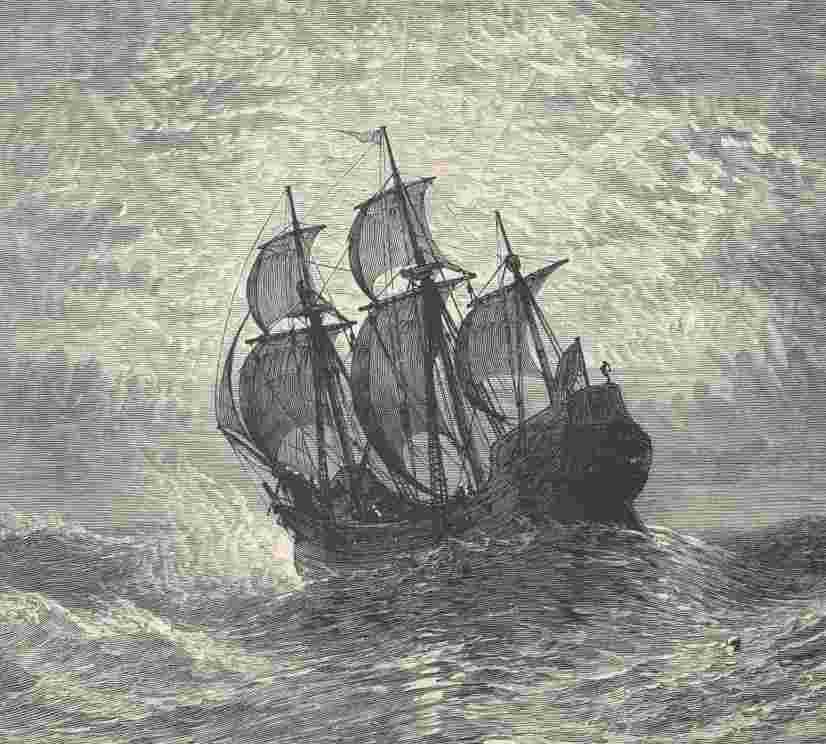
THE JOURNAL OF THE SHIP MAY-FLOWER
Thomas Jones, Master, from London, England, towards “Hudson’s River” in Virginia
at Delfshaven, and though, as incident to the tatter’s brief career,
we have been obliged to take note of some of the happenings to the
larger ship and her company (at Southampton, etc.), out of due
course and time, they have been recited only because of their
insuperable relation to the consort and her company, and not as part
of the MAY-FLOWER’S own proper record]
Gravesend. Finished lading. Got
passengers aboard and got under way for
Southampton. Dropped down the Thames to
Gravesend with the tide.
[Vessels leaving the port of London always, in that day, “dropped
down with the tide,” tug-boats being unknown, and sail-headway
against the tide being difficult in the narrow river.]
Masters Cushman and Martin, agents of the
chartering—party, came aboard at London.
Gravesend. Channel pilot aboard. Favoring
wind.
In Channel. Course D.W. by W. Favoring
wind.
In Channel. Southampton Water.
Southampton Water. Arrived at Southampton
and came to anchor.
[Both ships undoubtedly lay at anchor a day or two, before hauling
in to the quay. The MAY-FLOWER undoubtedly lay at anchor until
after the SPEEDWELL arrived, to save expense]
Lying at Southampton off north end of “West
Quay.”
Lying at Southampton. Masters Carver,
Cushman, and Martin, three of the agents
here. Outfitting ship, taking in lading,
and getting ready for sea.
Lying off Quay, Southampton.
Lying off Quay, Southampton.
Lying off Quay, Southampton.
Lying off Quay, Southampton. Waiting for
consort to arrive from Holland.
Lying off Quay, Southampton. Pinnace
SPEEDWELL, 60 tons, Reynolds, Master, from
Delfshaven, July 22, consort to this ship,
arrived in harbor, having on board some 70
passengers and lading for Virginia. She
came to anchor off north end “West Quay.”
Lying at Quay, Southampton, SPEEDWELL
warped to berth at Quay near the ship, to
transfer lading.
[Some of the cargo of the SPEEDWELL is understood to have been here
transferred to the larger ship; doubtless the cheese, “Hollands,”
and other provisions, ordered, as noted, by Cushman]
Lying at Quay, Southampton, Much parleying
and discontent among the passengers.
[Bradford gives an account of the bickering and recrimination at
Southampton, when all parties had arrived. Pastor Robinson had
rather too strenuously given instructions, which it now began to be
seen were not altogether wise. Cushman was very much censured, and
there was evidently some acrimony. See Cushman’s Dartmouth letter
of August 17 to Edward Southworth, Bradford’s Historie, Mass. ed.
p. 86.]
Lying at Quay, Southampton. Some of the
passengers transferred from SPEEDWELL and
some to her. Master Christopher Martin
chosen by passengers their “Governour” for
the voyage to order them by the way, see to
the disposing of their pro visions, etc.
Master Robert Cushman chosen “Assistant.”
The ship ready for sea this day, but
obliged to lie here on account of leakiness
of consort, which is forced to retrim. Ship
has now 90 passengers and consort 30.
Lying at Southampton.
Lying at Southampton. Letters received for
passengers from Holland. One from the
Leyden Pastor [Robinson] read out to the
company that came from that place.
Lying at anchor at Southampton. SPEEDWELL
retrimmed a second time to overcome
leakiness.
Lying at anchor at Southampton. Master
Weston, principal agent of the Merchants
setting out the voyage, came up from Lon
don to see the ships dispatched, but, on
the refusal of the Planters to sign certain
papers, took offence and returned to London
in displeasure, bidding them “stand on
their own legs,” etc.
[The two “conditions” which Weston had changed in the proposed
agreement between the Adventurers and Planters, the Leyden leaders
refused to agree to. Bradford, op cit. p. 61. He says: “But they
refused to sign, and answered him that he knew right well that these
were not according to the first Agreement.” Dr. Griffis has made
one of those little slips common to all writers—though perfectly
conversant with the facts—in stating as he does (The Pilgrims in
their Three Homes, etc. p. 158), with reference to the new
“conditions” which some blamed Cushman for assenting to, as “more
fit for thieves and slaves than for honest men,” that, “nevertheless
they consented to them;” while on p. 169 he says “The SPEEDWELL
people [i.e. the Leyden leaders would not agree with the new
conditions, without the consent of those left behind in Leyden.”
The fact is that the Pilgrims did not assent to the new conditions,
unwarrantably imposed by Weston, though of small consequence in any
view of the case, until Cushman came over to New Plymouth in the
FORTUNE, in 1621, and by dint of his sermon on the “Sin and Danger
of Self-Love,” and his persuasion, induced them (they being also
advised thereto by Robinson) to sign them. All business up to this
time had been done between the Adventurers and the Pilgrims,
apparently, without any agreement in writing. It was probably felt,
both by Robinson and the Plymouth leaders, that it was the least
reparation they could make Cushman for their cruel and unjust
treatment of him, realizing at length that, through all
vicissitudes, he had proven their just, sagacious, faithful, and
efficient friend. There does not appear to be any conclusive
evidence that any articles of agreement between the Adventurers and
colonists were signed before the MAY-FLOWER Sailed.]
Lying at anchor at Southampton. After
Master Weston’s departure, the Planters had
a meeting and resolved to sell some of such
stores as they could best spare, to clear
port charges, etc., and to write a general
letter to the Adventurers explaining the
case, which they did. Landed some three
score firkins of butter, sold as
determined.
Lying at anchor at Southampton. Consort
nearly ready for sea. Heard that the
King’s warrant had issued to Sir James
Coventry, under date of July 23, to prepare
a Patent for the Council for the Affairs of
New England to supersede the Plymouth
Virginia Company, Sir Ferdinando Gorges and
Sir Robert Rich the Earl of Warwick among
the Patentees.
Weighed anchor, as did consort, and in
company dropped down Southampton Water.
Took departure from Cowes, Isle of Wight,
and laid course down the Solent to Channel.
Winds baffling. General course S.W. by S.
Head winds. Beating out Channel.
SPEEDWELL In Company. Passed Bill of
Portland.
Wind contrary. Beating out Channel.
SPEEDWELL In company.
Wind still contrary. Beating out Channel.
SPEEDWELL in company.
Wind ahead. Beating down Channel. Consort
in company.
Wind fair. All sail set. SPEEDWELL in
company. Signalled by consort, which hove
to. Found to be leaking badly. On
consultation of Masters and chief of
passengers of both ships, it was concluded
that both should put into Dartmouth, being
nearest port. Laid course for Dartmouth
with wind ahead.
Wind ahead. Bearing up to Dartmouth.
Made port at Dartmouth. SPEEDWELL in
company, and came to anchor in harbor.
[Bradford, op. cit. Deane’s ed. p. 68, note. Russell (Pilgrim
Memorials, p. 15) says: “The ships put back into Dartmouth, August
13/23.” Goodwin (op. cit. p. 55) says: “The port was reached
about August 23.” Captain John Smith strangely omits the return of
the ships to Dartmouth, and confuses dates, as he says “But the next
day after leaving Southampton the lesser ship sprung a leak that
forced their return to Plymouth,” etc. Smith, New England’s Trials,
2d ed. 1622. Cushman’s letter, written the 17th, says they had
then lain there “four days,” which would mean, if four full days,
the 13th, 14th, 15th, and 16th.]
Lying at anchor with SPEEDWELL leaking
badly in Dartmouth harbor. No passengers,
except leaders, allowed ashore.
[Cushman in his letter to Edward Southworth, written at Dartmouth,
August 17, says that Martin, the “governour” of the passengers in
the MAY-FLOWER, “will not suffer them the passengers to go, ashore
lest they should run away.” This probably applied especially to
such as had become disaffected by the delays and disasters, the
apprenticed (“bound”) servants, etc. Of course no responsible
colonist would be thus restrained for the reason alleged.]
Lying at anchor, Dartmouth harbor.
SPEEDWELL at Quay taking out lading for
thorough overhauling.
Lying at anchor, Dartmouth harbor.
Lying at anchor, Dartmouth harbor.
SPEEDWELL being thoroughly overhauled for
leaks. Pronounced “as open and leaky as a
sieve.” Much dissatisfaction between the
passengers, and discontent with the ship’s
“governour” Master Martin, between whom
and Mr. Cushman, the “assistant,” there is
constant disagreement.
[Cushman portrays the contemptible character and manner of Martin
very sharply, and could not have wished to punish him worse for his
meannesses than he has, by thus holding him up to the scorn of the
world, for all time. He says, ‘inter alia’: “If I speak to him, he
flies in my face and saith no complaints shall be heard or received
but by himself, and saith: ‘They are froward, and waspish,
discontented people, and I do ill to hear them.’”]
Lying at anchor, Dartmouth harbor. Consort
being searched and mended. Sailors offended
at Master Martin because of meddling.
[Cushman’s letter, Dartmouth, August 17. He says: “The sailors also
are so offended at his ignorant boldness in meddling and controling
in things he knows not what belongs to, as that some threaten to
mischief him . . . . But at best this cometh of it, that he
makes himself a scorn and laughing stock unto them.”]
Lying at anchor, Dartmouth harbor. Consort
still repairing. Judged by workmen that
mended her sufficient for the voyage.
Lying at anchor, Dartmouth harbor.
SPEEDWELL relading.
Lying at anchor, Dartmouth harbor.
Lying at anchor, Dartmouth harbor. Consort
relading.
Lying at anchor, Dartmouth harbor. Both
ships ready for sea.
[Bradford, Historie, Deane’s ed. p. 68. He says: “Some leaks were
found and mended and now it was conceived by the workmen and all,
that she was sufficient, and they might proceed without either fear
or danger.” Bradford shows (op. cit. p. 69) note that they must
have left Dartmouth “about the 21st” of August. Captain John Smith
gives that date, though somewhat confusedly. Arber (the Story of
the Pilgrim Fathers, p. 343 says: “They actually left on 23 August.”
Goodwin (Pilgrim Republic, p. 55) says : “Ten days were spent in
discharging and re-stowing the SPEEDWELL and repairing her from stem
to stern,” etc.)]
Weighed anchor, as did consort. Laid
course W.S.W. Ships in company. Wind
fair.
Comes in with wind fair. General course
W.S.W. Consort in company.
Comes in with wind fair. Course W.S.W.
SPEEDWELL in company.
Observations showed ship above 100 leagues
W.S.W. of Land’s End. SPEEDWELL signalled
and hove to. Reported leaking dangerously.
On consultation between Masters and
carpenters of both ships, it was concluded
to put back into Plymouth—Bore up for
Plymouth. Consort in company.
Ship on course for Plymouth. SPEEDWELL in
company.
Made Plymouth harbor, and came to anchor in
the Catwater, followed by consort.
At anchor in roadstead. At conference of
officers of ship and consort and the chief
of the Planters, it was decided to send the
SPEEDWELL back to London with some 18 or 20
of her passengers, transferring a dozen or
more, with part of her lading, to the
MAY-FLOWER.
At anchor in Plymouth roadstead off the
Barbican. Transferring passengers and
lading from consort, lying near by.
Weather fine.
[Goodwin notes (Pilgrim Republic, p. 57) that “it was fortunate for
the overloaded MAY-FLOWER that she had fine weather while lying at
anchor there, . . . for the port of Plymouth was then only a
shallow, open bay, with no protection. In southwesterly gales its
waters rose into enormous waves, with such depressions between that
ships while anchored sometimes struck the bottom of the harbor and
were dashed in pieces.”]
At anchor in Plymouth roadstead.
Transferring cargo from SPEEDWELL.
At anchor in Plymouth roadstead.
Transferring passengers and freight to and
from consort. Master Cushman and family,
Master Blossom and son, William Ring, and
others with children, going back to London
in SPEEDWELL. All Of SPEEDWELL’S
passengers who are to make the voyage now
aboard. New “governour” of ship and
assistants chosen. Master Carver
“governour.”
[We have seen that Christopher Martin was made “governour” of the
passengers on the MAY-FLOWER for the voyage, and Cushman
“assistant.” It is evident from Cushman’s oft-quoted letter (see
ante) that Martin became obnoxious, before the ship reached
Dartmouth, to both passengers and crew. It is also evident that
when the emigrants were all gathered in the MAY-FLOWER there was a
new choice of officers (though no record is found of it), as Cushman
vacated his place and went back to London, and we find that, as
noted before, on November 11 the colonists “confirmed” John Carver
as their “governour,” showing that he had been such hitherto.
Doubtless Martin was deposed at Southampton (perhaps put into
Cushman’s vacant place, and Carver made “governour” in his stead.)]
At anchor, Plymouth roadstead. Some of
principal passengers entertained ashore by
friends of their faith. SPEEDWELL sailed
for London. Quarters assigned, etc.
At anchor in Plymouth roadstead.
At anchor in Plymouth roadstead. Some Of
company ashore.
At anchor in Plymouth roadstead. Ready for
sea.
Weighed anchor. Wind E.N.E., a fine gale.
Laid course W.S.W. for northern coasts of
Virginia.
Comes in with wind E.N.E. Light gale
continues. Made all sail on ship.
Comes in with wind E.N.E. Gale continues.
All sails full.
Comes in with wind E.N E. Gale holds.
Ship well off the land.
Comes in with wind E.N.E. Gale holds.
Distance lost, when ship bore up for
Plymouth, more than regained.
Same; and so without material change, the
daily record of wind, weather, and the
ship’s general course—the repetition of
which would be both useless and wearisome
—continued through the month and until the
vessel was near half the seas over. Fine
warm weather and the “harvest-moon.” The
usual equinoctial weather deferred.
One of the seamen, some time sick with a
grievous disease, died in a desperate manner.
The first death and burial at sea of the
voyage.
[We can readily imagine this first burial at sea on the MAY FLOWER,
and its impressiveness. Doubtless the good Elder “committed the
body to the deep” with fitting ceremonial, for though the young man
was of the crew, and not of the Pilgrim company, his reverence for
death and the last rites of Christian burial would as surely impel
him to offer such services, as the rough, buccaneering Master (Jones
would surely be glad to evade them).
Dr. Griffis (The Pilgrims in their Three Homes, p. 176) says “The
Puritans [does this mean Pilgrims ?] cared next to nothing about
ceremonies over a corpse, whether at wave or grave.” This will
hardly bear examination, though Bradford’s phraseology in this case
would seem to support it, as he speaks of the body as “thrown
overboard;” yet it is not to be supposed that it was treated quite
so indecorously as the words would imply. It was but a few years
after, certainly, that we find both Pilgrim and Puritan making much
ceremony at burials. We find considerable ceremony at Carver’s
burial only a few months later. Choate, in his masterly oration at
New York, December 22, 1863, pictures Brewster’s service at the open
grave of one of the Pilgrims in March, 1621.]
A sharp change. Equinoctial weather,
followed by stormy westerly gales;
encountered cross winds and continued
fierce storms. Ship shrewdly shaken and
her upper works made very leaky. One of
the main beams in the midships was bowed
and cracked. Some fear that the ship could
not be able to perform the voyage. The
chief of the company perceiving the
mariners to fear the sufficiency of the
ship (as appeared by their mutterings) they
entered into serious consultation with the
Master and other officers of the ship, to
consider, in time, of the danger, and
rather to return than to cast themselves
into a desperate and inevitable peril.
There was great distraction and difference
of opinion amongst the mariners themselves.
Fain would they do what would be done for
their wages’ sake, being now near half the
seas over; on the other hand, they were
loath to hazard their lives too
desperately. In examining of all opinions,
the Master and others affirmed they knew
the ship to be strong and firm under water,
and for the buckling bending or bowing of
the main beam, there was a great iron scrue
the passengers brought out of Holland which
would raise the beam into its place. The
which being done, the carpenter and Master
affirmed that a post put under it, set firm
in the lower deck, and otherwise bound,
would make it sufficient. As for the decks
and upper works, they would caulk them as
well as they could; and though with the
working of the ship they would not long
keep staunch, yet there would otherwise be
no great danger if they did not overpress
her with sails. So they resolved to
proceed.
In sundry of these stormes, the winds were
so fierce and the seas so high, as the ship
could not bear a knot of sail, but was
forced to hull drift under bare poles for
divers days together. A succession of
strong westerly gales. In one of the
heaviest storms, while lying at hull, [hove
to D.W.] a lusty young man, one of the
passengers, John Howland by name, coming
upon some occasion above the gratings
latticed covers to the hatches, was with
the seel [roll] of the ship thrown into the
sea, but caught hold of the topsail
halliards, which hung overboard and ran out
at length; yet he held his hold, though he
was sundry fathoms under water, till he was
hauled up by the same rope to the brim of
the water, and then with a boathook and
other means got into the ship again and his
life saved. He was something ill with it.
The equinoctial disturbances over and the
strong October gales, the milder, warmer
weather of late October followed.
Mistress Elizabeth Hopkins, wife of Master
Stephen Hopkins, of Billericay, in Essex,
was delivered of a son, who, on account of
the circumstances of his birth, was named
Oceanus, the first birth aboard the ship
during the voyage.
A succession of fine days, with favoring
winds.