
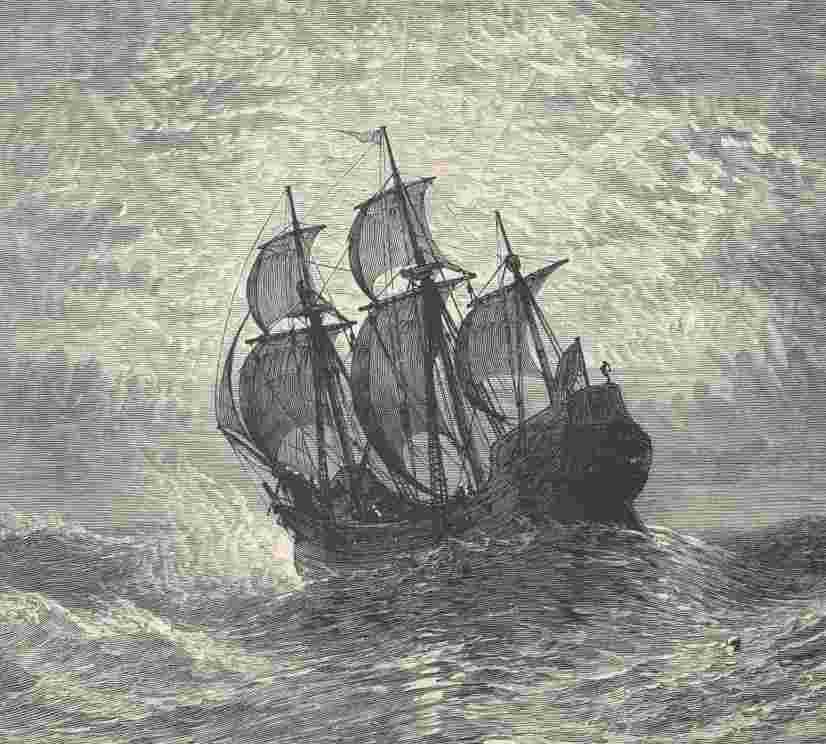
At anchorage. Large burial-party went
ashore with bodies of Masters Mullens and
White, and joined with those on shore made
the chief burial thus far had. The service
on shore, the most of the people being
there, Master Mullens being one of the
chief subscribing Adventurers, as well as
one of the chief men of the Planters, as
was Master White. Their deaths much
deplored.
At anchorage. Party from the ship went on
shore to help finish work on the ordnance.
At anchorage. Same. Fetched wood and
water.
At anchorage in Plymouth harbor. Eleventh
Sunday in this harbor. Mistress Mary
Allerton, wife of Master Isaac Allerton,
one of the chief men of the colonists, died
on board this day, not having mended well
since the birth of her child, dead-born
about two months agone.
At anchor in harbor. Burying-party went
ashore to bury Mistress Allerton, services
being held there.
At anchorage. The sickness and deaths of
the colonists on shore have steadily
increased, and have extended to the ship,
which has lost several of its petty
officers, including the master gunner,
three quarter-masters, and cook, and a
third of the crew, many from scurvy.
[There can be no doubt that both planters and ship’s crew suffered
severely from scurvy. The conditions all favored it, the sailors
were familiar with it, and would not be likely to be mistaken in
their recognition of it, and Dr. Fuller, their competent physician,
would not be likely to err in his diagnosis of it. Tuberculosis was
its very natural associate.]
At anchorage. The last day of the month.
The fifty-third day the ship has lain in
this harbor, and from the present rate of
sickness and death aboard, no present
capacity or prospect of getting away, those
better being yet weak. The Planters have
lost seventeen this month, their largest
mortality.
At anchorage. Blustering but milder
weather.
FRIDAY, Mar. 2/12
At anchorage. Wind south. Morning misty
[foggy]. Towards noon warm and fine
weather. At one o’clock it thundered. The
first heard. It rained sadly from two
o’clock till midnight. Fetched wood and
water.
At anchor in Plymouth harbor. The twelfth
Sunday in this harbor. Cooler. Clear
weather.
At anchorage. Rough weather.
At anchorage. Same.
At anchor in harbor. Wind full east, cold
but fair. The Governor went this day with
a party of five, to the great ponds,
discovered by one of the ship’s mates and
Francis Billington. Some planting done in
the settlement.
At anchor in harbor. Rough easterly
weather.
At anchorage. Same. Many sick aboard.
At anchorage. Same. Fetched wood and
water.
At anchorage, Plymouth harbor. The
thirteenth Sunday the ship has lain in this
harbor. Many of crew yet ill, including
boatswain.
At anchorage. Easterly weather.
At anchorage. The sickness and mortality
on ship and on shore continue.
At anchorage. Same.
At anchorage. Same.
At anchorage. A fair, warm day, towards
noon. The Master and others went ashore to
the general meeting. The plantation was
startled this morning by a visit from an
Indian who spoke some English and bade
“Welcome.” He is from Monhiggon, an island
to the eastward some days’ sail, near where
Sir Ferdinando Gorges had a settlement. He
was friendly, and having had much
intercourse with Englishmen who came to
fish in those parts, very comfortable with
them. He saw the ship in the harbor from a
distance and supposed her to be a fishing
vessel. He told the Governor that the
plantation was formerly called “Patuxet”
[or Apaum], and that all its inhabitants
had been carried off by a plague about four
years ago. All the afternoon was spent in
communication with him. The Governor
purposed sending him aboard the ship at
night, and he was well content to go and
went aboard the shallop to come to the
ship, but the wind was high and water scant
[low], so that the shallop could not go to
the ship. The Governor sent him to Master
Hopkins’s house and set a watch over him.
At anchor in harbor. The Master and others
came off to the ship. Samoset the Indian
went away back to the Massasoits whence he
came. A reasonably fair day. Fetched wood
and water.
At anchor in Plymouth harbor. The
fourteenth Sunday the ship has lain at this
anchorage. A fair day. The sickness
stayed a little. Many went on shore to the
meeting in the common-house. Samoset the
savage came again, and brought five others
with him.
[This Sunday visit was doubtless very much to the dislike of the
good brethren, or at least of the leaders, but policy dictated every
possible forbearance. Their consciences drew the line at trade,
however, and they got rid of their untimely visitors as soon as
possible without giving offense. Massasoit’s men seem to have
shown, by leaving their peltry with them, a confidence in their new
white neighbors that is remarkable in view of the brevity of their
friendship.]
They left their bows and arrows a quarter
of a mile from the town, as instructed.
The Planters gave them entertainment, but
would not truck with them.
[“Truck—to trade.” All early and modern lexicographers give the
word, which, though now obsolete, was in common use in parts of New
England fifty years ago.]
They sang and danced after their manner,
and made semblance of amity and friendship.
They drank tobacco and carried pounded corn
to eat. Their faces were painted. They
brought a few skins which they left with
the Planters, and returned the tools which
Captain Standish and Francis Cooke left in
the woods. The Planters dismissed them
with a few trifles as soon as they could,
it being Sunday, and they promised soon to
return and trade. Samoset would not go
with them, feigning sick, and stayed.
Those on shore from the ship came off to
her at night.
At anchorage. A fair day. The Planters
digging and sowing seeds.
At anchorage. A fine day. Digging and
planting of gardens on shore. Those sick
of the crew mending.
At anchorage. A fine warm day. Beginning
to put ship in trim for return voyage.
Bringing ballast, etc. Some, including
the Masters-mates, went on shore, who on
return reported that the Planters sent the
Indian Samoset away. A general meeting of
the Planters was held at the common-house,
to conclude laws and orders, and to confirm
the military orders formerly proposed, and
twice broken off by the savages coming, as
happened again. After the meeting had held
an hour or so, two or three savages
appeared on the hill over against the town,
and made semblance of daring the Planters.
Captain Standish and another, with their
muskets, went over to them, with the two
Masters-mates of the ship, who were ashore,
also armed with muskets. The savages made
show of defiance, but as our men drew near
they ran away. This day the carpenter, who
has long been ill of scurvy, fitted the
shallop to carry all the goods and
furniture aboard the ship, on shore.
At anchorage. A very fair, warm day.
At work on ship getting ready for sea,
bringing ballast aboard, etc. Another
general meeting of the Planters which all
able attended. They had scarce been an
hour together when Samoset the Indian came
again with one Squanto, the only native of
Patuxet (where the Planters now inhabit)
surviving, who was one of the twenty captives
carried away from this place by Captain Hunt,
to England. He could speak a little English.
They brought three other Indians with them.
They signified that their great Sagamore,
Masasoyt, was hard by, with Quadequina his
brother, and all their men. They could not
well express what they would in English,
but after an hour the king came to the top
of the hill, over against the plantation,
with his train of about sixty men. Squanto
went to him and brought a message that one
should be sent to parley with him, and Master
Edward Winslow went, to know hisnmind, and
signify the wish of the Governor to have
trading and peace with him, the Governor
sending presents to the king and his brother,
with something to eat and drink.
[Edward Winslow gives us here another proof of that rare
self-sacrifice, that entire devotion to his work, and that splendid
intrepidity which so signally characterized his whole career. At
this most critical moment, the fate of the little colony trembling
in the balance, when there was evident fear of treachery and
surprise on the part of both the English and the savages; though the
wife of his youth lay at the point of death (which came but two days
later), and his heart was heavy with grief; forgetting all but the
welfare of his little band of brethren, he goes forward alone, his
life in his hand, to meet the great sachem surrounded by his whole
tribe, as the calm, adroit diplomatist, upon whom all must depend;
and as the fearless hostage, to put himself in pawn for the savage
chief.]
The king, leaving Master Winslow with
brother, came over the brook, with some
twenty of his men, leaving their bows and
arrows behind them, and giving some six or
seven of their men as hostages for Master
Winslow. Captain Standish, with Master
Williamson, the ship’s-merchant, as
interpreter,
[It would seem from the frequent mention of the presence of some of
the ship’s company, Master Jones, the “Masters-mates,” and now the
“ship’s-merchant,” that the ship was daily well represented in the
little settlement on shore. The presence of Master Williamson on
this occasion is perhaps readily accounted for. Every other meeting
with the Indians had been unexpected, the present one was
anticipated, and somewhat eagerly, for upon its successful issue
almost everything depended. By this time Standish had probably
become aware that Tisquantum’s command of English was very limited,
and he desired all the aid the ship’s interpreter could give. By
some means, the sachem and the colonists succeeded in establishing
on this day a very good and lasting understanding.]
and a guard of half a dozen musketeers, met
the king at the brook,
[The guard was probably made thus small to leave the body of the
colonists as strong a reserve force as possible to meet any surprise
attack on the part of the Indians. Colonel Higginson, in his Book
of American Explorers, gives a cut of this meeting of Massasoit and
his pineses with Standish and his guard of honor, but it is
defective in that the guard seems to have advanced to the hill
(“Strawberry,” or later “Watson’s”) to meet the sachem, instead of
only to “the brook;” and more especially in that there are but two
officers with the “six musketeers,” where there ought to be three,
viz. Standish, in command, Edward Window, as the envoy and hostage
(in full armor), and “Mr. Williamson,” the ship’s-merchant or
purser, as interpreter, perhaps acting as lieutenant of the guard.
It is always matter of regret when books, especially text-books,
written by authors of some repute, and published by reputable
houses, fail, for want of only a little care in the study of the
available history of events they pictorially represent, to make
their pictures and the known facts correspond.]
and they saluted each other, and the guard
conducted the Sagamore to one of the new
houses then building, where were placed a
green rug and three or four cushions. Then
came the Governor with drum and trumpet,
and a guard of musketeers, and they drank
to each other in some strong waters, and
the Governor gave the king and his
followers meat, and they made a treaty in
King James’s name, and drank tobacco
together. His face was painted a sad red,
and his head and face were oiled, which
made him look greasy. All his followers
were more or less painted. So after all
was done, the Governor conducted him to the
brook, and his brother came, and was also
feasted, and then conveyed him to the
brook, and Master Winslow returned.
Samoset and Squanto stayed in the town and
the Indians stayed all night in the woods
half a mile away. The last of the
colonists on board the ship went ashore to
remain to-day.
At anchor. A fair day. Some of the ship’s
company went on shore. Some of the Indians
came again, and Captain Standish and Master
Allerton went to see the king, and were
welcomed by him. This morning the Indians
stayed till ten or eleven of the clock, and
the Governor, sending for the king’s
kettle, filled it with pease, and they went
their way? Making ready for sea, getting
ballast, wood, and water from the shore,
etc. The Planters held a meeting and
concluded both of military orders and some
laws, and chose as Governor, for the coming
year, Master John Carver, who was
“governor” on the ship.
At anchorage. The ship’s company busy with
preparations for the return voyage,
bringing ballast, wood, and water from the
shore, etc., the ship having no lading for
the return. This day died, on shore,
Mistress Elizabeth Winslow, wife of Master
Winslow. Many still sick. More on the
ship than on shore.
At anchor in Plymouth harbor. The
fifteenth Sunday in this port. Many of the
crew dead and some still sick, but the
sickness and mortality lessening.
At anchor. Bringing ballast from shore and
getting ship in trim.
At anchorage. Getting ballast, overhauling
rigging, getting wood, water, etc., from
shore.
At anchorage. Same.
At anchorage. The Master offered to take
back any of the colonists who wished to
return to England, but none desired to go.
Getting in stores and ballast.
At anchorage. Hastening all preparations
for sailing. Getting ballast, etc. Water
butts filled.
At anchorage. Setting up rigging, bending
light sails, etc. Getting ballast and wood
from the beach and island. The colonists
have lost thirteen by death the past month,
making in all half of their number.
At anchor in Plymouth harbor. The
sixteenth Sunday the ship has lain at
anchor here, and to be the last, being
nearly ready to sail. Most of the crew
ashore on liberty. In the sixteen weeks the
ship has lain here, half of her crew (but
none of her officers) have died, and a few
are still weak. Among the petty officers
who have died have been the master gunner,
boatswain, and three quartermasters, beside
the cook, and more than a third of the
sailors. A bad voyage for the owner,
Adventurers, ship, and crew.
Still at anchor, but making last
preparations for voyage. Ship’s officers
made farewells on shore. Governor Carver
copied out, and Giles Heale and Chris.
Jones witnessed, Master Mullens’s will, to
go to England.
Still at anchorage, but (near) ready to
sail with a fair wind. Master Williamson,
the ship’s-merchant [purser], appointed by
Master Mullens an overseer of his will,
takes copy of same to England for probate,
with many letters, keepsakes, etc., etc.,
to Adventurers and friends. Very little
lading, chiefly skins and roots. Make
adieus to Governor Carver and company.
Still at anchor in Plymouth harbor. Sails
loosened and all ready for departure except
Governor’s letters. Last visits of shore
people to ship. Sail with morning tide, if
wind serves. One hundred and ten days in
this harbor.
Got anchors, and with fair wind got
underway at full tide. Many to bid adieu.
Set colors and gave Planters a parting
salute with the ensign and ordnance.
Cleared the harbor without hindrance, and
laid general course E.S.E. for England
with a fine wind. Took departure from Cape
Cod early in the day, shook off the land
and got ship to rights before night. All
sails set and the ship logging her best.
And so the MAY-FLOWER began her speedy, uneventful, homeward run, of but thirty-one days, arriving in England May 6, 1621, having been absent, on her “round voyage,” from her sailing port, two hundred and ninety-six days.
THE END OF THE VOYAGE
AND OF THIS
JOURNAL
AUTHOR’S NOTE. Of the “Log” Of the MAY-FLOWER, the author is able to repeat the assurance given as to the brief Journal of the SPEEDWELL, and is able to say, in the happy phrase of Griffis, “I have tried to state only recorded facts, or to give expression to well grounded inferences.”
APPENDIX
In view of the natural wish of many of “restricted facilities,” to consult for themselves the full text of certain of the principal letters and documents which have imparted much of the most definite and valuable information concerning the Pilgrim movement, it has been thought well to include certain of them here verbatim, that they may be of ready availability to the reader. The list comprises copies of—
I. The Agreement of the Merchant Adventurers and Planters;
II. The Letter of the Leyden Leaders to John Carver and Robert Cushman (at London), May 31/June 10, 1620;
III. The Letter of Robert Cushman to John Carver (then at Southampton), Saturday, June 10/20, 1620;
IV. The Letter of Robert Cushman to the Leyden Leaders, June 10/20, 1620;
V. The Letter of Robert Cushman to the Leyden Leaders, Sunday, June 11/21, 1620;
VI. The Letter of Rev. John Robinson to John Carver at London, June 14/24, 1620;
VII. The Letter of the Planters to the Merchant Adventurers from Southamp ton, August 3, 1620;
VIII. The Letter of Robert Cushman (from Dartmouth) to Edward Southworth, Thursday, August 17,1620;
IX. The MAY-FLOWER Compact;
X. The Nuncupative Will of Master William Mullens; and
XI. The Letter of “One of the Chiefe of ye Companie” (The Merchant Adventurers), dated at London, April 9, 1623—
Many other early original documents frequently referred to in this volume are of no less interest than those here given, but most of them have either had such publication as to be more generally known or accessible, or involve space and cost disproportionate to their value in this connection.
I
THE AGREEMENT OF THE MERCHANT ADVENTURERS AND PLANTERS
Anno: 1620, July 1.
1. The adventurers & planters doe agree, that every person that goeth being aged 16. years & upward, be rated at 10li., and ten pounds to be accounted a single share.
2. That he goeth in person, and furnisheth him selfe out with 10li. either in money or other provisions, be accounted as haveing 20li. in stock, and in ye devission shall receive a double share.
3. The persons transported & ye adventurers shall continue their joynt stock & partnership togeather, ye space of 7 years, (excepte some unexpected impedimente doe cause ye whole company to agree otherwise,) during which time, all profits & benifits that are gott by trade, traffick, trucking, working, fishing, or any other means of any person or persons, remaine still in ye comone stock untill ye division.
4. That at their coming ther, they chose out such a number of fitt persons, as may furnish their ships and boats for fishing upon ye sea; imploying the rest of their severall faculties upon ye land; as building houses, tilling, and planting ye ground, & makeing shuch comodities as shall be most usefull for ye collonie.
5. That at ye end of ye 7 years, ye capitall & profits, viz. the houses, lands, goods and chatels, be equally devided betwixte ye adventurers, and planters; wch done, every man shall be free from other of them of any debt or detrimente concerning this adventure.
6. Whosoever cometh to ye colonie hereafter, or putteth any into ye stock, shall at the ende of ye 7. years be alowed proportionably to ye time of his so doing.
7. He that shall carie his wife & children, or servants, shall be alowed for everie person now aged 16. years & upward, a single share in ye devision, or if he provid them necessaries, a duble share, or if they be between 10. year old and 16., then 2. of them to be reconed for a person, both in trasportation and devision.
8. That such children as now goe, & are under ye age of ten years, have noe other shar in ye devision, but 50. acers of unmanured land.
9. That such persons as die before ye 7. years be expired, their executors to have their parte or sharr at ye devision, proportionably to ye time of their life in ye collonie.
10. That all such persons as are of this collonie, are to have their meate, drink, apparell, and all provissions out of ye comon stock & goods of ye said collonie.
Governor Bradford adds:—
“The chief and principal differences betwene these & the former [original] conditions, stood in those 2. points; that ye houses, & lands improved, espetialy gardens & home lotts should remaine undevided wholy to ye planters at ye 7. years end. 2ly, yt they should have had 2. days in a weeke for their owne private imploymente, for ye more comforte of themselves and their families, espetialy such as had families.”
[Apparently, as has been noted, neither these articles of agreement, nor their predecessors which received the approval of the Leyden leaders, were ever signed by the contracting parties, until Robert Cushman brought the later draft over in the FORTUNE, in 1621, and the planter body (advised thereto by Pastor Robinson, who had previously bitterly opposed) signed them. Much might be truly said on either side of this controversy—indeed was said at the time; but if the Pilgrims were to abandon their contention, whatever its merits, in a year’s time, as they did, it would seemingly have been much better not to have begun it, for it undoubtedly cost them dear.]
II
LETTER OF THE LEYDEN LEADERS TO JOHN CARVER AND ROBERT CUSHMAN, AT
LONDON
To their loving freinds John Carver and Robart Cushman, these, &c.
Good bretheren, after salutations, &c. We received diverse letters at ye
coming of Mr. [Thomas] Nash & our pilott, which is a great incouragmente
unto us, and for whom we hop after times will minister occasion of
praising God; and indeed had you not sente him, many would have been
ready to fainte and goe backe. Partly in respecte of ye new conditions
which have bene taken up by you, which all men are against, and partly in
regard of our owne inabillitie to doe any one of those many waightie
bussineses you referr to us here. For ye former wherof, wheras Robart
Cushman desirs reasons for our dislike, promising therupon to alter ye
same, or els saing we should thinke he hath no brains, we desire him to
exercise them therin, refering him to our pastors former reasons, and
them to ye censure of ye godly wise. But our desires are that you will
not entangle your selvs and us in any such unreasonable courses as those
are, viz. yt the marchants should have ye halfe of mens houses and lands
at ye dividente; and that persons should be deprived of ye 2. days in a
weeke agreed upon, yea every momente of time for their owne perticuler;
by reason wherof we cannot conceive why any should carie servants for
their own help and comfort; for that we can require no more of them than
all men one of another. This we have only by relation from Mr. Nash, &
not from any writing of your owne, & therfore hope you have not proceeded
farr in so great a thing without us. But requiring you not to exseed the
bounds of your comission, which was to proceed upon ye things or
conditions agred upon and expressed in writing (at your going over it),
we leave it, not without marveling, that your selfe, as you write,
knowing how smale a thing troubleth our consultations, and how few,
as you fear, understands the busnes aright, should trouble us with such
matters as these are, &c. Salute Mr. Weston from us, in whom we hope we
are not deceived; we pray you make known our estate unto him, and if you
thinke good shew him our letters, at least tell him (yt under God) we
much relie upon him & put our confidence in him; and, as your selves well
know, that if he had not been an adventurer with us, we had not taken it
in hand; presuming that if he had not seene means to accomplish it, he
would not have begune it; so we hope in our extremitie he will so farr
help us as our expectation be no way made frustrate concerning him.
Since therfor, good brethren, we have plainly opened ye state of things
with us in this matter, you will, &c. Thus beseeching ye Allmightie, who
is allsufficiente to raise us out of this depth of difficulties, to
assiste us herin; raising such means by his providence and fatherly care
for us, his pore children & servants, as we may with comforte behould ye
hand of our God for good towards us in this our bussines, which we
undertake in his name & fear, we take leave & remaine
Your perplexed, yet hopful
bretheren,
June 10, New Stille
Ano: 1620. SAMUEL FULLER, EDWARD WINSLOW,
WILLIAM BRADFORD, ISAAC ALLERTON.