
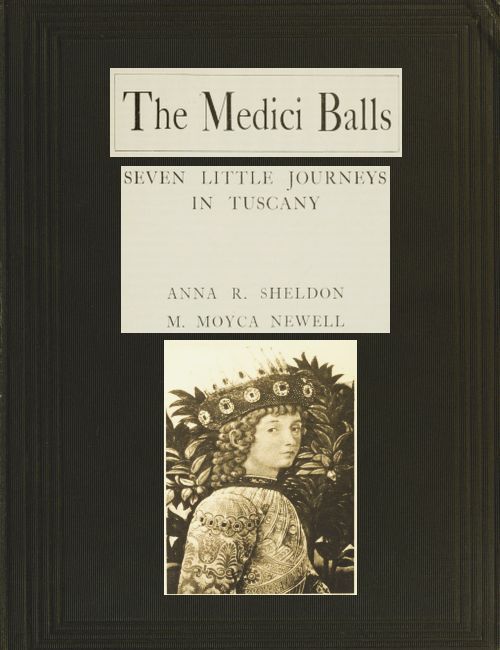
The Project Gutenberg eBook of The Medici Balls: Seven little journeys in Tuscany
Title: The Medici Balls: Seven little journeys in Tuscany
Author: Anna R. Sheldon
Marjorie Moyca Newell
Release date: July 22, 2016 [eBook #52619]
Most recently updated: October 23, 2024
Language: English
Credits: Produced by Clarity, Jane Robins and the Online Distributed
Proofreading Team at http://www.pgdp.net (This file was
produced from images generously made available by The
Internet Archive/Canadian Libraries)
The Medici Balls
SEVEN LITTLE JOURNEYS
IN TUSCANY
ANNA R. SHELDON
M. MOYCA NEWELL
OVER ONE HUNDRED ILLUSTRATIONS
CHARTERHOUSE PRESS
NEW YORK
1904
COPYRIGHT, 1904, BY
M. M. NEWELL
ALL RIGHTS RESERVED
SCHLUETER
PRINTING
COMPANY
NEW YORK
To
Frances Cecilia Newell
WE DEDICATE THIS BOOK
PREFATORY NOTE
HY the Medici family assumed the well-known device of red balls on a field of gold, is one of the vexed questions of heraldic history. Some hold that as the saints, Cosmo and Damian, who appear so often in the votive pictures of the Medici, were also patron saints of medicine and surgery, and because the name of the family signifies physicians, the balls may suggest pills (palle). Others think that a cluster of balls, formerly the sign of money-lenders, was adopted as a device by Giovanni de' Medici, founder of the greater branch of the illustrious house, who as a banker attained great wealth and influence. As the Medici identified themselves with the trading interests and government of Florence, and were connected with several noble Florentine families, their coat of arms became familiar throughout all that extensive territory subject to Florence in the fifteenth century. With its varied number of balls, or quartered with other arms, as charged with the royal lily of France, or surmounted by the keys of St. Peter and a pontiff's tiara, it greets the traveller at every turn, not only on palaces and city gates, but on illuminated manuscripts and choir books, on the covers of mediæval ledgers, and terra-cotta wine jars.
Thus the title of "Medici Balls" has been given to the following record of seven little journeys in Tuscany by the authors, who in all their travels, even in lanes and modest farm-houses, have found themselves under the ægis of the powerful banker-princes of Florence. The shield, bearing seven red balls on a field of gold, represents the arms of Piero de' Medici, and the period when Medicean supremacy was at its height; in the sequence of balls employed by the various members of the family, it serves to connect the eight balls displayed on the arms of Cosimo, Pater Patriæ, the munificent financier, with the six balls of Lorenzo the Magnificent, in whom the glory and renown of the family culminated.
CONTENTS
LIST OF ILLUSTRATIONS
| Lorenzo de' Medici. Photogravure From "Procession of the Magi," Riccardi Palace, Florence. By Benozzo Gozzoli. |
Frontispiece |
| PAGE | |
| Della Robbia Frieze | 3 |
| Badia a Settimo | 4 |
| Straw Plaiters, Mugnone Valley | 7 |
| A Loggia, Piero a Sieve | 9 |
| Palazzo Pubblico, Scarperia | 11 |
| The Main Street, Scarperia | 13 |
| Madonna and Child, Chapel of the Sacred Girdle, Duomo, Prato. By Giovanni Pisano |
15 |
| Ancient Campanile della Pieve, Borgo San Lorenzo | 20 |
| Torraccia Romanelli, Borgo San Lorenzo | 21 |
| A Farm-house, Mugello | 22 |
| Ponte d'Elsa, Mugello | 23 |
| Hill of Vespignano, Mugello | 24 |
| Round Tower of Vespignano, Mugello | 26 |
| Joachim Returning to the Sheepfold, Arena Chapel, Padua. By Giotto |
29 |
| From the Walls of Scarperia | 31 |
| A Country Road, Scarperia | 32 |
| Detail of Bronze Grille. Chapel of the Sacred Girdle, Prato | 33 |
| Portrait of Bianca Cappello, Uffizi, Florence. By Alessandro Allori |
37 |
| Coats of Arms of the Ubaldini and Vichio | 40 |
| The Procession of the Magi, Riccardi Palace, Florence. By Benozzo Gozzoli |
43 |
| Ornamental Band, Della Robbia | 45 |
| The Campanile, Prato. By Giovanni Pisano | 46 |
| Detail, Procession of the Magi, Riccardi Palace, Florence. By Benozzo Gozzoli |
47 |
| Arcades "Where Hang the Copper and Woolen Goods," Prato | 50 |
| The Fortress, Prato | 51 |
| The Cathedral of Prato | 53 |
| Garden Belonging to Lorenzo's Favorite Villa, Poggio a Caiano | 56 |
| Erroneously entitled in the book as "Villa of Petraia." External Pulpit, Cathedral, Prato. By Donatello |
57 |
| Madonna and Child, with Saints, Lunette Over Central Door, Duomo, Prato. By Andrea Della Robbia |
61 |
| Lucrezia Tornabuoni, Wife of Lorenzo Il Magnifico. Wearing the Marsyas Jewel of the Medici. By Botticelli |
65 |
| Coat of Arms of Prato | 68 |
| Detail of Frieze. S. Maria Delle Carceri, Prato. By Andrea Della Robbia |
69 |
| The Piazza, Greve, Chianti | 73 |
| Ponte Falciano, Chianti | 74 |
| Ponte Capello, River Greve | 75 |
| Vitigliano, Chianti | 76 |
| Old Watch-Tower, Chianti | 77 |
| Panzano from a Distance, Chianti | 78 |
| S. Leolino a Flacciano, Pieve di Panzano, Chianti | 79 |
| A Villa in Panzano, Chianti | 81 |
| Old Wine Jar, Chianti | 83 |
| A Peasant of Chianti | 85 |
| The Stately Cypress | 87 |
| A Country Road, Chianti | 89 |
| Piazza, Impruneta | 90 |
| A Street, Impruneta | 91 |
| Predella to Tabernacle, Chapel of the Holy Cross, Impruneta. By Luca della Robbia |
93 |
| Adoring Angels, Impruneta. By Luca della Robbia | 95 |
| Coat of Arms, Courtyard, Palazzo Cenami, Lucca | 99 |
| Della Robbia Ornament | 101 |
| Apse End and Campanile, San Andrea, Serravalle | 103 |
| The Rocca of Castruccio, Serravalle | 104 |
| Olive Trees | 105 |
| Iron Lantern, Palazzo Baroni, Lucca | 107 |
| Monument of General Bartolommeo Colleoni, Venice. By A. Verrocchio |
108 |
| Moat of Castle Sarzanella, Sarzana | 109 |
| Monument of General Gattamelata, Padua. By Donatello |
111 |
| Statue of John Hawkwood, Cathedral, Florence. By Paolo Uccello |
112 |
| Madonna and Child, with Two Saints, Castelfranco. By Giorgione |
115 |
| Portrait of a Young Florentine, Royal Gallery, Berlin. By Botticelli |
116 |
| Stemma of Serravalle | 118 |
| Medici Shield, Ospedale del Ceppo, Pistoja. Della Robbia | 121 |
| Viale dell'Arcadia, Pistoja | 123 |
| Shield of Pistoja, Supported by Bears | 124 |
| Piazza del Duomo, Pistoja | 125 |
| Coat of Arms, Pistoja. By Verrocchio | 129 |
| Bronze Candelabra, Duomo, Pistoja | 132 |
| Head of Filippo Tedici, Pistoja | 133 |
| Campanile, from Via Ripa del Sale, Pistoja | 137 |
| Loggia, Ospedale del Ceppo, Pistoja | 141 |
| Coat of Arms of Hospital, Pistoja. Della Robbia | 145 |
| Healing the Sick, Detail of Frieze, Ospedale del Ceppo, Pistoja. By Giovanni della Robbia |
149 |
| Via Abbi Pazienza | 152 |
| Coronation of the Virgin, Ospedale del Ceppo, Pistoja. By Benedetto Buglione |
153 |
| Adoration of the Magi, S. Andrea, Pistoja | 155 |
| Monument of Cardinal Forteguerra, S. Cecilia, Rome. By Mino da Fiesole |
157 |
| Virgin and Child, with Saints, Cathedral, Lucca. By Fra Bartolommeo |
161 |
| Bastions of San Colombo, Lucca | 163 |
| Old City Wall and Moat, Lucca | 164 |
| Tomb of Ilaria del Carretto, Cathedral, Lucca. By Jacopo della Quercia |
165 |
| On the Ramparts, Lucca | 168 |
| San Frediano, Lucca | 169 |
| S. Frediano, from the Guinigi Tower, Lucca | 171 |
| A "Grey Tower" | 173 |
| Ponte a Moriano, Serchio River | 175 |
| An Old Stone Bridge | 177 |
| Bridge Over the Serchio | 178 |
| Church of Santa Maria e San Giorgio, Brancoli | 179 |
| San Lorenzo, Brancoli | 181 |
| Interior of Santa Maria e San Giorgio, Brancoli | 183 |
| Holy-water Stoup, Santa Maria e San Giorgio, Brancoli | 186 |
| Baptismal Font, Santa Maria e San Giorgio, Brancoli | 187 |
| Detail of Pulpit, Santa Maria e San Giorgio, Brancoli | 189 |
| Detail of Pulpit, Santa Maria e San Giorgio, Brancoli | 190 |
| Pulpit, Santa Maria e San Giorgio, Brancoli | 191 |
| Three Coats of Arms, Lucca | 194 |
| St. George and the Dragon, Brancoli. By Andrea and Giovanni della Robbia |
195 |
| Sarzanella | 199 |
| Bridge at Vinchiana | 200 |
| "The Devil's Bridge," Borgo a Mozzano | 201 |
| Bagni di Lucca | 203 |
| Parish Church, Loppia | 204 |
| The Cathedral, Barga | 205 |
| Door of the Cathedral, Barga | 208 |
| Interior of the Cathedral, Barga | 211 |
| Pulpit in Cathedral, Barga | 215 |
| Adoration of the Magi, Pulpit, Cathedral, Barga | 219 |
| Tabernacle in Cathedral, Barga, Della Robbia School | 223 |
| Assumption of the Virgin, Church of the Capuchins, Barga. By Giovanni della Robbia |
227 |
| "Violet-eyed Tuscan Oxen" | 229 |
| Trappings on Horse of Lorenzo de' Medici | 230 |
THE MUGELLO
THE MUGELLO
VERY year Italy is thronged with thousands of travellers who are thoroughly familiar with the larger cities of Tuscany: Florence, Lucca, Siena, and Leghorn are crowded with visitors, while Florence has practically become the Italian home of English and American wanderers; they not only fill hotels, pensions, and apartments, but occupy many of the villas on neighbouring hillsides. Fiesole's terraces are converted into tea-gardens, and resound with Anglo-Saxon chaffer for straw fans and baskets. San Miniato, with its incomparable view of the city, also caters to the universal cry for "the cup that cheers," which outrivals in popularity the noble old Tuscan-Romanesque church hard by. Trim Americans are met at every turn; Settignano, Bello-Sguardo, Marignano, Badia a Settimo, and the rest, are frequent haunts; and the padrona of the vine-covered terrace at Majano, where stone-cutters are wont to sit about rude stone tables and drink their wine, has learned the "afternoon tea" secret for the gentili forestieri, who walk out from Florence to enjoy the charming view. Convenient tram lines run to the more distant and choicest places, and whoever demands more retired ways may board one of those nondescript vehicles, by courtesy called "diligence," which are seen on every country road leading from Florence, making their way through pretty valleys and hill towns. The Tuscan diligence is an institution in its way, though not always inviting in appearance; usually covered with dust, its brown canvas curtains strapped down, excluding all air and views, and "full up" to bursting with all sorts and conditions of humanity and luggage. However, one is always sure of the most respectful and obliging driver, smiling and kindly travelling companions, and no end of interesting chat and story at the cost of a few centesimi. Thus the country distant from the usual railway lines is every year becoming more and more familiar and appreciated, although there are still many delightful "untrodden ways" known but to the few, who are good pedestrians or devoted lovers of nature and "dear country places." Follow up any of the Tuscan rivers—through the Val d'Ema, Val di Pesa, Val d'Elsa, or the valleys of the Mugnone, Sieve, Bisenzio, and Ombrone, every one an affluent of the Arno—and you will find a pathway of delight, a real progress through a world of exquisite colour, form, and fragrance. Yet it is not easy to turn away from Florence and wander off in pastures new; like a siren, she holds us in willing thraldom by the infinite variety of charms so potent that all the world beyond her warm, grey walls becomes vague and unreal.
M. M. Newell
BADIA A SETTIMO
But suddenly, on a crisp spring morning, a quick turn from a narrow street gives us a vision of the hills, olive-grey, brown, and purple—hills with the Apennine heights beyond. The spell is broken, our hearts burn for the "spring running," and, as in old Chaucer's day, "Then longen folk to go on pilgrimage." We have the old poet's authority that England's Spring came in April, but to us in Tuscany this year she appeared by the middle of January, and has never for a day turned her face, coming safely through the "ides of March," even to the end of April in almost continuous sunshine and ever-increasing bloom. Blackthorn, almond, and fruit trees, daisies and daffodils, violets and roses, rival each other in bewildering loveliness wherever the eye may turn; out of city gates the paths lie luringly open to hillsides clad with ilex and magnolia, to hidden valleys, and the snow-clad Apennines beyond Vallombrosa.
M. M. Newell
STRAW PLAITERS IN THE MUGNONE
We yearn for unbroken space with no dome but the blue above, no tower but the stately cypress; our resolution is quickly taken to climb out of Val d'Arno, and slip over yonder delectable heights into the Mugello. Diligence and tram are too slow for our patience; therefore, at the easy hour of nine, on a clear, sunny morning, we leave the city by the Florence and Faenza railway, run through the pretty valley of the Mugnone, pass the stone-quarries close under the northern flank of steep Fiesole, discover a world of beauty unknown to us before, dash in and out of tunnels, catching flying glimpses of a broken countryside, grey-walled towns, and bosky slopes; thus pushing northward for half a dozen miles, where the line loops back toward the south, and gives us once more, and from a greater height, the charming view of Fiesole's northern slope. Now the railroad rises rapidly by well-built viaducts, galleries, and tunnels to Vaglia, only nine miles from Florence, as the crow flies, then passes swiftly over the ridge which separates the valleys of the Arno and Mugnone from the Mugello region.
There are no more views of populous Fiesole; we are in a new world, over which Mr. Ruskin feels justified in making lament. After expanding with his customary word-painting upon the view from Fiesole over Val d'Arno, he continues thus: "The traveller passes the Fiesolan ridge, and all is changed. The country is on a sudden lonely. Here and there, indeed, are scattered houses of a farm grouped gracefully upon the hillsides; here and there the fragment of a tower upon a distant rock; but neither gardens nor flowers nor glittering palaces exist." To us, however, the scene is charming; the still distant valley spreads out broad and fertile to the sun, well-watered by the Sieve and its many tributaries, or torrenti, all of which hasten to lose themselves later in the Arno, just within the western boundary of the Casentino. Surrounding the happy valley rises a cordon of mountains belonging to the Central Apennine range—among them Monte Giove, 3,255 feet above sea-level, and Monte Morello, 3,065 feet. The latter peak is clearly seen from Florence, and in its varied moods is regarded as a natural weather bureau by the people, who are fond of repeating the old saying, "Take your umbrella when Monte Morello puts on his cap."
M. M. Newell
A LOGGIA, PIERO A SIEVE
Descending the narrow pass of Carza, the train reaches Piero a Sieve, where we leave it to pursue its way through a most picturesque country, over the mountains to Faenza, while we explore the quaint little hamlet of Piero a Sieve, which clings by grey walls and terraces to the side of a steep hill, crowning which are the massive fortifications of San Martino. We climb to the fortress, take a snap-shot at one of the loggias, where the group of ever-busy women in bright skirts and kerchiefs would make a delightful picture in water-colour, have a look at the parish church, with its so-called Della Robbia font, and then proceed on our way to Scarperia, three miles to the northwest, which is our destination.
Alinari
PALAZZO PUBBLICO, SCARPERIA
After judicious bargaining at the station with drivers of a varied assortment of country vehicles, we are cleverly packed into two small, rattling, rather clumsy but very comfortable carts, one drawn by a phenomenally brisk donkey, and away we bowl toward the towers of Scarperia. Somehow the sunshine and exhilarating air incites us into rebellion against Mr. Ruskin's opinion that the scene is "only a grey extent of mountain ground, tufted irregularly with ilex and olive, a scene not sublime, for its forms are subdued and low; not desolate, for its valleys are full of sown fields and tended pastures; not rich nor lovely, but sunburnt and sorrowful."
M. M. Newell
THE MAIN STREET, SCARPERIA
For us a golden touch is laid on everything; we love the plain of olive orchards and vineyards and peaceful fields; the large, white, violet-eyed Tuscan oxen driven by kindly faced peasants; even the donkey is a nonesuch, and we wax poetic over the greenest of green patches of grain in vineyards, the rows of lopped elm-trees married to the vines, which are festooned from trunk to trunk. Along the way we meet the country doctor, riding madly in his cart drawn by a quick-stepping pony. Another Dr. Antonio, we say, ready in case of accident to invent and furnish us anything from bathing-machines and coffee-pots, instruction in botany and art, to a serenade, or making butter to accompany the good bread of Scarperia, unbaked loaves of which we see carried into the town on a long board over a man's shoulder.
But now we are rattling up the main street of Scarperia, the donkey trying his best to get ahead, and it is high time to speak like a guide-book, though no account we have found condescends to give the population of the place, which is the way every well-regulated book should begin. Murray's description is summed up in half a dozen lines, as follows: "Scarperia was built in 1306 by the Commune of Florence to curb the pride of the Ubaldini and other rebels of the Mugello. The parish church has some fine cloisters. In the Palazzo Vecchio there are interesting frescoes. There is a large industry of scissors." This is all.
Alinari Giovanni Pisano
MADONNA AND CHILD OF THE SACRED GIRDLE
DUOMO, PRATO
We hasten to buy scissors, also the ubiquitous postal card, visit the cloisters, which are really good, and then hang about the old Palazzo, which would alone make the town interesting. Its tower, or campanile, is remarkably fine, simpler and a thought more serious, perhaps, but hardly less beautiful, than its more famous sister of the Palazzo Vecchio, Florence; and the good people of Scarperia proudly declare that it was at least designed by the same master hand—that of Arnolfo di Cambio. It rises gracefully as a lily on its grey stalk, dominating the clustering red roofs below and peering at us over the cloister roof, as if to say, "We belonged together in those stirring mediæval days when municipal life had two centres: the Palazzo Pubblico and the Duomo—Civil Government and the Church." The façade of the old palace is a mad eruption of various coats of arms, or stemmi, carved in stone or formed in reliefs of glazed terra-cotta, and no less than fourteen of these are products of the Della Robbia atelier, bearing the devices of great families of Tuscany; and here, if we were wise in heraldry, might the whole history of the Mugello be set forth as it transpired in those adventurous days before its rebels had been curbed! Prominent and oft-repeated among these stemmi is the Medici shield emblazoned with its balls, or pills, suggesting the traditional origin of that famous house and proud device. The story runs that, when Charlemagne made his historic descent upon Italy, among his followers was a certain brave and noble knight named Avérard Medici, who, amid the Apennines, encountered and challenged to mortal combat a mighty giant called Mugello, who ruled with a high and cruel hand all this portion of Italy. After a long and furious battle the giant was done to death, and Avérard, as victor, took possession, not only of his arms and personal goods, but all the lands under his sway—that is, the territory bearing his name to this day. What is more, the six dents on Avérard's golden buckler, which had been made by the furious blows of Mugello's iron-spiked club, became the Medici device. There is historical evidence that an early Medici settled in this region and possessed great estates and castles, to which he very shrewdly retired whenever his enemies in Florence became too troublesome. There is also proof that while Cosimo, "father of his country," beautified Florence with noble villas, palaces, and churches, he did not neglect the cradle of his race, but built in the Mugello the two convents of the Bosco and of St. Francis.
We enter the old palace through a stately atrium, or vestibule; the walls are covered with coats of arms and faded frescoes, and beyond is a pleasant little court open to the sky, but serving the municipality to-day no further than as a chicken enclosure. Then we ascend the broad stone stairway to the municipal offices; the faded frescoes of Our Lady and saints in the anteroom are doubtless good, and deserve more attention than we give them; but our eyes are enthralled by the superb view from the window of the river-laced plain and encircling mountains.
After lunch at the modest albergo, where kindly faces and willing service more than compensate for an indifferent cuisine, we set forth for a long drive of exploration through the Mugello. Our carriage, "the calash," is apparently an institution of Scarperia, and is such a pleasant surprise that we heartily commend it to all fellow travellers. It is a rather light, well-hung, smart-looking vehicle, something between a victoria and landau in shape, with comfortable seats which easily accommodate our party of five. It is drawn by a pair of glossy chestnut roadsters unvexed by checking-straps or throat-chains, and stepping off freely at a brisk, even trot, which they maintain steadily during the entire drive of thirty miles. Our handsome young driver is in keeping with his equipage—kind and skilful with his horses, and courteous in answering our many questions. Thus we drive all the sunny afternoon through the fertile and well-tilled valley, over the best of roads, passing comfortable farm-houses, orchards, and vineyards, where the peasants are busy trimming and tying the vines or turning the earth with awkward, primitive spades. We cross and recross the river Sieve over picturesque stone bridges half hidden by birches and elms.