
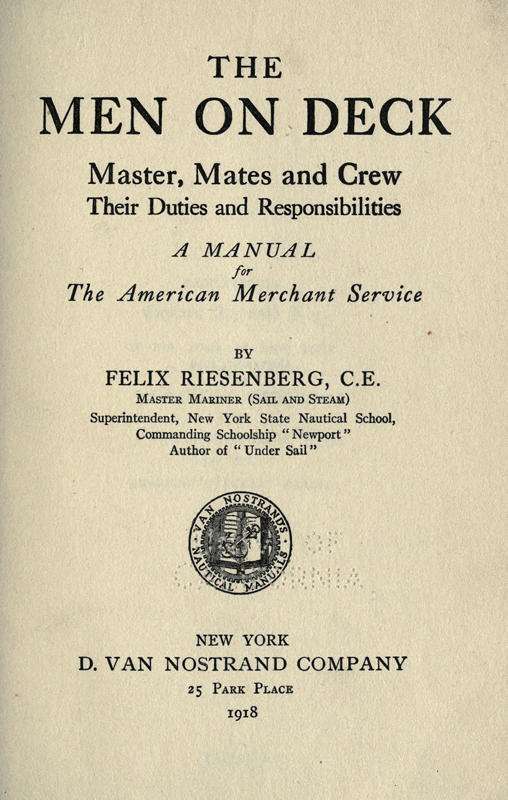
The Project Gutenberg eBook of The Men on Deck: Master, Mates and Crew, Their Duties and Responsibilities
Title: The Men on Deck: Master, Mates and Crew, Their Duties and Responsibilities
Author: Felix Riesenberg
Release date: August 31, 2018 [eBook #57820]
Language: English
Credits: Produced by Chris Curnow, Chris Pinfield and the Online
Distributed Proofreading Team at http://www.pgdp.net (This
file was produced from images generously made available
by The Internet Archive)
Transcriber's Note.
Apparent typographical errors have been corrected. The use of hyphens has been rationalised. Sub-paragraphs and lists have been indented. A line in blackletter font in the dedication has been bolded.
An advertisement for another book by the same author has been shifted to the back of the book.
Chapter XVIII describes the Rules of the Road as they apply to the High Seas and to U.S. Inland Waters. In the original work corresponding passages are set out on opposite pages. In this version the Rules applying to the High Seas are followed by those applying to Inland Waters. Inland Waters are defined in Chapter XIX.
THE MEN ON DECK
Master, Mates and Crew
Their Duties and Responsibilities
A MANUAL
for
The American Merchant Service
BY
FELIX RIESENBERG, C.E.
Master Mariner (Sail and Steam)
Superintendent, New York State Nautical School,
Commanding Schoolship "Newport"
Author of "Under Sail"
NEW YORK
D. VAN NOSTRAND COMPANY
25 Park Place
1918
Copyright, 1918
by
D. VAN NOSTRAND COMPANY
DEDICATED TO
Captain Reginald Fay
OF THE PORT OF NEW YORK
IN RECOGNITION OF
HIS UNTIRING EFFORTS
FOR
THE BETTERMENT
OF THE
AMERICAN MERCHANT MARINE
Preface
In the days of sail, the duties of masters, mates, and crews, were well defined. Sea practice, in the various rigs, had become standard with the authority of an ancient calling.
The art of sailing, and of rigging ships, was a precise matter. Gear remained standard for a century. The main to'bowline of a Black Ball Liner, tearing to windward in a North Atlantic hummer, was rove and led in much the same fashion as the main to'bowline of the ships of Nelson and Van Tromp. And the old time seamen, in their usage and habits, followed the regularity of the ships upon which they sailed.
The gradual transition from sail to steam carried with it, for a time, the old system of sailing ship routine. But to-day the sailing ship sailor is a thing of the past; the works of steam and steel are upon the waters—we are in the age of engines and the engineer. Great problems of mechanical propulsion, and of construction, are constantly presenting themselves, and the successors of the ancient mariner, the modern master, mates, and crew; the "deck department," if you will, of the present day steamer, find themselves afloat with different gear and under different conditions every time they change vessels.
No standard form of sea training has yet come to take the place of the old-time apprentice system of sail, and in addition to ships that are far from standard, we find that many ideas prevail as to the duties and organization of the seamanship branch of the modern steamer.
Able as they may be individually, officers of mixed training are constantly being thrown together in vessels of the merchant service, while in most cases crews are picked up haphazard from the beach. It is not to be wondered at that many ideas prevail as to the proper way of doing things. Indeed, many otherwise intelligent officers often have a very hazy notion as to just what they are supposed to do, or to know.
Seamen are often confused, through lack of knowledge, as to what may be expected of them; one vessel is run one way, and another one may be quite different. In fact the lack of uniformity at sea breeds uncertainty and makes for disorder in situations where order and discipline are essential.
Among many junior officers in the merchant service a notion prevails that their main object in life is to get along with as little effort as possible while awaiting early promotion and increased pay—they look forward hopefully to that glad day when they will wear the Master's stripes, with all day ashore, while in port, and all night in, while at sea—this book will not be agreeable reading for them.
In the following pages an attempt is made to point out the things the various members of the deck department of an ocean steam vessel may reasonably be expected to know, and the things that they may be required to do. The book does not pretend to tell HOW, but the object is to show WHAT a modern American Seaman ought to know, and to do, and to lay before him the laws by which his calling is regulated.
It is also hoped that the book will help to inform owners and shore managers of the kind and quality of service that they should expect from sea officers and men. It is hoped that it will also aid in creating a greater respect for the quality of the men who go down to the sea in steamers; sail has gone, but a mighty wake of heavy gear and great responsibility has come along to take its place.
Great Lakes officers and seamen, who are being called to salt water during the winter season, as a matter of war emergency, will, it is hoped, find the following pages of use in their new situations.
In conclusion it may be well to remind the hard-working merchantman that while many things are expected of him fortunately he is not required to do them all at once, nor do the United States Local Inspectors examine him upon all of the things mentioned in the pages of this little book.
The American who goes to sea to-day will not content himself with minimum requirements. He means to be more than a ten-per cent seaman. War emergencies have sent many men out on blue water who formerly would never have reached the deck or bridge. They know their limitations—all we can do is to point out the way.
The Author will welcome suggestions and criticisms from officers and men of the Merchant Marine who happen to read the pages of this book. Standard practice at sea is desirable, and such practice can best be achieved by some common ground upon which all minds may meet and reasonably agree.
Letters addressed in care of my publishers, D. Van Nostrand Company, 25 Park Place, New York, will be forwarded to me and be appreciated.
Table of Contents
| CHAPTER | PAGE | |
| I. | The Master | 1 |
| II. | Laws affecting the Duties of the Master | 9 |
| III. | Entry and Clearance | 18 |
| IV. | Entry of Merchandise | 27 |
| V. | Liability of Owners, Masters, and Shippers | 53 |
| VI. | Miscellaneous Laws | 59 |
| VII. | The Chief Mate | 72 |
| VIII. | The Chief Mate (Continued) | 92 |
| IX. | Rules of the U. S. Supervising Inspectors Relating to Lifesaving | 103 |
| X. | Passenger Act of 1882 | 116 |
| XI. | The Second Mate | 128 |
| XII. | The Third Mate | 131 |
| XIII. | The Junior Officers | 133 |
| XIV. | Cadets | 145 |
| XV. | Laws Defining Officers of the Merchant Marine | 146 |
| XVI. | Examinations for Licenses; Master and Mates | 153 |
| XVII. | The Watch Officer | 167 |
| XVIII. | The Rules of the Road—International—Inland | 184 |
| XIX. | The Limits of U. S. Inland Waters | 222 |
| XX. | The Quartermasters | 229 |
| XXI. | The Carpenter | 231 |
| XXII. | The Boatswain | 234 |
| XXIII. | Able Seamen | 236 |
| XXIV. | U. S. Navigation Laws Relating to Merchant Seamen | 241 |
| XXV. | Discipline at Sea | 286 |
| Appendix A. Customs Districts, Ports and Sub-Ports of the United States | 305 | |
| Appendix B. The Sea Library | 319 |
THE MEN ON DECK
CHAPTER I
THE MASTER
The Master Mariner who has the vessel in charge is called the CAPTAIN, or the MASTER, the latter being his official title. It is correct, however, to address the master of a vessel as CAPTAIN, a courtesy to which the Master Mariner is fully entitled through ancient sea usage.
Among seagoing people, the Master Mariner who is in charge of a vessel is in complete charge at all times; divided authority in this matter is intolerable to the minds of men accustomed to the sea.
The Master is responsible as follows:—
For the safe handling of his vessel in and out of port.
For the safe and expeditious navigation of his vessel from port to port.
For the good management, and order, of the various departments that constitute the internal economy of his vessel—deck—engine—steward's—etc.
He is responsible for the safety of the lives of passengers and crew.
He is responsible for the safe stowage, carriage, and unlading of the cargo.
The vessel is his direct responsibility. If the Pilot is in charge, this does not relieve the Master of his full responsibility.
The Master is responsible to the owners.
He is also responsible to the insurance underwriters.
He is also responsible to the Government of the United States, under which he receives his license as a Master Mariner.
The Master Mariner who is well qualified to bear the great responsibilities of his station; to have the keeping of many lives in his charge; to be the sole judge of what is right and proper in times of emergency; such a man is not made in a year, nor is he the product of any short-cut system of training. His sea lore must be learned at sea. His duty to ship and cargo must be truly come by through close and thorough contact with the great vessels he is called upon to command.
The Master Mariner must be a student of the laws governing his business upon the sea, and of the laws defining his duties and responsibilities to ship, passengers, crew, and cargo.
Briefly, he is charged with the following specific duties and responsibilities:
1. The safe navigation of his vessel.
2. The general management and care of his vessel.
3. The proper coaling—provisioning—supplying of water—etc.
4. That she be fully found—anchors—cables—warps—hawsers—boats— rafts—life-saving equipment—fire-fighting equipment, as required by law—compasses—chronometers—charts—sailing directions—sextants—and stores of all kinds needed to safely navigate her.
5. The proper signing of the ship's articles.
6. The keeping of the Official Log.
7. The carrying of a properly equipped medicine chest.
8. The carrying of a required slop chest, and compliance with the laws regulating the sale of slops.
9. He is liable for the wrong delivery of specie and cargo, or for loss or damage to the same due to carelessness or mismanagement on the part of the crew.
10. He is responsible for any neglect through which the validity of the insurance to ship or cargo is called into question.
11. He must enforce the rule that the vessel is never to be left without an officer in charge, either at sea or in harbor, day or night.
12. He shall see that a licensed engineer officer is on duty when steam is up on a boiler.
13. When maneuvering—in and out of port—or at sea, he should see that the most qualified engineer officers on board are in charge of the working of the engines.
14. He must see that no waste or extravagance is practiced with the ship's stores and provisions.
15. He must see that the lawful scale of provisions is issued to the crew.
16. He must see that no prohibited cargo or stores come aboard, and that his hatches are battened down before going to sea. He is responsible for the correct lading of the vessel.
17. He must enter and clear his vessel at the custom house. He must see that the proper papers are produced. Ship's register (with his name entered as master); Manifest; Bills of Health; Passenger and stores list; and any other papers that may be required.
18. He must be familiar with the laws, rules, and regulations in force in the various countries and at the various ports he visits.
19. He should find out where to obtain the services of the local medical authorities, and the police authorities, when in a strange port.
20. He should study the charter under which he is operating—if under charter. Is it a "time charter" or a "trip charter"? He will be largely responsible for the carrying out of his owner's part of the contract. If abroad he may sign the charter party, as agent of the owner.
21. He is the accredited representative of the owner. He has the authority to act contrary to the wishes of the ship's agents, when he is satisfied that such action is to the best interests of his owners; he must be prepared to bear full responsibility for his actions.
22. He is responsible to his owners for the safety of his vessel, whether he is on board or not.
23. He cannot delegate his authority, or name his successor to command, without the consent of his owners—unless physically unfit for duty, and then he has the authority to retain command and delegate such duties as he may be unable to perform himself.
24. He is always in command of and responsible for the safety of the vessel, whether he is using the services of a pilot, or otherwise, and his station, while in pilot waters under way, is on the bridge.
25. He has the authority to take the vessel from the pilot's control at any time, when in his opinion her safety demands such action. The use of the pilot indicates that the most careful measures are being taken to prevent accident, and for the protection of the insurance underwriters. Under such conditions, the taking over of the vessel from the pilot is weighted with the fullest responsibility.
26. He is responsible for the correct keeping of the wage account of the crew.
27. He is responsible for the safe carriage of mail entrusted to the vessel.
28. He is responsible for the acceptance on board of anyone except his crew, or regularly accredited passengers. He is accountable to the port authorities of the first port visited, for the presence of the same.
29. He must see that the legal requirements safeguarding the carriage of live stock are complied with.
30. He shall handle his vessel in conformity with the International Rules of the Road at Sea, or the Inland Rules, depending upon the waters in which he is navigating; he must know if he is on the high seas, or within the limits defined as inland waters.
31. He is the responsible navigator of his vessel, and cannot delegate this responsibility.
32. He must see that the officers and men respect the laws and regulations of the ports visited, that no contraband or dutiable articles are brought on board in violation of the same.
33. He must take steps to prevent smuggling.
34. He must keep a record of all fines, punishments, and charges against members of the crew, and must not permit punishment to be inflicted that is contrary to law, and only such punishment as is sanctioned by his express order. In the Official Log, where these entries are to be made, he must specify the nature and extent of the punishment.
35. In the Official Log Book he must enter the following:
First. Every legal conviction of any member of his crew, and the punishment inflicted.
Second. Every offense committed by any member of his crew for which it is intended to prosecute or to enforce a forfeiture, together with such statement concerning the reading over such entry, and concerning the reply, if any, made to the charge, as is required by the provisions of section forty-five hundred and ninety-seven.
Third. Every offense for which punishment is inflicted on board, and the punishment inflicted.
Fourth. A statement of the conduct, character, and qualifications of each of his crew; or a statement that he declines to give an opinion of such particulars.
Fifth. Every case of illness or injury happening to any member of the crew, with the nature thereof, and the medical treatment.
Sixth. Every case of death happening on board, with the cause thereof.
Seventh. Every birth happening on board, with the sex of the infant, and the names of the parents.
Eighth. Every marriage taking place on board, with the names and ages of the parties.
Ninth. The name of every seamen or apprentice who ceases to be a member of the crew otherwise than by death, with the place, time, manner, and cause thereof.
Tenth. The wages due to any seaman or apprentice who dies during the voyage, and the gross amount of all deductions to be made therefrom.
Eleventh. The sale of the effects of any seaman or apprentice who dies during the voyage, including a statement of each article sold, and the sum received for it.
Twelfth. In every case of collision in which it is practicable so to do, the master shall, immediately after the occurrence, cause a statement thereof, and of the circumstances under which the same occurred, to be entered in the official log-book. Such entry shall be made in the manner prescribed in section forty-two hundred and ninety-one, and failure to make such entry shall subject the offender to the penalties prescribed by section forty-two hundred and ninety-two. (R. S., 4290; Feb. 14, 1900.)
Every entry hereby required to be made in the official log-book shall be signed by the master and by the mate, or some other one of the crew, and every entry in the official log-book shall be made as soon as possible after the occurrence to which it relates, and, if not made on the same day as the occurrence to which it relates, shall be made and dated so as to show the date of the occurrence, and of the entry respecting it; and in no case shall any entry therein, in respect of any occurrence happening previously to the arrival of the vessel at her final port, be made more than twenty-four hours after such arrival. (R. S., 4291.)
If in any case the official log-book is not kept in the manner hereby required, or if any entry hereby directed to be made in any such log-book is not made at the time and in the manner hereby directed, the master shall, for each such offense, be liable to a penalty of not more than twenty-five dollars; and every person who makes, or procures to be made, or assists in making, any entry in any official log-book in respect of any occurrence happening previously to the arrival of the vessel at her final port of discharge, more than twenty-four hours after such arrival, shall, for each offense, be liable to a penalty of not more than one hundred and fifty dollars. (R. S., 4292.)
36. He must see that the ship's log-book is properly kept.
37. He must see that the property of deceased persons is disposed of according to law.
38. He must not depart from the safest and most usual course in making a passage between the designated ports of his voyage, unless under instruction from legal authorities, as in time of war.
40. He must not depart from port, unless authorized to do so by the proper port or other authorities.
41. He must see that all drills and inspections required by law are carried out and record of same made in the official log-book.
42. In case of collision he must stand by, and give the name and hailing port of his vessel, if required.
43. He must make the required reports to the U. S. Local Inspectors, concerning all matters laid down in their rules.
44. He must see that his officers stand proper watches and conform to all the requirements of the law.
45. He must see that the licenses of all licensed officers are exhibited as required by law.
46. He must see that the requirements of the vessel's Certificate of Inspection are rigidly adhered to—passengers—steam pressure—etc.
47. He should report promptly to his owners, and to the U. S. Local Inspectors, all details regarding accidents.
48. He must see that orderly conduct is maintained by his passengers as well as his crew—He must regularly inspect the quarters and accommodations assigned to them—must see to the ventilation—warmth—and cleanliness—of sleeping and dining rooms, and the cleanliness of kitchens, pantries, store rooms, bath rooms and lavatories.
49. He should be familiar with the regulations of the customs authorities of the ports to which he is trading. He should know the customs districts, ports and sub-ports of entry in the United States.
50. He should study the navigation laws of the United States.
51. Being MASTER, he should really be a Master Mariner in every sense of the word. He should know his ship, her cargo, whatever it may be, and he should never be satisfied until he is skilled in every branch of the art of navigation and seamanship.
52. He has the authority to suspend officers from duty, for cause, and in the case of mutinous conduct at sea, he is justified in putting in irons any member of his crew, or any officer, or passenger, when the safety and discipline of the vessel require such action.
53. At sea, or outside any legal jurisdiction, he is justified, as a matter of protecting the lives and property in his care, to take human life, when other measures are inadequate to this end.
54. He may be called upon to set a leg, or saw it off—to deliver a woman in childbirth—to perform the marriage ceremony—or to read the burial service at sea.
55. In the event of disaster; he must see to the safety of all hands, passengers and crew.
56. When his vessel founders, he must be the last man to leave the ship.
CHAPTER II
LAWS AFFECTING THE DUTIES OF THE MASTER
The principal laws of the United States affecting the duties and responsibilities of the Master are appended. Much of the bulk of the law, having to do with the construction of vessels and their fitting, and regulating the methods of inspection and control are omitted, and only those parts are given that directly affect the Master himself.
Much of the law, to the mind of a sailor, could be boiled down and simplified—perhaps some day sailors will go to Congress and do this—in the mean time the best that can be done is to make an attempt to unscramble the hodge-podge of rules, regulations, specifications, penalties, and what not, that fill the bulky red volume issued by the Bureau of Navigation, Department of Commerce.
Master's oath of citizenship. Upon making application for registry of a vessel.
If the master of a vessel is within the district where a registry thereof is to be made, when application is made for registering the same, he shall himself, instead of the owner, or of the agent, or attorney, as hereinafter mentioned, make oath touching his being a citizen, and the means whereby or manner in which he is citizen; in which case, if the master shall knowingly swear to anything untrue, no forfeiture of the vessel, on account of such false oath, shall be incurred, but the master shall be liable to a penalty of one thousand dollars. (R. S., 4144.)
Change of master.
When the master or person having the charge or command of a registered vessel is changed, the owner, or one of the owners, or the new master of such vessel, shall report such change to the collector of the district where the same has happened, or where the vessel shall first be after the same has happened, and shall produce to him the certificate of registry of such vessel, and shall make oath, showing that such new master is a citizen of the United States, and the manner in which or means whereby he is so a citizen. Thereupon the collector shall indorse upon the certificate of registry a memorandum of such change, specifying the name of such new master, and shall subscribe the memorandum with his name; and if other than the collector of the district by whom the certificate of registry was granted, shall transmit a copy of the memorandum to him, with notice of the particular vessel to which it relates; and the collector of the district, by whom the certificate shall have been granted, shall make a like memorandum of such change in his book of registers, and shall transmit a copy thereof to the Commissioner of Navigation. If the change is not reported, or if the oath is not taken, as above directed, the registry of such vessel shall be void, and the master or person having the charge or command of her shall be liable to a penalty of one hundred dollars. (R. S., 4171—July 5, 1884; sec. 2.)
Master must produce ship's register when entry is made.
The master or other person having the command or charge of any vessel, recorded in pursuance of this Title [R. S., 4131-4305], shall, on entry of such vessel, produce the certificate of such record to the collector of the district where she is so entered; and in default thereof the vessel shall not be entitled to the privileges of a recorded vessel. (R. S., 4184.)
Offenses against the registry law.
Every collector or officer who knowingly makes, or is concerned in making, any false register or record, or who knowingly grants or is concerned in granting, any false certificate of registry or record of or for any vessel, or any other false document whatever touching the same, contrary to the true intent and meaning of this Title [R. S., 4131-4305], or who designedly takes any other or greater fees than are by this Title allowed, or who receives any voluntary reward or gratuity for any of the services performed, pursuant thereto; and every surveyor or other person appointed to measure any vessel, who willfully delivers to any collector or naval officer a false description of such vessel, to be registered or recorded, shall be punishable by a fine of one thousand dollars, and be rendered incapable of serving in any office of trust or profit under the United States. (R. S., 4187.)
If any person authorized and required by this Title [R. S., 4131-4305] to perform, as an officer, any act or thing, willfully neglects to do or perform the same, according to the true intent and meaning of this Title, he shall, if not subject to the penalty and disqualification prescribed in the preceding section, be punishable by a fine of five hundred dollars for the first offense, and by a like fine for the second offense, and shall thenceforth be rendered incapable of holding any office of trust or profit under the United States. (R. S., 4188.)
Whenever any certificate of registry, enrollment, or license, or other record or document granted in lieu thereof, to any vessel, is knowingly and fraudulently obtained or used for any vessel not entitled to the benefit thereof, such vessel, with her tackle, apparel, and furniture, shall be liable to forfeiture. (R. S., 4187.)
No sea-letter or other document certifying or proving any vessel to be the property of a citizen of the United States shall be issued, except to vessels duly registered, or enrolled and licensed as vessels of the United States, or to vessels which shall be wholly owned by citizens of the United States, and furnished with or entitled to sea-letters or other custom-house documents. (R. S., 4190.)
Every person who knowingly makes, utters, or publishes any false sea-letter, Mediterranean passport, or certificate of registry, or who knowingly avails himself of any such Mediterranean passport, sea-letter, or certificate of registry, shall be liable to a penalty of not more than five thousand dollars, and, if an officer of the United States, shall thenceforth be incapable of holding any office of trust or profit under the authority of the United States. (R. S., 4191.)
Provisions and water.
Should any master or owner of any merchant vessel of the United States neglect to provide a sufficient quantity of stores to last for a voyage of ordinary duration to the port of destination, and in consequence of such neglect the crew are compelled to accept a reduced scale, such master or owner shall be liable to a penalty as provided in section forty-five hundred and sixty-eight of the Revised Statutes. (R. S., 4564. Dec. 21, 1898; sec. 12.)
Any three or more of the crew of any merchant-vessel of the United States bound from a port in the United States to any foreign port, or being of the burden of seventy-five tons or upward, and bound from a port on the Atlantic to a port on the Pacific, or vice versa, may complain to any officer in command of any of the vessels of the United States Navy, or consular officer of the United States, or shipping-commissioner or chief officer of the customs, that the provisions or water for the use of the crew are, at any time, of bad quality, unfit for use, or deficient in quantity. Such officer shall thereupon examine the provisions or water, or cause them to be examined; and if, on examination, such provisions or water are found to be of bad quality and unfit for use, or to be deficient in quantity, the person making such examination shall certify the same in writing to the master of the ship. If such master does not thereupon provide other proper provisions or water, where the same can be had, in lieu of any so certified to be of a bad quality and unfit for use, or does not procure the requisite quantity of any so certified to be insufficient in quantity, or uses any provisions or water which have been so certified as aforesaid to be of bad quality and unfit for use, he shall, in every such case, be liable to a penalty of not more than one hundred dollars; and upon every such examination the officers making or directing the same shall enter a statement of the result of the examination in the log-book, and shall send a report thereof to the district judge for the judicial district embracing the port to which such vessel is bound; and such report shall be received in evidence in any legal proceedings. (R. S., 4565.)
If the officer to whom any such complaint in regard to the provisions or the water is made certifies in such statement that there was no reasonable ground for such complaint, each of the parties so complaining shall forfeit to the master or owner his share of the expense, if any, of the survey. [This section shall not apply to fishing or whaling vessels or yachts—Dec. 21, 1898, sec. 26.] (R. S., 4566. Dec. 21, 1898; sec. 13.)
If any seamen, while on board any vessel, shall state to the master that they desire to make complaint, in accordance with the two preceding sections, in regard to the provisions or the water, to a competent officer, against the master, the master shall, if the vessel is then at a place where there is any such officer, so soon as the service of the vessel will permit, and if the vessel is not then at such a place, so soon after her first arrival at such place as the service of the vessel will permit, allow such seamen, or any of them, to go ashore, or shall send them ashore, in proper custody, so that they may be enabled to make such complaint; and shall, in default, be liable to a penalty of not more than one hundred dollars. (R. S., 4567.)
If, during a voyage, the allowance of any of the provisions which any seaman is entitled to under section forty-six hundred and twelve of the Revised Statutes is reduced except for any time during which such seamen willfully and without sufficient cause refuses or neglects to perform his duty, or is lawfully under confinement for misconduct either on board or on shore; or if it shall be shown that any of such provisions are, or have been during the voyage, bad in quality or unfit for use, the seaman shall receive, by way of compensation for such reduction or bad quality, according to the time of its continuance, the following sums, to be paid to him in addition to and to be recoverable as wages:
First. If his allowance is reduced by any quantity not exceeding one-third of the quantity specified by law, a sum not exceeding fifty cents a day.
Second. If his allowance is reduced by more than one-third of such quantity, a sum not exceeding one dollar a day.
Third. In respect to bad quality, a sum not exceeding one dollar a day.
But if it is shown to the satisfaction of the court before which the case is tried that any provisions, the allowance of which has been reduced, could not be procured or supplied in sufficient quantities, or were unavoidably injured or lost, or if by reason of its innate qualities any article becomes unfit for use and that proper and equivalent substitutes were supplied in lieu thereof, the court shall take such circumstances into consideration and shall modify or refuse compensation, as the justice of the case may require. [This section shall not apply to fishing or whaling vessels or yachts—Dec. 21, 1898, sec. 26.] (R. S., 4568. Dec. 21, 1898; sec. 14.)
Weights and measures.
Every master shall keep on board proper weights and measures for the purpose of determining the quantities of the several provisions and articles served out, and shall allow the same to be used at the time of serving out such provisions and articles, in the presence of a witness, whenever any dispute arises about such quantities, and in default shall, for every offense, be liable to a penalty of not more than fifty dollars. (R. S., 4571.)
Medicines and anti-scorbutics.
Every vessel belonging to a citizen of the United States, bound from a port in the United States to any foreign port, or being of the burden of seventy-five tons or upward, and bound from a port on the Atlantic to a port on the Pacific, or vice versa, shall be provided with a chest of medicines; and every sailing-vessel bound on a voyage across the Atlantic or Pacific Ocean, or around Cape Horn, or the Cape of Good Hope, or engaged in the whale or other fisheries, or in sealing, shall also be provided with, and cause to be kept, a sufficient quantity of lime or lemon juice, and also sugar and vinegar or other anti-scorbutics, to be served out to every seaman as follows: The master of every such vessel shall serve the lime or lemon juice, and sugar and vinegar, to the crew, within ten days after salt provisions mainly have been served out to the crew, and so long afterward as such consumption of salt provisions continues; the lime or lemon juice and sugar daily at the rate of half an ounce each per day; and the vinegar weekly at the rate of half a pint per week for each member of the crew. (R. S., 4569.)
If, on any such vessel, such medicines, medical stores, lime or lemon juice, or other articles, sugar, and vinegar, as are required by the preceding section, are not provided and kept on board, as required, the master or owner shall be liable to a penalty of not more than five hundred dollars; and if the master of any such vessel neglects to serve out the lime or lemon juice, and sugar and vinegar in the case and manner directed, he shall for each such offense be liable to a penalty of not more than one hundred dollars; and if any master is convicted in either of the offenses mentioned in this section, and it appears that the offense is owing to the act or default of the owner, such master may recover the amount of such penalty, and the costs incurred by him, from the owner. (R. S., 4570.)
Slop chest.
Every such vessel [R. S., 4569] except vessels engaged in the whaling or fishing business shall also be provided with a slop-chest, which shall contain a complement of clothing for the intended voyage for each seaman employed, including boots or shoes, hats, or caps, under clothing and outer clothing, oiled clothing, and everything necessary for the wear of a seaman; also a full supply of tobacco and blankets. Any of the contents of the slop-chest shall be sold, from time to time, to any or every seaman applying therefor, for his own use, at a profit not exceeding ten per centum of the reasonable wholesale value of the same at the port at which the voyage commenced. And if any such vessel is not provided, before sailing, as herein required, the owner shall be liable to a penalty of not more than five hundred dollars. The provisions of this section shall not apply to vessels plying between the United States and the Dominion of Canada, Newfoundland, the Bermuda Islands, the Bahama Islands, the West Indies, Mexico and Central America. (June 26, 1884; sec. 11. June 19, 1886; sec. 13.)
Warmth and clothing.
Every vessel bound on any foreign voyage exceeding in length fourteen days shall also be provided with at least one suit of woolen clothing for each seaman, and every vessel in the foreign or domestic trade shall provide a safe and warm room for the use of seamen in cold weather. Failure to make such provision shall subject the owner or master to a penalty of not less than one hundred dollars. [This section shall not apply to fishing or whaling vessels or yachts—Dec. 21, 1898, sec. 26.] (R. S., 4572; Dec. 21, 1898; sec. 15.)
Log-book.
Every vessel making voyages from a port in the United States to any foreign port, or being of the burden of seventy-five tons, or upward, from a port on the Atlantic to a port on the Pacific, or vice versa, shall have an official log-book; and every master of such vessel shall make, or cause to be made therein, entries of the following matters, that is to say: