
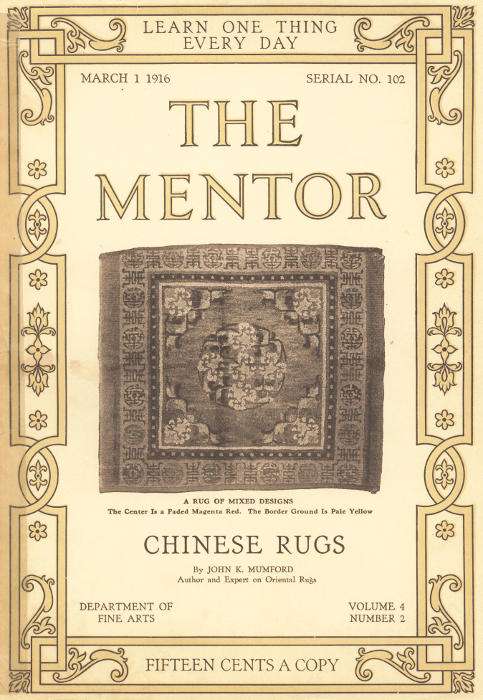
CHINESE RUGS
VERY EARLY CHINESE RUG
Monograph Number Six in The Mentor Reading Course
Length, nine feet nine inches.
Width, six feet six inches.
Sixteen hand-tied knots to the square inch, double yarns.
It should be, and probably will be, unnecessary to write any words of praise for the wonderful old carpet so well reproduced in this plate. It has all the marks of great and genuine antiquity. It represents the Chinese rug-weaving art at its best, so far as clear concept, perfect simplicity, and balance go, and the marvelous color which distinguishes the highest expression. When this piece came to America, together with the temple carpet shown in Plate V, it was in a sorry state of disrepair, although but little of the original web was missing. The work of reparation occupied a very considerable period of time, but resulted in bringing back to life and utility one of the most perfect examples of early weaving that have ever been imported.
If praise of the rug is unnecessary, analysis of it is next to impossible, for the good reason that there is nothing much to analyze. In color there are only two shades of tan, one gold, the other brown, and the one shade of very peculiar, misty blue. These, together with the wide band of dark brown around the sides and ends, all softened by age, complete the narrowest color schedule it could well be possible to employ in a rug. The range of design is still more limited. There is nothing but the fret in the central medallion and the single border, and the small medallions and corners, which, while not pretending to actual depiction, even conventionally, are nevertheless doubtless derived from the simple dragon forms so widely used at the remote period when this rug was made. In all this there is nothing complex, nothing pretentious, and yet the whole has a decorative atmosphere, and a completeness, which could not have been more impressive and which a free use of divers patterns could only have impaired.
From the standpoint of composition, particular attention should be paid to this blue. The color printing process has fortunately reproduced it with astonishing fidelity. It is not alone unique among the multitude of wonderful blues in which the old Chinese dyers excelled, but it would be difficult for the most skilful of present day colorists to have selected or devised a shade which would have taken its place in complementing to the shades of gold brown which dominate the entire fabric. In the light of such an accomplishment, it is difficult to believe that the scientific theory of color was worked out by a Frenchman, at so very late a day.
Some importance, finally, attaches to the brown band formed around the outside of the rug. Wide observation of old Chinese rugs reveals the fact that brown, used for this purpose, is an almost unfailing mark of very early origin. As time went on, blue began to supersede it, and through recent centuries the blue band has been well nigh universal; though in some few localities, apparently, brown has been adhered to for this purpose, down to a comparatively late day.
PREPARED BY THE EDITORIAL STAFF OF THE MENTOR ASSOCIATION
ILLUSTRATION FOR THE MENTOR, VOL. 4, No. 2, SERIAL No. 102
COPYRIGHT, 1916, BY THE MENTOR ASSOCIATION, INC.
CHINESE RUGS
By JOHN KIMBERLY MUMFORD
Author and Expert on Rugs
COLOR PLATES
ANTIQUE CHINESE RUG
ANTIQUE CHINESE RUG
ROUND CHINESE RUG
COLOR PLATES
OLD CHINESE RUG
OLD CHINESE TEMPLE RUG
VERY EARLY CHINESE RUG
A VERY CONSISTENT DESIGN
Center and border have a single motive. The fret and spot stripes furnish the accent
THE MENTOR · DEPARTMENT OF FINE ARTS
MARCH 1, 1916
Entered at the Post-office at New York, N. Y., as second-class matter. Copyright, 1916, by The Mentor Association, Inc.
There are many reasons for believing that the weaving of rugs was not indigenous to China, but was borrowed, perhaps a very long time ago, from Persia, or, possibly even earlier, from the Turkomans, to whom has generally been attributed the invention of the piled or upstanding knot. Recent investigations lead one to disbelieve in this, and to consider even these ancient Turkomans as more or less modern. But they nevertheless confirm the belief that rug weaving was an acquired art with the Chinese. This conviction is further sustained by the relatively small part rugs or rug weaving have had in the Chinese artistic tradition, the absence of reference to them in literature, and the fewness of fine Chinese rugs as compared with the multitude of wonderful pieces that have emanated from Persia, Turkestan, India, and Turkey.
In China rugs do not appear to have been so much a part of the daily, intimate life of the people as they are and always have been in the Moslem countries, nor have they received so much of reverent attention. True, much of Chinese religious symbolism has been woven into the rugs, but chiefly in the few special pieces made for the ornamentation or furnishing of the temples. The Mohammedan’s rug is closely related to his daily devotions. In China the rug has no such place, but is in the main a utility; and for this reason, perhaps, efforts to produce masterpieces have been far fewer in China, and there appears to have been no record or tradition of individual weavers of renown. In only a few instances is there found in Chinese rugs the studious and wonderful elaboration displayed, for example, in the sixteenth-century Persian rugs, the fine fabrics of old Damascus, or the superlative weavings of the Perso-Indian artists.
A VERY AMBITIOUS DESIGN
The garden idea is apparent. The deer, stork, tree, and cotyledon (seed leaf) forms are of the “Shou” order suggestive of long life. The round fret forms at the corners likewise symbolize this
The art of China, as expressed in porcelain and in painting, took hold upon the fancy of the West long ago: witness the Delft ware, which of course owes its inspiration to Chinese sources. Europe had a passable notion of Chinese artistic tenets at a rather early period. So, relatively, had America. It is interesting to note that of the Chinese rugs, now so amazingly popular in this country, practically nothing was known until fifteen or twenty years ago, save to an exceedingly small number of people. The period of their predominance in popular favor has been brief; but already the supply of old pieces with real merit is exhausted, particularly in the larger sizes.
SUDDEN POPULARITY
The vogue of the Chinese rug in this country is unquestionably due to the artistic sense and discernment of the late Stanford White. In a certain establishment in New York there had grown up an accumulation of old Chinese pieces, some of them very rare and beautiful, which had been “thrown in” with other art objects purchased. They begged for attention at thirty or forty dollars each, until Mr. White placed one or two of them in the hall of the late William C. Whitney’s house. From that moment the demand for them, and consequently their market value, advanced at a prodigious rate.
No matter what anybody may claim, it is doubtful if there has ever been in Europe or America any definite or systematized knowledge of the locality of origin or the period of Chinese rugs. Aside from the small importance usually attached to them as art products by the Chinese themselves, this dearth of specific knowledge has been due to the fact that the rugs were not woven in Eastern China, but in the interior provinces, and, even after a demand arose for them in the West, buyers were well content to await arrivals in the Treaty Ports, rather than court the perils of travel into the Chinese hinterland. It was believed that as soon as the demand became known there would be great influx of desirable fabrics to Peking. There was; but it lasted only for a little space, and today in the Chinese capital a rug of any merit whatsoever commands a price almost prohibitive. This has led to a great volume of manufacture in Peking, both in new designs and in more or less creditable copies of the old. But so violently has this commercial production been promoted that the very multitude of modern Chinese rugs has begun to work injury to the enterprise; although the texture of the new rugs is finer than that in many of the old ones. In fact, Chinese rug weaving as a whole does not show any impressively high measure of technical accomplishment.
TEXTURE OF CHINESE RUGS
The texture of Chinese floor coverings is usually far coarser than the Persian, or even the Turkish, notwithstanding that they are woven in the Persian knot, which lends itself to amazing fineness of detail. In addition to this coarseness a very heavy weft or cross-thread is used, sometimes four heavy strands after each transverse row of knots. This results in a very flat “lie” of the pile. The difference between this and the fine, almost perpendicular pile found in the rugs of Ispahan (so-called) of Tabriz and of Kashan, is striking; but it doubtless expresses the general attitude of the Chinese toward the rug. They evidently regarded it merely as a medium for the presentation of simple patterns and broad masses of color, and the quickest method of securing these was the best.
DESIGN AND TREATMENT
Chinese rug design and treatment are plainly impressionistic, as contrasted with the infinite detail that marks the high-school weavings of Persia.
COVERING FOR A CHAIR SEAT AND BACK
This fabric is in yellow and blue. The sacred mountain is the chief feature of the design
The Chinese weaver adapted the method to his requirements, and some of the most beautiful effects in the Chinese fabrics are found in absurdly coarse specimens. On the other hand, when he did undertake finer accomplishments, he vindicated all the high artistic traditions of his race. Perhaps the most impressive illustration of the racial skill and deftness is the cut work with which, in the better rugs, many of the patterns are outlined. This consists in the seemingly simple device of cutting away half the knot along the lines of a pattern; such, for example, as a flower or vine, a wave or a bird. The result is to leave the pattern clearly defined and in actual relief, without the interjection of another color. This cutting takes the place of the color outline almost universally used in Persia. In this, as in almost every phase of artistic accomplishment, the Chinese individuality and conservatism are manifest.
When we consider Chinese history and note the multitude of race factors that have gone into China-Arabs, Jews, Nestorians, Hindus, Armenians, and Turks, the wonder is that the Chinese weaving art is not manifestly and obtrusively composite; that is to say, that it does not show on its surface these various elements. But, on the contrary, it has taken the “busy” patterns of the races farther west, stripped them of their masses of confusing detail, and imbued them with the dignity and indefinable calm which seems to be the inevitable Chinese mark.
Anyone familiar with rugs can discern, in a certain school of Chinese fabrics, the Persian characteristics as found in the rugs of Khorassan; but always, and from whatever source derived, these patterns have been touched with the purely Chinese character, laid in the Chinese color, and so in the course of time have become thoroughly localized. China converted the hard octagons of the Turkoman rugs into circular scrolls or medallions, beautifying them meanwhile with some floral character manifestly borrowed from the Persians—and yet by no means Persian. There has been in all the world probably no more perfect example of racial individuality in art.
A COMPOSITE DESIGN
Of a rather late period. In the border are found somewhat overloaded Mohammedan characteristics
CHINESE INFLUENCE ON RUG DESIGN
It should be said, however, that Chinese influence has been equally effective outside its own pale. In the thirteenth century, Hulaku Khan, leading his Mongol hordes in conquest, took Chinese artists and workmen as far west as Bagdad. Traces of this transportation may be found in a great many Persian and Turkish rugs, particularly the palace pieces made for three hundred years after that time. The so-called “cloud band” and the cotyledon symbol (representing the life idea) may be seen in many fine Persian rugs. The dragon, which plays so large a part in Chinese ornament, has also been imparted to other races. The best illustration of this is the large Bagdad carpet from the Yerkes Collection, now in the Metropolitan Museum of Art.
In eliminating the overactive quality in Persian design, China made use of “background” in a way which the most advanced theorists in artistic composition must approve. The field of plain color became paramount; but it was rarely used, in the best early periods, as it is in the West, as a hard, defined area with central medallion and corner spaces. Where this was done the softest color was used throughout, such as a golden brown, relieved by dull blues and perhaps a deeper brown or a touch of gold yellow. In by far the most cases the pattern is distributed over the field sparsely instead of densely as in so many of the Persian rugs. Almost the only exceptions to this rule are small, repetitious diaper patterns, usually in mild coloring. Generally speaking, the patterns in Chinese rugs are large in proportion to the fabric; but it will be noticed that each has a more distinctive value. The natural effect of this would have been excessive strength in general effect; but here again the Chinese art intuition rose to the requirement. The difficulty was obviated by an entire change of color scheme.
A RUG OF UNUSUAL QUALITY, TEXTURE AND COLOR
The strength of the patterns is well distributed
COLOR IN CHINESE RUGS
While the Chinese of early times were master color makers, a very narrow schedule of colors has always served for the rugs, until the later decadent periods; in fact, this holds true in all Chinese art. There is in the entire kingdom of Chinese rug weaving no such jumble of unrelated colors as we find in the Persians. I have had occasion heretofore to make clear the Persian theory of color, that of neutralization by juxtaposition, in which a score of naturally conflicting colors are thrown together with great freedom, with the purpose that they shall neutralize one another. The Chinese had a concept more nearly approaching our own. He dealt in simple colors rather than in complex ones, and what neutralizations he accomplished were done before the actual weaving or else effected by the fading of the dyes after the rug was completed. In Chinese rugs art takes precedence of workmanship, and as the art declines, in the moderns, the texture seems to improve.
AN OLD RUG IN GRAY AND SOFT BROWN COLORS
Simple and effective. The lattice ground of the border has been used very intelligently
With this wide view of the Chinese habit and tendency before us, it is well to consider the all important matter of color. The range of coloring is noticeably narrow and correspondingly simple; though at first glance it does not always seem to be so. To this fact is doubtless due the restfulness which is the great charm of Chinese rugs. There are, to be sure, designs which are to the Western eye hard and discordant; but it will be found that most of these are in rugs of a religious sort, where the patterns include the dragons, Foo dogs, and other symbolic devices which seem to us grotesque and even repellent. It will be observed, however, when one has acquired familiarity with the Chinese rugs, that the adjustment of color values is most accurate, always bearing in mind that the Chinese seem to have discounted in the oldest and best periods of artistic production the mellowing influence of time.
A COHERENT AND WELL BALANCED DESIGN
The colors are blue and white
Most noticeable in Chinese rug coloring is the wonderful scope and quality of the blues. The highest expression of Persian skill in dyeing has always been found in blue; but even in this art—which, by the way, the Persians have now in a great measure lost—they must yield place to the Chinese. In the older rugs the Chinese blues show a range, a depth, and a luminous quality which are not surpassed in the world, and even the best modern pieces now being produced in Peking are in this respect superior to their Persian contemporaries.
Second, certainly, to the blues in importance come the yellows. While yellow has been used freely in Persian rugs, and more so in those of Kurdistan and Asia Minor, the fact of its royal and semi-religious value in China has caused it to be employed in some of the Chinese fabrics with a frankness not equaled elsewhere. Twenty years ago, before popular taste in America had attained its present appreciative attitude toward all Chinese art, the prevalence of yellow in strong values and large areas in the rugs was one of the chief causes of American dislike for them. It is unpleasant to admit this now, when old Chinese rugs in yellow, and some not so old, are sought with an avidity that disregards the question of price.
IMPERIAL YELLOW
Since Chinese rugs have come into demand we have heard a great deal of “imperial yellow.” Almost any yellow is “imperial” when a sale hangs in the balance. But it should be unnecessary to say that true imperial yellow is quite as rare in Chinese rugs as are imperial persons among the 400,000,000 of Chinese population. Its actual frequency is about equal to that of “inscriptions from the Koran in the modern rugs of Persia.” To describe it would tax the skill of Lafcadio Hearn, who would not have been so rash as to undertake it. Perhaps the most descriptive thing one can say is that it outyellows all the gold that ever shone.
INHARMONIOUS DESIGN
It is too strong for a small fabric. The sacred mountain and the Foo dogs are combined badly with a border stripe derived from India or Khorassan
The green schedule is very limited and the employment of green even more uncommon than in Moslem countries, where its religious importance restricts its use. When green does occur in Chinese fabrics, it has usually an admixture of yellow which converts it to olive, or else is a frank attempt to reproduce the color of jade. The colorings of old Chinese rugs, in the order of their frequency, are about as follows:
1. Blue and white, with the pattern in two or even three shades of blue, on white background, or occasionally with a splash of some salmon shade to give warmth and accent.
2. Reds and pinks, with design in two blues, yellow, tan, and white.
3. Yellow and blue, yellow ground with design in two shades of blue, with admixture of white and secondary elements in soft shades of tan and brown.
4. Browns and fawns, with patterns in blues, white, red, or yellow.
5. Dark blues, with design in white, or far less frequently in gold tan, relieved by small bits of light blue and white, sometimes one note of rust red for luck. (This seems to be common in all parts of Asia.)
6. Light blues, with pattern in white and the softer shades of yellow, pink, and fawn or brown, and small display of dark blue.
7. Green grounds, usually olive, with pattern in dark and light blue, yellow, and some red.
There are some other eccentric colorings, but these are the chief. The blue and white pieces are scarce now for the reason that they contribute to the “cool effects,” the attainment of which has of late been one of the chief aims of the highest practitioners in the art of decoration. The reds and certain “mustardy” shades of yellow have perhaps been least liked and linger longest on the shelf. Blue or yellow has proved a more attractive color arrangement. The dark blue and light blue grounds have always been very rare, and a green rug is an episode.
A TEMPLE FABRIC
When fastened around a pillar the dragon is complete and appears twined spirally
Red appears in Chinese silks in clear tones. In the rugs it almost always has a yellowish cast. There are many shades of salmon pink and red, but very few pieces with pink of a cool character, such as the “shell” shades, rose pink, or the famous Du Barry. All these appear in Persian and Kurdish rugs, and to one knowing how infinitely skilful Chinese dyers have been it is at first hard to understand why the schedules of this common and popular color included chiefly the yellowish tints, from pale apricot to a deep red which nevertheless verged toward orange. The reason for it is still difficult to discern: the method of obtaining these shades, in a softness which increases with age, is now clear.
If a Persian dyer wished to secure any particular shade of color, he would mix his dyes to that end, and the color, when applied, would remain. The oldtime Chinese dyer was more ingenious. He dyed the wool first in a fast yellow. When this was dry and thoroughly set it was dipped into a rather strong red, more or less fugitive. Upon long exposure to the air the red faded and the yellow came through; enough of the red remaining to leave the degree of warmth desired. The delicacy of these colors increases with age. In some old pieces, obviously of the Ming period, the wool which was originally red has come down to pale gold, with only the faintest blush over it, and in the faded color there is a quality which no accurate one-color dying can give. The Chinese dyer evidently counted upon the softening effect of the years, a foresight which could be found nowhere save among a race of collectors.
FEATURES OF CHINESE RUG PATTERNS
The simplicity which distinguishes Chinese coloring may be said equally to distinguish the design. This is more true of the old fabrics than of those of later origin. In fact, one of the distinguishing marks of the old rugs is the use of very simple patterns and usually a narrow border, consisting of some form of the fret or wave pattern which in architecture is known as “Greek,” but which appears with the swastika (卐), of which it is a clear development, in the primitive art of all races, and which in China has been employed most freely from the earliest times.
A RUG CONSISTENT IN ITS STRICTLY FLORAL CHARACTER
Well balanced, and modelled after the Kien Lung designs, but probably made later. The color effect is sprightly
Just when or at what stage of Chinese religious culture the dragon came into Chinese art we probably do not know; but it is found in the earliest rugs we have trace of. In these, however, it shares the prevailing simplicity, is strictly conventional in character, usually laid in blue and worked into the shape of a circular medallion, or sometimes, in conjunction with the fret, into corner devices. These, however, seem to have been appropriated from the Persian along with the central medallion.
MAT OF A VERY EARLY PERIOD
The purest of designs in gold and brown
As time and the art progressed there crept into the design a greater opulence, a higher degree of elaboration. Something of the floral richness of Persia was absorbed, and it abides to this day; but everything adopted was transformed, in color and treatment, to fit into the Chinese decorative scheme. Instead of a profuse mass of floral material, one flower was taken as a motive and presented in repeating fashion, duly emphasized, and with no multiplicity of other floral factors to detract from it. In almost every case the flower had an ethical or religious meaning which became the keynote of the rug.
In this connection it may be said that there is no art in the world in which so great a part of the prevailing figures has a generally recognized symbolic meaning.
CHINESE SYMBOLISM
Very comprehensive is this symbolism. It includes not alone a multitude of things from the floral and animal kingdoms, but even certain utensils had a meaning; social, ethical, or moral, if not religious. The bat, the bird, the butterfly, the dragon, the kylin, the Foo dog, the leopard, the elephant, the horse, the phœnix, the stork,—the list is altogether too long to permit of any thorough tabulation. The old symbols of primitive religion, found in Turanian rugs and dating back to the very morning of mankind, do not seem to appear in the Chinese weavings; but it is manifest that somewhere, at some time, the Chinese symbols and their attendant meanings were derived directly from some imaginative form of nature worship (witness the cotyledon or seed germ, which was adopted by Persia from China and appears so often in the high-school Persian rugs of Sefavian times). The meanings, once established, have been maintained in popular understanding. Every intelligent Chinaman today knows them as his remote ancestors did. It is a part of the great fund of popular information that bird, bat, deer, and butterfly convey wishes for long life and good fortune.
ONE OF THE OLDEST AND FINEST EXAMPLES OF CHINESE RUGS
The dragons at the center and the corners are in marvellous blue on a background of pure gold. The “tiger” marks are in brown
Chinese symbolism has developed some eccentric and even egregious things; such, for example, as the dragon and the kylin. Each and every of such impossible creatures had his sphere and his legend. Of the dragons, there are several kinds,—one of the heavens, one of the mountains, one of the sea. The emperor’s dragon has five claws. So has that of the first- and second-class princes. The next two classes of the royal family may display only a four-clawed one; while ordinary mortals must be content with three. A four-clawed serpent bespeaks a mandarin or a prince of the fifth rank.
AN UNUSUAL SADDLE CLOTH
It has religious symbols in the center on a yellow background. The border shows Hindu influence. The coloring is splendid
The kylin, a fearsome four-footed beast, means long life and good government. The phœnix, in addition to his indestructible life, was reputed to live high in the air, and to descend to earth only as the bearer of good news. The catalogue is endless, and perhaps to the Occidental useless, unless it be for the information of the collector or to divert the curious mind.
Many of the superstitions common in Turkey and Persia, seem to prevail throughout China. For example, I have found a “cash” (perforated Chinese coin) sewed fast to an old Chinese rug to bring good luck. It should be noted that the “cash” is one of the Buddhistic “symbols of happy augury.” Few people in any part of the world will fail to see the fitness of this. The Mohammedans indulge this same practice, using sometimes a gay bead or a scrap of cloth.
In weaving rugs the Chinese in earlier times had one custom of which I have found no trace in western Asia; namely, that of weaving a rug in two, three, or four sections, breaking an elaborate design without respect for its continuity, and knitting the parts together by the warp threads, evidently to produce just the required size. This is most prevalent in large temple rugs.
A word should be said concerning the assigning of rugs to specific periods. There are persons who will name a period for any Chinese rug. I believe more of these are wrong than right. There are some rugs which present coloring or design of distinct period character, and in general it is probable that the earliest are the simplest. The poor old Ming dynasty has had an awful burden to carry. Ability to tell when any and every rug was made would imply an intimate and detailed familiarity with the civil and artistic history of China for unnumbered years, and the person who professes such knowledge should be ready to give a reason for the faith that is in him. Not too much is known about Chinese rugs. They offer an ideal field for the ambitious student, and when he has mastered it thoroughly he will know much besides rugs.
SUPPLEMENTARY READING
There is a scarcity of literature dealing with Chinese rugs. A knowledge of Chinese rugs is based on a knowledge of rugs in the general Asiatic sense, and on Chinese art in all its developments.
| CHINESE ART | By Stephen W. Bushell |
| London, 1910. Chap. V, “Textiles, Woven Silks, etc.” | |
| CHINESE PICTORIAL ART | By Herbert A. Giles |
| Shanghai, 1905. | |
| CHINESE POTTERY AND PORCELAIN | By R. L. Hobson |
| Two Volumes. | |
| BULLETIN OF THE METROPOLITAN MUSEUM OF ART | |
| February, 1909. | |
| L’ART CHINOIS | By M. Paleologue |
| Paris, 1888. | |
| CHINESISCHE KUNST GESCHICHTE | By O. Münsterberg |
| Esslingen, 1912. | |
| THE TIFFANY STUDIOS COLLECTION OF ANTIQUE CHINESE RUGS | By Mrs. M. C. Ripley |
| New York, 1908. | |
| ORIENTAL RUGS BEFORE 1800 | By F. Martin |
| London, 1909. | |
| ORIENTAL RUGS ANTIQUE AND MODERN | By W. A. Hawley |
| New York, 1913. | |
| THE FLIGHT OF THE DRAGON | By Binyon |
| London, 1908. | |
| EPOCHS OF CHINESE ART | By Ernest F. Fenellosa |
| New York, 1913. |
THE OPEN LETTER
A RUG OF EARLY DESIGN
It is of heavy quality, dignified, and harmonious, in brown and gray colors. The device in the center is a symbol standing for long life
It is a curious fact that, while China is the oldest nation that we know, and the history of her civilization stretches back to the early morning of time, there are many interesting Chinese things with which we have only in recent years become familiar. The Chinese rug is a case in point. How long the Chinese have been making fine rugs no one can tell. It is safe, however, to say that, like their other arts, Chinese rugmaking is of very great antiquity.
And yet, as Mr. Mumford points out, the Chinese rug has come into vogue in the west only within the past fifteen or twenty years. It is true the vogue was anticipated by a few collectors in England and America, but they can be numbered on the fingers of one hand. Mr. H. O. Havemeyer, some twenty-five years ago, took a fancy to Chinese rugs and made quite a collection of them. They had no special market value then, for they were not sought after. Mr. Havemeyer collected them because he was attracted to them as unusual products of the loom, and then because, he found them to be an interesting and profitable subject of study. His collection is no doubt in the possession of his family today, and if a present day value were set upon those rugs they would probably show an appreciation over their original prices of fully a thousand per cent, if not more.
Mr. Mumford calls attention to the fact that the Chinese rug was made popular in this country by the late Mr. Stanford White. Mr. White was a very strong and original figure in art. He did not look to others for suggestions. He led the way and others followed. So when he picked out a number of old Chinese rugs that he found in a New York shop and placed them in Mr. William C. Whitney’s house, connoisseurs and collectors took notice and very soon the Chinese rug became the vogue. All that were to be had in America were soon bought up and the prices rose sensationally. Some time ago a New York collector bought a Chinese rug for $30. This was in the days before the vogue. Two years later he found a mate to this rug in the same shop, ordered it without hesitation—and it was delivered to him with a bill for $3,600. This shows the increase of value that can be effected by a quick growth in demand. And today few genuine old Chinese rugs can be had at any price.
W. D. Moffat
Editor
The Mentor Association
ESTABLISHED FOR THE DEVELOPMENT OF A POPULAR INTEREST IN ART, LITERATURE, SCIENCE, HISTORY, NATURE, AND TRAVEL
THE ADVISORY BOARD
- JOHN G. HIBBEN, President of Princeton University
- HAMILTON W. MABIE, Author and Editor
- JOHN C. VAN DYKE, Professor of the History of Art, Rutgers College
- ALBERT BUSHNELL HART, Professor of Government, Harvard University
- WILLIAM T. HORNADAY, Director New York Zoological Park
- DWIGHT L. ELMENDORF, Lecturer and Traveler
The purpose of The Mentor Association is to give its members, in an interesting and attractive way, the information in various fields of knowledge which everybody wants to have. The information is imparted by interesting reading matter, prepared under the direction of leading authorities, and by beautiful pictures, produced by the most highly perfected modern processes.
THE MENTOR IS PUBLISHED TWICE A MONTH
SUBSCRIPTION, THREE DOLLARS A YEAR. FOREIGN POSTAGE 75 CENTS EXTRA. CANADIAN POSTAGE 50 CENTS EXTRA. SINGLE COPIES FIFTEEN CENTS. PRESIDENT, THOMAS H. BECK; VICE-PRESIDENT, WALTER P. TEN EYCK; SECRETARY, W. D. MOFFAT; TREASURER, ROBERT M. DONALDSON; ASST. TREASURER AND ASST. SECRETARY, J. S. CAMPBELL
COMPLETE YOUR MENTOR LIBRARY
Subscriptions always begin with the current issue. The following numbers of The Mentor Course, already issued, will be sent postpaid at the rate of fifteen cents each.
- Serial No.
- 1. Beautiful Children in Art
- 2. Makers of American Poetry
- 3. Washington, the Capital
- 4. Beautiful Women in Art
- 5. Romantic Ireland
- 6. Masters of Music
- 7. Natural Wonders of America
- 8. Pictures We Love to Live With
- 9. The Conquest of the Peaks
- 10. Scotland, the Land of Song and Scenery
- 11. Cherubs in Art
- 12. Statues With a Story
- 13. Story of America in Pictures: The Discoverers
- 14. London
- 15. The Story of Panama
- 16. American Birds of Beauty
- 17. Dutch Masterpieces
- 18. Paris, the Incomparable
- 19. Flowers of Decoration
- 20. Makers of American Humor
- 21. American Sea Painters
- 22. Story of America in Pictures: The Explorers
- 23. Sporting Vacations
- 24. Switzerland: The Land of Scenic Splendors
- 25. American Novelists
- 26. American Landscape Painters
- 27. Venice, the Island City
- 28. The Wife in Art
- 29. Great American Inventors
- 30. Furniture and Its Makers
- 31. Spain and Gibraltar
- 32. Historic Spots of America
- 33. Beautiful Buildings of the World
- 34. Game Birds of America
- 35. Story of America in Pictures: The Contest for North America
- 36. Famous American Sculptors
- 37. The Conquest of the Poles
- 38. Napoleon
- 39. The Mediterranean
- 40. Angels in Art
- 41. Famous Composers
- 42. Egypt, the Land of Mystery
- 43. Story of America in Pictures: The Revolution
- 44. Famous English Poets
- 45. Makers of American Art
- 46. The Ruins of Rome
- 47. Makers of Modern Opera
- 48. Dürer and Holbein
- 49. Vienna, the Queen City
- 50. Ancient Athens
- 51. The Barbizon Painters
- 52. Abraham Lincoln
Volume 2
- 53. George Washington
- 54. Mexico
- 55. Famous American Women Painters
- 56. The Conquest of the Air
- 57. Court Painters of France
- 58. Holland
- 59. Our Feathered Friends
- 60. Glacier National Park
- 61. Michelangelo
- 62. American Colonial Furniture
- 63. American Wild Flowers
- 64. Gothic Architecture
- 65. The Story of the Rhine
- 66. Shakespeare
- 67. American Mural Painters
- 68. Celebrated Animal Characters
- 69. Japan
- 70. The Story of the French Revolution
- 71. Rugs and Rug Making
- 72. Alaska
- 73. Charles Dickens
- 74. Grecian Masterpieces
- 75. Fathers of the Constitution
- 76. Masters of the Piano
Volume 3
- 77. American Historic Homes
- 78. Beauty Spots of India
- 79. Etchers and Etching
- 80. Oliver Cromwell
- 81. China
- 82. Favorite Trees
- 83. Yellowstone National Park
- 84. Famous Women Writers of England
- 85. Painters of Western Life
- 86. China and Pottery of Our Forefathers
- 87. The Story of The American Railroad
- 88. Butterflies
- 89. The Philippines
- 90. Great Galleries of The World: The Louvre
- 91. William M. Thackeray
- 92. Grand Canyon of Arizona
- 93. Architecture in American Country Homes
- 94. The Story of The Danube
- 95. Animals in Art
- 96. The Holy Land
- 97. John Milton
- 98. Joan Of Arc
- 99. Furniture of the Revolutionary Period
- 100. The Ring of the Nibelung
Volume 4
- 101. The Golden Age of Greece
NUMBERS TO FOLLOW
Mar. 15. THE WAR OF 1812.
By Albert Bushnell Hart, Professor of Government, Harvard University.
This number is one of the series “America In Story and Picture.” It follows “Fathers Of The Constitution,” and will tell in an entertaining manner of all the interesting events that took place before, during, and shortly after the War of 1812.
April 1. GREAT ART GALLERIES OF THE WORLD—THE NATIONAL GALLERY, LONDON
By Professor John C. Van Dyke.
This number continues the series on the Great Art Galleries of the World, of which that on the Louvre at Paris, was the first. This number, will, if possible, be even more beautiful and interesting. Many of the works of the great masters will be reproduced. Professor Van Dyke’s text is as entertaining as it is instructive.
THE MENTOR ASSOCIATION, Inc.
52 EAST 19th STREET, NEW YORK, N. Y.
THE MENTOR
THE MENTOR AS A REFERENCE LIBRARY
Every number of The Mentor is valuable. The back numbers are as useful and entertaining at any time as on the date of publication. Therefore, many members wish to own a complete file of back numbers.
For those who own a complete set and desire to use The Mentor as a reference library, we have provided a simple and convenient method of filing and cataloguing The Mentor. In a booklet which we have especially provided for our members, the various Mentors are grouped under headings which link similar numbers together in sets. Attached to the name of each Mentor is a list of the gravure pictures accompanying it, together with a short synopsis of the contents. This gives immediate information as to what each Mentor contains. We will be glad to send this booklet free of charge.
We also provide for our members file boxes the size of The Mentor. These are furnished stamped in gold lettering for forty cents apiece. In these The Mentors may be grouped according to sets.
We also supply a binder which holds twelve or thirteen Mentors and has proved satisfactory in every way. This binder has been arranged so as to hold The Mentor complete, and it has tie-pins to which the pictures are attached, so that they swing freely in their place and the pictures can be enjoyed as well as the text on the back. The price of these binders is one dollar each.
When our members desire to refer to a picture or look up a fact, it is only necessary for them to consult the booklet, finding there in which Mentor the information may be sought.
The price of all back numbers of The Mentor is fifteen cents each.
Write and let us explain the plan more fully.
THE MENTOR ASSOCIATION, INC.
52 East Nineteenth Street—New York City, N. Y.
MAKE THE SPARE
MOMENT COUNT