
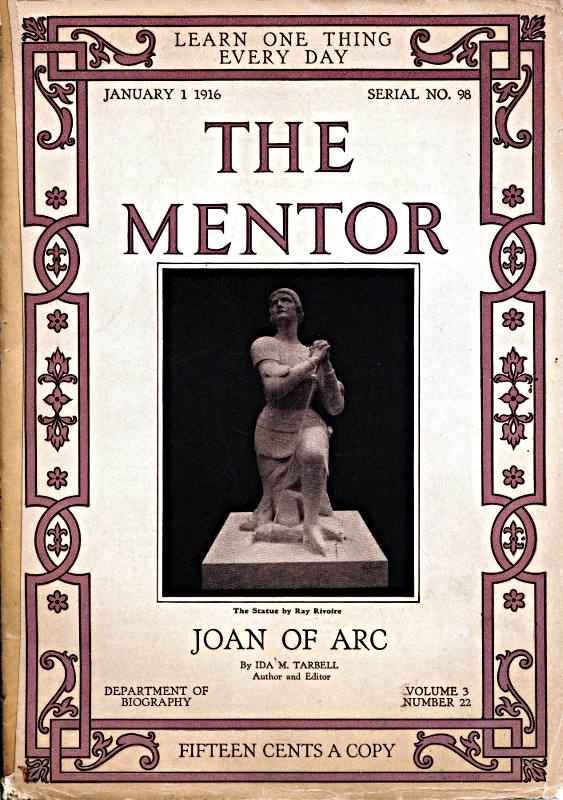
The Project Gutenberg eBook of The Mentor: Joan of Arc, v. 3, Num. 22, Serial No. 98, January 1, 1916
Title: The Mentor: Joan of Arc, v. 3, Num. 22, Serial No. 98, January 1, 1916
Author: Ida M. Tarbell
Release date: January 6, 2016 [eBook #50859]
Most recently updated: October 22, 2024
Language: English
Credits: Produced by Juliet Sutherland, Christopher Wright and the
Online Distributed Proofreading Team at http://www.pgdp.net
LEARN ONE THING EVERY DAY
JANUARY 1 1916
SERIAL NO. 98
THE
MENTOR
JOAN OF ARC
By IDA M. TARBELL
Author and Editor
DEPARTMENT OF
BIOGRAPHY
VOLUME 3
NUMBER 22
FIFTEEN CENTS A COPY
The Maid of Orleans
What is to be thought of her? What is to be thought of the poor shepherd girl from the hills and forests of Lorraine, that—like the Hebrew shepherd boy from the hills and forests of Judea—rose suddenly out of the quiet, out of the safety, out of the religious inspiration, rooted in deep pastoral solitudes, to a station in the van of armies, and to the more perilous station at the right hand of kings?
The boy rose to a splendor and a noonday prosperity, both personal and public, that rang through the records of his people, and became a by-word amongst his posterity for a thousand years, until the sceptre was departing from Judah. The poor, forsaken girl, on the contrary, drank not herself from that cup of rest which she had secured for France.
Pure, innocent, noble-hearted girl!... This was amongst the strongest pledges for thy truth, that never once didst thou revel in the vision of coronets and honor from man.... To suffer and to do, that was thy portion in this life; that was thy destiny; and not for a moment was it hidden from thyself.
Great was the throne of France even in those days, and great was he that sat upon it: but well Joanna knew that not the throne, nor he that sat upon it, was for her; but, on the contrary, that she was for them; not she by them, but they by her, should rise from the dust. Gorgeous were the lilies of France, and for centuries had the privilege to spread their beauty over land and sea; ... but well Joanna knew, early at Domrémy she had read that bitter truth, that the lilies of France would decorate no garland for her. Flower nor bud, bell nor blossom, would ever bloom for her!
THOMAS DE QUINCEY
THE YOUTH OF THE MAID
Monograph Number One in The Mentor Reading Course
Joan of Arc, whose name more properly was Jeanneton Darc, and who is now known in France as Jeanne d'Arc, was one of the most wonderful women that ever lived. It is hard to believe some of the strange things that happened to her before she was twenty years old.
She was born at Domrémy, over in the eastern part of France, on January 6, 1412. She was the daughter of a peasant, and never learned to read or write; yet later in her life learned men could not puzzle her by questions. She was so sympathetic that she would stop to comfort her wounded enemies on the battlefield; yet she was so brave that even when severely wounded she continued to lead her soldiers.
Before hearing the story of Joan of Arc, it is interesting to know something of what was happening in France at the time she lived. For a long time the English king had been trying to make himself also the ruler of France. The ruler at that time was named Charles; but he had never been crowned king, as the coronation should have taken place at the Cathedral at Rheims (English pronunciation—Reemz.) But as Rheims was in the power of the English, Charles could not go there to be crowned.
The French themselves were divided into two parts. Some of them sided with Charles; but more took the part of England. These latter people lived in Burgundy. So at the time that Joan of Arc was born France was in a most unhappy state.
The girl sometimes guarded her father's flocks, and she was always glad to assist in the household work. She was noted for her physical strength, and for this reason and for her unselfish kindness she was a favorite in her village. She was of an extremely religious temperament, and the church services made her very happy.
When Joan was about thirteen years old her Voices came to her for the first time. She told of this great event later in her life:
"When I was about thirteen years old there came to me a Voice from God, teaching me how I was to behave and what I was to do. And the first time that Voice came I was afraid. I was standing about the middle of the day, in summer, in my father's garden. The Voice came from the right hand, from where the church stands, and when it came I usually saw a great light on the side from which it spoke. The Voice told me to be a good girl and go to church and go to save France. I said I was only a poor girl, who could not ride or lead the soldiers in the wars."
Joan also said that she saw figures of angels, and she enjoyed talking to them and listening to their counsel. However, no one else ever saw the angels or heard the Voices.
About this time Henry V of England died, and his son became heir to the throne. But the war against France was still being carried on. Just then the English were besieging the town of Orléans. This was in the fall of 1428. It seemed as though the city would be captured and the last stronghold of Charles would be lost to him. There were about 4,000 English besieging the city, and they planned to starve Orléans into surrender. It was then that the Voices advised Joan to save France.