
THE TRIAL AND DEATH OF THE MAID
Monograph Number Six in The Mentor Reading Course
The English turned Joan of Arc over to the Inquisition on January 3, 1431. The Inquisition was a court which tried people for religious offenses against the church. They put her into a cage in the castle of Rouen. Chains were placed on her legs, and five rough soldiers kept watch in the room day and night. Her captors wished to prove her a witch to take away the sting of having been defeated by a girl. The principal enemy of Joan was Pierre Cauchon (co-shong), the Bishop of Beauvais (bo-vay´), who hoped to be made Archbishop of Rouen by the English.
Her examination by the Court of the Inquisition began on January 9th. For three months these wise men examined the Maid every day. She had no advocate, and was forced to defend herself. But she showed that she was far wiser than her learned judges. She would never answer questions about her Saints and Voices except when the Voices gave her permission to do so.
In particular the judges wished to know the secret of the king, which secret they knew Joan possessed. But in spite of the king's neglect of the Maid, she would never betray him. Finally they told her they would torture her. They took her to the torture chamber and asked her if she would tell them then. But Joan said:
"Torture me if you please. Tear my body to pieces. Whatever I say in my pains will not be true, and as soon as I am released I will deny that it was true. Now go on!"
They did not torture her, but continued to harass her with questions. They said she should not wear man's dress as she did. She answered that when among men in war it was better and more proper. Once during the trial she seemed to hear her Voices and stopped speaking suddenly. Then after listening a moment she said, "Before seven years are passed the English will lose a greater stake than they have lost at Orléans: they will lose everything in France." This prophecy came true, as we know.
At last, on May 24, 1431, her judges took Joan to the graveyard of the Church of St. Ouen (Oo-ong) at Rouen. There was a stake and faggots all ready for the burning, and they said that she would be burned to death unless she signed a paper saying that she would wear woman's dress and would submit to the judges. She said that she would be willing to do this if she would receive pardon. But as Joan could not read, the judges substituted another paper for her to make her mark on. On this paper was a statement that her saints were evil spirits, and that she had done all sorts of wrong things.
She was still a prisoner of the English, and they kept her in prison. Her jailers by trickery induced her to put on her man's dress once more. When she had done this she was judged to have relapsed. This was the greatest crime, and she was sentenced to death.
On May 30, 1431, she was burned to death in the marketplace of Rouen. Eight hundred soldiers surrounded the stake for fear that someone might attempt to save her. Only one kind priest who pitied her brought a cross and held it before her eyes while she was burning.
In 1436 a woman appeared who said she was Joan of Arc escaped from the flames. Many people believed her; but afterward she confessed to being an impostor.
On July 7, 1456, the pope revoked the sentence passed on the Maid. In February, 1903, a formal proposal was entered for her canonization, and on December 13, 1908, she was made a saint.
PREPARED BY THE EDITORIAL STAFF OF THE MENTOR ASSOCIATION
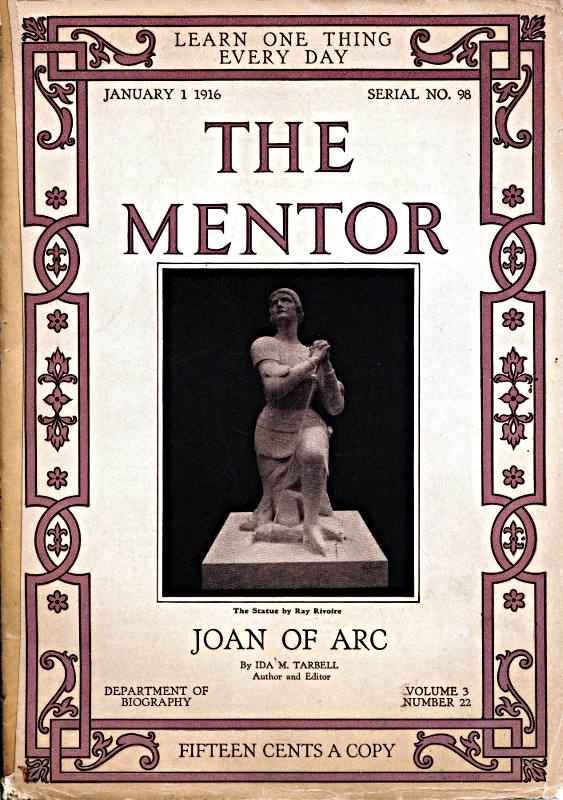
ILLUSTRATION FOR THE MENTOR, VOL. 3, No. 22, SERIAL No. 98
COPYRIGHT, 1916, BY THE MENTOR ASSOCIATION, INC.