
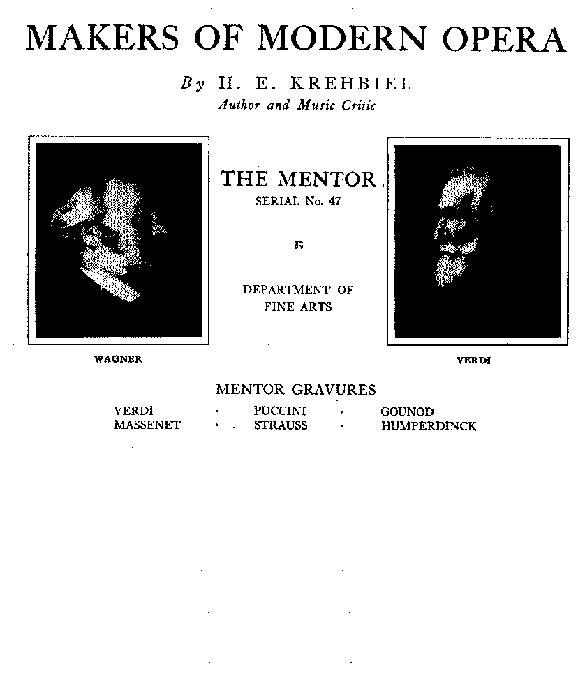
MAKERS OF MODERN OPERA
Jules Émile Frédéric Massenet
TWO
Massenet, one of the most renowned French composers, was born at Montaud, May 12, 1842. Like nearly all French musicians, he began his study in the French Conservatory. He was so poor in his early days that he had to help pay his living expenses by playing the kettledrum in a café orchestra. He carried off several minor prizes during his student days, and finally in 1863 secured the prize of Rome, and this despite the fact that the head of the conservatory at first tried to exclude him on the ground that he had no musical ability. On returning from Rome in 1867 he produced his first opera, a one-act affair which achieved only moderate success. He served in the Franco-Prussian War, and his impressions received there found musical expression in his study “Alsaciennes” and his one-act opera “Navarraise.” After that time Massenet was industrious in composition, turning out operas every year or so. The wonder of it is that most of them have been successful and are a part of the operatic repertoire today.
From 1878 to 1896 he was a professor of composition at the Paris conservatory, and had under his tuition a number of pupils who have since become famous; Charpentier, the composer of “Louise,” was one of them. His activities may be gathered from the fact that he has written more than twenty operas and five oratorios, together with incidental music to four dramas.
In 1878 he was elected a member of the Academy of Beaux Arts, an honor that he won over Saint-Saëns, who is reckoned a superior musician.
He died in Paris August 13, 1912.
Massenet has been called a puzzling personality in modern musical history. His subjects are chosen to suit a Parisian public, and yet they have been successful in foreign fields. His style has been called “weak and sugary,” and his music “superficially clever.” But in spite of that Massenet’s music has lasted for years, and, however he may be criticized, his poetic sentiment and richly colored orchestration are emphatically suitable to the public taste.
PREPARED BY THE EDITORIAL STAFF OF THE MENTOR ASSOCIATION
ILLUSTRATION FOR THE MENTOR, VOL. 1, No. 47
COPYRIGHT, 1914, BY THE MENTOR ASSOCIATION, INC.
© AIMÉ DUPONT
GIACOMO PUCCINI