
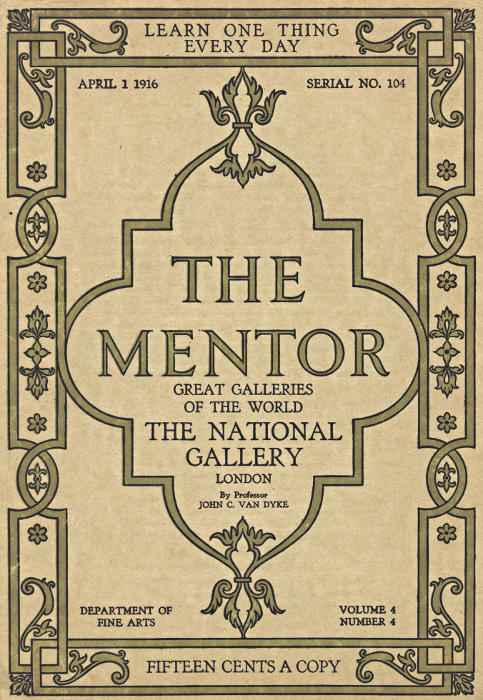
THE NATIONAL GALLERY
SIR JOSHUA REYNOLDS
Monograph Number Six in The Mentor Reading Course
Sir Joshua Reynolds was one of the greatest of English portrait painters; and as a painter of childhood he has no superior. He was a rapid worker, and it is estimated by some authorities that he finished as many as 3,000 portraits. His career was one long series of successes, and he made an immense fortune by his painting.
Reynolds was born in Devonshire, England, on July 16, 1723. Thomas Hudson was his first teacher. Then the young artist visited Italy. There he studied carefully the works of the old masters. He returned to London and almost immediately was accorded first place among the portrait painters of the day. At the same time he became one of the leading members of the famous Literary Club, among whose members were Doctor Samuel Johnson and Oliver Goldsmith, the authors, David Garrick, the leading actor of the time, and other men prominent in the fields of art and letters.
The British Royal Academy was founded in 1768, and its first president was Reynolds. There he distinguished himself by delivering his famous “Discourses” on art. With these he proved himself to be as much a master of words as of the brush.
Reynolds’ success and prosperity naturally made his less fortunate rivals jealous of him; at the same time his attitude towards some of them was not altogether generous. In particular his relations with Gainsborough were not pleasant. Nevertheless, Reynolds went to Gainsborough’s deathbed, and there was an apparent reconciliation.
In 1784, at the death of Ramsay, Reynolds was appointed painter to the king. Two years before a stroke of paralysis had attacked him; but he was able to resume his painting after a month of rest. In the summer of 1789, however, his sight began to fail. Nevertheless, he continued to practise his art until about the end of 1790. But from then on he began to sink gradually. He suffered for only a few months, and on February 23, 1792, passed peacefully away.
Sir Joshua Reynolds, though a great artist, lacked academic education, and therefore he never could draw the human figure properly. He sacrificed this ability to secure a thorough knowledge of the great paintings of the world, their faults and their excellencies.
He also had a tendency to tamper with his pigments. It is said that one day the famous American artist, Gilbert Stuart, was copying one of Reynolds’ fine heads in a very warm room. Suddenly he noticed that one eye on the painting seemed to be moving downward. At first he thought his imagination was playing him false; but finally he was convinced that the eye was moving. He quickly removed the painting to a cold room, and gradually worked the eye back in place. It was then that he discovered that his great predecessor had used wax in his pigments. This explained something that had baffled artists for years—the brilliant transparency of many of Reynolds’ colors.
PREPARED BY THE EDITORIAL STAFF OF THE MENTOR ASSOCIATION
ILLUSTRATION FOR THE MENTOR, VOL. 4, No. 4, SERIAL No. 104
COPYRIGHT, 1916, BY THE MENTOR ASSOCIATION, INC.
GREAT GALLERIES OF THE WORLD
THE NATIONAL GALLERY
LONDON
By JOHN C. VAN DYKE, Professor of the History of Art, Rutgers College
MENTOR GRAVURES
THE DOGE LOREDANO
By Giovanni Bellini
ARIOSTO
By Titian
THE DUCHESS OF MILAN
By Hans Holbein
MENTOR GRAVURES
SAINT GEORGE AND THE DRAGON
By Tintoretto
THE GUITAR LESSON
By Gerard Terborch
LADY COCKBURN AND CHILDREN
By Sir Joshua Reynolds
The National Gallery
Entered at the postoffice at New York, N. Y., as second-class matter. Copyright, 1916, by The Mentor Association, Inc.
THE MENTOR · DEPARTMENT OF FINE ARTS
APRIL 1, 1916
The National Gallery, whether the tourist sees it first or last in his trip around Europe, is sure to make an impression. It is one of the famous galleries of the world, and has a rarefied atmosphere about it, even to those who know the galleries by heart. The walk up the wide stone steps approaching the first room excites a wonder that is almost amazement. The pictures have a richness—a jewel quality about them—that seems preternaturally splendid. You have not perhaps noticed such depth and mellowness of color in other galleries. What does it mean? Well, in some cases it may mean merely that the pictures are framed under glass, and get a certain tone and richness from that; but it more often means that you are looking at very unusual pictures. The National Gallery is full of masterpieces.
THE VIRGIN AND CHILD, SAINT JOHN THE BAPTIST AND SAINT NICHOLAS OF BARI
By Raphael
SAINT HELENA—THE VISION OF THE CROSS
By Paolo Veronese (vay-ro-nay´-zee)
Where did they come from? Out of the famous private collections of England. When nobility dies without an heir, or the heir himself needs money, then the pictures collected by the art-loving elders of perhaps a dozen generations come by bequest to the National Gallery, or find their way to the auction room and are purchased for the gallery. Thus it is that the National Gallery has been the natural inheritor of the rich collections of England. It started less than a hundred years ago (in 1824) with the Angerstein collection, and has been growing ever since with gifts of collections such as those of Vernon, Wynn Ellis, Vaughan, Salting. If it is found necessary to bid for a picture at auction, a government grant or the subscriptions of wealthy art patrons, or both, generally carries the day against any private collector. Thus such famous pictures as Raphael’s “Ansidei Madonna,” Titian’s (tish´-an) “Ariosto,” Holbein’s “Duchess of Milan” were bought for the gallery at enormous prices—the Raphael bringing over $350,000, and the others some $150,000 each.
There are now about 3000 pictures in the gallery, though, of course, all of them are not hung at any one time. There is not enough wall space for that, though the building is in a chronic state of enlargement. New rooms are added from year to year, and new editions of the catalogue are being continually issued. The gallery is very well arranged and lighted, and very well managed. Management of a gallery seems very easy to the public because there is apparently no friction, but the director has his trials. And the pictures have their perils, not only from accidents, but from fanatical visitors. The greatest perils however, are from dust, gas, the tooth of time, and the hand of the careless cleaner. The pictures in the European galleries have suffered more from drastic scrubbing and reckless restoration than from all the other causes combined. The cleaning room has been the graveyard of many a masterpiece.
ITALIAN MASTERPIECES
Beyond doubt the Italian pictures here are the most important, both in quality and in quantity. No gallery in Europe quite equals that of London in its Renaissance masterpieces. And its Pre-Renaissance pictures are not to be despised. Of their kind nothing could be finer than the altar-piece by Orcagna (or-can´-ya) and the panels of Duccio (doo´-cho) or Monaco; but they are not carried so far, or so effectively, as the works of the later men—the “Doge Loredano” by Bellini, for example. Bellini is not the final word in art, but how perfect of its kind is this portrait of the Doge (doje) with its serene poise and supreme dignity! How devoid of anything like ostentation or display! And how direct it is in the revelation of the stern old warrior, who, when Doge of Venice, did not hesitate to wage war against France, Germany, and the Papacy—all three together. There are a number of attractive Madonnas by Bellini in the gallery, and an “Agony in the Garden” with a famous landscape at the back; but none of them quite comes up to the Doge in force or conviction of reality.
THE ANNUNCIATION
By Carlo Crivelli
In the same vein, but with less nobility and more detail, is the “Portrait of a Young Man” by Antonello da Messina and the “Young Venetian” by Basaiti—(ba-sa-ee´-tee) both contemporaries of Bellini in Venice. They were not his equals, however. Basaiti was his follower, as was also Catena, who is represented here by a large “Warrior Adoring the Infant Christ”—a notable picture for Catena. Among the early Venetians in the gallery Crivelli makes a distinct impression. There are half a dozen altarpieces by him, and one hesitates to say which is the best, so very perfect in workmanship are all of them. The “Annunciation” is perhaps the type, and for pure decorative charm few pictures go beyond it. The architecture of it, the rugs, curtains, bedspread, costumes, even the peacock and the children, are all put in for color effect and to carry out the scheme of making the picture beautiful to look at, as well as interesting in story. It fairly reeks with color. Crivelli’s pictures are the most brilliant and the best preserved in surface of any of the early Venetian works; and, oddly enough, they are all painted, not in oil, but in distemper—the medium used before the introduction of oil. It was the Antonello da Messina mentioned above who is credited with bringing oil-painting to Venice about 1470, but Crivelli declined to use it.
GREAT VENETIANS
Bellini was as famous for his pupils as for his work, he having been the master, or the influencer, of almost all the great Venetians. Giorgione (Jor-jo´-nee) and Titian were his direct pupils, and the difference between the portrait of the “Doge Loredano” and the portrait of “Ariosto” by Titian is the difference between master and pupil. Both portraits are reproduced herewith in photogravure, and the student has a good opportunity to compare them. Bellini belonged to the Early and Titian to the High Renaissance, and, in a measure, the portraits emphasize a difference in time, though they may have been painted in the same year. Bellini lived to be old—lived into the High Renaissance—and must have painted this portrait after 1501, when Loredano became Doge; Titian was young, and probably painted the “Ariosto” about 1508; but the style of the one is early, the style of the other late. The “Doge” has great dignity, but with it rigidity of poise, sharpness of line, paucity of light and shade, thinness of color. It is emphatic rather than insinuating, and a little awkward in its positive truth. The “Ariosto,” on the contrary, is superb in its easy graceful poise, its inherent nobility of look, its perfect repose. The workmanship of it is infallibly right in its composition, its full light and shade, and its gamut of greys, browns and flesh colors. Compare the drawings of the robes for the difference between the men, and other differences will make themselves manifest. Both portraits are excellent, but they are by no means alike in point of view or method.
A YOUNG LADY AT A SPINET
By Jan Vermeer
PORTRAIT OF A TAILOR
By Giambattista Moroni
A MAN’S PORTRAIT
By Jan Van Eyck
Titian was perhaps the master-painter of the craft in Italy, and the “Ariosto” is not his only masterpiece in the National Gallery. There is an early “Madonna” and a “Christ and the Magdalen,” both of them excellent, and yet giving way in interest to his large “Ariadne and Bacchus,” the most considerable of his figure pictures north of the Alps. It is a little cold in its blue color, but perfect in workmanship, and a marvel of life and movement. Tintoretto’s “St. George and the Dragon” is a romantic canvas that in life and spirit presses the Titian very hard. It is not possible to pick flaws in it, which cannot be said about every Tintoretto. The charging St. George, the hurrying princess, the dead body, the sea, the sky, the distance, are quite as they should be. And what a beautiful piece of color! Tintoretto was a genius of exalted rank, as was also Paolo Veronese, some of whose best canvases are here—notably the large “Family of Darius at the Feet of Alexander.”
The “St. Helena” (reproduced herewith) is put down to Paolo in the catalogue, and, though it may not be by him, is, nevertheless, a fine picture in decorative arrangement and color. Lotto in a superb “Family Group” and Paris Bordone (bor-do´-nee) in the “Portrait of a Lady,” of a patrician type, are both extremely well represented in the gallery; but perhaps they do not attract so much attention as a more commonplace portraitist—Moroni. The reason of this is that the National Gallery has two of the very best works by Moroni—the “Tailor” and the “Lawyer.” The “Tailor” is very much admired, and justly so. He is shown standing at his cutting board, shears in hand, and as the door opens he looks up to see who has entered. What a very natural action! And what a serene, even noble, type of man! The portrait is modern enough in method to have been done today, only there is no painter of today who could do it. It is not, however, in the class with the Titian “Ariosto.” Compare them and you will see that intellectually the Titian is the more profound, as technically it is the more subtle.
THE FLORENTINES
“CHAPEAU DE PAILLE”
This portrait, known as “The Straw Hat,” by Peter Paul Rubens, is of Suzanne Fourment, his wife’s sister
The Florentines never had the fine color sense of the Venetians, but from that you will not infer that they never painted fine pictures. They were different from the Venetians, were more intellectual or romantic or pathetic, cared more for linear drawing than for light, shade or color. The Botticellis in the gallery illustrate this distinction. There are a number of them, and they all carry by pathetic sentiment or romance, and exhibit linear drawing primarily. The famous “Mars and Venus” shows the drawing and the “Nativity,” the sentiment. The round picture of the “Madonna, Child and St. John,” shown in the illustrations, is a school piece, but gives the Botticelli pathos in the girlish types and the sad faces. Do you notice how cleverly the circle is filled with lines and forms? Filippino, contemporary of Botticelli, (botte-chél-lee) and much influenced by him, has here an altar-piece that is admired and copied by students as it deserves to be; and put down to Lorenzo di Credi is a portrait of “Costanza de Medici” that is supremely fine not only in color but in character. An early Florentine, Paolo Uccello, (Oo-chél-lo) famous for his study of perspective, is here shown in his masterpiece, “The Rout of San Romano,” and Antonio and Piero Pollajuolo (pol-la-you-oh´-lo) by the “St. Sebastian,” their most important work. These are only the pictures that may justly be called great masterpieces. It is astonishing what a list may be made. The list should include the two wonderful panels by Piero della Francesca—the very noblest kind of fine art,—all the pictures by Cosimo Tura, the “Madonna” by Verrocchio, (ver-ro´-kee-o) though it is merely a school piece, the “Agony in the Garden” by Mantegna, and many another panel by Fra Filippo, or Pisanello, or Benozzo.
THE VIRGIN AND CHILD
By Sandro Botticelli
The Florentine trio—Michelangelo, Raphael and Leonardo—are represented here in rather dubious examples. The two Michelangelos are school pieces, though very good work, and the genuineness of the Leonardo da Vinci (vín-chee) “Madonna of the Rocks” is disputed by a similar picture in the Louvre. The London picture has much beauty about it, and no doubt Leonardo had some hand in its production, but he was probably assisted in it by a pupil. As for Raphael, there are several pictures assigned to him, but none of them gives much of an idea of that great artist. The “Ansidei Madonna” cost a great deal of money, and has renown; but it is a thin, cold work of Raphael’s youth. If you would see Raphael and judge him justly, you must go to Florence and Rome. Florence, too, is the proper place to see painters such as Andrea del Sarto, while Perugia is the spot for Perugino, and Parma for Correggio (kor-red´-jo). One’s opinion of an Italian painter is not to be formed from seeing one or more isolated examples of him in the northern galleries.
FLEMISH MASTERS
PORTRAIT OF AN OLD LADY
By Rembrandt
Among the Early Flemish painters there is nothing finer than the Arnolfini portraits by Jan Van Eyck, the pathetic “Deposition” by Bouts, or the two large panels by Gerard David (dah´-veed). Work of a similar nature is shown by Gerard of Haarlem (Geertgen tot Sint Jans) in his “Madonna and Child.” It is delicate, miniature-like work, and not painting in any Hals or Velasquez sense; but done with tremendous earnestness and sincerity and without a slip or flaw technically. A much later man, Gossart (or Mabuse) tried to elaborate the miniature method of the early men, and apply it to large canvases. The result is here shown in the large “Adoration of Kings,” wherein everything is so realized in surface appearance that you could pick up the tiles or hats or jewelled presents, so deceptively are they portrayed. This is, of course, considered a great feat in art, and ever since the picture was added to the gallery there have been many admirers about it. But art consists of something more than cats and fiddles to be picked up, as Sir Joshua Reynolds remarked many years ago.
CHRIST AT THE COLUMN
By Velasquez (ve-las´-keth)
The Later Flemings, Rubens and Van Dyck, did not despise a surface realism, but they spent no time on petty details. They struck out with a large brush, and sought to give also the body and bulk of things. Rubens, all told, had perhaps the most learned and facile brush of any of the great painters. He was more sure than Hals, more swift than Titian, more learned than Velasquez. He was the master craftsman of them all. His “Drunken Silenus,” “Judgment of Paris” and “Chapeau de Paille” in this gallery will give you an excellent idea of his skill, his color sense, his Flemish point of view. His pupil, Van Dyck, never reached up to him, and was not the greatest portrait painter of the world, though he occasionally did a great portrait. One of them is in this gallery, the “Portrait of Cornelius Van der Geest,” a perfect head, done in Van Dyck’s early period; and done so surely and truly that it will stand comparison with the best works of any period or country.
THE DUTCHMEN
In Dutch art the name of Rembrandt usually leads all the rest, and here in the London gallery are many examples put down to him. The early “Portrait of an Old Lady,” herewith reproduced, is perhaps the most satisfactory of all, not only because of its wonderful rendering of an aged face, but because of the great humanity shown in it. The tremulous line of the lips and chin, the flabby cheeks of old age, the eyes that seem filled with tears, all suggest a life that has known sorrow. That appealed to Rembrandt very strongly. He was always sympathetic with the suffering because, perhaps, he had suffered himself. No painter could put more feeling or meaning into a face, a hand, an arm, a bent form than he. He was the great genius of Netherland art. Hals was a mere tavern-roysterer with a gift for painting, compared with him. The National Gallery, however, has no first-rate example of Hals, though several mediocre canvases are attributed to him. Nor is Steen, or Vermeer of Delft, or De Hooch seen here at his best. By Terborch there is a “Guitar Lesson” showing a young woman in white and yellow satin that is attractive, and a beautifully drawn “Portrait of a Gentleman.” Cuyp (kipe) is shown, in many examples, and better than in any other European gallery. This is also true of the sea-painter Jan van de Cappelle. There is a whole wall devoted to examples by Ruisdael, (rise´-dale) and among the many Hobbemas is one at least of commanding interest—“The Avenue, Middelharnis.” It is slate-grey in color, but its linear perspective and atmosphere have made it very popular.
THE GRACES DECORATING A FIGURE OF HYMEN
By Sir Joshua Reynolds
MARRIAGE A LA MODE
By William Hogarth
SPANISH AND GERMAN PICTURES
The National Gallery is not by any means complete in its representations of the Spanish painters, though it has a number of excellent pictures. By Velasquez one bust portrait alone, that of Philip, is worth a day’s journey to see. There probably never was a more perfect presentation. It not only shows the physical but the moral and mental in the sitter in a most convincing way. There are several full-length portraits here ascribed to Velasquez, but they are not entirely by his hand. The “Christ Bound to the Column” is a great picture and the Rokeby “Venus” is another masterpiece; but neither of them can be attributed with certainty to Velasquez. He was the master-painter of Spain, and Murillo, with his “Holy Family” and “St. John and the Lamb” looks very weak and sentimental beside him. Ribalta who preceded Velasquez, and Goya, who came long after him, were painters in the Velasquez tradition if they were not of his class.
The German pictures in the gallery are quite as limited as the Spanish with only one masterpiece of commanding importance. The large “Ambassadors” by Holbein is not that one, it being a rather commonplace affair for all its vastness; but the “Portrait of Christina of Denmark, Duchess of Milan,” makes amends for it. Here Holbein is at his simplest and his noblest. The lady is dressed in black velvet and silk with fur edgings, and is shown against a blue background. She stands there looking at us with a faint attempt at a smile, with her beautiful hands crossed in front of her. This is one of the ladies that Henry VIII wished to marry. He had this portrait of her painted by Holbein, but did not succeed in marrying her. The portrait is a wonder of good drawing and good taste. There is nothing of value by Dürer in the German collection, and the only other notable picture there is a portrait of a young girl by Lucidel.
HEAD OF A GIRL, LOOKING UP
By Jean Baptiste Greuze
PORTRAIT OF MRS. SIDDONS
By Sir Thomas Lawrence
THE PARSON’S DAUGHTER
By George Romney
ENGLISH MASTERS
Naturally the English pictures loom large in the National Gallery, though many of them in recent years have been transferred to the Tate Gallery. Here one sees Hogarth in his series “Marriage a la Mode” and in several portraits. He was the beginner in the school and one of its best painters. He, of course, had not the court and society following of Sir Joshua Reynolds who came after, with many full-length portraits of nobility painted to look a trifle nobler than reality. He was a famous master, and never did a better group than the “Lady Cockburn (co´-burn) Children.” He signed his name on the edge of the dress at the bottom, and told Lady Cockburn, with a courtier’s bow, that he could not neglect the opportunity to go down to posterity on the hem of her ladyship’s garment. The saying pleased him quite as much as his painting, for he repeated it to Mrs. Siddons when painting her portrait. It is not known whether the ladies compared notes, but if they did it probably resulted in a bad quarter of an hour for Sir Joshua.
THE AVENUE AT MIDDELHARNIS, HOLLAND
By Meindert Hobbema
PASTORAL LANDSCAPE
By Claude Lorrain
Gainsborough, the contemporary of Reynolds, also painted Mrs. Siddons, and made the more famous portrait of her. The color is a trifle cold in blues, and the surface is glassy; but the portrait has dignity, personality and style. This is the picture that Gainsborough had such difficulty in painting the nose that at last he exclaimed in a rage, and it is said with some mild profanity, “Madame, there seems to be no end to your nose.” Many excellent portraits by both Reynolds and Gainsborough, with their contemporaries Hoppner, Romney, and others are here. The best Romney is the celebrated “Parson’s Daughter,” and the best Lawrence, the sad-faced bust portrait of Mrs. Siddons.
THE TURNERS
The gallery some years ago had a very extensive collection of Turners, but many of them are now removed to the Tate Gallery. The celebrated ones, such as the “Frosty Morning,” “Crossing the Brook,” and “Rain, Steam and Speed,” are still here. When Turner died he left many canvases and about 19,000 sketches and drawings to the National Gallery. Among the canvases were a “Dido Building Carthage” and a “Sun Rising through Vapor” that Turner in his will requested should be hung between two large pictures by Claude Lorrain—the thought being to show how far Turner surpassed Claude. But the comparison is not wholly in Turner’s favor. He is flushed, hectic, a little spectacular, where Claude is cool, calm and serene. The Turners are more cunning in artifice, but they lack Claude’s simplicity and sincerity. Claude and Poussin (poo´-sang), by whom there are plenty of canvases here, were past masters in their time and it is somewhat dangerous for any modern to put himself in comparison with them. Art is not, after all, a thing that will bear comparisons so well as contrasts. It is supposed to reveal the individuality of the man behind the brush, and one great pleasure of the great galleries is that they show us these differing individualities—even as Turner and Claude.
RIVER SCENE
By Turner
SUPPLEMENTARY READING
| NEW GUIDES TO OLD MASTERS | |
| LONDON—THE NATIONAL GALLERY | By John C. Van Dyke |
| ART OF THE NATIONAL GALLERY | By J. deW. Addison |
| NATIONAL GALLERY | By A. A. Corkran |
| WHAT PICTURES TO SEE IN EUROPE | By Lorinda M. Bryant |
| Containing chapters on The National Gallery | |
| NATIONAL GALLERY | By P. J. Konody |
| LECTURES ON NATIONAL GALLERY | By J. P. Richter |
| THE NATIONAL GALLERY | By J. E. C. Flitch |
| MASTERPIECES IN THE NATIONAL GALLERY | |
| Reproductions from the paintings, with an introduction by Karl Voll | |
| GERMAN AND FLEMISH MASTERS IN NATIONAL GALLERY | By M. H. Witt |
⁂ Information concerning the above books may be had on application to the Editor of The Mentor
THE OPEN LETTER
THE NATIONAL GALLERY
The National Gallery is situated on the north side of historic old Trafalgar Square. It is a long, low building more imposing in its proportions than beautiful. It was designed by Wilkins and is in the Grecian style. It was erected in the years between 1832 and 1838 at a cost of nearly $450,000. Since then it has been enlarged several times. It is now 460 feet in length, and it contains one of the finest collections of paintings in the world. The National Gallery was established by an act of Parliament in 1824, and at first the collection consisted of only 38 pictures, the gift of Mr. Angerstein, whose portrait by Thomas Lawrence hangs on the wall of the staircase in the entrance hall. As years passed by rich and important collections were contributed until now the National Gallery is composed of nearly 3,000 pictures. More than half of them, however, are not housed in the National Gallery building. About 1,100 are there. Most of the others are in the Tate Gallery, which is situated on Grosvenor Road. The great old masterpieces are in the National Gallery building, and that is naturally the part of the collection that the art student visits first. The Tate Gallery, which is under the management of the trustees of the National Gallery, is regarded as a branch of that institute. The Tate Gallery was built and presented to the nation by Sir Henry Tate in 1897, and the paintings there are chiefly those of modern British artists. If anyone wants to study the art work of English painters from the time of Turner down to the present day, he should go to the Tate Gallery. If the visitor is particularly interested in what has been called the modern “Pre-Raphaelite School,” he will find there a great wealth of representative work of G. F. Watts, Dante Gabriel Rossetti, Ford Madox Brown, Sir Edward Burne-Jones, Holman Hunt, and Sir John E. Millais. These were the leaders of that circle of artists of fifty years ago which assumed the name of the “Pre-Raphaelite Brotherhood.” The members drew their title from the fact that their art was inspired by the simplicity and purity of feeling and the patient handiwork of the painters that preceded Raphael. This movement in art and the work of its brilliant leaders will receive attention later in The Mentor. The present number is devoted to the famous master works included in the collection in the National Gallery building.
W. D. Moffat
Editor
The Mentor Association
ESTABLISHED FOR THE DEVELOPMENT OF A POPULAR INTEREST IN ART, LITERATURE, SCIENCE, HISTORY, NATURE, AND TRAVEL
THE ADVISORY BOARD
- JOHN G. HIBBEN, President of Princeton University
- HAMILTON W. MABIE, Author and Editor
- JOHN C. VAN DYKE, Professor of the History of Art, Rutgers College
- ALBERT BUSHNELL HART, Professor of Government, Harvard University
- WILLIAM T. HORNADAY, Director New York Zoölogical Park
- DWIGHT L. ELMENDORF, Lecturer and Traveler
The purpose of The Mentor Association is to give its members, in an interesting and attractive way, the information in various fields of knowledge which everybody wants to have. The information is imparted by interesting reading matter, prepared under the direction of leading authorities, and by beautiful pictures, produced by the most highly perfected modern processes.
THE MENTOR IS PUBLISHED TWICE A MONTH
SUBSCRIPTION, THREE DOLLARS A YEAR. FOREIGN POSTAGE 75 CENTS EXTRA. CANADIAN POSTAGE 50 CENTS EXTRA. SINGLE COPIES FIFTEEN CENTS. PRESIDENT, THOMAS H. BECK; VICE-PRESIDENT, WALTER P. TEN EYCK; SECRETARY, W. D. MOFFAT; TREASURER, ROBERT M. DONALDSON; ASST. TREASURER AND ASST. SECRETARY, J. S. CAMPBELL
COMPLETE YOUR MENTOR LIBRARY
Subscriptions always begin with the current issue. The following numbers of The Mentor Course, already issued, will be sent postpaid at the rate of fifteen cents each.
- Serial No.
- 1. Beautiful Children in Art
- 2. Makers of American Poetry
- 3. Washington, the Capital
- 4. Beautiful Women in Art
- 5. Romantic Ireland
- 6. Masters of Music
- 7. Natural Wonders of America
- 8. Pictures We Love to Live With
- 9. The Conquest of the Peaks
- 10. Scotland, the Land of Song and Scenery
- 11. Cherubs in Art
- 12. Statues With a Story
- 13. Story of America in Pictures: The Discoverers
- 14. London
- 15. The Story of Panama
- 16. American Birds of Beauty
- 17. Dutch Masterpieces
- 18. Paris, the Incomparable
- 19. Flowers of Decoration
- 20. Makers of American Humor
- 21. American Sea Painters
- 22. Story of America in Pictures: The Explorers
- 23. Sporting Vacations
- 24. Switzerland: The Land of Scenic Splendors
- 25. American Novelists
- 26. American Landscape Painters
- 27. Venice, the Island City
- 28. The Wife in Art
- 29. Great American Inventors
- 30. Furniture and Its Makers
- 31. Spain and Gibraltar
- 32. Historic Spots of America
- 33. Beautiful Buildings of the World
- 34. Game Birds of America
- 35. Story of America in Pictures: The Contest for North America
- 36. Famous American Sculptors
- 37. The Conquest of the Poles
- 38. Napoleon
- 39. The Mediterranean
- 40. Angels in Art
- 41. Famous Composers
- 42. Egypt, the Land of Mystery
- 43. Story of America in Pictures: The Revolution
- 44. Famous English Poets
- 45. Makers of American Art
- 46. The Ruins of Rome
- 47. Makers of Modern Opera
- 48. Dürer and Holbein
- 49. Vienna, the Queen City
- 50. Ancient Athens
- 51. The Barbizon Painters
- 52. Abraham Lincoln
Volume 2
- 53. George Washington
- 54. Mexico
- 55. Famous American Women Painters
- 56. The Conquest of the Air
- 57. Court Painters of France
- 58. Holland
- 59. Our Feathered Friends
- 60. Glacier National Park
- 61. Michelangelo
- 62. American Colonial Furniture
- 63. American Wild Flowers
- 64. Gothic Architecture
- 65. The Story of the Rhine
- 66. Shakespeare
- 67. American Mural Painters
- 68. Celebrated Animal Characters
- 69. Japan
- 70. The Story of the French Revolution
- 71. Rugs and Rug Making
- 72. Alaska
- 73. Charles Dickens
- 74. Grecian Masterpieces
- 75. Fathers of the Constitution
- 76. Masters of the Piano
Volume 3
- 77. American Historic Homes
- 78. Beauty Spots of India
- 79. Etchers and Etching
- 80. Oliver Cromwell
- 81. China
- 82. Favorite Trees
- 83. Yellowstone National Park
- 84. Famous Women Writers of England
- 85. Painters of Western Life
- 86. China and Pottery of Our Forefathers
- 87. The Story of The American Railroad
- 88. Butterflies
- 89. The Philippines
- 90. Great Galleries of The World: The Louvre
- 91. William M. Thackeray
- 92. Grand Canyon of Arizona
- 93. Architecture in American Country Homes
- 94. The Story of The Danube
- 95. Animals in Art
- 96. The Holy Land
- 97. John Milton
- 98. Joan Of Arc
- 99. Furniture of the Revolutionary Period
- 100. The Ring of the Nibelung
Volume 4
- 101. The Golden Age of Greece
- 102. Chinese Rugs
- 103. The War of 1812
NUMBERS TO FOLLOW
April 15, MASTERS OF THE VIOLIN—Joachim, Paganini, Ole Bull, Maud Powell, Ysaye, Kreisler, and others. By Henry T. Finch, Author and Music Critic.
May 1. AMERICAN PIONEER PROSE WRITERS. By Hamilton W. Mabie, Author and Editor.
THE MENTOR ASSOCIATION, Inc.
52 EAST 19th STREET, NEW YORK, N. Y.
THE MENTOR
THE MENTOR LIBRARY
Back numbers of The Mentor are as valuable now as at the date of issue. Each individual copy goes to form a cumulative library—The Mentor Library—comprising a collection of facts indispensable to any one who wants to be well informed.
In attractiveness, The Mentor Library cannot be surpassed. By graphically and vividly depicting interesting persons, places, events, and works of art, it makes it easy for you to accumulate a growing store of “worth while” knowledge.
An Opportunity to Complete Your Mentor Library
All but a few of our members have already completed their sets. Some, however, have delayed. This announcement is intended for these few. Please act quickly, for you may not have another opportunity to procure all the previous issues on these special terms.
| Issues Nos. 1 to 100 inclusive | $15.00 |
| Issues Nos. 1 to 90 inclusive | 13.50 |
| Issues Nos. 1 to 80 inclusive | 12.00 |
| Issues Nos. 1 to 70 inclusive | 10.50 |
| Issues Nos. 1 to 60 inclusive | 9.00 |
| Issues Nos. 1 to 50 inclusive | 7.50 |
| Issues Nos. 1 to 40 inclusive | 6.00 |
| Issues Nos. 1 to 30 inclusive | 4.50 |
| Issues Nos. 1 to 20 inclusive | 3.00 |
| Issues Nos. 1 to 10 inclusive | 1.50 |
SINGLE COPIES FIFTEEN CENTS EACH
Payable $1 on Receipt of Bill and $2 Monthly
SEND NO MONEY NOW! Merely assure your being among the possessors of complete Mentor Libraries by sending us your name and address, together with a statement of the issues that you desire.
THE MENTOR ASSOCIATION
52 EAST NINETEENTH STREET—NEW YORK, N. Y.
MAKE THE SPARE
MOMENT COUNT