
The Project Gutenberg eBook of The Mentor: The Revolution, Vol. 1, Num. 43, Serial No. 43
Title: The Mentor: The Revolution, Vol. 1, Num. 43, Serial No. 43
Author: Albert Bushnell Hart
Release date: September 4, 2015 [eBook #49877]
Most recently updated: October 24, 2024
Language: English
Credits: Produced by Juliet Sutherland and the Online Distributed
Proofreading Team at http://www.pgdp.net
The Mentor 1913.12.08, No. 43,
The Revolution
THE STORY OF AMERICA IN PICTURES
THE REVOLUTION
By ALBERT BUSHNELL HART
Professor of Government, Harvard University
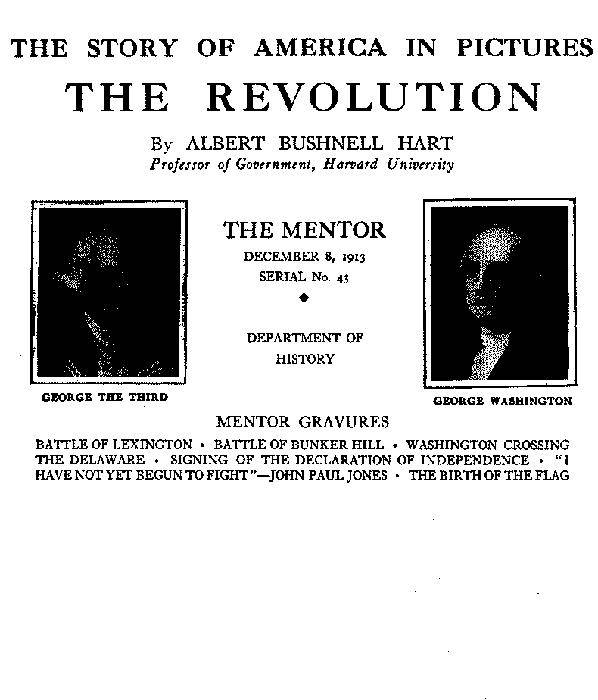
GEORGE THE THIRD
GEORGE WASHINGTON
THE MENTOR
DECEMBER 8, 1913
SERIAL No. 43
DEPARTMENT OF HISTORY
MENTOR GRAVURES
BATTLE OF LEXINGTON · BATTLE OF BUNKER HILL · WASHINGTON CROSSING THE DELAWARE · SIGNING OF THE DECLARATION OF INDEPENDENCE · “I HAVE NOT YET BEGUN TO FIGHT”—JOHN PAUL JONES · THE BIRTH OF THE FLAG
Words wear out after using them a thousand or a million times. “Liberty,” “The Constitution,” “The People’s Government,”—people take those terms into their minds nowadays as they take a chocolate cream, without stopping to think of its contents. So with “Revolution.” When we hear the word we feel a pleased sensation of a good, great, glorious time, intended by Providence to prepare the way for our various patriotic organizations. The Revolution? Why, yes, that was when our forefathers tied the first hard knot in the British lion’s tail! All the people were patriots, and all the patriots were as wise as college professors, and as brave as Albanians, and as great as a president. All the statesmen wore silk stockings and red velvet suits and powdered wigs. All the ladies were lovely, and spurned the offers of marriage made by British generals.
THE MILITARY REVOLUTION
GENERAL NATHANAEL GREENE
His courageous work in the South greatly helped the American cause. (From painting in possession of the Historical Society of Pennsylvania.)
What is a revolution but an overturning, a spinning of the wheel, left to right, and bottom come uppermost? Likewise, since the right believes itself right, and the top is sure that the world exists in order that it may be the top, most revolutions mean force, arms, big guns booming, troops marching, bullets flying, heads cut off with axes or caught in a hangman’s noose; also arms and legs cut off, and the ground soaked with a crimson fluid. “You can’t make an omelet without breaking some eggs,” and in a revolution there is bound to be breakage of heads and hearts, and banks and constitutions.
We know that the American Revolution was a military contest, because the pictures in our first textbook of American history show General George Washington, in buff and blue, leading his Continentals up to within sixteen feet and eight inches of General Howe, in a magnificent red coat laced with gold, in vain trying to rally battalions of craven Hessians wearing highly inconvenient bearskin caps.
THE BUNKER HILL MONUMENT
Commanding officers of opposing armies are not really so intimate as that; but Americans are justified in immense pride over the military success of the Revolution. The simple fact was that three million people, of whom about a fourth were negro slaves, put up a fight against a mother country having four times their population. They began without a single professional officer, except the traitor Charles Lee; and with only a thousand or two men who had not seen military service except militia training day, and desultory frontier warfare with French and Indians. They had not one ship of war, not a factory of arms. Yet they attacked the great British empire,—though it was flanked right and left by the lion and the unicorn, trained by two centuries of European wars, thousands of troops under arms, officers successful in other fields,—and they sailed into the greatest naval power on the sea.
So far as power and prestige and experience decide wars in advance, the Revolution was due to be snuffed out at the end of 1776; Benjamin Franklin was destined to be hanged, George Washington to be immured for life in a gloomy dungeon, dressed in a ball and chain. Were not the English everywhere successful? They captured New York, they captured Newport, they captured Philadelphia, they captured Savannah; they were driven away from Charleston by the palmetto forts, but returned and captured Richmond. They beat the Americans at Long Island, at the Brandywine, at Germantown, at Camden. Their cruisers and privateers swept the seas, until Nathaniel Tracy of Newburyport lost ninety of his hundred and twenty vessels. They drove the little American navy from the seas.
Yet in the end they were beaten. It is easy now to criticize the strategy of Washington and Greene and the rest, and to show that by all the laws of war they laid themselves open to defeat. Nothing can alter the stubborn fact that the American militia at Bunker Hill for hours held off a British army and so damaged it that it never took the field again; then the Americans captured Burgoyne’s army at Saratoga in 1777, a humiliation seldom known in British annals. And this victory brought the French alliance, and the aid of Von Steuben the magnificent drill master, of d’Estaing and his fleet, of Rochambeau and his army. With that aid, the Americans beat the second army at Yorktown, and that ended the war. General Cornwallis had to surrender his sword to an officer whom a few months before the British had addressed as “George Washington, Esq., etc., etc.”
SURRENDER OF BURGOYNE AT SARATOGA
This picture, from a painting by Trumbull, the famous American artist, shows the surrender of the English general John Burgoyne to the Americans at Saratoga, New York, on October 17, 1777.
EXTRAORDINARY AMERICAN SUCCESS
In one way the Americans were too successful. Beginning with raw militia, ill-equipped, worse disciplined, the Americans made an army that beat the British. General Washington never ceased to implore Congress and the states to give him a better system for a real national army. Half the men and a fourth of the money expended would have done the job just as well, if the advice of Washington and other experts had been followed.
SURRENDER OF CORNWALLIS
The British general, Lord Cornwallis, surrendered to Washington at Yorktown, Virginia, on October 19, 1781. The victory virtually decided the Revolution in favor of the Americans.
On the sea also the Americans began a great career of naval success; or, rather, they repeated the methods of earlier wars by sending out a hornets’ nest of privateers, christened with such gallant and suggestive names as The Charming Peggy, The Fair Lady, The American Revenue, The Black Joke, The Fair America, The Scotch Irish, The Skunk, The Nimble Shilling, and The King Tamer. If they did not tame George III, they did tame the British merchant and his representatives in Parliament; for American privateers in the course of the war captured about seven hundred British merchantmen.
SURRENDER MONUMENT YORKTOWN, VIRGINIA
GENERAL LORD CORNWALLIS
And then there was the American navy; or rather John Paul Jones, for in him the navy was concentrated. It was a painful surprise to the British to have the royal frigate Serapis taken in 1779 by the Bonhomme (Bo-nom) Richard, a condemned merchant ship hastily fitted out in France. Jones is already a sort of mythical figure, partly because of Buell’s imaginary so-called biography; but he is the naval father of Hull and Porter, and the grandfather of Farragut and another Porter, and the great-grandfather of Sampson and Dewey.
THE CIVIL REVOLUTION
A revolutionary overturning came whenever the Union Jack was hauled down and the Stars and Stripes hauled up. But the revolutionary army was not the Revolution: it was like the line in a football match, desperately holding back the other line while the backs get into play. The real Revolution was an overturning of governments, and charters, and political power. The revolving wheel whirled the old colonies out of existence, and cunningly framed and polished new state governments. The Revolution turned the British empire down, and pushed the United States of America up. The Revolution rolled to the bottom of the wheel Governor Gage of Massachusetts, and Governor Tryon of North Carolina, and Governor Dunmore of Virginia; and up to the top revolved Patrick Henry, and Benjamin Franklin, and John Adams. The Revolution was like a religious conversion: it set the American people out of their old ways, and into a new upward path.
JOHN PAUL JONES
Commander of the first American navy. From the portrait by C. W. Peale.
BIRTHPLACE OF JOHN PAUL JONES
John Paul Jones, the “founder of the American navy,” was born in this cottage at Kirkbean, in Scotland, in 1747. He died in Paris in 1792.
All that seems natural to us; for we have been brought up on the tyranny of George III, and the misgovernment and plunder of the colonies by the British government. We realize the bad state of things much better than did the Americans at the beginning of the Revolution. In truth the colonies were freer from harsh and arbitrary government than England, Scotland, and Wales, to say nothing of what was then the separate kingdom of Ireland. Every colony had its local assembly: not a single English county had one. In every colony any freeman who had the necessary pluck and health could acquire land and become a voter: in England not a twentieth part of the adult men could vote. The colonists laid their own taxes and expended them for their own purposes: Englishmen paid taxes levied by a Parliament over which only a few of them had control.
Apparently the main cause of the Revolution was that the colonists could do so much for themselves that there was no reason why they should not do substantially everything for themselves. They had a personal attachment for England, the king, and the English system of government, very like that now felt by the Canadians, and would have been quite satisfied with the degree of self government that England has since freely given to Canada. John Adams says, “That there existed a general desire of independence of the Crown in any part of America before the Revolution, is as far from the truth as the zenith is from the nadir.”
OLD BELFRY, LEXINGTON MASSACHUSETTS
From this belfry was rung out the alarm on the morning of April 19, 1775, calling the minute men to assemble on the common.
PAUL REVERE’S HOME IN BOSTON
The tablet that may be seen between the second and third stories of the house was placed there by the Paul Revere Chapter of the Daughters of the American Revolution.
PAUL REVERE
From the painting by the famous American artist, Gilbert Stuart.
Then why revolt, especially when above a third of the thinking people in America were opposed to the Revolution, and had to be driven out or silenced? To the original grievances of the Revolution was added a stupid John Bull obstinacy, concentrated in George III, but shared by a good part of the British nation. These mistakes made by England are a fine example of what comes to a country that falls into the hands of what are called the “Interests”; for Parliament was really nothing but a combine of great titled families, who took in some representatives of the cities and the merchant class. One of the best results of the Revolution was that it shook up the British aristocracy; and the best proof that the Revolution was right is the admission of Lord North, when the war was all over, that it had been a great mistake, but that the nation had made it, and not simply the prime minister.
The Revolution was worth all the blood and treasure that it cost, because it lighted a new torch of popular government. There had been plenty of government of the people in ancient and medieval times; but at the epoch of the American Revolution the formerly democratic Swiss and Dutch, and the free citizens of the German and French and Spanish cities, had lost faith in themselves. It was fashionable to revere Demosthenes and Cato and Brutus and the Populus Romanus; but real republican government had about ceased on the earth when the new constellation of the United States appeared on the horizon.
The colonies had very tidy little governments, schools of politics, in which the speaker of the assembly was commonly the leader of a healthy opposition to the governor; and on that foundation they built tidy little state governments, which showed the prevalent belief that governors were dangerous creatures who ought to have as little power as possible; while legislatures were a reflection of the people’s will which could not err. The wheel of revolution has twirled backward in our day; for we make governors and presidents great political leaders, and set our legislators on a one-legged race against the initiative and referendum. In the midst of the confusion of the Revolution, when town after town was picked up by the British, and nobody knew whether the Revolution would win out, it is wonderful how well the state governments worked, and how successful they were in putting on record the great principle of the two kinds of law,—fundamental or constitutional law, and statute law.
PATRICK HENRY ADDRESSING THE VIRGINIA ASSEMBLY IN 1765.
He is famous for his speech supporting the resolutions to resist the Stamp Act. At one point he exclaimed, “Caesar had his Brutus, Charles the First his Cromwell, and George the Third”—“Treason! treason!” shouted the Speaker of the Assembly, “Treason! treason!” shouted the members—“and,” Henry continued, “George the Third may profit by their example. If this be treason, make the most of it!”
THE CHAIR AND TABLE USED AT THE SIGNING OF THE DECLARATION OF INDEPENDENCE
The finest work of the Revolution was the making of a national government; for which the army and the navy were in part responsible, because a central national power was all that could save the army from capture and the navy from destruction. The Continental Congress became a government before it knew it, authorizing an army and navy, borrowing money, issuing many times more paper notes than it could ever redeem, appointing George Washington commander in chief of the Continental forces, sending ambassadors to foreign countries.
Were men greater on the average then than now? Would Speaker Clark and Senator Lodge of Massachusetts, and Senator Beveridge bulk as big as Patrick Henry and Sam Adams and John Dickinson, if revolution broke out now? “These are the times that try men’s souls,” said Tom Paine, and it was also a time that made men’s souls! The one indispensable man in the Revolution was George Washington; for there was no other in the colonies who was so central, so immovable, a force. But the Revolution would also have failed but for Benjamin Franklin, and Thomas Jefferson, and the other civilians who built up the new government.
BENJAMIN FRANKLIN
THOMAS JEFFERSON
THE DECLARATION OF INDEPENDENCE
THE SIGNING OF THE DECLARATION OF INDEPENDENCE
From the painting by John Trumbull.
OLD STATE HOUSE IN BOSTON
A crowd listening to the reading of the Declaration of Independence.
And they framed the Declaration of Independence! They framed it; but Thomas Jefferson wrote it. He was bent on proving that the Revolution was right. And, having taken an unpaid brief for his country, he found twenty-seven good reasons for independence, even at the cost of a bloody revolution. Those reasons are not the Declaration: the real pith of that splendidly written document is the brief statement of “self evident truths”; among them “that all men are created equal, that they are endowed by their Creator with certain unalienable Rights, that among these are Life, Liberty and the pursuit of Happiness, that to secure these rights, Governments are instituted among Men, deriving their just powers from the consent of the governed.” Some of the states made much longer and fuller statements of the same kind; but this is the bedrock of popular government in America. Time cannot tarnish, use cannot diminish, age cannot weaken, this splendid thought that God Almighty sends His children into the world with equal political rights; that every human being has an interest in that mutual understanding with other human beings called society and government.
SAMUEL ADAMS
From the painting by the early American artist, J. S. Copley.
SOCIAL AND COMMERCIAL REVOLUTION
When Rip Van Winkle came back home he found a new set of neighbors who scoffed at good King George. The Americans lived in a changed world. In the South most of the political leaders who were not Englishmen took the patriots’ side,—the Randolphs, and the Peytons, and the Carrolls, and the Rutledges, and the Pinckneys, and the Haynes,—and when the war was over the wheel had revolved under them, but left them still at the top. In the North there was a greater change,—Sam Adams, the untitled leader of the Boston town meeting, became leader of Massachusetts; John Hancock, the merchant accused of smuggling, was governor; John Adams, the struggling lawyer, was minister to England. Where were the rich and fashionable people who lived in the fine colonial mansions and drank too much Madeira? Hundreds of them gone, exiled, driven forth, farming in the eastern townships of Canada, waiting in the antechambers of the great in London.
PARSON CLARK’S HOUSE, LEXINGTON
Here Samuel Adams and John Hancock were sleeping when aroused by Paul Revere on his famous ride on April 19, 1775.
JOHN HANCOCK’S HOUSE IN BOSTON
Interesting not only in its historic associations, but as an attractive example of colonial architecture.
EFFECTS OF THE WAR
That was a revolution that reached the wives and daughters, and the handsome sons who inherited their fathers’ silken suits and had expected to inherit their dignities. It took the Americans thirty years to find out how great a revolution they had undergone in business; for when the war was over they had an unpatriotic hankering for the broadcloths and kerseymeres of old England. For their women folk, dealers still bought calimancos, and paduasoys, and oznabrig linens, and India muslins, through reliable English houses. Again Great Britain made the mistake of undervaluing the Americans; and when they became independent told them to be independent—and suffer for it. Now that the United States of America was a separate nation, let it keep its vessels out of the trade with the former sister colonies! It took long years to open up other avenues of trade.
REVOLUTION IN THE WEST
Within the military and civic Revolution arose another territorial revolution. When in 1778 George Rogers Clark with his few score frontiersmen slipped down the Ohio River and picked up the little British towns of Kaskaskia, Cahokia, and Vincennes, he was blazing the trail into the West, and opening that vast country to millions of Americans still to be born or adopted, till they would in the end rule the republic. Because of Rogers Clark, or rather of the westward vision of the great men of that time, Great Britain gave up the Northwest, and then yielded the Southwest. With all its boldness and courage, the Revolution did not make a complete nation: to become a world power, it was necessary to cross the mountains and bind the Mississippi to the sea. And the man of that time, who was at the same time eastern and western, who fought the French and took up lands and planned roads and canals beyond the mountains, was George Washington, the greatest soldier, best statesman, and most clear-sighted business man of the Revolution.
GEORGE ROGERS CLARK
An American general who in 1778 captured Vincennes from the British. It was soon recaptured; but Clark took it again after a terrible march across country in midwinter. He then conquered all the country near the Wabash and Illinois rivers.
MERIWETHER LEWIS
Companion of William Clark in his western explorations.
SUPPLEMENTARY READING.—“American Revolution,” Claude H. Van Tyne; “American Revolution,” John Fiske; “American Revolution” (3 vols.), George Otto Trevelyan; “Struggle for American Independence” (2 vols.), S. G. Fisher; “George Washington” (5 vols.), John Marshall; “American Statesmen” series (16 vols.); “Literary History of the American Revolution” (2 vols.), Moses Coit Tyler; “Paul Jones,” Norman Hapgood; “Letters and Memoirs,” Madame Rediesel; “The Spy,” James Fenimore Cooper; “Hugh Wynne,” S. Weir Mitchell; “The Partisan,” William Gilmore Simms; “Alice of Old Vincennes,” James Maurice Thompson.
THE MENTOR
ISSUED SEMI-MONTHLY BY
The Mentor Association, Inc.
381 Fourth Ave., New York, N. Y.
Volume 1 Number 43
ANNUAL SUBSCRIPTION, FOUR DOLLARS. SINGLE COPIES TWENTY CENTS, FOREIGN POSTAGE, 75 CENTS EXTRA. CANADIAN POSTAGE, 50 CENTS EXTRA. ENTERED AT THE POST OFFICE AT NEW YORK, N. Y., AS SECOND-CLASS MATTER. COPYRIGHT, 1913, BY THE MENTOR ASSOCIATION, INC., PRESIDENT AND TREASURER, R. M. DONALDSON; VICE-PRESIDENT, W. M. SANFORD; SECRETARY, L. D. GARDNER.
Editorial
In the early part of the nineteenth century the United States Government realized the importance of having a record on canvas of the nation’s great historical events, and several painters of that day produced pictures that hold places of honor in our Government buildings. John Trumbull was the foremost of these painters.
There has been a demand for several years for new historic paintings. The feeling exists that the painters of one hundred years ago could not have the perspective to portray the Revolution correctly, no more than a historian of the same period could write its history. The time has come for modern artists in American historic art. The World’s Fair at Chicago gave an impetus to the work, especially in decorative form. As a result, public buildings erected within the past twenty years show many interesting and distinguished examples of historic art in mural decorations, by such artists as Blashfield, Kenyon Cox, C. Y. Turner, and others. There is a demand now from many sources—from galleries, Federal and state governments, and from schools—for historical pictures which shall be true and shall also be worthy examples of modern work.
This number of The Mentor contains four distinguished examples of modern historical art. Three of them are the work of Mr. Henry Mosler, and were painted within the past five years.
Mr. Mosler has been known as an artist of great distinction for a long time. As early as 1874 he won a medal at the Royal Academy of Munich, and he won the Thomas B. Clarke prize in the National Academy of Design, New York, in 1896. Mr. Mosler, therefore, brought the ripe powers of a master painter to the work, and he has produced four paintings of great art value and historic importance.
The first picture, which appeared four years ago, is entitled “Ring, Ring, for Liberty,” and represents, with great strength and vigor, the old bell ringer in the cupola of Independence Hall, who sounded the note of liberty in July, 1776. Three years ago Mr. Mosler finished his painting of Betsy Ross and her companions making the first flag, which is reproduced in this number of The Mentor. Mr. Mosler based his work on careful sketches made in the Betsy Ross house on Arch Street, Philadelphia. Our readers will surely feel the grace and charm as well as the vital interest of this picture.
Many have said that our country needed a new painting of “Washington Crossing the Delaware.” The familiar composition, by Leutze, is regarded as stiff and constrained and as lacking a sense of reality. Mr. Mosler’s picture gives a true and spirited conception of the event, based on historical study and on sketches made in the winter time at the point of the Delaware where Washington crossed. The painting of Paul Jones is a vivid dramatic presentment of a historical subject that has never heretofore been pictured in an adequate manner.
Another interesting picture in this group is the “Signing of the Declaration of Independence,” by Miss Sarah Ball Dodson. The actual life and spirit of the scenes in Independence Hall during July, 1776, have not been fully realized by other artists. Miss Dodson’s picture is a striking presentment of the scene, distinguished not only for its art value but for its truth. Each figure is an actual portrait and takes an earnest, living part in the composition. Miss Dodson was a native of Philadelphia, and knew her subject at first hand. Her death some years ago was a distinct loss to American art.
BATTLE OF LEXINGTON