
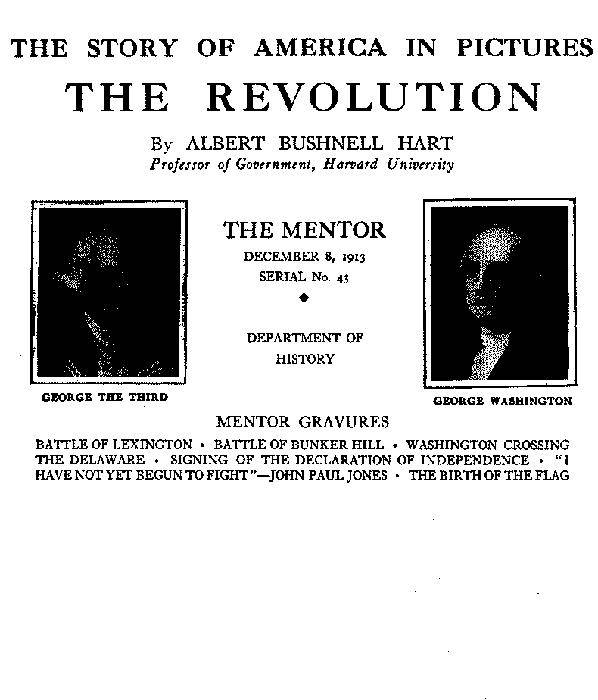
THE REVOLUTION
The Declaration of Independence
FOUR
The Declaration of Independence was a big step for the thirteen brave little colonies to make. Until then they had only been fighting for their rights as colonies of England,—“No taxation without representation.” But after the Declaration of Independence they were battling as a separate country, and if conquered would have had to suffer the fate of rebels and traitors. Congress knew that if America declared itself free from England the aid of France might be hoped for, and this help might decide the whole outcome of the struggle. Besides they had come to a point where they could no longer fight as colonies, but must unite as a separate and independent country.
So on June 7, 1776, a committee was appointed to draw up a Declaration of Independence, which should be prefaced by a clear explanation of the causes that made the colonies adopt it. This committee consisted of Thomas Jefferson, John Adams, Benjamin Franklin, Roger Sherman, and Robert R. Livingston.
After a long discussion the committee decided to have Jefferson make out a copy of the Declaration. His draft was amended slightly, and then reported to Congress as a whole. Here the debate was very warm. Some of the representatives did not want to vote for independence at all. They considered it a too violent move. But at that time the voting was done by colonies, and it soon appeared that the Declaration, much amended, would finally be passed by most of them.
At last, on the Fourth of July, 1776, the Declaration was put up to be voted upon. Pennsylvania voted for independence, a majority of her representatives being favorable, and other colonies soon followed. Delaware had three delegates; but one of them, Caesar Rodney, was absent, over eighty miles from Philadelphia. McKean, one of the two others, burning with a desire to have the vote of his colony recorded in the affirmative, sent a man on a fast horse to bring him back. Ten minutes after receiving McKean’s message Rodney was in the saddle, and, riding all night, he reached Independence Hall in Philadelphia on July 4, just in time to secure the vote of Delaware in favor of independence.
Although it was on July 4, 1776, that the Declaration of Independence was adopted by Congress, it was not signed by all the delegates present at that time; but they all signed before the end of the year.
PREPARED BY THE EDITORIAL STAFF OF THE MENTOR ASSOCIATION
ILLUSTRATION FOR THE MENTOR. VOL. 1, No. 43. SERIAL No. 43
COPYRIGHT, 1913, BY THE MENTOR ASSOCIATION, INC.
© The Knapp Co., Inc.
“I HAVE NOT YET BEGUN TO FIGHT”—JOHN PAUL JONES
PAINTING BY HENRY MOSLER