
The Project Gutenberg eBook of The Mentor: The Wife in Art, Vol. 1, Num. 28, Serial No. 28
Title: The Mentor: The Wife in Art, Vol. 1, Num. 28, Serial No. 28
Author: Gustav Kobbé
Release date: September 6, 2015 [eBook #49892]
Most recently updated: October 24, 2024
Language: English
Credits: Produced by Juliet Sutherland and the Online Distributed
Proofreading Team at http://www.pgdp.net
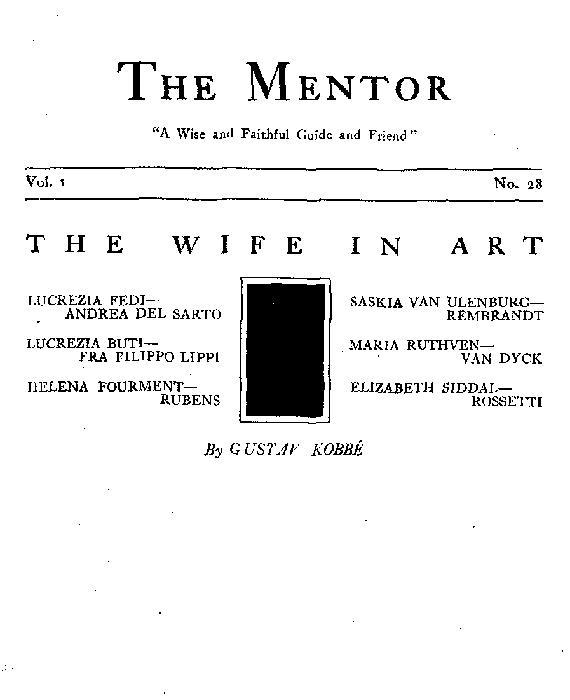
The Mentor, No. 28, The Wife in Art
The Mentor
“A wise and Faithful Guide and Friend”
Vol. 1 No. 28
THE WIFE IN ART
LUCREZIA FEDI—
ANDREA DEL SARTO
LUCREZIA BUTI—
FRA FILIPPO LIPPI
HELENA FOURMENT—
RUBENS
SASKIA VAN ULENBURG—
REMBRANDT
MARIA RUTHVEN—
VAN DYCK
ELIZABETH SIDDAL—
ROSSETTI
By GUSTAV KOBBÉ
It may be that he who rides alone rides fastest; and that the man encumbered with wife and family feels his pace slacken and the goal as far away as ever. Andrea (ahn´-dree-ah) del Sarto, in the closing lines of Browning’s poem, utters the same thought. He is addressing his wife, Lucrezia Fedi, whose extravagant and wayward tastes, many think, ruined his career and prevented his ranking with Leonardo (lay-o-nar´-do), Raphael (rah´-fay-ell), and Angelo (ahn´-jel-o):
LUCREZIA FEDI, BY DEL SARTO
In the Royal Gallery, Berlin.
And so, in that supreme painting contest with his three rivals, he still is distanced, “because there’s still Lucrezia” (loo-crate´-see-ah). But note that he adds, “as I choose.” He had rather fail with her than triumph without her.
Indeed, my point in mentioning Andrea and Lucrezia is to assert that he rode faster for not riding alone; that he was not the equal of the three artists he aspired to rival; and that, if it is sometimes thought he might have rivaled them, this is due to the works he painted under the inspiration of his love for Lucrezia. She kept him in a constant state of impecuniosity and jealousy; but it was “as I choose.” And well it might have been! His art seems to rise to a higher plane from the moment her dark, imperious beauty—a new note in religious painting—looks out at us from works like the “Madonna of the Harpies” and the youthful Saint John. For from her face he painted the faces not only of women, but also of boys and youths, and always it is her beauty that dominates the picture.
ANDREA DEL SARTO, BY HIMSELF
In the Pitti Gallery, Florence.
INFLUENCE OF THE WIFE
If she, in character the worst kind of wife a man can have, so inspired her husband, how rare and exquisite must have been the influence of Lucrezia Buti (boo´tee) over Fra Filippo Lippi (lip´pee), of Helena Fourment (hel-en-ah fur´-ment) over Rubens (roo-benz), of Maria Ruthven over Van Dyck, of Saskia over Rembrandt, of Elizabeth Siddal over Rossetti! For these women were devoted to their artist-husbands, and were in turn adored by them. Doubtful, indeed, if any of these men would have subscribed to the doctrine that he rides fastest who rides alone.
Lucrezia Buti, who was the wife of Fra Filippo Lippi, must not be confused with the Lucrezia Fedi (fay´-dee) whom Andrea married. Moreover, the circumstances under which Fra Filippo wooed and won his Lucrezia were far more romantic. He was a man whose great talent manifested itself early in life, and, although he had been put in a monastery because his relatives were too poor to educate him, his evident genius for art earned him many liberties. In fact, he was decidedly gay, and the hero of numerous escapades, the most famous of which has been immortalized by Browning, who found in the two Italian artists, Andrea and Lippo, subjects for two of his finest poems.
DETAIL OF THE VIRGIN AND CHILD BY FRA FILIPPO LIPPI
Lucrezia Buti was the model for the Virgin.
FRA FILIPPO LIPPI
The adventure of which Browning writes occurred upon the triumphant return to Florence of Cosimo de’ Medici (med´-e-chee) and his patronage of Fra Filippo. Cosimo, frequently annoyed by the friar’s loose habits, and despairing of his ever finishing an important picture that he had commissioned him to paint, caused him to be locked up in a room of the Medici Palace. Fra Filippo stood this for a few days. Then one night, wearying of his confinement, he escaped. The friar’s own pleading in Browning’s poem tells the story:
Notwithstanding his conduct, so out of keeping with his cloth, he was appointed chaplain to the nuns of the convent of Santa Margherita (mahr´-gare-ee-tah) in Prato (prah´-to) and commissioned by the abbess to paint a picture of the Madonna for the altar of the convent church. It chanced that there was in the nunnery a novice to whom convent life was just as ill suited as monastic life would have been to Fra Filippo had he been obliged to abide by its tenets.
FILIPPO AND LUCREZIA BUTI
The name of the novice was Lucrezia Buti, and, struck by the grace and beauty of this young woman, the artist begged that she might be allowed to pose for him for the picture, and the request was granted. It may indeed have been diplomacy on the part of the abbess; for it is not unlikely that Lucrezia, who had no vocation whatsoever for conventual life, had proved herself refractory, and that the convent authorities saw a chance of getting rid of her, which they could not do by returning her to her family, because she had been consigned to them against her will by a stepbrother, anxious to get rid of her care and expense. In any event, the friar Lippi fell in love with her and she with him. Profiting by the crowd and confusion attendant on the festival of the Madonna of the Girdle, which is celebrated in Prato on the first of May, Fra Filippo carried off Lucrezia, appealed to his patron, Cosimo de’ Medici, and through the latter’s intercession received from the Pope, Pius II., a special brief, absolving both himself and the novice from their ecclesiastical vows and granting them dispensation to marry. He and Lucrezia had two children; their son, Filippino Lippi, more than rivaling his father’s fame as a painter. The Madonna that Fra Filippo painted for the convent may still be seen in Prato, and there are other pictures in which Lucrezia’s lovely face is discernible.
THE TWO WIVES OF RUBENS
PETER PAUL RUBENS, BY HIMSELF
In Windsor Castle, England.
HELENA FOURMENT, BY RUBENS
Rubens was so happy with his first wife, Isabella Brandt, who died after eighteen years of blissful married life with him, that he could not endure the loneliness of being a widower, but four years after Isabella’s death took as his second wife Helena Fourment. This marriage proved to be as happy as the first; although he was already fifty-three and she barely sixteen. Their union was blessed with five handsome children; so that his declining years found him surrounded by youth and beauty, and with a splendid young wife as comrade.
HELENA FOURMENT, BY RUBENS
A portrait of the artist’s second wife and two of their children, hanging in the Louvre, Paris.
During the eighteen years of his first marriage Isabella appeared in nearly all his large pictures. She was of a more refined type than Helena; so that, with his second marriage, when he began to introduce his second wife into his pictures, his style becomes broader and more vigorous. For Helena had a strong, fully developed figure of pronounced contour, rosy flesh tints, golden hair, and lips that seemed always partly open to show the flash of pure white teeth. These were her attractions. She was obviously more beautiful, more brilliant, than Isabella, although in her youth her development was somewhat too luxuriant,—a picture of healthy, bursting, buoyant young womanhood. Indeed, so proud does Rubens seem of having, at his age, won a woman of her pronounced and youthful charms, that in some of his pictures he expresses them too freely, as, for example, in the Helena in a fur pelisse in the Imperial Gallery, Vienna. That Rubens drew a vast amount of inspiration from his two wives, Isabella and Helena, is obvious to anyone familiar with his work; for they appear in picture after picture from his brush. His married life, first with Isabella and then with Helena, was a constant stimulus to his best work.
REMBRANDT AND SASKIA
SASKIA, BY REMBRANDT
Rembrandt, too, was married twice, and although his first wife was refined and aristocratic and his second far from it, having been a servant in his household, he was intensely happy with both and painted them many times. Saskia van Ulenburg, although not strictly speaking a beauty from the casual point of view, lent herself admirably, nevertheless, to pictorial treatment, especially that pictorial treatment of lights and deep shadows of which her husband was the greatest master that ever lived. Indeed, the pictures in which she appears are almost too numerous to mention. There is the delightful portrait of her in the gallery at Cassel, said to have been painted in her own home in 1633, the year before she and Rembrandt were married. Her face in profile, the features delicately delineated, is shown against a background of deep, rich colors. With the lightest touch her wavy chestnut hair lies upon her cheek and forehead. A spray of rosemary in her hand rests across her heart. This, the emblem of a Dutch maiden’s betrothal, tells its own story.
REMBRANDT, BY HIMSELF
In the Royal Gallery, Berlin.
Probably, however, the most famous portrait ever painted of an artist and his wife is that by Rembrandt in the Dresden Gallery, of Saskia seated on his knees while he clasps her waist with his left hand and raises in his right a half-filled glass. The joy on their faces gives witness to the pride and pleasure they found in each other. Saskia was a wealthy woman, and while she lived want never entered Rembrandt’s house. But, alas! she was delicate, and died in 1642, less than a year after giving birth to the son who was christened Titus. Rembrandt had spent much money in filling his house with objects of art,—prints, rich stuffs for costumes, and other things—and not long after Saskia’s death he found himself impoverished. Some idea of the richness of his collections is obtained from the adornments with which Saskia appears in the picture known as the “Jewish Bride,” and in the genre portrait, “Minerve,” in which she is shown as a learned lady in the richest of costumes, seated at a beautiful table and reading from an ancient tome.
Rembrandt ranks with the greatest masters in art. “He rides fastest who rides alone.” Is it possible that Rembrandt could have ridden faster or reached a farther goal without Saskia and Hendrikje?
REMBRANDT AND SASKIA, BY REMBRANDT
In the Royal Gallery, Dresden.
VAN DYCK’S PORTRAIT OF MARIA RUTHVEN
VAN DYCK, BY HIMSELF
This portrait, which hangs in the Hermitage, St. Petersburg, shows the artist as a young man.
VAN DYCK, BY HIMSELF
Van Dyck, the favorite pupil of Rubens,—so much so that when some romping pupils in Rubens’ absence brushed against a partly finished picture and marred it he was asked to retouch it in order that the master might not notice the defect,—also was a favorite in the world of women, and much influenced by them. Even in youth a love adventure is said to have sent him from Rubens’ atelier to Italy. In England, where no one is more closely identified than he with the period of Charles I., “die schönen ladies,” as a German writer on Van Dyck expresses it, fairly fought for the honor of being painted by him.
If his works lack the vital vigor and joyous abandon of the typical Flemish masters, it must be remembered that his Italian sojourn, passed largely in court circles, greatly refined his style, and that he, the painter of aristocrats, is also an aristocrat among painters. His output for his short life (1599-1641) was great, and of the 1,500 works catalogued as his 300 are portraits of women. Walpole speaks of their beautiful hands. But Van Dyck had special models for the hands, for those of both the men and the women. The elegance and refinement of his work is, however, undoubted, and, though he lacks the power of a Rembrandt and the tremendous verve of a Rubens, much of his work (within the limitations imposed by elegance) is executed in the “large” manner.
It is said that his ability to accomplish so much was due to the fact that he never allowed a sitter to weary him, obviating this by dismissing them at the end of an hour. At the time appointed for the sitting the artist appeared in his studio. At the end of the hour he rose, made his obeisance, and appointed the hour for the next sitting. A servant cleaned the brushes and reloaded the palette, while the artist received and entertained the next sitter. He had many love affairs in England, and especially one with Margaret Lemon, who threatened, when his love began to cool, to cut off his hand. The world is the richer by a beautiful portrait for this love affair, and fortunately, instead of cutting off his hand or even attempting to, Margaret went to Holland with friends. Van Dyck’s gay life, however, seriously alarmed the king, who, being genuinely attached to him and also admiring his art, feared for his health. Accordingly, his Majesty chose for him a wife, a beautiful young woman, Maria Ruthven, daughter of Lord Ruthven. Van Dyck painted her several times, and one of his best known portraits is that of her with her violoncello, which is in the old Pinakothek (pin´-a-ko-thek), Munich. His married life seems to have been happy, though brief. He died within two years of his nuptials, leaving us the portraits of Maria as souvenirs of his happiness.
MARIA RUTHVEN, BY VAN DYCK
ROSSETTI’S “BLESSED DAMOZEL”
ROSSETTI, BY HIMSELF
Painted in 1855.
Dante Gabriel Rossetti, who was poet as well as painter, buried the manuscript of his poems, although they had been announced for publication, in the coffin of his wife, who died in February, 1862. Not until October, 1869, was the manuscript resurrected and the publication of his poems made possible. It is doubtful if poet or painter has ever paid a greater tribute than Rossetti thus paid to Elizabeth Siddal.
ROSA TRIPLEX, BY ROSSETTI
Rossetti was introduced to Elizabeth by a brother artist, who had discovered her in a milliner’s shop in London. She consented to pose for Rossetti. His brother, in some charming reminiscences of her, writes that to fall in love with Elizabeth Siddal was a very easy performance, and that Dante Gabriel did it at an early date. The name Elizabeth, however, was never on Dante’s lips; but rather Lizzie or Liz, and fully as often Guggums, Guggum, or Gug. Mrs. Hueffer, the younger daughter of Ford Madox-Brown, says that when she was a small child she saw Rossetti at his easel in her father’s house uttering momentarily, in the absence of the beloved one, “Guggum, Guggum!” After awhile “Guggum” became a settled institution in Rossetti’s studio, and other people, his brother included, understood they were not wanted there. Dante was constantly drawing from Guggum, and she designing under his tuition. He was unconventional, and she, if not so originally, became so in the course of her companionship with him. In her appearance, as in her character, she was a remarkable young woman.
THE BEAUTY OF ELIZABETH SIDDAL
ELIZABETH SIDDAL, BY ROSSETTI
The artist’s brother writes of her that she was truly a beautiful girl,—tall, with a stately throat and fine carriage, pink and white complexion, and massive, straight, coppery golden hair. Her heavy-lidded eyes were large and greenish blue. But, as this narrator says, it is not necessary to speak much about her appearance, “as the designs of Dante Rossetti speak for it better than I could do.” Her whole manner, in spite of her great beauty, was reserved, self-controlling, and “alien from approach.” Rossetti’s brother says that her talk was, in his experience, scanty; slight and scattered, with some amusing turns, and little to seize hold upon; little clue to her real self, or anything determinate.
But, alas! the beautiful Elizabeth was a sufferer from consumption, accompanied by neuralgia. For the neuralgia frequent doses of laudanum had been prescribed. Her condition was such toward the end that sometimes she was obliged to take one hundred drops at a time. On February 10, 1866, she dined at a hotel in London with her husband and Swinburne. She and Rossetti returned to their home about eight o’clock. She was about to go to bed at nine, when Dante Gabriel went out again. When he came back at half-past eleven the room was in darkness. He called to his wife; but received no reply. He found her in bed, unconscious. On the table was a vial. It had contained laudanum—it was empty.
He paid her the tribute of burying his poems with her. He had already paid her the great tribute of painting her, and that often. Those large, greenish blue eyes of hers were his guiding stars. Let him who will say that he rides fastest who rides alone. There are six great artists—and many more—to say him nay.
BEATA BEATRIX, BY ROSSETTI
A portrait of Elizabeth Siddal.
SUPPLEMENTARY READING
| Fra Filippo Lippi | Edward C. Strutt |
| Rembrandt and His Work (8 vols.) | Wilhelm Bode |
| Rembrandt | R. Muther |
| The Rossettis | Elisabeth Luther Cary |
| L’Oeuvre de P. P. Rubens | Maximilian Rooses |
| Rubens (Masterpieces in Color Series) | S. L. Bensusan |
| Andrea del Sarto | H. Guinness |
| Sir Anthony Van Dyck | Lionel Cust |
QUESTIONS ANSWERED
Subscribers desiring further information concerning this subject can obtain it by writing to
The Mentor Association
381 Fourth Avenue, New York City
LUCREZIA FEDI, By Andrea del Sarto