
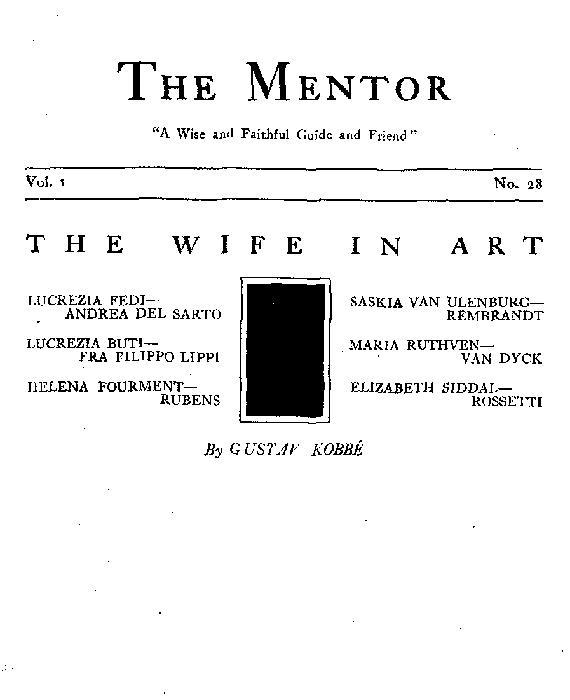
THE WIFE IN ART
Rossetti and Elizabeth Siddal
SIX
One day when Rossetti was painting in his studio, Deverell, a fellow artist, rushed in and exclaimed that he had found the ideal woman. She was working in a milliner’s shop, he said; but she was a wonderful girl of stately dignity, with blue-green eyes and coppery tinted hair. This girl was Elizabeth Siddal, and from that time on she was the model for Rossetti’s mystical dreams in color. She later became his wife.
Dante Gabriel Rossetti was born in England in 1828, the son of an Italian refugee. His parents lived simply, almost in poverty, but with refinement suited to the fostering of art and poetry in their children. The mother believed that one good picture on a plain wall was more beautiful than many worthless decorations. Rossetti used this simplicity in his paintings. He and a number of other artists formed the Preraphaelite Brotherhood. This was an organization that took a love of simplicity as its motto, and believed in using simplicity in everything.
Besides being an artist of great genius, Rossetti was a poet. He and his sister Christina were the leaders in the Preraphaelite movement in poetry. Before he was nineteen he wrote “The Blessed Damozel,” a poem that expressed his ideal in womanhood. Elizabeth Siddal proved to be his ideal woman. Ruskin spoke of her as a “noble, glorious creature.” Later the artist painted a picture to go with the poem, and his model was Elizabeth Siddal.
When Rossetti first asked her to pose for him the ideal beauty thought that he wanted her for fashion plates. She little thought that she was to be made the object of a great artist’s lifework.
Her death plunged Rossetti into lifelong misery, almost insanity. Up to the moment of his own death in 1882 he never ceased to grieve for her.
PREPARED BY THE EDITORIAL STAFF OF THE MENTOR ASSOCIATION
ILLUSTRATION FOR THE MENTOR, VOL. 1, NO. 28, SERIAL NO. 28