
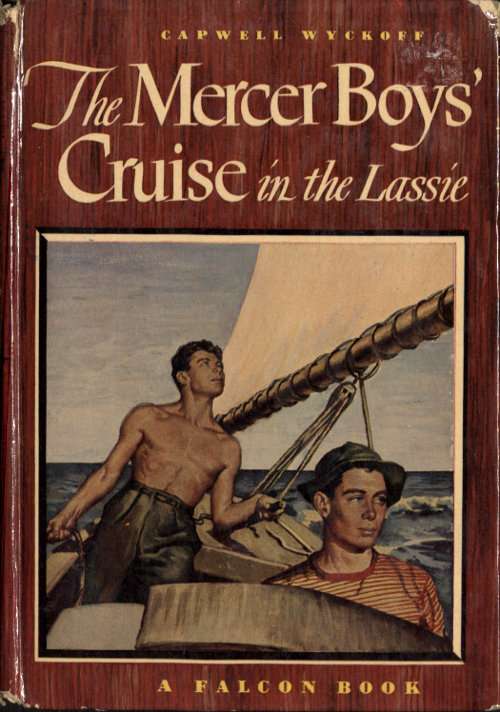
The Project Gutenberg eBook of The Mercer Boys' Cruise in the Lassie
Title: The Mercer Boys' Cruise in the Lassie
Author: Capwell Wyckoff
Release date: August 11, 2017 [eBook #55335]
Language: English
Credits: Produced by Stephen Hutcheson and the Online Distributed
Proofreading Team at http://www.pgdp.net
FALCON BOOKS
The Mercer Boys’ Cruise in the Lassie
BY CAPWELL WYCKOFF
When Don and Jim Mercer and their buddy Terry Mackson set out in their sloop, Lassie, for a visit to Mystery Island, they were in search of adventure and fun. But they quickly found they were getting more than they bargained for—real danger, a skirmish with marine bandits, and a fight for their lives. This is a thrilling adventure story of three modern boys—with action and excitement on every page.
Other titles in The Mercer Boys’ Series
- THE MERCER BOYS AT WOODCREST
- THE MERCER BOYS ON A TREASURE HUNT
- THE MERCER BOYS’ MYSTERY CASE
- THE MERCER BOYS WITH THE COAST GUARD
Don joined Jim at the porthole.
THE
Mercer Boys’ Cruise
IN THE LASSIE
By CAPWELL WYCKOFF
THE WORLD PUBLISHING COMPANY
CLEVELAND AND NEW YORK
Falcon Books
are published by THE WORLD PUBLISHING COMPANY
2231 West 110th Street · Cleveland 2 · Ohio
W 4
COPYRIGHT 1948 BY THE WORLD PUBLISHING COMPANY
MANUFACTURED IN THE UNITED STATES OF AMERICA
Contents
- 1. The Finishing Touches 9
- 2. The Marine Bandits 18
- 3. The Start of the Cruise 25
- 4. Stormy Weather 34
- 5. Mystery Island 45
- 6. The Inner Room 50
- 7. Jim Starts Out 57
- 8. The Old Captain 66
- 9. Alone on the Sloop 75
- 10. Blown Out to Sea 81
- 11. The Storage Room 89
- 12. The Beach Party 98
- 13. The Red Lamp 106
- 14. Terry’s Adventure 114
- 15. The River Barge 126
- 16. An Important Clue 136
- 17. Aboard the Wreck 147
- 18. The Ghost of the “Alaskan” 159
- 19. The Escape 168
- 20. The Voyage Resumed 179
- 21. The “Black Mummy” 185
- 22. The Secret of the Freighter 192
- 23. The Chandler’s Shop 200
- 24. The End of the Cruise 208
THE MERCER BOYS’ CRUISE IN THE LASSIE
1. The Finishing Touches
“Hooray! That finishes it!”
Don Mercer straightened up from the marine motor over which he had been bending and gave a whoop to express his feelings. At the same time a browned face, topped off by a wind-blown mass of brown hair, looked down at him from the companionway of their sloop, the Lassie.
“What’s up?” Jim Mercer grinned. “Are you getting old and talking to yourself, Don?”
His older brother returned the grin from the bottom of the tiny cabin of the sloop. “Not so you could notice it. But I’ve got the engine hooked up, and now we can start our summer cruise, as soon as I see if she works.” He mopped his forehead. “Boy, that was some job. Lucky thing I learned something about marine engines down at Stillwell last year.”
Jim slipped one foot over the edge of the companionway and dropped into the hold, joining his brother beside the engine. “It surely was. Every connection hooked up?”
“Everything. I thought there was a little leak in that exhaust pipe, the one we had brazed over at Tarrytown, but it’s all right. I had a little trouble hooking up the switch wires, because I had never seen just this type of motor before, but I got it at last. How does it look to you, kid?”
Jim bent down to look at the motor. The two Mercer boys were much alike in every way, and were devoted to each other. Their father owned a large lumber business in the Maine woods, and the boys had never wanted anything in their young lives, but as they were fine, healthy boys, their comparative wealth had never spoiled them. Don was the older of the two, being seventeen, and Jim was one year his junior. Both of them were well built physically, with fine gray eyes, sandy hair, an abundance of freckles, and good-humored grins. They had graduated from the Bridgewater High School the year before.
Besides the two boys there was one sister, Margy, aged fifteen, and their mother. They had grown up in Bridgewater and were well known and liked in the town. Mr. Mercer believed in keeping his boys interested in wholesome things, and during their early years they had had one or two cat-boats. On the first week of the summer, however, the boys were surprised and delighted to find a fine 30-foot sloop riding gently at anchor in the creek which ran through their own back yard. Their father, who had done considerable cruising in his younger days, taught them how to handle the larger-sized boat, and had given them permission to go for a cruise down the Maine coast that summer.
For the last week Don, who was mechanically inclined, had been hooking up the motor. He had always been interested in motors and had studied them carefully while spending a week at the house of an uncle. He had learned more than he had thought. The motor had been in the boat at the time Mr. Mercer purchased it, but the connections had not been fitted. Late on this July afternoon Don had succeeded in finishing it.
Jim straightened up from his inspection of the motor. “Looks all right to me,” he declared. “Although I don’t know as much about them as you do. But before we crow, I guess we had better give it a spin and see if it works.”
“OK,” agreed Don. “Go up and push the starting lever over a couple of notches, while I spin the flywheel, will you?”
Jim skipped up the four steps that led to the deck, and bending down beside the tiller, grasped the lever. Don gave the flywheel a vigorous turn, and a slight chug answered him. He gave it a second spin, it coughed, chugged and began to turn over. Jim moved the lever a notch, slowly.
The engine broke into a regular, steady run, and a thin streak of smoke issued from the exhaust pipe above the water line. Don’s cheerful face appeared above the rim of the companionway.
“Jeepers, it works!” he exulted.
Jim nodded. “It sure does. Nice work, old man. Want to let it run?”
“Yes, let it go for awhile. It needs a little breaking in; I notice it’s stiff in spots.” He climbed up alongside his brother and wiped his moist brow. “Wow, that was quite a job while it lasted.”
“I’ll bet it was. Nothing to stop us from taking our cruise, now.”
“You are right there. But the question is: who are we going to take along with us? Dad wants us to take at least one other fellow. He thinks just the two of us won’t be enough. I’ve thought of most of the fellows round here, but either they have summer jobs or they are away. Who do you think we ought to take?”
“What time is it?” Jim asked, casually.
Don looked at his watch. “Half past three. What has that to do with who we’ll take on a cruise with us?”
“Maybe a whole lot!” Jim answered mysteriously. “Want to take a walk?”
“Where to?”
“Oh, nowhere in particular. Just up to where the highway touches the Lane.”
“Sure, I’ll go. I can’t see what you’re driving at, but I’ll go along.”
They stepped into the dock, walked the long stretch that made up their back yard, passed the house and walked out to the shady street on which their home stood, a street appropriately called the Lane. They walked slowly down it, making plans concerning provisioning the sloop for the cruise, which they expected to begin on the following day. About half a mile from the house the Lane ran into the State highway, and here Jim said he wanted to sit on a stone wall. So they sat down and continued to talk for a time.
Don finally became restless. “Let’s go to town and get some of the things we need,” he suggested. “No use sitting here all day.”
But Jim was not ready to go yet. He was looking down the road, to where a single car was coming toward them. It was a battered old rattletrap of a car, with sad-looking mudguards, no top, and doubtful looking tires on it. The wheels, which were the least bit crooked, made weird movements as it came toward them.
“Wait a minute,” Jim said. “I want to see who’s in this car.”
The driver of the car was a red-headed boy of seventeen, tanned by the sun and endowed with a multitude of freckles. Two laughing gray eyes peered from his long face. He looked Scotch. He was whistling as he drove the battered old car, and his sandy hair, decidedly red in the sun, stood up almost straight. There was no glass in the windshield of his car, and now and then he pretended to wipe the missing glass, greatly to the amusement of as many of the Bridgewater inhabitants as chanced to be on the road.
“Why do you want to see who the driver is?” Don began, impatiently. “You don’t——”
He broke off as Jim waved to the driver, and the driver waved back and brought his bounding car to a halt beside them. Don gasped.
“Why ‘Chucklehead’ Mackson!” he cried, while Jim grinned.
Terry Mackson, known as chucklehead, from his habit of bobbing his auburn head when laughing, ignored him completely. He carefully adjusted one soiled glove on his hand and asked Jim gravely: “Pardon me, old fellow, but could you by any chance direct me to the residence of the Mercers?”
“I think I could, if you give me time enough to think,” Jim grinned.
“Then please do so, without unnecessary loss of time,” Terry drawled. That was as far as he got. With a whoop the Mercer brothers piled into the car and thumped him on the back.
Terry Mackson had gone to grammar school with the boys, but had moved to a distant town, where he had worked hard on a farm for his old father. The boys had always admired him for his cheerful kindliness and respected him for his fine self-sacrificing nature. He had worked without complaint for a mean old father, who had even begrudged him his brief time in grammar school. Recently his father had died, and Terry had been living somewhat more happily with his mother and one sister.
When Terry was out of breath, and the old car had jounced dangerously, the boys stopped to catch their breath.
“How in the world did you get here?” Don asked.
“Jim wrote me to come down for a summer cruise,” Terry explained, as he started his car. “Didn’t you know it?”
“He didn’t know a thing about it,” Jim declared, sinking into the back seat. “We were looking for someone to take on our cruise with us, and I heard from Bill Bennet that you were living in Berrymore, so I didn’t say a thing to Don, but wrote to you. Thought I’d put one over on him.”
“And you certainly did that,” Don nodded. “But that’s OK. I’d rather it be Terry than anyone else.”
“Many thanks,” the newcomer murmured.
“How is everything at home?” Jim asked.
“Very well, thanks. We’re getting in nice shape. Mother said it was high time I had a vacation, when I read her your letter. Oh, I beg your pardon!”
“What’s the matter?” both boys asked.
“I’ve been guilty of a grave social error. I want you to meet my trusted chariot, my car. Boys, this is my intimate friend ‘Jumpiter.’”
To make it seem real, he drove the car over a bump, and the car bounced like a thing alive. Both boys acknowledged the introduction gravely.
“Happy to meet you, Jumpiter,” Don said.
“Me too,” Jim added. Terry made it rattle furiously, and vigorously wiped the imaginary windshield.
Mrs. Mercer made Terry feel right at home, and then the boys took him down to see the Lassie. To Terry it was quite a treat, for his life had been spent in working hard, far from any of the pleasures of life. He was delighted with the trim little ship, and the boys led him down the companionway.
Inside, there was plenty of room to move around without being cramped. There were four bunks built along the side of the hull, a tiny sink with running water, a refrigerator, a small stove and two compact closets for knives and forks and linen. Toward the bow it became narrow, and before the mast a small storage room took up the waste space. The engine was in the stern, under the steps that led down into the cabin. The center of the cabin was taken up with the centerboard, which the boys told Terry was an extra keel weighing two hundred and fifty pounds.
“That’s in addition to the regular keel,” Don explained. “There is about two tons of lead in the keel, but it isn’t enough when the canvas is spread. When we’re sailing under full sail, without reefs, we have to let the centerboard down. The 250 pounds makes just enough weight to balance the weight of the sails and keeps us from capsizing. When we come up the creek, or when we are using motor power, we don’t use the centerboard.”
The boys spent the rest of the afternoon running down to the village and getting supplies. Terry insisted on using his car for the work, so they bought food from the grocery stores and loaded several gallons of gasoline. With Terry’s car they were able to run right down to the sloop and carry the supplies aboard.
“There!” exclaimed Jim, finally. “We’re all set to go.”
The boys went up to supper, where Terry saw Mr. Mercer again. While they were eating they discussed plans and Mr. Mercer gave them a word of warning.
“There has been quite a little trouble lately with a gang of marine bandits,” the lumber man said. “They’ve been working up and down the coast, robbing boats and boathouses, and no one has been able to catch them. They steal all kinds of ship materials that they can lay their hands on. People think they store it all somewhere and then go down to Boston or other seaports where they sell it to dishonest ship chandlers. Nowadays a good many people are going in for sailing, and the ship chandlers have quite a business. I suppose people buy things where they can get them cheapest, and so there is quite a trade in it. I want you boys to keep your eyes wide open.”
“We certainly will,” Jim said. “You mean that they may try to take things off the Lassie?”
“Yes, you’ll have to be careful.”
“I’d like to run those fellows down,” Don declared.
After supper they went down to close up the sloop. The sails were tied down firmly and the portholes closed. After making an inspection Don pulled the top of the companionway closed, and snapped the lock.
“There,” he said, with satisfaction. “I don’t think anybody will get aboard the Lassie tonight. Nor any other night, if we can help it.”
2. The Marine Bandits
After they had locked up the sloop the boys took Terry around town, showing him the sights, and then they returned to the house, where they pored over a map of the Atlantic coast. Since they would naturally keep inshore in a boat as small as the sloop was, the boys paid particular attention to channel markings. Then, bidding the family good night, they left the house and went down the yard to the little shack that the boys always slept in.
A few years ago, during one of their summer vacations, the boys had built a small two-room house at the end of the yard, near the boathouse and the dock. There was plenty of room for all of them in the house, but they had thought that when they had company during the summer it would be a little more convenient for their mother if they had a small place of their own down in the yard; so their parents had allowed them to build the bungalow. Whenever company came they took them to the cottage and they slept there, going to the main house for their meals. The arrangement had been handy in many ways, and had taught the boys to be self-reliant, as they had to keep things clean and attend to their own beds and the daily airing of their blankets. Just outside their cottage they had built a workbench, with a tool shed at the end of it, and on clear days they worked out there, making small things for the house and their boats. Jim had made the stand for the ship’s clock and other small pieces.
It was to this cottage that they now took Terry, and he was delighted with the cozy little place. The boys had wired it for electric lights, and on a back porch, protected from intrusion by lattice work, they had installed a shower bath and a small sink. The front room of the cottage was taken up with a table, some chairs, lockers, and a few boxes, and the walls were covered with pictures of boats and the teams at school. It was a typical boy’s room. The back room was given over to sleeping, and three cots occupied most of the floor space. In the glow of a ship’s lantern, now made over into an electric lamp, the boys undressed and prepared for bed.
“I won’t be a bit sorry for these blankets,” Terry decided, as he crawled into his cot.
“No, it gets quite cold here at night, no matter how warm the days may be,” Don said, as he settled down on his cot.
They talked for a few minutes and then, saying good night, dropped off to sleep. That is, the two Mercer boys did. They were so used to the place that they wasted no time lying in bed thinking, and they were usually so active in the daytime that they dropped into a healthy sleep as soon as they went to bed. But everything was new to Terry, and he lay there thinking about it.
He had been used to a life of constant work, and the prospect of this vacation, spent with boys like the Mercer brothers, held a fascination to him. His mother had been right when she said that he needed a vacation, and as things at home were in much better circumstances than they ever had been before, Terry felt justified in going away. So he lay there, staring out of the window over his head, seeing the black outline of the boathouse, and beyond it the mast and rigging of the sloop, moving gently with the motion of the tide.
Finally, Terry dozed off, enjoying to the last the cool wind that brushed over his brown face, and the slight and refreshing tang of the salt air. How long he had been asleep he did not know, but suddenly he awoke. He sat up, leaning on one elbow and listened. The brothers were asleep, as he could tell from their deep and regular breathing, and the boy was at a loss to know what had awakened him. He listened keenly, thinking that some sound, usual to the place, but new to him, had awakened him, but as a few minutes went by and he heard nothing, he lay down again.
Then a sound reached his ears, a thin, screaming sound as though someone was pulling nails out of a board. Wondering what it could be, Terry looked in the direction from which the sound had come.
Terry’s eyes were good, and he could make out the boathouse perfectly even in the darkness. At first he could see nothing, but as he continued to watch, a shadow detached itself from the corner of the boathouse and went around the side. Terry tossed aside his blanket, stepped over to Don and shook him, at the same time placing his hand over the boy’s mouth. Don sat up quietly, pushing Terry’s hand away.
When Terry had whispered his message to Don they woke up Jim, and standing at the window, the three boys looked toward the boathouse. While looking they were hastily dressing, tossing on a few clothes and pulling on rubber boots.
“I don’t see anybody,” Don whispered.
“He went around the side,” Terry answered. “Is there a window there?”
“Yes, there is. Are you ready, Jim?”
“Sure thing. Let’s go.”
They cautiously opened the back door, crossed the yard, and arrived at the front of the boathouse, where they paused for a moment to listen. Inside, they could hear someone walking around.
“Somebody in there, all right,” nodded Jim. “Shall we rush ’em?”
“Yes. We’ll catch them in a trap. Come on, kids.”
With that Don stepped around the corner of the boathouse. There was a small stick lying on the ground, and the boy stepped on it, causing it to break with a loud, snapping sound. Realizing that caution was now useless Don called out:
“Who is there?”
From the shadows beside the boathouse a man stepped into view. He darted to the window of the boathouse and called out: “Beat it, Barney, the kids is coming!”
Don dashed forward, clutching at the man, who was tall and thin, but the man twisted savagely and got away. At the same time Terry and Jim ran to the window, but they were too late. A small man leaped nimbly over the sill and joined his companion in flight.
“After them!” shouted Don, as they heard the men thrashing their way through the tangled undergrowth. All three boys joined in the chase, following the men with ease by the sound of their headlong progress. The chase led them to the edge of their own creek, where the men jumped into a small boat and pushed away from the shore.
“The dinghy!” gasped Jim.
The Mercer boys turned and ran to where the sloop was anchored, and Terry followed them. Riding gently on the waters of the creek, attached to the Lassie by a rope, was a new dinghy. Into this rowboat the boys piled, Don and Jim seizing the oars.
“Cast off, Terry,” Don called.
Terry slipped the rope from the deck of the sloop and the brothers began to pull toward the other boat, which was drifting aimlessly along the creek. Both men seemed to be in the back of their boat, bending over something. Just as the boys got within hailing distance one of the men whirled his arm, there was a flash of a spark, and a small motor began to hum.
“I knew it!” Don groaned. “He’s got an outboard motor.”
One of the men seized the tiller and the other boat ran rapidly down the creek, leaving the rowboat with the boys in it far behind. Although they knew it was useless they followed, reaching the broad expanse of the ocean. But once in the open water they lost track entirely of the other boat and its occupants.
“It’s no use,” Jim declared. “We haven’t a chance to find them.”
“I’m sorry to say that you’re right,” Don agreed. “I don’t even hear the sound of their motor. More than likely they shut it off and rowed up some creek, to throw us off. Well, there is nothing to do but to go back, I guess.”
They turned the dinghy, which bobbed like a cork in the ocean waves, and headed back for the creek.
“Do you suppose they were the marine bandits your father mentioned at supper?” asked Terry.
“I wouldn’t wonder,” Don replied. “But we’ll see when we get back to the boathouse. I hope it all didn’t wake the family up.”
But it had. When they finally tied the dinghy up to the sloop they found Mr. Mercer standing at the dock, anxiously watching for them.
“Hello,” he hailed. “What’s going on down there?”
Don briefly related the events of the last few minutes and then led the way to the boathouse. Using a key, which he had in his pocket, Don led them into the boathouse.
It was a neat little building, with various grades of wood stacked along the walls, a work bench in one corner, and some extra canvas piled on racks. A small rowboat lay bottom up in the center of the floor. They examined the window, to find that several wooden bars had been pried out and the sash raised.
“Is there anything missing?” Mr. Mercer asked. “There doesn’t seem to be.”
But Jim shook his head sadly. “Sorry to say that there is, Dad. That swell ship’s clock that you bought me down in Boston is missing. It was over there on the bench, and I was making a new case for it. I guess those guys were the marine bandits, all right.”
3. The Start of the Cruise
As the clock which Jim had lost was a very valuable one, they wasted no time in reporting the circumstances to the police. Early in the morning the boys were up, and spent the time immediately after breakfast in loading last minute articles on the sloop. Don found that the lock on the companionway had been tampered with.
“Somebody tried to get in here,” he said, showing the others the lock, which was slightly twisted. “But I guess they found it too much of a job.”
After they had reported the entire matter to the chief of police, who promised to have the waterfront searched for the thieves, the boys ran down in Terry’s car to the local drugstore and bought a case of cokes. When they had loaded it on the boat, and final instructions had been half-jokingly given them by Mr. and Mrs. Mercer, the boys were prepared to go.
Don went below, bending over the engine, while Jim sat at the tiller, his fingers on the starting switch. Terry, feeling useless as a sailor, sat in the cockpit, watching the proceedings. Jim nodded to him.
“Cast off the painter, will you, Terry?”
Terry looked helplessly around. “When did a painter get aboard?” he asked.
Jim laughed. “The painter is that rope at the bow,” he explained. “Throw it to Dad.”
Terry took the painter and tossed it to Mr. Mercer, who caught it and placed it on the ground. Don turned the flywheel and the motor began to churn. Slowly, Jim advanced the spark, pushing the tiller from him. Like some graceful bird the Lassie turned in the creek, her nose pointing toward the ocean.
The boys waved goodbye to Mr. and Mrs. Mercer and Margy and the sloop headed out to the mouth of the creek. As it cleared the banks at the mouth of the channel it struck the small ocean waves, bounding and dipping like a thing alive. The little ship seemed glad to get out on its own element. The boys were fairly launched on their cruise.
“Well, we’re off,” exclaimed Don, coming up the ladder and stepping into the little cockpit.
“Off on a nice start,” Jim nodded, watching a buoy about half a mile ahead of him.
“This is swell,” Terry struck in, his eyes dancing.
The wind was blowing a lively little breeze, and the Lassie rose and fell with the action of the waves. It was a bright, clear day, and they could see for miles over the tossing, tumbling Atlantic. On the port side they could see the long coast of Maine stretching along before them.
“Just think,” sighed Don. “Nothing to do but sail for a month or more.”
“It surely is great,” Terry agreed. “I hope in that month you’ll teach me something about sailing. I feel awfully ignorant.”
“You needn’t,” Jim told him. “We’re not any too good, ourselves. We’ve been used to sailing cat-boats around, but this is the first time we’ve had an opportunity to handle this boat in any kind of weather. I think we’ll all learn things together.”
After they had sailed down the coast for five miles Don said to Jim: “How about putting on sail?”
Jim considered the sky. “I guess we can. But we’ll have to take two reefs in it. With a small gale like this, we can’t risk putting on full canvas.”
“No, you’re right. Teach Terry how to hold the tiller, while I shut the motor off.”
“All you have to do,” Jim told Terry, while Don turned the motor off, “is simply to drive the bow straight toward that buoy. See the buoy? Now, hold the tiller loose in your hand. Just as soon as the bow moves away from pointing straight at the buoy, move the tiller the least little way in either direction. No, not so far over. That’s it, just a fraction. Now you have it.”
While Terry held the tiller somewhat gingerly, secretly as proud as a prince, the Mercer boys sprang to the sails, and began to untie the straps that held down the spread of canvas on the boom. When this was finished they jumped to the halyards and pulled the canvas up the mast, the wooden rings slipping with a clattering sound. While Don held the halyard ropes Jim tied the sail down at the second reef. Then, pulling up the jib sail, the boys walked back over the heaving cabin roof.
“All right, Terry my friend,” said Don. “You can let me have the tiller now. I have to guide the mainsail and jib from the tiller. Let down the centerboard, Jim.”
Terry surrendered the tiller. “Here you are,” he announced, with dignity. “Any time you want your boat tillered straight, call for Mr. Mackson!”
Under the spread of canvas the Lassie sped along before the wind, the sails cracking with a stinging, invigorating sound, the mast creaking and the pulleys straining and squealing occasionally. The sloop was heeled far over on her port side, and the water boiled furiously over the rail, much to the wonder of Terry, who was perched far up on the starboard side.
“Gosh, this boat leans far over,” he observed. “Doesn’t it ever go all the way over?”
Jim winked at Don. “Well, once in a while. I think the most times it ever capsized was three times.”
“Three times!” repeated Terry, aghast. “In how many cruises?”
“Oh, all in one cruise,” Jim replied.
Terry’s eyes narrowed. “Look here! If the boat went over a good-sized derrick would have to come out here and right it. And if I remember correctly, this is the first time you have ever been out for any length of time in this boat.”
Jim opened his eyes in surprise. “That’s so! It must have been some other boat!”
“I think you mean you fell out of bed three times on one cruise,” Terry retorted.
Jim was the cook, and on the little galley stove he prepared an excellent meal at noontime. Rather than bother with the sails while eating, the boys had taken the canvas in, and were at present simply drifting idly with the tide. A few miles down the coast they could see the Midland Amusement beach, and Don proposed that they go there for a swim in the afternoon.
After the meal was over they cruised under motor power to the beach and, locking the companionway door, went ashore in the dinghy. They hired a bathhouse and soon emerged onto the beach in their trunks. From a long dock they dived into the water, amusing themselves for fully an hour in the sparkling water. Then, as the afternoon sun showed signs of going down rapidly, they dressed and climbed into the dinghy, pushing out from the shore.
“Hey, look!” exclaimed Terry. “There is someone on our boat.”
The boys stopped rowing and looked toward the sloop. A small rowboat was tied to the stern, and two men were walking around in the cockpit, peering down into the cabin through the portholes in the companionway.
“Wonder what they have in mind?” Jim said.
“Let’s get out there and see,” advised Don. Accordingly, they rowed with all their strength, until they were alongside.
The men had seen them coming, and one of them, a stocky individual with an unpleasant face, stepped to the side and smiled at them. Although the boys did not like the looks of either of them, they were polite and open in their manner.
“How d’you do?” the stocky individual hailed. “This your boat?”
“Yes, it is,” said Don, stepping on deck. The others followed, and Jim tied the dinghy to the stern.
“Thought likely it was,” the leader of the two went on. “Nice boat.”
“It surely is,” Don agreed, waiting. He felt sure that the man wanted him to open the companionway slide, and he had no intention of doing so. The shorter of the two men was standing back of him, evidently waiting.
“You—you don’t want to sell it, do you?” the leader asked.
Don shook his head. “No, it isn’t for sale. I don’t think you would have any trouble in having one like it built, though.”
“I couldn’t wait for one to be built,” the heavy man murmured. He turned to his companion. “Come on, Frank, time we were getting along. Thanks for letting us look it over, boys.”
“You are welcome,” Don replied. The men entered their boat and pulled rapidly for the shore.
“I don’t know that we could help letting them look at it,” Jim remarked.
“We couldn’t,” Don agreed, sliding back the hatch. “I wonder who those guys were? They must have come aboard while we were getting dressed.”
“Maybe they belong to the marine gang, and were looking us over,” Terry suggested.
“You may be right,” Don replied. “We’ll have to keep our eyes open for them in the future.”
After supper the boys continued the cruise, sailing for a time and then, as darkness came down, using the motor. Jim put on the lights and Terry asked concerning them.
“The green one is the starboard light,” Jim said. “The port is the red one. The danger side of a ship is the port side; the watch has to be keenest there. The easiest way to remember which is which is to think that port wine is red, and then you can always remember that the port light is the red one.”
Two miles off shore, on a lonely section of the coast, the boys lowered the anchor and prepared to spend the night. Terry, who had looked forward eagerly to his first night on the water and his first sleep in a bunk, was disappointed to find that they intended to sleep on deck.
“You can sleep inside, if you want to,” Don told him. “Only, I think you’ll like it better sleeping out on deck, under the stars. If we have stormy weather—and I think we are going to, because the barometer is going down—you’ll sleep indoors quite enough. But suit yourself.”
Terry decided that he would sleep on deck, and they accordingly carried the blankets out on deck and spread them out. As it was too early to go to sleep yet, they talked for a time of general subjects.
“Suppose a storm, like a fog, comes up in the night?” Terry asked.
“Well, we can go close to shore, or anchor out, but if we anchor out, we’ll have to toll the bell all night. If anyone feels particularly like sitting up all night and pulling on the rope, they are perfectly welcome to do so.”
“Count me out,” Terry decided. “We might use Jim, however.”
“How is that?” Jim asked, suspiciously.
“When you give that little imitation of a snore that you do, your mouth half opens and shuts,” Terry explained. “I was just thinking that we might hitch the rope up to your front tooth and have it tolled all night without anyone having to sit up or keep awake!”
“I see. Well, look here. When you are lying under the bell, don’t you ever yawn!”
“And why not?”
“Because we’ll never find it again, and we’ll have to hang you to the mast and shake you back and forth every time we have a fog,” said Jim, soberly.
“Meaning that I’ll swallow the bell, I suppose?”
“Something like that.”
The boys turned in around ten o’clock, thoroughly tired out. Before Don put out the light he looked at the barometer.
“Going down,” he muttered. “Doesn’t look any too good for the morning.”
The last thing that Terry remembered was lying on the gently heaving deck, looking up at a multitude of soft glowing stars. Then a deep sleep fell upon him.
4. Stormy Weather
Terry Mackson was dreaming. He dreamed that he was sitting on a bench and that Jim was hurling buckets of water over him. The bench was heaving up and down and the water continued to pour over him. The part that made him angry was the fact that he couldn’t seem to get up. And now, to make matters much worse, someone, he couldn’t see who it was, was shaking him.
He woke up with a start, to find Jim bent over him shaking him roughly, and shouting something in his ear. Jim was saying, “Get up, it’s raining,” and Terry, struggling to his feet, found that Jim was putting things mildly. The rain was coming down in sheets, and Don was heaving the bedding down the companionway. Terry took a brief look before going below.