
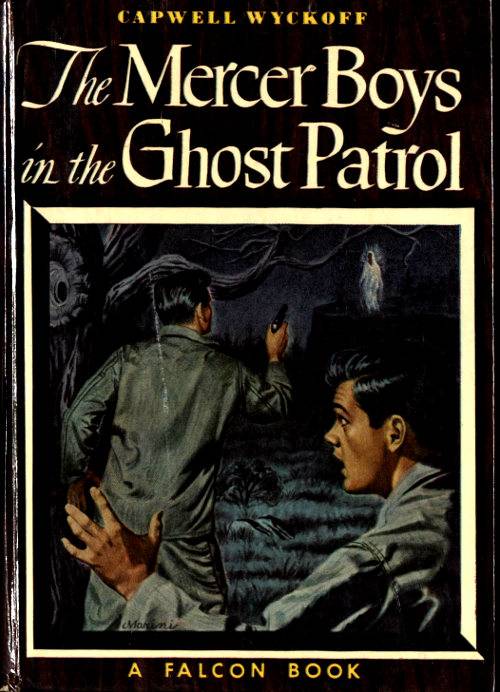
He dropped to his knees and looked under the cot. Then he reached under and brought out his weapon.
“Look under your cots,” he directed. Don and Jim did so and uttered a sharp cry.
“Sticking upright, so that when we lay down on the bed the point would prod us,” Don growled.
“And that explains where Rowen was this evening,” guessed Terry.
“Say, this is going a little too far!” cried Jim. “That’s a dangerous trick.”
“Well, not especially dangerous,” said Don slowly. “The point wasn’t in such a position that it would have actually run into us. But he figured that we’d come in just at taps and jump into bed, landing on the points with enough force to make us squirm. The worst part of it all is that we can’t prove who did it.”
“From now on,” said Terry, his eyes narrowing, “we have got to keep a wary eye on that guy.”
“Yes,” nodded Don. “I guess he placed all three bayonets so that one of the disliked boys would be sure to get it. It would be funny if it had been me, who so far has done nothing to antagonize him.”
“If I catch him in any funny business I’ll sail right into him,” promised Jim, as they replaced the bayonets in the scabbards.
Taps rang out and the camp quieted down. In a moment the three boys drifted off to sleep.
4
Strange Tales from the Ridge
Three shots sounded from the east side of the camp. Almost on top of them three shots sounded from a point close by.
With the first shots the three friends stirred and woke up, listening while half asleep. But with the second three shots they rose up in their beds, wide awake.
Close at hand the sound of rapidly turning wheels reached their ears, accompanied by the beat of horses’ hoofs. Something metallic bumped and banged. A voice called out: “Corporal of the guard! Post Number Three!”
The boys jumped from their cots with one accord, reaching for their clothes.
“Something wrong with the sentries,” cried Don.
“Who is at Number Three post?” asked Jim.
“Anderson,” answered Terry, fumbling with his shoes.
The camp was in motion. Lights flashed at various points and voices sounded. Past the tent went running feet. But the bugle did not sound, so they knew that it was not a fire or any similar emergency.
“I’m ready. How about you two?” Don called.
“Right with you,” was the response and the three soldiers burst out of the tent.
A central fire was burning and at this point the colonel was standing, half-clad and with mussed-up hair, his eyes heavy with sleep. The other cadets were clustering around him there, and the sentries were straggling in to that center. Just as the three boys reached the spot the sentries from Number Three and Number Four posts came up and saluted.
Number Three post was at a point up the Ridge and Number Four was right at the edge of camp. The shots from Number Four had followed so closely to those from Number Three that they knew the same thing had caused both signals.
“Sentries to report, sir,” announced the corporal of the guard, saluting.
The colonel saluted and faced the sentries. “Make your report, gentlemen,” he ordered.
Anderson, from Number Three post spoke up. “While patrolling my post I heard a wagon coming along that dirt road just above the camp on the Ridge. It appeared to be coming at a great rate of speed and just as it reached a point above my post it left the road and cut right down through the bushes toward me. It had a man and a boy in it and I challenged them, but without slacking speed a single bit the wagon tore right past me toward the camp. I then fired the shots to warn the camp and the next sentry.”
“Very good,” nodded the colonel. “Mr. Simms?”
“I heard the shots, though I had heard the thrashing of the wagon previously,” spoke up the second sentry. “I turned to find the wagon bearing down on me, swinging from side to side, and with a man and boy hanging onto the seat. It cut straight across the lower end of the camp grounds, down the slope and across the drill grounds. I fired to bear out Mr. Anderson.”
“Very good, gentlemen,” said the colonel, with a puzzled frown on his forehead. In the momentary silence that followed they could hear the mysterious wagon bumping and banging across the country, apparently at top speed.
Now that the official reports had been given the talk became general. The incident was extremely puzzling. Both sentries remarked that the man and boy had been huddled together much as though pretty badly frightened, and the sight of the cadets with guns had not seemed to reassure them any. Neither sentry had been able to see what had been in the wagon because it had passed them in too great a hurry, but from the sound they judged the rattling was caused by pots and pans. A single horse had pulled the cart.
“Strangest thing I ever heard of,” murmured the new senior captain, Henry Jordan.
“I can’t figure out why the party in the wagon left the dirt road,” said the colonel to Major Rhodes, the drill instructor. “That road runs parallel with the Ridge and works gradually down to the level of the countryside. For some reason or other that pair in the wagon wanted to get off the Ridge and out on the open meadow.”
“It is possible that they were fleeing from some crime,” suggested Rhodes.
“True enough,” assented the colonel. “And when they saw the cadets the vision didn’t reassure them any. Well, it goes beyond my understanding.” He turned once more to the attentive soldiers. “Corporal of the guard, restation the sentries. Everyone back to his bed.”
The sentries were reposted and the other cadets straggled back to their cots. Once in their tent Jim looked at his watch.
“A quarter past three,” he announced. “Quite an uncanny hour out here in the country. I’ll bet there is something behind that wild wagon flight.”
“Funny they should cut right across the camp,” remarked Don.
“I agree with Rhodes that those fellows were probably fleeing from something like a crime,” advanced Terry.
“That may be the explanation,” agreed Don. “I can’t think of any other reason for such a wild flight. Well, me for some more sleep.”
The rest of that night was quiet and in the morning the cadets discussed the event further. The details of the day then took up all of their attention and the night adventure was pushed from their minds.
Late in the afternoon Don and Terry hastened into the tent to get their baseball gloves. Jim was in the tent at the time.
“Going to play some ball?” Terry hailed.
Jim shook his head. “I’m out of luck today,” he announced. “Six of us have to go to a near-by farmhouse and buy some eggs and butter. The colonel told me to try and strike a bargain with a farmer for eggs, butter, milk and meat.”
“Don’t forget to wait for your change after you pay the farmer!” advised Terry.
“Go chase yourself!” flung back Jim. “I guess I know enough for that.”
While the other two went off to play ball Jim rounded up his five companions and they set off on horseback for the farmhouses that lay scattered over the Ridge. Two of the farms they passed did not look very promising but at last they came to a neat-looking one which had a large sign on the front fence. This sign announced that chickens, eggs and butter were on sale and into this yard the six cavalrymen turned their horses. An uproar of barking dogs announced their presence and a farmer appeared, scanning their uniforms with great interest. To him Jim explained their errand.
The farmer was more than pleased and hastened to bring out several dozen fresh eggs and a dozen pounds of butter. In the meantime some children and two farmhands had gathered about the soldiers, staring at them curiously. When the supplies had been paid for Jim asked the farmer to come to camp and confer with the colonel concerning future food supplies. The farmer was delighted beyond words.
“You bet your boots I’ll come down,” he cried. “Business is mighty poor, and this is a big boost to me. My name’s Carson.”
A little boy named Jimmie was particularly interested in the cadets, and they took an instant liking to him. He was a bright and sturdy little boy, and some of the cadets invited him to visit the camp, an invitation which he willingly accepted.
Just before they rode off the farmer spoke to Jim. “Ain’t see nothing of the ghost, have you?” he asked.
Jim shook his head. “No. Have you one?”
The farmer nodded solemnly. “Haven’t you heard about the ghost of Rustling Ridge?” he asked.
“No, we haven’t,” laughed Lieutenant Thompson.
“There is a sure-enough ghost that prowls this Ridge,” said the farmer, gravely. “Every once in a while it walks and scares people half to death. More than one family’s up and moved away just on account of him.”
“So far we haven’t been lucky enough to see him,” returned Jim, distributing the packages. “If we do, we’ll try and take him apart and look at him.”
The farmer shook his head. “Very bad business, that ghost. Look out he doesn’t turn up in your camp some night.”
With more jests about the ghost the cadets swung out of the yard and headed back toward camp, carrying their packages carefully.
“So there is a ghost on the Ridge, is there?” Thompson said to Jim.
“I’m not greatly surprised,” Jim said. “Most of these country places have room for at least one good ghost. They wouldn’t be quite happy if they didn’t.”
The colonel was pleased at their success and planned to buy more things from the farmer in the future. The provisions, with the exception of the canned goods which they had brought with them from school, had been all used up, for the invigorating outdoor life gave all the cadets ravenous appetites.
The cadets had been asleep perhaps two hours that night when a medley of shots rang out from post Number One, deep in the woods. As on the previous night the three boys hopped out of bed immediately.
“Golly, this is getting to be an epidemic,” snorted Terry.
“But this must be something different,” remarked Don. “I don’t hear any wagon crashing through the bushes.”
“There aren’t any more shots, either,” mentioned Jim.
Once outside the corporal of the guard brought in Douglas from the post. The colonel asked for a report.
“While standing at my post I saw a white shape pass me about ten yards away!” was Harry’s startling statement. “I challenged it, but it just glided on past me. At my shots it flashed into the trees and was gone. I was unable to find any trace of it.”
“A shape, Mr. Douglas?” frowned the colonel. “What sort of a shape?”
“Well, it looked like someone in a sheet,” explained Douglas. “I couldn’t see any head on the object, and it seemed to glide along the ground!”
“Hmm, our ghost of the Ridge!” said Jim to Thompson.
“What was that, Mr. Mercer?” the colonel cried, alertly.
Jim explained the story which the farmer had told to them that afternoon. “We didn’t say anything about it, because we put it down for a lot of nonsense,” he wound up.
“I see,” replied the colonel. “Captains and lieutenants go to post Number One and look around.”
The others waited a long half-hour until the officers came back. There was no news.
“We found no traces of anything,” Senior Captain Jordan reported.
Puzzled over the events of the past two nights the colonel ordered the boys back to bed. It was a long time before a good many of them fell asleep. In their own tent the three pals talked quietly of the situation, but could not puzzle it out.
“If this business doesn’t stop pretty soon,” Terry concluded the talk, “we won’t get enough sleep on this camping trip!”
5
A Fight and a Stampede
Captain Jim made his way around the last of the tents that formed the A Company row and then paused. With a motion that combined speed with caution he stepped out of sight behind the slope of the tent, his eyes narrowed, senses alert.
He was on his way to the section of the camp allotted to the cavalry horses. It was midafternoon and active drill was over for the day. Most of the young soldiers were in swimming, a few played baseball out in the blazing sun, and a few with less energy lay in the shade. Jim had dismounted rather hurriedly to make a report and he was on his way to see that the cadet orderlies had properly taken care of his horse.
The horses were just before him at the present moment, a score or more of restless, high-strung mounts. No orderly or cavalryman was with them at the moment and no one save one cadet could be seen. This cadet was acting queerly, and Jim’s attention was the more quickly attracted when he saw that the lone cadet was Dick Rowen.
Rowen’s campaign hat was in his crooked arm and he was standing directly in front of Jim’s horse, Squall. From time to time Rowen looked furtively around the camp to see if anyone was observing him, but he failed to see the cavalry captain. The lone cadet dipped his hand into the hat and extended something to the horse. Squall appeared to reach out eagerly for whatever it was each time, but the neck of another horse obscured from Jim what it was that Rowen was feeding his horse.
“Now, what the dickens can that fellow be doing?” Jim puzzled. “He seems to be unusually kind to my horse, and it looks suspicious to me. Of course, it is possible that Rowen likes horses and is feeding them, but he knows that one is mine. Maybe he doesn’t carry his grudges as far as the animals!”
One of the objects that Rowen was feeding to the horse dropped to the ground, rolling a short distance. As soon as Jim recognized it he became indignant.
“A green apple! A lot he knows about horses! If he wants to be kind to them he should pick something else beside—”
He stopped short in his thought. Rowen looked right and left again and then moved off a few paces to the left, reaching down for a bucket of water. With this in his hand he walked back to the horse, raised it to his eager lips, and tilted the bucket.
Jim Mercer waited to see no more. The whole cowardly trick was plain to him now. Each cavalryman was required to keep his mount in perfect condition and no excuse would be accepted for failure to do so. He could picture Squall after his meal of green apples and his drink of cold water, rolling in agony for hours, and himself severely blamed for criminal neglect. The boy’s eyes blazed in fury as he hurled himself in Rowen’s direction.
He was on top of the boy before Rowen was aware of him. Rowen turned startled eyes in his direction, his face paling swiftly. The tongue of the horse had just touched the water’s surface when Jim landed his fist with all his force on the cheek of the cadet.
Rowen went down promptly, the bucket of water spilling all over his uniform. A dull red spot showed where Jim’s fist landed, and Rowen rolled over with a faint bleat. With bulging eyes he looked up to where Jim towered over him.
“Why, you contemptible, sneaking coward!” Jim, his voice trembling, exploded with emotion. “You intended to bloat my horse so that I would do ‘growl duty’ for neglect, did you? How about the hours of agony that the horse would suffer? Did you think of that? Get on your feet, because I’m going to thrash you until you won’t be able to walk for the rest of the summer!”
“If you lay your hands on me, Mercer, I’ll report you to the colonel,” cried Rowen, cowed at Jim’s attitude. The captain was ablaze with wrath.
“Tell the colonel all you want to, but I’m going to put you in the infirmary for a month,” promised Jim, reaching for the collar of the fallen cadet.
At that moment Terry, Jordan, Don and Vench came around the end of the tent row. They had been playing ball and were on their way to change clothes for a swim. They saw the two before them and hurried over.
“Look here, gentlemen,” commanded Jordan, briskly. “You can’t fight in camp. What’s the row, anyway?”
“Mercer knocked me down,” complained Rowen, while Don pulled Jim away. Don was surprised to feel how violently Jim was trembling.
“Why did you knock Rowen down, Mercer?” Jordan asked.
Jim did not in the least mind Jordan’s commanding tone. Although they were both captains of divisions, and Jim was therefore an equal as an officer, Jordan nevertheless claimed a slight privilege as the senior captain of the school. In the following year, their last one at Woodcrest, Jim would be senior captain of the cavalry, with the unusual record of having held that post for three years. His heroism at Hill 31, when he rescued Vench, had won him that rank. But in the final year Don would be promoted from the infantry lieutenant to Senior Cadet Captain of the Corps, thus ranking a step higher than Jim, for all the latter’s three years of captaincy in the cavalry.
Jim readily related the story of the short fight. He felt that the action was so cowardly and sneaking that Rowen did not deserve to have it hushed up. The faces of the cadets described their feelings as the story was told. Rowen turned white to red-faced as he saw the looks cast in his direction.
“I don’t care so much about the punishment I would have received,” Jim said in conclusion, “but how any guy in the world with a grain of common decency in him would stoop to give a horse hours of agony is more than I can see. You fellows can see the evidences of his guilt on the ground, the pail and the apple. When you came along I was about to give him the biggest licking he ever got in his life!”
“Get up, Rowen!” commanded the senior captain, sternly. “We are not on duty, or I’d put up with this trick just long enough to order you under arrest! I don’t mind telling you frankly that you won’t last long enough in the corps to ever graduate if this story gets out!”
“I don’t care a hang about the corps!” snapped Rowen. “How about Mercer here? Don’t forget that he struck me.”
“I won’t forget him for doing it, instead I will remember him gratefully for doing it. Perhaps it was too bad that we arrived just as we did.”
Rowen looked up at Jordan shamefaced yet still belligerent. “I’ll get even with you boys! Just wait and see. And you can’t prove I harmed your old horse, either, Mercer.” With these remarks, Rowen turned on his heel and strode away, his chin high in the air.
“Gee! How do you like that?” Terry exclaimed. “He sure has some nerve carrying a grudge after what’s happened just now!”
“I thought I had met up with a lot of the mean, tricky people!” exclaimed Jordan. “But that beats me!”
“What about the horse, Jim?” Don asked.
“I’ll have to duck over to the canteen and get out some of the horse medicine and then run him around until he gets over the effects of the green apples,” replied the cavalry captain. “No water for you, Squall old boy, until you have lost the effects of your unexpected meal.”
While Jim was looking after the horse the others walked over to the tents, talking the matter over. All of them were deeply upset by the total unjustness of it all.
“Just because Jim slipped on the springboard and made a dive like Rowen’s!” said Vench. “I can’t understand some fellows.”
“Well, I’ll tell you,” replied Don, slowly. “For a long time Rowen has had a grouch against all of us; for no particular reason at all. He’s the kind of boy who just seems to have trouble wherever he goes.”
It was not until they were preparing for bed that evening that the three boys had an opportunity to further discuss the afternoon’s incident.
“Is your horse OK?” Terry asked, kicking off his shoes.
“Yes,” Jim answered. “As long as he didn’t get a big drink of water he—Oh, golly!”
“What’s the matter?” the other two asked, aroused at the dismay in Jim’s tone.
“I’ve lost my belt,” Jim returned. “I had it on when I went to the corral, and I guess I must have dropped it there. I’ll have to go back and find it.”
“You’ve got to have it for inspection tomorrow,” said Don. “Wait a shake, and I’ll go back with you.”
“No, you won’t,” vetoed Jim. “I can sneak out myself and make the trip in record time. No use in running the risk of having you reported with me. Douglas is patrolling post Number Five and I can slip through him.”
“Yes, but the guard will have been changed by the time you get back,” Terry reminded him. “Then what are you going to do?”
“I’ll just have to take my chances and slip through while he is at the far end of the patrol,” replied Jim, putting his shirt on again. “I should have seen to it that I didn’t drop my belt, that’s all. You fellows go to sleep, and I’ll soon be back.”
“OK,” agreed Don. “Good luck, kid!”
“Thanks,” murmured Jim, looking carefully from the flap of the tent. “See you later.”
With that he was gone, slipping back of the tents and keeping well in the shadows. At the edge of the camp he waited until he saw Douglas standing with his back toward him. Then Jim slipped by him and plunged into the woods.
It didn’t take him long to reach the spot where the horses were corralled and after a little hunting he found his belt. It had dropped close to the foot of a clump of bushes and was out of the direct rays of the moon. Buckling it around his waist Jim began his return journey to the camp.
But now, as he approached the place, he became very cautious. He must trust to luck to slip past the man at the post and it would be no easy task.
He decided that perhaps by flitting along past the animals he could more easily gain the corner of the nearest company street and by lying on his stomach in the shadow of a tent he could escape the eyes of the cadet until it was safe to move on. With this thought in mind Jim moved to the horses and then paused.
There was a tall white shape close to the animals, and they had sensed the presence of the thing. It looked to be a very tall man shrouded in white, and he was at the moment near the foremost horses. Forgetting his unusual position Jim rushed forward to see what was going on.
The shape before him heard his quick step, turned toward him, and then moved with an agility that astonished the cadet captain. Slapping the flanks of the horses right and left the man in white started them moving. Jim jumped forward.
“Hey, you!” he cried. “What are you doing to those horses?”
The figure in white took to the trees swiftly and Jim was unable to stop him. For the horses, frightened by something, perhaps the white shape itself, moved with increasing speed out of the corral. Before Jim could call to them it had developed into a wild stampede, and the horses were headed like a cyclone for the nearest tents.
6
The Trouble Bug Bites Deep
After that, things happened rapidly. Just as the horses began their rapid flight the sentry on the post rushed up to Jim. As luck would have it, it was none other than Rowen.
Before he could say anything the stampeding horses hit the first tents. They had spread out fan-wise on their wild run, and those on the wings were unable to push into the company streets. Blindly they crashed into the tents, taking two of them down in a flash and tipping a third over. The thunder of hoofs, the ripping of tent cords and the shouts of bewildered cadets buried under the entangling canvas turned the peaceful camp into a raging scene of chaos.
Cadets at the further end of the camp ran out, only to meet the galloping horses face to face. They were too bewildered to comprehend at once just what was going on, but they scurried back under cover. There was a vast uproar on all sides. A cloud of dust rose over the camp, partially obscuring the moon. To add to the confusion the sentries on other posts excitedly fired their guns.
Jim stood confused, wiping the dust from his eyes impatiently. Close beside him stood Rowen, coughing violently from the dust that the horses had raised. When he could speak he turned to Jim sternly.
“What are you doing here, Mercer?” he asked.
“I went back to the corral for my belt and then I saw a white shape near the horses,” related Jim. “Just as I challenged him he slapped them on the flank, starting the stampede.”
Rowen looked around the near-by woods. There was nothing to be seen. Deliberately he faced Jim.
“Absurd, Mercer,” he declared, his intention plain.
“Do you mean you think I’m lying?” Jim demanded, his cheeks flushing.
“I don’t have to mean anything. You tell me a story like that but I don’t see the faintest evidence of it. What do you expect of me?”
“Look here, Rowen,” said Jim. “How far away were you when these horses started?”
“A few yards. I was just patrolling this way when I heard them go,” answered the sentry.
“Then you heard me say, ‘What are you doing to those horses?’ didn’t you?”
“No, Mercer, I did not,” returned Rowen, steadily.
“You did so!” retorted Jim, flatly.
“I heard nothing,” repeated Rowen. “When I got here I found the horses in flight and I saw you standing back of them. Under the circumstances I must tell that to the proper officers and the colonel.”
“Certainly you must. But I will also tell them about the white shape.”
“I hope they will be a little more inclined to believe you than I am,” sneered Rowen.
Jim took a step forward. “Rowen, if you intimate that I lie, I’ll surely thrash you worse than I did this afternoon!”
“Mercer, in addition to reporting you for stampeding the horses, I shall also report you for threatening the sentry while he was performing his duty,” followed up the vengeful cadet.
Hot words leaped to Jim’s lips, but he stopped them. More words would lead to trouble, and he was sure that he had enough of that on his hands right now to last him for some time. Beside that, the camp was a bedlam and the horses were scattered all over the meadow below. Outwardly cool he faced the sentry.
“I am going to help round up the horses,” he told Rowen. “I’ll see you later.”
With this Jim turned and ran across the camp, heading down the slope to the field below. The colonel was now on the job, with some realization of what had occurred. A detail of cadets was busy at the fallen tents, lifting the canvas and helping the stunned soldiers out into the open. One boy had had his shoulder sprained but that was all the physical damage there was. Most of the horses had halted on the plain below and were quietly cropping the grass.
All of the cavalrymen turned instinctively toward the horses and were now engaged in the difficult job of trying to secure them. The infantrymen and artillerymen stood around talking things over, understanding that there had been a stampede but not fully realizing why the horses had run away.
“Guess something just scared them and they bolted,” Cadet Douglas said, speaking to a group.
“I’d like to know where Jim is?” murmured Terry.
“Too bad it had to happen while he was out of the camp,” returned Don, in a low voice. “If the colonel ever learns that he was absent at the time he’ll have a job explaining where he was. If he doesn’t turn up and go hunting the horses he’ll have to answer for that.”
Drill Master Rhodes bore down on the assembled cadets. “A few fires to be lighted, please,” he directed briskly. At this word the cadets scattered and fell to work gathering fuel for fires. A short time later a half-dozen fires lighted up the sky and threw the camp into bright relief.
“There’s Jim!” cried Don, pulling at Terry’s sleeve. “He has been right on the job.”
Jim was riding Squall bareback and driving other horses before him. Lieutenant Thompson brought in others, and the main band of the animals had been captured. But there were now at least five horses that had run far off and some of the cadets saddled and went after them.
This time they found real work cut out for them. The horses that had run the farthest away were the unruly ones. They objected strongly to being captured and led the cadets a merry chase. After an hour of hard work all but one horse had been captured.
“Mr. Mercer,” called the colonel. “Take Mr. Thompson and get that one stray horse.”
Jim and Thompson mounted and dashed across the field toward Twinkletoes, the stubborn cavalry horse. The animal, a beautiful chestnut stallion, tossed his head disdainfully and trotted off in a sweeping circle, seeming to enjoy the chase keenly. He was moving away from the camp and Jim saw that unless he could get on the far side of the horse he would lose him. Accordingly, he abandoned the direct chase, heading Squall out across the moonlit field until he had passed the cavorting horse. Then Jim swung sharply in toward the camp, the animal now in front of him. Thompson stopped and allowed Twinkletoes to retreat past him, and then the two cavalry officers began a chase that entertained and delighted the camp.
Twinkletoes tried in vain to dodge out of the circle which the two young soldiers had drawn around him, and it took all of their skill to keep him from attaining his objective. Twinkletoes raced and plunged, first toward one side and then toward the other, making short, mad little dashes, but as fast as he dashed the officers dashed after him. In this fashion, working ever in toward the slope, the two cadets drove the frisky animal in far enough to make escape possible only by dashing up the hill. This Twinkletoes refused to do, and Jim, staking all on a last desperate drive, forced Squall up beside the fugitive horse and secured him. As he led him into camp a cheer went up.
“Very good work, men,” nodded the colonel.
The horses were now all in and the work of securing them firmly went on. No recall was sounded and the cadets wandered aimlessly around the camp. When Jim and the other cavalrymen returned to the central fire they found the colonel standing there, surrounded by the instructors and most of the cadets. Jim was walking toward the colonel to make his report when Rowen stepped from the group, triumph written on his face.
“Mr. Mercer!” he called, loudly. All of the assembled soldiers, including the colonel, turned to look at him.
“What is it, Mr. Rowen?” Jim asked, quietly.
“You will kindly consider yourself under arrest for starting the stampede!” continued Rowen, still in the loud voice.
His words produced a decided sensation. The colonel looked particularly astonished. Terry groaned and nudged Don.
“What do you know about that! Jim started the stampede!”
“Mr. Mercer, did you start the stampede?” the colonel asked.
“No, sir,” replied Jim, promptly.
The colonel turned to Rowen. “What is your exact charge against Captain Mercer, Mr. Rowen?” he asked.
“I charge Captain Mercer with being absent from camp without official leave, of stampeding the horses, and of threatening a sentry in the performance of his duty!” cried Rowen.
“Those are very serious charges, Captain Mercer,” the colonel told Jim. “What have you to say to them?”
“I admit being out of camp without leave, but refuse to acknowledge stampeding the horses or having been in any way responsible for their breaking loose. I did threaten to thrash Mr. Rowen because he insisted that I was deliberately lying when I informed him that a figure clothed entirely in white slapped the horses and started them on their stampede,” reported Jim. There was a stir of eager interest from the cadets.
“A figure in white?” said the colonel, sharply. “What was that, Captain Mercer?”
“I do not know, sir,” replied Jim. “I challenged him sharply and at the sound of my voice he slapped the horses on the flanks, starting them on their break.”
“Captain Mercer says he called out to the figure in white,” said the colonel, turning to Rowen. “Did you hear him call, Mr. Rowen?”
“I did not, sir,” answered the sentry. “Colonel Morrell, Captain Mercer did not call out!”
“Limit your statement to the fact that you did not hear him, Mr. Rowen,” advised the colonel. Rowen flushed and trembled with rage.
“And you really saw a white shape at the horses, Captain Mercer? This talk of ghosts has not influenced you any, has it?”
“Not a bit, sir,” affirmed Jim, gravely. “I distinctly heard the sharp sounds of his slaps and as I started for him he glided into the woods close at hand.”
“Did you see anything, Mr. Rowen?” the colonel asked.
“The only thing I saw was Mr. Mercer standing there, watching the horses tear across the camp, sir,” answered Rowen.
The colonel thought for a moment. “Very well, men,” he returned. “I will consider the case carefully. Captain Mercer, you will consider yourself at least temporarily under arrest, on the two charges preferred by Mr. Rowen, namely, for being absent without official leave and for threatening the sentry, although I realize that you threatened Mr. Rowen not for ordering your arrest, but for doubting your word. All these things don’t go well with an officer’s commission, Captain Mercer, and I shall be compelled to look into the entire affair.”
“Very good, sir,” responded Jim, saluting.
The cadets were sent back to their cots and soon quiet settled over the entire camp. In their tent Jim, Terry and Don discussed the situation.
“Just your luck to run right into Rowen,” commented Terry. “I’d like to bet my last nickel that he heard you call out, too.”
“I think that he did, but we can’t prove it,” sighed Jim. “Well, I’m not going to worry about it.”
“You won’t need to,” reassured Don. “The colonel will see to it that you have the proper justice. Your word is as good as Rowen’s and he will find out the truth some way.”
7
The Old Man of the Ridge
Jim’s punishment did not last long. A circumstance came up that made the colonel suspend judgment for some time.
One morning, soon after the incidents related, a man in a battered old car drove up to the camp. He was a minister who preached in a regular circuit of county churches and he was known to the colonel. The headmaster received him with great pleasure and the two men talked of many things as they sat in the colonel’s tent.
“By the way,” said the Reverend Mr. Powers, after a time. “Did someone go past your camp very hurriedly a few nights ago?”
The colonel showed signs of unusual interest. “Why, yes, a few nights ago a wagon with two men in it tore right through the camp,” he said. “We couldn’t stop it.”
“There was a man and a boy in it,” corrected the pastor. “Well, then you don’t know what sent them flying past you like that?”
“No,” confessed the colonel. “If you had seen the way they flew by, you wouldn’t wonder that I didn’t learn anything about them. But tell me what you know.”
“First, I would like to ask you a question. Have you heard anything about a ghost of the Ridge, since you have been here?”
The colonel snorted. “I haven’t heard much about anything else,” he retorted.
“The ghost scared these two off. The father is a farmer who came down here from Pennsylvania. As it turns out, he is very superstitious, and the very first night on his own farm, while driving into the yard with his only son, he saw the white shape skulking along near his barn. He was just about crazed with fear and fled to the valley, passing your camp as he did.”
“Of course this ghost is simply some would-be humorous person who is having some fun,” was the colonel’s opinion. But Mr. Powers had another opinion.
“I doubt that very much, Morrell. The thing has been going on for years and some very good citizens have given up their homes just on account of it. The joke would have worn out years ago. No, I’m inclined to think that there is something deeper in it than mere fun.”
“Some determined effort should be made to drive the ghost from the Ridge,” grumbled the headmaster.
“Who is to start it?” shrugged the parson. “No one seems to want to and the sheriff of the county simply laughs at the whole business.”
As a result of this talk the colonel called Rowen and Jim into his tent after drill that very afternoon. They faced him expectantly.
“Gentlemen,” said the colonel. Then he paused, and a frown swept over his face. “I call you gentlemen, and will continue to do so until one of you is proved guilty of deliberate lying. Your conflicting stories show that one of your statements, coming from one or the other of you, is a deliberate falsehood. But to get back to the business in hand: I have just heard some more tales concerning this ghost of the Ridge, and in view of it I have decided to drop the suspension against Captain Mercer. The word of one of you is as good to me as the word of the other, and until I prove that one of you is trying to conceal anything I must consider the case dismissed until further notice. Mr. Rowen, you say you did not hear Mr. Mercer call out nor did you see the white shape. But on the other hand, Captain Mercer did tell you immediately that he had seen a white shape, and that the ghost—or whatever it was—had started the stampede. Inasmuch as you did not see Captain Mercer start the stampede, and you doubted his word, I shall be able to hold him only on the count of being absent without official leave. For that Captain Mercer will receive demerits. It that all clear, and satisfactory?”
“Very much so, to me, sir,” approved Jim. Rowen muttered.
“What was that, Mr. Rowen?” the colonel asked, sharply.
Rowen lost his temper in his sudden fright. “I simply said that of course a Mercer would get the breaks, sir!” he sneered. Then, realizing the slip he had made, his face turned white.
“So!” murmured the colonel. His eyes flashed but his voice was calm. “I asked you if my decision was satisfactory, Mr. Rowen.”
“Yes, sir,” murmured the disappointed cadet.
“Very well. You are both dismissed,” nodded the colonel. Left alone, his brain worked busily. He saw a good many things in a clear light now.