
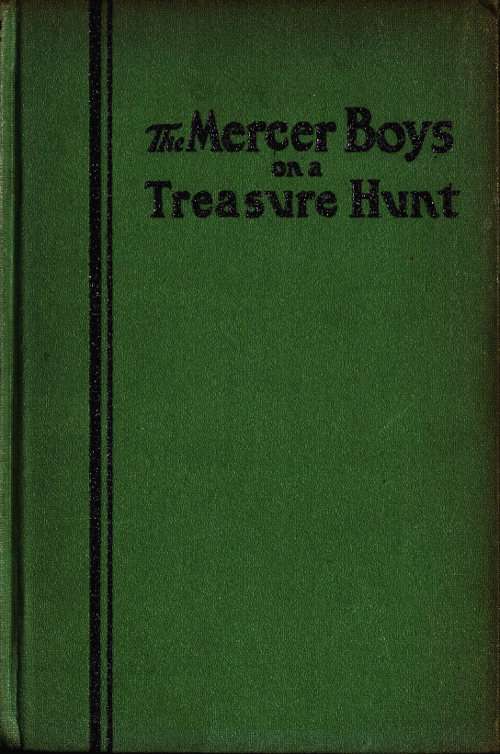
The Project Gutenberg eBook of The Mercer Boys on a Treasure Hunt
Title: The Mercer Boys on a Treasure Hunt
Author: Capwell Wyckoff
Release date: December 6, 2016 [eBook #53673]
Most recently updated: October 23, 2024
Language: English
Credits: Produced by Stephen Hutcheson, Rod Crawford, MFR and the
Online Distributed Proofreading Team at http://www.pgdp.net
THE MERCER BOYS ON
A TREASURE HUNT
By CAPWELL WYCKOFF
Author of
“The Mercer Boys at Woodcrest,” “The Mercer Boys’ Cruise in the Lassie,” “The Mercer Boys’ Mystery Case,” “The Mercer Boys on the Beach Patrol,” “The Mercer Boys in Summer Camp.”
THE
WORLD SYNDICATE PUBLISHING CO.
Cleveland, Ohio New York City
Copyright, MCMXXIX
by
THE WORLD SYNDICATE PUBLISHING CO.
Printed in the United States of America
CONTENTS
- CHAPTER PAGE
- I The Professor’s Letter 3
- II The Story of the Phantom Galleon 13
- III A Royal Invitation 20
- IV The Professor is Attacked 29
- V The Prowler in the Night 41
- VI The Scene in the Moonlight 52
- VII Sackett’s Raid 63
- VIII The Search is Begun 72
- IX The Ruined Castle 81
- X The Rope in the Dungeon 92
- XI The Underground Passage 101
- XII The Tolling of the Bell 109
- XIII A Forced March 119
- XIV History Repeats 129
- XV The Mountain Sage 139
- XVI The Landing Party 150
- XVII The Escape 159
- XVIII Treasure and Treachery 170
- XIX An Old Friend Joins the Party 182
- XX The Tar Barrel 191
- XXI The Cairn 201
- XXII The Den 211
- XXIII The Dragon’s Last Stroke 219
- XXIV Ned Takes a New Overseer 237
THE MERCER BOYS ON A
TREASURE HUNT
CHAPTER I
THE PROFESSOR’S LETTER
“I’d like to have a crack at that ball,” said Don Mercer, with a grin.
His brother Jim returned the grin as he said: “Let’s go out on the field and ask the kids to toss us one. They won’t mind giving us one swing at it.” The two Mercer brothers were standing at the edge of a large vacant lot near the center of their home town one morning late in June. They had been home from Woodcrest Military Institute for a week now on their summer vacation, and this particular day, having nothing more exciting to do, they had wandered around the town, coming at length to a familiar field where they had often played baseball. A number of youngsters were on the ground now, tossing and batting a discolored baseball, and the sight of them had caused the sandy haired, slightly freckled Don to express his wish.
The two boys walked across the field toward the boys and Don said: “Wonder how much further I can hit it now than I could when I played here as a kid?”
“Hard to tell,” returned Jim. “But we certainly got quite a bit of practise this spring at Woodcrest.”
The small boys looked at them as they drew nearer, but as the Mercer boys were well known the boys felt no alarm or resentment at the approach of the larger lads. Don walked over to the boy who held the bat and held out his hand.
“How about giving me one crack at the ball, Charlie?” he asked.
The boy smiled and extended the bat, a bit of embarrassment in his look. “Sure, Don. Take a couple of them,” he invited.
“I guess one will be enough,” remarked Don, as he turned to face a boy who held the ball. “Put a good one over, Tommy, will you?”
The boy addressed as Tommy grinned boyishly and turned to the youngsters who stood far afield, waiting for flies to be batted to them. “Get way out, you fellows,” he cried. “This fellow can hit ’em!”
The two fielders backed away and Tommy threw a fast ball to Don. The latter easily batted it out and one of the youngsters caught it triumphantly. Don handed the bat to Jim, who in turn cracked the ball out along the ground.
“Just one more, fellows,” begged Don, taking the bat from his brother’s hand. When the ball had been turned over to young Tommy he wound his arm up slowly and then pitched it with considerable force in Don’s direction.
“Hit that!” he cried.
It was traveling on a straight line and Don swung the bat around sharply. There was a singing crack as the wood met the ball, and the muddy spheroid sailed in a mounting curve up into the air. It passed high above the fielder’s head and made its way straight for the side window of a small house that stood on the edge of the field.
“Oh, boy!” shouted Jim. “Right through the window!”
His statement was correct. With a disconcerting crash the ball smashed the window to pieces.
Don dropped the bat and shoved his hands into his pocket. “Well, I’ll be jiggered!” he exclaimed. “How is that for bad luck? Right through Professor Scott’s window!”
“I hope the professor wasn’t at home, and in that room,” said Jim. “Guess we had better go over and see about it.”
“Right you are,” nodded Don. “Thanks for the hits, kids. Come on, Jim.”
Leaving the boys to gather and talk things over in awed tones the two Mercer brothers made their way across the field in the direction of Professor Scott’s house. The gentleman mentioned had been their history teacher while they were in grammar school, and they knew him quite well, so they had no great fears as to the outcome. No one had appeared at the window or at the doors, and Jim supposed that the professor was not at home.
“I guess not,” Don returned, “or he would surely have appeared by now. But we’ll go over and see, and if he isn’t we’ll leave a note and tell him who did it, and offer to pay for it.”
While the Mercer boys are making their way across the field something may be said as to who they were. Both boys, fine, manly chaps, were the sons of a wealthy lumber man of Bridgewater, Maine. They had lived the life of healthy young men whose interests were centered in worthwhile things. Of late they had had some adventurous events in their lives, some of which were related in the first volume of this series, The Mercer Boys’ Cruise in the Lassie, when they ran down a marine bandit gang, and later when solving a baffling mystery at the military school, details of which were related in the second volume entitled The Mercer Boys at Woodcrest. Together with their comrade, Terry Mackson, they had faced many perils and adventures, and now they were home to spend, as they thought, a comparatively dull vacation. Just how deeply mistaken they were in their thought will be found later.
They entered the front yard of Professor Scott’s house and walked around to the side, where the broken window faced toward the empty lot. There appeared to be no one at home, but when they came opposite to the window Don raised himself slightly on his toes and looked in. Then he dropped down again and looked at Jim in astonishment.
“The professor is at home,” he said, in a low tone. “He’s sitting there, reading a letter!”
“Reading a letter?” asked Jim, amazed.
“Yes,” answered his brother. “Look in.”
Jim raised himself and looked in the window. A tall man with bushy white hair and a thick iron gray beard was seated at the desk in what appeared to be a study, busily engaged in reading a letter. Near him, almost at his feet, lay the boys’ ball, and fragments of broken glass littered the floor. The professor was apparently deeply absorbed in his letter.
“Well, what do you know about that!” exclaimed Jim, softly. “Doesn’t even seem to know that the window is broken! We always knew that he was somewhat absent-minded, but I thought he was more responsible than that!”
Before Don could reply there was a stir in the room and the next minute the professor came to the window and looked down at them. He still held what appeared to be a lengthy letter in his hand, and he recognized them.
“Why, Don and Jim Mercer!” he cried, showing strong white teeth in an engaging smile. “I’m glad to see you home again. Did you come to see me?”
“I came to apologize for breaking your window, and to offer to pay for it, Professor Scott,” answered Don. “I was batting out the ball for some boys, and I hit it harder than I expected to. I hope it didn’t startle you very much?”
“I jumped a little bit,” admitted the professor. “I did notice it!”
“Notice it!” exploded Jim. “I should think that you might have! It certainly made enough noise.”
“It did make some. I felt that it was some of the boys playing ball and I was going to throw the ball back to them in a minute.” He picked the ball up and handed it to Don. “Throw it back, and then come inside, won’t you?”
Don threw the ball back to the small boys, who were watching from the field. “Are you sure we won’t be breaking in on you, professor?” he asked.
“Not as much as you did a few minutes ago!” smiled the teacher. “Come around through the back way.”
When the boys entered the professor’s study he motioned them to chairs and asked them a few questions about their school life and studies. All the time he held the letter in his hand, and when he had finished talking about their school he took the lead in the conversation.
“I guess you boys wonder what is so interesting in this letter that I hardly noticed a ball when it broke through my window,” he began. “Well, I remember how interested you boys were in history while in my classes, and I’m glad you came along when you did. This letter is from my son Ned, who lives in Lower California, and it contains one of the most fascinating stories I ever came across!”
Knowing as they did the professor’s deep interest in historic and scientific studies and discoveries the boys found themselves interested at once. The teacher went on, after a glance at the letter, “Ned owns a small farm or homestead in Lower California near the mines at San Antonio and Triunfo, where he tests the ores and carries on general scientific studies. He tells me that the ores are refractory and not easy to test, but he enjoys the work and is devoting his whole life to it. I don’t think he is quite as much interested in historic things as I am, but knowing how eager I am for relics and information of the past, he has sent me this remarkable piece of news.
“Some time ago, a steam trawler, while fishing in 130 fathoms of water, hauled up a piece of wreckage in its net. Upon examination it appeared to be the bulwark of an ancient Spanish galleon, with parts of the rigging attached. On the sides, plainly distinguishable, were designs in hand-sewn leather. Some of those big, lumbering ships were decorated quite extensively, you know, and this one was distinguished by its hand-sewn leather covering. It was evident that somewhere in the neighborhood a Spanish galleon had gone to the bottom, and it is always a safe conclusion that where there is galleon there is also a treasure. Those ships carried gold, silver and jewels from Old Mexico and Peru to Spain, and this particular ship may have been going home after a trip up the coast of California. That was the type of ship that the brave English seamen of Queen Elizabeth’s time whipped so soundly at the time of the Spanish Armada, and there were hundreds of them in service along the shores of the Americas and the Islands.
“The spot was marked in the hope that treasure would be discovered, on the presumption that it was a treasure ship, and shortly afterward active operations were started by a California diving company. But although they searched the shore under water in minute detail they found nothing. The mystery is not that they didn’t find any treasure, but that they didn’t find any more of the ship. You might think that perhaps that particular piece had been washed there from some point further out, and it is possible, but the piece, when netted, had been buried in the mud, and it looks as though it had been there for centuries, though ships haven’t a habit of sinking in sections, one part at one place and another part in a different place. However, they didn’t find a thing, and at last the whole undertaking was given up.”
“That is too bad,” said Jim, who was deeply absorbed in the story. “So it was a false hope from the first.”
“How long ago was that?” asked Don.
“That was a little over a year ago,” answered the professor. “And that leads me to the second part of my story. Ned had given up all interest in it even before the diving and salvage company had, and he thought no more about it. The piece of wreckage is a treasure in itself and was sent up to San Francisco, where it was subsequently placed in a museum. Realizing that I would be interested in it all he first wrote to me at the time it happened, and I read it and wrote for news, but as the thing died down I forgot it, too. I have planned to run out to San Francisco sometime and see the part myself, and I intend doing so soon.
“Ned told me at the time that there had been some slight changes in the coast line during the last few centuries. A number of creeks that formerly ran into the ocean have closed up and disappeared, some of them filled with shifting sand and soil. I don’t know if you were ever aware of the fact or not, but although Lower California has a dry climate and is mostly barren, there are spots where it is tropical and jungle plants and trees grow there in luxurious profusion. Although they have almost no rain, they do have violent storms, and at such times are treated to regular cloudbursts. At those periods the elements raise the old dickens and it was during these spells that some creeks and small rivers closed up.
“Maybe you wonder why I’m particular to tell you all this. I do so because I believe it has a direct bearing on the most amazing part of Ned’s letter. I believe it explains the disappearance of the Phantom Galleon!”
“The Phantom Galleon!” cried Don, while Jim stirred in eager interest. “What is that, Professor Scott?”
CHAPTER II
THE STORY OF THE PHANTOM GALLEON
“Well,” answered the professor, slowly. “Up until a very short time Ned, and others, thought that it was only a legend. He hadn’t been in the country very long before he heard it, and he put it down as one of those semi-historic tales that consist of half truth and half fancy. The tale had been handed down for centuries and always by word of mouth, and this is the story:
“On a certain evening, hundreds of years ago, a huge, lumbering Spanish galleon, loaded with treasure, fled along the coast of Lower California, pursued by three English barks. In the long run there was not a chance that the gold ship would get away, for the light English barks were much faster, and it was only a question of time before they hauled down on her and boarded. The way they were situated was this: one ship was in the rear of the Spaniard, one was coming up in front of it, and a third was moving in from the open sea. It was a regular trap, you see, and merely a matter of time.
“But fortunately—or unfortunately, I don’t know which—for the galleon, one of those rare tropical storms came up at that moment when capture seemed assured for the gold ship. There was a furious rush of the wind, the sky grew black and lowering, and finally, in one great maelstrom of confusion the three ships and the galleon were blotted out of sight. The storm only lasted for some half hour, which is unusually long for some of them, and when it lifted the galleon was nowhere to be seen. The English barks had had all they could handle and had been so busy holding their own against the elements that they hadn’t time to keep up the pursuit, and their conclusion was that the Spaniard had gone to the bottom of the sea. As it was built much higher and was much harder to handle than the lighter ships, the conclusion was justified, and the pursuers drew off and left the shore.
“As I told you, that had happened in the evening, just as dusk was coming down over the shore and the sea, and the high decked galleon, with its spread of strained canvas and yellow streamers, its lofty rigging and its ornamental work, looked like some strange phantom as it fled down the coast. I don’t know who saw it or how many saw it, but to this day the story, half legend as it is, has persisted concerning the phantom galleon. Some fantastic tales still linger about it appearing on dusky nights and sailing swiftly along the shore, but they are idle stories to which no one with intelligence pays any attention. Ned never gave the whole thing much credit until a remarkable circumstance brought it forcefully to his mind.
“Near his little ranch there is a large old estate which belongs to a once noble family of mixed Spanish and Mexican blood, and although they keep pretty much to themselves, out of a lofty sense of pride, they have been rather friendly to Ned, in their stately and exacting way. There was an old man who was head of the place, his daughter, and one or two servants. Lately the old gentleman died, and Ned kindly helped out with the funeral and the management of the ranch affairs until a permanent overseer was brought over from Mexico, and in her gratitude the young senorita allowed him to roam pretty much around the house. I suspect from his letter that he has of late become rather more than friendly with the young lady, but that doesn’t make much difference either way. It seems that she had been left with quite a library, reading being an important business in such a lonely place, and some of the volumes were pretty precious, being hand written works of early settlers and priests, who thus left interesting historic records. One of these books attracted Ned’s attention strongly.
“It had been written by a priest in the year 1571, and it described the Spanish treasure hunts, some of which were plain plundering expeditions, and this particular book related them in detail. Ned wasn’t unusually interested until he came across the part relating to a chase that the galleon had had from three English ships. According to the author they had loaded with something like 100,000 pesos and a fortune in gold and silver bars, to say nothing of jewels, and had sailed for Upper California. But near the shores of Lower California the galleon had been sighted by an English bark, which had instantly given chase. The galleon, which had a good start, fled, but its chances of escape suddenly became less as another English ship appeared before it, and another bore down on it from the open sea. It was growing dark, wrote the priest, and there was some hope that it would slip away in the darkness, but something more to the point stepped in when a tropical storm wrapped the nearby world in temporary darkness. The Don Fernando, that was the name of the galleon, slipped into a nearby creek or small river and ran hard and fast aground, the lofty masts and spars crashing down, a total ruin. The creek seems to have been far enough back for the wreck to have escaped the notice of the English, for they were not molested, and the crew, after assuring themselves that the treasure was safe, tried to make their way inland for help.
“But somehow or other—the writer does not say how—they all perished, and he alone escaped to Mexico, there to write down the story of the flight of the galleon. He affirms positively in his journal that the treasure was not touched, and he planned to raise enough men to go and get it. Whether he did or not no one knows, but if he didn’t that treasure is still somewhere in a creek, in the wreck of that galleon, perhaps buried below the level of the sand which has shifted. Ned thinks that it is nearby and that is why he has written to me.
“The tragedy of the thing is this: the priest wrote everything except the name of the creek down which the phantom galleon fled. There are several pages missing from his book, and it breaks off like this: ‘The ship with its fortune in gold and precious stones, its coin and bars, is still buried in the sand in a creek called——’ and there it unfortunately ends. If the name was only there we could tell something, for it is always probable that someone can be found who will recall the name, no matter how ancient it may be, but as the name is lost, Ned faces a blank wall. He inquired from Senorita Mercedes just where she had obtained that book, but she knew nothing outside of the fact that it had apparently always been in their house.”
“That certainly is interesting,” said Don, as the professor stopped. “Your son Ned thinks that it is somewhere near his place?”
“Yes, he believes it is somewhere within a radius of a hundred miles. The legend has it that the galleon vanished somewhere right on that very shore, and that would indicate that the galleon ran up some creek very near to his place. If no one ever did get back and take that treasure it is probably in the rotted hold of the treasure ship, buried more or less deeply in the sand, just waiting for some lucky one to discover it. Much of the land near Ned’s ranch has never been thoroughly explored, and it may be that it is nearer to him than he has any idea of.”
“Has he made any effort to find it?” inquired Jim.
“A somewhat feeble one, yes. He endeavored to enlist the aid of some nearby ranch men, some half breed Mexicans, but although they started with some enthusiasm they soon gave it up. They are the kind who would not mind sharing in the rewards if someone else does the work. So he gave it up, except that he patiently read every other book in Senorita Mercedes’ library in the hope of obtaining some clue, but the missing pages were not to be located and he is still no nearer to finding out the name of that creek than he was at first.”
“And he never did find out how that book came to be in the library of the Spanish ranch?” asked Don.
“No, but we can hazard a guess as to that. The Mercedes family have lived in Lower California for at least a hundred years, but before that they came from Mexico. It is very possible that the priest had escaped to Mexico and fallen in some way in with this ancient Spanish family, perhaps dying there and leaving the book with them. How the last few leaves of the book came to be missing no one knows. But perhaps you can see the possibilities?”
“What do you mean?” asked Jim.
“I mean that perhaps someone has already read that book, tore out the sheets with the information on them, and has already found that treasure!” was the startling answer.
CHAPTER III
A ROYAL INVITATION
They were somewhat dismayed at the professor’s reasoning but at length Don shook his head. “I don’t see that it is necessarily so,” he insisted. “Of course, there is a big chance that such is the reason, but on the other hand it may simply be that the pages have been lost. It can be taken both ways.”
“Yes,” nodded the professor. “It can. That is why I would never allow myself any false hopes.”
“Then you are going out and help Ned look for this treasure?” asked Jim.
“I’m going out more because he wants me to come than for anything else,” said Professor Scott. “And as much for the change as for anything else. I’ve been studying pretty hard of late, and I’m sure a change of air and scenery wouldn’t hurt me a bit. I haven’t any idea that Ned will ever find that legendary treasure, but the fact that he found evidence that the story of the phantom galleon is true interested me greatly.”
“But if you do go out there you will look around for it, won’t you?” inquired Don.
“Oh, yes, Ned will see to that! He has the idea that he will run across it, and nothing stops him once he gets an idea. I’ll join in with him and do some tramping around, but while he’ll be looking for gold I’ll be looking for health. I’m rather more sure of finding what I am after than he is.”
“Just the same,” murmured Jim. “It is a dandy opportunity, and I wouldn’t mind having a shot at it.”
“You boys are greatly interested,” remarked the professor, looking at them keenly.
“I suppose we are,” admitted Don, smiling. “It appeals to us, and I guess it would to any fellow. If you go, professor, we certainly wish you all kinds of luck.”
“Thanks,” said the professor. “If you went on such a trip, I suppose you’d hunt the treasure with much energy?”
“I guess we would,” nodded Jim. “If it was anywhere near I guess we would uncover it.”
“I don’t doubt it,” the professor smiled. He was silent a moment and then he asked: “Now that you boys are home for a vacation, what do you plan to do? Have you anything definite in mind?”
Don shook his head. “We might do a little sailing,” he replied. “We have a fine thirty-foot sloop, and we may sail for a ways down the coast. Last summer we did and we had a good time.”
“I know about that voyage,” the professor returned. “That was the time you ran down those marine bandits, wasn’t it? I remember reading about it.”
“That was the time,” Don answered. “We don’t expect to run down any bandits this summer, but we may take a cruise.”
“That is fine,” said the professor, somewhat absent-mindedly. “So you two boys were interested in what I told you of Ned’s letter, eh?”
“We couldn’t help being,” grinned Jim. “I guess every fellow is interested in treasure hunting.”
“I suppose that is true,” the professor returned. “Well, that is the contents of the letter which made me so interested that I paid very little attention to the ball as it broke the window.”
“I’m sorry about that, professor,” said Don. “How much is it, please? I’m very anxious to have it repaired.”
“Forget it,” said the professor.
But Don insisted, feeling that it would not rightly do to accept the professor’s generous offer to put it in himself, and at length the teacher agreed that Don should pay for the work. He rather admired Don’s spirit in insisting upon paying his own way through life, and although he knew that the Mercer brothers had plenty of ready money he allowed Don to pay for the broken glass more as a concession to his spirit of the right thing to do than for any other reason. After Don had turned over the money to the professor the boys took their leave.
“Thanks for that interesting story, Professor Scott,” said Jim, as they were leaving.
“Yes, we enjoyed it,” added Don.
“You are very welcome,” smiled the professor. “I thought you would be interested, and may—be—humph, well, let that pass for now. Good morning, boys.”
The boys left the professor and walked slowly down the shady street, discussing the letter and his story. It appealed to them greatly.
“That sure was a strange thing, that finding of the old book relating to the flight of the galleon,” mused Don. “Looks like the hand of fate, eh?”
“It surely does,” chimed in Jim. “Those fellows took that treasure centuries ago, it lays buried in the sand for years and years, and then a chance discovery points to where it is. Sort of like a dead man’s finger pointing at the treasure, isn’t it?”
“Somewhat,” admitted Don. “I rather feel that if the treasure had been found by someone else Ned Scott would not have come across that book. Now, that is my own way of looking at it. Just as the professor says, someone may have torn the valuable leaves, with the location of the creek on them, out and have found it long ago. But I somehow just can’t believe it.”
“Nor I,” said Jim. “I’d surely like to be along when Ned Scott unearths that old ship and its treasure.”
“Provided that he does,” smiled Don, as they reached their home. “There isn’t any guarantee that he will. It is always possible that the whole thing happened miles down the coast, for if I remember correctly, from my school map, Lower California is a mighty long stretch. Well, all I hope is that he’ll tell us if anything turns up. Just as soon as he comes back, if we are home from school, we’ll hunt him up and ask him all about it.”
“Surely,” agreed Jim. “If he isn’t home by the time we are ready to return to school we can see him during some vacation. Well, what do you say, old man? Shall we go down and tinker with the boat?”
“Don’t think we have time,” decided Don, looking at his watch. “That visit to the professor took up the whole morning, and mother will be waiting dinner.”
The boys entered the quiet but homelike little house which was their home and prepared for dinner. When they sat down at the table Mr. Mercer, a kindly and energetic man, was there. He worked in a local office, where he ran his vast lumber business, and was generally home for meals. Margy Mercer was also there, and the family was complete.
“Well, what have you two fellows been doing this morning?” asked Mr. Mercer, as he vigorously attacked a piece of steak.
“Don’s been breaking into people’s houses!” chuckled Jim. “This was an expensive morning for Don.”
Don related what had happened, and finding his family deeply interested in the professor’s letter, told them the story of the phantom galleon. Mr. Mercer smiled as he finished.
“I suppose you two wouldn’t mind going along on a trip like that, would you?” he asked.
“I should say not!” exclaimed Jim. “We’d go without mother’s apple pie for a month to go on that trip!”
“Hum!” said Mr. Mercer. “Score one for mother’s pie! I imagine if anything spectacular comes out of the professor’s treasure hunt the newspapers will have it.”
The two boys went for a brief sail in a small catboat during the afternoon and later worked at the bench in their boathouse, turning out the sides for some bunks which they planned to place in their little sleeping cottage at the end of the yard. They already had three beds in the little place, but lately Jim had hit upon the idea of constructing regular ships’ bunks and they were now busy making the pieces. They stuck to this job until the time of the evening meal, and after that they remained at home, listening to the radio entertainment.
Don, who was sitting near the living room window, idly looking out, suddenly uttered an exclamation and straightened up.
“What’s the matter, Don?” asked Jim, quickly.
“Here comes Professor Scott!” Don exclaimed.
“In here?” demanded Jim.
“Yes, he’s coming up the walk.” And Don got up and went to the door, to open it for the teacher.
“How do you do, Professor Scott,” he greeted. “Won’t you come in?”
“Yes, thank you,” nodded the professor. “Is your father at home?”
“Yes, he surely is,” said Don. “Come right on in.”
He showed the professor into the living room, where the Mercer family greeted him, and after a few minutes of pleasant talk Mr. Mercer guided him to his study, where they might talk in quietness and alone. Jim looked inquiringly at Don.
“What in the world do you suppose he wants with dad?” he whispered.
“Jiggered if I know,” shrugged Don.
In less than half an hours’ time the two men returned, both of them smiling, and Mr. Mercer turned off the radio. Then, as they sat down the father looked with mock sternness at his two boys.
“I want your promise to at least make an effort to keep out of trouble while you are with Professor Scott,” he said.
“With Professor Scott!” echoed Don, while Jim stared. “Where are we going with Professor Scott?”
“Out to tramp all around the sands of Lower California, I think,” Mr. Mercer returned.
“No!” shouted Don, leaping to his feet.
“No? Well, all right. I thought that you wanted to go, but as long as you don’t why——”
That was as far as he got. “Of course we want to go,” cried Jim. “By George, this is great. What made you decide to take us with you, professor?”
“It’s a protective measure,” smiled the professor, pleased at their enthusiasm. “I saw how interested you boys were when I told you about it this morning, and I was wondering if you would care to go and if I could persuade your father to allow you to go. You see, I want to go out there for a rest, and I’m afraid Ned will insist upon dragging me all over the country in search of Spanish treasure, so I’m taking you boys along as buffers, to help him in his mad adventuring.”
“Well,” smiled Mrs. Mercer. “We’ll let them go if you’ll try to keep them out of trouble, Professor Scott. They have a very bad habit of getting into plenty of it.”
“I guess Ned will keep them so busy that they won’t have time to get into any scrapes,” said the professor.
They sat and talked for another hour, the boys unable to believe their good fortune, the suddenness of which had stunned them. The professor took his leave at last, telling them that he planned to start at the end of the coming week. After he had gone they sat and talked some more, the boys excited at the prospect of their coming trip.
When at last they went up to bed it was not to sleep immediately. They discussed the event for more than an hour.
“Dad and mother say for us to keep out of trouble,” chuckled Jim. “We’ll try hard to obey orders, but I do hope we have some exciting times.”
“Don’t you worry,” chuckled Don. “I wouldn’t be a bit surprised if we did!”
The two boys fell asleep, worn out by the events of the day. It is doubtful if they would have slept so peacefully had they been able to foresee the events which loomed before them.
CHAPTER IV
THE PROFESSOR IS ATTACKED
After three days of preparation the boys and the professor were ready to leave for the west coast. They were to go to San Francisco and take a steamer there down to the settlements in Lower California. It was a bright Saturday morning when they waved out of the window to their friends on the station platform.
“Well,” remarked Don, as the train moved out of the station. “We are off for new scenes at last.”
The journey across the continent was uneventful. They enjoyed it thoroughly, never growing tired of the endless views which unfolded as the train sped westward. The professor, with his varied knowledge of places and people, his understanding of scientific facts and his historic incidents, proved to be a most delightful companion. In a few days they left the train at the great city of the coast and the professor hunted up a hotel.
Professor Scott had never been to California, although he had been in many other cities in the United States, and his interest was as keen as that of the boys. One of his first tasks, after they had been installed in a good hotel, was to hasten to the water front and inquire concerning a steamer to take them down the coast. When he returned he reported his findings to the boys.
“There is a steamer named the Black Star that will take us down the day after tomorrow,” he said. “I went aboard and arranged for our passage. It isn’t a passenger boat, but I didn’t have any trouble in persuading the captain to take us as passengers. The boat is a fruit steamer, but they have one or two extra cabins for our use.”
They turned in early that night and the next day took an extensive tour of the great city. A great many of the foremost buildings and places of interest were visited, and they obtained their longed-for view of the piece of wreckage of the Spanish galleon of which Ned Scott had written them. It was a huge piece, worn by the action of the waves, with studded leather on the sides and pieces of rigging still clinging to it. It occupied a prominent place in the city museum.
“If that thing could only talk,” the professor remarked, as they walked around it. “What a story it could tell!”
“I guess it would be very helpful to us, in our search,” smiled Jim.
When evening came the boys were tired, but strange to relate, the professor was not. His interest in places and men amounted to a passion with him, and he loved to study them at every opportunity. The boys were sitting around in the hotel room and the professor, after walking around restlessly, suddenly faced them.
“Are you boys too tired to do some more walking?” he asked.
“Well, I’m pretty well played out,” admitted Don. “But if you’d like us to go with you, anywhere, professor, we’ll gladly go.”
“Oh, no,” replied the professor, hastily. “I just wanted to ask you if you’d care to take a stroll down near the water front. There are some very quaint places down there, and I’d like to visit some of them. But I don’t want you boys to go out if you are tired.” He reached for his hat and went on: “I’m going down there for a stroll. I’ll be back shortly.”
“If you want us—” began Jim, but the professor cut him short.
“No, no, not at all. You boys stay here and I’ll wander a bit myself. See you later.”
“Take care of yourself, professor,” called Don, as he went out.
“I will, thanks. Don’t worry; I’ll be right back.”