
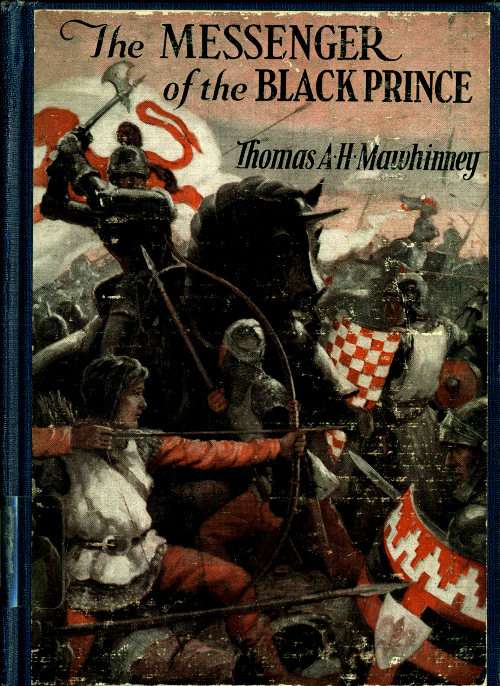
The Abbot, after he passed these two, drew up with a jerk. He wheeled around before the last of the three men could think fast enough to make a move, and before the first knight (the one with the lance) was in position to return to the fray. It was now one against one. With all odds for the final victory in favor of the Abbot, he grasped his mace in his hand and was about to put spurs to his horse to make an attack.
I heard a cry from one of the archers who were now coming up at a slower pace in the rear. He rose in his saddle and pointed down the road towards the bend. Just turning into full view we saw first the glint of the sun upon bright steel. There were four men riding towards us now—four, who, if they proved to be our foes, would settle the combat without the shadow of a doubt.
The Abbot lowered his mace. As though it were hardly worth his effort to strike down the last of the three who was now turning towards him to defend himself alone, he pressed his knees against the horse, and with a courage which I considered nothing more than folly rode on to meet his new foes.
You will understand, of course, that what I have been telling you happened in a very short time and with a swiftness that kept our eyes dancing from spot to spot. It was a whirlwind for speed and suddenness. Most of the time I was filled with marvel. Never once did I consider, now that I was free, that I ought to find a means of escape nor did Charles or the two captive archers, I am sure, have any other thought except their interest in the fight.
The Abbot took his course down the road. The men who had attacked him at the very beginning (the archers of the King) drew up on the side to let him pass. Not one of them raised his bow. With all the ease in the world they could have shot down the horse from under him, but instead they let out a shout that rang with approval. It was their sense of fairness, I suppose, that caused them to do this, and their respect for the boldness of the man. His deliberation, his surpassing skill, his ease, but above all now his utter confidence against such odds stirred their hearts with admiration and regard.
The battle was to be fought further down the road. Like a crowd of spectators at a tournament we saw we had no advantage where we were standing, so swept by the fervor and excitement of it all, the two captive archers, Charles and I ran along the bank at the side of the highway. We were within earshot when the four knights and the Abbot met. Indeed the latter was maneuvering his horse to dash into the fray when the foremost of his adversaries raised his hand as a signal that he was anxious for a parley.
“You are not a servant of the King?” he demanded.
“I am his enemy!” came the sturdy answer.
“There are four of us here,” were the next words. “Are you anxious to die?”
“I shall die when my time comes, not before,” replied the Abbot. “If there were a dozen, it would make little difference.”
The knight made a gesture with his hand.
“We will give you every advantage,” he said. “We will fight you one by one. Before we begin, will you let me see your face?”
The Abbot hesitated and then laughed.
“Agreed!” he replied. “Provided you let me see yours.”
Both men made a move with their hands, when the eyes of us all were drawn to the figure of a lone rider who had just come into sight around the bend in the road. He was on a horse as black as the raven’s wing. He must have been driving hard for its flanks were covered with white sweat and the froth was dripping from its mouth. The man himself was not much bigger than the Abbot. Although he was clad in a suit of black chained mail and had a casque on with the visor closed, I was able to see that his body was of unusual sturdiness with great breadth of shoulders and thickness of limb.
When he came up he drew rein, and with a smoothness that I had not expected, asked, “A fight, my gentles?”
The Abbot answered.
“—about to begin,” he said.
“Ho, ho!” was the reply. “But, I hope, not the four of you against one?”
I am sure the knight flushed under his helmet at the slyness of the taunt.
“Not at the same time,” he answered, and shifted uneasily on his saddle. “But no matter. He ought to die, for he is enemy of the King.”
The other laughed, and slowly moved over to the side of the Abbot.
“And so am I,” he answered. “Do you think I ought to die too?”
The knight gathered the reins in his hands.
“Who are you?” he demanded.
The Abbot interrupted.
“When you were coming up, my lord,” he said turning to the rider, “we were about to uncover. I have a suspicion that I know this man. He tells me that before I die he would like to know me——”
But the knight made a gesture full of wrath.
“We are wasting time!” he cried and put his hand to his visor. “When you drop from your saddle—dead, you will know that it was the Sieur de Marsac who killed you!”
The Abbot laughed, a slow taunting laugh.
“You know me as the Abbot of Chalonnes, my lord de Marsac. My shadow has hovered over these hills and valleys. I have balked your schemes and plans a hundred times,” he said impressively. “But I have worn other garbs than these,—and other faces. I have been a fool, a beggar, a highwayman—a dozen persons in one. I have watched you try trick after trick. I have snapped my fingers under your nose. All the time you thought yourself so clever, you have been but a bungler and a dunce.” He raised his visor inch by inch till his whole face was revealed. “Did you ever dream that you would be confronted, in armor such as this and on a footing equal to yours, your old friend, the Scrivener, the Highwayman of Tours?”
De Marsac’s mouth fell open. He looked, as though he were in a dream, from the Scrivener to the knight on the black horse.
“You!” he cried. “I have seen you, too, some time and some place before!”
“You have, de Marsac,” came the reply in a voice that shook like a peal of thunder. “We have met ere this. But today it will be for the last time. I shall not raise my visor, for I think you know now it would be useless. I am Edward, the son of England’s King, the Black Prince!”
CHAPTER XXVII
THE BLACK PRINCE AGAIN
The last sentence came like the crack of doom. The four men started in their saddles. Even the horses raised their heads and snorted. Without a word De Marsac and the Abbot—or the Scrivener as I knew him—closed their visors and with a grimness faced their foes. The Black Prince drove his spurs into his horse’s side and plunged forward. He closed his huge fist and swung his arm with all his might against the knight who was nearest. There was no time to draw a weapon. So sudden and with such determination was the attack that the man caught the blow on his helmet full in the face. His head went back with a snap and he fell to the road without a sigh or groan.
The Abbot was not far behind. He, too, urged his horse to the fore. But even in the hurry he took time to lay his hand upon his mace. The knight whom he had singled out was quick enough to draw his sword and to take a steady aim at the Abbot’s head. As the mace wheeled in the air the sword fell. It struck the top of the Abbot’s helmet so sharply that I heard the ring of it where I was standing. The steel was dented in but the sword shivered into a hundred pieces and left the useless pommel in its owner’s hand. Then the mace struck. The clang of it was like the sound of a great muffled bell. The Abbot had lifted himself in his stirrups to get a better swing. The knotted points crashed against the neck of his opponent. There was no armor broken but the force of the blow was strong enough to drive him forward with his face down flat over the horse’s mane.
That made two knights out of the fight at the first encounter. It is true that De Marsac and the other had tried to maneuver so that they could all strike at the same time. But the speed with which the Black Prince and the Scrivener had acted was more that they had counted on. They were left, with their horses prancing madly about, in the middle of the road while the two victors galloped on past and slowly reined in their steeds and turned around ready for the next trial.
They came back at an even trot. The Abbot had his mace grasped in his right hand taking a sure aim as he came up. The Black Prince sat like an iron statue on his horse. His mace, which was thrice the ordinary size, hung idly at his side. The Abbot singled out the remaining knight as his target. The men met. Their maces rose and fell in the same breath. Their aim was each at the other’s head. But their arms locked. The maces crashed together with a loud clap. The Abbot turned in his saddle and with a slight movement gave his wrist a twist. The mace fell out of his enemy’s hand and he was left on his horse with no weapon save his sword.
The Black Prince looked on the fight as though it were a mere play. He came on a little behind the Abbot, straight at his foe. De Marsac knew the strength he was to encounter. He poised his weapon in his hand to get the balance of it so that he might strike his hardest blow. He intended to come down upon his enemy’s head, for it was there that he considered him most vulnerable, and if successful, would put a quick end to him.
He rose in his saddle. His mace was in the air. The Black Prince stuck out his arm as though with it he would ward off the force of the blow. The mace descended. In the same second the Black Prince urged his horse a little to the side. The arm that was to receive the weight of De Marsac’s mace suddenly dropped. The blow was spent in the air and the weight of the weapon and the force he had behind it toppled De Marsac from his balance. His feet left the stirrup and he fell in a cloud of dust to the road.
The Black Prince could have ended the fight here. He might have jumped to the ground and crushed his enemy with his mace. The advantage was his, but he made no move except to lean over his foe and laugh.
“De Marsac,” he cried, “you ought to wear a cap and bells and carry a bauble in your hands. You would make a good king’s fool.”
If De Marsac was angry before, he was full of venom now. His horse had galloped off in fright and his mace lay on the ground.
“I am not done yet!” he cried and he took his weapon in his hand. “I will fight you till the end.”
It was only an idle boast. The Black Prince threw his leg over his horse and dropped lightly to the road. De Marsac with the fury of a madman whirled his mace about his head. He caught the Prince a heavy blow on the shoulder which would have knocked an average man kicking to the earth. The Prince stiffened himself to receive the shock, then, when it was spent, he knotted his mailed fist. He drove it with all his strength into De Marsac’s chest and dented the armor flat against his body. De Marsac spun and staggered like a man walking in a dream. Then, with his breath catching in his throat, he uttered a heavy groan and fell his whole length sprawling to the road.
I was so intent on the actions of the Black Prince that I almost forgot the Abbot. He had knocked the mace from his enemy’s hand to be sure. And then, when I turned to him again, I saw that the two men had wheeled their horses about and were running at full tilt at each other for the second time. The knight had his sword in his hand but the Abbot, like the Black Prince, was without arms of any kind, for he had hung his mace at the side of his saddle. When the knight raised his weapon to strike, the Abbot lowered his head and shoulders. With a deft movement he caught his foe by the wrist. As his horse was speeding past, he drew in the reins and gave the wrist a sudden twist. It was the same trick that he had done with the mace. The sword dropped from the knight’s hand but this time the Abbot held on. He half dragged his foe from his saddle and as he was slipping backward he dealt him a swinging blow on the side that sent him headlong from his seat rolling over till he flattened out on his back with his arms extended in the form of a cross.
I thought that the fight was now over and that all we had to do was to join the victors. I was burning to deliver my message to the Black Prince and to warn him of the great danger that threatened him from the army that was marching down the valley of the Loire. But I had counted too soon. The archers, who up till now, had drawn themselves up along the side of the road to witness the fray, began to feel the doubtfulness of their own safety. They saw, to their surprise, the Black Prince and the Abbot bowl over the four knights as though they were as inexperienced as boys. And when the leader, De Marsac, was sent tumbling to the ground, they looked to one another for a signal. Their captain was, of course, gone, but the boldest of them strung an arrow to his bow. The others followed suit. Before I could grasp the situation there were the lot of them, some aiming at the Black Prince, some at the Abbot, and one, indeed, had the thought even to cover us.
Charles gave me a shove in the ribs. I knew what he meant, so while the going was opportune, we edged back step by step, until we found ourselves in the shelter of one of the scrub trees. There were rocks around, as I have already said, so that with no more ceremony we jumped behind the first, then the second, till we were far enough away to be entirely safe.
Then I got the jar of my life. I heard a laugh, a wicked mocking laugh. Before the echo of it died away the Dwarf of Angers popped his head out from behind the boulder next to us. He must have gone the whole distance back to his cave, for he carried in his hands three strong bows and as many quivers full of arrows slung over his shoulder.
“Take this,” he said, “and go back.”
We were none too soon. The archers had already shot a round at the Black Prince and the Abbot and were stringing their bows for a second attack. The armor of the two warriors had, of course, protected them from hurt. They were both on foot and advancing step by step with dogged resolution. But there was always a chance that the point of an arrow pierce their armor at the vulnerable spot where the headpiece is joined to the corslet or through the opening for the eyes or mouth.
As soon as he saw what was happening, the Dwarf let out one of his unearthly yells. He bade each of us to single out a man. We raised our bows and the next second the twang of them sung in our ears.
One fellow dropped kicking in the dust. The archer, whom Charles hit, clapped his hand to his side and sank down on the grass at the edge of the road. My fellow was more fortunate, for, although I had taken a steady aim at the region of his heart, he made a sudden move as the arrow left the bow. I caught him above the elbow in the fleshy part of the arm. Although his wound was not deadly, it must have stung him with pain, for he uttered a scream. He threw his bow at his feet and with his arm limp at his side shuffled off to tear his shirt into strips to stop the flow of blood.
The victory was ours. It took only one round of arrows to bring our foes to our feet. The few of those left standing did not know which way to turn. The Dwarf with Charles and me at his heels broke from out our cover of the rocks. Each of us once more drew an arrow on his man. But it was only a threat that needed no carrying out. Our enemies saw that we had the upper hand and that to make a further show of fight would only mean their deaths. As though they were obeying a command, they threw their weapons out into the road and advanced with their hands extended as a sign of their submission.
It was all over. I ran faster than I had ever run before to the Abbot of Chalonnes. By this time he had raised his visor and was beaming on me with all the old-time twinkle in his eye.
“Where is the dagger that you were to bring to the Abbot of Chalonnes?” he demanded playfully.
“It is in the shirt of one of those fellows lying on the road,” I said. “He took it from me when they captured us in the inn.”
He gave me a resounding clap on the shoulder.
“It’s of no consequence,” he said. “I let you take it from me when I met you on the highway near your home. I knew you were without weapons and I was sure you would have need of it to protect yourself.” He smiled and looked at me a long time. “Ah, lad,” he said finally, “you have made a great fight of it. The best of it all is that you have come through.”
“But,” said I, “how did you get here?”
“I went back and made a long detour through the north of France. I knew you would have trouble near the end of your journey.”
“But, my horse?” I insisted. “Where did you find him?”
He jerked his thumb over his shoulder.
“The fellow who took him is lying back there somewhere in the woods.”
“And you’re not a highwayman, nor a thief, nor a scrivener after all?”
“Tut, tut!” he replied. “I told you once before that you should never judge a man by his clothes. I’m a simple servant of the greatest fighter in France—the Black Prince there. Come,” he said touching me on the arm. “I think you have a word for him.”
CHAPTER XXVIII
VICTORY ... AND HOME
I may say now that I have come to the end of my tale. I had come through as the Abbot said. But to my way of thinking it was more by blundering and good luck than by any craft or circumspection of mine.
I was glad to have my horse back again. The feel of him under me was like home. I rode along towards the west—that is towards the encampment of the army of the Black Prince—with more joy in my heart than had been my share for many a day.
It was by merest chance, I learned, that the Prince was in the neighborhood at all. His army lay a good two days’ journey off. He had sent scouts out to scour the country round about to warn him if the highways were safe for him to march to the south to his headquarters for the winter at Bordeaux. He had even gone out on an expedition himself. He had come upon a troop of the King’s horsemen and in pursuing them had ridden far out of his way, had outdistanced his followers and was lost for a night in the woods. He was on his way back when he came upon us, riding hard, for he had suspicions that there were more foes in the neighborhood than he had imagined.
But when I unfolded to him the tale of what I had gone through—of the activities in the valley of the Loire, the preparations for war that were going on on every hand, the vast number of soldiers (there were sixteen thousand, twice the number of his entire force) that were moving with the greatest secrecy towards the west, when he heard this, I say, he gritted his teeth and cried out, “They want to cut us off on our way south. They think they can crush the power of England in France. They are tricksters and knaves, men like De Marsac and his crew. But we have English brawn back of us, men who will take their lives in their hands for the joy of battle and of conflict. We’ll beat them yet.” He clenched his fists and repeated it. “We’ll beat them yet.”
And in the end it proved that he was right. I could spend another hour in your company and relate to you all that followed. But I feel that my manner of telling it would be incomplete. Besides the scribes of our times—men who knew how to wield the quill with greater skill than I—have written a history of it for all who will to read.
We came to the army of the Prince on the morning of the third day where it was lying north of the city of Poitiers. At once the movement started towards the south. The wisest plan would be to avoid a battle if we could. But we were scarcely under arms and it was while we were passing the city to the east that we saw the pennons of the King and after a while his horsemen and his knights. The army that I had seen piecemeal traveling down the valley of the Loire was joined in one. There was no escape from it now for they were bent on destruction and slaughter.
We faced them. The Prince was a master in the art of war. He chose his ground with all the care he could for he had to offset the greater number of his foes with matchless skill. The battle raged from early morn to the setting of the sun. The archers shot their arrows as thick as hail so that the air seemed filled with flakes of snow with the darting of the white feathers. Knights, who had won fame and name in every part of Europe, hewed and hacked with their battle-axes and their maces. Bright swords flashed like polished silver. The lancers charged. Men were toppled from their horses and rose again to fight it out upon the ground. It was like a sea tossed into storm. And when night fell the enemy withdrew fewer in number than they began, humiliated in defeat, with a blow delivered at them from which they for years to come were not able to recover.
The flower of their warriors threw their lives away in their arrogance and pride. The valley of the Loire was opened up in case we chose to take it. If we had had an army big enough the whole of France might have been annexed to the English crown, for when the prisoners were brought in it was to the amazement of us all that among them was the greatest enemy we had—the King of France himself!
You may be a bit curious to learn what part I took in the fight. I was but a lad, of course, and hardly of the strength to cope with knights who were seasoned and toughened by years of life in camp and on the field of battle. But even at that I did what might be considered my share. The Abbot furnished me with what accoutrement was needful. I rode beside him in the fray. The mace he gave me was of a weight that I could wield and the sword I used did its work as well as it might have done in older hands than mine.
At the first go I was overfull of haste. I had singled out a foe and was hard at it when the swaying of the fight carried him from me down the field. On another occasion I found myself between two knights who were vying with each other to see who could strike me down the first. I warded off their fury with what skill I had until one of them was stricken from behind by a hand that was as sudden as it was sure. The other I struck a fortunate blow for I stunned him so hard that he rode off the field to nurse his wound.
Late in the afternoon I was knocked from my horse, but had wit enough left to scramble again into the saddle. I was tossed here and there with driving force as the battle swayed this way or that. My helmet was dented in from the swing of a mace. My right arm near the shoulder was numbed from over action and from a sword beat that had landed on it.
But I came out of it with a whole skin and no bones broken which was enough to make me thankful. As for Charles of Gramont, I never laid eyes on him from the outbreak of the fight. It was long after dark when I found him inquiring among the troops who had been near me if they knew if I had fallen. When he saw me he threw out his hands. I must confess that a kind of weakness came over me at the sight of my companion. As though we were children we flew to each other’s arms and cried like babies.
Then came the parting. It is true that the Black Prince asked us to go along with him to Bordeaux to stay there for the winter with the promise that he would take us with him in the early spring on a campaign into Spain. For a while we were divided two ways, but the longing for home won in the end. Charles was anxious to get home to put his house in order and (now that he was left alone) to give care to the estate. As for me, I knew that my brother, André, was lying awake far into the nights, wondering what had become of me and whether he would ever lay eyes on me again. Besides the fall was coming on (it was already September) and I knew the streams were full of fish and that the woods about my home were thick with game.
You should have been present in our village when we rode in. The country folk (they had been warned of our coming beforehand) gathered from the fields. They wore their best of everything and I can tell you that their simple dress of velvet jerkins, their breeches of leather, their hats with feathers in them, never looked more welcome or more pleasing to my eye. You would have thought it was some great holiday for the country players were assembled. Jugglers and sleight-of-hand artists and to my surprise the man with the birds whom I had met on my journey out, came to greet us and to display the best of their wares. And in the midst of all the merrymaking it was my brother, André, who was the proudest man alive. He never left my side and when my name was mentioned, he boasted of my courage and my strength of will that led me on a quest through the heart of our enemies, till I had to turn my face away in shame.
We settled down to the quiet life of the countryside. The first snows of winter came and the fields about the house were covered white, when a courier rode into the yard. He was from Bordeaux on his way to the great city of Paris to negotiate for peace and a return of the King. He had been commanded, he said, to deliver a letter from his master, the Black Prince.
With my brother André looking over my shoulder, I broke the seal and read,
At Bordeaux. December
To Henri la Mar, the Norman,
My lad,It has long been in my minde to write you a lettre of thanks for the helpfull deed you performed. Your name shall always be enscrolled in my memorie and I shall think of you as a brave and worthie servant of your countrie. If there come a time when you wish to try your hande as a soldier of England, you will but come to me.
Your timely warning saved an army from destruction. Not only that, it saved your land and fireside from the greed of your enemies.
Edward.
Postscriptum.
It may be to your interest to learn that De Marsac recovered from the blow I gave him when we fought together on the highway. But he was slain later at Poitiers.
That was all.
“Well, Henri,” said André, “that letter is worth while.”
Transcriber’s Notes
- Copyright notice provided as in the original—this e-text is public domain in the country of publication.
- Silently corrected palpable typos; left non-standard spellings and dialect unchanged.
- In the text versions, delimited italics text in _underscores_ (the HTML version reproduces the font form of the printed book.)