
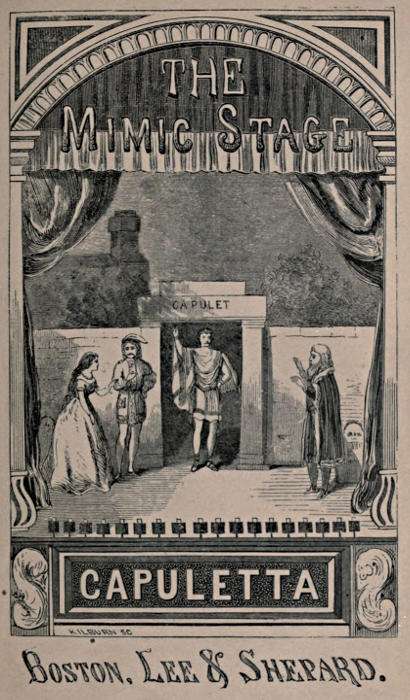
Scene 3. Capulet’s burying-ground. Tomb, C., on which is written, “No one allowed to pick here without permit of the proprietor.” Graves, R. and L., with headstones facing audience. On R. is painted, “To be occupied by Juliet Capulet;” on L., “To be occupied by Romeo Montague.”
[1] Half a cheese box covered with cotton cloth, on which is painted a very jolly face, with the letters S. T. 1860 X. upon it, illuminated by a candle placed behind, and drawn up by a pully and string, is the original moon prepared for this piece.
[2] The pianist or leader of the orchestra.
THE GREAT ELIXIR.
CHARACTERS.
| Waldimer Wiggins | (the seventh son of a seventh son). |
| Gunnybag Greenbax, | } Wiggins’ patients. |
| Nervous Aspen, | |
| Major Fingers | (a discontented Bridegroom). |
| Charles Freedley | (a dissatisfied heir). |
| Harry Quilldriver | (an author). |
| Herbert Easel | (his friend). |
| Dennis McGrath | (the Doctor’s help). |
| Bob | (the Doctor’s boy). |
COSTUMES.
| Wiggins. | —Eccentric gray wig, with cue, white necktie, crimson vest, dressing-gown, and slippers. |
| Greenbax. | —Long brown coat, gray wig, broad brimmed hat. |
| Aspen. | —Brown wig, nankeen pants and vest, dark coat, hat and cane. |
| Fingers. | —(Very short man.) Undress uniform. |
| Freedley, Quilldriver, and Easel. | —Modern costume. |
| Dennis. | —Red wig, white jacket, yellow vest, dark pants. |
Scene.—Wiggins’ Office. Table, C. Chairs, R. and L. of table. Entrances, R. and L. Letters and bottles on table.
Enter Wiggins, L.
Wiggins. I am a lucky man! I should like to know how many times an hour, by the most approved rules of computation, that sentence escapes my lips; to how many mirrors have I uttered those memorable words; how many sheets of paper have been devastated with that multum in parvo of sentences, I am a lucky man? Look at me, Waldimer Wiggins, seventh son of Waldimer Wiggins, the blacksmith, who was the seventh son of Wigglesworth Wiggins, the cooper. I, who have been knocked about the world like a shuttlecock, buffeted by everybody and everything; who never saw but one schoolhouse in all my life, and that from the outside,—here am I puzzling all the learned doctors, creating a frenzy among the apothecaries, and setting the whole town to taking medicine by the pint, quart, and even demijohn, and hauling greenbacks into my capacious pockets with an agility and velocity that would astonish the father of greenbacks. I am the lucky possessor of the greatest remedy of modern times,—a medicine that will cure anything and everything, anybody and everybody; and where there is nothing to cure, will make something, and then cure that. Men praise it, women dote on it, and children cry for it. I am the lucky possessor of this treasure, and yet I never received a diploma, or even amused myself with the graceful but rather monotonous exercise of the pestle and mortar. As I before suggested, it’s all luck. I’ll tell you all about it (seats himself familiarly before the audience). Like Byron, that beautiful but dyspeptic poet, “I had a dream.” It was one night after I had partaken of oysters. I generally indulge in a light supper before retiring. Upon this occasion it consisted of cold chicken, mince pie, pigs’ feet, and, as I before remarked, oysters. I had retired to my downy couch, when the following striking tableau was presented in a vision. I beheld the great Barnum, surrounded by greenbacks. On his right were the Albino woman and Joyce Heath, on his left, Tom Thumb and his Bride; while the “What is it?” a little elevated, was crowning the great showman with a wreath of posies. Of course my attention was first attracted to the free exhibition of curiosities, but after a careful examination of them, my eyes were fixed upon the great “Supporter of the Moral Drama,” by whom I was greeted with this characteristic original remark, “How are you, Wiggins?” to which I answered, as is customary in all polite circles, “How are you, Barnum?” “Wiggins,” said he, “do you want to make a fortune?” to which I responded, “I do.” “Then look in ‘The Daily Slungshot,’ outside, first column, top line, and obey the injunction there given.” I thanked the great man, signified to him that I thought him an immense individual, but that he could not keep “The Aquarial Gardens.” He pronounced my remark very of fish ous; and with this scaly joke, vanished. I awoke, purchased “The Slungshot,” sought the designated spot, and read this cabalistic word, “Advertise.” It was enough. I remembered a recipe an Indian woman had given me when a child. It was for curing corns. I resolved to make a fortune from that. Now everybody is not afflicted with corns; so, to have a striking effect on all diseases, I call my medicine “The Great Elixir,” and warrant it to cure everything. I might easily show you how all diseases are first taken into the system through the medium of corns, but as it would take some time to convince you, I will not make the attempt. Advertising has done the business for me, and now everybody is taking The Great Elixir and blessing the name of Waldimer Wiggins. (Rises, takes a seat at table R., and opens letters, making memorandums on each as read.) Now, here is a string of correspondents that would puzzle a regular physician, but which I, with my superior skill, can dispose of in a very few moments. (Reads.) Hm! an old lady has fits. (Mem.) Take The Elixir three times a day. (Reads.) An old gentleman with a bald head wants his hair to grow. (Mem.) Apply The Elixir externally and internally three times a day. (Enter Dennis, L.) Well, Dennis, what is it?
Dennis. Faith, I don’t know; there’s the kitchen fire don’t burn at tall, at tall, and there’s a gintleman wants to say the dochter.
Wiggins. Show the gentleman in here, and put “The Great Elixir” on the fire. If that wont make a blaze, then nothing will. (Exit, R., with letters.)
Dennis. Faith it’s an illigant man is the dochter. It’s the—the learning he has onyhow, and it’s the fine physic he makes. The Great Elixir. Put it in the fire? by my sowl, I will do that same; and—and in the blacking and in the soup. It’s meself that has a mind to take a wee dhrap meself, for the sthrong wakness I have for Judy Ryan. Bless her purty face! (Enter Charles Freedley, L.)
Charles. Did you tell Dr. Wiggins I wished to speak with him?
Dennis. Indade I did, sir, and he’ll say yez in a minute. (Exit, L.)
Charles. So this is the office of the Great Doctor. Great Fiddlesticks! He’s no more a doctor than I am, and he shall own it, too, before I’ve done with him. There’s my Aunt Hopkins, whose heir I expect to be, crazy about this Dr. Wiggins. Calls his “Great Elixir” delightful, and vows she will leave him a legacy. Now I have set my heart on possessing all the property of Aunt Hopkins, and have no idea of parting with it to such a humbug as this; and here I am on a voyage of discovery, which will, I hope, end in the unmasking of this quack. (Enter Wiggins, R., slowly, his eyes fastened on an open book in his hand.)
Wiggins. Why is the privacy of the Seventh Son of the Seventh Son thus intruded upon?
Charles. Privacy? Why, aint you a regular physician?
Wiggins. I am, very regular. My office hours are from 10 A. M. to 2 P. M. The balance of my time is devoted to the study of the human system; to poring over the open book of nature, or to gazing in quiet, tranquil solitude upon the sublime spectacles performed by stars of the first magnitude.
Charles. Oh! you mean at the theatres.
Wiggins. Theatres, sir! No, sir, the study of the heavens is enough for my inquiring mind. What want you with me?
Charles. I have a very painful malady.
Wiggins. What is it?
Charles. An itching sensation in my hand. (Aside.) Itching to get hold of you.
Wiggins. Let me look at it (offering to take it).
Charles (raising his arm quick, hits the doctor in the stomach). It hurts me when I raise it thus.
Wiggins (jumping back). Oh! confound you! Then why in the deuce do you raise it thus?
Charles. I want it cured.
Wiggins (looking very wise). Let me see. Mars in the seventh heaven, and Jupiter in an eclipse, Venus in a brown study, and Mercury in the blues. Young man, the stars tell me you can be cured.
Charles. Much obliged to the stars. How?
Wiggins (speaking very quick, as though repeating an old story). By a plentiful application of “The Great Elixir,” which will cure coughs, colds, burns, bruises, consumption, fits, fevers, earache, heartache, headache, toothache, corns, bunions, etc., etc. Whose virtues are known and appreciated from one end of the continent to the other. Prepared under the special directions of the stars, and sold by all respectable druggists at the low price of one dollar a bottle.
Charles (aside). Just as I thought, an ignorant quack. (Aloud.) I will procure a bottle, and give it a fair trial. (Aside.) I’d sooner take poison than his infernal stuff. (Exit, L.)
Wiggins. It is thus that science blesses her devotees with the glow of success. (Looking at watch.) 10 o’clock! We must prepare for the patients. Here, Dennis (Enter Dennis, L.), prepare the paraphernalia.
Dennis (puzzled). The what is it?
Wiggins. Prepare the paraphernalia.
Dennis. Yis, sir, directly (going, L.).
Wiggins. Where are you going?
Dennis. For the razor, sir.
Wiggins. Razor! What do you want of a razor?
Dennis. To pare your nails ouv course. You wouldn’t expect me to bring an axe.
Wiggins. Oh, pshaw! Set out the table and put the instruments upon it; it is time to receive patients.
Dennis. Oh, yis, sir. (Aside.) Why don’t he spake his mother tongue in the first place (sets table in C., takes from a drawer in the table a long carving-knife, a saw, and other instruments, places them upon the table. Wiggins seats himself at back of table pompously. Bell rings outside).
Wiggins. Our first patient. Show him in, Dennis.
Dennis. Yis, sir. (Exit, L.)
Wiggins. Talk about your colleges! What is the good of them while there’s newspapers to advertise in, and people with throats large enough to swallow anything. (Enter Dennis with Greenbax, L.) Hallo, who’s this?
Dennis. Here you are, sir; that’s the doctor; be quick, for he’s awful busy.
Greenbax. Dizzy! I should think so; it’s enough to make anybody dizzy climbing so many stairs. Where’s the doctor?
Dennis. There he is in his place!
Greenbax. Wrong place! Why didn’t you tell me so before?
Dennis. What a stupid ould man.
Wiggins (coming forward). Here’s a queer customer. What do you want?
Greenbax. Hey?
Wiggins. Do you want the doctor?
Greenbax. Of course I do (going).
Wiggins. Hold on, I am the doctor.
Greenbax. Hey?
Wiggins. I am the doctor.
Greenbax. Yes, yes, I want the doctor.
Wiggins (very loud). I am the doctor. Stupid!
Greenbax. No, no! Dr. Wiggins, not Dr. Stupid.
Wiggins (shouting). I am Dr. Wiggins. Who are you?
Greenbax (holding out his hand). Pretty well, I thank you; a little deafness for you to cure, that’s all.
Wiggins. How long have you been so?
Greenbax. Yes, it does look like snow, but I think it will turn to rain.
Wiggins. How long have you been in this condition?
Greenbax. Awful bad condition. I went over shoes in mud getting here.
Wiggins. Oh, pshaw! what’s to be done with him? (Still louder.) Does your deafness increase?
Greenbax. Hey?
Wiggins (shouting). Do you keep getting worse?
Greenbax. Oh, yes! I keep a horse,—fast one, too.
Wiggins. I am speaking about your ear.
Greenbax. Yes, I’ve had him about a year. He has the heaves a little.
Wiggins (shouting). I’m talking about you—you—you!
Greenbax. Me! oh, no! I never had the heaves.
Wiggins. Oh, dear, dear! what shall I do? (Shouting.) Have you ever tried The Elixir?
Greenbax. No, sir, I never do. The hostler he licks her sometimes.
Wiggins (desperately takes bottle from table). Here, take this three times a day.
Greenbax. Certainly, with pleasure. I’ll take it to Mr. Day. Go right by his house.
Wiggins (shouting). No, no; take it yourself.
Greenbax. Oh, yes; for my ear.
Wiggins. Apply it externally and internally.
Greenbax (looking at bottle). It does have an infernal look. Oh, I’ve tried this, it wont do. Must have something stronger,—something to shake me up.
Wiggins. I must try something else. What shall it be? I’ll mix something to warm him up. I will return in a moment. (Exit, R.)
Dennis. What an ould heathen! he’s as deaf as ould Mother Mullin’s cow, that was so deaf she couldn’t say straight. What’s the matter wid his ears? they’re long enough onyhow. (To Greenbax.) Servant, sir!
Greenbax. Hey?
Dennis. It’s a fine day, sir.
Greenbax. No. Nothing to give away. Go to the poorhouse.
Dennis. Poorhouse, is it, you thaif!
Wiggins (outside). Dennis!
Dennis. Coming, sir. Away wid yez, you deaf ould haddock. (Exit, R.)
Greenbax. So many beggars about. Strange the police will allow it. (Re-enter Dennis, R., with a phial.)
Dennis. I’m to give the deaf fellow, then, this bottle, and he’s to follow the directions. What’s that? (Reads label.) “To be well shaken before taken.” Faith, my boy, I’ll do that same for yez. (Seizing Greenbax and shaking him.) Ye’d have me go to the poorhouse, would yez?
Greenbax. Murder, murder!
Dennis (shaking him). Howl away, ye spalpeen. ’Twill help the circulation.
Greenbax. Murder, murder!
Dennis. Once more, ould man, and then ye’ll do.
Greenbax. Murder, help, murder! (Enter Wiggins, R.)
Wiggins. What are you doing, you scamp?
Dennis. Faith, obeying orders, to be sure. “To be well shaken before taken.”
Wiggins. You stupid blockhead! I meant the medicine, and not the patient.
Dennis. Oh, murder! I thought it was the ould man.
Wiggins (shouting). I’m sorry this happened; ’twas all a mistake.
Greenbax. Yes. It was a pretty good shake.
Wiggins. My man will be more careful in future. (Gives him phial.)
Greenbax. Shall I take this?
Wiggins. Yes, morning and night.
Greenbax. Oh, no! I wont get tight. I belong to the temperance society. Good-by. (Exit, L.)
Wiggins. There’s one disposed of. Who’s the next, Dennis?
Dennis. Mr. Aspen, the shaky gintleman.
Wiggins. Oh, yes! Show him in, Dennis. (Exit Dennis, L.) My nervous patient; we must shake him up a little. (Re-enter Dennis with Aspen, who is very nervous; drops first his hat, in picking that up drops his cane, and then his gloves (to be continued). Wiggins takes his seat at back of table. Dennis sits R. of table, and during the scene with Aspen flourishes the carving-knife, scrapes it on the table, etc., to frighten Aspen.)
Wiggins. Good-morning, Mr. Aspen. Take a seat. How do you feel this morning?
Aspen (sits L. of table). Oh, I don’t know, I guess—I think—I should say—I must be-er—kind-er—sort-er—I don’t know.
Dennis. Faith! He’s getting no better very fast.
Wiggins. A decided improvement. How much of the Elixir have you taken?
Aspen. Two dozen bottles.
Wiggins. Not enough. You must take a gross.
Dennis. Not enough. You must take a gross (flourishing knife).
Aspen (shaking). A gross? Oh, dear!
Wiggins. Perhaps a barrel.
Dennis. A barrel (flourishing knife).
Wiggins. Your nervous, bilious organization is completely prostrated by sudden and repeated attacks of dorrammomphia, and an enlargement of the ambigular excrescences in the influctions of the cornicopia.
Dennis. D’ye mind that now? (knife.)
Wiggins. You must continue the Elixir night and day, and in six or seven years you will be entirely cured.
Dennis. Yes, skewered (knife).
Aspen. But it makes me so horrid sick.
Wiggins. What if it does?
Dennis. What if it does? (knife.)
Aspen (rising). Well, no matter, I’ll take it. Take a barrel of that nasty stuff. Oh, dear! (Exit with Dennis, L.)
Wiggins. That is one of my best patients. With a little moral suasion, I shall be able to make him swallow a hogshead of the Elixir. (Enter Dennis, L.) Well, Dennis, who now?
Dennis. Major Fingers, sir. (Exit Dennis, L.)
Wiggins. Major Fingers! who the deuce is Major Fingers? It must be a military man. I’m afraid of those chaps. I’ll tell Dennis I can’t receive him. (Starts for door, L., and nearly upsets Major Fingers, who enters.) Excuse me, sir, I didn’t see you.
Major (fiercely). Didn’t see me, stupid, swords and bayonets! Is this the way you receive patients?
Wiggins. Excuse me, sir; but you are so diminutive.
Major. Diminutive, sir! Look at my face! look at that moustache! Is there anything diminutive about that? I’d have you know, sir, that I am the equal of any man, in intellect, sir.
Wiggins. I really beg your pardon. To what do I owe the honor of this visit?
Major. My name is Fingers. I called to see you about my wife.
Wiggins. Your wife? You mean your mother.
Major. Swords and bayonets! sir, what do you mean? My wife, I said. Didn’t you know I was married? I thought everybody knew it. Married in New York. Great eclat. Everybody turned out. Married in style, style. Yes, sir, style.
Wiggins (aside). What a young bantam.
Major. Now, sir, I have come to you on a very important matter. No listeners about, hey?
Wiggins. Not a soul.
Major. Then listen. When I was married I took a beautiful young lady of my own size. Perhaps you’d like to know the reason. I had been my own master so long that I could not bear to have a woman rule over me, so, although I have had many ladies at my feet, I waited until I met my “Vene.”
Wiggins. Your Vene?
Major. Yes, my “Vene,”—short for Lavinia, my wife.
Wiggins. Oh! I see. Short wife, short name.
Major (fiercely). Sir!
Wiggins. Oh, no offence intended.
Major. Well, sir, soon after my marriage, my “Vene” undertook to tell me, her lord and master, that if I stopped out after ten o’clock, she would turn the key on me. Think of that!
Wiggins. It’s outrageous.
Major. Now, sir, seeing the advertisement of your “Great Elixir,” I have called to see if it will do what it pretends,—a miracle,—and make a tall man of me.
Wiggins. Make a tall man of you? (Aside.) Here’s a job. What’s to be done? I must get him for a customer; he’s rich. (Aloud.) Yes, sir, the Elixir will cause you to grow right out of your boots. You shall see a specimen of its working. Dennis! (Enter Dennis, L.) Where’s Bob?
Dennis. Down-stairs, sir.
Wiggins. Send him up. (Dennis going.) And hark you, Dennis. (Whispers.)
Dennis. All right. I understand. (Exit, L.)
Wiggins. Be seated, major, and you shall see a specimen of the miraculous effects of the Elixir. (Enter Bob, with a long cloak on his shoulders and a fur cap on his head.) What are you doing in that rig? Do you think it is winter?