
The Project Gutenberg eBook of The Modern Pistol and How to Shoot It
Title: The Modern Pistol and How to Shoot It
Author: Walter Winans
Release date: December 12, 2012 [eBook #41610]
Most recently updated: October 23, 2024
Language: English
Credits: Produced by The Online Distributed Proofreading Team at
http://www.pgdp.net (This file was produced from images
generously made available by The Internet Archive.)
By WALTER WINANS
The Art of Revolver Shooting.
Royal 8vo. New Edition, Revised and Enlarged. Fully Illustrated net, $5.00
The Sporting Rifle.
Royal 8vo. Fully Illustrated net, $5.00
Automatic Pistol Shooting.
16mo. Illustrated net, $1.00
Practical Rifle Shooting.
16mo. Illustrated net, 50 cents
Shooting for Ladies.
12mo. 50 cents
Animal Sculpture.
Crown 8vo. Illustrated net, $1.75
G. P. PUTNAM’S SONS
NEW YORK LONDON
THE AUTHOR
Photo by London Stereoscopic Co.
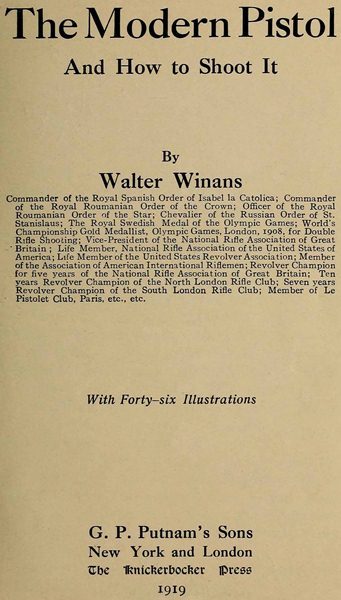
The Modern Pistol
And How to Shoot It
By
Walter Winans
Commander of the Royal Spanish Order of Isabel la Catolica; Commander of the Royal Roumanian Order of the Crown; Officer of the Royal Roumanian Order of the Star; Chevalier of the Russian Order of St. Stanislaus; The Royal Swedish Medal of the Olympic Games; World’s Championship Gold Medallist, Olympic Games, London, 1908, for Double Rifle Shooting; Vice-President of the National Rifle Association of Great Britain; Life Member, National Rifle Association of the United States of America; Life Member of the United States Revolver Association; Member of the Association of American International Riflemen; Revolver Champion for five years of the National Rifle Association of Great Britain; Ten years Revolver Champion of the North London Rifle Club; Seven years Revolver Champion of the South London Rifle Club; Member of Le Pistolet Club, Paris, etc., etc.
With Forty-six Illustrations
G. P. Putnam’s Sons
New York and London
The Knickerbocker Press
1919
Copyright, 1919
BY
WALTER WINANS
The Knickerbocker Press, New York
PREFACE
My first book on pistol shooting (The Art of Revolver Shooting) was published in 1900. Up to that date there existed no book which contained instruction on pistol shooting, though several books had appeared describing the different makes of pistols.
Since that date several books have appeared—some very good ones, by various revolver experts. Unfortunately (as always happens when something original appears), others who were not revolver shots took to writing books on the same subject, largely made up of unacknowledged extracts from my books. Not understanding their subject, they distorted my teaching, and so any one trying to learn pistol shooting from them gets hopelessly confused.
I therefore give this warning; do not follow the advice of any but an acknowledged expert in pistol shooting, as books by hack writers, made up of extracts from other writers, and illustrations from gunmakers’ catalogues, are not to be taken seriously.
Moreover, the revolver is now obsolete, and there is no use learning to shoot it.
My object in writing this book is to give instruction in the modern substitute for the revolver. That is to say, the automatic pistol, and incidentally, to instruct in the single shot or duelling pistol.
For those who wish to study revolver shooting, I would refer them to my book The Art of Revolver Shooting.
The present work might be called volume ii. of The Art of Revolver Shooting, as it instructs in the form of pistol shooting which has now taken the place of revolver shooting.
Though the revolver is now obsolete, my Art of Revolver Shooting is of interest, as giving details of out-of-date firearms, and the best-on-record scores made with them.
These records will be of the greatest importance for future generations.
There are now no records extant of scores made with the long bow, the cross-bow, and the various stone-hurling slings and balistæ. All concerning them is legendary.
If we depended only on newspaper articles for what was possible in revolver shooting, we should get legends similar to those of obsolete arms.
I was credited with making a World’s Record with a revolver at five hundred yards by a reporter when it should have been fifty yards. He merely added a nought to the figures.
As all records are important for historical purposes, and for comparison with future scores, I give as an appendix in this book those revolver records which cannot now be beaten, the revolvers and cartridges being now no longer made.
It is curious how, even up to the outbreak of the Great War, people did not understand that shooting was more important than playing games, or that shooting had to be learned.
I recently read a “trench anecdote” which relates that a man who had never fired a shot before he was conscripted was shot in the back, and whilst dying, “seized his rifle and dropped an enemy who was running past 200 yards off.”
To do this would require a first-class trained rifle shot who specialized in shooting at moving objects, and even he, with his back broken, could not swing, which is the essence of successful shooting at moving objects.
Another writer, a lieutenant, wrote during the war to one of the daily papers, advising the purchase of a revolver to be deferred till actually starting for the Front!
I have had several men on leave bring me revolvers and automatic pistols, asking me to test them, as they could not hit anything with them at the Front.
With one of these pistols I made the highest possible score at thirty yards; with another I made ten out of twelve bulls at twenty yards. None of the pistols was wrong. It was the men’s lack of skill.
Just before the war, several rifle ranges in England were closed, because they interfered with golf players.
It is to be hoped that after this war, men will spend their spare time in learning rifle and pistol shooting instead of wasting it in games, and will not close rifle ranges because they interfere with their golf links.
The fallacy that games are the best training for military service is exposed by a very interesting article in the Field newspaper.
I maintain that no man who has not the instinct to shoot ingrained in him, will shoot when under intense excitement and danger. If he is a player of games he will not shoot, but throw things at his adversary, or use his rifle as a pike or club.
Mr. John Lloyd Balderston, writing to the Field newspaper of September 29, 1917, says:
“An officer showed me his charges going through a mimic attack—firing rifle volleys instead of hurling bombs or going in with the bayonet; in these attacks reliance was placed too much on the bayonet and bomb—now we have realized that when the enemy runs away and you run after him he is likely to get away. Accordingly we teach the men not to rush wildly along with the sole idea of bayoneting, but to stop and pump some bullets after him.”
Walter Winans.
January 1, 1919,
17 Avenue de Teroneren,
Bruxelles, Belgique.
CONTENTS
| PAGE | ||
| Preface | iii | |
| CHAPTER | ||
| I.— | Introduction | 1 |
| II.— | Sport Versus Sports | 6 |
| III.— | Why Pistol Shooting is Unpopular | 13 |
| IV.— | The Wrong Way to Learn | 16 |
| V.— | Preliminary Information | 20 |
| VI.— | How to Prevent Accidents | 26 |
| VII.— | How to Prevent Accidents (Continued) | 33 |
| VIII.— | Trigger-Pull | 38 |
| IX.— | Ammunition | 44 |
| X.— | First Lessons | 46 |
| XI.— | Learning to Shoot | 53 |
| XII.— | Sights | 62 |
| XIII.— | Targets | 71 |
| XIV.— | Practical Targets | 77 |
| XV.— | How to Hold the Pistol | 80 |
| XVI.— | Running Shots | 86 |
| XVII.— | Running Shots (Continued) | 92 |
| XVIII.— | Shooting an Automatic Pistol | 97 |
| XIX.— | Timing Apparatus | 102 |
| XX.— | Snap Shooting | 104 |
| XXI.— | Long Range Shooting | 108 |
| XXII.— | The Automatic Pistol | 113 |
| XXIII.— | The Mechanism of the Automatic Pistol | 118 |
| XXIV.— | Peculiarities and Faults of Automatic Pistols | 125 |
| XXV.— | Final Practice | 132 |
| XXVI.— | Exhibition Shooting | 135 |
| XXVII.— | Control of Temper | 139 |
| XXVIII.— | The Effect of Alcohol and Nicotine on Shooting | 145 |
| XXIX.— | Cleaning and Care of the Pistol | 152 |
| XXX.— | Practical Pistol Shooting | 154 |
| XXXI.— | Danger of Leaving Pistols about | 160 |
| XXXII.— | Using One’s Brains in Shooting | 163 |
| XXXIII.— | The Perfect Target | 166 |
| XXXIV.— | Is Duelling Wrong? | 171 |
| XXXV.— | Remarks on Duelling | 176 |
| XXXVI.— | Remarks on Duelling (Continued) | 180 |
| XXXVII.— | Details as to Duelling | 185 |
| XXXVIII.— | Ought Duelling to be Abolished? | 189 |
| XXXIX.— | How to Prepare a Novice in Half an Hour for a Duel | 194 |
| XL.— | Pistols for Self-Defence | 200 |
| XLI.— | Dress | 207 |
| XLII.— | Self-Defence | 212 |
| XLIII.— | Protecting the Eyes and Ears | 215 |
| XLIV.— | Eyesight | 222 |
| XLV.— | The Weather and Shooting | 226 |
| XLVI.— | Military Automatic Pistols | 231 |
| XLVII.— | Recoil | 239 |
| XLVIII.— | Judging Distance | 243 |
| XLIX.— | Game Shooting | 249 |
| L.— | Shooting from Horseback | 253 |
| LI.— | Gallery Automatic Pistols | 260 |
| LII.— | Shooting Gallery | 266 |
| LIII.— | The Gastinne-Renette Gallery | 270 |
| LIV.— | Open Air Ranges | 276 |
| LV.— | Shooting in Literature | 280 |
| LVI.— | Grip | 285 |
| LVII.— | Trick Shooting | 291 |
| LVIII.— | The Devilliers Bullet | 300 |
| LIX.— | Killing Injured Animals | 305 |
| LX.— | Competitions | 313 |
| LXI.— | Police Pistols | 317 |
| LXII.— | Inventors | 320 |
| LXIII.— | Simplification | 326 |
| Appendix A | 333 | |
| Appendix B. The Law Relating to Revolvers and Revolver Shooting in Great Britain and Ireland |
351 | |
| Appendix C. The Law of Carrying Weapons in the United States | 360 | |
ILLUSTRATIONS
| PAGE | |
| The Author | Frontispiece |
| Breech-Loading Pistols | 47 |
| Author’s Winning Score for Gastinne-Renette Competition, April 7, 1910 | 49 |
| Colt Automatic Pistol, Pocket Model, Calibre .32 | 52 |
| Colt Automatic Pistol .22 Target Model | 54 |
| Colt Automatic Pistol, Military Model, Calibre .38 | 70 |
| Colt Automatic Pistol, Military Model, Calibre .45 | 70 |
| How to Hold the Duelling Pistol (1) | 82 |
| How to Hold the Duelling Pistol with Spur (2) | 83 |
| Colt New Safety Disconnector Automatic Pistol, .25 | 129 |
| The Gastinne-Renette 16 Metres Target | 168 |
| Ornamental Duelling Pistols by Gastinne-Renette | 181 |
| Pistols by Gastinne-Renette | 183 |
| Colt Derringer | 203 |
| Colt Automatic Pistol .25 | 205 |
| United States Army Regulation .45 Colt Automatic Pistol | 233 |
| United States Army Regulation .45 Colt Automatic Pistol. Sectional View | 237 |
| Gastinne-Renette Gallery | 271 |
| Gastinne-Renette Gallery—Firing Points | 273 |
| Shield on Duelling Pistol with Guard for Devilliers Bullet | 301 |
| The Greener Killer | 310 |
| Winans’ Revolver Front Sights | 324 |
| Author’s World’s Record Score | 334 |
| Author’s World’s Record Score | 335 |
| Author’s World’s Record Score | 336 |
| Author’s World’s Record Score | 337 |
| Author’s World’s Record Score | 338 |
| Author’s World’s Record Score | 339 |
| Author’s World’s Record Score. Twenty Yards Disappearing Target | 340 |
| Author’s World’s Record Score. Twenty Yards Disappearing Target | 341 |
| Author’s World’s Record Score. Twenty Yards Disappearing Target | 342 |
| Author’s World’s Record Score. Six Shots in 12 Seconds | 343 |
| Author’s World’s Record Score. For Military Revolver and Sights | 344 |
| Author’s World’s Record Score. Twenty Yards Rapid-Firing Target | 345 |
| Author’s World’s Record Score. For 3-Inch Bull’s-Eye Traversing Target, 20 Yards | 346 |
| Author’s World’s Record Score. For 2-Inch Bull’s-Eye Traversing Target, 20 Yards | 347 |
| Author’s World’s Record Score Advancing Target | 348 |
| Author’s World’s Record Score Fifty Yards Target | 349 |
| Twelve Highest Possible Scores Made by the Author in Revolver Competitions at 20 Yards in 1895 | 350 |
The Modern Pistol and
How to Shoot it
CHAPTER I
INTRODUCTION
There is now no use learning revolver shooting. That form of pistol is obsolete except in the few instances where it survives for target shooting, or is carried for self-defence; just as flintlock muskets even now survive in out-of-the-way parts of the world.
If a man tries to defend himself with a revolver against another armed with an automatic pistol he is at a great disadvantage.
The automatic is more accurate than a revolver, as the “blow-back” does not vary as much as does the escape of gas past the cylinder in a revolver.
The bullet in the revolver has to jump into the cylinder, whereas in the automatic it is already fitted up against the rifling, before being fired.
The single-shot pistol is the most accurate of any, there being no escape of gas.
The automatic has not only a much longer range than the revolver (although the popular idea that it can be shot accurately at a thousand yards or more is nonsense) but it cocks itself instead of having to be cocked by the thumb, or trigger finger.
Cocking by trigger-pull is such a strain on, not only the trigger finger, but the whole hand, that, after a few shots, good shooting cannot be made.
I won all my rapid-firing revolver competitions using the single action and cocking with the thumb, as this rested my trigger finger.
With the automatic, cocking is unnecessary and, with its lighter recoil, good scores in rapid-firing are very much easier to make.
The penetration of the nickel-coated automatic bullet propelled by its big charge of nitro powder is very great.
A man brought me a “pistol-proof” cuirass to test; I put a bullet at twelve yards clean through it and then through two “bullet proof” ones, placed one behind the other. (I used a regulation U. S. .45 Automatic pistol.)
This was before the war. The inventor was disappointed. He had experimented only with revolvers shooting soft leaden bullets and these his cuirass had stopped.
Unfortunately, in its present comparatively imperfect development, the automatic is the most dangerous firearm of all pistols for a novice to handle.
The long barrel of a rifle can be struck aside if a beginner swings it round and points it at the instructor or a nearby spectator, but the short barrel of a pistol is easily pointed at and with difficulty brushed aside by the unfortunate person standing near a “brandishing” and “flourishing” man who is learning to shoot.
In spite of all warnings even those who ought to know better do this swinging about. In fact, it is the recognized way of handling a pistol; according to reporters, they always say So and So “was brandishing a pistol” if he happens to be armed.
You can test the truth of the above remark by asking any one to show how he would shoot a pistol.
He will raise his hand above his head and then jerk it down. It is very difficult to get any one to understand the danger and the futility of doing this.
Euclid tells us the shortest way from one point to another is a straight line. Why then, in order to get the muzzle of your pistol on an object, move it towards the stars first?
Never let the muzzle of any firearm, either loaded or unloaded, point in the direction where it would do harm unintentionally if discharged.
I, once only, in all my experience, found a beginner who did not do this, and the beginner was a lady!
After a few shots with a duelling pistol the wind blew the target down, the pistol was loaded and at full-cock in her hands. I had seen enough of how she handled a pistol, to know she had grasped the necessity of never pointing where there is danger.
The target blew down as she was beginning to aim at it; she raised the muzzle vertically and put the pistol at half-cock, I at the same moment going forward to put the target back in place.
With any other beginner I would have taken the pistol with me when I went up to the target.
Smoking is one of the greatest enemies to good shooting, even more so than alcohol.
A drinking man may, for a time, shoot well, till his nerves are destroyed, but smoking, long before it kills, makes a man unable to shoot well. He has too much twitch in his muscles.
It is curious how heavy smokers deceive themselves, and think it does them no harm.
At a dinner, a man told me that smoking could not possibly interfere with a man’s shooting.
He said: “I can lift a tumbler full of water without spilling a drop.”
There were plenty of tumblers and a decanter before him, but he took very good care not to demonstrate his contention.
I looked for his hands; he had one carefully out of sight, behind him; the other, with the eternal cigarette between the fingers, he was pressing tightly to his waistcoat, but not tightly enough to prevent my seeing that his hand was trembling as if with the palsy.
Then, he added, to clinch his argument:
It is all nonsense to pretend that smokers cannot stop smoking if they want to; I stopped for a whole week and the only thing was that I did not sleep and had no appetite; it was not worth it, so I began smoking again.
This is an extreme case, but all smoking, from the first whiff, is cumulative poison, deteriorating the nerves.
If a man gives up smoking and takes to pistol shooting in the open air, he will find his nerves enormously strengthened and, as long as he guards his ears from the concussion (which I will deal with later), his health much improved.
For elderly men also there is not the strain on the heart as in golf or tennis.
CHAPTER II
SPORT VERSUS SPORTS
When I wrote my book on revolver shooting, in 1900, I caused indignation amongst many, by saying that the time wasted over games would be better employed in learning to shoot.
I was told that, although pistol shooting might be amusing, it was “such a waste of time and of no practical use,” and this by men who waste most of their time over golf!
Later, the Kipling poem on Flanneled Fools and Muddied Oafs came out, and there was an outcry as if one of the dogmas of the church had been assailed.
If games are so good for the health, why does one see so many young men with round backs and contracted chests, and heads poking forward, in England?
Until the war is forgotten, shooting men will be considered as making better use of their time than players of games, and the latter will not consider themselves superior to all others, and, figuratively speaking, carve footballs on the tombs of their heroes (as the feet were crossed on the tombs of crusaders) to indicate the greatest deed of the deceased.
A great deal of this worship of “Sports” is the confusion, owing to the similarity of the sound and spelling, between “sport” and “sports.”
“Sport” is the backbone of all manhood. It is the hunting instinct inherent in all healthy, normal males; it means the cultivation of skill in shooting and horsemanship, and men proficient in it are ready to rise in the defence of their country.
This is what “sport” means. Now, however, the term “sportsman” is employed to mean a man who has never fired a shot or swung his leg over a horse, but one who is merely a kicker or hitter of balls, or worse, one who sits sucking at a cigarette watching others playing games. The things he indulges in are called “sports,” and it is “sports” which, before the war, were considered to overshadow all else, and were taught at schools and colleges.
A feeble old man, past active participation in “sport” can be, of course, excused if he keeps himself in health by playing golf, but a healthy young man should shoot or ride.
The general public, not knowing the training necessary before a man can either shoot or ride, imagines that there is no necessity to learn either.
They think that the moment a man puts on a military uniform he can ride in a cavalry charge, break wild horses, or hit a man a thousand yards off with either pistol or rifle.
Besides the absence of skill in shooting, there is not in such men the instinct to shoot.
A shooting man has in him the instinct of shooting, so innate that he aims and presses the trigger as instinctively as he lifts his foot when stepping off the road on to the curb.
He does not have to think at all.
If he is crossing a field in which there is a savage bull, when carrying a gun, rifle, or pistol, his only anxiety is not to be compelled to shoot. It might get him into trouble with the farmer. Any danger to himself from the bull he knows does not exist.
A man who knows nothing about shooting, even if given a loaded pistol, gun, or rifle, before crossing the field, would be more afraid of the firearm going off than of the bull, and, if attacked, would club the gun or rifle to hit the bull with, or would throw the pistol at it.
Painters of battle pictures depict soldiers using their rifles as clubs or pikes, not as shooting with them.
As an artist myself, I know one excuse for this.
You need a model who is a shooting man, to pose correctly for a soldier shooting. Such a model is expensive, but you can get any one to pose as a man clubbing with the butt end of his rifle.
When I say that every able-bodied man should know how to shoot, and that it is a disgrace if a man cannot both shoot and ride, I am answered: “Shooting is a gift, I could not learn to shoot if I tried all my life.” This is nonsense. A man may be more apt for it, which generally means that he has a liking for it; and this enables him to learn to shoot sooner and to become a better shot. But any normal man, and with even moderately good sight, can learn to shoot well enough to make of himself a very dangerous opponent.
It is the way shooting competitions are conducted (as I will explain later), which makes shooting so uninteresting to the average man.
It is to him like having to take a black draught of medicine.
I confess the usual shooting gallery has the same effect on me; I always pass by on the other side when I see the notice “Shooting Gallery.”
The constant paragraphs in the papers announcing a “did not know it was loaded” accident bear testimony to how ignorant the public are of even the elementary knowledge (I will not say common sense), not to point a firearm at another in play.
The public think that a bullet goes only where the shooter wants it to go, “You pull the trigger and the bullet does the rest” sort of idea.
They believe the bullet goes direct of itself to that object and stops there, when the trigger is pulled. They have no idea that the bullet may miss that object and hit someone beyond.
People will stand in the direct line of fire to watch a wounded buck in a park being shot, and are indignant if asked to move to one side.
They think it is absolutely safe to fire into the air, even in a crowded city. They do not think that the falling bullet may do any injury.
As there is only slight danger from falling shot, this fosters the idea. They do not know the difference between a shotgun or rifle. Both are “sporting rifles” to them and a military rifle is a “gun.”
A man does not put a razor to the throat of another in play, but he thinks it “humour” to take up a firearm, point it at another and pull the trigger.
The extraordinary thing is that if the “did not know it was loaded” man were taken to a range and asked to hit a target, he would miss it every shot, but he never misses his victim when he is playing at the game of “I did not know it was loaded.” He kills his victim every time.
The reason is that the fool takes very good care to go up to within a few inches of his victim before killing him with his “I did not know it was loaded” joke.
Some people have no sense of humour.
They handle horses in the same way, but, fortunately, animals make allowance for ignorance in human beings but a firearm makes no such allowance. Therefore there are fewer accidents to human beings from horses than from firearms, in proportion to the silly things the humans do.
A dog will allow a small child to poke its fingers in its eyes. If a grown person attempted it he would get bitten, but a pistol makes no such distinction.
I was being shown round a remount depot where the horses were picketed out with a hind leg tethered to a peg, when a sour-looking, underbred artillery horse, began kicking at his neighbour.
The horse kicked himself free and trotted off to the corner of the field, where he stood, sulkily, with his ears laid back, a piece of rope wedged between his near hind shoe and the foot.
A man was ordered to bring the horse back. He was wearing a pince-nez of very near sighted type.
Now what he ought to have done was to first catch the horse, taking care not to get kicked whilst doing so, then to hold up a fore leg (so that the horse could not kick), whilst someone else removed the bit of rope from the hind shoe, standing to one side.
Instead, he walked up straight behind the horse. When he got within a few yards of him, to my intense horror, he went down on his hands and knees and began crawling towards the horse’s hind legs.
The horse had been laying back his ears and showing the whites of his eyes and measuring the distance for a kick at the man.
This manœuvre on the man’s part, however, so surprised the horse that he stood quite still, looking at the man enquiringly.
The man crawled up close to the horse’s heels, took out his pocket knife and, putting his nose within a few inches of the horse’s near hind foot, quietly sawed away at the piece of rope with his blunt pocket knife and jerked the ends out from between the shoe and hoof. The horse stood like an angel all the time.
The man to this day has not the least idea he ran any risk or performed an act worthy of the V. C.
The horse evidently thought such a fool was not worth kicking. There is no fun kicking a man who is not frightened.
CHAPTER III
WHY PISTOL SHOOTING IS UNPOPULAR
Games, or “sports” as they are called, would not be popular if they were conducted on the same lines that pistol shooting usually is.
Pistol shooting is made as dull and uninteresting as possible, and then surprise is expressed that hardly any one takes a pistol in his hand, except when compelled to do so, and that shooting galleries do not pay.
Small white squares of cardboard, a minute black spot in the middle of each, are put up at various distances. You are told to aim at this spot. If you hit it it counts so much, if you miss it, the further from it you perforate the paper, the less points you score.
When you have fired a certain number of shots, the total is added up and you go on again.
Occasionally, you have the mild excitement of being allowed to do this in competition, and a “spoon” is given you if you make top score, paid for out of your own money less a percentage which the gallery keeps.
Your skill does not avail you long, as the next time you shoot, by however many points you have won, by that number of points you are handicapped, so it is possible that if you get very proficient, you can have the pleasure, when making all bull’s-eyes, of being beaten by a man who has not made a single bull’s-eye, and beats you by handicap, and the list of spoon winners appears in the papers with his name on top and yours at the bottom, and people say, “How badly X shoots.”
This is not very encouraging to X or conducive to a desire to gain proficiency.
However bad a shot you are, you have an equal chance of winning this spoon.
Even the possibility of gaining a spoon applies to only a few shooting clubs. The shooting galleries in black cellars, do not give prizes. You are supposed to be fully compensated, after being deafened by a man with a full charge revolver or automatic pistol blazing away into the darkness beside you, by paying for your targets, ammunition, and hire of a greasy revolver with a trigger-pull hard enough to break your finger and a report like a cannon, whilst you strain your eyes to see a black front sight in the darkness.
There is no sport, or comfort, in all this. Under such circumstances nobody can be blamed if he gives up pistol shooting in disgust.
I shall describe later, how a gallery should be built (see Plates 15 and 16), or an open range planned and conducted, but I here merely indicate why pistol shooting in England is deservedly unpopular as at present conducted.
There should be no handicapping. Being able to shoot well should be an incentive, not a handicap.
Next, there should be the excitement and amusement of a game.
Who would go to look at a game conducted under the following conditions?
Sit in a room with all the lights out, with a faint glimmer at the far end.
Hear incessant, deafening noises.
Nothing else but noise for an hour or two, except occasionally a pause whilst the black spot in the distance disappears and then reappears.
Finally a man reading from a piece of paper announces:
| X | 40 points, First. | |
| Y | 39 points, Second. | |
| Z | 38 points, Third. |
Then you go home.
Some drudgery in learning has to be gone through with, but it should be in a good light out-of-doors, and this drudgery is only while learning. It should not be continued all through a man’s shooting career, and be considered “pistol shooting.”
As I will show, shooting can be made intensely interesting to both spectators and participants.
The present style of shooting competitions leads many sportsmen to say: “I love shooting, but I hate target shooting.”