
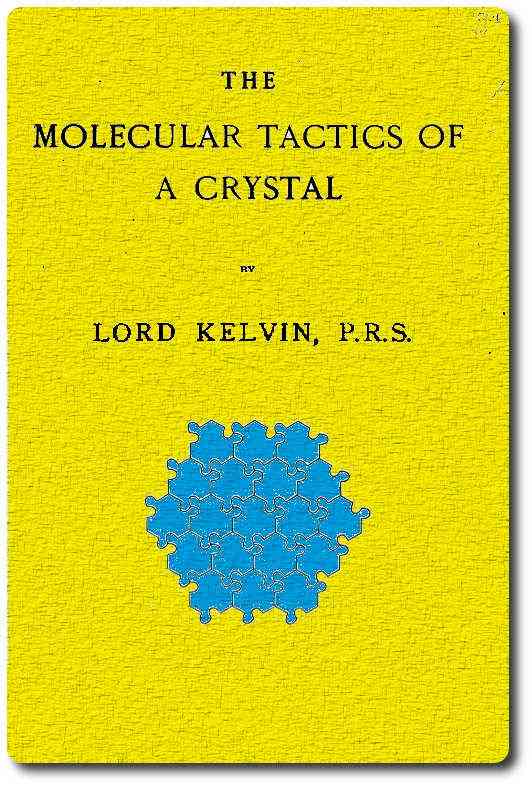
About This Book
A scientific lecture investigates how molecules arrange into crystalline solids by treating a crystal as a homogeneous three‑dimensional assemblage of equal units. It builds geometric models of planar neighbourhoods, stacked layers, and acute tetrahedra to explain nearest‑neighbor relationships and lattice symmetry, invoking Bravais’s ideas. The text highlights equilateral packings where twelve equidistant neighbours surround a central unit and shows how such clusters extend to cubic and octahedral lattices and practical sphere‑packing models. It also considers layered plates and faces parallel to primitive tetrahedral planes and notes geometric implications for elastic and structural behaviour.
About the Author

You May Also Like
6 picks
 A bacteriological study of ham souring
by Charles Neil McBryde
A bacteriological study of ham souring
by Charles Neil McBryde
 A Brief Account of Radio-activity
by F. P. Venable
A Brief Account of Radio-activity
by F. P. Venable
 A Brief History of Element Discovery, Synthesis, and Analysis
by Glen W. Watson
A Brief History of Element Discovery, Synthesis, and Analysis
by Glen W. Watson
 A Century of Science, and Other Essays
by John Fiske
A Century of Science, and Other Essays
by John Fiske
 A few secrets of the metallurgist simply told
by Gerald Watson Hinkley
A few secrets of the metallurgist simply told
by Gerald Watson Hinkley
 A handbook of laboratory glass-blowing
by Bernard D. Bolas
A handbook of laboratory glass-blowing
by Bernard D. Bolas