
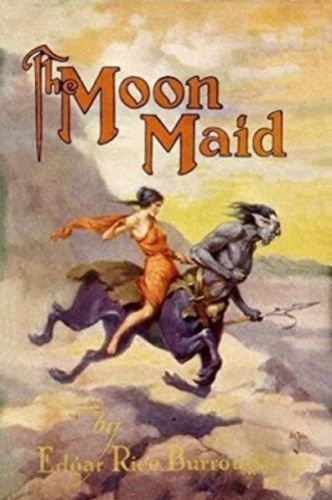
PART III
THE RED HAWK
Being the Story of Julian 20th
CHAPTER I
THE DESERT CLANS
The January sun beat hotly down upon me as I reined Red Lightning in upon the summit of a barren hill and looked down upon the rich land of plenty that stretched away below me as far as the eye could see toward the mighty sea that lay a day’s ride, perhaps, to the westward—the sea that none of us had ever looked upon—the sea that had become as fabulous as a legend of the ancients during the almost four hundred years since the Moon Men had swept down upon us and overwhelmed the Earth in their mad and bloody carnival of revolution.
In the near distance the green of the orange groves mocked us from below, and great patches that were groves of leafless nut trees, and there were sandy patches toward the south that were vineyards waiting for the hot suns of April and May before they, too, broke into riotous, tantalizing green. And from this garden spot of plenty a curling trail wound up the mountainside to the very level where we sat gazing fiercely down upon this last stronghold of our foes. When the ancients built that trail it must have been wide and beautiful indeed, but in the centuries that have elapsed man and the elements have sadly defaced it. The rains have washed it away in places and the Kalkars have made great gashes in it to deter us, their enemies, from invading their sole remaining lands and driving them into the sea; and upon their side of the gashes they have built forts where they keep warriors always. And well for them that they do. It is so upon every pass that leads down into their country.
Since fell my great ancestor, Julian 9th, in the year 2122, at the end of the first uprising against the Kalkars, we have been driving them slowly back across the world. That was over three hundred years ago. For a hundred years they have held us here, a day’s ride from the ocean. Just how far it is we do not know; but in 2408 my grandfather, Julian 18th, rode alone almost to the sea. He had won back almost to safety when he was discovered and pursued almost to the tents of his people. There was a battle, and the Kalkars who had dared invade our country were destroyed, but Julian 18th died of his wounds without being able to tell more than that a wondrous rich country lay between us and the sea, which was not more than a day’s ride distant. A day’s ride, for us, might be anything under a hundred miles.
We are desert people. Our herds range a vast territory where feed is scarce that we may be always near the goal that our ancestors set for us three centuries ago—the shore of the western sea into which it is our destiny to drive the remnants of our former oppressors. In the forests and mountains of Arizona there is rich pasture, but it is far from the land of the Kalkars where the last of the tribe of Or-tis make their last stand, and so we prefer to live in the desert near our foes, driving our herds great distances to pasture when the need arises, rather than to settle down in a comparative land of plenty, resigning the age-old struggle, the ancient feud between the house of Julian and the house of Or-tis.
A light breeze moves the black mane of the bright bay stallion beneath me. It moves my own black mane where it falls loose below the buckskin thong that encircles my head and keeps it from my eyes. It moves the dangling ends of the Great Chief’s blanket where it is strapped behind my saddle. On the twelfth day of the eighth month of the year just gone this Great Chief’s blanket covered the shoulders of my father, Julian 19th, from the burning rays of the summer’s desert sun. I was twenty on that day and on that day my father fell before the lance of an Or-tis in the Great Feud and I became The Chief of Chiefs.
Surrounding me today, as I sit looking down upon the land of my enemies, are fifty of the fierce chieftains of the hundred clans that swear allegiance to the house of Julian. They are bronzed and, for the most part, beardless men. The insignias of their clans are painted in various colors upon their foreheads, their cheeks, their breasts. Ochre, they use and blue and white and scarlet. Feathers rise from the head bands that confine their hair—the feathers of the vulture, the hawk and the eagle. I, Julian 20th, wear a single feather. It is from a red-tailed hawk—the clan-sign of my family.
We are all garbed similarly. Let me describe The Wolf, and in his portrait you will see a composite of us all. He is a sinewy, well built man of fifty, with piercing, gray-blue eyes beneath straight brows. His head is well-shaped, denoting great intelligence. His features are strong and powerful and of a certain fierce cast that might well strike terror to a foeman’s heart—and does, if the Kalkar scalps that fringe his ceremonial blanket stand for aught. His breeches, wide below the hips and skin tight from above the knees down are of the skin of the buck deer. His soft boots, tied tight about the calf of each leg, are also of buck. Above the waist he wears a sleeveless vest of calfskin tanned with the hair on. The Wolf’s is of fawn and white. Sometimes these vests are ornamented with bits of colored stone or metal sewn to the hide in various manners of design. From The Wolf’s headband, just above the right ear, depends the tail of a timber-wolf—the clan-sign of his family.
An oval shield, upon which is painted the head of a wolf, hangs about this chief’s neck, covering his back from nape to kidneys. It is a stout, light shield—a hard wood frame covered with bull hide. Around its periphery have been fastened the tails of wolves. In such matters each man, with the assistance of his women folk, gives rein to his fancy in the matter of ornamentation. Clan-signs and chief-signs, however, are sacred. The use of one to which he is not entitled might spell death for any man. I say might, because we have no inflexible laws. We have few laws. The Kalkars were forever making laws, so we hate them. We judge each case upon its own merits, and we pay more attention to what a man intended doing than what he did.
The Wolf is armed, as are the rest of us, with a light lance about eight feet in length, a knife and a straight, two-edged sword. A short, stout bow is slung beneath his right stirrup leather and a quiver of arrows is at his saddle bow.
The blades of his sword and his knife and the metal of his lance tip come from a far place called Kolrado and are made by a tribe that is famous because of the hardness and the temper of the metal of its blades. The Utaws bring us metal, also, but theirs is inferior and we use it only for the shoes that protect our horses’ feet from the cutting sands and the rocks of our hard and barren country.
The Kolrados travel many days to reach us, coming once in two years. They pass, unmolested, through the lands of many tribes because they bring what none might otherwise have and what we need in our never-ending crusade against the Kalkars. That is the only thread that holds together the scattered clans and tribes that spread east and north and south beyond the ken of man. All are animated by the same purpose—to drive the last of the Kalkars into the sea.
From the Kolrados we get meager news of clans beyond them toward the rising sun. Far, far to the east, they say, so far that in a lifetime no man might reach it, lies another great sea, and that there, as here upon the world’s western edge, a few Kalkars are making their last stand. All the rest of the world has been won back by the people of our own blood—by Americans.
We are always glad to see the Kolrados come, for they bring us news of other peoples, and we welcome the Utaws, too, though we are not a friendly people, killing all others who come among us, for fear, chiefly, that they may be spies sent by the Kalkars. It is handed down from father to son that this was not always so, and that once the people of the world went to and fro safely from place to place and that then all spoke the same language; but now it is different. The Kalkars brought hatred and suspicion among us, until now we trust only the members of our own clans and tribes.
The Kolrados, from coming often among us, we can understand, and they can understand us, by means of a few words and many signs, though when they speak their own language among themselves we cannot understand them, except for an occasional word that is like one of ours. They say that when the last of the Kalkars is driven from the world we must live at peace with one another, but I am afraid that that will never come to pass, for who would go through life without breaking a lance or dipping his sword point now and again into the blood of a stranger? Not The Wolf, I swear, nor no more The Red Hawk. By The Flag! I take more pleasure in meeting a stranger upon a lonely trail than in meeting a friend, for I cannot set my lance against a friend and feel the swish of the wind as Red Lightning bears me swiftly down upon the prey as I crouch in the saddle, nor thrill to the shock as we strike.
I am The Red Hawk. I am but twenty, yet the fierce chiefs of a hundred fierce clans bow to my will. I am a Julian—the twentieth Julian—and from this year, 2434, I can trace my line back five hundred and thirty-four years to Julian 1st, who was born in 1896. From father to son, by word of mouth, has been handed down to me the story of every Julian, and there is no blot upon the shield of one in all that long line, nor shall there be any blot upon the shield of Julian 20th. From my fifth year to my tenth I learned, word for word, as had my father before me, the deeds of my forebears, and to hate the Kalkars and the tribe of Or-tis. This, with riding, was my schooling. From ten to fifteen I learned to use lance and sword and knife, and on my sixteenth birthday I rode forth with the other men—a warrior.
As I sat there this day, looking down upon the land of the accursed Kalkars, my mind went back to the deeds of the 15th Julian, who had driven the Kalkars across the desert and over the edge of these mountains into the valley below just one hundred years before I was born, and I turned to The Wolf and pointed down toward the green groves and the distant hills and off beyond to where the mysterious ocean lay.
“For a hundred years they have held us here,” I said. “It is too long.”
“It is too long,” replied The Wolf.
“When the rains are over The Red Hawk leads his people into the land of plenty.”
The Rock raised his spear and shook it savagely toward the valley far below. The scalp-lock fastened just below its metal-shod tip trembled in the wind. “When the rains are over!” cried The Rock. His fierce eyes glowed with the fire of fanaticism.
“The green of the groves we will dye red with their blood,” cried The Rattlesnake.
“With our swords, not our mouths,” I said, and wheeled Red Lightning toward the east. The Coyote laughed and the others joined with him as we wound downward out of the hills toward the desert.
On the afternoon of the following day we came within sight of our tents where they were pitched beside the yellow flood of The River. Five miles before that we had seen a few puffs of smoke rise from the summit of a hill to the north of us. It told the camp that a body of horsemen was approaching from the west. It told us that our sentry was on duty and that doubtless all was well. At a signal my warriors formed themselves in two straight lines, crossing one another at their centers. A moment later another smoke signal arose informing the camp that we were friends and us that our signal had been rightly read.
Presently, in a wild charge, whooping and brandishing our spears, we charged down among the tents. Dogs, children and slaves scampered for safety, the dogs barking, the children and the slaves yelling and laughing. As we swung ourselves from our mounts before our tents, slaves rushed out to seize our bridle reins, the dogs leaped, growling, upon us in exuberant welcome, while the children fell upon their sires, their uncles or their brothers, demanding the news of the ride or a share in the spoils of conflict or chase. Then we went in to our women.
I had no wife, but there were my mother and my two sisters, and I found them awaiting me in the inner tent, seated upon a low couch that was covered, as was the floor, with the bright blankets that our slaves weave from the wool of sheep. I knelt and took my mother’s hand and kissed it and then I kissed her upon the lips and in the same fashion I saluted my sisters, the elder first. It is custom among us; but it is also our pleasure, for we both respect and love our women. Even if we did not, we should appear to, if only for the reason that the Kalkars do otherwise. They are brutes and swine. We do not permit our women a voice in the councils of the men, but none the less do they influence our councils from the seclusion of their inner tents. It is indeed an unusual mother among us who does not make her voice heard in the council ring, through her husband or her sons, and she does it through the love and respect in which they hold her and not by scolding and nagging. They are wonderful, our women. It is for them and The Flag that we have fought the foe across a world for three hundred years. It is for them that we shall go forth and drive him into the sea.
As the slaves prepared the evening meal I chatted with my mother and my sisters. My two brothers, The Vulture and Rain Cloud, lay also at my mother’s feet. The Vulture was eighteen, a splendid warrior, a true Julian. Rain Cloud was sixteen then, and I think the most beautiful creature I had ever seen. He had just become a warrior, but so sweet and lovable was his disposition that the taking of human life seemed a most incongruous calling for him, yet he was a Julian and there was no alternative. Everyone loved him and respected him too, even though he had never excelled in feats of arms for which he seemed to have no relish; but they respected him because they knew that he was brave and that he would fight as courageously as any of them, even though he might have no stomach for it. Personally, I considered Rain Cloud braver than I, for I knew that he would do well the thing he hated while I would be only doing well the thing I loved.
The Vulture resembled me in looks and the love of blood, so we left Rain Cloud at home to help guard the women and the children, which was no disgrace since it is a most honorable and sacred trust, and we went forth to the fighting when there was likely to be any, and when there wasn’t we went forth and searched for it. How often have I ridden the trails leading in across our vast frontiers longing for sight of a strange horseman against whom I might bend my lance! We asked no questions then when we had come close enough to see the clan-sign of the stranger and to know that he was of another tribe and likely he was as keen for the fray as we, otherwise he would have tried to avoid us. We each drew rein at a little distance and set his lance, and each called aloud his name, and then with a mighty oath each bore down upon the other, and then one rode away with a fresh scalp-lock, and a new horse to add to his herd, while the other remained to sustain the vulture and the coyote.
Two or three of our great, shaggy hounds came in and sprawled among us as we lay talking with mother and the two girls, Nallah and Neeta. Behind my mother and sisters squatted three slave girls, ready to do their bidding, for our women do no labor. They ride and walk and swim and keep their bodies strong and fit that they may bear mighty warriors, but labor is beneath them as it is beneath us. We hunt and fight and tend our own herds, for that is not menial, but all other labor the slaves perform. We found them here when we came. They have been here always—a stolid, dark skinned people, weavers of blankets and baskets, makers of pottery, tillers of the soil. We are kind to them and they are happy. The Kalkars, who preceded us, were not kind to them—it has been handed down to them from father to son for over a hundred years that the Kalkars were cruel to them and they hate their memory, yet, were we to be driven away by the Kalkars, these simple people would remain and serve anew their cruel masters, for they will never leave their soil. They have strange legends of a far time when great horses of iron raced across the desert dragging iron tents filled with people behind them, and they point to holes in the mountain sides through which these iron monsters made their way to the green valleys by the sea, and they tell of men who flew like birds and as swiftly, but of course we know that such things were never true and are but the stories that the old men and the women among them told to the children for their amusement. However, we like to listen to them.
I told my mother of my plans to move down into the valley of the Kalkars after the rains. She was silent some time before replying.
“Yes, of course,” she said; “you would be no Julian were you not to attempt it. At least twenty times before in a hundred years have our warriors gone down in force into the valley of the Kalkars and been driven back. I wish that you might have taken a wife and left a son to be Julian 21st before you set out upon this expedition from which you may not return. Think well of it, my son, before you set forth. A year or two will make no great difference. But you are The Great Chief and if you decide to go we can but wait here for your return and pray that all is well with you.”
“But you do not understand, Mother,” I replied. “I said that we are going to move down into the valley of the Kalkars after the rains. I did not say that we are coming back again. I did not say that you would remain here and wait for our return. You will accompany us. The tribe of Julian moves down into the valley of the Kalkars when the rains are over, and they take with them their women and their children and their tents and all their flocks and herds and every other possession that is movable, and—they do not return to live in the desert ever more.”
She did not reply, but only sat in thought. Presently a man-slave came to bid us warriors to the evening meal. The women and the children eat this meal within their tents, but the warriors gather around a great, circular table, called The Council Ring.
There were a hundred of us there that night. Flares in the hands of slaves gave us light and there was light from the cooking fire that burned within the circle formed by the table. The others remained standing until I had taken my seat which was the signal that the eating might begin. Before each warrior was an earthenware vessel containing beer and another filled with wine, and there were slaves whose duty it was to keep these filled, which was no small task, for we are hearty men and great drinkers, though there is no drunkenness among us as there is among the Kalkars. Other slaves brought meat and vegetables—beef and mutton, both boiled and broiled, potatoes, beans and corn, and there were bowls of figs and dried grapes and dried plums. There were also venison and bear meat and fish. There was a great deal of talk and a great deal of laughter, loud and boisterous, for the evening meal in the home camp is always a gala event. We ride hard and we ride often and we ride long. Often we are fighting and much of the time away from home. Then we have little to eat and nothing to drink but water, which is often warm and unclean and always scarce in our country.
We sit upon a long bench that encircles the outer periphery of the table and as I took my seat, the slaves, bearing platters of meat, passed along the inner rim of the table, and as they came opposite each warrior he rose, and leaning far across the board, seized a portion of meat with a thumb and finger and cut it deftly away with his sharp knife. The slaves moved in slow procession without pause and there was a constant gleam and flash of blades and movement and change of color as the painted warriors rose and leaned across the table, the firelight playing upon their beads and metal ornaments and the gay feathers of their headdresses. And the noise!
Pacing to and fro behind the warriors were two or three score shaggy hounds waiting for the scraps that would presently be tossed them—large, savage beasts bred to protect our flocks from coyote and wolf, hellhound and lion, and capable of doing it, too.
As the warriors fell to eating the din subsided, and at a word from me a youth at my elbow struck a deep note from a drum. Instantly there was silence.
“For a hundred years we have dwelt beneath the heat of this barren waste land while our foes occupied a flowering garden, their cheeks fanned by the cooling breezes of the sea. They live in plenty; their women eat of luscious fruits, fresh from the trees, while ours must be satisfied with the dried and wrinkled semblance of the real; ten slaves they have to do their labor for every one that we possess; their flocks and herds find lush pasture and sparkling water beside their masters’ tents, while ours pick a scant existence across forty thousand square miles of sandy, rock-bound desert; but these things gall the soul of The Red Hawk least of all. The wine turns bitter in my mouth when in my mind’s eye I look out across the rich valleys of the Kalkars and I recall that here alone in all the world that we know there flies not The Flag.”
A great growl rose from the fierce throats. “Since my youth I have held one thought sacred in my breast against the day that the blanket of The Great Chief should fall upon my shoulders. That day has come and I but await the time that the rains shall be safely over before making of that thought a deed. Twenty times in a hundred years have the Julian warriors ridden down into the Kalkar country in force, but their women and their children and their flocks remained behind in the desert—an unescapable argument for their return.
“It shall not be so again. In April the tribe of Julian leaves the desert forever. With our tents and our women and all our flocks and herds we shall descend and live among the orange groves. This time there shall be no turning back. I, The Red Hawk, have spoken.”
CHAPTER II
EXODUS
April arrived and with it the clans, coming at my bidding. Soon there would be little danger of heavy rains in the coast valleys. To have been caught there in a week of rain with an army would have been fatal, for the mud is deep and sticky and our horses would have mired and the Kalkars fallen upon us and destroyed us. They greatly outnumber us, and so our only hope must lie in our mobility. We realize that we are reducing this by taking along our women and our flocks, but we believe that so desperate will be our straits that we must conquer, since the only alternative to victory must be death—death for us and worse for our women and children.
The clans have been gathering for two days and all are here—some fifty thousand souls, and of horses, cattle and sheep there must be a thousand thousand, for we are rich in live stock. In the past two months, at my orders, all our swine have been slaughtered and smoked, for we could not be hampered by them on the long desert march, even if they could have survived it.
There is water in the desert this time of year and some feed, but it will be a hard, a terrible march. We shall lose a great deal of our stock, one in ten, perhaps; The Wolf thinks it may be as high as five in ten. We shall start tomorrow an hour before sunset, making a short march of about ten miles to a place where there is a spring along the trail the ancients used. It is strange to see all across the desert evidence of the great work they accomplished. After five hundred years the location of their well graded trail, with its wide, sweeping curves, is plainly discernible. It is a narrow trail, but there are signs of another, much wider, that we discover occasionally. It follows the general line of the other, crossing it and recrossing it, without any apparent reason, time and time again. It is almost obliterated by drifting sand, or washed away by the rains of ages. Only where it is of a material like stone has it endured. The pains those ancients took with things! The time and men and effort they expended! And for what? They have disappeared and their works with them.
As we rode that first night Rain Cloud rode often at my side and, as usual, he was gazing at the stars.
“There is so much that we do not know,” sighed Rain Cloud; “yet all that we can spare the time for is thoughts of fighting. I shall be glad when we have chased the last of the Kalkars into the sea, so that some of us may sit down in peace and think.”
“It is handed down to us that the ancients prided themselves upon their knowledge, but what did it profit them? I think we are happier. They must have had to work all their lives to do the things they did and to know all the things they knew, yet they could eat no more, or sleep no more, or drink no more in a lifetime than can we. And now they are gone forever from the Earth and all their works with them and all their knowledge is lost.”
“And presently we will be gone,” said Rain Cloud.
“And we will have left as much as they to benefit those who follow,” I replied.
“Perhaps you are right, Red Hawk,” said Rain Cloud; “yet I cannot help wanting to know more than I do know.”
The second march was also made at night and was a little longer than the first. We had a good moon and the desert night was bright. The third march was about twenty-five miles and the fourth a short one, only ten miles; and there we left the trail of the ancients and continued in a southwesterly direction to a trail that followed a series of springs that gave us short marches the balance of the way to a lake called Bear by our slaves. The way, of course, was all well known to us, and so we knew just what was ahead and dreaded the fifth march, which was a terrible one, by far the worst of them all. It lay across a rough and broken area of desert and crossed a range of barren mountains—for forty-five miles it wound its parched way from water hole to water hole. For horsemen alone it would have been but a hard march, but with cattle and sheep to herd across that waterless waste, it became a terrific undertaking. Every beast that was strong enough carried hay, oats or barley in sacks, for we could not depend entirely upon the sparse feed of the desert for so huge a caravan; but water we could not carry in sufficient quantities for the stock, transporting enough, however, on the longer marches to insure a supply for the women and all children under sixteen, and on the short marches enough for nursing mothers and children under ten.
We rested all day before the fifth march began, setting forth about three hours before sundown. From fifty camps in fifty parallel lines we started. Every man, woman and child was mounted. The women carried all children under five, usually seated astride a blanket on the horse’s rump behind the mother. The rest rode alone. The bulk of the warriors and all the women and children set out ahead of the herds, which followed slowly behind, each bunch securely hemmed in by outriders and followed by a rearguard of warriors.
A hundred men on swift horses rode at the head of the column, and as the night wore on, gradually increased their lead until they were out of sight of the remainder of the caravan. Their duty was to reach the camp site ahead of the others and fill the water tanks that slaves had been preparing for the past two months. We took but few slaves with us, only a few personal attendants for the women and such others as did not wish to be separated from their masters and had chosen to accompany us. For the most part the slaves preferred to remain in their own country and we were willing to let them, since it made fewer mouths to feed upon the long journey and we knew that in the Kalkar country we should find plenty to take their places, as we would take those from the Kalkars we defeated.
The long, tiresome march was over at last. The years of thought that I had given it, the two months of preparation that had immediately preceded it, the splendid condition of all our stock, the training and the temper of my people bore profitable fruit and we came through without the loss of a man, woman or child, and with the loss of less than two in a hundred of our herds and flocks. The mountain crossing on that memorable fifth march took the heaviest toll, fully ten thousand head, mostly lambs and calves, falling by the trail side.
With two days out for rest, we came, at the end of the tenth march and the twelfth day, to the lake called Bear and into a rich mountain country, lush with feed and game. Here deer and wild goats and wild sheep abounded, with rabbit and quail and wild chicken and the beautiful wild cattle that the legends of our slaves say are descended from the domestic stock of the ancients.
It was not my plan to rest here longer than was necessary to fully restore the strength and spirits of the stock. Our horses were not jaded as we had had sufficient to change often. In fact we warriors had not ridden our war-horses once upon the journey. Red Lightning had trotted into the last camp fat and sleek.
To have remained here long would have been to have apprised the enemy of our plans, for the Kalkars and their slaves hunt in these mountains which adjoin their land, and should a single hunter see this vast concourse of Julians, our coming would have been known throughout the valleys in a single day and our purpose guessed by all.
So, after a day of rest, I sent The Wolf and a thousand warriors westward to the main pass of the ancients with orders to make it appear that we were attempting to enter the valley there in force. For three days he would persist in this false advance and in that time I felt that I should have drawn all the Kalkar fighting men from the valley lying southwest of the lake of the Bear. My lookouts were posted upon every eminence that gave view of the valleys and the trails between the main pass of the ancients and that through which we should pour down from the Bear out into the fields and groves of the Kalkars.
The third day was spent in preparation. The last of the arrows were finished and distributed. We looked to our saddle leathers and our bridles. We sharpened our swords and knives once more and put keener points upon our lances. Our women mixed the war paint and packed our belongings again for another march. The herds were gathered in and held in close, compact bunches. Riders reported to me at intervals from the various lookouts and from down the trail to the edge of the Kalkar farms. No enemy had seen us, but that they had seen The Wolf and his warriors we had the most reassuring evidence in the reports from our outposts that every trail from south and west was streaming with Kalkar warriors converging upon the pass of the ancients.[1]
[1] Probably Cajon Pass.
During the third day we moved leisurely down the mountain trails and as night fell our vanguard of a thousand warriors debouched into the groves of the Kalkars. Leaving four thousand warriors, mostly youths, to guard the women, the children, the flocks and the herds I set out rapidly in a northwesterly direction toward the pass of the ancients at the head of full twenty thousand warriors.
Our war-horses we had led all day as we came slowly out of the mountains riding other animals, and not until we were ready to start upon the twenty-five mile march to the pass of the ancients did we saddle and mount the fleet beasts upon which the fate of the Julians might rest this night. In consequence our horses were fresh from a two weeks’ rest. Three hours of comparatively easy riding should see us upon the flanks of the enemy.
The Rock, a brave and seasoned warrior, I had left behind to guard the women, the children and the stock. The Rattlesnake, with five thousand warriors, bore along a more westerly trail, after fifteen miles had been covered, that he might fall upon the rear of the enemy from one point while I fell upon them from another, and at the same time place himself between their main body, lying at the foot of the pass, and the source of their supplies and reinforcements.
With The Wolf, the mountains and the desert upon one side and The Rattlesnake and I blocking them upon the south and the southeast, the position of the Kalkars appeared to me to be hopeless.
Toward midnight I called a halt to await the report of scouts who had preceded us and it was not long before they commenced to come in. From them I learned that the camp fires of the Kalkars were visible from an eminence less than a mile ahead. I gave the signal to advance. Slowly the great mass of warriors moved forward. The trail dipped down into a little valley and then wound upward to the crest of a low ridge, where a few minutes later I brought Red Lightning to a halt. Before me spread a broad valley bathed in the soft light of moon and stars. Dark masses in the nearer foreground I recognized as orange groves even without the added evidence of the sweet aroma of their blossoms that was heavy on the still night air. Beyond, to the northwest, a great area was dotted with the glowing embers of a thousand dying camp fires. I filled my lungs with the cool, sweet air; I felt my nerves tingle; a wave of exaltation surged through me; Red Lightning trembled beneath me. After nearly four hundred years a Julian stood at last, upon the threshold of complete revenge!
CHAPTER III
ARMAGEDDON
Very quietly we crept down among the orange groves, nearer, ever nearer to the sleeping foe. Somewhere to the west of us, beneath the silvery moon, The Rattlesnake was creeping stealthily forward to strike. Presently the stillness of the night would be broken by the booming of his war drums and the hoarse war-cries of his savage horde. It would be the signal that would send The Wolf down from the mountain heights above them and The Red Hawk from the orange groves below them to sink fang and talon into the flesh of the hated Kalkars, and ever The Rattlesnake would be striking at their heels.
Silently we awaited the signal from The Rattlesnake. A thousand bowmen unslung their bows and loosened arrows in their quivers; swords were readjusted, their hilts ready to the hand; men spat upon their right palms that their lance grip might be the surer. The night dragged on toward dawn. The success of my plan depended upon a surprise attack while the foe slept. I knew that The Rattlesnake would not fail me, but something must have delayed him. I gave the signal to advance silently. Like shadows we moved through the orange groves and deployed along a front two miles in length, a thousand bowmen in the lead and behind these, line after line of lancers and swordsmen. Slowly we moved forward toward the sleeping camp. How like the lazy, stupid Kalkars that no sentries were posted at their rear. Doubtless there were plenty of them on the front exposed to The Wolf. Where they could see an enemy they could prepare for him, but they have not imagination enough to foresee aught. Only the desert and their great numbers have saved them from extermination during the past hundred years.
Scarce a mile away now we could catch occasional glimpses of the dying embers of the nearest fires, and then from the east there rolled across the valley the muffled booming of distant war drums. A momentary silence followed and then faintly, there broke upon our ears the war-cries of our people. At my signal our own drums shattered the silence that had surrounded us. It was the signal for the charge. From twenty thousand savage throats rose the awful cries of battle, twenty thousand pairs of reins were loosed and eighty thousand iron-shod hoofs set the earth atremble as they thundered down upon the startled enemy, and from the heights above came the growl of the drums of The Wolf and the eerie howls of his painted horde.
It was dawn as we smote the camp. Our bowmen, guiding their mounts with their knees and the swing of their bodies, raced among the bewildered Kalkars, loosing their barbed shafts into the cursing, shrieking mob that fled before them only to be ridden down and trampled by their horses’ feet.
Behind the bowmen came the lancers and the swordsmen thrusting and cutting at those who survived. From our left came the tumult of The Rattlesnake’s assault and from far ahead and above us the sounds of battle proclaimed that The Wolf had fallen on the foe.
Ahead I could see the tents of the Kalkar leaders and toward these I spurred Red Lightning. Here would be the representatives of the house of Or-tis and here would the battle center. Ahead the Kalkars were forming in some semblance of order to check and repel us. They are huge men and ferocious fighters, but I could see that our surprise attack had unnerved them. They gave before us, before their chiefs could organize them for resistance, yet again and again they reformed and faced us. We were going more slowly now, the battle had become largely a matter of hand-to-hand combats; they were checking us, but they were not stopping us. So great were their numbers that even had they been unarmed it would have been difficult to force our horses through their massed ranks. Back of their front line they were saddling and mounting their horses, which those who had borne the brunt of our first onslaught had been unable to do. We had cut the lines to which their animals had been tethered and driven them, terrified, ahead of us to add to the confusion of the enemy. Riderless horses were everywhere, those of the Kalkars and many of our own, whose riders had fallen in battle. The tumult was appalling, for to the shrieks of the wounded and the groans of the dying were added the screams of stricken horses and the wild, hoarse war-cries of battle-maddened men, and underlying all, the dull booming of the war drums. Above us waved The Flag, and here were the drums and a massed guard of picked men. The Flag and the drums moved forward as we moved. And near me was the clan flag of my family with the red hawk upon it and with it were its drums. In all there were a hundred clan flags upon that field this day, and the drums of each rolled out, incessantly, defiance of the enemy.
Their horsemen now were rallied, and the dismounted men were falling back behind them and presently a Kalkar chief upon a large horse confronted me. Already was my blade red with their blood. I had thrown away my lance long since, for we were fighting in too close quarters for its effective use, but the Kalkar had his spear, and there was a little open space between us. In the instant he crouched and put spurs to his horse and bore down upon me.
He was a large man as most Kalkars are, for they have bred with that alone in mind for five hundred years, so that many of them are seven feet in height and over. He looked very fierce, did this fellow, with his great bulk and his little, blood-shot eyes. He wore a war bonnet of iron to protect his head from sword cuts and a vest of iron covered his chest against the thrusts of sword or lance, or the barbed tips of arrows. We Julians, or Americans, disdain such protection, choosing to depend upon our skill and agility, not hampering ourselves and our horses with the weight of all this metal.
My light shield was on my left forearm and in my right hand I grasped my two-edged sword. A pressure of my knees, an inclination of my body, a word in his pointed ear were all that was needed to make Red Lightning respond to my every wish, even though the reins hung loose upon his withers.
The fellow bore down upon me with a loud yell and Red Lightning leaped to meet him. The Kalkar’s point was set straight at my chest and I had only a sword on that side to deflect it, and at that I think I might have done so had I cared to try, even though the Kalkar carries a heavy lance and this one was backed by a heavy man and a heavy horse. With my left hand I grasped Red Lightning’s mane and at the instant that the Kalkar thought to see his point tear through my chest I swung from my saddle and lay flat against Red Lightning’s near side, while the Kalkar and his spear brushed harmlessly past an empty saddle. Empty for but an instant though. Swinging back to my seat in the instant that I wheeled Red Lightning I was upon the Kalkar from the rear even as the fighting mass before him brought him to a halt. He was swinging to have at me again, but even as he faced me my sword swung down upon his iron bonnet, driving pieces of it through his skull and into his brain. A fellow on foot cut viciously at me at the instant I was recovering from the blow I had dealt the mounted Kalkar, so that I was able only to partially parry with my shield, with the result that his point opened up my right arm at the shoulder—a flesh wound, but one that bled profusely, though it did not stay the force of my return, which drove through his collarbone and opened up his chest to his heart.
Once again I spurred in the direction of the tents of the Or-tis, above which floated the red banners of the Kalkars, around which were massed the flower of the Kalkar forces; too thickly massed, perhaps, for most effective defense, since we were driving them in from three sides and packing them there as tightly as eggs in the belly of a she-salmon. But now they surged forward and drove us back by weight of numbers, and now we threw ourselves upon them again until they, in their turn, were forced to give the ground that they had won. Sometimes the force of our attack drove them to one side while at another point their warriors were pushing out into the very body of the massed clans, so that here and there our turning movements would cut off a detachment of the enemy, or again a score or more of our own men would be swallowed by the milling Kalkar horde, until as the day wore on, the great field became a jumbled mass of broken detachments of Julian and Kalkar warriors surging back and forth over a bloody shambles, the iron shoes of their reeking mounts trampling the corpse of friend and foe alike into the gory mire.
Once, late in the afternoon, during a lull in the battle, I sat looking about the chaos of the field. Red with our own blood from a score of wounds and with the blood of friend and foe, Red Lightning and I stood panting in the midst of the welter. The tents of the Or-tis lay south of us—we had fought half way around them—but they were scarce a hundred yards nearer for all those bitter hours of battle. Some of the warriors of The Wolf were near me, showing how far that old, grey chief had fought his way since dawn, and presently behind a mask of blood I saw the flashing eyes of The Wolf himself, scarce twenty feet away.
“The Wolf!” I cried and he looked up and smiled in recognition.
“The Red Hawk is red indeed,” he bantered; “but his pinions are yet unclipped.”
“And the fangs of The Wolf are yet undrawn,” I replied.
A great Kalkar, blowing like a spent hound, was sitting his tired horse between us. At our words he raised his head. “You are The Red Hawk?” he asked.
“I am The Red Hawk,” I replied.
“I have been searching for you these two hours,” he said.
“I have not been far, Kalkar,” I told him; “what would you of The Red Hawk?”
“I bear word from Or-tis the Jemadar.”
“What word has an Or-tis for a Julian?” I demanded.
“The Jemadar would grant you peace,” he explained.
I laughed. “There is only one peace which we may share together,” I said, “and that is the peace of death—that peace I will grant him, and he will come hither and meet me. There is nothing that an Or-tis has the power to grant a Julian.”
“He would stop the fighting while you and he discuss the terms of peace,” insisted the Kalkar. “He would stop this bloody strife that must eventually annihilate both Kalkar and Yank.” He used an ancient term which the Kalkars have applied to us for ages in a manner of contempt, but which we have been taught to consider as an appellation of honor, though its very meaning is unknown to us and its derivation lost in antiquity.
“Go back to your Jemadar,” I said, “and tell him that the world is not wide enough to support both Kalkar and Yank, Or-tis and Julian; that the Kalkars must slay us to the last man or be slain.”
He wheeled his horse toward the tent of the Or-tis and The Wolf bade his warriors let him pass. Soon he was swallowed by the close-packed ranks of his own people, and then a Kalkar struck at one of us from behind and the battle raged again.
How many men had fallen one might not even guess, but the corpses of warriors and horses lay so thick that the living mounts could but climb and stumble over them and sometimes barriers of them nearly man-high lay between me and the nearest foeman so that I was forced to jump Red Lightning over the gory obstacle to find new flesh for my blade. And then, slowly, night descended until man could not tell foe from friend, but I called to my tribesmen about me to pass along the word that we would not move from our ground that night, staying on for the first streak of dawn that would permit us to tell a Kalkar from a Yank.
All through the night we heard a considerable movement of men and horses among the Kalkars, and we judged that they were reforming for the dawn’s attack, and then quite suddenly and without warning of any sort, we saw a black mass moving down upon us. It was the Kalkars—the entire body of them—and they rode straight for us, not swiftly, for the corpse-strewn, slippery ground prevented that; but steadily, overwhelmingly, like a great, slow-moving river of men and horses. They swept into us and over us, or they carried us along with them. Their first line broke upon us in a bloody wave and went down and those behind passed over the corpses of those that had fallen. We hacked until our tired arms could scarce raise a blade shoulder high. Kalkars went down screaming in agony, but they could not halt, they could not retreat, for the great, ever-moving mass behind them pushed them onward, nor could they turn to right or left because we hemmed them in on both flanks, nor could they flee ahead, for there, too, were we.
Borne on by this resistless tide I was carried with it. It surrounded me. It pinioned my arms at my sides. It crushed my legs. It even tore my sword from my hand. At times, when the force ahead stemmed it for a moment, and the force behind continued to push on, it rose in the center until horses were lifted from the ground, and then those behind sought to climb over the backs of those in front, until the latter were borne to earth and the others passed over their struggling forms, or the obstacle before gave way and the flood smoothed out and passed along again between the flashing banks of Julian blades, hewing, ever hewing, at the Kalkar stream. Never have I looked upon such a sight as the moon revealed that night—never in the memory or the tradition of man has there been such a holocaust. Thousands upon thousands of Kalkars must have fallen upon the edge of that torrent as it swept its slow way between the blades of my painted warriors, who hacked at the living mass until their arms fell numb at their sides, and then gave way to the eager thousands pressing from behind.
And ever onward I was borne, helpless to extricate myself from the sullen, irresistible flood that carried me southward down the broadening valley. The Kalkars about me did not seem to realize that I was an enemy, or notice me in any way, so intent were they upon escape. Presently we had passed the field of yesterday’s thickest fighting, the ground was no longer strewn with corpses and the speed of the rout increased, and as it did so the massed warriors spread to right and left sufficiently to permit more freedom of individual action, still not enough to permit me to worm my way from the current.
That I was attempting to do so, however, was what attracted attention to me at first and then the single red hawk feather and my other trappings, so different from those of the Kalkars.
“A Yank!” cried one near me and another drew his sword and struck at me, but I warded the blow with my shield as I drew my knife, a pitiful weapon wherewith to face a swordsman.
“Hold!” cried a voice of authority near by. “It is he whom they call The Red Hawk, their chief. Take him alive to the Jemadar.”
I tried to break through their lines, but they closed in upon me, and though I used my knife to good effect upon several of them they overbore me with their numbers, and then one of them must have struck me upon the head with the flat of his sword, for of a sudden everything went black, and of that moment I remember only reeling in my saddle.
CHAPTER IV
THE CAPITAL
When I regained consciousness it was night again. I was lying upon the ground, out beneath the stars. For a moment I experienced a sense of utter comfort, but as my tired nerves awoke they spoke to me of pain and stiffness from many wounds, and my head throbbed with pain. I tried to raise a hand to it, and it was then that I discovered that my wrists were bound. I could feel the matted stiffness of my scalp, and I knew that it was caked with dried blood, doubtless from the blow that had stunned me.
In attempting to move, that I might ease my cramped muscles, I found that my ankles were fastened together as well as my wrists, but I managed to roll over, and raising my head a little from the ground I looked about and saw that I was surrounded by sleeping Kalkars and that we lay in a barren hollow ringed by hills. There were no fires, and from this fact and the barrenness and seclusion of the camp I guessed that we were snatching a brief rest in hiding from a pursuing foe.
I tried to sleep, but could do so only fitfully, and presently I heard men moving about and soon they approached and awakened the warriors sleeping near me. The thongs were removed from my ankles shortly thereafter, and Red Lightning was brought and I was helped into the saddle. Immediately after, we resumed the march. A glance at the stars showed me that we were moving west. Our way led through hills and was often rough, evidencing that we were following no beaten trail, but rather that the Kalkars were attempting to escape by a devious route.
I could only guess at the numbers of them, but it was evident that there was not the great horde that had set forth from the battlefield below the pass of the ancients. Whether they had separated into smaller bands, or the balance had been slain I could not even conjecture; but that their losses must have been tremendous I was sure. We travelled all that day, stopping only occasionally when there was water for the horses and the men. I was given neither food nor water, nor did I ask for either. I would die rather than ask a favor of an Or-tis. In fact, I did not speak all that day, nor did any of the Kalkars address me.
I had seen more Kalkars in the past two days than in all my life before and was now pretty familiar with the appearance of them. They range in height from six to eight feet, the majority of them being midway between these extremes. There is a great variety of physiognomy among them, for they are a half-caste race, being the result of hundreds of years of interbreeding between the original Moon Men and the women of the Earth whom they seized for slaves when they overran and conquered the world. Among them there is occasionally an individual who might pass anywhere for a Yank, in so far as external appearances are concerned; but the low, coarse, brutal features of the Kalkar preponderate.
They wear a white blouse and breeches of cotton woven by their slaves and long, woolen cloaks fabricated by the same busy hands. Their women help in this work as well as in the work of the fields, for the Kalkar women are no better than slaves, with the possible exception of those who belong to the families of the Jemadar and his nobles. Their cloaks are of red, with collars of various colors, or with borders or other designs to denote rank. Their weapons are similar to ours, but heavier. They are but indifferent horsemen. That, I think, is because they ride only from necessity and not, as we, from love of it.
That night, after dark, we came to a big Kalkar camp. It was one of the camps of the ancients, the first that I ever had seen. It must have covered a great area, and some of the huge stone tents were still standing. It was in these that the Kalkars lived or in dirt huts leaning against them. In some places I saw where the Kalkars had built smaller tents from the building materials salvaged from the ruins of the ancient camp, but as a rule they were satisfied with hovels of dirt, or the half-fallen and never-repaired structures of the ancients.
This camp lies about forty-five or fifty miles west of the battlefield, among beautiful hills and rich groves, upon the banks of what must once have been a mighty river, so deeply has it scoured its pathway into the earth in ages gone.[2]