
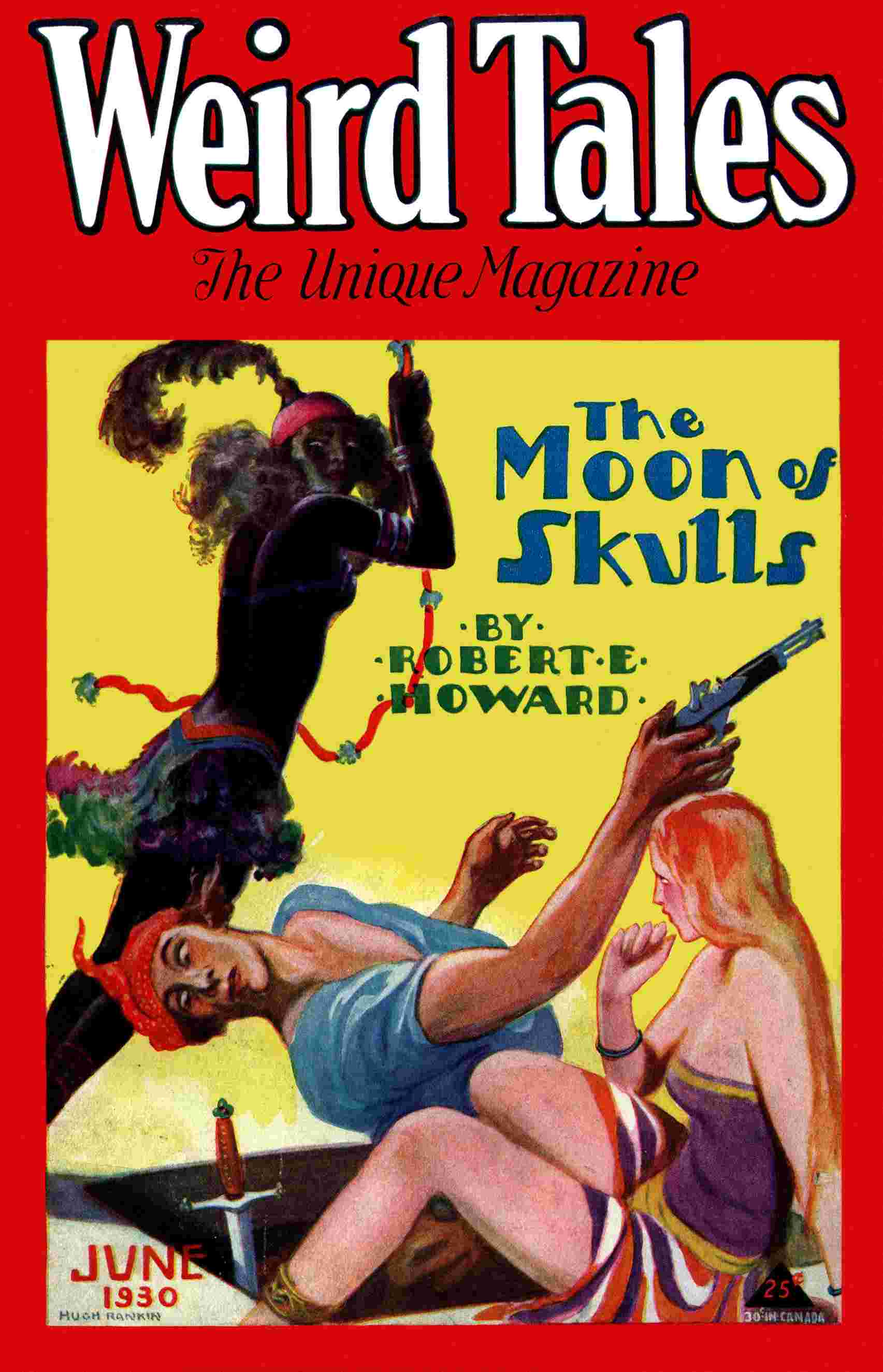
The Project Gutenberg eBook of The Moon of Skulls
Title: The Moon of Skulls
Author: Robert E. Howard
Illustrator: Hugh Rankin
C. C. Senf
Release date: January 1, 2026 [eBook #77605]
Language: English
Original publication: Indianapolis, IN: Popular Fiction Publishing Company, 1930
Credits: Greg Weeks, Mary Meehan & the online Distributed Proofreaders Canada team at https://www.pgdpcanada.net
The Moon of Skulls
By ROBERT E HOWARD
[Transcriber's Note: This etext was produced from
Weird Tales June and July 1930.]
"The giant's roar of triumph had scarcely died on his lips before the two were falling into darkness."
1. A Man Comes Seeking
A great black shadow lay across the land, cleaving the red flame of the sunset. To the man who toiled up the jungle trail it loomed like a symbol of death and horror, a menace brooding and terrible, like the shadow of a stealthy assassin flung upon some candle-lit wall.
Yet it was only the shadow of the great crag which reared up in front of him, the first outpost of the grim foothills which were his goal. He halted a moment at its foot, staring upward where it rose blackly limned against the dying sun. He could have sworn that he caught the hint of a movement at the top, as he stared, hand shielding his eyes, but the fading glare dazzled him and he could not be sure. Was it a man who darted to cover? A man, or——?
He shrugged his shoulders and fell to examining the rough trail which led up and over the brow of the crag. At first glance it seemed that only a mountain goat could scale it, but closer investigation showed numbers of fingerholds drilled into the solid rock. It would be a task to try his powers to the utmost but he had not come a thousand miles to turn back now.
He dropped the large pouch he wore at his shoulder, and laid down the clumsy musket, retaining only his long rapier, dagger, and one of his pistols. These he strapped behind him, and without a backward glance over the darkening trail he had come, he started the long ascent. He was a tall man, long-armed and iron-muscled, yet again and again he was forced to halt in his upward climb and rest for a moment, clinging like an ant to the precipitous face of the cliff. Night fell swiftly and the crag above him was a shadowy blur in which he was forced to feel with his fingers, blindly, for the holes which served him as precarious ladder. Below him, the night noises of the tropical jungle broke forth, yet it appeared to him that even these sounds were subdued and hushed as though the great black hills looming above threw a spell of silence and fear even over the jungle creatures.
On up he struggled, and now to make his way harder, the cliff bulged outward near its summit and the strain on nerve and muscle became heart-breaking. Time and again a hold slipped and he escaped falling by a hair's breadth. But every fiber in his lean hard body was perfectly co-ordinated, and his fingers were like steel talons with the grip of a vise. His progress grew slower and slower but on he went until at last he saw the cliff's brow splitting the stars a scant twenty feet above him.
And even as he looked, a vague bulk heaved into view, toppled on the edge and hurtled down toward him with a great rush of air about it. Flesh crawling, he flattened himself against the cliff's face and felt a heavy blow against his shoulder, only a glancing blow, but even so it nearly tore him from his hold, and as he fought desperately to right himself, he heard a reverberating crash among the rocks far below. Cold sweat beading his brow, he looked up. Who—or what—had shoved that boulder over the cliff edge? He was brave, as the bones on many a battlefield could testify, but the thought of dying like a sheep, helpless and with no chance of resistance, turned his blood cold.
Then a wave of fury supplanted his fear and he renewed his climb with reckless speed. The expected second boulder did not come, however, and no living thing met his sight as he clambered up over the edge and leaped erect, sword flashing from its scabbard.
He stood upon a sort of plateau which debouched into a very broken hilly country some half mile to the west. The crag he had just mounted jutted out from the rest of the heights like a sullen promontory, looming above the sea of waving foliage below, now dark and mysterious in the tropic night.
Silence ruled here in absolute sovereignty. No breeze stirred the somber depths below, and no footfall rustled amid the stunted bushes which cloaked the plateau, yet that boulder which had almost hurled the climber to his death had not fallen by chance. What beings moved among these grim hills? The tropical darkness fell about the lone wanderer like a heavy veil through which the yellow stars blinked evilly. The steams of the rotting jungle vegetation floated up to him as tangible as a thick fog, and making a wry face he strode away from the cliff, heading boldly across the plateau, sword in one hand and pistol in the other.
There was an uncomfortable feeling of being watched in the very air. The silence remained unbroken save for the soft swishing that marked the stranger's cat-like tread through the tall upland grass, yet the man sensed that living things glided before and behind him and on each side. Whether man or beast trailed him he knew not, nor did he care over-much, for he was prepared to fight human or devil who barred his way. Occasionally he halted and glanced challengingly about him, but nothing met his eye except the shrubs which crouched like short dark ghosts about his trail, blended and blurred in the thick hot darkness through which the very stars seemed to struggle, redly.
At last he came to the place where the plateau broke into the higher slopes and there he saw a clump of trees blocked out solidly in the lesser shadows. He approached warily, then halted as his gaze, growing somewhat accustomed to the darkness, made out a vague form among the somber trunks which was not a part of them. He hesitated. The figure neither advanced nor fled. A dim form of silent menace, it lurked as if in wait. A brooding horror hung over that still cluster of trees.
The stranger advanced warily, blade extended. Closer. Straining his eyes for some hint of threatening motion. He decided that the figure was human but he was puzzled at its lack of movement. Then the reason became apparent—it was the corpse of a black man that stood among those trees, held erect by spears through his body, nailing him to the boles. One arm was extended in front of him, held in place along a great branch by a dagger through the wrist, the index finger straight as if the corpse pointed stiffly—back along the way the stranger had come.
The meaning was obvious; that mute grim signpost could have but one significance—death lay beyond. The man who stood gazing upon that grisly warning rarely laughed, but now he allowed himself the luxury of a sardonic smile. A thousand miles of land and sea—ocean travel and jungle travel—and now they expected to turn him back with such mummery—whoever they were.
He resisted the temptation to salute the corpse, as an action wanting in decorum, and pushed on boldly through the grove, half expecting an attack from the rear or an ambush.
Nothing of the sort occurred, however, and emerging from the trees, he found himself at the foot of a rugged incline, the first of a series of slopes. He strode stolidly upward in the night, nor did he even pause to reflect how unusual his actions must have appeared to a sensible man. The average man would have camped at the foot of the crag and waited for morning before even attempting to scale the cliffs. But this was no ordinary man. Once his objective was in sight, he followed the straightest line to it, without a thought of obstacles, whether day or night. What was to be done, must be done. He had reached the outposts of the kingdom of fear at dusk, and invading its inmost recesses by night seemed to follow as a matter of course.
As he went up the boulder-strewn slopes the moon rose, lending its air of illusion, and in its light the broken hills ahead loomed up like the black spires of wizards' castles. He kept his eyes fixed on the dim trail he was following, for he knew not when another boulder might come hurtling down the inclines. He expected an attack of any sort and, naturally, it was the unexpected which really happened.
Suddenly from behind a great rock stepped a black man; an ebony giant in the pale moonlight, a long spear blade gleaming silver in hand, his headpiece of ostrich plumes floating above him like a white cloud. He lifted the spear in a ponderous salute, and spoke in the dialect of the river-tribes:
"This is not the white man's land. Who is my white brother in his own kraal and why does he come into the Land of Skulls?"
"My name is Solomon Kane," the white man answered in the same language. "I seek the vampire queen of Negari."
"Few seek. Fewer find. None return," answered the other cryptically.
"Will you lead me to her?"
"You bear a long dagger in your right hand. There are no lions here."
"A serpent dislodged a boulder. I thought to find snakes in the bushes."
The giant acknowledged this interchange of subtleties with a grim smile and a brief silence fell.
"Your life," said the black presently, "is in my hand."
Kane smiled thinly. "I carry the lives of many warriors in my hand."
The negro's gaze traveled uncertainly up and down the shimmery length of the Englishman's sword. Then he shrugged his mighty shoulders and let his spear point sink to the earth.
"You bear no gifts," said he; "but follow me and I will lead you to the Terrible One, the Mistress of Doom, the Red Woman, Nakari, who rules the land of Negari."
He stepped aside and motioned Kane to precede him, but the Englishman, his mind on a spear-thrust in the back, shook his head.
"Who am I that I should walk in front of my brother? We be two chiefs—let us walk side by side."
In his heart Kane railed that he should be forced to use such unsavory diplomacy with a black savage, but he showed no sign. The giant bowed with a certain barbaric majesty and together they went up the hill trail, unspeaking. Kane was aware that men were stepping from hiding-places and falling in behind them, and a surreptitious glance over his shoulder showed him some two score black warriors trailing out behind them in two wedge-shaped lines. The moonlight glittered on sleek black bodies, on waving head-gears and long cruel spear blades.
"My brothers are like leopards," said Kane courteously; "they lie in the low bushes and no eyes see them; they steal through the high grass and no man hears their coming."
The black chief acknowledged the compliment with a courtly inclination of his lion-like head, that set the plumes whispering.
"The mountain leopard is our brother, oh chieftain. Our feet are like drifting smoke but our arms are like iron. When they strike, blood drips red and men die."
Kane sensed an undercurrent of menace in the tone. There was no actual hint of threat on which he might base his suspicions, but the sinister minor note was there. He said no more for a space and the strange band moved silently upward in the moonlight like a cavalcade of black specters led by a white ghost. The trail grew steeper and more rocky, winding in and out among crags and gigantic boulders. Suddenly a great chasm opened before them, spanned by a natural bridge of rock, at the foot of which the leader halted.
Kane stared at the abyss curiously. It was some forty feet wide, and looking down, his gaze was swallowed by impenetrable blackness, hundreds of feet deep, he knew. On the other side rose crags dark and forbidding.
"Here," said the black chief, "begin the true borders of Nakari's realm."
Kane was aware that the warriors were casually closing in on him. His fingers instinctively tightened about the hilt of the rapier which he had not sheathed. The air was suddenly supercharged with tension.
"Here, too," the black man said, "they who bring no gifts to Nakari—die!"
The last word was a shriek, as if the thought had transformed the speaker into a maniac, and as he screamed it, the great black arm went back and then forward with a ripple of mighty muscles, and the long spear leaped at Kane's breast.
Only a born fighter could have avoided that thrust. Kane's instinctive action saved his life—the great blade grazed his ribs as he swayed aside and returned the blow with a flashing thrust that killed a warrior who jostled between him and the chief at that instant.
Spears flashed in the moonlight and Kane, parrying one and bending under the thrust of another, sprang out upon the narrow bridge where only one could come at him at a time.
None cared to be first. They stood upon the brink and thrust at him, crowding forward when he retreated, giving back when he pressed them. Their spears were longer than his rapier but he more than made up for the difference and the great odds by his scintillant skill and the cold ferocity of his attack.
They wavered back and forth and then suddenly a black giant leaped from among his fellows and charged out upon the bridge like a wild buffalo, shoulders hunched, spear held low, eyes gleaming with a look not wholly sane. Kane leaped back before the onslaught, leaped back again, striving to avoid that stabbing spear and to find an opening for his point. He sprang to one side and found himself reeling on the edge of the bridge with eternity gaping beneath him. The blacks yelled in savage exultation as he swayed and fought for his balance, and the giant on the bridge roared and plunged at the rocking white man.
Kane parried with all his strength—a feat few swordsman could have accomplished, off balance as he was—saw the cruel spear blade flash by his cheek—felt himself falling backward into the abyss. A desperate effort, and he gripped the spear shaft, righted himself and ran the spearman through the body. The black's great red cavern of a mouth spouted blood and with a dying effort he hurled himself blindly against his foe. Kane, with his heels over the bridge's edge, was unable to avoid him and they toppled over together, to disappear silently into the depths below.
So swiftly had it all happened that the warriors stood stunned. The giant's roar of triumph had scarcely died on his lips before the two were falling into the darkness. Now the rest of the negroes came out on the bridge to peer down curiously, but no sound came up from the dark void.
2. The People of the Stalking Death
As Kane fell he followed his fighting instinct, twisting in midair so that when he struck, were it ten or a thousand feet below, he would land on top of the man who fell with him.
The end came suddenly—much more suddenly than the Englishman had thought for. He lay half stunned for an instant, then looking up, saw dimly the narrow bridge banding the sky above him, and the forms of the warriors, limned in the moonlight and grotesquely foreshortened as they leaned over the edge. He lay still, knowing that the beams of the moon did not pierce the deeps in which he was hidden, and that to those watchers he was invisible. Then when they vanished from view he began to review his present plight. The black man was dead, and only for the fact that his corpse had cushioned the fall, Kane would have been dead likewise, for they had fallen a considerable distance. As it was, the white man was stiff and bruised.
He drew his sword from the negro's body, thankful that it had not been broken, and began to grope about in the darkness. His hand encountered the edge of what seemed a cliff. He had thought that he was on the bottom of the chasm and that its impression of great depth had been a delusion, but now he decided that he had fallen on a ledge, part of the way down. He dropped a small stone over the side, and after what seemed a very long time he heard the faint sound of its striking far below.
Somewhat at a loss as to how to proceed, he drew flint and steel from his belt and struck them to some tinder, warily shielding the light with his hands. The faint illumination showed a large ledge jutting out from the side of the cliff, that is, the side next the hills, to which he had been attempting to cross. He had fallen close to the edge and it was only by the narrowest margin that he had escaped sliding off it, not knowing his position.
Crouching there, his eyes seeking to accustom themselves to the abysmal gloom, he made out what seemed to be a darker shadow in the shadows of the wall. On closer examination he found it to be an opening large enough to admit his body standing erect. A cavern, he assumed, and though its appearance was dark and forbidding in the extreme, he entered, groping his way when the tinder burned out.
Where it led to, he naturally had no idea, but any action was preferable to sitting still until the mountain vultures plucked his bones. For a long way the cave floor tilted upward—solid rock beneath his feet—and Kane made his way with some difficulty up the rather steep slant, slipping and sliding now and then. The cavern seemed a large one, for at no time after entering it could he touch the roof, nor could he, with a hand on one wall, reach the other.
At last the floor became level and Kane sensed that the cave was much larger there. The air seemed better, though the darkness was just as impenetrable. Suddenly he stopped dead in his tracks. From somewhere in front of him there came a strange indescribable rustling. Without warning something smote him in the face and slashed wildly. All about him sounded the eery murmurings of many small wings and suddenly Kane smiled crookedly, amused, relieved and chagrined. Bats, of course. The cave was swarming with them. Still it was a shaky experience, and as he went on and the wings whispered through the vasty emptiness of the great cavern, Kane's Puritan mind found space to dally with a bizarre thought—had he wandered into Hell by some strange means, and were these in truth bats, or were they lost souls winging through everlasting night?
Then, thought Solomon Kane, I will soon confront Satan himself—and even as he thought this, his nostrils were assailed by a horrid scent fetid and repellent. The scent grew as he went slowly on, and Kane swore softly, though he was not a profane man. He sensed that the smell betokened some hidden threat, some unseen malevolence, inhuman and deathly, and his somber mind sprang at supernatural conclusions. However, he felt perfect confidence in his ability to cope with any fiend or demon, armored as he was in unshakable faith of creed and the knowledge of the rightness of his cause.
What followed happened suddenly. He was groping his way along when in front of him two narrow yellow eyes leaped up in the darkness—eyes that were cold and expressionless, too hideously close-set for human eyes and too high for any four-legged beast. What horror had thus reared itself up in front of him?
This is Satan, thought Kane as the eyes swayed above him, and the next instant he was battling for his life with the darkness that seemed to have taken tangible form and thrown itself about his body and limbs in great slimy coils. Those coils lapped his sword arm and rendered it useless; with the other hand he groped for dagger or pistol, flesh crawling as his fingers slipped from slick scales, while the hissing of the monster filled the cavern with a cold pæan of terror.
There in the black dark to the accompaniment of the bats' leathery rustlings, Kane fought like a rat in the grip of a mouse-snake, and he could feel his ribs giving and his breath going before his frantic left hand closed on his dagger hilt.
Then with a volcanic twist and wrench of his steel-thewed body he tore his left arm partly free and plunged the keen blade again and again to the hilt in the sinuous writhing terror which enveloped him, feeling at last the quivering coils loosen and slide from his limbs to lie about his feet like huge cables.
The mighty serpent lashed wildly in its death struggles, and Kane, avoiding its bone-shattering blows, reeled away in the darkness, laboring for breath. If his antagonist had not been Satan himself, it had been Satan's nearest earthly satellite, thought Solomon, hoping devoutly that he would not be called upon to battle another in the darkness there.
It seemed to him that he had been walking through the blackness for ages and he began to wonder if there were any end to the cave when a glimmer of light pierced the darkness. He thought it to be an outer entrance a great way off, and started forward swiftly, but to his astonishment, he brought up short against a blank wall after taking a few strides. Then he perceived that the light came through a narrow crack in the wall, and feeling over this wall he found it to be of different material from the rest of the cave, consisting, apparently, of regular blocks of stone joined together with mortar of some sort—an indubitably man-built wall.
The light streamed between two of these stones, where the mortar had crumbled away. Kane ran his hands over the surface with an interest beyond his present needs. The work seemed very old and very much superior to what might be expected of a tribe of ignorant negroes.
He felt the thrill of the explorer and discoverer. Certainly no white man had ever seen this place and lived to tell of it, for when he had landed on the dank West Coast some months before, preparing to plunge into the interior, he had had no hint of such a country as this. The few white men who knew anything at all of Africa with whom he had talked, had never even mentioned the Land of Skulls or the she-fiend who ruled it.
Kane thrust against the wall cautiously. The structure seemed weakened from age—a vigorous shove and it gave perceptibly. He hurled himself against it with all his weight and a whole section of wall gave way with a crash, precipitating him into a dimly lighted corridor amid a heap of stone, dust and mortar.
He sprang up and looked about, expecting the noise to bring a horde of wild spearmen. Utter silence reigned. The corridor in which he now stood was much like a long narrow cave itself, save that it was the work of man. It was several feet wide and the roof was many feet above his head. Dust lay ankle-deep on the floor as if no foot had trod there for countless centuries, and the dim light, Kane decided, filtered in somehow through the roof or ceiling, for nowhere did he see any doors or windows. At last he decided the source was the ceiling itself, which was of a peculiar phosphorescent quality.
He set off down the corridor, feeling uncomfortably like a gray ghost moving along the gray halls of death and decay. The evident antiquity of his surroundings depressed him, making him sense vaguely the fleeting and futile existence of mankind. That he was now on top of the earth he believed, since light of a sort came in, but where, he could not even offer a conjecture. This was a land of enchantment—a land of horror and fearful mysteries, the jungle and river natives had said, and he had gotten whispered hints of its terrors ever since he had set his back to the Slave Coast and ventured into the hinterlands alone.
Now and then he caught a low indistinct murmur which seemed to come through one of the walls, and he at last came to the conclusion that he had stumbled onto a secret passage in some castle or house. The natives who had dared speak to him of Negari, had whispered of a ju-ju city built of stone, set high amid the grim black crags of the fetish hills.
Then, thought Kane, it may be that I have blundered upon the very thing I sought and am in the midst of that city of terror. He halted, and choosing a place at random, began to loosen the mortar with his dagger. As he worked he again heard that low murmur, increasing in volume as he bored through the wall, and presently the point pierced through, and looking through the aperture it had made, he saw a strange and fantastic scene.
He was looking into a great chamber, whose walls and floors were of stone, and whose mighty roof was upheld by gigantic stone columns, strangely carved. Ranks of feathered black warriors lined the walls and a double column of them stood like statues before a throne set between two stone dragons which were larger than elephants. These men he recognized, by their bearing and general appearance, to be tribesmen of the warriors he had fought at the chasm. But his gaze was drawn irresistibly to the great, grotesquely ornamented throne. There, dwarfed by the ponderous splendor about her, a woman reclined. A black woman she was, young and of a tigerish comeliness. She was naked except for a beplumed helmet, armbands, anklets and a girdle of colored ostrich feathers and she sprawled upon the silken cushions with her limbs thrown about in voluptuous abandon.
Even at that distance Kane could make out that her features were regal yet barbaric, haughty and imperious, yet sensual, and with a touch of ruthless cruelty about the curl of her full red lips. Kane felt his pulse quicken. This could be no other than she whose crimes had become almost mythical—Nakari of Negari, demon queen of a demon city, whose monstrous lust for blood had set half a continent shivering. At least she seemed human enough; the tales of the fearful river tribes had lent her a supernatural aspect. Kane had half expected to see a loathsome semi-human monster out of some past and demoniacal age.
The Englishman gazed, fascinated though repelled. Not even in the courts of Europe had he seen such grandeur. The chamber and all its accouterments, from the carven serpents twined about the bases of the pillars to the dimly seen dragons on the shadowy ceiling, were fashioned on a gigantic scale. The splendor was awesome—elephantine—inhumanly oversized, and almost numbing to the mind which sought to measure and conceive the magnitude thereof. To Kane it seemed that these things must have been the work of gods rather than men, for this chamber alone would dwarf most of the castles he had known in Europe.
The black people who thronged that mighty room seemed grotesquely incongruous. They no more suited their surroundings than a band of monkeys would have seemed at home in the council chambers of the English king. As Kane realized this the sinister importance of Queen Nakari dwindled. Sprawled on that august throne in the midst of the terrific glory of another age, she seemed to assume her true proportions—a spoiled, petulant child engaged in a game of make-believe and using for her sport a toy discarded by her elders. And at the same time a thought entered Kane's mind—who were these elders?
Still the child could become deadly in her game, as the Englishman soon saw.
A tall massive black came through the ranks fronting the throne, and after prostrating himself four times before it, remained on his knees, evidently waiting permission to speak. The queen's air of lazy indifference fell from her and she straightened with a quick lithe motion that reminded Kane of a leopardess springing erect. She spoke, and the words came faintly to him as he strained his faculties to hear. She spoke in a language very similar to that of the river tribes.
"Speak!"
"Great and Terrible One," said the kneeling warrior, and Kane recognized him as the chief who had first accosted him on the plateau—the chief of the guards on the cliffs, "let not the fire of your fury consume your slave."
The young woman's eyes narrowed viciously.
"You know why you were summoned, son of a vulture?"
"Fire of Beauty, the stranger brought no gifts."
"No gifts?" she spat out the words. "What have I to do with gifts? I bade you slay all black men who came empty-handed—did I tell you to slay white men?"
"Gazelle of Negari, he came climbing the crags in the night like an assassin, with a dagger as long as a man's arm in his hand. The boulder we hurled down missed him, and we met him upon the plateau and took him to the Bridge-Across-the-Sky, where, as is the custom, we thought to slay him; for it was your word that you were weary of men who came wooing you."
"Black men, fool," she snarled; "black men!"
"Your slave did not know, Queen of Beauty. The white man fought like a mountain leopard. Two men he slew and fell with the last one into the chasm, and so he perished, Star of Negari."
"Aye," the queen's tone was venomous, "the first white man who ever came to Negari! One who might have—rise, fool!"
The man got to his feet.
"Mighty Lioness, might not this one have come seeking——"
The sentence was never completed. Even as he straightened, Nakari made a swift gesture with her hand. Two warriors plunged from the silent ranks and two spears crossed in the chief's body before he could turn. A gurgling scream burst from his lips, blood spurted high in the air and the corpse fell flatly at the foot of the great throne.
The ranks never wavered, but Kane caught the sidelong flash of strangely red eyes and the involuntary wetting of thick lips. Nakari had half risen as the spears flashed, and now she sank back, an expression of cruel satisfaction on her beautiful face and a strange brooding gleam in her scintillant eyes.
An indifferent wave of her hand and the corpse was dragged away by the heels, the dead arms trailing limply in the wide smear of blood left by the passage of the body. Kane could see other wide stains crossing the stone floor, some almost indistinct, others less dim. How many wild scenes of blood and cruel frenzy had the great stone throne-dragons looked upon with their carven eyes?
He did not doubt, now, the tales told him by the river tribes. These people were bred in rapine and horror. Their prowess had burst their brains. They lived, like some terrible beast, only to destroy. There were strange gleams behind their eyes which at times lit those eyes with up-leaping flames and shadows of Hell. What had the river tribes said of these mountain people who had ravaged them for countless centuries? That they were henchmen of death, who stalked among them, and whom they worshipped.
Still the thought hovered in Kane's mind as he watched—who built this place, and why were negroes evidently in possession? He knew this was the work of a higher race. No black tribe had ever reached such a stage of culture as evidenced by these carvings. Yet the river tribes had spoken of no other men than those upon which he now looked.
The Englishman tore himself away from the fascination of the barbaric scene with an effort. He had no time to waste; as long as they thought him dead, he had more chance of eluding possible guards and seeking what he had come to find. He turned and set off down the dim corridor. No plan of action offered itself to his mind and one direction was as good as another. The passage did not run straight; it turned and twisted, following the line of the walls, Kane supposed, and found time to wonder at the evident enormous thickness of those walls. He expected at any moment to meet some guard or slave, but as the corridors continued to stretch empty before him, with the dusty floors unmarked by any footprint, he decided that either the passages were unknown to the people of Negari or else for some reason were never used.
He kept a close lookout for secret doors, and at last found one, made fast on the inner side with a rusty bolt set in a groove of the wall. This he manipulated cautiously, and presently with a creaking which seemed terrifically loud in the stillness the door swung inward. Looking out he saw no one, and stepping warily through the opening, he drew the door to behind him, noting that it assumed the part of a fantastic picture painted on the wall. He scraped a mark with his dagger at the point where he believed the hidden spring to be on the outer side, for he knew not when he might need to use the passage again.
He was in a great hall, through which ran a maze of giant pillars much like those of the throne chamber. Among them he felt like a child in some great forest, yet they gave him some slight sense of security since he believed that, gliding among them like a ghost through a jungle, he could elude the black people in spite of their craft.
He set off, choosing his direction at random and going carefully. Once he heard a mutter of voices, and leaping upon the base of a column, clung there while two black women passed directly beneath him, but besides these he encountered no one. It was an uncanny sensation, passing through this vast hall which seemed empty of human life, but in some other part of which Kane knew there might be throngs of people, hidden from sight by the pillars.
At last, after what seemed an eternity of following these monstrous mazes, he came upon a huge wall which seemed to be either a side of the hall, or a partition, and continuing along this, he saw in front of him a doorway before which two spearmen stood like black statues.
Kane, peering about the corner of a column base made out two windows high in the wall, one on each side of the door, and noting the ornate carvings which covered the walls, determined on a desperate plan. He felt it imperative that he should see what lay within that room. The fact that it was guarded suggested that the room beyond the door was either a treasure chamber or a dungeon, and he felt sure that his ultimate goal would prove to be a dungeon.
He retreated to a point out of sight of the blacks and began to scale the wall, using the deep carvings for hand and foot holds. It proved even easier than he had hoped, and having climbed to a point level with the windows, he crawled cautiously along a horizontal line, feeling like an ant on a wall.
The guards far below him never looked up, and finally he reached the nearer window and drew himself up over the sill. He looked down into a large room, empty of life, but equipped in a manner sensuous and barbaric. Silken couches and velvet cushions dotted the floor in profusion and tapestries heavy with gold work hung upon the walls. The ceiling too was worked in gold.
Strangely incongruous, crude trinkets of ivory and ironwood, unmistakably negroid in workmanship, littered the place, symbolic enough of this strange kingdom where signs of barbarism vied with a strange culture. The outer door was shut and in the wall opposite was another door, also closed.
Kane descended from the window, sliding down the edge of a tapestry as a sailor slides down a sail-rope, and crossed the room, his feet sinking noiselessly into the deep fabric of the rug which covered the floor, and which, like all the other furnishings, seemed ancient to the point of decay.
At the door he hesitated. To step into the next room might be a desperately hazardous thing to do; should it prove to be filled with black men, his escape was cut off by the spearmen outside the other door. Still, he was used to taking all sorts of wild chances, and now, sword in hand, he flung the door open with a suddenness intended to numb with surprize for an instant any foe who might be on the other side.
Kane took a swift step within, ready for anything—then halted suddenly, struck speechless and motionless for a second. He had come thousands of miles in search of something and there before him lay the object of his search.
3. Lilith
A couch stood in the middle of the room and on its silken surface lay a woman—a woman whose skin was white and whose reddish gold hair fell about her bare shoulders. She now sprang erect, fright flooding her fine gray eyes, lips parted to utter a cry which she as suddenly checked.
"You!" she exclaimed. "How did you——?"
Solomon Kane closed the door behind him and came toward her, a rare smile on his dark face.
"You remember me, do you not, Marylin?"
The fear had already faded from her eyes even before he spoke, to be replaced by a look of incredible wonder and dazed bewilderment.
"Captain Kane! I can not understand—it seemed no one would ever come——"
She drew a small hand wearily across her white brow, swaying suddenly.
Kane caught her in his arms—she was only a girl, little more than a child—and laid her gently on the couch. There, chafing her wrists gently, he talked in a low hurried monotone, keeping an eye on the door all the time—which door, by the way, seemed to be the only entrance or egress from the room. While he talked he mechanically took in the chamber, noting that it was almost a duplicate of the outer room, as regards hangings and general furnishings.
"First," said he, "before we go into any other matters, tell me, are you closely guarded?"
"Very closely, sir," she murmured hopelessly; "I know not how you came here, but we can never escape."
"Let me tell you swiftly how I came to be here, and mayhap you will be more hopeful when I tell you of the difficulties already overcome. Lie still now, Marylin, and I will tell you how I came to seek an English heiress in the devil city of Negari.
"I killed Sir John Taferal in a duel. As to the reason, 'tis neither here nor there, but slander and a black lie lay behind it. Ere he died he confessed that he had committed a foul crime some years agone. You remember, of course, the affection cherished for you by your cousin, old Lord Hildred Taferal, Sir John's uncle. Sir John feared that the old lord, dying without issue, might leave the great Taferal estates to you.
"Years ago you disappeared and Sir John spread the rumor that you had drowned. Yet when he lay dying with my rapier through his body, he gasped out that he had kidnapped you and sold you to a Barbary rover, whom he named—a bloody pirate whose name has not been unknown on England's coasts aforetime. So I came seeking you, and a long weary trail it has been, stretching into long leagues and bitter years.
"First I sailed the seas searching El Gar, the Barbary corsair named by Sir John. I found him in the crash and roar of an ocean battle; he died, but even as he lay dying he told me that he had sold you in turn to a merchant out of Stamboul. So to the Levant I went and there by chance came upon a Greek sailor whom the Moors had crucified on the shore for piracy. I cut him down and asked him the question I asked all men—if he had in his wanderings seen a captive English girl-child with yellow curls. I learned that he had been one of the crew of the Stamboul merchants, and that she had, on her homeward voyage, been set upon by a Portuguese slaver and sunk—this renegade Greek and the child being among the few who were taken aboard the slaver.
"This slaver then, cruising south for black ivory, had been ambushed in a small bay on the African West Coast, and of your further fate the Greek knew nothing, for he had escaped the general massacre, and taking to sea in an open boat, had been taken up by a ship of Genoese freebooters.
"To the West Coast, then, I came, on the slim chance that you still lived, and there heard among the natives that some years ago a white child had been taken from a ship whose crew had been slain, and sent inland as a part of the tribute the shore tribes paid to the upper river chiefs.
"Then all traces ceased. For months I wandered without a clue as to your whereabouts, nay, without a hint that you even lived. Then I chanced to hear among the river tribes of the demon city of Negari and the black queen who kept a white woman for a slave. I came here."
Kane's matter-of-fact tone, his unfurbished narration, gave no hint of the full meaning of that tale—of what lay behind those calm and measured words—the sea-fights and the land fights—the years of privation and heart-breaking toil, the ceaseless danger, the everlasting wandering through hostile and unknown lands, the tedious and deadening labor of ferreting out the information he wished from ignorant, sullen and unfriendly savages, black and white.
"I came here" said Kane simply, but what a world of courage and effort was symbolized by that phrase! A long red trail, black shadows and crimson shadows weaving a devil's dance—marked by flashing swords and the smoke of battle—by faltering words falling like drops of blood from the lips of dying men.
Not a consciously dramatic man, certainly, was Solomon Kane. He told his tale in the same manner in which he had overcome terrific obstacles—coldly, briefly and without heroics.
"You see, Marylin," he concluded gently, "I have not come this far and done this much, to now meet with defeat. Take heart, child. We will find a way out of this fearful place."
"Sir John took me on his saddle-bow," the girl said dazedly, and speaking slowly as if her native language came strangely to her from years of unuse, as she framed in halting words an English evening of long ago: "He carried me to the sea-shore where a galley's boat waited, filled with fierce men, dark and mustached and having simitars, and great rings to the fingers. The captain, a Moslem with a face like a hawk, took me, I a-weeping with fear, and bore me to his galley. Yet he was kind to me in his way, I being little more than a baby, and at last sold me to a Turkish merchant, as he told you. This merchant he met off the southern coast of France, after many days of sea travel.
"This man did not use me badly, yet I feared him, for he was a man of cruel countenance and made me understand that I was to be sold to a black sultan of the Moors. However, in the Gates of Hercules his ship was set upon by a Cadiz slaver and things came about as you have said.
"The captain of the slaver believed me to be the child of some wealthy English family and intended holding me for ransom, but in a grim darksome bay on the African coast he perished with all his men except the Greek you have mentioned, and I was taken captive by a black chieftain.
"I was terribly afraid and thought he would slay me, but he did me no harm and sent me up-country with an escort, who also bore much loot taken from the ship. This loot, together with myself, was, as you know, intended for a powerful king of the river peoples. But it never reached him, for a roving band of Negari fell upon the beach warriors and slew them all. Then I was taken to this city, and have since remained, slave to Queen Nakari.
"How I have lived through all those terrible scenes of battle and cruelty and murder, I know not."
"A providence has watched over you, child," said Kane, "the power which doth care for weak women and helpless children; which led me to you in spite of all hindrances, and which shall yet lead us forth from this place, God willing."
"My people!" she exclaimed suddenly like one awaking from a dream; "what of them?"
"All in good health and fortune, child, save that they have sorrowed for you through the long years. Nay, old Sir Hildred hath the gout and doth so swear thereat that I fear for his soul at times. Yet methinks that the sight of you, little Marylin, would mend him."
"Still, Captain Kane," said the girl, "I can not understand why you came alone."
"Your brothers would have come with me, child, but it was not sure that you lived, and I was loth that any other Taferal should die in a land far from good English soil. I rid the country of an evil Taferal—'twas but just I should restore in his place a good Taferal, if so be she still lived—I, and I alone."
This explanation Kane himself believed. He never sought to analyze his motives and he never wavered, once his mind was made up. Though he always acted on impulse, he firmly believed that all his actions were governed by cold and logical reasonings. He was a man born out of his time—a strange blending of Puritan and Cavalier, with a touch of the ancient philosopher, and more than a touch of the pagan, though the last assertion would have shocked him unspeakably. An atavist of the days of blind chivalry he was, a knight errant in the somber clothes of a fanatic. A hunger in his soul drove him on and on, an urge to right all wrongs, protect all weaker things, avenge all crimes against right and justice. Wayward and restless as the wind, he was consistent in only one respect—he was true to his ideals of justice and right. Such was Solomon Kane.
"Marylin," he now said kindly, taking her small hands in his sword-calloused fingers, "methinks you have changed greatly in the years. You were a rosy and chubby little maid when I used to dandle you on my knee in old England. Now you seem drawn and pale of face, though you are beautiful as the nymphs of the heathen books. There are haunting ghosts in your eyes, child—do they misuse you here?"
She lay back on the couch and the blood drained slowly from her already pallid features until she was deathly white. Kane bent over her, startled. Her voice came in a whisper.
"Ask me not. There are deeds better hidden in the darkness of night and forgetfulness. There are sights which blast the eyes and leave their burning mark forever on the brain. The walls of ancient cities, recked not of by men, have looked upon scenes not to be spoken of, even in whispers."
Her eyes closed wearily and Kane's troubled, somber eyes unconsciously traced the thin blue lines of her veins, prominent against the unnatural whiteness of her skin.
"Here is some demoniacal thing," he muttered, "A mystery——"
"Aye," murmured the girl, "a mystery that was old when Egypt was young! And nameless evil more ancient than dark Babylon—that spawned in terrible black cities when the world was young and strange."
Kane frowned, troubled. At the girl's strange words he felt an eery crawling fear at the back of his brain, as if dim racial memories stirred in the eon-deep gulfs, conjuring up grim chaotic visions, illusive and nightmarish.
Suddenly Marylin sat erect, her eyes flaring wide with fright. Kane heard a door open somewhere.
"Nakari!" whispered the girl urgently. "Swift! She must not find you here! Hide quickly, and"—as Kane turned—"keep silent, whatever may chance!"
She lay back on the couch, feigning slumber as Kane crossed the room and concealed himself behind some tapestries which, hanging upon the wall, hid a niche that might have once held a statue of some sort.
He had scarcely done so when the single door of the room opened and a strange barbaric figure stood framed in it. Nakari, queen of Negari, had come to her slave.
The black woman was clad as she had been when he had seen her on the throne, and the colored armlets and anklets clanked as she closed the door behind her and came into the room. She moved with the easy sinuousness of a she-leopard and in spite of himself the watcher was struck with admiration for her lithe beauty. Yet at the same time a shudder of repulsion shook him, for her eyes gleamed with vibrant and magnetic evil, older than the world.
"Lilith!" thought Kane. "She is beautiful and terrible as Purgatory. She is Lilith—that foul, lovely woman of ancient legend."
Nakari halted by the couch, stood looking down upon her captive for a moment, then with an enigmatic smile, bent and shook her. Marylin opened her eyes, sat up, then slipped from her couch and knelt before her black mistress—an act which caused Kane to curse beneath his breath. The queen laughed and seating herself upon the couch, motioned the girl to rise, and then put an arm about her waist and drew her upon her lap. Kane watched, puzzled, while Nakari caressed the white girl in a lazy, amused manner. This might be affection, but to Kane it seemed more like a sated leopard teasing its victim. There was an air of mockery and studied cruelty about the whole affair.
"You are very soft and pretty, Mara," Nakari murmured lazily, "much prettier than the black girls who serve me. The time approaches, little one, for your nuptial. And a fairer bride has never been borne up the Black Stairs."
Marylin began to tremble and Kane thought she was going to faint. Nakari's eyes gleamed strangely beneath her long-lashed drooping lids, and her full red lips curved in a faint tantalizing smile. Her every action seemed fraught with some sinister meaning. Kane began to sweat profusely.
"Mara," said the black queen, "you are honored above all other girls, yet you are not content. Think how the girls of Negari will envy you, Mara, when the priests sing the nuptial song and the Moon of Skulls looks over the black crest of the Tower of Death. Think, little bride-of-the-Master, how many girls have given their lives to be his bride!"
And Nakari laughed in her hateful musical way, as at a rare jest. And then suddenly she stopped short. Her eyes narrowed to slits as they swept the room, and her whole body tensed. Her hand went to her girdle and came away with a long thin dagger. Kane sighted along the barrel of his pistol, finger against the trigger. Only a natural hesitancy against shooting a woman kept him from sending death into the black heart of Nakari, for he believed that she was about to murder the girl.
Then with a lithe cat-like motion she thrust the girl from her knees and bounded back across the room, her eyes fixed with blazing intensity on the tapestry behind which Kane stood. Had those keen eyes discovered him? He quickly learned.
"Who is there?" she rapped out fiercely. "Who hides behind those hangings? I do not see you nor hear you, but I know someone is there!"
Kane remained silent. Nakari's wild beast instinct had betrayed him and he was uncertain as to what course to follow. His next actions depended on the queen.
"Mara!" Nakari's voice slashed like a whip, "who is behind those hangings? Answer me! Shall I give you a taste of the whip again?"
The girl seemed incapable of speech. She cowered where she had fallen, her beautiful eyes full of terror. Nakari, her blazing gaze never wavering, reached behind her with her free hand and gripped a cord hanging from the wall. She jerked viciously. Kane felt the tapestries whip back on either side of him and he stood revealed.
For a moment the strange tableau held—the gaunt white man in his blood-stained, tattered garments, the long pistol gripped in his right hand—across the room the black queen in her savage finery, one arm still lifted to the cord, the other hand holding the dagger in front of her—the white girl cowering on the floor.
Then Kane spoke: "Keep silent, Nakari, or you die!"
The queen seemed numbed and struck speechless by the sudden apparition. Kane stepped from among the tapestries and slowly approached her.
"You!" she found her voice at last. "You must be he of whom the guardsmen spake! There are not two other white men in Negari! They said you fell to your death! How then——"
"Silence!" Kane's voice cut in harshly on her amazed babblings; he knew that the pistol meant nothing to her, but she sensed the threat of the long blade in his left hand. "Marylin," still unconsciously speaking in the river-tribes' language, "take cords from the hangings and bind her——"
He was about the middle of the chamber now. Nakari's face had lost much of its helpless bewilderment and into her blazing eyes stole a crafty gleam. She deliberately let her dagger fall as in token of surrender, then suddenly her hands shot high above her head and gripped another thick cord. Kane heard Marylin scream but before he could take another step, before he could pull the trigger or even think, the floor fell beneath his feet and he shot down into abysmal blackness. He did not fall far and he landed on his feet; but the force of the fall sent him to his knees and even as he went down, sensing a presence in the darkness beside him, something crashed against his skull and he dropped into a yet blacker abyss of unconsciousness.
4. Dreams of Empire