
CHAPTER II
THE RESCUE
Frank stood aside in the bank vestibule, to give the excitable stranger room to pass, but the man did not seem to want to take advantage of the courtesy extended by the young motion picture operator.
"I—I don't see what's gotten into you young puppies nowadays," the man blurted out, when he had recovered his voice. "The idea of ramming into me that way! I—I——" But words failed him. His red face grew redder, and his neck swelled up until Frank could think of nothing but a strutting turkey gobbler.
"Out of my way!" the man exclaimed. "You have no business obstructing the door like that."
"Why, I—you——" began Frank, intending to say that the man himself had been at fault, for going to the left instead of the right.
But the fellow gave him no chance. Roughly thrusting Frank to one side the man rushed past him, and out into Broadway, leaving Frank gasping against the marble sides of the bank vestibule.
"Well, of all the nerve!" the lad exclaimed, as he recovered himself, and went on into the institution to make his deposit.
While Frank is doing this I will take just a few lines to tell my new readers something about the characters who are to figure in this story, and also mention the previous books in which are set forth their exploits.
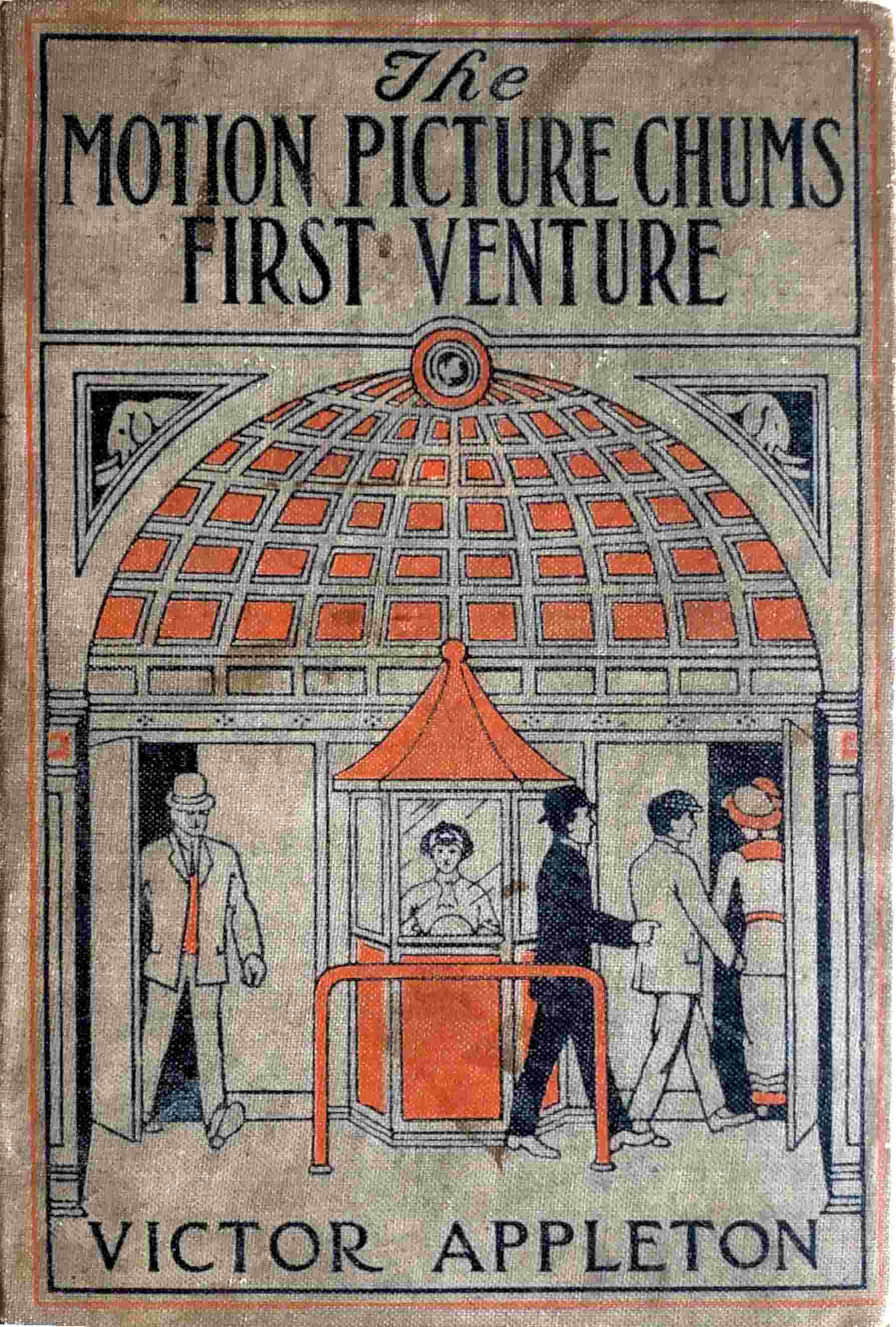
Some two years before the opening of the present story Frank Durham, Pepperill Smith and Randolph Powell had lived in the Pennsylvania town of Fairlands. As might be guessed from the little glimpse I have given you of Frank's character, it was he who first suggested motion pictures, and found a way of employing the savings of himself and his friends. They brought a motion picture theatre outfit to Fairlands, and at once became known as the "motion picture chums." So, most appropriately, I hope, I named the first book of this series "The Motion Picture Chums' First Venture." It was indeed a venturesome beginning for them, and they had many trials and tribulations, but, eventually they succeeded, and made money.
In the second book, "The Motion Picture Chums at Seaside Park," I had the pleasure of telling you how again Frank found a means of making more money for himself and friends. When the winter season in Fairlands had passed, and local trade became dull with the arrival of hot weather, Frank discovered an opening for a Wonderland No. 2, named after their first venture. In a seaside resort, about fifty miles from New York, they presented a series of films that made good.
Of course that was only a summer resort, and when visitors and cottagers departed the boys found their business gone, too. But they had been getting experience in these months, and this they put to good advantage when they founded their Empire playhouse on upper Broadway, New York City. In the volume named "The Motion Picture Chums on Broadway; Or, The Mystery of the Missing Cash Box," I related their metropolitan successes and troubles, for they had not a few of the latter.
"The Motion Picture Chums' Outdoor Exhibition" told of the film that saved a fortune, and I will leave you to find out for yourselves just how this came about.
Then Frank and his chums had a new idea. They went to Boston, opened a playhouse there, and had the distinction of showing the first real educational films; an idea that originated with Professor Achilles Barrington, a most lovable but odd character.
In Boston, no less than in other places, the chums found rivalry, but they managed to get the best of their enemies, and had a most successful season.
It was now October, and they had come on to New York to make arrangements for showing some imported film dramas, consisting of many reels, which ran the cost up very high. But even with that, they had made money. The motion picture chums had so prospered, thanks to Hank Strapp's aid, that they could afford to hire managers for their various places of amusement, which enabled them to travel about supervising matters, looking for new attractions, and providing for their patrons. They were getting the name of being among the most enterprising of the New York moving picture operators, and of being the first to adopt innovations.
I have mentioned Hank Strapp of Montana, and those of you who have read the other books of the series know what a fine character he was. I need not dwell on him.
As for Ben Jolly, he asked nothing better than to sit down in front of a piano, or pipe organ, and an "effects box," and produce music that went well with the various motion scenes shown, bringing out, meanwhile, the different sounds that added to the effectiveness of the film. Ben had perfected a little arrangement of his own which, he claimed, so perfectly imitated the barking of a dog that he had a standing offer among the employees of the Empire, to scare with his device any cat they might bring in. And he did it, too!
Sometimes Ben would have so many "effects" to produce that he took this task for himself alone, leaving his helper to play the piano or organ.
Hal Vincent, a ventriloquist and cornet player, was also an efficient and faithful helper to the boys. He was sometimes at one, and sometimes at another, of the various enterprises the chums owned, for they had, in addition to those I have mentioned, the Model at Belleview, up the Hudson.
The motion picture chums had aided and befriended many young fellows since their first venture, and some of these lads they hired to look after their interests in the various theatres. But it was to Hank Strapp and Ben Jolly that they clung most closely, and on whom they depended most for help. Ever since Frank had saved the Westerner from losing a large sum of money through a swindler, Strapp had remained with his new friends, and had invested goodly sums in their various enterprises.
Of late matters had been going excellently at the Empire, the best-paying theatre in the chain the chums controlled, and it was at a gathering of his friends to talk over matters that Frank had made the proposal about the Panama Exposition.
Then had come the interruption when he went to the bank, and the collision with the choleric man.
"Well, I like his nerve—not!" exclaimed Frank with boyish earnestness as he watched the red-faced individual make his way through the throng of pedestrians on the street. "There he goes again!" the lad cried, as he saw his late antagonist encounter a man in the street, colliding with, and nearly knocking him down. "He must have the habit," Frank went on, grimly, as he adjusted his hat, which had been knocked askew, and proceeded on to the brass-grated window of the receiving teller. "I don't like that man at all—not for a cent, and if I meet him again I'll give him a clear path.
"I'd know him again, sure!" Frank declared to himself. "I never saw a man with such a red face, and it wasn't all from anger, either. He'll have apoplexy if he isn't careful."
"Hello, Frank!" called the receiving teller, as our hero, or, rather, one of them, approached the window. "What was that chap in the vestibule trying to do; get your cash away from you?"
"Hardly!" laughed Frank. "He didn't seem very steady on his feet. Did you see what he did?"
"Yes. He was on the wrong side. He must be an Englishman; going to the left that way."
"He has an English name anyhow," remarked the paying teller, at the next window, for business was slack just at that moment.
"Did he cash a check?" inquired his fellow-employee from his "cage."
"He tried to. Signed his name—Royston—with a big flourish and said he wanted it in big bills."
"Did you give it to him?" asked Frank, as he shoved his satchel full of money in through the brass wicket, which the receiving teller opened for him.
"I did not. The check was good enough, I knew that, but I said he'd have to be identified, as he was a stranger to me. Whew! But he got as mad as a wet hen; said it was a shame and all that! Said he'd done business with this bank before. But he couldn't prove it, and I wouldn't give him the money until he made himself better known than by just endorsing a check with enough ink to make half a dozen ordinary signatures."
"Maybe that's what made him mad, so he tried to bowl me over," suggested Frank, stepping down to speak to the paying teller, while the receiving clerk was counting the cash the motion picture lad had handed in.
"Shouldn't wonder," the teller agreed. "Funny how some people get mad when you simply ask them to comply with ordinary banking rules. And I've always noticed that it's the cheap chaps; the tin-horn sports, or the man with very little money, who makes the most fuss.
"Why, I've had millionaires, strangers to me, come in here to cash checks, and when I said they'd have to be identified, they wouldn't make the least fuss about it. They'd make themselves known in a way that was satisfactory. But let some fellow come in here with a big idea of his own importance, and he gets a flea in his ear right away if I question him. That's Royston's sort, I guess."
"Royston, eh?" murmured Frank. "So that was his name?"
"Yes, and it ought to be Roysterer or Roasterer from the way he acted. Nearly knocked you down, I understand."
"Yes," answered Frank.
"Here you are—all correct," spoke the receiving teller, as he entered the amount Frank had deposited on the pass-book, and tendered that and the now empty satchel to the youth. "You're putting in big money these days, Frank."
"Yes, we're doing pretty well, thank you. Better prospects ahead, too."
"You don't say. Something new?"
"Yes, if I can make it work. Going out to the Panama Exposition."
"You don't say! Well, I'm glad to hear that, but we'll be sorry to lose you."
"Oh, I'll still bank our New York receipts here," Frank said.
"Thanks. We like to do business with you," and with a nod the teller took the deposit of the next in line, Frank making his way out of the bank.
"Whew! That Royston chap certainly gave me a bang!" remarked Frank, as he walked along. His shoulder was beginning to feel lame where the man had collided with him, and afterward whirled him so unceremoniously against the marble wainscoting of the vestibule. "I'll be stiff," Frank went on, swinging his arm about so vigorously that he nearly struck the hat of a girl walking just ahead of him.
"Oh, I beg your pardon!" he exclaimed, impulsively. "I wasn't thinking of what I was doing."
"That's all right," she assured him, with a smile and a glance from a pair of bright eyes. "No harm done."
"Guess I'll have to stop using the street as a gym," murmured Frank, as he passed on, after raising his hat.
His arm was really paining him, though he knew it was nothing serious. He was considering whether he had time to attend to some business matters in the vicinity of the bank before going back to the Empire office.
"No, I think I'd better go back," he decided to himself. "I want to see how those 'Pickwick' films are running."
For he and his chums had recently contracted for the exclusive right, in their vicinity, of showing a series of motion pictures, depicting the life of that most famous of Dickens's characters.
"And the boys will want to talk more about that Panama scheme," Frank decided. "I'll let the business stand until Monday and go back now to the theatre."
Frank was crossing Broadway at a point where traffic was unusually congested at that moment, when he noticed a rather oddly-dressed man rushing forward without any regard to the danger of passing wagons and automobiles.
"Hi there! Look out!" Frank cried in warning.
The man turned his face toward him, showing to the lad a much excited countenance. There was a wild look in the man's eyes, as though his thoughts were either far away, or as if he were reckless enough not to care what he did.
"Wait a minute," advised Frank, coming up behind the man. "The traffic policeman will hold up the machines in a little while, and you can go on."
"No time to wait! No time to wait!" was the sharp retort. "I must go on now!"
He made a dash forward just as a swiftly-moving auto swung around a corner. It was coming straight for the wild-eyed man.
"Look out!" Frank yelled, springing to the rescue with a hand extended to pull the man out of danger.