
CHAPTER XVIII.—IT’S AN ILL WIND.
Billie and Elinor strolled together that evening along the palm-bordered walk of the hotel.
They had grave matters to discuss and they had slipped away from their friends to be alone. Percy and Nancy waited eagerly on the piazza for the first strains of the orchestra, which meant that dancing would begin, and Mary and Charlie lingered on a bench talking of West Haven.
“It is a queer business, Elinor,” Billie was saying. “I do wish he had written.”
“He might have sent either you or Edward just a line,” exclaimed the other. “How can he think Edward is going to masquerade like this much longer? He is really working quite hard for a boy who has never done anything much in his life.”
“It will do him good,” insisted Billie. “He’s twice as manly as he was when we first met him.”
“But what is going to happen now? Is he to wait until Edward l’Estrange comes back?”
“He promised to.”
“But he didn’t expect him to go beyond St. Augustine, and he’s gone to New York.”
“The family is here. Edward Paxton could let them know who he is at any moment if he doesn’t trust the other Edward. Why doesn’t he?”
Elinor was silent.
“He’s afraid, Billie, I think,” she said presently.
“That’s just it,” cried Billie. “He’s always afraid, afraid, afraid.”
“It’s certainly queer, all of it,” answered Elinor, when a figure which had been standing behind a clump of palms stepped into the path.
It was Clarence Paxton, and so little did Billie trust this treacherous cousin of her friends, that she gladly joined Timothy Peppercorn who had come running down the walk to find her.
“They are playing the barn dance, Billie,” cried the red-headed youth, eagerly. “We had such a jim-dandy barn dance together at the Duffy’s, I thought we might try it again to-night.”
“‘Barkis is willin’,” answered Billie, and away they ran like two frisky young colts.
“I don’t know any of the native dances, Miss Butler,” said Clarence, who was much more English than his cousins, “or I would ask you to try this—er—jig——”
“Barn dance,” prompted Elinor, who also had no liking for Edward’s cousin.
“Will you go for a little stroll?”
“I will go as far as the hedge. Miss Campbell does not allow us to go out of sight of the hotel in the evening.”
Clarence thrust his hands in his pockets and walked beside her. He had very grown-up airs, although she had heard from his cousins that he was only seventeen.
“Perhaps you think our meeting just now was accidental,” he went on.
“I hadn’t thought of it at all,” replied Elinor.
“Please don’t be unkind to me, Miss Butler. It was because I was in trouble that I wanted to speak to you. I knew you would listen to me when perhaps the other girls wouldn’t. You were especially fond of him——”
“Fond of whom?” she interrupted.
“Why, of Edward, my cousin. Although we did quarrel a good deal, Miss Butler, I loved him like a brother. That’s why I’m so unhappy now.”
“Do get to the point,” she answered impatiently. “Has anything happened to your cousin?”
“Yes.”
“Can’t you tell me what it is? Is he ill or hurt, or anything?”
“No, no; not that. Something much worse.”
“My grandmother has disowned him; cast him off.”
“Oh! Are you quite sure?”
“Perfectly. I was present when it happened.”
For the first time since he had joined her, Elinor began to notice that Clarence, far from being dejected and cast down, was in such high spirits he could hardly conceal his joy. His eyes had a new light in them. There was an unusual color in his cheeks, and he smiled continually as he flicked the foliage with a light little cane and walked with an elastic step as if he were going down the middle in a quadrille.
“Yes,” he went on joyfully, “I was in the room. So was Georgiana. And we both saw the whole thing.”
“But what brought it about? Had Edward done anything so terrible as to be punished like that?”
“Oh, he’s been going off ever since we came to this place. He’s been rebellious and bad tempered—and—and—” here Clarence smiled reminiscently, “I’ve had some trouble with him myself. Finally, in St. Augustine, Grandmamma and he had an out and out quarrel over nothing apparently, but they worked it up between them until it came near being a pitched battle. They really seemed to enjoy it, the two of them. It was like a game of battledore and shuttlecock. I didn’t know Edward had it in him. But Grandmamma, she’s a Tartar when she’s scratched, and anybody within range of that stick of hers had better look alive. She started to strike him with it, and he caught it and broke it into two pieces and threw it on the floor. Then she turned on him so calmly and quietly Georgiana and I thought she wasn’t angry but we changed our minds. ‘This changes every prospect you ever had,’ she said. ‘Leave me and from this day your future, as far as I am concerned, is altered.’”
“Good heavens,” exclaimed Elinor, her thoughts turning to the real Edward Paxton, who was at that moment lying on his back under the Comet, cleaning the machinery. “But don’t you think it can be patched up? He’s only a boy. Surely, she will take him back.”
“I’m afraid not,” answered Clarence, smiling with secret pleasure. “I doubt it very much. Georgiana has been on her knees to Grandmamma, but the old General only says, ‘Don’t let me hear you speak that name again.’”
“And what have you done for him? Anything?”
Clarence shrugged his shoulders.
“If Georgiana could do nothing, you don’t suppose I could?”
“But think of his being in a strange country without any money or friends? Couldn’t you let him have some of your allowance until he gets a start?”
“Hardly. My allowance is not sufficient for my own wants.”
Here was a state of things, indeed. Elinor began to wonder how Edward Paxton could ever induce his grandmother to forgive the trick he had played on her. Would she ever listen to him? Would she even see him, no matter how many proofs he could give her that he was the real Edward Paxton? And where, oh where, was Edward l’Estrange?
“Then you will be your grandmother’s heir,” she said presently, breaking the silence which had fallen between them.
“Oh, Georgiana will have a little, I suppose,” he replied carelessly. “But I shall have the bulk, of course. You see Grandmamma’s second husband, Mr. Steele, who left most of the money, had no heirs.”
“What will you do with all those thousands, or millions, is it?”
“A million and a half. Oh, I shall live in a yacht a great deal. I shall have a shooting box in Scotland and a town house in London. I don’t care for Grandmamma’s London house. It’s old and dingy and rather cramped. I shall get rid of it at any price. I shall have a villa on the Riviera, probably at Monte Carlo, and that reminds me, Miss Butler,” he broke off suddenly, looking at his watch, “you will pardon me if I leave you, will you not? I am due at the Casino at twenty past eight. Good evening.”
Lifting his straw hat with the affected air of a Piccadilly dandy, he tripped down the walk out of sight.
Elinor laughed out loud as she watched him stepping off, flicking the palm leaves with his rattan cane.
“And that is going to get the money!” she ejaculated. “What a shame. I’m sure Edward Paxton has more in him than his ridiculous cousin, who has already commenced to gamble at the Casino on prospects. If Edward could only prove to his grandmother that there is something to him!”
The young people had finished the barn dance and were resting on the broad piazza overlooking the lake, when Elinor found them.
“Do you suppose we could find Edward Paxton?” she whispered to Billie. “I have a piece of very bad news for him. I will tell you about it if we can get away.”
Billie knit her brows.
“Is it about the other Edward?” she asked.
“It certainly is. He’s been and gone and done it!”
“Done what?”
“Got disinherited and packed off by Mrs. Paxton-Steele, and if you can explain why he didn’t pack himself back home, you must know a great deal more about him than the rest of us.”
“I can’t explain it, Elinor,” replied Billie. “I can’t even try. But I still believe he’s honest and I’d rather wait a little longer before I pass judgment. There may be some explanation.”
Elinor could not but admire her friend’s loyalty, which was one of the strongest characteristics in her fine nature.
“What a trump you are, Billie,” she said. “You are the truest friend in the world.”
“The chauffeur wishes to speak to one of the ladies,” announced a bellboy. “He is at the side entrance.”
“Elinor and I will go, Cousin Helen,” said Billie, promptly seizing the opportunity which had come so quickly.
Edward was waiting for them in a passage leading to one of the side exits. He was in his chauffeur’s suit and was singing to himself as they approached the song he had dedicated to Elinor: “On thy fair bosom, silver lake.”
“I came for orders for to-morrow,” he announced cheerfully. “I have a good many engagements, and I was afraid I would be filled up if I didn’t see you this evening.”
“Engagements for what?” demanded Elinor.
“To make money,” he answered gaily. “I made six dollars to-day and I expect to earn almost twice that much to-morrow. At this rate, I’ll be earning a real salary, soon.”
“Good,” cried Billie, clapping her hands.
“And you are really beginning to like the work, then?” asked Elinor.
“Well, rather. I find machinery almost as interesting as the piano. The climate of this place agrees with me, too. I don’t have those attacks of indigestion any more. My eyes are lots stronger and I sleep seven hours a night and eat everything in sight. But what are your plans for to-morrow? There is a man waiting to see me, now.”
“We are going to the Duffy’s in the Firefly at four o’clock for a tea.”
The two girls hadn’t the heart to tell him the unwelcome news that night.
CHAPTER XIX.—A PASSAGE AT ARMS.
Mr. and Mrs. Duffy’s teas were quite different from other people’s afternoon affairs. There was always lots to eat for one thing; long buffet tables piled with salads and sandwiches; great bowls of fruit drinks and ices and cakes. There was dancing, too, in the big parlors, and who ever heard of dancing at a tea before?
“Young people like to dance no matter what the hour of the day,” Mrs. Duffy had said in explanation to Miss Campbell.
“But this is a very beautiful entertainment, my dear,” replied Miss Campbell. “We had expected simple tea and you are giving us an elaborate lawn party. You must have gone to no end of trouble, and what a good time they all seem to be having. My girls are everywhere. Billie is on the tennis court, and Mary is playing croquet, and Nancy is dancing, and here is Elinor hovering over me like a guardian angel.”
“You are a careful chaperone, I see,” observed a deep, well-trained English voice at her elbow.
Miss Campbell turned quickly. It was Mrs. Paxton-Steele leaning heavily on her stick. Elinor could not keep from looking at that stick with much curiosity. Edward Paxton had told her that the old lady had numbers of canes which her man servant packed around in a case like golf sticks. It would have been interesting, she thought, to have been an unseen witness at that famous battle when the other Edward had seized the stick and broken it in half. She wondered if there had been a great clap of thunder and a flash of lightning, as there was when Siegfried smote the staff of Wotan.
Miss Campbell turned smiling. Her manners were always exquisite and she was not in the least afraid of the old bird of prey, as the girls had disrespectfully christened the war-like English lady.
“Ah, well,” she replied, “they are not my own. That is why I must be particularly careful of them. They are only borrowed children. One feels especially responsible for borrowed property, don’t you think?”
“They are all equally troublesome, my dear lady,” returned Mrs. Paxton-Steele, “whether they are one’s own or another’s. I assure you that bringing my three grandchildren with me to America was much more difficult than bringing three packages of Bohemian glass of the most expensive and brittle character. That is what they are, these young people, expensive and brittle. They have no stability—no strength.”
“With your permission, madam, I would like to introduce my four girls to you,” put in Miss Campbell proudly. “They are much more satisfactory than Bohemian glass and I can rely on them always.”
Elinor smiled to herself. The two ladies reminded her of an old baldheaded eagle in a garden hat and a silver pheasant in a lavender bonnet.
“Perhaps if you were suddenly deprived of your grandchildren, Madam,” went on the silver pheasant, “you would realize how much you really cared for them.”
The old eagle shrugged her shoulders and flapped the brim of her garden hat with a sort of fierce humor.
“Ah, but they are a problem, Madam, they are a problem. People should not bring children into the world and leave them for others to rear. I had hoped for a peaceful old age and I find neither peace nor rest.”
“That’s because you don’t give any yourself,” thought Elinor. “Just leave a few of those canes behind and things would go smoother.”
“This young woman,” continued the old eagle, pointing to Elinor with her cane—Elinor held up her head haughtily because she did not enjoy being under inspection in this way—“this high-bred, proud young woman looks as if she might have plenty of backbone.”
Elinor blushed slightly. After all, Mrs. Paxton-Steele had a flattering way with her that was not entirely unpleasant.
“Elinor, dear, have you met Mrs. Paxton-Steele?” asked Miss Campbell. “This is Elinor Butler, one of my most precious charges.”
“A very good name,” pursued the old lady. “Butler, a fine, Irish name. Perhaps, if you will excuse me, Madam, Mistress Elinor Butler will be good enough to walk with me about the garden. I do not notice that my granddaughter, Georgiana, is paying me much attention. What I like about you, child, is that you are not timid. Georgiana is like a frightened hare. She rushes under cover at the first loud noise.”
“Perhaps,” replied Elinor, feeling that it would do no harm to live up to this high opinion of courage, “perhaps Georgiana is afraid of your ebony stick.”
The old lady chuckled.
“My dear Mistress Elinor Butler,” she exclaimed, “you have quite hit the nail on the head. That is the very test of courage I have always been setting them, but they don’t seem to understand. Why should they be afraid of a stick? I’m not going to murder them. Suppose I should threaten to strike you with this stick. What would you do?”
“If I had the strength, I should break it in two; if not, I should throw it as far as I could send it.”
“And you would be quite right to do either. I have respect only for those who stand up for their rights. If my sticks were loaded, if they were pistols or rifles, there might be some excuse. They are merely harmless splinters of wood. And yet, I assure you, not a member of my household, either servants or grandchildren, has ever found it out. There is no more harm in them than there was in the Queen of Hearts who cried, ‘Off with his head,’ every other moment and never beheaded anyone. But I have only to raise one of these bits of sticks and shake it in the air and they are all at my feet. It is very monotonous.”
“Why don’t you tell them so?” asked Elinor. “Perhaps poor Georgiana would be happier and so would the others, if they knew it was all a—a bluff.”
“Oh, child; that is the point. That is the test. A coward is always a coward until he proves his own courage, and these grandchildren of mine are cowards, worthless, characterless cowards. If Georgiana were only like you or your friend who saved the young man in bathing—what’s her name? But she is not. She is a spiritless little creature.”
“You mean you would like her better if she wouldn’t allow you to—to go on so?” hesitated Elinor, hardly knowing what name to call the old lady’s fits of rages.
“Nothing would give me greater pleasure than to see her stand up for herself. But it is not in her. It is a pity some good red American blood could not be injected into her veins.”
“Oh,” broke in Elinor, “but I thought you didn’t like American girls. I once heard you say you thought they were too bold.”
The old lady looked at her with a shrewd smile.
“I find the species improving,” she said.
While they had been idling along the path, a bold stroke had occurred to Elinor and she now determined to put it into action. Gently, but firmly, she had turned her companion’s footsteps toward the boat landing. As they took the lower walk, she said:
“Is Edward coming back to Palm Beach?”
“I know nothing of Edward or his movements,” replied the other sharply.
“And you don’t miss him?”
“Miss him, indeed! Lazy, piano-playing fellow! It was his music I could forgive least of all. It has been a curse in my family. I am old and bent from the misery it has brought me.”
“But suppose he could do other things besides play? Couldn’t you forgive him then?”
“No, no,” answered Mrs. Paxton-Steele. “I am tired of hearing his name. Never speak to me of Edward again. You are a presuming, impudent young upstart.”
“And you,” exclaimed Elinor, flushing scarlet, “and you, Mrs. Paxton-Steele, are a cruel, vain old woman. You think you are wise and you are only stupid. Because it is stupid to be a bully. You are crushing all the soul and spirit out of Edward and Georgiana until, instead of loving you, they—they hate you,” she ended, stamping her foot on the gravel path.
“What? What?” screamed the old woman, choking with rage.
She raised her stick. But before she could lay it across Elinor’s back the young girl seized it with both hands, wrenched it from her and pitched it into the lake. Then she burst into tears.
Mrs. Paxton-Steele sat down on a bench and folded her hands in her lap. “Don’t cry, child,” she said as calmly as if a moment before a tornado of rage had not almost swept both of them off their feet. “But of course all women must cry,” she added. “I was curious to see if you would keep your word, which I am delighted to see you did. I shall have no sticks left if this keeps up. Dear, dear, dear!”
“But you had no right to experiment with me like that,” sobbed Elinor. “I’m not one of your unfortunate grandchildren.”
Mrs. Paxton-Steele laughed good-humoredly.
“I haven’t enjoyed myself so much in years,” she said. “It’s a dangerous thing, my dear, for a rich old woman to be bored and disappointed, that is, if she has a bundle of sticks nearby. But of course I had no intention of striking you, just now. I should have had the whole Duffy clan on my back in a moment if I had, and your little peacock chaperone in the bargain. It was only an experiment, as you say. So I am a vain, cruel, stupid bully, am I?”
Elinor hung her head. She was ashamed of her outbreak now that calm was restored. She felt that Mrs. Paxton-Steele was really just a big tease; that her grandchildren had never understood her and perhaps—perhaps. A notion had come into Elinor’s head. Might it not be that she was too deep for any of them to fathom? For just one instant Elinor had caught a glimpse into this strange woman’s mind, and now she was more than ever bent on the original object of the walk which had taken its course downward toward the water’s edge.
“Why didn’t you add that I was an old cat playing with a harmless little mouse?” her eccentric companion added leaning on the young girl’s shoulder almost affectionately.
“Because I didn’t feel like a helpless mouse,” returned Elinor, dabbing her eyes with her pocket handkerchief to remove the last traces of tears from them.
“But where are you bound for now, Elinor Butler?”
“Wouldn’t you like to take a motor-boat ride? We have a splendid engineer. He is reliable and knows the engine thoroughly.”
“I should like it very much. It would cool our blood after our recent passage at arms.”
CHAPTER XX.—THE HAND OF DESTINY.
Edward Paxton, with nothing special to do, was lying on one of the cushioned seats of the Firefly, humming his favorite tune. Mechanically he felt in his pockets for a roll of bills.
“All earned,” he said softly, smiling into the deep blue sky with an expression of ineffable content. “Pretty good for a new hand,” he added, listening with pleasure to the quiet music of the waves lapping the sides of the boat.
He drew the money from his pocket and began to count it.
“I beg your pardon,” said a voice just over him.
Edward looked up quickly. It was his cousin, Clarence, flicking at his duck trousers with his everlasting rattan cane. “By Jove,” added Clarence with a somewhat startled expression on his face, “by Jupiter, but you resemble my cousin Edward! Georgiana told me, but I didn’t altogether believe her. I’ve really never seen your face well by daylight before, you know.”
Edward did not trust himself to reply.
“I came down here,” Clarence went on, “to make you an humble apology. It was awfully nasty of me, you know, that day to have spoken as I did. I hope it’s all over and forgotten now, old man. Isn’t it?”
“Yes,” said Edward, thrusting his hands in his pockets and turning his face toward the lake.
“How is business at present? Pretty good?” went on Clarence in his most ingratiating tone, climbing into the boat without being asked and sitting down beside Edward.
“Pretty good.”
“I imagine you earn quite a good deal now, don’t you, taking out parties every day? And I notice you are working on the motor cars at night, too.”
Edward shrugged his shoulders. He was not surprised at what was coming next.
“I had a beastly stroke of luck last night, old man. I went over to the Casino with some fellows and lost more than I happened to have on hand just now. What do you say to lending me a small sum at a high rate of interest?”
“Why don’t you borrow from your cousin?” asked Edward.
“By Jove—but of course you haven’t heard the news, old man, have you, not having any way to hear it. Edward’s played the deuce with my old Grandmamma and she’s disinherited him. Sent him packing, bag and baggage, don’t you know.”
“What——” the engineer began and then turned his face away to hide his expression of amazement, horror, and alas, fear.
“I’m the only heir, now, don’t you know. Of course, Georgiana counts for nothing. I’m the old lady’s favorite grandchild and I shall be as rich as Croesus, I tell you. You can safely lend me any amount. I’ll pay you back twice over. Grandmamma can’t last much longer now. She’ll go off with apoplexy in one of her fits of rage. She’s bound to, don’t you know. She’ll not last a year.”
Edward’s shoulders suddenly began to shake with irrepressible laughter, not at the thought of the ending Clarence had pictured for his unfortunate grandmother, but at Clarence’s unexampled assurance.
“It is something of a joke, old man, isn’t it? But about that money, you know,” he was beginning, while he drew a package of cigarettes from his pocket, offered one to Edward which was refused, and lit another himself. “By Jupiter, if here isn’t the old woman herself,” he exclaimed laying the cigarette down on the seat. “Were you looking for me, Grandmamma?” he asked, jumping off and removing his hat with a flourish.
“No, I’m not looking for you. I’m looking for a boat with a first-class, reliable engineer in it, who will take me out on the lake without upsetting me into the water.”
“Here is the one, Mrs. Paxton-Steele,” said Elinor, trying not to smile, as she helped the old lady into the Firefly with Clarence’s assistance. “This is the boat and the engineer both. Will you take us for a little ride, Edward?” she asked, giving the boy a meaning glance.
“Let me out first,” demanded Clarence, who had no mind to go boat riding that afternoon with his aged relative.
“No such thing,” snapped his grandmother. “Stay where you are. You know how to run a motor-boat and if one engineer fails, we shall have another at hand. Stay where you are, but don’t talk. I want to hear Mistress Elinor Butler talk about her home in America, and what methods her parents used to rear her into such a fine, spirited young woman, who is not afraid to speak out when she wants to.”
Elinor blushed. She had planned other things for this boat ride and this incorrigible old eagle was upsetting all her schemes. Both grandsons looked up with interest. Never had they heard their grandmother speak in this way before.
Edward started the boat and presently they were sailing smoothly over the pleasant waters of Lake Worth. Mrs. Paxton-Steele, who was enjoying the ride extremely, had hardly noticed the engineer who had pulled his cap well down over his eyes and bent over the engine. Clarence, bored to extinction, looked sullenly toward shore, and took furtive puffs from his cigarette which was concealed between times on the seat beside him. The English lady had become reminiscent. She was telling Elinor a really thrilling story of a shipwreck in which she had nearly lost her life some fifty years before. Elinor remembered afterwards that she had an indescribable feeling of waiting for something. As the tropical shores receded and the striped awnings on the lawn of the Duffy villa became spots of white, she exchanged a long glance with Edward, who smiled slightly and began whistling softly the air he had composed to “The white swan spread his snowy sail.”
After all, life was an exceedingly pleasant thing to a perfectly able-bodied and quite talented young man, even if he were disinherited by an irascible old grandparent.
“It all proved to me,” finished Mrs. Paxton-Steele, “that courage—” (Clarence laid down his cigarette and began to listen and Edward turned his face toward her) “real courage, is the most admirable trait of character that——”
One of those inexplicable little puffs of wind which people who sail in boats on a lake must learn to expect, gave the old lady’s hat brim an impudent flop, tossed Edward’s cap to the other end of the boat, and blew Clarence’s cigarette dangerously near the gasoline tank. But this same frolicsome breeze was the means of saving two lives. Both boys rose at the same moment and moved to the other end of the boat, one to get his cap and the other his cigarette which he thought had blown that way.
The next instant there was a loud explosion. The boat was shaken as a leaf in the wind, then with a convulsive shiver lay still in the water, like a creature stricken to death. A puff of smoke followed the noise and after that a tongue of flame shot high into the air and began licking its way hungrily along the seat.
Elinor found herself lying across Mrs. Paxton-Steele’s lap and the two boys were flat in the bottom of the boat. The old lady’s face had turned a deep purplish red and she sat looking at the flames with a strange, stupid expression.
Then up jumped Clarence, gave one look at his grandmother, another at the burning boat, and leaped into the water. With long, even strokes he made for the shore. As his grandmother watched him, a light came into her eyes and she tried to speak, but she could only mutter in a thick unnatural voice:
“Cow-ad-cowad-cowad!”
In the meantime Elinor was throwing water into Edward’s face. He had been stunned by the explosion but consciousness came back to him with the first dash of cold spray on his cheeks, and he sat up. Perhaps, in his dazed condition, he had forgotten that his grandmother and Elinor were in the burning boat and only saw the flames leaping high into the air. At any rate, without looking behind him, he jumped to the seat, stood for an instant poised on the side of the boat, and dived into the water as his cousin had done. When he rose again to the top and started to strike out toward shore, he glanced back over his shoulder. What he saw was his grandmother’s countenance, still that strange purplish color, and Elinor sitting beside her, holding her hand with a very haughty, proud expression on her face.
With three strokes he was at the side of the boat.
“Oh, what have I done?” he cried as he drew himself on board again.
It all happened very quickly, and Clarence was still hardly twenty yards from them, when Edward, kneeling in the bottom of the launch, drew out the fire extinguishers.
“It’s the gasoline that’s burning now,” he said in a quiet, steady voice. “If we can only put that out we’re all right.”
Wrenching the cap off the top of the torpedo shaped object, he rushed to the burning end of the boat and poured it over the flames. There were only two extinguishers, however, and the fire still continued to lick its way along the cushions after all the fluid had been used.
Elinor drew out a striped Roman blanket that Miss Campbell was in the habit of using to keep her knees warm when sailing, and thrust it into his hands.
They dipped it into the lake and throwing it over the obstinate little flames which still remained, extinguished them completely.
“It’s all out,” announced Edward, looking quite old and grizzled with his eyebrows and front hair burned to an ashen gray.
“I’m afraid your grandmother has had a bad shock, Edward,” said Elinor. “We must get her to shore as quickly as possible.”
“Grandmamma, dear grandmamma,” he exclaimed, kneeling beside her with a sudden impulse of affection which he would have lavished on her long before with a little encouragement.
The poor old woman lifted one hand heavily and put it on his head.
“Brase-boy sedward-my granson,” she tried to say.
“There comes the other launch,” cried Elinor as a boat shot out from shore. And it did not reach them any too soon, for the Firefly had a hole pierced in her side and was already fast filling with water.
It was not an easy matter to transfer Mrs. Paxton-Steele from one boat to the other, but it was finally accomplished, and towing the stricken Firefly after them, they made for the shore.
Nobody had remembered Clarence until they heard him hail loudly. He was evidently very tired and had been resting on his back when they reached him. But he clambered in and plucked up breath sufficient to say:
“I had hoped to get to land and bring a boat back myself, grandmamma.”
“Cowad-an-liar,” she mumbled and closed her eyes.
CHAPTER XXI.—PICNICKING UNDER THE PINES.
“We are very much like murderers returning to the scene of their crime,” observed Mary Price as she followed her friends along a sandy trail which led to the forest. “Suppose the mate of the dead leopard should be lurking about somewhere?”
“And suppose the moccasin we didn’t kill should return with self, wife and numerous family,” added Nancy.
“Don’t suppose so many dreadful things,” objected Billie. “The moccasin isn’t going to come out here in these open spaces, and as for Mrs. Leopard, Charlie will kill her with his borrowed rifle if she comes snooping about.”
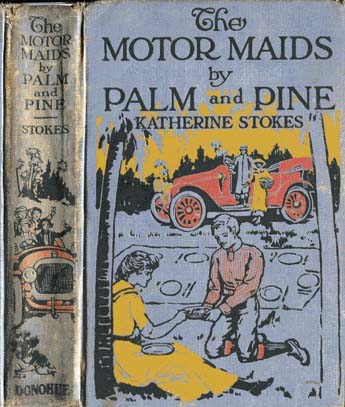
Ever since that eventful day when the Comet had been stalled in a sand bank, Billie and her friends had wished to return to the pine forest for a picnic. Leaving the Comet among those vanguard trees which lingered on the outskirts of the woods, before the trail became too soft, they carried their luncheon somewhat within the confines of the pine woods and chose for their picnicking ground an open space carpeted with pine needles. Here the trees grew to immense heights before they put forth their crown of fringy foliage.
Miss Campbell, off on a motor trip with the Duffys that morning, had trusted her young charges to their old West Haven friends, Percy and Charlie. They had invited Timothy Peppercorn to come, and Edward Paxton, who was growing more and more in favor with the Motor Maids every day.
Two days had passed since the explosion of the gasoline on the Firefly and the old eagle, his grandmother, who had suffered a slight stroke, had not asked for him again. Georgiana was at her side, but Clarence, she had ordered to keep out of her sight.
“The girls are not to do any work to-day,” announced Percy gallantly. “Be seated, ladies, while we become your slaves.”
“But you don’t know how,” exclaimed Billie. “You haven’t been trained in the business as we have.”
“Just you wait and watch,” returned Percy. “Charlie, you build the fire while we prepare the victuals.”
“What an unappetizing word,” ejaculated Elinor, sniffing. “Why not viands?”
“The first course will be viands, then,” said Percy, proceeding to peel the bark from a long, straight althea twig, while Charlie with a knife and tablespoon dug a circular trench to keep the flames from spreading, swept the pine needles into the centre, and built a beautiful fire of pine logs and branches.
Presently it burned down to a bed of very hot cinders, on each side of which he planted two stout sticks with forked ends.
“What on earth are you doing with those long gumbo shooters, Charlie?” called Billie, fidgeting from the inactivity of being served by four slaves.
“Something perfectly ripping,” he answered. “Wait until you taste what’s to come, and see.”
“This will be a course of viands, good strong food, I can tell you,” added Percy, very busy over the luncheon hamper.
“We don’t like the looks of it now,” said Nancy. “Fortunately, there are cakes and sandwiches in the basket for those who can’t quite go strong food, as you call it.”
“Well, this is our contribution to the party beside our services, and I’ll wager a pound of candy apiece that after the cooking process you’ll eat every scrap, even the onions.”
“Ugh!” shuddered Elinor.
In the meantime Edward had opened a bundle containing a large juicy beefsteak which he cut into small round pieces. Percy was engaged in peeling and slicing potatoes and Timothy was putting half a dozen Bermuda onions through the same process.
“Ready, mates?” called Percy.
“Aye, aye, sir,” answered the others. And with that they began spearing slices of the meat and vegetables on a long stick and between every potato slice and section of beefsteak, they sandwiched a slice of bacon, then came another piece of potato, then a slice of onion and then the beefsteak again.
“Now for the salt and pepper, gentlemen. Build up the fire a little, Charlie. Swing him over. Who says we are not cooks?”
Resting neatly in the crotchet of the two upright sticks, this unusual arrangement of meat and vegetables began sending out a sizzling, appetizing odor while the four cooks danced a wild Indian war dance around the fire.
“Dear me, it does smell good,” admitted Billie at last. “I’m beginning to think I may lose that pound of candy, Percy.”
“Spread the cloth, Charlie, dear,” called Percy in a high woman’s voice which always made them laugh. “Lady Elinor may make the tea now, and Miss Nancy-Bell may cut the cake. I’m head chef of this kitchen. That’s the reason I give so many orders. Timothy, suppose you entertain the guests with one of your stunts while the beefsteak is cooking.”
“Do ‘The Battle of Marathon,’ Timothy,” ordered Billie.
Timothy rose obediently and made a bashful bow.
“I’m supposed to be a little schoolgirl,” he said, “ridiculous as that may seem, and the teacher has commanded me to tell the story of the Battle of Marathon. This is the history class.
“The Ba-el of Marathon,” he began, in an absurd little girl’s voice, “the Ba-el of Marathon was a great ba-el. It happened in Greeth yearth and yearth ago. There were two sidths to the ba-el and they fo’t and fo’t and fo’t and ever tho many pe-pel wath killed and at lath the thide that had the moth men killed wath beaten an’ the other thide won, an’ that wath the end. I forget which wath the thide that won.”
A joyous laugh went up at this lucid and graphic account of the famous battle. But deeper and merrier was the laugh which mingled with it. The young people suddenly became aware that a stranger had joined their circle and was now leaning against a pine tree looking at the picnic party with an expression of intense amusement. He was a handsome man, rather past middle age, of medium height with a fine rugged face, bronzed with sun and wind, and quizzical, laughing, gray-blue eyes. He wore khaki trousers much the worse for wear. His rather large head with its iron-gray hair, slightly thin at the temples, was uncovered, and across the forehead was the red mark of a recent bruise or scar. He carried a rifle under one arm and a fishing rod under the other.
“I beg your pardon, young ladies,” he said. “I didn’t mean to intrude, but I was attracted by the appetizing fumes of your beefsteak and bacon. Not many visitors at Palm Beach are fond of Gypsy picnics like this. I was curious to see whom it could be.”
They knew, all of them, at once, that it was not a tramp who was speaking, in spite of his shabby old trousers and his collarless shirt.
Then Billie, looking at his face closely again, and the beautiful smile which now radiated it, rose rather shyly and said, somewhat to the surprise of her friends—
“Won’t you join us? We’ve brought lots of lunch, and I’m sure there is enough of Percy’s burgoo, or whatever it is, to feed a regiment.”
The stranger hesitated a moment, looking at the others.
“Do please,” echoed Nancy, always following the lead of Captain Billie.
“I hope you will,” added Percy, cordially, never behind in dispensing hospitality.
“I accept your invitation with pleasure,” replied the stranger. “It’s most kind of you, I am sure. I’m hungry as a wolf, and it’s rather far from—er, supplies.”
Without the slightest embarrassment, he sat down in the group of boys and girls and joined in the talk and laughter so naturally, that presently they quite forgot he was a stranger at all.
He had a talent, this ingratiating individual, of making all of them talk a great deal, while he listened always with that amused, quizzical expression which Nancy confided to Elinor’s private ear “was fascinating.” He ate a great deal and enjoyed himself thoroughly. The sizzling, delicious combination of beefsteak and other things, he pronounced the most appetizing dish he had tasted in years. He smacked his lips over Elinor’s tea and asked for a second cup. He joked with Nancy, smiled gravely into Mary’s serious dark eyes, took many long searching glances at Billie when she wasn’t looking, and started each boy, even silent Charlie, on his favorite hobby.
Before that famous luncheon was over, it really seemed that they were entertaining an angel unawares.
CHAPTER XXII.—THE LAST OF THE HOUSE OF TROUBLES.
At last, as the afternoon shadows began to lengthen, everybody lent a hand at clearing up the lunch things, while the stranger in the khaki trousers sat under a tree smoking a short black pipe, and watched them thoughtfully.
“I smell burning,” announced Charlie, suddenly, sniffing the air like a hunting dog.
“It’s your own fire, midget,” replied Percy.
“No, no, it’s on the breeze. There, look at that.”
As he spoke a spark fell at his feet, then another and another.
The stranger jumped up quickly, wet his finger and held it in the air.
“The wind’s from the northwest,” he exclaimed under his breath.
As he faced the wind, another group of sparks, borne on the breeze, blew against him.
“By Jove,” he cried. “It must be Virginia’s house. Thanks for your hospitality, I must go,” he added, starting to run down the trail.
“Come back,” called Billie, “we’ll take you in the car quicker than you can cut through the woods.”
Without a word the stranger turned and joined them as they gathered their belongings together and raced through the woods to the Comet.
Silently they piled themselves into the machine and in another ten minutes Billie had guided them safely over the rutty wagon track to the hard beaten automobile road and they were speeding along toward Virginia’s.
As they tore up the avenue of giant trees, over which hung a cloud of dense smoke, Billie said to the stranger who was sitting beside her:
“I know that you are Mr. Ignatius Donahue. I have known it from the first.”
“How did you recognize me?” he asked smiling.
“From your pictures.”
“Well, keep the secret awhile longer,” he said. “I have been getting over an—er—accident I was in not long ago, and staying here quietly with Virginia and Edward.”
The only living soul they could see as they approached Virginia’s home was old Mammy who was running up and down the front gallery like a distracted creature, lifting up her voice in wails and lamentations. One wing of the house had entirely burned down and the flames had leapt over the main roof and were making rapid headway.
“Bress de Lord, oh my soul,” she cried when she saw the automobile full of people come up to the front door.
Mr. Donahue was the first to jump out.
“Is your mistress in her room, Mammy?”
“Yes, Marsa, yes, sir. I cyan’t move her a step,” wailed the poor old woman.
“Where’s Miss Virginia?”
“A lady don’ sen’ fur her to come to the hotel quick. She’s been gone an hour.”
“Where’s Uncle Peter?”
“He don’ drive little Missy over, Marsa.”
Another moment, and Mr. Donahue had disappeared in the smoke-filled house, followed by the boys.
Then Billie did something for which I am sure you will hardly know whether to commend her for her bravery or blame her for her recklessness.
“Where’s Dick, the mocking bird, Mammy?” she asked.
“In his cage in de kitchen, little Missy,” moaned the colored woman, rocking herself back and forth.
Running around the back of the house where she dimly remembered the kitchen was situated, Billie pressed her face against one of the windows and peered into the room, which was fast filling with smoke that poured in from a passage leading from the burning wing. She knew it was the kitchen because the floor was of brick and she could make out the dim outline of the great range which had not been used in all these years. It was impossible to find the door in all the intricate back region of the old house. It must be somewhere in that smoke-filled passage. Seizing an old stool under the window, Billie broke in the glass; then using it to stand on, she climbed through.
“Dick, old fellow,” she called.
A feeble chirp answered. Yes, there he was, huddled in his cage, his feathers all ruffled up and his head under his wing. She seized the cage and ran to the window just as the roof of the wing with a great crash fell in, covering the porch outside with burning debris. A volume of smoke and flame outside curled into the open window and she knew that escape was impossible that way.
As she ran up the three steps which divided the kitchen from the next room, she stumbled and fell over something stretched across the doorway. It was the body of a man lying face downward, his head on his arm. Seizing him by the shoulders, she dragged him away from the door and closed it to keep the smoke from pouring in. Then to confirm the suspicions which had come to her when she saw the rumpled black hair and slight, well-knit frame, she turned the man over.
“Edward!” she cried. “Get in here, Dicky-bird,” she said, slipping the mocking bird from the cage into her blouse.
Seizing the unconscious boy by his ankles, she began dragging him slowly across the floor. It required all her strength, but she managed to get him through the doorway and into the hall. The smoke was terrible, however. Not in the great fire at Shell Island had it seemed so dense and thick. At last, staggering toward the door, she called:
It was Ignatius Donahue who carried her out in his arms, while she whispered hoarsely,
“Be careful not to crush the bird! He’s in my blouse.”
Edward’s double and Charlie Clay lifted him out of the smoke-filled hall.
“Shan’t we try and save the house, sir?” asked Percy, who saw in the stranger now only a very distinguished person, born to command.
“No, no, my boy. It can’t be saved and it had better burn. It has been a house of sorrow always.”
They carried Edward l’Estrange farther down the avenue to the automobile which had been moved out of reach of smoke and sparks. As Billie’s dazed senses began to return, she saw, sitting in the back, Virginia’s mother, very pale and ill. But strange to say, the invalid was not looking at the house. Her eyes were fastened on Ignatius Donahue with an expression in which could be read many things: wonder, surprise, perhaps even joy. Billie thought her more beautiful even than the first time she had met her, and it occurred to her, watching the delicate, lovely face, that at least the poor lady would never know now about her prized heirlooms. They would to her always have been burned with the house.
Edward l’Estrange was not long unconscious, after he was brought into the fresh air. They chafed his wrists and temples and presently he opened his eyes.
“Are they all safe?” he asked as memory returned to him.
“All safe, my boy, and if you are able to stand up, we’d better be taking your mother back to the hotel,” answered Mr. Donahue.
As he spoke, the roof of the old house crashed in and the four walls stood out bleak and desolate in the smoking ruins.
The Comet carried a big load that afternoon. For the first time in her life, old Mammy rode in an automobile, but the old woman, like her mistress, was too dazed to realize that she was skimming along the high road at the rate of thirty miles an hour.
On the way to the hotel, Billie heard Mr. Donahue say to Edward: “I didn’t know you were in the house or in the neighborhood, my boy.”
“I only arrived this morning. I was to stay away two or three days longer, but I went to your office in New York as you directed, with the message for your secretary, and while I was waiting a bunch of mail arrived. The letter on top was this. It may have been wrong, but I took it because you see I couldn’t help recognizing the handwriting as my father’s. Who directed it or where it came from, is a mystery.”
He put his hand in his pocket and drew out a letter which Billie recognized as the very one she had re-directed several days before.
“But where did it come from?” demanded Mr. Donahue in amazement.
“We found it under a little house in the woods,” she broke in, “and I sent it to your New York address, which is the one Papa gave me.”
“You are a jolly, clever young lady,” cried the older man delightedly, “and you can never know what a debt of gratitude we owe you.”
It was a lucky chance that Mr. Duffy’s motor car happened to pass before they reached the hotel, and some of the party were transferred to that roomy and capacious machine. So that the overloaded Comet did not, after all, create a sensation as it rolled up to the side entrance of the hotel.
Contrary to their expectations, Mrs. l’Estrange was neither ill nor cast down. Perhaps she did not realize yet that her home had just been burned to the ground. At any rate, when Mr. Donahue carried her into the hotel, she rested her cheek on his shoulder and said softly:
“You find me a broken old woman, Ignatius.”
“No, no, Virginia. Only much paler and thinner. There is a great doctor who is an intimate friend of mine, and he has promised to come down in a few days and have a look at that spine of yours. I have enormous faith in him. I believe he can cure you.”
The two Edwards were talking earnestly together when Billie restored the little mocking bird to its master, and before they parted they grasped hands like two brothers who had been reunited after a long separation.
CHAPTER XXIII.—EXPLANATIONS.
Late that evening, when Billie sat resting on the piazza, not caring to join the others who were laughing and talking together, Edward l’Estrange drew up a chair beside her and told her the strange story which had drawn them all into a network of puzzling incidents.
“My father was an Englishman, Billie. His name was Paxton.”
Billie started.
“Then you are——”
“Yes. I am Edward’s first cousin. Our fathers were twins and adored each other as twins usually do. My father did not get on well with his mother because he wanted to be a musician. Edward’s father was more practical and he was her favorite son. But he was dissipated, and once in a fit of wild temper he committed a crime, and when they arrested my father by mistake, his brother let him go to jail.”
“How dreadful! How wicked!” put in Billie.
“Yes, it was pretty bad. But Edward’s father made up for it afterwards by his misfortunes, and at last he committed suicide. But to go on, my father escaped and came to this country. He changed his name and went south where he met my mother and eloped with her, although she was to have been married the next day to Ignatius Donahue. It was wrong, of course, and I can’t defend it except that they were so much in love. They lived very happily until my father got word that they were on the track of him. My mother wanted him to fight it out in the courts, but it would have been a difficult case, because you see he had run away. My father was very delicate and visionary, and I suppose he lacked the spirit to defend himself. At any rate, he would build the house in the pine woods and hide himself, and there he stayed for several months—until we brought him home to die, in fact. Just before the end came, he called me into his room one day and told me that he had in his possession a very valuable letter. He had addressed it to Mr. Donahue but it was not to be delivered unless we were in actual want. As we had plenty of money, it didn’t seem likely then that the letter would ever be sent. Anyhow, when I went to look for it, I couldn’t find it. My father’s mind must have been wandering at the time.
“But that wasn’t the end of our troubles, because after father’s death, mother had a fall and injured her spine so that she has never been able to walk a step since. Then the cotton mills, in which all her money was invested, failed and we lost every cent we had. Mother doesn’t know that, though. Virginia and I have managed to keep it from her, so far.”
“I know,” said Billie. “You were wonderful, both of you. But what was in the letter?”
“It came just before father’s death, while he was still at the little house, and it was a full confession written by his brother. After we got so poor, I wrote to Mr. Donahue, thinking perhaps he might have received this lost letter. I suppose father wanted him to have it because of his devotion to mother, and he has helped us in every sort of way. I think he bought the Firefly just for me to take parties out in. He never came to our house, but he used to run down here on his car for a night or two and consult with me.”
“One more question?” asked Billie. “What was he doing that night in the avenue when he had the fight with the man in the motor car?”
“Well,” said Edward, “you must know that there were people who were trying to get that paper away from us before my grandmother could see it. Clarence’s people they were, a bad lot. I suppose they thought if Clarence inherited his grandmother’s millions, they would all come in for their share.
“That fellow who fought with Mr. Donahue represented himself as coming from my grandmother. But then he tried to play a double game and Mr. Donahue caught on and they fought.”
“Now, a last question, Edward. Where in the world have you been hiding?”
“You see, my grandmother and I made friends immediately. When I took the stick away from her that day, she saw at once I was not Edward Paxton, although that is really my name, and she knew she had found her other grandson. The quarrel we had when I broke her stick later in St. Augustine was all fixed up between us. She enjoyed it immensely. Then she ordered me to lie low somewhere, until she sent for me. She was anxious to see if Edward would really keep his word and get to work. He has, so I suppose she’s well pleased. But she has had a hard life. Her children disappointed her one way or another, and have all died, and her grandchildren didn’t seem to come up to the mark either. She’s just a soured, embittered old woman, but I like her, anyhow, now that we understand each other.”
That night Billie related the strange story to her three intimate friends in their bedroom. Each Motor Maid made her own characteristic observation.
Nancy, standing before the mirror, rolling her curls on her pretty fingers, smiled at her image and remarked:
“Mr. Ignatius Donahue is the most charming, fascinating, delightful man I ever met.”
Elinor, in a long white bath robe, her braids twisted around her small head like a coronet, observed:
“It was really family pride, I suppose, that made Edward l’Estrange’s father keep the letter a secret.”
“Oh, no, Elinor,” cried Mary, seated cross-legged on the bed, while she thoughtfully brushed her fine brown hair, “it was his love for his brother. They say that the love of one twin for another passeth understanding.”
“Whatever it was,” said Billie, lying flat on her back on the bed and gazing up at the ceiling, “a fine American boy and girl, honest and plucky and proud, too, for that matter, have come up, head and shoulders from the whole wretched muddle.”