
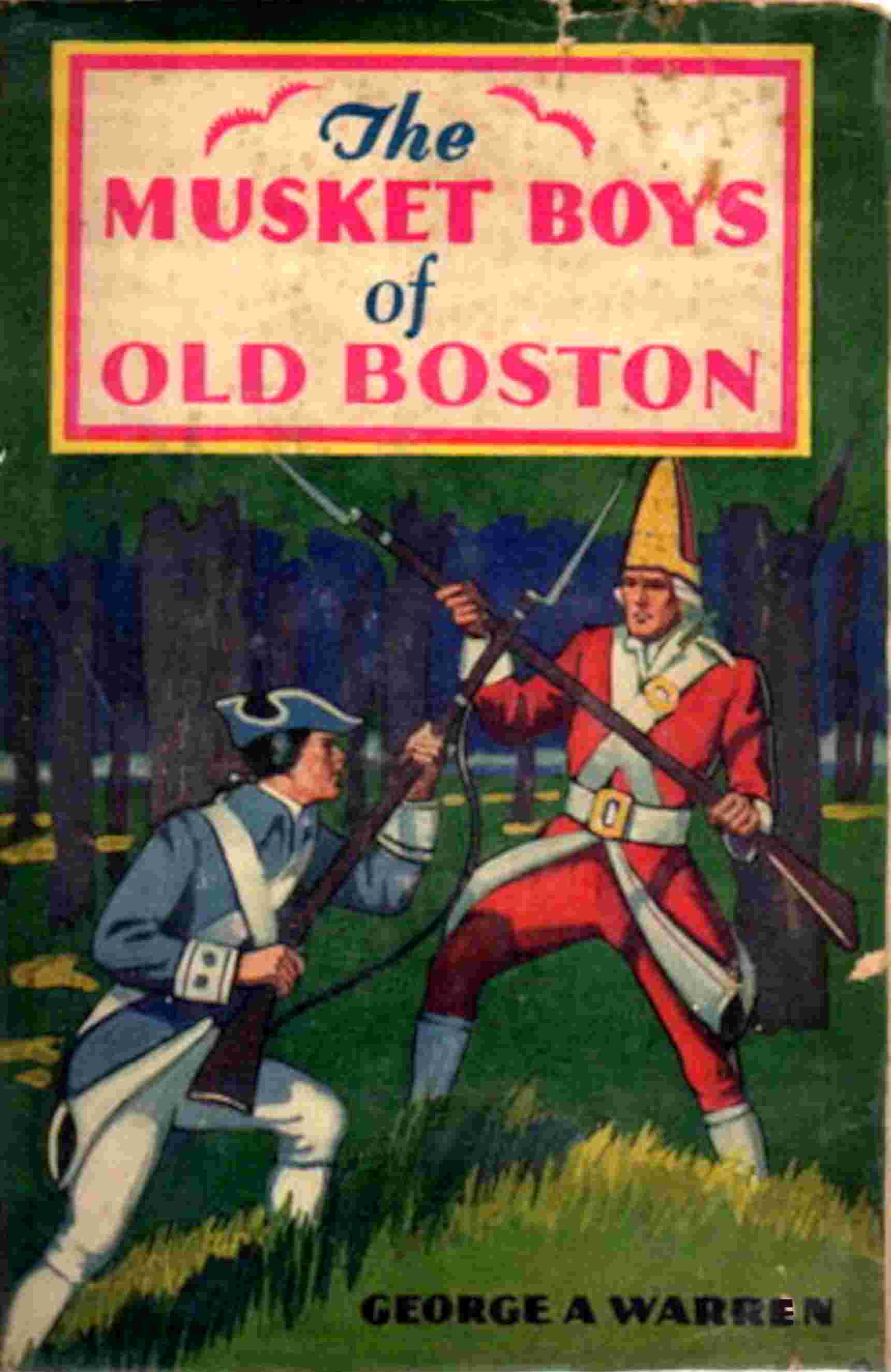
CHAPTER I
A PUFF OF POWDER
"That's a queer proceeding, Phil."
"I should say so. Why, Andy, what is the fellow up to?"
"Let's watch and find out. Here, dodge down behind this bush out of sight."
Puff!
"Gunpowder!" declared Phil Warrington in a thrilling whisper. "There, the fellow has turned around. He is running away. I say, Andy, I know him!"
"You know him, Phil?"
"Yes, he is the same boy I told you about this morning. See, there is the long-tailed muskrat cap I described to you. See it is certainly the mysterious boy who startled me so here in Concord, and who, I am mightily certain, I met before that somewhere in Boston."
"After this boy of mystery, then!" cried Andy. "I am curious to know the secret of all these peculiar proceedings."
The scene was wild and wintry, the time March, 1775, the place a stretch of woods and fields just back of the famous old town of Concord.
The two boys were Phil Warrington and Andy Sabine. The former was on a brief visit to his best friend and chum. Phil's father was a merchant in Boston and Andy's father was a storekeeper in Concord, and the two men were old-time friends. Andy had spent a month in Boston the year previous, and Phil was now returning the visit. The latter had left his home city at a time when loyalty and royalty were beginning a conflict that had already set the country afire. Phil had brought to the excited juveniles of the backwoods town not only the keen, snappy vigor of an all-around intelligent lad nursed by the exhilarating, briny breezes of the Bay, but the grim echo of the gunpowder days. Those were stirring times, and everybody was on the tip-toe of expectation, waiting for something to happen.
Phil belonged to a club called the Musket Boys of Boston. Its existence dated back to the day after the famous "tea party," when some Boston citizens, disguised as Indians, resisted the Stamp Act by throwing a whole cargo of English tea into the waters of the Bay. Phil had witnessed that stirring event personally, and that made him an object of interest to every lively, patriotic lad in Concord.
Then, too, Phil was one of those boys who had formed themselves into a committee to visit General Gage at the British headquarters in Boston, to complain of his rude royalist soldiers. The soldiers had spoiled the snow slides of the boys on Boston Commons out of malice, taunting them with being "young rebels."
Whenever Phil related this incident, he stirred his manly young hearers to deep indignation and patriotic fervor, and they voted him quite the hero that he was.
This all led to stir up more deeply the latent spirit of resistance and outbreak long smoldering in the bosoms of the ardent youths of Concord. Their parents talked nothing but war, and were already organizing for the conflict that seemed inevitable. The boys followed their example, and many secret meetings of youthful warriors were held in Andy's barn. They had even drilled like real full-grown soldiers. Phil was the leader in these operations. In fact, he and Andy had just come from target practice with the self-same muskets that they now dropped to the ground as they arose to their feet simultaneously, after curiously watching a boy about their own age who stood at a distance.
They had been following some rabbit tracks across the snow when Andy Sabine uttered the remark which opens our story:
"That's a queer proceeding, Phil!"
It was decidedly an unusual spectacle that the two friends witnessed. About a hundred yards distant the land ran up a small hill. It was covered with light brush, except at the top, where there was a barren space. Here, clearly outlined against the dull grey sky, stood a lad wearing a muskrat skin cap, thinly clad and shivery-looking.
The stranger, as Phil and Andy saw, had some kind of a parcel done up in paper. This he had rested on a solitary tree stump. Then with flint and steel he ignited some tinder he had placed across the top of the tree stump. As this ignited, he retreated to a little distance.
The tiny flames curled around the paper, and finally there was a giant puff. The strange boy watched the ascending smoke for a minute or two and then pursued his way, disappearing over the crest of the hill.
"You cut around that way," directed Andy, pointing, "and run across to him. I'll head him off at the bottom of the hill if he tries to run away from us."
The boys had disencumbered themselves of their muskets and game bags to brace for a dash. Phil somewhat hesitated.
"I say, Andy," he observed, nodding towards a line of low rail fencing, "won't we be trespassing?"
"Where? when?" demanded Andy, somewhat puzzled, staring askance at his comrade.
"That's old Jasper Bram's property, isn't it," asked Phil.
"Yes, and this, too," replied Andy. "What of it? This is not like Boston—no trespassing around these diggings. Free as the air, Phil, full range when a fellow wants to make a short cut or chase a rabbit."
"I don't know about that in this especial case," said Phil to himself, with a grimace. "Andy don't quite understand our pleasant family relations with Jasper Bram. I met the old curmudgeon once since I came to Concord, and I don't fancy a second encounter. Here goes, though, on a venture!" and Phil promptly started in the direction indicated by his chum.
Two things were uppermost in Phil Warrington's mind as he made for the hilltop—Jasper Bram and the mysterious boy he was after, the latter first of all, in a speculative, curious sort of way.
Two nights previous Andy and his friends had held a club meeting in the roomy loft of Mr. Sabine's old barn. They had wound up with a kind of banquet. Phil, starting with Andy to escort their guests home, suddenly remembered that he had left his pocket knife on the rude deal boards that had answered for the banqueting table.
"Go on, boys, I'll catch up with you in a minute or two," Phil had remarked, running back to the barn, which he soon reached. He clambered to the loft, and by aid of the bright moonlight, made his way to the table, groped for his pocket knife, secured it, and was about to leave the place when a sound at one end of the loft caused him to turn quickly.
Some one had mounted the sloping roof of an adjoining shed and had pulled open a narrow wooden window. This person was a boy. He was reaching towards a barrel on which stood some of the remnants of the recent feast.
"Hold on, there!" irresistibly called out Phil. Then, noticing more closely the outline of the marauder, he added: "Don't run. Take what you want—nothing to be scared at. I say, haven't I seen you before?"
In a flash Phil had been interrupted. The stranger, a boy about his own age, at being so startlingly hailed, had dropped a handful of doughnuts he had grabbed. He drew back and disappeared as if by magic. Phil ran to the window in time to see the night marauder slide the slanting shed roof, reach the ground and flit from view beyond some garden bushes.
Like a photograph, however, there had been imprinted on his mind the thin, starved-looking face of the boy and the peculiar muskrat skin cap with a long tail which he wore. The picture remained vivid for a long time, the more so as Phil puzzled himself to make out where he had seen the boy before. He concluded, that it must have been in Boston.
"The poor fellow must have been terribly hungry," Phil had decided. "He looked like some refugee in trouble," and Phil later recited the incident to Andy, and revived it just now as for the second time he had happened across the strange lad in as strange a way as on the former occasion.
This was the first thought Phil had in his mind as he ran rapidly on. His second thought was of Jasper Bram.
Phil had heard that name many a time long before he came to Concord. His father had frequently mentioned it in conversation with Phil and Mrs. Warrington. From what he had heard, Phil came to understand that his father regarded Jasper Bram of Concord as an enemy.
Since the trouble with the British troops in Boston had begun, Mr. Warrington had met with severe business losses. He was a strong loyalist, and had refused to side with the English troops in the matter of supplies in which he dealt.
One night his warehouse was set on fire in a mysterious way, and was burned to the ground. There was no doubt in the mind of the merchant and his patriotic friends that the British soldiers had committed this outrage.
A few days later Phil overheard his father remark to his mother that he was pretty nearly ruined financially by this great loss. He said, too, that he could not see his way very clear to continue business unless he could get money or help somewhere.
Mr. Warrington, in discussing the situation, complained bitterly of a great business wrong done him some years before by Jasper Bram. He alluded to trickery, robbery, and stolen documents. He said that if he could get what Bram legally owed him he could renew business.
Phil naturally thought of all this when he came to Concord. He made some inquiries about Jasper Bram, to find that he and his loutish son, Greg Bram, were very generally disliked. The more so was this true because they were designated as "regular Tories."
The day preceding Phil was coming home from the river when he stepped out of the road to let a sled pass him. Its driver had eyed him sharply. Phil recognized him as the person whom Andy Sabine had pointed out to him a few days previous as Jasper Bram.
The grizzled, mean-faced old man stared hard at Phil. He drew his team to a sharp halt.
"Hey, you!" he hailed. "What's your name?"
"My name is Warrington," replied Phil.
"Thought so. Heard you were in town, saw you were a stranger. Now look here, you young cub," and old Bram flourished his whip in a way so menacing, and his crafty old eyes gleamed with such furious rage, that Phil was positively electrified—"you come sneaking around again trying to spy on me, and I'll fill you full of shot and salt and pepper!"
Phil's eyes flashed. The insulting tone and manner aroused him indignantly. Only the age of his challenger prevented the youth from saying something desperate. He controlled himself, and remarked:
"Your place? Why I don't even know where it is."
"Bah! Think I can't figure out that your father sent you here for a purpose? Think I can't guess you to be the boy that I saw peeking in a window of my stone shed, if you don't wear a muskrat skin cap now, as you did then? Just you keep away from me and mine, young Paul Pry, or you'll get a dose that will lay you up for a while."
And then with a vicious snort, and shaking his fist venomously, old Jasper Bram drove on with the sled.
"Well! well!" the stupefied Phil had commented, staring wonderingly after the old man, "that's a fine reception for a fellow. My father is right, and Jasper Bram has little use for our family. A muskrat skin cap. I never owned one. That half-starved fellow who tried to get the food at Andy's barn must have made old Bram a visit, too."
All these varied memories and reflections darted through Phil Warrington's mind as he now made the ascent of the hill on the land of the man he knew to be no friend. Soon he reached the summit.
In an instant his meditative mood took flight. Real action fixed his attention. The minute Phil came into view of the summit of the hill a loud call rang out:
"Stop him!"