
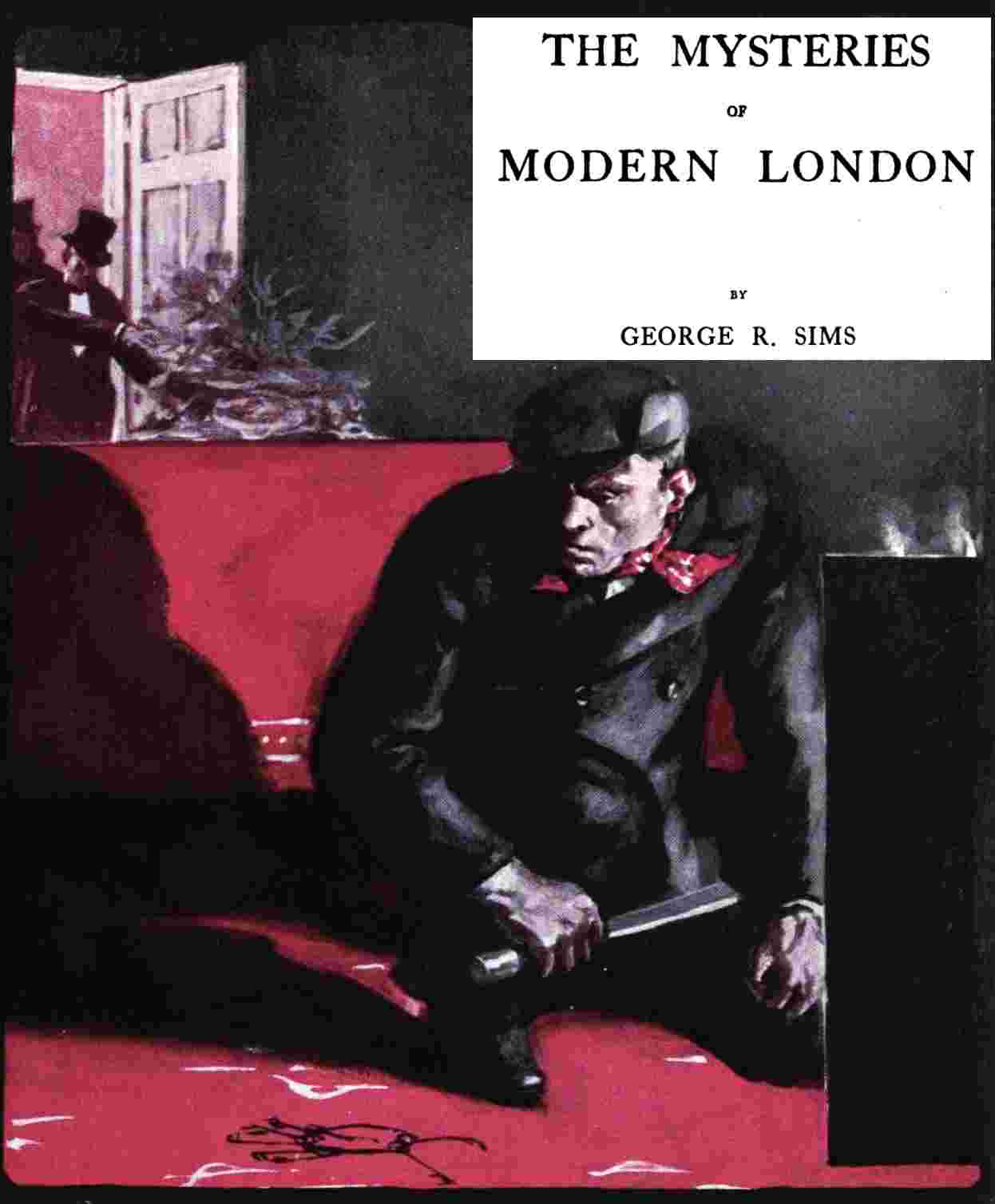
CHAPTER XXI.—THE ROMANCE OF REALITY
She waits in vain—Messengers from the First Cousin of the Moon— Witches and wise women—The seventh child of a seventh child— Secret societies of vengeance—Italy in London
THE strange, the weird, the romantic, may be found at every turn of the great maze of mystery which is called London.
The homes of mystery and romance lie often at our very doors, unknown and unexpected. We pass a scene that the novelist or the dramatist could turn to thrilling account, and to us it suggests not even a passing thought of wonder.
Here is a house in a fashionable road in that part of the north-west which borders on Hampstead.
It is an ordinary villa residence. There are flowers in the windows, and all the signs of well-to-do occupation. But in this ordinary-looking villa there is a room at the back in which the light of day never penetrates. The shutters are always closed, the door is always kept locked. Only one person has that key, the lady to whom the house belongs. She lives there with a brother and a sister, who came to make their home with her in her hour of distress, and who do their best to brighten a life that has known a great sorrow.
The lady came to the house a young married woman. It was the house that she and her fiancé selected and furnished to be their home when they returned from their honeymoon.
The young couple knew in it one happy month. Then the young husband went out one day and never returned. From that hour no inkling of his fate ever reached the unhappy bride, whose reason almost gave way under the strain and stress of the long agony of suspense.
On the day that he went out from the home to which he was never to return, the young husband was expected back at six o'clock in the evening.
It was his birthday, and a little birthday dinner had been arranged, to which a few intimate friends had been invited.
It was the young wife's first dinner-party, and she took great pride in the arrangement of the room and the floral decorations of the table.
The table as it was laid out for that little dinner-party remains to-day. The flowers are dead and withered, the table-linen is yellow with age, the furniture is faded and decayed, and desolation has settled on the scene. But the wife so suddenly and mysteriously widowed refused from the first to allow a thing in the room to be touched. The birthday-table is still laid for the husband, who will never come home again.
Here in the south-west of London is a little old-fashioned shop in which second-hand furniture and curios are sold.
There is nothing out of the common in the shop, yet it has its strange romance. If you look over the doorway you will see a Chinese name. If you enter the shop the young lady who comes forward, though she has Oriental features, addresses you in ordinary English, with perhaps a slightly Cockney twang.
The shop was founded by her father, a young Chinaman who suddenly appeared in London. No one knew where he came from. He wore Chinese dress and a pigtail, and started in business with a hired barrow, with which he went round to houses in the neighbourhood, buying the odds and ends that people wanted to get rid of.
Gradually he became less Chinese in appearance. The pigtail went, and he took to European clothes. He seemed to have prospered, for he took a little shop, and later on married an Englishwoman.
It was quite a humble little shop at first, but there passed in and out of it occasionally Chinamen who were evidently grandees. They came in elegant carriages, and, according to report, they were mandarins.
Once the carriage of the Chinese Ambassador stopped in the street, and the representative of the Brother of the Sun and First Cousin of the Moon passed into the shop and remained for a quarter of an hour in the little back parlour closeted with the Chinaman who had come here from nowhere, and had started business in England buying old bottles, old iron, and old rags.
Every one in the street knew the Chinaman, and gradually many became his tenants, for he bought a good deal of property round about. But no one ever penetrated the mystery of his connection with the great mandarins who from time to time visited him, and no one was ever able to form the faintest idea why the Chinese Ambassador came to interview him in the back parlour.
The Chinese name is over the door, the Chinaman's children are carrying on the business at the present moment. They are in everything but appearance English men and women. The Chinaman himself lies in a London cemetery, where the broken stones are on his grave. But the mystery of who he was, and what interest the high representatives of the great Chinese Emperor had in him, remains unfathomed.
While we are in Chinese company let us cross London to the east and enter the Chinese quarter, which is still round Lime-house Causeway, although many of the lodging-house proprietors and opium-den keepers have moved into High Street, Poplar.
Here is a little shop which looks innocent enough. The only suggestion that it is an opium den is in the odd-looking little pipes exhibited for sale in the window.
You may pass up and down the street all day and not see a soul enter this shop. If you peer in you will see something in Chinese characters over the door that leads to the inner portion of the premises. If you were to enter you would be in the presence of a Joss and the strange worship of the wooden image. Here in the heart of living London are the mysteries of the East to be found—here you may see phases of life as they might have been depicted in some side street of Pekin by Guy Boothby.
To this house opium smokers with strange histories have come again and again. It was here that an English opium smoker, who had been searched for in vain by his friends for many months, was found at last, lost to knowledge of himself, lost to everything except the mad craving for the drug that had degraded him from a high estate to lie cheek by jowl with the strange men of the East, who bring their mysteries with them for awhile to the world's port, and then vanish to be seen no more.
The Londoner may think when he sees high up upon a tapering flagstaff a red lamp glowing in the darkness of the night that it is intended, by the small body of men and women who have imbibed the occultism of the East, to light the wandering Mahatmas home.
Though the general knowledge of the rites of the Theosophists is vague, there is no concealment about the temples of the worshippers. But there are strange rites practised in the heart of busy London, and there is no sign or token given of the meeting-place of those who indulge in them.
In a gloomy synagogue in a by-street of Alien Land the patriarchal Jew may be seen writing out the sacred amulets and scrolls by the light of a guttering candle—a picture for a Rembrandt; but no one but her dupes sees the "witch" or the "wise woman," who still carries on her trade in the twentieth century, making the charms and the love philtres that she knows where to sell.
The West End palmists and fortune-tellers flourished for a time and had their day, and went down before the arm of the law; but a far more dangerous trade than theirs, which did but minister to a foolish, fashionable craze, is still carried on daily and nightly in secret in unsuspected places.
It is nine o'clock at night and the darkness has descended over London. At the top of a street near Victoria Station, once inhabited by the well-to-do, but now fallen into the seediness of floor-letting, a cab stops and a lady closely veiled alights.
She makes her way to one of the houses, looking furtively behind her now and then. She rings the bell and is admitted.
If we follow her we shall see her descend the stairs to the basement. She is shown into a room dimly lighted and fantastically draped, and filled with strange objects.
A dark, sallow-faced woman, clad in a curious Eastern robe, receives her, and the door is closed and locked.
The woman passes for a seeress—a modern witch. She is consulted by women of education, women who come to her to gaze into the crystal and the ink pool, to peer into the future, and who—strange as it may seem to common sense, level-headed people—implicitly believe in the supernatural powers of the wily adventuress, the cunning woman who trades upon their credulity.
We can understand the ignorant servant-girl who pays the half-crown she can ill spare for some wretched hag in a garret to read the cards for her and tell her her future; but there is nothing more amazing in the mysteries of London than the hold which the clairvoyante and the "divineress"—generally, according to themselves, "the seventh child of a seventh child"—still have upon the minds of women of education and position.
There is hardly one of the clairvoyantes who practised in the West until the law stepped in who is not still carrying on the business, though in a more secret and a less profitable manner.
Here is a house that the agents would call "a desirable villa residence." It stands in a long garden at the corner of one of the leafy roads of St. John's Wood.
Within its walls meets a little band of men and women who go through strange ceremonies and perform strange rites, and almost worship as their leader a woman who calls herself a prophetess, and who has persuaded her ignorant dupes that she is directly appointed to save them from death. The semblance of death they will know, but their souls will pass into other bodies, and in a reincarnated state they will continue to live upon the earth in greater happiness and greater health and strength and well-being than they ever knew before.
The policeman on duly passes the house at night and flashes his lantern on the door, but he has no idea of the strange orgies of exaltation which take place behind the closed shutters of that charming villa residence.
There are "offerings" to the prophetess, the giving up of jewellery and "adornments" for the good of the cause, and so it may be that one day the Old Bailey will see "a prophetess" in the dock again, and the spectators will look with astonishment at the men and women who enter the witness-box to tell a story that will startle the newspaper reader and make the humdrum world open its eyes and say, "Can such things be in these days of enlightenment?"
In a road running off the outer circle of Regent's Park there is another house of mystery. It is walled in in front, and there is a door in the wall which is always kept locked.
If you ring the bell a man-servant will open the little trap in the door and look at you keenly.
You are not likely to be admitted unless you have satisfied the janitor that your visit is expected, and that your presence will be welcome to the master of the house.
The master of the house is a foreigner. The name in which he dwells in the house is not his own. He is one of the most trusted agents of the great Revolutionary Party, and his guests are "comrades" who come with messages from the capitals of Europe.
More than one plot which has startled the world has been arranged in that ordinary, unromantic-looking house, and its walls have from time to time sheltered men whose whereabouts certain European Governments were exceedingly anxious to discover.
The Mafia! We read of this terrible Italian secret society and its murderous doings in the land of the stiletto, and we accept the printed stories with a vague suspicion that they belong to modern Italian opera rather than real life.
But the emissaries of the Mafia—the Society of Vengeance—are tracking down their prey in the dull, drab streets of our own prosaic city.
If you pass along the Clerkenwell Road you will come to a side street that dips down into a hollow, and this hollow, though open to the view of all who pass along the bustling London thoroughfare, is perhaps the most un-English spot in the whole of England.
As you pass the top of Eyre Street Hill—that is the opening which leads to the district we call Little Italy—you will see two policemen in uniform standing together. You will see two policemen always there after nightfall, and when there is trouble they go down into the hollow together.
For the natives of Little Italy are given to sudden outbursts of anger, and then the knife flashes and the pistol shot rings out on the air. Occasionally, when the quarrel is an ordinary one, which has arisen over a sweetheart, or perhaps over the wine bottles in the kitchen of the padrone, the English police may make a capture.
But when the knife or the pistol is used to carry out the sentence of the Mafia, the agent of that dreaded society who has executed the "order" with which he was entrusted by the chiefs in Naples, or, perhaps, in Palermo, finds it no difficult matter to lie concealed from the most active search the English officers of justice may make.
The ordinary assassin may be denounced and given up by neighbours who were witnesses of the outrage, but the man of the Mafia is not likely to be betrayed by an Italian who wants to continue in the peaceable enjoyment of his life.
It sounds very like a sensational novelette, but it is plain fact. The Mafia agents who stab or shoot in Little Italy are shielded by those who fear to offend the society, and an early opportunity is taken of getting them secretly out of the country. Their mission accomplished, they go back to Italy.
I have spent more than one night in the kitchen of a padrone. I have been into most of the houses from floor to basement, even into the underground cellars, where at night-time they dance the Tarantella, and I have found the inhabitants of Little Italy a hard-working and civil lot of men and women, very much more prosperous, and with a far higher standard of comfort, than we gather from sensational newspaper articles about ice-cream vendors and organ-grinders. But there are two classes of inhabitants, the North Italians and the South Italians, and there is as much difference between them in temperament as there is between a Scotchman and an Irishman.
The Piedmontese, who are in Little Italy in large numbers, are mostly paviors and labourers, and they repudiate the acts of violence for which the district has, or had, a bad name.
If you speak in a lodging-house where the clients are Piedmontese about the stabbings and shootings, they will say, "Oh yes, the Neapolitans, perhaps—but not us."
But both North and South know the Mafia, and would hesitate to speak the truth about any of its members if the truth were likely to do the said members harm. If you were to ask in Little Italy to-morrow about the Mafia, they would even deny that its agents were to be found there at all.
But they are there, and on more than one occasion they have made their presence felt in the most approved manner of the vendetta as it finds expression in Italian opera.
In every quarter of London, in the most matter-of-fact environment, the romance of reality is to be found—a romance as thrilling as anything the sensational novelist could invent and give to the world with a certainty that his invention would be looked upon as wildly improbable.
Nothing that is imagined and invented is so astounding as that which really is, and the most astounding thing is that the existence of the reality is unsuspected by the people who live constantly in close proximity to it.
Over much that is strange and terrible in modern Babylon the veil is wisely drawn by those who write for the great public. In Paris there is less discretion, and the sores of the city are laid bare for the idle and the curious to stare at them.
If a writer knowing London wrote with the lack of reticence which distinguishes the Parisian who knows Paris, the result would be one beside which all the "startling revelations" that are imagined and dressed up by fictionists disguised as journalists would pale into insignificance.
CHAPTER XXII.—SOME CONTRASTS
The inquest and the garden party—A policeman sits behind the screen—The portrait of a prosperous impostor—From his wife's death-bed to the House—The judge and his pet dog—Tea and cakes while they wait for the sentence
UNDER the trees in the garden the tables are spread for a pastoral fête. Smiling waitresses are handing ices and claret cup and strawberries and cream to daintily-gowned ladies who are sitting in the shade and chatting gaily with their admiring cavaliers. I come out from a little building in the grounds and gaze at the fair and festive scene. As I see the pretty frocks and pretty faces, and listen to the rippling laughter, I cannot help being struck by the vivid contrast between the tragedy I have that moment left and the comedy I have come upon.
These grounds are the grounds of a famous hospital, and the company are gathered together under the trees after listening to speeches and witnessing the presentation of prizes in the great hall of the institution.
I come through the little door of the out-building to step right into the joy of life, and the door as it closes behind has shut away a tragedy. Behind it lies a dead man upon whom the verdict of a coroner's jury has been pronounced.
I am not easily upset, and I have looked in my professional wanderings upon many gruesome sights, but my nerves have been sorely tried during the five minutes I have been inside that little out-building of a great hospital.
There were only two men inside it when I entered, and one of them was dead. The living man was the inquest porter, and he was spending the blazing summer afternoon in giving back to the dead one the shape and impress of humanity.
It was a sight to make the unaccustomed spectator shudder, and I only lingered long enough to hear the story of the tragedy. Then I passed out again into the sunshine and found myself at a garden party. I looked at the charming scene and the smiling faces of the fair guests; I listened to the rippling laughter and the musical clink of the ice in the cooling wine cups, and I could not help thinking of the strangeness of the contrast. Only a few inches of space and a wooden door separated the garden party from the dead-house.
Not one fair visitor in that gay crowd had the faintest idea of what was happening within a few yards of where she sat in the sunshine under the trees eating strawberries and cream.
As I passed the group a young lady whom I knew came towards me. "What a delightful place this is!" she said. "Really, I never thought a hospital was so charming."
"Charming" seemed a strange word to apply to a hospital. But in our great palaces of pain to-day the eye is constantly cheered, and in the note of colour and comfort the casual visitor forgets the anguish that lies hidden beneath the gay coverlets and behind the pretty curtains.
Here is a hospital ward that an artist might delight in. The colour scheme is soothing to the eye. Along the ward are little tables on which stand bowls and vases of daintily arranged flowers. In the centre of the ward is a square of carpet of a soft artistic green. A young lady with a basket of roses is passing from bed to bed. She places one of her sweet flowers in the hand of every sufferer.
Outside the sun is shining and the birds are singing. The scene is delightful, and the visitor forgets the pain of the patients in the charm of the environment.
But at the far end of the room there is a screen. Behind that screen is a bed on which lies a man white and motionless, with his throat swathed in surgical bandages.
Beside the bed, hidden also by the screen, sits a policeman.
The visitor sees the flowers and the pretty coverlets and curtains, the polished floors, and the soft green art carpet. But he does not see the horror behind the screen; he does not suspect it, for he is not allowed to go near enough to know that the screen conceals anything at all.
The man behind the screen was brought to the hospital with a gaping wound in his throat. He had inflicted it himself, after stabbing the wife who lay by his side. The woman may die. She is in another part of the hospital. When the man is well enough he will be taken to prison. If the woman dies the charge against him will be murder. Night and day in that charmingly arranged, flower-decorated ward, the officer of justice sits guarding, not a patient, but a prisoner.
In the next bed lies a young man who is rapidly approaching convalescence. His happy wife bends over him with tender love in her eyes. The sunshine of returning life and the shadow of a dreadful death are separated only by a few inches of polished floor and a little table on which stands a bowl of roses.
The world once rang with the story of the Tichborne Claimant. The romance of that colossal imposture will be told again and again for many a long year to come.
In the days when he was still "Sir Roger" to the great public, I met the Claimant and conversed with him. Long after the huge edifice of fraud had crumbled to the dust I made the acquaintance of some members of the Orton family, and from them received certain photographs, which I added to my souvenirs of famous cases.
After he had served his sentence the Claimant made a confession, which he sent to a weekly newspaper. Later on he tried to withdraw the confession, but it was substantially true, and its publication destroyed the last vestige of faith which some few people still had in him.
After this "Sir Roger" gradually dropped out of public knowledge. He lived quietly and meanly in furnished rooms in a street in Marylebone. In these rooms he died. He was taken to the Marylebone mortuary, and there one sunny morning I went to see him in his coffin.
A gravel path bordered by flowers and trees leads to the hostel of the dead. After I had seen the Claimant, the adventurous life ended at last, the lying lips closed for ever in the eternal silence, I came back along that flower-bordered pathway and out into the busy thoroughfare.
My way home lay through a long street of private houses. Passing one of the houses, I looked up at the windows of the drawing-room floor, and the thought of the dead man I had left came vividly back to me. For in these rooms there lived for many years a gentleman whose name was on every one's lips in the days of the great Tichborne trial. He believed in the Claimant implicitly. He found large sums of money for "Sir Roger" during the years that the case remained undecided.
Long after the butcher of Wapping had gone to reduce his weight on a convict regime, his friend and supporter took this house. He lived there and died there, and up to the day of his death, quaint and eccentric in many things, he still believed that Arthur Orton was Sir Roger Tichborne, Bart., of the B.K.
There were many mementoes of the old Tichborne days in the possession of his former supporter. When he died he left them to his housekeeper. His housekeeper kept the house on, and let a portion of it in apartment. I knew, for I had seen them, that the Tichborne relics were still in the drawing-room. One of them was a portrait of the Claimant, taken in the days of his prosperity, when the Tichborne Bonds had been put on the market and money was pouring in. I could not resist the temptation of calling and telling the lady of the house of the Claimant's death, and asking to see the portraits and the relics. There they stood as I remembered them in the old days. The portrait of "Sir Roger" was on the old-fashioned chiffonier, standing between two little vases of flowers. I looked at the smiling face of the prosperous impostor in his heyday a few minutes after I had seen Arthur Orton lying in the parish mortuary.
A nurse from one of the big nursing institutions has been sent for hurriedly to a woman who is lying dangerously ill in cheap apartments in Pimlico.
Nurses are accustomed to contrasts. One week they may be tending a patient in a magnificent mansion, the next they may be in charge of a case where the surroundings are of the humblest description.
The nurse whose adventure I am about to tell did not particularly like the look of the house to which she had been summoned. Her quick, professional eye read the character of the inmates before she had passed through the hall into the room occupied by her patient.
The patient, a woman of about five-and-thirty, was what is technically known as "a drink case." The doctor who had been in attendance and telephoned to the institution was in the room waiting for the nurse.
"She is very bad," he said, "and I don't think there is much hope. I have ascertained who she is, and I have communicated with her husband. He may come this afternoon or this evening."
At eight o'clock in the evening a gentleman called and asked to see Mrs. —————. He saw the nurse and told her the doctor had informed him that Mrs. ————— was ill. He asked to see her alone.
The visitor, a man of about fifty, remained alone with the sick woman for a few minutes. Then he came out and spoke to the nurse.
"She is very bad," he said. "Does the doctor give any hope?"
The nurse shook her head. "Very little," she replied.
Two days afterwards the blinds were down in the Pimlico lodging-house. The patient was dead.
The morning after the visitor had called, the nurse read the daily paper, and, because a certain fact which had come to her knowledge had aroused her curiosity, she turned to the Parliamentary Report.
A well-known and distinguished member of Parliament had made a speech the previous evening which had attracted general attention, and which was reproduced in full, as it was on a burning question of the day.
The politician had gone from the bed of the dying woman in the Pimlico lodging-house to the House of Commons to make the speech of the evening. The woman whom he had called to see he had not spoken to for many years. But she was his wife. The dying woman had revealed her identity to the doctor, and had implored him to let her husband know of her whereabouts and to beg him to come and see her.
In his Memoirs Lord Brampton, known to an earlier generation as Sir Henry Hawkins, quotes a little article written about his famous dog Jack, and says he wishes he knew who the author was.
I have not written to Lord Brampton telling him that the words he quotes are mine. If I refer to them here, it is because the great judge's pet was always associated in my mind with a vivid contrast.
Many years ago I was in a provincial town where a man was being tried for murder. I went to the court and heard the trial, and was present when the prisoner was sentenced to death. I saw the judge upon the Bench with the black cap upon his head, and I heard him pronounce the awful words of doom.
Early the next morning I went for a walk to a rural suburb of the town. Crossing a meadow I came upon a gentleman who was also taking a country stroll. In the middle of the meadow he was playing with his dog. He had a piece of stick in his hand, and the dog was jumping up and barking, and eagerly demanding in canine language that the stick should be thrown.
The smiling gentleman romping with his dog in the morning sunshine was the stem judge who had the previous evening sentenced a man to death. I recognized the dog before I recognized his master, because I had met Jack at Worcester Assizes, and had seen him held on a lead by his master, solemnly escorted by the javelin men, who met the Judge at Worcester Station to accompany him to his lodgings.
I can imagine no greater contrast than that between the solemn procession illustrating the majesty of the law and the antics in which Jack indulged as he followed the javelin men. The contrast is hardly a London one, but it is permissible to mention it here, as Jack, the famous judge's dog, was a great London celebrity as well as a provincial one.
A fashionable London church is filled with flowers and palms. The pews are crowded with pretty women and handsome men. Outside the church there is an eager, expectant crowd that is with difficulty kept back from the red carpet under the awning.
The bridesmaids have arrived and are waiting in the porch. Presently a carriage drives up, and there is a buzz of admiration as the beautiful and aristocratic bride alights, and, leaning on the arm of her father, enters the church.
There is a bishop at the altar, and he is "assisted" by a distant relative of the bridegroom. The service is fully choral, and the lady journalists are taking notes of the dresses for tomorrow's newspapers.
As the bridal party comes out of the church there is a little accident. A man falls in a fit in the crowd, and the policeman, turning to help him, the people surge up, and the bridal procession is interrupted. In the confusion some of the flowers in the bride's bouquet become detached and fall to the ground. A workman with a sad, careworn face bends down and picks them up. He will take them home when his work is over. The flowers of the bride's bouquet will lie on the breast of the dead girl who has given him a year of happy wedded life, and now lies dead in the desolate little home.
The fair young bride of the West will know nothing of the dead wife in the East. But the flowers that were bought for the bridal of the one will lie in the coffin of the other.
******
Of all the dramatic contrasts of our modern London life few are so striking as those which are conventional at a trial for murder at the Old Bailey.
In the shadow of death on the last day of the trial sits the prisoner, while a large portion of the spectators take the proceedings as an interesting and sometimes thrilling form of entertainment.
There are rooms set apart in the Old Bailey for the necessary refreshment of officials connected with the court, and in one of these, while the jury are deliberating on their verdict, and the prisoner is waiting in the cells below in feverish agony, lady visitors take tea and cakes, and male visitors have coffee and cigarettes.
In the corridors of the court there are little groups chatting together, and the talk is not always of the trial.
On the emotional man surveying the scene and listening to the light conversation, sometimes to the jokes, this feature of a murder trial makes a vivid impression. He looks around him at the light-hearted groups and thinks of the dumb despair of the man or woman who waits, white-faced and terror-stricken, in a cell below the dock.
And when with the solemn words of the death sentence ringing in his ears he passes out of the court into the street, and the newsboys rush by him shouting "All the winners," the contrast is complete.
One evening, in a quiet side street in the south of London, there floated through an open window the sound of a banjo. Near the window sat a man. He was amusing himself with the banjo, and presently he played a cake-walk tune. The children in the street heard the music and began to dance to it, and the man played on.
An hour or two later he gave himself up at the police-station. He had murdered his little girl "to save her from her mother," he stated at his trial. The child was lying dead in the room while he played the banjo and the merry children danced the cake-walk in the roadway below.
Not long ago, on a bitter winter day, I passed along the Euston Road. Outside the soup kitchen stood a shivering crowd of penniless men and women.
Up the street in front of me went a tall, military-looking man walking with a beautifully dressed woman.
Opposite the soup kitchen the pair stopped for a moment and looked at the pitiful spectacle. Suddenly the woman gave a little cry of distress.
"Oh! come along," she exclaimed—"Jack's there."
They passed rapidly along, and I stayed and watched the poor wretches shivering in the blizzard, and waiting for the food that charity had made possible for them.
Presently I saw the military man come back. He crossed the road, and, going up to a man of about forty—refined-looking even in his rags—he slipped a sovereign into his hand and then walked rapidly away.
The well-dressed man was an officer in the Army. He was engaged to the lady with whom he was walking. The ragged outcast waiting at the soup kitchen was the lady's husband, from whom she had been divorced some years previously.
She was an actress well known in musical comedy. Some little time ago she left the stage, and her marriage with Captain ————— was announced. When I saw the announcement I remembered the soup kitchen in the Euston Road and the ragged outcast to whom his wife sent a sovereign by the man she was about to marry.
The contrasts of life in the great city meet us at every turn. Those that are sharply defined—the wealth and the poverty, the happiness and the misery—we look upon and understand; but the greatest contrasts of all are those which fail to appeal to us because we cannot see beneath the surface of things as they are.
CHAPTER XXIII.—AT DEAD OF NIGHT
Flotsam and Jetsam—The midnight coffee-stall—A sense of "life going on"—A long row of three-storey houses—Sleeping on a staircase—The burglar's business hours
FROM the moment that Big Ben booms the hour of midnight over the great City the sounds of its ceaseless life begin to diminish in volume.
Silence comes to her never, but over vast spaces between the midnight and the dawn there reign a peace and a quietude unfamiliar to the ears of day.
But even in the shadows and silent places lurk the mysteries of humanity. The lords of life and death look down upon a drama that is played. The sentinel stars keep watch over a battlefield strewn with the victims of the human conflict.
The palatial hostelries of wealth that glow with lights far into the night are divided but by a few yards from the silent river, on which gleam here and there the dull red lamps of black barges and vessels moored at the wharves or anchored in the stream.
But between the gilded guest-houses of the wealthy and the river freighted with the world's wealth there lie scattered heaps of human wreckage.
Walk along the Embankment in the dead of night, and you will see the outcasts lying huddled together in corners of the stonework, sometimes reaching in lines of misery almost to the last step by the water's edge.
Every seat is occupied by homeless men and women, tramps and tatterdemalions of both sexes, who are camping out because they have not the money for a bed, and prefer the canopy of heaven to the ceiling of the refuge or the casual ward.
Every now and then a policeman passes, creeping along in silent shoes that give no warning of his approach, and as he flashes his lantern on the faces of the sleepers you can see that they are young and old and middle-aged men and women who have gone under, and men and women who were born under and never tried to rise.
There is no mystery about the bulk of them, but now and again amid the herd of hapless ones you will find traces of refinement and intelligence; the look of despair may be in the sunken eyes raised to yours from a row of brutal and sinister faces.
From one of these dormitories of the desolate a woman rose wearily one night as the dawn was breaking, and, climbing the parapet, dropped into the river.
She was rescued and charged with attempting to commit suicide. The magistrate, struck by the refinement of the poor creature's voice and manner, asked the police-court missionary to see her.
To the missionary the homeless, penniless woman who had staggered in the dawn from a seat on the Embankment to end her misery in the merciful river confided her story. He took her to his own home and sought her friends. They had not seen her for years, and were ignorant of her fate. Her story was as old as the first love tragedy—a woman's faith and a man's treachery, and then the shame that hides itself away from all who knew and cared.
The outcast of the Embankment who leapt to a suicide's grave has taken her old place in her father's home, and the past is forgotten. That home is across the Atlantic. Not long ago her people came to London, and she came with them, travelling with all the comfort and luxury of wealth.
From the window of her room in one of the great hotels she may have looked out in the hush of the starlit night at the crouching outcasts of whom she once was one.
Through the long night, in deserted streets and squares, the human shadows pass, some creeping furtively as if ashamed, others fierce and reckless prowlers of the darkness, waiting for prey.
Along the main thoroughfares of London, from the West to the East, from the North to the South, there is never the intense loneliness of the streets that lie off the track. There the late Londoner and early Londoner divide the night between them, and as the late brougham or cab bears the tired pleasure-seeker home to rest, the carts and the wagons begin to wend their way to the markets and the docks and the great railway stations.
Here and there along the line of route there are belated groups of men gathered at the night coffee-stalls. The last reveller has hardly slunk sleepily home before the early workers begin to make their way into the streets.
But at the dead of night in many a big thoroughfare, crowded and busy in the daytime, there is a sense of loneliness and mystery.
It is past two o'clock in the morning, and a young woman, who has perhaps returned from her late work at the West, stops for a moment outside a popular theatre in a main street in the East End of London. There is no one on the broad pavement but herself. A little way off across the road is a coffee-stall. It is deserted, and the keeper is dozing in his box.
Two young men come lounging up the street. One of them knows the girl and greets her by name, and in a friendly way invites her to have a cup of coffee.
The two men and the girl linger for a few moments at the stall, and the girl says good night and goes towards her home. The young men pass along the street and disappear. No one sees them again until six o'clock in the morning, when a boy and a man notice them coming out of a closed shop.
In the dead of night these two young men disappeared. No one met them, no one saw them. When the time came to trace their movements, only the girl who stood outside the theatre at two o'clock, and a young man who passed them a little earlier, could be found to give Justice the information she sought. For Justice laid her hand upon the men and charged them with being concerned in a crime for which they eventually paid the penalty on the gallows.
It is in the dead of night, when London sleeps, that crime stalks abroad warily and plies its trade. The policeman passes on his beat, but the darkness hides the figures that creep along the streets or crouch behind high walls, and, defying bolts and bars, enter the houses of the rich—uninvited guests.
Having secured any valuables they can lay their hands on, they steal away stealthily to their lairs, and buy a paper the next day to read about the daring burglary which has been discovered by the early maidservant as she goes yawning down the stairs to light the kitchen fire.
The darkness of the night is the burglar's hour, for then he knows that the better parts of residential London are silent as the grave. And yet in the deadest hour of night a mighty crowd can be gathered as if by magic in a few minutes.
There is a red glow in the sky, the cry of "Fire!" rings out, and the engine rattles past with the thrilling shouts of the men, and instantly sleeping London wakes and pours a half-dressed crowd of men and women into the streets. A city of the dead becomes a city of wild, turbulent life in an instant.
There is no mystery of the City greater than that sudden gathering of vast crowds in the dead of night to see someone else's house on fire. In some areas the news spreads from street to street, even at such an hour, so rapidly that a huge mob is crowding every approach to the burning building before any of the fire-engines have been able to reach the scene.
In the neighbourhood of the great stations where the mail trains arrive between three and four o'clock in the morning, there is a sense of "life going on" that attracts a certain kind of loafer—a nondescript lounger totally different from the back-against-the-wall specimen of the daytime.
If some of those people who are attracted to centres of movement during the small hours could be tracked to their homes, we should be astonished to find that a good many of them are in respectable circumstances. They are generally men living alone, either bachelors or widowers, and some of them are professional men and the victims of insomnia.
There are men who get up constantly in the middle of the night and go out "to get rid of their thoughts," as one of the victims of this peculiar form of distraction once told me. These men haunt the streets in the dead of night; but they do not choose the lonely places, they want to see their fellow-men who are still awake and about, and the railway station with its bustle in the middle of the night has a peculiar attraction for them.
They wait about on the platform, most of them, as if they were going to meet friends; they watch the cabs away until the last luggage-laden four-wheeler has crawled out of the station, and then when the lights are turned down they go slowly out into the street again to make their own way home.
There is one phase of London at the dead of night which is remarkable, but it is not advisable to investigate it if you are alone. To see it you must spend an hour or two in "the streets with the open doors," and these streets are not to be recommended to the stranger between the hours of I and 4 a.m.
Picture to yourself a long row of three-storey houses, grimy, monotonous, dilapidated. There is not one house that has not broken window-panes, either stuffed with rag or pasted across with newspaper. The stucco has peeled away in many places. Where it is left it is black with grime.
To each of these houses there is a front door. But it has no knocker, and by the side of it are no bells. Passed through the hole in the door, intended originally for a key, there is a short piece of cord or string. The string is there that the inmates may, if so minded, open or pull the door to after them.
These doors are never bolted or locked. If they were the tenants would be seriously inconvenienced, because they come in at all hours of the night, and pass up the broken, dilapidated stairways to their rooms.
If you waited at the end of the street through the small hours you would occasionally see rough-looking men come slouching along on their way home. When one of these men reaches the door of his residence he either pushes it open with his hand or his shoulder, or, if he is not in an amiable mood, he probably kicks it open.
Anyone may pull the doors open in such a street and enter, and the consequence is that occasionally a tenant has to pick his way up the stairs over the reclining forms of travellers who have taken up their quarters for the night without any preliminary negotiations with the landlord. These people are of the same class as those who make a dormitory of the Embankment, the seats on the bridges and in the public thoroughfares and Trafalgar Square, and in the mews and stable-yards, and under railway arches.
In fine weather they may sleep in the streets, in bad weather they make themselves comfortable on the stairways of low-class tenant "blocks" and the houses with "the doors that are always open." They used to be called "'Appy Dossers"—a term the late Lord Salisbury with a smile asked me to explain when I used it in giving evidence before the Royal Commission on the Housing of the Working Classes.
Sometimes these people have a room for a week or two, then they put in a week at the 'appy dosser business. That is why the tenants step over them with a certain amount of consideration. They themselves, though they have a room in the house this week for which they are paying rent, may be glad next week to sleep on the stairs for nothing.
At the Old Bailey, when the Strattons were tried for the Mask murder, one of the women was asked where she slept when they were turned out of their lodgings. "On a staircase," was the reply.
But there is a certain etiquette even among the 'appy dossers. It is not considered good manners to settle down for the night on somebody else's staircase until after one o'clock, and the usual hour for rising is between five and six.
In the dead of night strange burthens are borne across the sleeping city. It is in the early morning that the night watchman, quitting his post in some great works or storeyard, generally makes the gruesome discovery which is to fill the Press for many days with the "mystery" that all classes of readers delight in.
Skulking through the silent, deserted streets go men at war with society, men living by crime, who under the cover of darkness ply their perilous trade, ready armed to kill if need be, either the sleeping householder or the guardian of the night who interrupts them at their villainous work.
Sometimes they have accomplished their task and are returning to their homes with the spoil upon them, but so cunningly concealed that they can pass the policeman strolling on his lonely beat without exciting his suspicion.
For these men—the professional burglars who follow crime as a craft—plan and plot beforehand with the strategical skill of a general arranging an attack upon the enemy. After they have studied the "crib" they intend to "crack," and ascertained the habits of its inmates, they frequently walk the route they intend to follow once or twice beforehand in the night, noting everything by the way.
If you study the details of famous burglaries that have been brought home to their authors, you will find that the men concerned have made elaborate calculations, not only of the means of access, but of the position of the moon—the "Oliver" of the highwayman of the days of the romance of the road. "Shall we do it to-night?" is frequently the question asked when the accomplices meet to confer. They know what they mean to do, and the discussion is only as to whether the conditions are favourable. And one of the conditions to be considered is whether the dead of night is likely to be dark or bright.
Most of these men are known to the police, and many of them are "under observation." Millsom and Fowler were being watched by special instructions from Scotland Yard all through January and right up to the time they committed the burglary and murder at Muswell Hill. The burglars knew this so well that after the crime they hid in Highgate Wood until between five and six in the morning, and then started to walk home, thinking, in the words of Millsom's confession, "that at that time the police would be fairly scarce."
Then they walked from Muswell Hill through Kilburn to North Kensington, with the proceeds of the crime upon them.
Fowler's clothes were covered with blood-stains. To hide them he wore Millsom's brown overcoat. Though they were watched and wanted men, they walked through London reeking from their crime without attracting attention, because they had timed their return for the quietest part of the night.
The early hours from two to four are the burglar's hours for business; the hour for the walk home is later, that criminals returning from work may be mistaken for honest men going to it.
But there is romance in the dead of night, and the mystery of the world's work as well as of dark deeds.
London, the mighty city, slumbers not nor sleeps. In the darkest hours of the night the work is going forward for the needs of the great city, that will presently wake to another day of life.
The side streets leading to the great markets are blocked with a great traffic of laden vans. The news of the world is being prepared in great printing offices for the million eyes as yet closed in sleep. Through the quiet wards of the great hospitals the sisters of suffering move gently from bed to bed, tending the maimed and sick.
The refreshment houses of the night-workers are open, and between four and five o'clock many of them are packed with breakfasting guests. Down by the dock gates a great crowd of men has gathered long before the grey dawn throws their anxious and often careworn faces into relief. These men have waited, many of them, through the dead of night to be nearest to the great gates when they open, and the foremen come to choose the hands that are needed for the unloading of the ships.
And there among the crowd waiting, some of them in the last despair for a day's work, you may find many a mystery. All the men who wait in dumb patience through the long hours for the dock gates to open are not of the labouring class. The wreckage drifts to the dock gates for a job, because it is the great market for unskilled labour.
I have seen in the crowd army men, 'varsity men, City men, actors, stockbrokers, and once a clergyman. To the dock gates there came a year or two back, day after day, a baronet. He was ill-clad, hungry, and broken-hearted. He got a job at last, only to be sent away before he had done a couple of hours' work, because he was too weak for the task he had undertaken in his last desperate strait.
But as the dead of night yields to the dawn, there are brighter scenes to look upon than the listless, anxious-eyed crowd at the dock gates and the wharves of the great river of wealth.
Soon after four, in many a little side street, the professional caller goes his round to rouse the sleepers who must be early astir, and by five there is a plentiful sprinkling of healthy-looking, clean-faced, stalwart men tramping along steadily, pipe in mouth and cloth-wrapped dinner in hand, wending their way to the labour of the day.
The trains have begun to discharge their human freight. Over the bridges pours a steady stream of humanity, the steam whistles sound shrilly on the morning air, the warning bells of the factories clang noisily. The rest of the night is over, the work of the day has begun, the evil-doer has slunk away into the darkness, and the honest breadwinners go cheerfully to their work, looking the whole world in the face.