
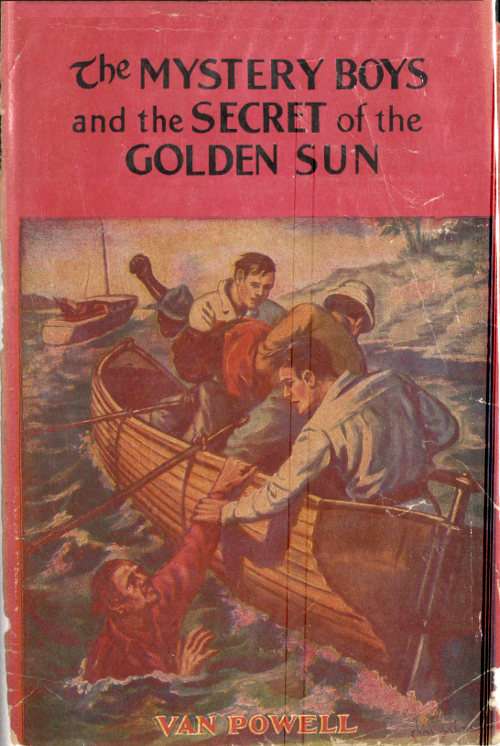
“But if Henry should get through!” Tom objected. “We ought to try and catch him.”
“No!” the trader remonstrated. “Wait! He will either get out of control—he’s weakened from his heavy debauches—and go over the falls instead of down the side currents and rapids, or he will be caught by the Indians and the Honduran soldiers.”
“It’s too bad it had to happen right in the middle of the witchcraft,” mused Bill.
“Why?” asked the trader.
“Toosa failed to tell us about the Golden Sun,” Tom said, knowing what was in his comrade’s mind.
Mr. Buckley spoke swiftly to Toosa who responded with a shake of his head. Then he became very thoughtful. Suddenly he walked away into the hut and sat, staring into the calabash, with its remaining liquid, the rest having been spilled.
“There isn’t any Golden Sun mine, at all,” Mr. Buckley explained. “The gold in the Honduran mountains in this section would be commercially profitless if you tried to mine it and get it to the coast. Those days of prosperity for Honduras are far in the future.”
“But Henry told us that Mort Beecher kept talking about the Golden Sun,” Tom remonstrated. “There must be something behind it!”
With a long arm Toosa beckoned to them. They hurried into the hut and stood, respectful and curious. Toosa looked up. This is what Buckley repeated from his curious sing-song chant:
“There is a Golden Sun! The Golden Sun is not a mine! The Golden Sun is alive. Ask of the San Blas Indians—and say that Toosa of the Mosquito country sent you. You find!”
“Find what?” asked Tom; but Toosa was out of the hut—and gone!
CHAPTER XI
A FALSE MESSAGE
With her propeller hammered out by slow, careful work, and with new gears in her speed changing device, the Porto Bello was once more ready for the sea.
Then there were long days of waiting.
Nicky was all set to start up the Rio Patuca. But Cliff agreed with his father and with Joe Anderson, “Andy,” that it was unwise. Although the large village of the Mosquito Indians just a short way up the lagoon was not yet infected, villages beyond it were suffering from yellow fever epidemics and the older heads judged that the boat could not pass the inevitable quarantine.
Cliff and Nicky were greatly worried about Tom; but they could do nothing but wait.
“If we can’t get up to him, he can’t get down to us,” Nicky affirmed.
“No,” agreed Cliff. “This is going to be a slow time. We can’t get any news, either. But the Indian we saw yesterday says that he thinks the fever is not as far up the river as Tom went.”
“I hope so,” Nicky agreed.
They passed the tedious days fighting the wickedly biting sand flies. The evenings sent the flies away, and there were long, beautiful and peaceful hours after sunset, before the mosquitos came out as far as the cruiser, when they could sit on deck and watch the stars; the glowing, sparkling orbs seemed very close, very clear and most beautiful. But there were many evenings when dull skies hovered above, when there was nothing to do but read the few books they had, or sit and talk. Mr. Gray told them countless stories of the old civilizations, and about the Indian customs and legends.
But all through the dreary wait they worried about Tom.
Then, one night, Henry arrived!
His body was thin and starved looking, and his clothes were rags. He came in a canoe and there was great excitement when he was recognized. Questions volleyed at him from all sides, but he would not talk—in fact, he could hardly stand—until he had been given some stewed turtle, a sweet yam and some fruit and tea.
He had not eaten such food for days, he told the eager party. To their questions about Tom he made one statement, and of course the chums had no way of guessing that it was false.
“Tom and Bill,” he declared, “they got took with fever. Not bad, but some. Bill found a good Indian doctor and he’s pulling them along.”
He told of his experiences in running the rapids and it was very probable that his story was not over-false as he recounted the thrills and dangers of his fight with the surging waters and the perilous rocks.
He had managed to get through by good fortune, he declared. Then he had gone on down the river until he came near the quarantine, and had deserted his canoe and gone into the brush. He happened to know of an inland village and he had made his way to that.
There he had found a guide who, on the promise of all the money he had, took him through the jungle, around the quarantined post. From there he had followed the river again, borrowing a canoe and avoiding every human habitation because he was in the fever zone. Once more, at the lower point of the infected area, he had taken to the brush, and with many privations, eating what he could find in the woods, or what game he could shoot, he had finally won out.
He made the tale a strong appeal for sympathy and fed his own vanity on the admiration of the chums.
All unsuspecting of his villainous desertion, he was made a sort of hero. Only Nicky seemed to be quiet and thoughtful. Finally he interrupted the second recital, late in the evening. Henry recalled some additional details of his misery, and repeated the whole story to get them in their proper places.
“Why didn’t you stay with Tom and Bill?” Nicky said finally. It seemed strange to him that Henry should have deserted his comrades.
“I left them on purpose,” Henry said. “’Cause why? ’Cause they sent me. They told me to come. They wanted me to. ’Cause why? They sent you a message!”
“Why haven’t you told it?” cried Cliff.
“There was plenty of time,” responded Henry, his old manner somewhat restored by good food and some rest. “They can’t leave where they are till the fever quits them. We can’t go up and do them any good. So they sent a message——”
“What is it?” Nicky demanded impatiently.
“That is it! You go on. I found out, from Toosa, that the fellow we want is at Porto Bello——”
“Porto Bello?” echoed Cliff. “That’s the name of this boat.”
“It’s the name of a town, too—a place where the old pirate, Henry Morgan, once had his rendezvous,” Nicky explained. His study of the old histories of pirate life gave him that information.
“What’s he in Porto Bello for?” asked Cliff.
Henry shook his head.
“That’s all he could tell. Go to Porto Bello was what he ordered. Then Tom and Bill said for us to go on and find this fellow——”
“What’s his name—you never told us,” Nicky said.
“His name—oh, never mind. I’ll be along. I know it.”
“Well, why must we go on without knowing how Tom and Bill are?”
“Because,” spoke up “Andy,” “if they’re sick they can’t travel, and we couldn’t get this boat to them even if we could get past the deadlines. And, instead of waiting here, doing nothing, we could go and find that lad and learn what he can tell us and then come back here. By that time the worst of the fever scare may be over and we can get our comrades and save time by going right where we have to.”
Mr. Gray seemed to agree, although he hesitated and asked Henry many questions.
Nicky, however, was very quiet.
“I don’t like this,” he told Cliff, as the two were sitting, far beyond midnight—they were too excited to sleep—watching the cold moonlight throw mosquitos into tiny, black silhouettes on the netting of the protecting cover under which they stayed.
“I don’t like it myself,” Cliff replied. “But what can we do?”
“I think we ought to go to the capital, and send help.”
“But,” Cliff objected, “if Tom and Bill are in the fever zone, the Honduras authorities won’t let them come out or let us go to them.”
“Do you want to go off and leave them, only knowing what Henry says about them?”
Cliff shook his head and answered soberly, “I don’t want to! But I can’t see what we could do in the capital.”
“Do you think Henry has told us the truth?” Nicky demanded, under his breath.
Cliff considered the question.
“I don’t know,” he said finally. “What makes you ask?”
“Why is he so anxious for us to go on?”
“To save time, as Andy argued.”
“Maybe to save something else?”
“What?” Cliff whispered, shuddering, “I don’t understand. Save what?”
“His neck, maybe. Suppose he found out where the man is—and then——”
He did not finish his sentence, but Cliff shivered and grew very thoughtful. Finally he spoke.
“I don’t trust him much. I wish we knew—the facts!”
CHAPTER XII
THE FACTS
Those Indians picked by the white trader, Mr. Buckley, to take Tom and Cliff across the mountain ways toward the capital, were by no means pleasant companions. Even in looks they were disconcerting.
Their faces were cruel and hard; their bodies were stalwart and powerful; they spoke very little, and then in their own peculiar up-river and mountain dialects. Toosa warned Bill quietly that they were noted for their avarice.
“Give no money,” Toosa warned. “Hide. Not show. They—” He made a meaning gesture, drawing his hand across his throat.
“Not very pleasant companions, buddy,” Bill told Tom, as they got into the canoe which would take them further up the river. “But Toosa says if we don’t show fear or weakness we will be all right—only, keep what money you have in your belt close to your skin and never let on that you have any!”
Tom’s last act before leaving Toosa, completely won the old man’s heart.
He called the great-grandson, Porfirio, to his forward seat in the canoe, and gave him, for his very own, the magnet with which the boy so often played. Toosa’s eyes lighted up when he saw the boy’s dazed, almost awed look; Toosa smiled—a real smile.
Suddenly coming close to the leader of the mountain Indians, three in number, he made some very firm declarations—to the effect that the white men were in his keeping and that he would watch over them and know if anything happened to them—and on the least sign of such danger he would release all the spirits of the mountain—evil ones!—to punish the offending Indians. They seemed to be strongly impressed.
“I guess we’ll be safe enough now,” Bill said. “That magnet is going to be a life-saver, Tom.”
“It’s a cheap price to pay for insurance,” Tom grinned, and they were sent out into the current by the lusty paddles of the four river natives who owned the canoe and who would take them on the first lap of their roundabout trip to the coast.
Their last sight of Toosa was one Tom would never forget; he had an arm around the shoulders of the child; behind his dwarfed figure clustered the Indian men, women and children. He lifted his long arm high in air, and made a sort of sign with his fingers.
“Great Gravy!” whispered Tom, to Bill. “Did you see that? How in the world did he come to make that sign?”
“What sign? With his fingers? Why, I suppose it’s a benediction or something.”
“He spread all his fingers wide; then he closed them tight, then spread them wide again,” gasped Tom.
“Well, what of it?” demanded Bill.
“That,” said Tom, in some awe, “that is the sign of our Mystery Boys’ order, as you very well know—the sign of ‘Goodbye, good luck and God be with you,’ that we use at parting!”
“By golly!” said Bill, and stayed silent a long time. What a coincidence that the almost savage man who lived in the woods had made such a final message without knowing, perhaps, that he did so—unless the boys had stumbled upon some ancient sign of some old cult.
After several days on the river the canoe was beached and the trio of mountaineers bade a gruff farewell to their river brethren, and, with heavy packs, of which Tom and Bill had their full share, the five started on foot for one of the most difficult and trying tramps Tom had ever experienced.
Before nightfall a small village was reached, and there the party was to stay over night.
“From what I understand, it’s proper in these parts to give our firearms to our host as a mark of good faith, for over night,” Bill told Tom.
“It must be safe enough, if it’s a custom,” Tom said, glancing at the ring of rough, coarse, dark faces studying them curiously.
“He’s supposed to hand them right back, Toosa said,” Bill answered, and accordingly he gave his rifle and one pistol to the Indian in whose hut they were quartered, while Tom handed over the other, given him by Bill. But the host did not hand them back.
No harm came to them during the night, however, although Bill was uneasy without his weapons.
Day after day, from then on, they went forward by increasingly difficult stages, first following the river, winding upward among the lower mountains, past dangerous rapids, over steep knolls, through rough canyons and up almost precipitous inclines, where ropes had to be used to hold any one who slipped from plunging to destruction.
Hard as was the way, and tiresome as was the furious pace set by the hardened mountain Indians, Bill and Tom kept up well, for Tom was of an athletic frame and always kept his body in perfect trim by lots of exercise, sports and fresh air, while Bill was of the lean, rangy type and never seemed to tire.
The attitude of their companions was a continual worry to Bill, however. Tom felt it also. Often he caught one or another of the three fierce-looking men watching him covertly in the camps, with speculative eyes roaming over his weapon, his clothing, his pack.
The Indians said little, but in their manner there seemed to be some expectancy, as if they either felt or knew that something was going to happen.
As the way grew more steep and difficult, the men seemed to be watching even more carefully, and Tom asked Bill what it meant. Bill, who understood their degraded Spanish words, used occasionally, but who pretended not to, replied that they were making some plan but he could not guess what it was.
They had reached a deep ravine, away high among the crags, and could look from it across a wide chasm, when a sudden storm caused them to make a hasty camp under a sheltering overhang of rock.
The men drew off and huddled together while Tom and Bill stuck close together under the rubber poncho which Bill carried. Presently one of the men approached.
“We wet,” he said. “You give coat, eh?”
Bill hesitated, but Tom, with a sudden inspiration, threw aside the covering with a generous wave of his hand. The man seemed surprised but took the garment away and the trio of Indians used it.
“Now,” said Bill, “they’ll demand everything we’ve got.”
“Maybe,” said Tom, “but we can stave them off at least until we get out of this ticklish place. If we get them mad, away up here, they could push us off the side, before we could wake up from sleep. We ought to keep them quiet till we get to a better place.”
“I think they want to rob us and desert us?” Bill hazarded.
“So do I,” Tom agreed. “But as long as we keep our pistols and your rifle, it will be all safe; we can take turns watching at night.”
They did, and Tom, on watch that night, noticed a creeping figure, coming close to their soggy mosquito protection, but made no sign. He told Bill, when the later awoke, and they redoubled their watchfulness.
The next day they went on and came into a high, and rough, but fairly level plateau where they camped. Bill managed to shoot a wild pig and it was roasted for dinner. With some biscuit made of flour, salt and water, and with cocoa, they made a regular feast.
“The men are planning something,” Tom whispered, after the meal. “See how they look at one another!”
“Well, let’s just be ready!”
Soon enough they had to be. The leader came over to them and in a very polite way, for him, made a suggestion.
“We afraid,” he said. “Bad mountain cat close by.” They had heard the cry of a jaguar or panther, or some other huge cat. “You have guns, you save. We not got. We be died!”
“One of us sits up and watches all night,” declared Bill, meaningly. “Don’t be afraid. We not let you be hurt!”
The man walked away doubtfully, and that night neither Tom nor Bill took much rest; however, nothing more happened.
The next morning they were surprised to discover that the Indians seemed very much more pleasant, and the leader brought the whites a special and tasteful piece of the roast pig which he had saved for them. “That’s the way to treat them,” Bill said. “Let them know we are on guard!”
They went on, and were wading along in a small torrent of water, the only way through a deep abyss, when suddenly Tom clutched Bill’s arm.
“Bill,” he gasped, “I feel queer and sick!”
“So do I?” replied Bill. “But I tried not to let you know.”
“Do you know what?” gasped Tom, as a great, sweeping spasm of pain flooded over him and he saw, as through a haze, Bill’s face whitening, even as Bill staggered.
“Yes,” gulped Bill, “we’ve been——”
Indian poisons are subtle, but they work swiftly.
“Especially a toadstool called ‘Fruit of the earth’!”
CHAPTER XIII
TOOSA’S VENGEANCE
Cliff and Nicky faced Henry Morgan on the cruiser’s deck. “Well, you are a fine one,” Cliff sneered. “You wouldn’t dare say what you do if my father and Andy hadn’t gone to the Indian village to find out if the fever quarantine is lifted up the river.”
“Yes, I would,” Henry said huskily. “I’d say it just the same. ’Cause why? ’Cause it’s true. I mean it!”
“You actually mean you’re going to ship on that sloop, lying off the reef?” Nicky argued.
“And leave us?”
“Ship on that schooner and leave you—yes! ’Cause why? What have you done about finding Mort Beecher, or—or the Golden Sun? Not one thing! You all sit around——”
“We had to scrape the hull and straighten the propeller and fix the shaft while you were gone—” Cliff grew angry.
“Yes—but when I got there, all was fixed and the cruiser was back in commission. But she’s laid still in the tide-race, here, for three days, and no move to go to Porto Bello, the way the old Indian said I should. I told you what word was sent from your friends—but you just sit and fight sand-flies and mosquitos and sweat and chafe and eat bananas and fire cocoanuts at sharks’ fins. I’m tired of waitin’. So, when that cutter comes off from final trading with the Indians, it’s Henry Morgan for on board and off for Colon or wherever the sloop touches.”
Cliff and Nicky looked at one another dubiously. This was a predicament. Cliff’s father had gone ashore to pay the Indians in fancy articles for helping to beach the cruiser first and then to drive her back into the water. Cliff had caught Henry packing a “ditty bag” and the resulting declaration that he was “quitting them,” brought Nicky racing to Cliff’s hail. But they were puzzled to know how to summon the older men from the village.
Finally, with a shrug, touching his left ear gently, to indicate to his chum that he wanted the Mystery Boys’ signals to be noted and understood, Cliff pushed his hair over his right ear with an index finger, indicating to Nicky, “Come with me!” Nicky promptly swung on his heel, with a contemptuous glance at Henry, and went below.
“We can’t tie him, or anything!” Nicky objected when Cliff asked what they could do. “I can’t see what good it will do to stop him. We know all he knows—that Mort Beecher is at Porto Bello.”
“All right,” Cliff agreed. “We’ll let him go. I guess we can get along just as well without him.”
“Better,” Nicky declared. “I don’t trust him.”
They took no action, therefore, when Henry climbed aboard the ship’s shore-boat and went out, across the sand bars, across the reefs, and, one would suppose, out of their lives.
However, the afternoon was well along before they stopped talking about him, about Tom and Bill, and about everything that had happened. By that time Mr. Gray and Andy had arrived.
“What do we care if that Morgan is gone?” demanded Joe Anderson. “He’s a poor comrade on a cruise. First he almost let us be broken up on the reefs because he liked ‘tonic’ better than watching; then he deserted our companions, and for all we know, did worse.”
“We can start up the river, anyhow,” Mr. Gray stated. “The river towns are no longer quarantined against the lower coast or the upper river. We can run as far up river as the boat will navigate and then several of us can go to Tom and Billy Sanders by canoe.”
Accordingly the anchor was raised the next morning and with a river Indian aboard as pilot, they ran smoothly and quickly up the lagoon. When they were about a day’s run up the Rio Patuca, Nicky, at the bow, watching the alligators slide off of the sand banks, seeing the strange, bright birds flying over the water, suddenly gave a cry.
“Isn’t that white people in that canoe——”
“It is!” echoed Cliff, running to his side. “And it’s——”
“Tom!” shrilled Nicky, dancing about until the pilot, watching the shifting currents, had to catch his coat and prevent him from toppling off the sharp bow.
Tom it was, with Bill, both alive, and quite hearty.
The story of their exploits was a thrilling one. They had been in the first throes of suffering from a violent poison administered in, or with their food by the Indians conducting them through the mountains.
“Tom recalled that I had a bottle of white vaseline in my pack,” Bill said, “and he crawled to it and got the stuff. It was not very easy to take, but we each got some down, and it melted and made a sort of oily coating, or else it acted as an emetic, for we were very sick, and almost wore ourselves out struggling—and we couldn’t get enough water!”
“It was lucky for us that we were right by the stream, almost in it,” Tom added. “The Indians didn’t move a hand to help. If we hadn’t kept sense enough to hold onto our pistols I guess they would have jumped on us. We found out later that they had picked some sort of mushroom—‘fruit of the earth’ it’s called, in the lower levels, and put some in folds of the pork meat when they gave it to us.”
“How did you find that out?” Nicky demanded.
“Did they confess?” asked Cliff.
“Toosa told us,” Tom explained. “He claims that he knew by his magic spells that we were in danger, and that he came to save us; and for that he expected Bill to give him Henry’s rifle when we left—which Bill was glad to do. But he and I privately think it was more chance than planning that brought him just in time to help us.”
“When you have lived as long as I,” said Mr. Gray quietly, “you will understand that there isn’t any such thing as ‘luck’ or ‘chance’ or ‘coincidence.’ It is all a part of a Great Purpose, that is deeper than most of us can see; but it is there, and we do not have to depend on ‘chance’ to get out of difficulties. If we believed in ourselves, and do our honest best for ourselves, help will come as we need it. Toosa, perhaps, was worried about you and so his intuition was keen and he felt that he should follow you.”
“I guess you are right,” Tom admitted. “Anyway, Toosa got there in time to stop the Indians from running away, after they divided our packs and while they were hoping we would die so they could get our gun and pistols and cartridges.”
“What did Toosa do?” asked Cliff.
“He threatened he would revenge himself if they hurt you, Bill has told us,” Nicky added.
“He had his vengeance, but in a curious way,” Tom said, glancing at Bill, as if for his backing-up of the story. Bill nodded encouragement and Tom continued:
“Toosa called the Indians back and they came, slinking and cowering, like whipped dogs. I don’t know yet what there was about him that scared them so, but he certainly ruled them by fear. He called them to him and then he made them stand there while he looked them steadily in the eye. Bill, the Indian he had with him was close to you, what did he tell you Toosa said in their own language?”
“Toosa said, ‘Which you like best, to eat rest of “fruit of earth” with roast wild pig, or have mountain spirits follow you and drive you into chasm?’” Bill related it with a reminiscent grin.
“They picked the wild pig and the poison mushrooms,” Nicky guessed. “I know that much about these Central American Indians.”
“We urged Toosa to be easy on them,” Tom said. “But he said it must be a lesson, and he made them go through with it.”
“What happened?” asked Cliff.
“He wouldn’t let us wait to see,” Bill replied. “He winked at me and told me to leave what there was in the vaseline bottle, and let them see how their own medicine man can save them with ‘white man’s butter.’ They weren’t even sick when we started back. The river was free of quarantine and so, of course, after we got back to it, we had no trouble at all.”
“I’ll never forget Toosa, waving to me with the very sign of the Mystery Boys, again, as we canoed away down stream,” Tom added.
“I’m glad your adventure ended so pleasantly—for you,” Mr. Gray stated.
“I hope it wasn’t too unpleasant for the hill Indians,” Andy said. “But if they were as sick as you that would be justice.”
“And in the long run, if you wait long enough,” said Bill. “Justice is always done, one way or another.”
“Then Henry Morgan still has some punishment due him,” said Nicky and the desertion and falsehood of the departed pilot was discussed.
“We sent no message,” said Bill, telling how Henry had turned savage and stolen his rifle and a canoe. “Wait till I catch him!”
“He said he was going to Porto Bello,” said Nicky. “Aren’t we?”
“No,” said Tom. “At least, only for a brief stop to see if Mort is there and if he really knows anything. Toosa told us, after Henry made his mad dash, that if we want to find out about Golden Sun—it isn’t a mine, either, he says!—we are to ask the San Blas Indians.”
“They live on reef islands down below Panama, I think,” Bill said.
“They do,” agreed Mr. Gray.
“And,” finished Tom, “if the Golden Sun isn’t a mine—my sister had golden hair—do you suppose?——” No one answered.
CHAPTER XIV
THE PORTO BELLO PUZZLE
Out from the Mosquito country the cruiser fought her way again; her machinery did not fail, and information given by the Indians, coupled with a fairly quiet sea, enabled the adventurers to make a safe passage through the treacherous rocks and the surging rollers.
There was no excitement during the run down the coast. Into the well-traveled route to and from the Panama Canal the voyagers worked the boat, and, by agreement, a stop was made at Colon.
In an earlier adventure the three chums, Tom, Cliff and Nicky, had visited Panama, and the great achievement of the Canal was therefore not a novelty to them, although they never ceased to marvel at the engineering skill by which it had been planned and built, nor did the vastness of its locks, the precision of its machinery, ever fail to make them thrill as they thought—the United States—“our country”—accomplished that feat. To them it was the Spirit of American success in an undertaking that made the world better and communication easier.
They did not wait long in Colon; only until Bill and Mr. Gray made inquiries about Mort Beecher.
As they traced the story, they learned, through many contacts which Mr. Gray’s reputation as a great scholar opened to them, that Morton Beecher had come to Colon, a few years before, and had seemed to be a very rich person. He had spent money freely and had gotten into a group of Spanish and of American pleasure-seekers who spent lavishly on the more sordid delights of a tropical life. Not many months ago Mort, broken in health and with no more money, had been compelled, as far as was known, to seek his fortune elsewhere. No one would give him employment because he was not dependable, had no strength, and spent all of his time bemoaning the vanished past of his opulence. No one knew just what had happened to him.
However, through the story that Henry Morgan had told them, they guessed that Mort’s misfortunes had finally led him to Porto Bello, that decayed spot on the Panama coast of the Caribbean which had once been a stronghold of the notorious pirate, Henry Morgan the first, the man who had first raided the Central and South American shipping and the towns of the coast, robbing and pillaging, and then had become reformed to such an extent that he had ended by making war on piracy and had achieved the great fame of being the governor of Jamaica who had done more than any other to “clean out” that nest of piratical looters.
With the wind kicking up a rough sea, the cruiser, namesake of the place they were bound for, headed toward Porto Bello.
With a pilot, a negro who called himself Bob, taking the place in their party vacated by Henry’s defection, they made the run safely, if under rough conditions. The entrance into the harbor of the ancient Spanish port was attended with only the usual dangers of any of the reef-locked, rock-studded passages along the coast.
Tom, Nicky and Cliff saw, with amazement, the ruins of the once noted place. There were the demolished battlements of its old fortifications, visible as they dropped anchor in a quiet harbor.
They found the population composed of Spanish and Negro people, of the most advanced state of dejection. No trade came to Porto Bello, no ships bothered to run the menace of her reefs, except for a very rare sailing sloop which might put in rather than to face a storm.
It took only a short time to land, and the crowd which assembled at the decrepit old shacks near the beach, astonished the boys by its slovenliness and its apathy. The people watched but made no effort to be pleasant or to help them.
“Did you ever see so many sickly people?” Nicky asked, and with good cause: hookworm was prevalent, from a diet that never varied; and the unclad bodies of the younger children seemed a very breeding place for sores. The ragged adults were in a like state.
“Father says that’s what comes of this kind of a life,” Cliff declared. “These folks never see anybody but themselves. They don’t have anything to interest them. They just eat, and sleep and exist, waiting till they die.”
“I don’t think I’d stay here, even if I had to build a canoe and run the risk of the reefs and the ocean rollers,” Tom stated. “I’d rather meet my end fighting for life than sitting down and waiting for the other thing.”
“So would I,” Nicky agreed. “But these people are just too lazy and dejected to care, I guess.”
“They have lost their self-respect and their wills,” Bill said. “I suppose I ought to feel sorry for them, but I don’t, because I was always of the idea that it’s up to every man to make himself what he wants to be.”
“I feel that way,” Tom agreed. “It isn’t easy, though.”
“Maybe it isn’t easy,” Bill nodded, “but it can be done if we stick to it. I always wanted to have a ranch in Uncle Sam’s good old West. I was down in Peru. Had no money. Just got enough to live on; but I stuck to my ideas and kept saying to myself that if I wanted it long enough and hard enough, and worked for it, I’d get what I had a desire for.”
“And you did,” admitted Nicky, for he had been with Bill during the adventure among the Incas in which Bill had been able to save Cliff’s father and eventually realize his desire for a ranch. “But it was a good deal by good luck, Bill.”
“Why, Nicky!” chided Tom, while they waited for Mr. Gray to make some arrangement with the “alcalde,” or head man, a sort of governor of the town. “You always say ‘there is something that looks out for us!’ and I’m surprised to hear you talk about luck.”
“That’s so,” Nicky agreed. “I didn’t stop to think. It looked like luck, that Bill, in Peru, found the eaglet that had Cliff’s father’s note tied to its leg.”
“But if you are sure that there is something, besides just chance,” Bill argued, “you’d see that sort of something could bring the bird to where I’d find it, and all the rest would come around through the same sort of purpose, instead of by pure chance.”
They all agreed to that, and Mr. Gray brought the alcalde to meet them. He was an elderly man, very sober and impressed with his dignity, though what he had to be dignified about Tom and his chums failed to see. However, with all the show of authority that he could put into what was really laziness and vanity, he pretended that he could not give them the information they sought until he prepared for an “audience” in the shabby old shack which served as his home and office.
“He makes me think of the little frog in the puddle,” Tom commented, as they stood about the beach, trying to be patient while Bill and Mr. Gray argued and asked questions. “He’s so swelled up because he has a little authority that he forgets to be decent or helpful.”
However, if the alcalde chose to be slow in his help, they found what they wanted in another way. They had come to Porto Bello to get information about Mort Beecher. This they secured through rather strange channels.
“Look what’s coming!” whispered Tom, nodding his head toward a figure slowly hobbling along the beach from a decrepit old lean-to among the palms and the bush.
They all looked, and stared!
Bent with apparent age, halting in his steps, clad in rags so far beyond repair that they scarcely covered him respectably, even in that half-clothed community, came a white man.
His face was covered with a rank, bushy beard. His figure, when he came close, was seen to be not only bronzed and roughened as to skin by exposure, but was, as well, in a pitiful condition with the ravages of drink. His eyes were more bleary and unpleasant than had been those of Henry Morgan. His voice, high and shaky, whined and implored.
“A beach comber,” Bill told them. “That’s what a white man comes to when he gets stranded in one of these dead spots, if he lets himself go.”
“It’s a pity,” Tom said. “He looks as if he has lost his own self-respect, for he isn’t even clean; and he has no will power, I’ll bet, or he wouldn’t have stayed here.”
“Laziness, drink—they tell the story,” Bill responded. “They’d sap the vitality of one of the old Greek Gods!”
The pitiable figure sidled up, whining, a shaky hand extended in supplication.
“I don’t suppose you’d give me a drink!” he whined.
Bill shook his head.
“No,” replied the bent figure, which looked seventy but which might have seen no more than fifty years of life—but such a life! “No, nobody ever does. Nor—a smoke—not even a little ’baccy for me pipe.”
Bill drew out a sack of tobacco and some thin papers and shook a little tobacco into one of the latter. He saw it spilled from the shaking fingers that tried to roll the paper, and made a cigarette.
“How long have you been here?” he asked, offering a light.
“I don’t know.”
“Long?”
“I can’t say, mister.”
“How did you get here?” Nicky inquired.
“I don’t seem to recall—I can’t seem to remember.”
They looked at one another. The alcalde came up.
“He is of no account,” he declared. “He cannot help you,” he continued in his slow Spanish, using the words as though he was trying to recall the proper ones; his usual conversation was in a degenerate dialect form that he seemed to feel was too undignified for the occasion of the visit of such dignitaries. “Come away!” he added. “Tomorrow I will receive you and talk to you.” He turned on his heel and walked away.
Bill looked after him and made a wry grimace of disgust.
“Tomorrow!” he said. “That’s what you hear all through the Spanish tropics, ‘tomorrow!’” And he might have added that “tomorrow” may also bring its “tomorrow,” for the hot countries breed delays and indolence and the slow, dragging moments seem interminable to the Americans, with their purposeful, aggressive manner and their habit of doing things at once!
“We can’t spend a night here,” Nicky urged.
“Don’t say ‘can’t,’” admonished Tom. “Look at this man. He’s said ‘can’t’ or ‘don’t’ to everything we ask him. That’s what ‘can’t’ gets you to—it breaks down everything you try to accomplish. Say ‘we won’t!’”
“Then, ‘we won’t,’” Nicky grinned.
“Mister,” Tom turned to the old man, sniffling and slumped down on the sand as though unable to sustain himself on his two legs, “you can tell us, I guess, what we want to know. Is there anybody in this place named Mort Beecher?”
The man looked at him dully.
“I don’t remember any names,” he replied.
“Well,” urged Nicky, “was there any white man besides you here?”
“Yes,” the other responded, “I guess you wouldn’t give me another smoke, would you?” He looked toward Bill. “Or something to—” he made a suggestive movement as if tilting a glass. “No—I guess nobody would give nothing to me no more.”
“There was another white man here,” Nicky persisted. “Was his name Mort Beecher?”
“I don’t recall his name. I can’t remember if he ever told me.”
They looked at one another in dismay.
“It must have been Mort Beecher,” Tom asserted confidently; then he turned to the derelict again. “Did he ever talk about being in Mexico?”
“Mexico—Mexico? I ain’t sure.”
“Did he ever mention a—a Golden Sun?” Bill, rolling and retaining a fresh cigarette just out of reach of the eager fingers.
“Sun? I—I don’t just—seems as if maybe he did, but——”
“It’s no use,” Bill said, quite gruffly, tossing the rolled paper contemptuously to the other who snatched it greedily. “We’ll have to wait for the old slow-poke alcalde. We’ll go back to the boat—I won’t spend a night in this sordid place!”