
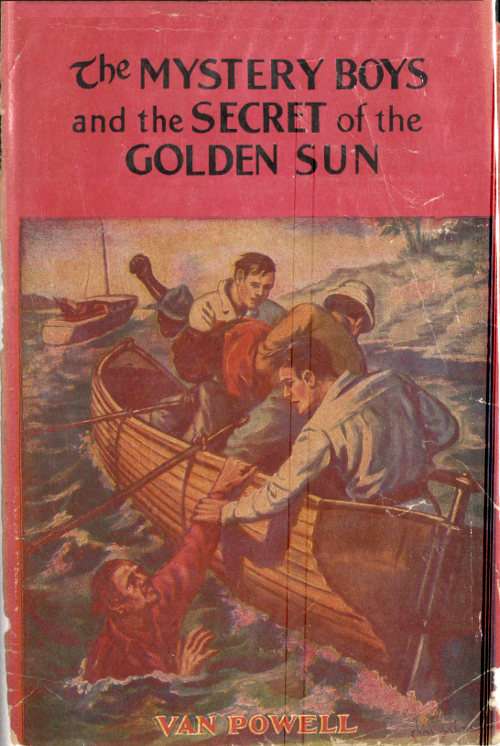
“How can that be?” demanded Nicky.
“This way,” Tom explained, despondently. “The chief called a man who speaks some Spanish and had him tell us. Two white men have come here already, a few days ago. I think it was Henry Morgan and Mort Beecher. They said they were great doctors, and they did have some medicines and they put stuff on the Indians and told them they would be cured of their sores and so on in a week.”
“They came in a sailing sloop,” Bill added. “It landed them and went on down the coast toward South America, but it is coming back in a week or so.”
“But what makes that mean anything to us, beyond the fact that they got here first?” asked Mr. Gray.
“Henry and Mort—if that’s who it was—told the Indians they are the only true medicine men, and they said that men would come soon and pretend to be as great—but they would be evil and undo all the good. And this is the diabolical part of their story—” he paused and bent forward impressively, to add:
“They said that if their medicine did not cure—it is because the evil ones that are coming—us!—are working with devil-medicine!”
“Good grief!” exclaimed Nicky. “That is wicked talk!”
“It has terrified the Indians,” Bill agreed. “And it was only because Tom’s trick with the lighter caught the chief’s fancy and impressed him that he told us. He warned us to go away. He can’t trust us, of course.”
“That does make it hard for us to do anything!” Cliff declared.
“Hard—” Nicky sniffed. “But not impossible—never say die!”
“I won’t,” Tom cried. “But what will we do?”
“Yes,” agreed Cliff, dejectedly, “what?”
CHAPTER XVIII
THE JUNGLE OPENS ITS ARMS
“Waiting for something to happen is the hardest thing in the world,” Tom declared. He, and Nicky and Cliff sat in the shade of a small awning on the forward deck.
“Especially waiting when nothing does happen,” Nicky put in.
“I don’t think anything will happen unless we make it happen,” he added. “The Indians didn’t pay the least bit of attention to us all day yesterday.”
“Well,” Cliff argued. “The day before, when Tom won the chief’s interest with the cigar lighter, the big man told him that the Indians don’t want to have anything to do with us.”
“I suppose he thinks he has done all that he needs to,” Tom said, dejectedly. “They are just waiting for us to go away.”
“I hope Bill and Jack get some results,” Nicky said. The two he mentioned had carried gifts to shore early in the morning of this, the second day following the audience with the chief; they hoped to win him over, to get his confidence. But while they tried they felt, from the start, that it was a hopeless attempt.
“If only we had something to do!” Nicky argued.
“Don’t you suppose we could row to the mainland?” Cliff suggested.
“Let’s ask,” Nicky cried, jumping up.
“We could find out what all the women do after they paddle over,” Tom said. “If we report their customs, Mr. Gray ought to be willing to let us go.”
They asked, and pleaded when Mr. Gray hesitated. They promised to be careful; they urged their case, agreeing to report customs and everything they saw. The elderly scholar did not feel like accompanying them himself, for he hated the humidity and the sun’s terrific heat; he told them that if Andy would go along—Bob had taken the two white men in the boat, and had brought it back—they might row a ways up the river and they could see across the wide expanse of the inner lagoon.
“I can’t go,” Andy told them. “I’ve got to tinker with my motor—there’s one spark plug that misses, and I want to clean the whole set and adjust the timing of my motor.”
The trio showed disappointment.
“Take the spare rifle and get Bob to row you over,” suggested the engineer; but they demurred among themselves. Bob, not because he was colored, but because he had a gruff, rather surly disposition, was not a pleasant companion on an exploring trip.
“I can’t see any harm in rowing up the river,” Andy said. “Don’t get out of the boat and you’ll be all right.”
They promised with the utmost sincerity and meant fully to obey the order. The pull across the hot lagoon taxed them, for the sun was hot and even though they took turns rowing the boat was slow and they were quite wearied when, early in the afternoon, they came to a place opposite the spot where the women had beached their canoes.
“We can just draw up on the sand and eat our lunch,” Nicky suggested. “It’s shady under those mangroves.”
Tom and Cliff conceded that no harm could come of that. As they watched the women they saw that the washing for the various families was being done. It was conducted in a way quite like that they had seen in Jamaica, and among other tribes: the women, standing knee deep in the river, beat and pounded the clothes in the water.
“That’s pretty hard on clothing,” Cliff said.
“The clothes they have aren’t in such good condition that they could stand any sort of scrubbing, anyhow,” Tom agreed. “It certainly is a primitive sight—but look! They’re running and hiding!”
As they approached the women, the latter dropped what they had, leaving the things to drift in the slow current, and raced across the beach and into the heavy jungle. The jungle came close to the water and was as thick and seemingly impenetrable as any tropical growth could be; yet the women disappeared into it.
“That’s a shame,” Cliff cried. “Their things will all be lost—row over faster, Nicky. We’ll save the clothes.”
They spent a busy half hour recovering the pieces of cloth from the water and piling them on shore. Though they called and tried to make the hidden watchers understand that they meant them no harm, the boys got no response. Rather disgusted with the Indians, they sat under a shady clump of brush, surrounded by vividly colored birds and butterflies and ate their lunch of sweet yams, a tin of meat and a thermos bottle of warm cocoa. Not a very appetizing lunch to one accustomed to refrigerators and well-stocked markets, but, to tropical appetites, after a long row, a meal which was eaten with gusto.
“Did you ever see butterflies like these?” asked Nicky, pointing to a bluish-silver beauty whose wings seemed iridescent in the sunlight.
“I know that father would love to have some of them,” Cliff said. “He hasn’t any of these great silvery ones, or the deep, blue-winged kind, in his collection.”
“Neither have I!” declared Nicky. “Let’s catch some!”
“Take the rifle along, if you go into the brush,” warned Tom. “We might meet a jaguar or a tapir or some old thing—or snakes!—watch out for snakes!”
Cliff put the rifle under his arm, and the trio, darting after the bright-winged insects, raced up the beach, and into the heavy fringe of brush.
They kept quite close together, at first, but when they had thrust a little way into the dense growth they saw that they came out into a fairy-land, and, forgetting all caution in the thrill of the beautiful sight, they paused for a moment and then pressed forward.
They saw none of the Indian women; indeed, they had forgotten all about them. The dense growth of brush, matted vines, tangled creepers, which fringed the river, gave place to great, lofty open glades of forest grandeur. Trees like great columns, reared their tall forms upward from every point, making vast aisles of gloom between their huge trunks. Overhead their leaves met and tangled, twined and held by giant creepers, so that only a dim, softly diffused light came down to light the magical scene.
There was, at first, a seeming silence, an awesomely deep silence; it made the boys stop talking, or converse in a whisper, feeling some inward tendency to be still. Gradually, however, the forest took up its solemn conversation; the hum of insects became noticeable, the faint crackle of twigs as some soft-footed denizen of the deep gloom made wary way along some hidden trail; the soft plash of a fish in the hidden, distant river; the twitter of several birds, and the soft, incessant flutter of bright—gaudily colored wings. Most of the tropical birds are vivid in color but have no song.
A flock of gaily plumed birds whirred by among the silences above their heads. Cliff half-automatically lifted the rifle and then let its barrel drop; they were too beautiful to be killed, to be dragged down, inert, lifeless, by a cruel and senseless use of lead. Cliff was a very humane youth and he destroyed animal life only for real needs at any time.
Came a glitter and glow before their eyes; a very battalion of gay butterflies flitted here and there. Forgetting the silence, with a whoop they were in pursuit. Cliff dropped the rifle.
Here and there, afar and then close, through the great boles of century-old trees, the pursuit led them.
Sometimes in eyeshot of one another, oftener not, they caught the gay little insects.
Finally, with whoop and call, the trio managed to locate one another and to gather to compare their catches.
“I have twelve of the blue ones, two silver ones, six yellow ones, and this burnished gold one.”
“Give me one of your silver ones for this red one.”
“If I had six of your blue ones I’d trade two of these golden sunshine ones,” Nicky completed the trio of voices.
The trade was made and they rose to return to the river.
And then three faces turned to a common center in dismay.
Cliff looked at Tom and Nicky and they, in turn, regarded each the other.
“Which way?” asked Nicky.
“You’ve got your compass, haven’t you?” asked Tom.
Nicky pulled out the little round case.
“Good gravy!” he exclaimed. “The needle is stuck. See—it doesn’t turn!”
“Well, that’s no good, then,” Cliff said, hiding his own misgivings. “We mustn’t get frightened and lose all our good sense. Let’s sit down and think how to go about finding our way out.”
“The sun won’t help—we can’t see where it is,” Nicky declared.
“But it’s getting dimmer,” Tom stated. “We won’t have too much time before night—let’s see if we can’t find where I dropped the rifle. Each one go in a different direction, and nick the trees with your knives so you can get back.”
They started off, and, after awhile, a hail from Tom showed that he had discovered the previous weapon. But then they all had to return to the common center and from there, after meeting, had to go back to the spot where the rifle lay.
“But are we any better off?” Nicky wondered. “Which way is ‘out’?”
“Let’s see if we can make the Indian women hear.”
“That won’t do. They ran before—they won’t come here.”
“I guess we’re lost,” said Tom, in a matter-of-fact voice.
“Isn’t there any woods’ sign in the tropics to show which is North, or some direction?” demanded Nicky. “Doesn’t moss grow mostly on one side of a tree?”
“In temperate climates I know some signs, but I don’t see any here,” Cliff acknowledged, spying about him carefully.
“Well,” Nicky declared, “we can shout, in turn, every half minute, and fire the rifle once in awhile.”
“We can’t waste shots,” objected Cliff. “We may need—” he broke off, not wishing them to picture the dangers he began to foresee.
But their minds were quick; however, each hid his growing uneasiness from his companions as well as he could.
“We’ve got a rifle with a full magazine,” Tom said stoutly. “That will protect us and give us food until we get out—and we’ve got the lighter of Bill’s to make a fire to cook it on. We’re not so badly off.”
“If we get excited and start planning and running around,” Cliff suggested, “we will wear ourselves out and get nowhere. Let’s sit here in this open glade and think. When anybody has an idea that is good sense, we can try it.”
“I see what looks like a trail yonder,” Tom had used his eyes and he pointed to the near end of the glade. “Let’s try it a ways—it ought to lead toward the river.”
“Which way?” asked Nicky. “From that end of the glade or this end?”
“That’s so—it is at both sides,” conceded Tom. “Let’s try one way for an hour and see what we see!”
At the end of that time by Nicky’s wrist watch they retraced their way—and when darkness came on, they were still on the other trail, and weary and excited; but no sight of the river rewarded their eager gaze, no sound of a response came back to their loud hallos.
“That didn’t work,” said Cliff. “Maybe we’d better pick out trees and get ourselves off the ground while its light enough to see——”
“But jaguars—cats can climb trees,” Nicky objected.
“We’re as safe on the ground,” Tom urged. “We can gather wood and make a big bonfire and that will be better.”
In the rapidly waning light, gloomy at the best, they managed to gather broken, half-rotted twigs, branches, small strips of bark and dead vines and several logs, back in the glade.
They made a good pile of them, keeping together, Cliff with the rifle always at his elbow.
“It’s watch-and-watch,” he said when they sat down to stare at the leaping flare of their fire, keeping quite close to its cheering blaze, “Nicky watches until nine, then Tom, then I will watch—two hours for each, unless we all have to wake up.”
Thus, as the day’s quiet gave place to the growing bedlam of the darkness, with hoots and wails, the strident sounds made by night insects making an undertone to the occasional weird voice of a wild beast, the three adventurous youths made the best of a bad situation and sat, supperless, by the one bright spot of safety in that wild place.
The jungle had opened its arms and had folded them upon its prey.
CHAPTER XIX
WASTED EFFORT
When all attempts to persuade the chief to listen had resulted in a final, and rather angry order for them to go, Bill and Jack gave up.
“It’s no use,” Bill said. “We are stumped. Let’s go to the dock and meet Bob—he ought to be back with the boat pretty soon.”
They went to the ramshackle wharf made of old, rotting poles stuck into the water, with old boards, from some wreckage, loosely laid on them for a footpath. The dock was seldom used—only for the few occasions when government launches came to the island to transact business with the chief.
But after a long wait, when Bob failed to show up, Bill became uneasy and finally hailed the cruiser by firing his pistol three times.
The boat was too far away for voices to carry, and also signs could not be distinguished.
Bill and Jack impatient and worried, for they could not see the small boat anywhere about, commandeered a canoe and paddled to the anchored cruiser.
“The boys have not come back,” said Mr. Gray uneasily when they came alongside. He told how he had given them permission to go to the river. Andy, summoned, was crestfallen and alarmed. He related his suggestion to the youths and Bob said that he had not been asked to be one of the party.
“We will take the canoe and paddle over,” said Bill. “No time to waste. It won’t be over-long till dark.” Without further word he and Jack paddled toward the mainland. They worked swiftly, for both knew that time was of supreme importance if any harm had come to their younger comrades.
“You don’t think the Indians?—” began Jack.
Bill shook his head.
“Here they come, anyhow,” he stated, pointing with his paddle to the fleet appearing at the river mouth. “We’ll ask.”
The canoes seemed to be bent on avoiding them, but Bill drew out a soiled but fairly white handkerchief and waved it, then beckoned. A canoe containing several younger women veered closer and the paddles ceased to sweep the glassy water.
“You see boat—boys?” hailed Bill.
One of the women nodded and pointed back the way they had come from the river.
“They’re back there,” Bill told Jack. “They must be all right. But we’d better go on and make sure.”
They passed through the squadron of canoes and up the river. Long before they reached the small, sandy beach, they discerned the rowboat, drawn up on shore. The Indian women had left it untouched, after a curious examination of its scanty contents.
“They’re nowhere around,” Bill exclaimed when they came closer: with tight lips he ran the canoe into shallow water and vaulted into the shallows.
“Tom—Nicky—Cliff!” he shouted, and waited.
The echoes were silent. Jack added his high pitched call, and they shouted together; but the jungle held its secret. The boys, at that time, were two miles beyond hearing, on a trail that ran almost parallel to the course of the river.
“If they’re in the jungle, how will we locate them?” asked Jack. “I know something about these places—once you get in, you wander and get further away all the time.”
“We’ll fire our pistols,” cried Bill. “Push in, here, as far as we dare go without getting lost ourselves!”
There they shouted and, at intervals, fired their pistols. But only the silent glades and the sentinels towering high above heard the hails and quivered a little to the strange sound of exploding powder.
“There’s nothing we can do by waiting here,” Bill said, finally. “My idea is to go to the chief and offer him all we’ve got to put out parties who know the trails, give them torches, and try to get some trace of what has happened. The boys are lost. We would be lost in no time, looking; but the Indians might not. We’ll try it. It’s the only thing to do.”
Tired as they were, their paddles fairly flew as they made their way back toward the cruiser.
“If the sun is setting in the open, it must be night back in the jungle,” began Jack.
“Be still!” snapped Bill, refusing to think of harm and thus lose his hold on his plans. They delayed at the boat only long enough to give the details of their discovery to a perturbed Mr. Gray, a penitent engineer and an excited colored pilot. Then they paddled for the shore.
Without ceremony they burst in at the chief’s big hut, where he was partaking of his evening meal.
He listened to Bill’s excited story, related in Spanish.
Then he sat in his hammock, munching on a yam, without retort.
“Well,” said Bill finally, exasperated out of all patience, “we will pay well to have men and boys take torches and scour the jungle.”
“What do you say?” demanded Jack, also in Spanish and dialect.
The chief put down his yam and stared without expression.
Finally he spoke, coldly.
“You say you much doctor-magic man!” he declared. “All right. You make magic. You find!”
CHAPTER XX
TRAILED BY A JAGUAR
“Look, Cliff,” whispered Nicky, directing his comrade’s attention toward a limb not far above their campfire. “See those two bright spots? Are they a jaguar’s eyes, do you think?”
Cliff moved his head upward very gently. Tom, likewise, stared.
“Don’t anybody move,” Tom whispered. “From where I am it looks too flat to be a cat. But it’s something.”
The tropical jungle was beginning to show its eyes: would it go further and show its teeth and claws? After three hours of darkness, with only the blazing fire for protection, the three chums were beginning to be a trifle nervous, and the eyes above them, discovered by Nicky, did not add to their ease.
“Listen!” Tom breathed, barely audibly. “Don’t shoot hastily, Cliff. Ease your rifle up till you can get a sight.”
“Try to make the first shot count!” begged Nicky softly.
“I will!” Cliff said; but his hands were trembling so much that he fumbled with the rifle and it clattered to the ground.
“I can’t—I—my muscles shake so!” Cliff said. “I’m not a coward, but the first shot is so important——”
“Tom,” Nicky breathed, “you’re closest. Can you reach the gun and steady yourself?”
Tom, rather shakily, answered. “Cliff can. Just wait, Cliff. He won’t jump straight down into the fire. He’ll wait till one of us goes off as far as the wood pile. There’s time to get steady. Wait a minute, Cliff, till you get set.”
“I don’t seem able to make my muscles stop quivering,” Cliff replied, as low as he could. “Here, Tom, you take the rifle.”
Tom extended a hand very slowly toward the weapon; Cliff pushed it slowly toward him. In spite of their inward fear they realized that the bright, tiny disks reflecting the firelight were noting every move; they forced themselves to be deliberate, lest a sudden move, startling that dusky figure above, might cause the animal—or whatever it was—to leap.
The rifle in his hand, Tom made a determined effort to hold his muscles steady. He did not think of his nerves as being unstrung, for he had been told often by Mr. Gray that nerves are only the messengers that take the messages from the mind to the muscles: when the mind sent the wrong messages or was unable to be steady, the muscles were shaken, but not the nerves.
He drew the rifle slowly to him, got his hand onto its stock, lifted it with a deliberate determination not to let the barrel waver.
Using every atom of his will-power to compel his mind to concentrate on what he was going to accomplish, instead of looking at his pictures of what might happen, he managed to gain control of himself.
Then he raised the barrel until its forward sight and its rear sight grew a fine line to the eyes so steadily glowing above, and a trifle to one side of their fire. Cliff, shaking with his disturbed mental condition, and Nicky, anxious and worried, fixed their eyes on those so high up above them and waited, tensely.
“Crack!” the rifle barked, a spurt of flame leaped from its barrel.
“Jump!” cried Tom, leaping away from the fire.
Cliff and Nicky threw themselves away from the fire, for there was a sliding, crackling, scraping sound above the fire, and down came a long, slender, weird looking form, to crash upon the ground just beside the fire.
“Good grief!” cried Nicky. “It isn’t a wildcat—what is it?”
“It’s a lizard—a big lizard!” answered Tom.
“It’s what they call an iguana—a huge lizard,” Cliff said. They approached the long reptile, which was about three feet from nose to tail.
“I think I startled it—maybe I hit it,” Tom gasped. “Anyhow, the fall has stunned it, I think.” He made sure by using the butt of the rifle as a club and striking the backbone just back of the skull: the lizard quivered, flailed its tail several times and then relaxed.
“Anyhow, it wasn’t a jaguar, I’m thankful to say!” Cliff commented.
“It’s much better than a jaguar, for these lizards are good to eat,” Tom responded. “Goodness knows we could all eat. How about cutting out some of the meat and roasting it on sticks?”
They did so, and as soon as they had cut away what seemed to be the most promising parts of the flesh, Tom had another idea.
“Just take what we can eat,” he suggested. “Then we’d better drag the rest out to the far edge of the glade and leave it. If any meat-eating animals are around we’d rather have them get it and go away than to invite them to risk a rush to grab it close to our fire—they might grab us on the way!”
Accordingly they took the carcass as far away as they dared, Cliff, now recovered from his attack of fear, watching with the rifle ready.
No beast approached while they worked, but they had hardly returned to put their choicer meat on spits made of twigs to roast it before the fierce blaze of their fire when they heard the unmistakable, blood-chilling wail of a jungle cat, not far away. From here, and then from there, first to the right, then to the left, but ever closer, the intermittent wail continued. Then, in the dull glow from their fire they saw fiery eyes at the edge of the glade. There was a rush, a swift retreat—and the remains of the iguana had disappeared.
“Did you see it?” Nicky gasped.
“Jaguar, for sure!” Tom replied shakily. “Mr. Jaguar, take your supper and don’t bother us any more. And, fellows, let’s hurry up and finish our own eating so we won’t tempt any of his cousins and brothers to come any closer.”
They gave the meat only time to cook, and then wasted no moments in tasting: the flesh proved to be quite palatable and it was consumed with the hearty avidity of appetites denied since noon. What they had left they flung far into the darkness: sudden, rushing sounds, several shrill squeals and one yelp very much like that of a startled dog, gave them the assurance that the jungle denizens were on hand.
The chums changed their plans about watching, two remaining awake and alert while one slept. Not that much sleep came to any of them.
From time to time, sometimes close, sometimes afar, they heard the weird, child-like cry of a jungle cat; the “teesh-teesh” of some other animal, a peccary, perhaps, and, once, the slithering progress of a large snake, apprised them that the jungle life was close around them.
But the bright fire served to restrain jungle curiosity and to hold the more fierce animals at bay, although during the night they saw eyes that glinted green, with a demon-like anger smouldering in them, and knew that the meat-eaters were abroad and watching their chance.
“Golly, I’m glad daylight’s coming,” yawned Nicky when the dim green tracery overhead began to let in the light which showed that the sun was getting higher. “I’ve got an idea, fellows. If I could ‘shin up’ that branchy tree yonder, and get to the top, I could see which is East and which is West, and we could judge which way to head for the river.”
Warning him about snakes and ants and poisonous insects he might meet and must avoid during his climb, Cliff and Tom agreed to his plan.
When, after an arduous climb, during which he disappeared from their sight in the heavy foliage, Nicky’s legs appeared again and finally he slid carefully to the ground.
“I brought you some breakfast,” he said, “eggs! If we can roast them in the coals they ought to be good. I know they are birds’ eggs and not poisonous—I took them out of a big nest.”
“That saves us having to shoot for our breakfast,” Tom said. “Now which way is East?”
“That way!” Nicky pointed down the trail at the closer end of the glade.
“Then the sea is in that direction,” Tom decided. “The river must be at our right hand when we face the East, and we can’t get lost if we are careful not to get turned around.”
“How can we avoid that?” asked Nicky.
“Well, suppose you were to stand with your arm extended toward the East—that trail and the big tree. Then I’d go just as far as I could and still see you plainly, and set myself exactly in the same position. Then Cliff would go on beyond me and get himself set, picking some marker to keep all three of us in a straight line. When Cliff gets set you, Nicky, can go on beyond him, then I go beyond you again, and so we’d be sure we still had our East direction right and were moving South, and so toward the river.”
“It ought not to be very far,” conceded Cliff.
“But it’s all swamp on the South side of this glade,” objected Nicky. “I looked, and we can’t get over it, and we daren’t wade it.”
“Well, we could go on East, down the trail, parallel with the river,” Tom suggested. “Only, when we tried, last night, it ended ‘blind’ and so I guess we would waste time going that way. Maybe we had better go West, that is, up the trail. There must be some place where it will take us to the river.”
“How did we ever get into this glade from the North, when we must have been South of it and of the swamp when we came into the jungle?”
“I guess we wandered in a sort of wide circle,” Cliff explained.
They ate the eggs, hot: they were not as palatable as had been the iguana meat, but it helped to stay their hunger. They were thirsty, and began looking for water to drink as soon as they set out on the upper trail.
They found a spring, in a little clearing, and since birds were bathing in the water Tom decided that it was safe for them to drink from it. They slaked their thirst and went on with a much better confidence. The jungle had yielded its food and drink to their confidence in themselves.
“I don’t want you to think I’m a ’fraid-cat,” Nicky said presently. “Do you fellows notice little cracklings off in the brush?”
“I’ve heard them, several times,” Tom agreed. “I wondered if some Indian might have seen our fire and was watching, going along some other trail, to see where we are bound for!”
“But it’s first on one side, then on the other,” Nicky protested. “Once I heard something, sort of ‘whoosh!’ away up ahead, and now—listen!”
They drew closer together on the trail, and Cliff took a tighter clutch of the rifle he carried. They kept still, and presently, from a point quite close, there came the crackle of a twig.
In an instant Cliff whirled to face the point, the rifle leveled.
But then, from far ahead, there came a queer noise as if something were breaking through brush. The sound close at hand became also more pronounced, like the passage of a body through lush grass.
“There’s two of—whatever it is!” whispered Nicky.
Spellbound they watched the scene that developed with the swiftness of a moving picture.
Into the path quite close to them, but ahead of their position, a dark, almost naked Indian sprang: he carried a bow and a quiver of arrows; his ragged trousers were torn and scratched. He glanced toward the chums only for an instant. Then, backing toward them, he pointed up the trail, saying no word.
Out from the brush, with a light bound, there came a dark shape, lithe and crouched as it landed, then swiftly assuming a posture that made it look like a great, blackish cat, squatting on its haunches, its long tail lashing to and fro, switching the grass at either side.
Although few have seen the “black panther,” or “black jaguar” of the Central Americas, and some deny its existence, the chums, backed by the authority of many books they had read, recognized the true nature of the animal. It was a black panther, or a dark specimen of the jaguar species. Which it was did not matter. That it was there, on the path before them, did matter.
The animal remained quiet, except for its swishing tail. The Indian, eyes fixed on the beast, slowly, gradually crept backward to be closer to them. Evidently he knew nothing of the use of the rifle that Cliff held ready. He paid no heed to it, but carefully selected an arrow, and very deliberately fitted it to his huge bowstring. Slowly he sighted, drew the string taut, and loosed the missile.
With a snarling cry the huge cat leaped into the air, coming down on all-fours. Swiftly, almost anxiously, the Indian drew out another arrow—his first had only pierced the outer coat of the beast.
Before he could draw his string, the jaguar—or panther—leaped!
CHAPTER XXI
WHERE NO WHITE MEN GO
While the panther was still in midspring, the Indian flung his body sidewise to escape the leap. He struck against the rifle barrel, and the impact knocked the weapon out of Cliff’s hands.
Tom, quick as a cat himself, caught the rifle before it touched the ground: the panther’s leap had fallen short by several feet and with its eyes smouldering with hate, its red tongue playing about its snarling lips, teeth bared, it gathered swiftly for a second leap.
Nicky jumped to one side as the Indian threw himself away: but Tom, swiftly bringing the rifle to his shoulder, said to himself:
“Now be steady. This shot must save our lives.” And he said a quick, earnest little prayer in his mind.
The trigger tensed: the cartridge exploded.
Crouched with muscles like steel springs, the panther never launched his body into the air. The bullet struck his eye and thence penetrated his skull. He rolled over, threshing his great paws, snarling and biting at his own flesh in his impotent helplessness.
Swiftly the Indian recovered himself, and, selecting an arrow from his quiver he watched his chance and managed to get to a point where, in an instant of comparative quiet, he drove the arrow like a lance, burying its point deep in the animal’s throat. There was renewed turmoil in that jungle path, but it was short. The jaguar, or panther, according to the natural history you choose to believe about the black species of Central America, lay still.
The Indian turned from watching the beast and regarded the youths with stolid, but awakened interest. His manner was not hostile. He seemed to be wondering what course to take.
“I think he saw our fire last night and has been watching us ever since,” Nicky said, his first remark since the exciting adventure, for Nicky, without a weapon, felt just a trifle ashamed because he had thought of his own safety first and had leaped aside to let Tom try to recover the rifle.
“In a way we saved his life,” Cliff said. “Or—Tom did. He ought to be grateful. Let’s try him with what Spanish we know.”
But the Indian did not respond either to English or to Spanish.
He said no word but turning he beckoned to them to follow him—they sidled past the beast, giving it as wide a berth as possible in case it still retained life enough to thresh out with those claws, curved like scimitars, sharp as steel grapples. The Indian led them up the trail for a short distance and then turned off with the trio following.
After an hour on the narrower, almost impenetrable way, where sharp branches caught at them, and poisonous scorpions stood their ground and dared intrusion with their stings all ready to back up their dare, Tom and his comrades saw that they had been brought to a small jungle village.
Slatternly, stout, worn old women, and sickly looking younger girls, cleanly athletic young fellows and old men came out to stare and to listen to the very few words with which the Indian explained.
“They are as sickly looking as the ones at Porto Bello were,” Cliff confided to his companions. “They certainly need a doctor,” Tom admitted. “It seems as though all the Central American Indians we have seen are degraded and poor looking through carelessness.”
“Bad diet, too,” Tom declared. “They eat the same diet year in and year out, and they’re too lazy—or don’t know how—to exercise. I don’t know that we ought to pity them. Still, somehow I do.”
“Well, why shouldn’t we pity them?” demanded Nicky.
“Because they really belong to a race which had a civilization that seems to have been as fine as ours in many ways,” Tom said. “But the race didn’t keep up to its old standards and so these people have themselves, and their ancestors, to blame.”
“I guess you’re right,” Nicky agreed.
They were not treated badly: their guide showed them a hut where several women brought them a sort of stew, taken from a big pot at one part of the small cleared square of the village. The stew was not as palatable as some might like; but it was food and seemed to be made in a reasonably clean way, considering the scanty provisions for cleanliness that these people possessed.
In that village Tom and his two comrades had to remain for three days. No restraint was put on their movements. The jungle was enough to keep them prisoners. From the village, once they had lost their sense of the direction whence they had come, there was no trace of the way out. Nevertheless people came and went, going into the jungle in the morning and returning with trapped game or birds shot with their finely polished, long, light arrows.
Nicky, who was rather good at archery, one day made friends with one of the younger boys who was watching a half dozen women polish and bind pointed thorns onto sticks.
“There’s a nice, true one,” said Nicky, knowing that his words were not understood, but intending to use the arrow to demonstrate his own skill and impress the other youth favorably; but the Indian, catching his hand, held him back from the tiny pile on which the arrow lay.
“Now, why did he do that?” Nicky wondered.
“Maybe they are touchy about their own property!” Tom decided.
However the youth proposed to show why he had been so quick: he touched Nicky’s arm and the trio followed him to a spot not far away, at the edge of the jungle. Here were several large earthen urns or shallow pots. Each had a lid.
The boy called and a companion issued from the brush: there was a brief pantomimic exchange between them and the latest arrival turned back into the woods to come forth again with a cage-like enclosure made of braided heavy vine stems, stiff enough to retain its shape. Within it, hissing and striking, was a furious snake.
“That’s a rattler,” confided Cliff. “See its tail!”
“And it’s angry, too—I hope he isn’t going to release it!” said Tom. Evidently the youth had another purpose.
He took a forked stick and taking the lid off one of the jars, he reached into its depths, which were very unpleasantly odorous, and brought out on the stick a piece of meat. It was in a very bad state of decay already; however the youth, lifting a small slat opening in the top of the withe cage, lowered the stick with the meat on it: then he did all in his power to infuriate the snake by prodding at it with the meat on the stick.
In a snake’s rage the rattler struck and struck repeatedly at the meat. Each time, as the boys could see, more of his poison was left in the meat. After a moment the boy took out the stick and returned the meat to the jar, covering it. The snake was killed, the Indians’ signs indicating that his usefulness was ended. But the white youths could see another cage in the brush.