
“But he got a letter, a couple of months ago, he says,” Tom took up the recital. “Another adventurer Mr. Morgan knows, wrote him, and—what did you say he wrote?”
“He wrote me that he had run onto—this fellow we been talking about, down in Colon—Panama, you know! Said he was livin’ like a millionaire, and was talkin’ that he was gettin’ gold off of——” ‘from’ he meant, of course—“off of some Indians. I guess it’s out of the Golden Sun. So, now, gent, my proposal is this:
“I know how to get where that Toosa, the old Indian, is. He will know about—this fellow—if he’s located that Golden Sun. But I couldn’t pay the fare from here to the coast, let alone get to Spanish Honduras. That’s where you come in. You finance me, while I try to find—that man. Then we’ll all learn what we want—you, where he took the little girl, what happened to her. Me, where that mine is. I staked him plenty of times, I have right to a share in it.”
“How would we get there?” asked Tom.
“Have to hire a boat to coast along to the outer reefs and the mouth o’ the Rio Patuca, then we’d have to get them Mosquito Indians to take us up the river in canoes. It’s rough country. What say if I go alone?”
The three young fellows shook their heads violently, thus indicating how much they trusted him.
Mr. Gray, also, shook his head.
“I will have to take time to think this over very seriously,” he said. “I am too old and weak to brave the dangers of such a trip. I can’t let you lads go alone, or with Mr. Morgan——”
“Just call me ‘Hen’—the ‘Hen that lays the golden eggs!’”
“Or with ‘Hen,’” smiled Mr. Gray, “but——” And there he stopped.
Their mounts were unsaddled and they stayed on overnight because of the new development. But after an evening of eager discussion, with urgent pleas for action by the youths and hesitancy on the part of Mr. Gray, their course of action was still undecided. Leaving Morgan with a promise to “get in touch” the minute they made a plan, they rode slowly away down the trail the next day.
“I wish Mr. Gray would let us go ‘on our own,’” Nicky said wistfully.
“He feels that there are a lot of holes in Henry’s story,” said Cliff. “We looked at the trail, and how any half dozen burros and their load of gold could get away in ten minutes is more than he can understand. And, if he was ‘fired’ from the mine, why is he there?”
“Those things are easy to explain, I think,” Tom stated. “About the burros—I asked him and he said he guessed his former friend must have unloaded them and dropped the gold sacks over the cliffs or into some hole and covered it up and turned the burros loose, or drove them into the chasm up the trail. He came to work at the mine again when the new superintendent was employed there, and that was natural because the new man did not know him or his record.”
“That makes it sound better, but there are still funny points,” Cliff replied.
“Well,” said Tom, suddenly squaring his shoulders, “Cliff, you know how anxious you were to leave no stone unturned when you were trying to learn about your father!”
“I don’t want to leave any stone unturned in this case, either,” agreed his chum, and Nicky nodded emphatically.
“Nor I,” said Tom. “And there is one stone I know about that I am going to turn as soon as we reach Mexico City again!”
What it was he kept to himself.
CHAPTER IV
TOM BREAKS THE TRAIL
The next ten days were dull ones for the Mystery Boys. Mexico was in a state of excitement, due to the approach of the Presidential election; and, while the revolutionary times were gone and a more orderly election would take place, there were some excitable spirits in the city whose outbreaks made it unwise for the youths to go out on the streets too often.
Cliff was busy enough for he worked with his father: Mr. Gray was working on a theory that all of the Indian tribes from North America, through Mexico, Central America, Venezuela and down to Peru, were offshoots of the same original migration from some other continent, many centuries before the white people discovered the new continents. He was writing a book about that migration, and his work in Mexico dealt with studies of the old Toltecs, who preceded the establishing of the Aztec empire.
It surprised the youths to learn how closely the Toltecs, and the Aztecs later, were allied with the Incas of Peru in certain ways: both were agriculturists of a high order, as were the Texcucans, kindred with the Azteca. But there was a great contrast in the nature of the people; while the Incas had been a mild people, ruling kindly, punishing justly, fighting only for a necessary cause, the Aztecs had been a fierce, cruel, actually brutal people, even giving the name of their war god, Mexitli, to their land in the corrupted form, Mexico.
Mr. Gray was anxious to fill in many gaps in his history by studying the life and customs and legends of the host of Central American tribes, the Mayas, the Chocos, the Mosquito and Talamanca tribes, as well as the Goajiras, the San Blas, and others.
But he hesitated, although the adventure offered in Henry Morgan’s proposal would give him close contact with some of the natives of at least one section—Spanish Honduras. The tribes were all rough, rather fierce, very primitive; and he was aged, as well as having been weakened, during his stay among the Incas. Nevertheless, had he seen a way, he would have gone into the adventure.
Nicky, staying rather idly in their hotel with Tom, was glum. He craved excitement; not only was he active and impulsive, but he was adventure-loving, athletic and quick, and he liked to go into strange places and meet new situations. Also Nicky sympathized keenly with Tom over the loss of the latter’s sister, and the uncertainty of her fate.
Tom, for his part, most eager of all to go to the Mosquito country and learn what could be learned about Margery, did not seem nearly as despondent as Nicky, nor was he as busy as Cliff; yet he seemed able to wear a confident air which puzzled both of his comrades.
Nicky sat with Tom in their hotel room, chafing at his long inactivity. Tom was busy going over some books which Cliff’s father had found for him in the public library.
“Here’s a funny one,” he exclaimed, indicating a passage in the book he held. “One explorer was down in the Central Americas, and because it is so rainy at times he had a mackintosh. Do you know, Nicky, that mackintosh gave him more trouble than anything else, because when the Indians saw him wearing it, as he came toward their villages on the river in his canoe, they thought he was a priest, and because some priests had sometimes been harsh in trying to compel the Indians to adopt their creeds, the Indians all ran and hid and this explorer couldn’t get any pictures of them or any stories.”
Nicky smiled forlornly. Cliff, coming in, with his father, saw Tom with a grin on his face and his companion looking glum.
“I wish I knew what makes Tom so joyful,” Cliff said. “Tom, why don’t you be a good fellow and tell your chums what you know that makes you feel so good. Is it that telegram you got last Saturday?”
Tom grinned with a touch of malice.
“Maybe,” he admitted.
“Say, look here!” burst out Nicky, “you’re not acting fairly to the Mystery Boys’ order. You are keeping a secret.”
“No,” Tom answered, grinning still more, “I’m simply living up to our oath—with a vengeance. ‘Telling all, I tell nothing; Seeing All, I see nothing, Knowing All, I know nothing!’” he quoted their oath of allegiance.
“Father, do you know what it is that he knows?” Cliff appealed to Mr. Gray who smilingly shook his head.
“Well, I’m going to shake it out of him,” cried Cliff. “Come on, Nicky.” The two attacked Tom with gusto, letting off some of their pent-up “steam” in an old-fashioned tussle that boded ill for the hotel furniture. Mr. Gray, only watchful lest they harm any of his old records, let them have their fun. Panting and laughing, at last they gave up, still none the wiser. A knock on the door panels halted their fun.
“Tom,” said Mr. Gray, turning from a brief conversation at the door, “There is a gentleman in the office asking for you.”
“A gentleman?” cried Nicky. “Who is it?”
“Have him come on up, please, sir,” begged Tom, and then turned his back deliberately on his companions while he stared out of the window; but Cliff, watching, saw his shoulders shaking.
Tom expected this arrival! Who could it be? The door opened. With a simultaneous shout three youths launched themselves toward the tall, thin, lank figure that appeared.
“Bill—‘quipu’ Bill!”
They grabbed him: they pawed him; they pounded him.
Bill Saunders had been prospecting in the Peruvian Andes at the time that Cliff had gone to try to discover if his father was still alive among a hidden Inca tribe in the cordilleras. Bill had taken active part in their adventures. After the successful end of the trip he had, with his share of money paid him by Mr. Gray, bought a Texas ranch. The youths heard from him often. Now, here he was.
“What are you doing here—how did you know——” Nicky began. Then he turned suddenly on Tom.
“So that’s why you ran off by yourself to telegraph when we got back to the city, and that’s why you wouldn’t tell us what was in the telegram you got!” he accused. “You sent for Bill.”
“I told you at the mine, I would leave no stone unturned to get news of Margery,” Tom admitted. “I said I knew one stone I’d turn.”
“And I guess I was it,” grinned Bill Saunders, depositing his long length in a chair. “Your telegram hit me just in time. I don’t know your mind and you don’t know mine, but if there’s any chance for a rolling stone to gather a little more moss, here’s the stone, all ready to roll. Cow-raisin’ is not very profitable, just now, and my bank book could stand a little more fattening. I never did—and I never will—forgive you fellows for leaving me out when you found the Captain Kidd treasure—and me a full-fledged member, paying dues and all, in the Mystery Boys.”
“We got ourselves into that adventure so fast that we didn’t have time to send word or even to think about you,” Tom admitted, with some regret, for Bill was a good companion on adventure trails, and he was, as he said, a regular member of their order since they had initiated him during their Inca experience.
“Well, give me the adventure, this time, anyhow,” urged Bill.
“And maybe some gold, too,” supplemented Cliff.
Then Tom related the story of their mine adventure and Henry Morgan’s tale.
To say that Bill was intrigued and eager would put it mildly. The ranch life had begun to grow tame to him: he loved adventure for its own sake, and for its thrills, as did Nicky. He began planning a trip without a delay.
Of course Mr. Gray’s last objection was removed. He had good reason to know and to trust Bill Sanders, and he did both to the full.
“I wasted no time,” Bill said. “I hopped my cayuse and galloped for the railroad, leaving my top hand in charge: but while I was laying over in a Texas town I got a long-distance telephone call in to a chum of mine in Galveston, asking if he had that cruising boat of his that he used to take me on hunting trips in. He did. We can charter it. It’s got an engine. Lots of cabin and storage room. It can go up pretty shallow rivers. It’s just what we need to go on an exploring trip.”
“You wasted no time,” said Mr. Gray. “You took it for granted that you and the boys would go.”
“That’s Bill!” praised Tom. “My telegram told him enough to get him started. I thought I’d better break a trail—we seemed to be stuck down here in this old hotel.”
His comrades praised his idea of summoning their former comrade. The very next day Bill and Tom returned to the mine, found Henry Morgan and had a talk. Bill asked some pretty sharp questions, but “Hen” gave satisfying replies and Bill arranged with him to return to Mexico City with them at once. This he did.
It seemed no time at all until the trim, staunch cruiser Porto Bello was in harbor, with the chums, Bill and Henry aboard, well supplied. with gasoline, both in her tanks and in five gallon reserve cans, and with plenty of tinned food, as well as some arms and ammunition aboard. They waited only for Mr. Gray who had determined to become a passenger. He could explore the coast, he said, and if any real information could be gleaned he was determined to secure it. He had as much enthusiasm for his historical records as the chums had for Tom’s quest, or Henry Morgan and Bill for news of the mine—the one Henry’s unnamed friend called “The Golden Sun.”
“Anchor a-weigh!” cried Nicky, when Mr. Gray came aboard with clearance papers from the port authorities. “Man the capstan, me bully boys!”
“Man it yourself,” laughed Cliff, working with his chum at the small winch forward which drew the cable: they had been off on a trial spin to see that the engine worked perfectly, and had dropped anchor a little away from the wharves. “To be nearer being somewhere else,” as Nicky put it.
“Full speed ahead, Andy,” called Bill, already elected Captain by unanimous consent. The engineer, who accompanied the cruiser to help and to represent his employer, the boat’s owner, eased his throttle forward, and engaged the clutch sending the propeller around in the proper direction. The bow parted the waters of the bay, and with caps waving, and hurrah after hurrah, Tom, Nicky and Cliff stood on the after deck and watched Mexico’s humid, sweltering coastline drop away aft.
“Lay your course for the Golden Sun!” begged Nicky.
“And the mystery man of Hen-ry Mo-r-r-r-gan!” chanted Cliff.
“And news of Margery!” added Tom, soberly, but hopefully.
CHAPTER V
STORM AND STRESS
Out into the sparkling waters of the Gulf of Mexico the sturdy cruiser, Porto Bello, ploughed her way. Laying her course in a quartering slant, partly South and partly East, Bill Sanders, who was agreed by all to be in command, shaped up a plan to round the nose of Yucatan, passing between it and the more Eastward island of Cuba.
There they turned South, and giving the reefy, island studded coast of Yucatan a wide berth because of the jagged rocky formation and the heavy surf close to shore, they forged steadily ahead. Their boat was not fast, but she was steady in heavy seas and had a good reserve of power in her heavy motor.
Henry Morgan knew the coast line very well, and Bill often consulted his judgment. They did not try to make landings or lie-to during the nights, preferring to hold on their course, well out in deep water, for every one on board was anxious to get to the coast of Honduras as quickly as possible. Tom and Nicky supplemented the work of Bill and of Henry as deckhands and sailors, watching and keeping everything clean and ship-shape. Cliff, who had a good deal of mechanical ability, soon made himself indispensable to Joe Anderson, the engineer, who was a quiet, rather moody Scotchman. The boys, without any intention of disrespect, promptly named him “Andy.” He accepted the new name without comment and, commandeering Cliff’s services in the engine room, soon had as clever an assistant as he could desire, although he gave few signs of his inward appreciation. Mr. Gray spent most of his time arranging the numerous glass beads and other tawdry, cheap ornaments and fancy trifles which would be very dear to the untutored Indians and would serve as trade items and presents to the chiefs of various tribes. The youths made a gay jaunt of their trip.
There was only one thing that clouded their delight: that was the misconduct of Henry Morgan.
“I don’t like the way Henry does, very much,” Tom confided to his two chums, as they rubbed up the brass work in the small wheelhouse, while Tom held the wheel, giving and taking a spoke or two as the little vessel felt the heavy surge of the Caribbean swells, rolling in great, lifting pulsations from the East, and heeled under the strong thrust of the trade wind. “Almost as soon as we left port I caught him with a bottle——”
“I know,” broke in Nicky. “He told me it was a ‘Mexican Tonic’ to keep him from being seasick.”
“But we know better,” Cliff spoke the thought in all three minds.
“Listen to him, now,” Tom said, disgustedly.
From the after deck came a strident, but husky roar:
“For, I’m a buccaneer, oh,
A rowdy-dowdy Buccaneer.
I cuts ’em down and I shoots ’em down
’Cause why?—I’m a buc—ca—nee-e-e-e-e-r!”
“Buccaneer, my hat!” said Tom, “Bill,” to their clean-living, high-principled friend as he sauntered to the doorway of the steering room, “Why don’t you throw Hen’s ‘Mexican Tonic’ overboard?”
“I can’t find it,” Bill said, “or I would, in a minute. We’re getting into Caribbean waters and it won’t be long before we are in among the tricky rocks. We have to steer down through the Gulf of Honduras and pick up the reefs outside the Rio Patuca, and that is no place to be ‘half-seas-over,’ let me tell you. Henry knows the course and he can navigate pretty well when he’s ‘straight’ but I don’t like him in his present condition——”
“——A rowdy-dowdy Buccane-e-e-e-er!” sang Henry.
“He’s a rowdy in his actions, and, goodness knows! he’s dowdy enough in his clothes and habits,” said Tom. “Nicky, why did you ever let him look at that book about pirates? He thinks he’s one.”
“I thought he would be interested, having a name the same as one of the most notorious pirates,” Nicky replied. “It isn’t the book that’s to blame, it’s the ‘Tonic.’”
“I’m going down in the cabin and have another good look,” Tom said, letting Bill take over the wheel, and indicating the course as Henry had last given it to him. “Cliff’s father is very nervous about Henry but he says not to argue with him, but to make the best of it.”
He did not find anything: Henry, whatever his failings, was of a cunning nature when it came to his own desires and he seemed to know of places on the boat that the chums could never think of. As Tom searched, he felt the boat rising and falling more violently, and lurching in a half-roll, half-plunge that was not very pleasant. The cabin was stuffy and close, and he opened the portholes, wrinkling his nose at the unpleasant odor in the small space; but a dash of salt spray flung itself in his face and hastily he closed the small brass-bound port glasses and fastened them securely, then went on deck, clinging to the companion rail to avoid being thrown down.
“She’s blowing up for a storm,” said Henry, clinging to the port rail as Tom came into view, and lurching wildly. “We’re due for a storm, my hearty! Oh—I’m a buc—buc——”
“You’d better stop being a ‘buc’ and get up to the wheel house,” Tom said snappishly. “Maybe the course ought to be changed.”
“What do I care?” Henry cried with a hoarse, choking guffaw. “Many’s the pirate has piled up on the rocks. ’Cause—— ’Cause Why? I’m a rowdy-dowdy buc—ca——”
Just then a comber, its green crest froth-flecked, reared its great top on their starboard quarter. “Look out!” yelled Tom. “Grab something!” for Henry was starting in a lurching gait toward the enclosed cabin companionway.
Tom, himself, caught a stanchion and clung, holding his breath. The Porto Bello lurched and staggered under the impact of a huge wave, and there came a gurgling yell, cut short, the surge of powerfully dragging water rushing at Tom.
Before it struck, almost burying him, tugging at his arms, he saw Henry meet the wave, spinning around in a mad, fruitless effort to clutch at the cabin coaming.
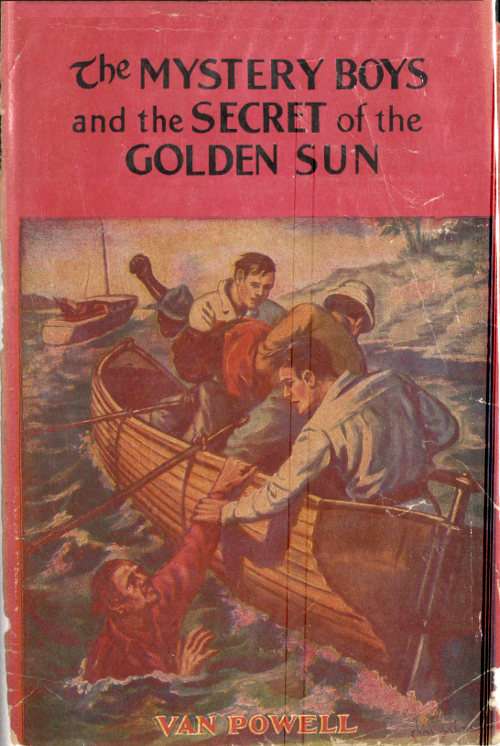
Down went Henry, and along the deck he was washed by the wave. Tom, at the risk of being himself torn loose and washed away, released one hand. He made a swift, reaching grab. His fingers caught Henry’s coat, in the surging inferno of water that swung along the deck. It seemed as though his arm would be torn from its socket: his face was stung and flailed by spume and great gouts of hard-flung water.
He braced and clung as the washing water swung Henry along: the check of his clutch slowed Henry’s body and Tom’s arms ached with the pull. He dared not let go until the wave should pass. Henry, caught off his guard, and with his brain befuddled, was helpless.
Came the thud of the companion door as Mr. Gray slammed it shut in bare time to prevent the cabin from being inundated.
From the wheelhouse door, now beyond the higher wash of the receding water, Bill leaped, with Cliff at his heels, Nicky clinging madly to the spokes of the wheel and fighting to hold the cruiser on her way, nose to wind and wave.
Gripping every foot and hand hold, Bill and Cliff fought through the swirl of water, while Tom clung grimly. The water receded and Henry was dumped, inert and gasping, onto the deck just as the hold Tom had was broken by the strain. Swiftly Bill grasped Henry’s shoulder and began to drag him toward the cabin companionway, while Cliff caught Tom and steadied him.
Another huge wave was rearing its white curl to the quarter. In the wheelhouse Nicky, a little frightened at his responsibility, and yet manfully rising to the occasion, knew that the boat must not be allowed to pay off so that she would catch the waves on her side—she would be rolled over, and over. He bore with his whole weight on the spokes, holding the rudder hard over as the valiant craft struggled against the rush of waters and the roar of the swiftly rising wind.
With Cliff aiding him, while Bill dragged at the gasping Henry, Tom got to the cabin. His father opened the door, and all three grasped Henry and fairly flung him in through the door and down the several steps. Then in they plunged, and just in time to close the door before the tumult of water was over the decks again.
The brave little vessel shuddered and groaned under the water, and Nicky said a little prayer for strength to hold the wheel against his enemies of wave and rushing air. Tom sputtered and got rid of some water he had taken in, while Henry, sitting up, gulping and choking, began to thank him.
“You saved my—” he began.
Totally unconscious that he was taking the command, or that his words rang with the authority of anger and just censure, Tom cried, “Never mind. Get yourself together and get to that wheel. Nicky’s alone there. Joe’s calling. Cliff, go help Joe. Bill, you drag this Henry up to that wheel and stand over him. Cliff’s father is battening down the ports. We’re all safe inside, but we don’t know what’s going to happen. Get going, you Henry!”
As if every one of them recognized the voice of command, Bill caught Henry’s collar and almost yanked him to his feet. Henry, sobered and now beginning to recover himself, and with the just rebuke and the evident menace of their position clearing his mind, obediently staggered along with Bill, while Cliff raced past them on the other side of the churning, coughing engine, to help Joe.
“What will you do, Tom?” asked Mr. Gray, thrusting home a heavy steel bar across the companion door, although, being aft, it was not subjected to the crushing force of the waves.
“I’ll find that Henry Morgan’s ‘tonic,’ if it’s my last act!” cried Tom and began flinging things out of the lazarette, or storage cubby in the floor, where their food was kept.
He had no success there, but he began on the bunks lining the sides of the long, low, narrow cabin, at whose forward end was the wheel, with the engines just a little aft of amidships.
Still the storm, sudden and furious, mounted in ferocity. The vessel plunged and reared, rolled and twisted; her timbers creaked and her decks echoed to the roar and thunder of waves. Cliff and “Andy” stuck, one on either side of the motor, oiling, wiping, Andy watching the gasoline pressure glass, and the oil flow, Cliff jumping, clinging to the bunks, to bring a rag, or to steady Andy while he made an adjustment of the carbureter to compensate for the slight and occasional “miss” in one cylinder.
Forward, Bill, Nicky and Henry clung to the wheel, all swinging together at Henry’s order, or releasing a spoke or two to pay off for more way between the great, onrushing combers.
“Are we close in, yet?” gasped Nicky, half out of breath.
“No,” said Henry, between his teeth. “I’m going to swing her around if I can get steerage way in some minute when it’s quieter—we’d better run before it—but I das’sent try now—’cause why? She’d roll like a barrel and maybe dive under!”
“A drop of oil on that propeller shaft bearing,” shouted Andy to Cliff.
“Right!” cried Cliff, above the thud of water and the groan of the timbers and the thrashing pulsation of the propeller, racing as it was lifted from the surging water. “Ease her when she races, Andy,” but he knew that Andy did so before his young aide spoke.
“If we could get a chance to swing her around,” choked out Henry, a thoroughly sober and frightened man.
“Hold her as she is,” Nicky urged. “It’s too wild to turn here!”
“I’ve found it!” exulted Tom, rising from an old airtight waste can, bolted down aft of the engine; it had been filled with oily waste and old wiping rags, and he had found, at the bottom, the bottles Henry had concealed there. “Mr. Gray—don’t say a word. I’ll put them back until this storm blows by and then I’ll break them on the rocks when we get in to shore.”
With the suddenness which characterizes tropical storms of certain sorts, less than hurricanes, the wind began to drop, and soon to fall to the steady trade wind velocity, while the clouds broke, the rain squalls ceased, blue sky appeared, and only the lifting heave of the turbulent Caribbean remained of the time of stress. They all breathed a sigh of relief; but the respite was brief.
“We’re closer in than I thought!” shouted Henry, at the wheel. “Quick, somebody, get forward with the lead. Half-speed, Andy! We may be close on a reef!”
Tom flung aside the brace of the after door, and with Nicky at his side, leaped on deck while Mr. Gray closed the door. Bill was already out of the side door to port, while Andy and Cliff stood by their engine.
“Reverse—back water!” cried Henry. “We’ve got to fight her off the shore and stand off and on until we can see what we’re doing.”
At the same minute came an agonized cry from Tom.
“Port—port—hard a-port! Rocks dead ahead!”
Henry flung his weight on the small wheel. Over it swung.
Before their bow, disclosed by an onrushing comber which had obscured them, great black fangs of rock held their bared teeth in readiness to crunch joyously, grimly, as the Porto Bello staggered and strove to claw around!
CHAPTER VI
STRANDED!
Gleaming and flashing like the huge tusks of a water wolf, waiting, submerged, to gnash upon the defenseless cruiser, Tom saw the rocks, great needles of terror, for only an instant. Then a great, great, green-blue wave lifted between his straining eyes and the danger.
The wave swept on, while under their keel, another equally huge mass of water bellied up and flung the boat aloft on its surface.
Slowly the bow swung. The next glimpse Tom caught of the menace, it was off to port—but did a range of submerged reefs extend far across their path? Tom pointed out the threat to Bill and Nicky. They gasped, so close was the nearer of the needles.
All along the coast of Central America these reefs and islands, huge barrier reefs, wide, low-lying circle reefs, atolls enclosing tiny islets—all are a menace to navigation, and it is a skillful pilot who will try to take a boat in among them.
Henry Morgan was not a skillful pilot, but he had been through the barriers about the Rio Patuca mouth many times and he felt sure of his ability, coupled with an abiding faith in his “luck.”
But just after a storm, and with the seas even more wild than was their usual turbulent state, the task of getting through the reefs was one to whiten his face and shake his very marrow. Bill, looking back, saw his face of terror and, with a word to the boys, scrambled to the cabin and snatched the wheel from fingers already nerveless with fear. But the boat had paid off, the signal for full speed ahead had been obeyed, the steerageway, aided by the surge and force of the waves, had enabled them to turn aside. They swept over the first barrier on a huge swinging crest, seeing, through the clear water, that the jaws of rock seemed to gnash in fury at the loss of their prey. Tom and Nicky, gripping the capstan with one hand each, clutched one another with the other, clinging in tense, breathless waiting.
But the boat did not strike. She missed the rocks by almost a miracle. Had Henry kept his senses earlier in the voyage he would hardly have exposed them to such peril. For it was not over; it had scarcely begun!
“It isn’t only the rocks,” Nicky shrilled. “It’s—sharks!”
“Keep still,” Tom called back, squeezing Nicky’s arm reassuringly. “Watch to the fore and on your side.”
Nicky’s eyes were fixed on the swirl in the water just ahead, and on the triangular black fin to port than on his duty, and it was fortunate that no rock loomed near his post; the sharks were gathering with seemingly uncanny instinct, waiting—waiting—waiting!
Bill, once the menace of the outer reef was passed, swung the bow down the coast, and because the most powerful thrust of the waves had been subdued, although they still were big enough to roll the cruiser sickeningly, they were able to make headway, always fighting outward a few points to overcome the inswing of the water.
Along the coast Tom and Nicky could see low, sandy stretches of beach, under the broil of the sun, now full out and very hot; beyond the wide strips of sand there were dense, tangled masses of jungle, and even in the cleared air after the storm they could scent that queer, fetid odor of decaying vegetation and mold which is characteristic of the tropics. Far in the distance, landward, back of sand and jungle, bluish mountains loomed.
“Where are we heading for?” Nicky wondered, and Tom shook his head. “I hope Henry knows,” he replied. “I don’t see any opening.”
Nor, at the moment, did Henry, who, thoroughly subdued, but with a remnant of his former manhood forcing him to steel his nerves to save his own precious life, and theirs, came forward and stood, eyes roving the shore and the waters.
“What are those big waves?” Nicky asked, pointing shoreward.
“Shifting sand banks,” Henry replied huskily. “They always change. If we once get aground there, the waves would pound the boat to a pulp! And—the—” He felt a kick from Tom, and, with a glance of surprise, saw Tom’s eyes warning him not to frighten Nicky.
Tom, himself no coward, had sometimes yielded to a nameless dread of things unseen, but any visible danger tightened his muscles to their athletic perfection, settled his nerves and steadied his whole body to its dominating mind’s demands. He knew Nicky was not a coward, but he also knew that for anybody’s mind to settle on fear and think about it and worry about it, made them helpless when the need for action came.
For once Henry took a hint.
Cliff, with the tense moment at the engines over, came on deck and joined his chums for a breath of the heated, but fresher air.
“Those are shifting sandbanks,” Tom explained, pointing. “We are hunting for the channel.”
“There’s Brower’s Inlet, that place inshore,” Henry said. “Now, form a line to pass word quick to Bill how to steer, and you, Cliff, be by the engine room port to call directions—we’ll try for the shore—but I don’t guarantee—” Tom kicked his shins again and Henry, scowling, became still and intent.
Suddenly, peering hard, Henry called his orders and the chums relayed them.
“Swing her head to that swirl of water.”
Around came the bow till the wind was from directly aft.
“Full speed ahead!” And the engine picked up its heavy thud.
“Ease her off a point to port. Slow down to quarter speed.”
Toward land the great rollers, muddy and moiled, rose into swirling lines of dirty foam, then drew off to the shore.
Seaward, greater combers reared their heads and growled their fury that they had not succeeded in flinging these daring people onto their fang-like reefs.
There was a moment of silence—of quiet.
Then came a sort of sighing, from the waves, as the Porto Bello swung her nose among them. She rose up over a wave, then settled; there came a trembling and a dragging as the bottom grated on the sand. She wrenched and tore herself free, like a living thing striving to help her friends at wheel and engine.
A great wave came rolling, its speed seeming to threaten that it would roar down upon the boat, her own speed diminished by the friction of her keel.
“We’re—we’re—” Henry began.
“No we’re not! We’re off!” shrilled Tom as the wave caught up to them and the Porto Bello, with a staggering effort, let herself be swung up into the cradling arms of the mighty water.
She staggered on; she lost the supporting force of the water and sunk down on one side; once again—and ever again for what seemed an eternity, she was lifted, borne forward, slumped down to roar and grind along the sand, or to lie, like a stricken thing, on her bulging side, the sole thing that kept her from turning over.
Bill did noble work, with Cliff again at his side, at the wheel, while Nicky and Tom stood by at the bows, one with the lead held ready if they ever got through this moiling mud and spume.
Came a wave, the greatest yet, as the Porto Bello was dumped on the sand. Crash! while they all grabbed and clung to stanchions with all their strength a huge swirl of muddied water swept over them. They emerged, gasping and coughing—came another grinding, forward movement—and then, like a tired bird, safe at last in her nest, the cruiser slid over the last sand of the bar and into quiet water where, as her engine slowed, she rocked in a soft, gentle swell.
“Phew!” coughed Bill, poking out a porthole glass, and sticking his head out through the opening. “That was——”
“Stand by!” shouted Henry, wildly. “We’re in a current running back out to sea like a torrent—get her around—get her around—hard a-starboar—no, hard a——”
Simultaneously he broke off his calls and stared ahead as if chained to the spot, speechless. Tom and Nicky, staring too, stiffened.
Out from the sand protruded needles of rock, with swirling water and roiling sand partly concealing the black doom!
“Back water!” yelled Cliff. “Swing her off!”
“No—forward—full speed ahead!” cried Nicky.
Henry had sunk down and covered his eyes from the vision of the black-finned monsters congregating in the muddy waters—sharks!
Bill had the tiller ropes roaring in their channel, for he had paid no heed to the conflicting orders but, with a little prayer of devout trust that he did not mention later, he stood, gripping the spokes.
The boat had lost way, and swung sideways across the rushing water. Tom saw what was coming. Instantly he snatched loose a life preserver! Not to leap and save his life. To save all of them!
He bent low, hanging over the bow, dropping the preserver so that it met the rock, was between it and the boat as she touched.
She shuddered, and there was a crunch, but no smash. Madly yelling for full speed astern, Bill pawed his wheel over; the boat hesitated, her back-lashed propeller striving against the stream; slowly she receded from the rocks. Tom released his clutch on the preserver rope; from aft came the grind and shiver of sickening contact; the engine grated to a stop with a jar and a cough. The boat shuddered, ran forward again in the current.
“The propeller hit!” shouted Cliff, from the after deck, staring overside at a wicked fang, seeming to lick its glistening lips at him.
“It’s probably bent beyond help!” called Andy, from the engine. “The gears in the shift box are stripped. When the propeller caught it tore the gear teeth off—lucky it didn’t crack the crankshaft!”
“But we have no power,” ruefully Bill called.
There was no use for it, had they possessed it. With the strong outsweep of the water, and with a low, sandy spit jutting before them, there was nothing to be done but wait.
Gently, almost at the inlet, the Porto Bello lifted her nose on a swell, and poked it experimentally into the sand.
She liked the soft bed, burrowed forward on the next low swell, and then settled down, like a baby in its cradle.
“We may thank goodness for being here,” cried Tom. “It’s not so bad!”
“Not so bad—to be stranded?” demurred Cliff.
“Better here than—out there!” Tom waved his arm toward the roaring surf of the outer reef.
“Yes,” Nicky agreed, then, ruefully, he added, “but we’re stranded!”
“Unless it’s quicksand, we’re all right,” Tom declared. “When it’s low tide we can examine the propeller.”
“But how can we get off?” urged Nicky.
“Let’s take one thing at a time—and take it as it comes!” said Tom. And Mr. Gray, somewhat shaken, but very calm, as well as Bill, agreed with Tom.
CHAPTER VII
TURTLES AND TROUBLE
Notwithstanding the youthful efforts to be optimistic, the Porto Bello’s position was bad. She lay with her stern in deeper, swift water. Sharks and the rapid flow of the tide made it impossible to get under her stern to examine the propeller. They had spare parts, and would be able to repair the stripped gearing, or, at least, to render the clutch and shifts possible to use by substituting new gears. But the damage to the propeller must be estimated.
“My idea,” said Tom, with proper diffidence, when the entire party discussed the situation while they ate the dinner Bill prepared, “my idea would be to get a rope over to those snags of rock, put pulleys fore and aft on the top of the cabin, reave a rope through them, run it to the capstan, forward, then carry it out to the snags, fasten it, and then, steadily take up on it with the winch. The pull would work on the whole boat that way, and if we moved most of our stuff aft and lightened the bow, she might drag off.”
“How would we get a line to those snags—across that deep water?” objected Henry. “I, for one, won’t risk those sharks! They say they don’t trouble the Indians, or Negroes, but white men are different.”
“Probably Indians will come out in canoes,” Tom said hopefully.
This prediction proved true, but not until the next morning; then a canoe containing two stolid Mosquito Indians came out. They wore ragged trousers and shirts worn outside the trousers, hanging down, and their dark faces were almost as expressionless as those of the North American Indians.
They paddled down the water near the stern, and coming into a small bight of water where the current was less violent, they sat still for almost an hour, staring fixedly and without answering a number of hails sent them by various ones.
Finally, however, they did respond. They spoke little, but seemed to comprehend a little English and a trifle more of Spanish. Henry Morgan, who was morose and angry about something, bellowed orders at them. Tom, who knew what made Henry sour, since Tom had already dropped several fat bottles into a swift eddy astern, remonstrated at his angry commands.