
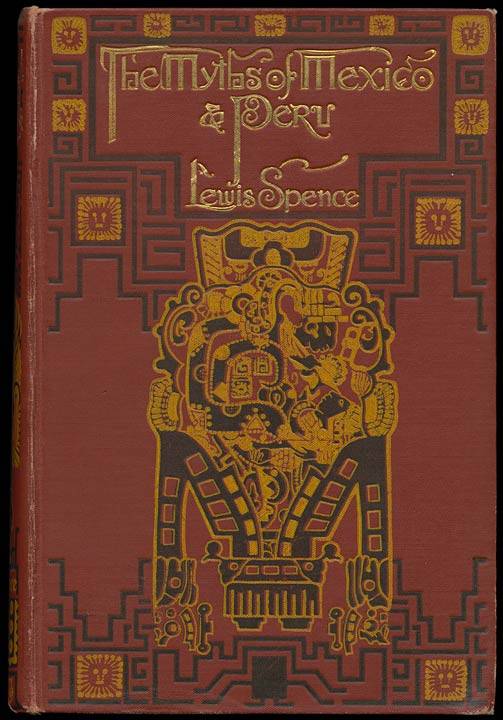
The Project Gutenberg eBook of The Myths of Mexico & Peru
Title: The Myths of Mexico & Peru
Author: Lewis Spence
Illustrator: Gilbert James
William Sewell
Release date: September 18, 2016 [eBook #53080]
Most recently updated: October 23, 2024
Language: English
Credits: Produced by Jeroen Hellingman and the Online Distributed
Proofreading Team at http://www.pgdp.net/ for Project
Gutenberg (This file was produced from images generously
made available by The Internet Archive/American Libraries.)
MEXICO & PERU
THOMAS Y. CROWELL COMPANY
PUBLISHERS
PREFACE
In recent years a reawakening has taken place in the study of American archæology and antiquities, owing chiefly to the labours of a band of scholars in the United States and a few enthusiasts in the continent of Europe. For the greater part of the nineteenth century it appeared as if the last word had been written upon Mexican archæology. The lack of excavations and exploration had cramped the outlook of scholars, and there was nothing for them to work upon save what had been done in this respect before their own time. The writers on Central America who lived in the third quarter of the last century relied on the travels of Stephens and Norman, and never appeared to consider it essential that the country or the antiquities in which they specialised should be examined anew, or that fresh expeditions should be equipped to discover whether still further monuments existed relating to the ancient peoples who raised the teocallis of Mexico and the huacas of Peru. True, the middle of the century was not altogether without its Americanist explorers, but the researches of these were performed in a manner so perfunctory that but few additions to the science resulted from their labours.
Modern Americanist archæology may be said to have been the creation of a brilliant band of scholars who, working far apart and without any attempt at co-operation, yet succeeded in accomplishing much. Among these may be mentioned the Frenchmen Charnay and de Rosny, and the Americans Brinton, H. H. Bancroft, and Squier. To these succeeded the German scholars Seler, Schellhas, and Förstemann, the Americans Winsor, Starr, Savile, and Cyrus Thomas, and the Englishmen Payne and Sir Clements Markham. These men, splendidly equipped for the work they had taken in hand, were yet hampered by the lack of reliable data—a want later supplied partly by their own excavations and partly by the painstaking labours of Professor Maudslay, now the principal of the International College of Antiquities at Mexico, who, with his wife, is responsible for the exact pictorial reproductions of many of the ancient edifices in Central America and Mexico.
Writers in the sphere of Mexican and Peruvian myth have been few. The first to attack the subject in the light of the modern science of comparative religion was Daniel Garrison Brinton, professor of American languages and archæology in the University of Philadelphia. He has been followed by Payne, Schellhas, Seler, and Förstemann, all of whom, however, have confined the publication of their researches to isolated articles in various geographical and scientific journals. The remarks of mythologists who are not also Americanists upon the subject of American myth must be accepted with caution.
The question of the alphabets of ancient America is perhaps the most acute in present-day pre-Columbian archæology. But progress is being made in this branch of the subject, and several German scholars are working in whole-hearted co-operation to secure final results.
What has Great Britain accomplished in this new and fascinating field of science? If the lifelong and valuable labours of the venerable Sir Clements Markham be excepted, almost nothing. It is earnestly hoped that the publication of this volume may prove the means of leading many English students to the study and consideration of American archæology.
There remains the romance of old America. The real interest of American mediæval history must ever circle around Mexico and Peru—her golden empires, her sole exemplars of civilisation; and it is to the books upon the character of these two nations that we must turn for a romantic interest as curious and as absorbing as that bound up in the history of Egypt or Assyria.
If human interest is craved for by any man, let him turn to the narratives of Garcilasso el Inca de la Vega and Ixtlilxochitl, representatives and last descendants of the Peruvian and Tezcucan monarchies, and read there the frightful story of the path to fortune of red-heeled Pizarro and cruel Cortés, of the horrible cruelties committed upon the red man, whose colour was “that of the devil,” of the awful pageant of gold-sated pirates laden with the treasures of palaces, of the stripping of temples whose very bricks were of gold, whose very drain-pipes were of silver, of rapine and the sacrilege of high places, of porphyry gods dashed down the pyramidal sides of lofty teocallis, of princesses torn from the very steps of the throne—ay, read these for the most wondrous tales ever writ by the hand of man, tales by the side of which the fables of Araby seem dim—the story of a clash of worlds, the conquest of a new, of an isolated hemisphere.
It is usual to speak of America as “a continent without a history.” The folly of such a statement is extreme. For centuries prior to European occupation Central America was the seat of civilisations boasting a history and a semi-historical mythology second to none in richness and interest. It is only because the sources of that history are unknown to the general reader that such assurance upon the lack of it exists.
Let us hope that this book may assist in attracting many to the head-fountain of a river whose affluents water many a plain of beauty not the less lovely because bizarre, not the less fascinating because somewhat remote from modern thought.
In conclusion I have to acknowledge the courtesy of the Bureau of American Ethnology, which placed in my hands a valuable collection of illustrations and allowed me to select from these at my discretion. The pictures chosen include the drawings used as tailpieces to chapters; others, usually half-tones, are duly acknowledged where they occur.
LEWIS SPENCE
CONTENTS
| CHAPTER | PAGE | |||||||
| I. | The Civilisation of Mexico | 1 | ||||||
| II. | Mexican Mythology | 54 | ||||||
| III. | Myths and Legends of the Ancient Mexicans | 118 | ||||||
| IV. | The Maya Race and Mythology | 143 | ||||||
| V. | Myths of the Maya | 207 | ||||||
| VI. | The Civilisation of Old Peru | 248 | ||||||
| VII. | The Mythology of Peru | 291 | ||||||
| Bibliography | 335 | |||||||
| Glossary and Index | 341 | |||||||