
CHAPTER III.
OF THE CHIEF OUTWARD CHARACTERISTICS OF THE GENT.
One has only to look into the advertisements of cheap tailors, and the windows of ticketed shops, to form a very good notion of the other principal marks by which the Gent may be distinguished.
It should be borne in mind, that the main object of the Gent is to assume a position which he conceives to be superior to his own.
Now this, he fancies, is in a great measure accomplished by out-of-the-way clothes—a mark of superiority which has the advantage of requiring but a small outlay of intellect; and cunning manufacturers invent things on purpose to suit this taste, as the men of Manchester export gay-coloured, large-figured patterns for the negroes.
For him the cheap Tailor announces the “Gent’s Vest”—which is the Hebrew for “Snob’s Waistcoat”—as patronised by the nobility. To catch his eye alone, are the representations of men of ton put at the side of the advertisements; and, for his inspection, do the dummies stand at the doors of the shops, invested in the splendour of an entire suit, with an impossible waist, “made to measure for the same terms.”
And we may observe that the Gents usually speak of their get-up as the ticket—the term possibly being used in allusion to the badge which distinguished their various articles of dress when exposed for sale. And, in writing these, the leaning of the Gents towards distinguished associations is very evident. A great coat must be a “Chesterfield,” a “Taglioni,” or a “Codrington;” a little rag of coloured silk for the neck is called a “Byron Tie;” and so on. If the things are not dignified by these terms, the Gent does not think much of them.
To his taste does the ready-made Shoemaker appeal in the short fancy Alberts, ticketed “The Fashion.” If you are accustomed to derive a little gratuitous amusement from shop windows, as you go along the streets, you will see in them the funniest things, meant for the Gents, that it is possible to conceive. The most favourite style of chaussure is a species of cloth-boot, with a shiny-leather toe, and a close row of little mother-of-pearl shirt-buttons down the front; not for any purpose, for they are simply sewn on, the real method of fastening on the brodequin being by the humble lace and tag of domestic life, at the side.
But it is with the Haberdashers that the toilet of the Gents comes out strongest.
You will see “Gents’ Dress Kid” ticketed in the window. Be ye sure that they are large sized, awkwardly cut, yellow kid gloves, at one-and-sixpence. The tint is evidently a weakness with the Gents, who think them dashing, and say they come from Hoobegongs. But the merchants, lacking discrimination, believe that the predisposition is general. We will wager a dozen pairs of them that you never went into one of these establishments, and simply and decidedly demanded a pair of white kid gloves, but you were immediately asked “if you would not prefer straw-coloured?”
And then the stocks—what marvellous cravats they form! Blue always the favourite colour—blue, with gold sprigs! blue, with a crimson floss-silk flower! blue Joinvilles, with rainbow ends! And, if they are black and long, they are fashioned into quaint conceits: Frills of black satin down the front, or bands of the same fabric looking like an imitation of crimped skate; or studs of jet made like buttons, as if the Gent wore a cheap, black satin shirt, and that was where it fastened. And the white stocks are more fanciful still. They are not very popular in their simple form; for the Gents feel that they cannot help looking like waiters in them; and so a little illegitimate finery is necessary. Hence they have lace ends, like the stamped papers from the top of bon-bon and French plum boxes. And the effect in society is very fine.
The Jewellers consult the Gents, and for them manufacture various dashing articles in electro-gold. Some of the ornaments for the cravat are like large white currants, with gilt eels twisting round them; and others like blanket-pins with water on the brain. We have also seen some sporting Gents—of whom we shall hereafter speak—with mosaic gold heads of horses and foxes stuck in their stocks. And they love rings in profusion, which we have seen them at times wear outside their gloves. But this, perhaps, was an advantage, as Gents are accustomed, in general, to wear their hands large and red, with flattened ends to the fingers.
It is for the Gents to buy, that the print-sellers put forward those dreary pictures of the Pets of the Ballet; consisting chiefly of chubby young persons, in short petticoats and ungraceful attitudes, like nothing ever seen on the stage anywhere; and coloured lithographs of housemaids cleaning steps; and chambermaids with flat candlesticks in their hands; and women with large black dots of eyes and heavy ringlets, trying on shoes. One was very popular a little time ago. It represented a young lady something between a hairdresser’s dummy and a barmaid, with a man’s coat and hat on over her own dress. She was looking through an eye-glass at the top of a whip, and underneath was written “damme!”—why, or wherefore, or in what relation to the singular mode of toilet she has adopted, or what the word itself meant in the abstract, we never could make out. But the Gents seemed to know all about it, and bought the picture furiously.
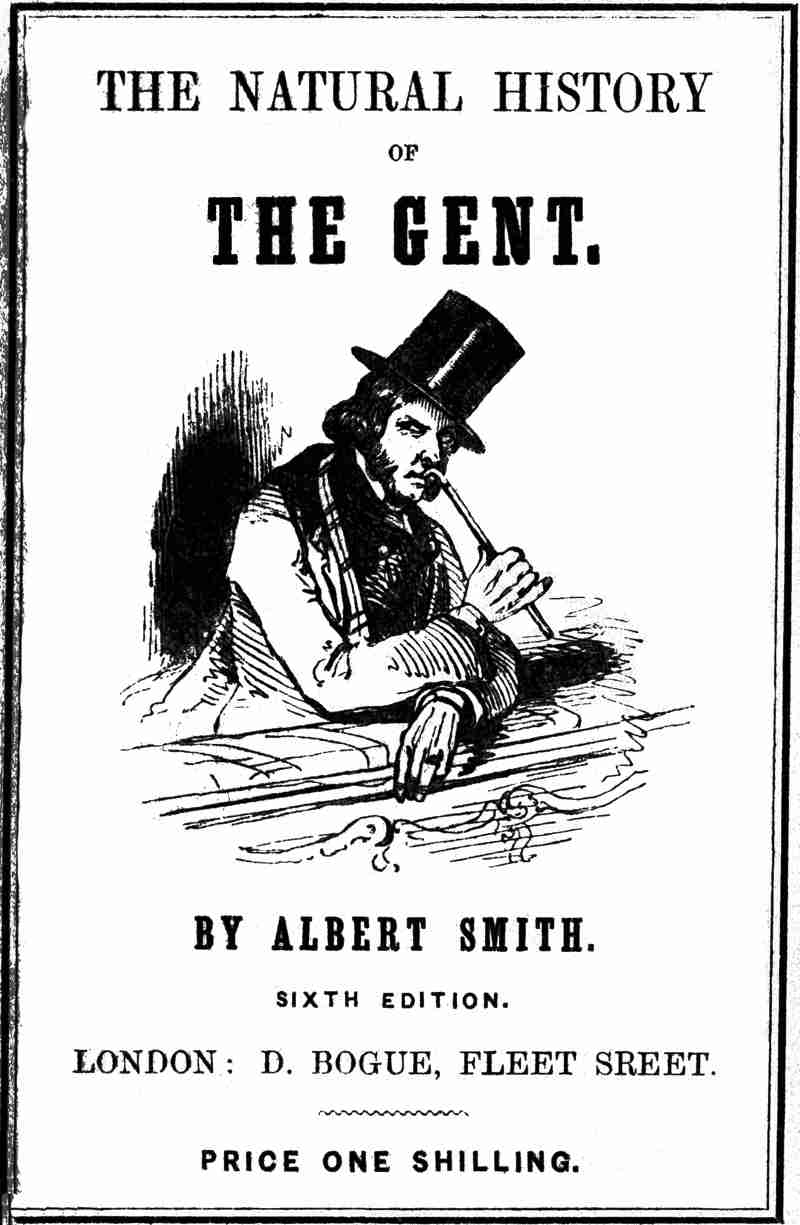
By the tokens above mentioned—including always the staring shawl and the al fresco cigar—you may know the Gent when you see him, even if you met him on the top of Mont Blanc—a place, however, where you are not very likely to encounter him. He prefers Windmill Hill.